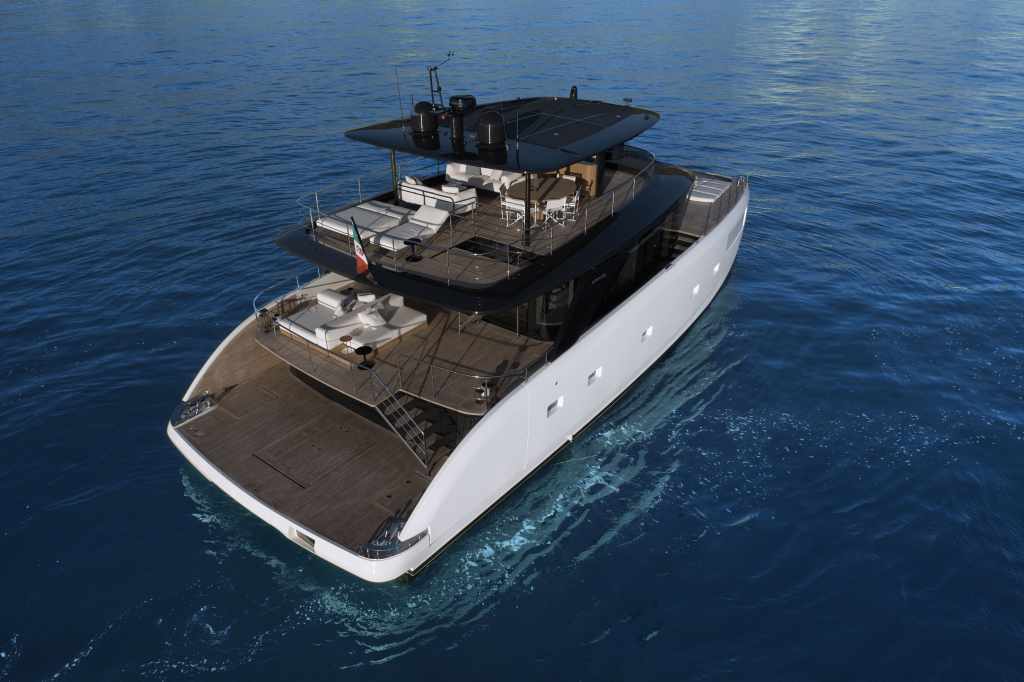
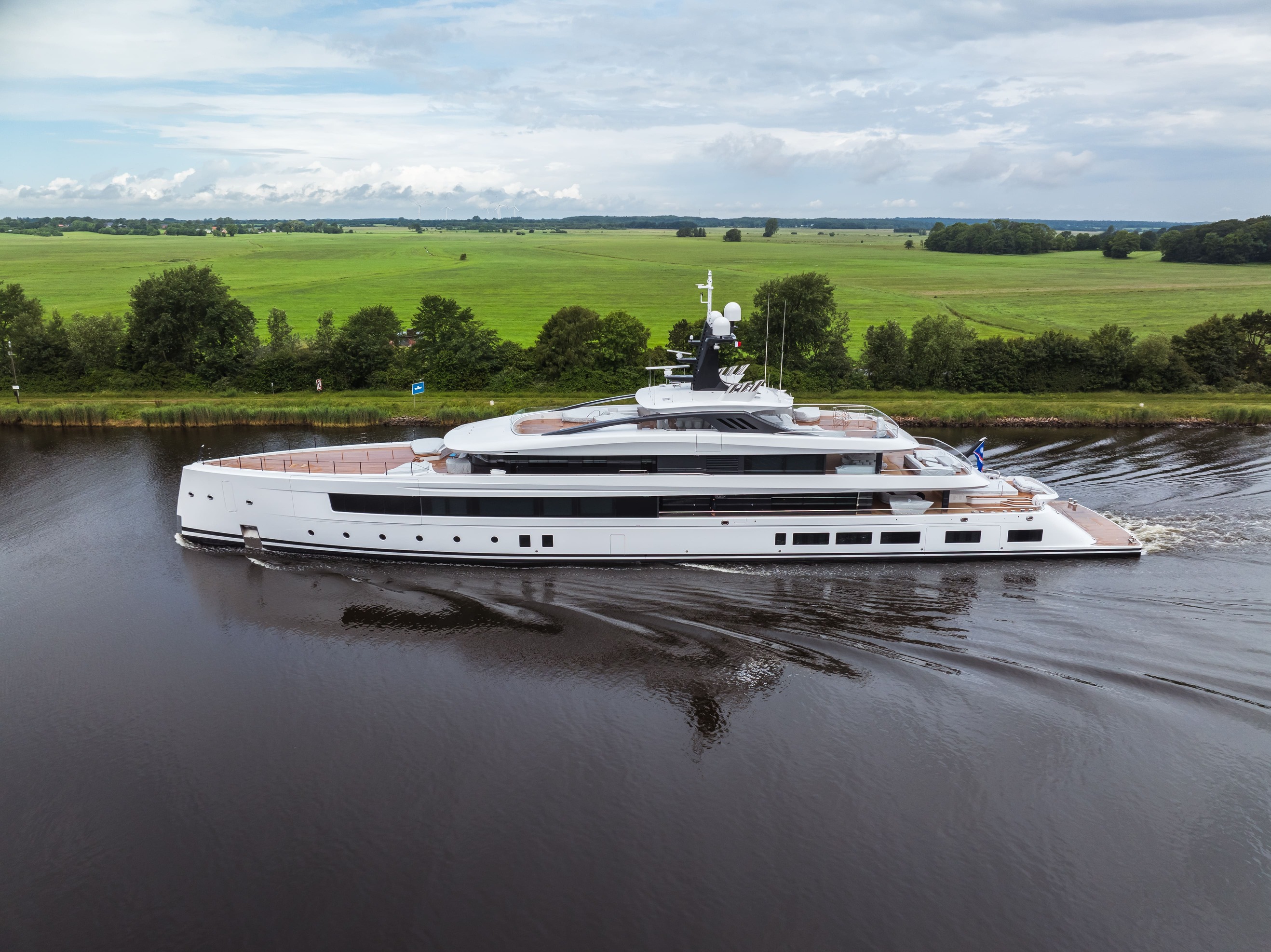
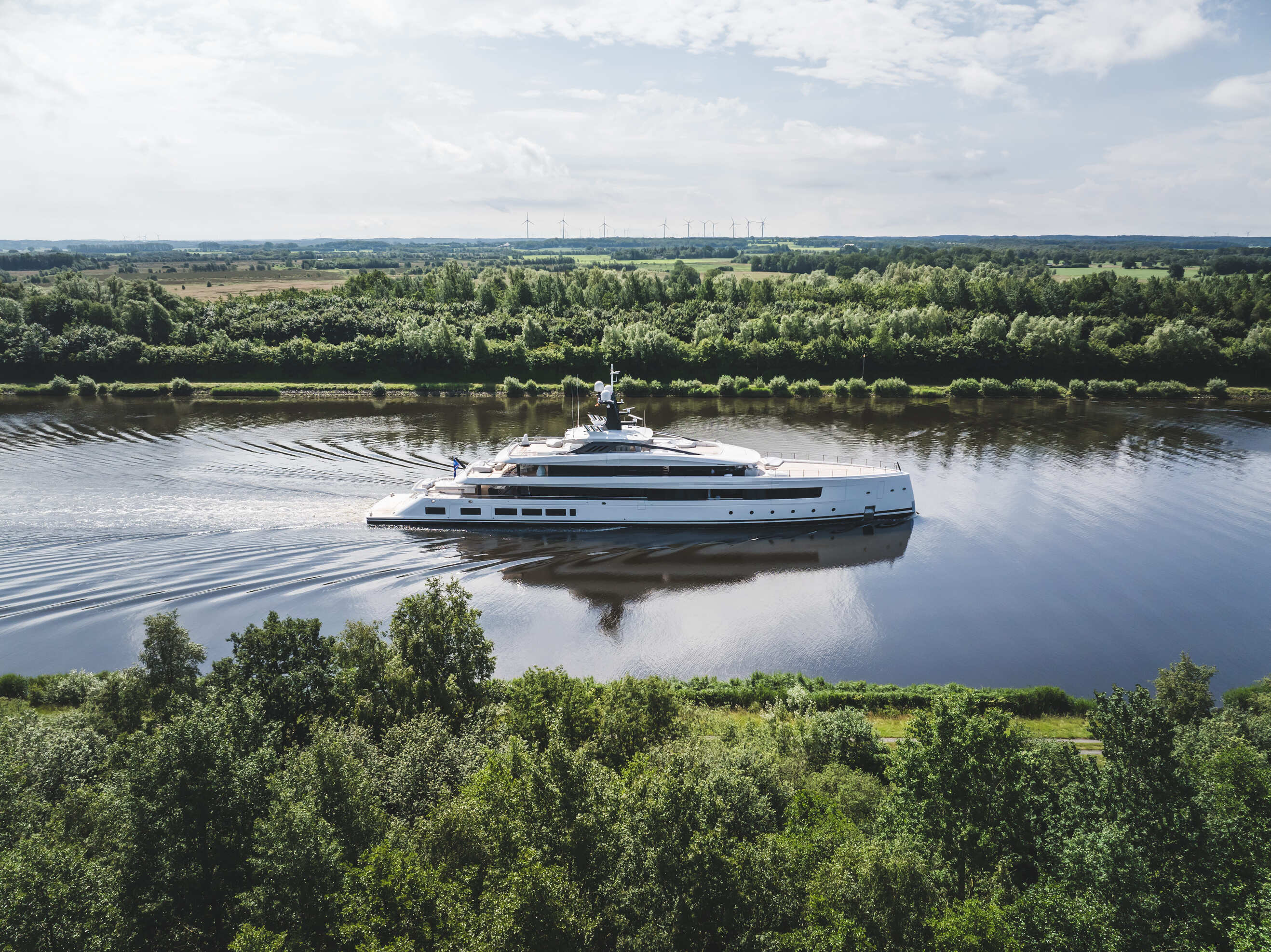
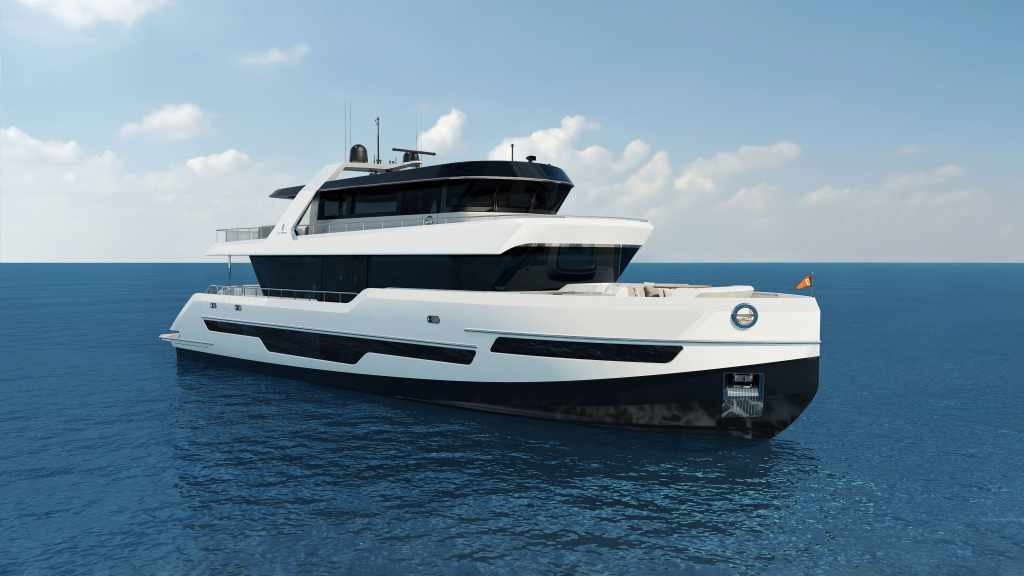
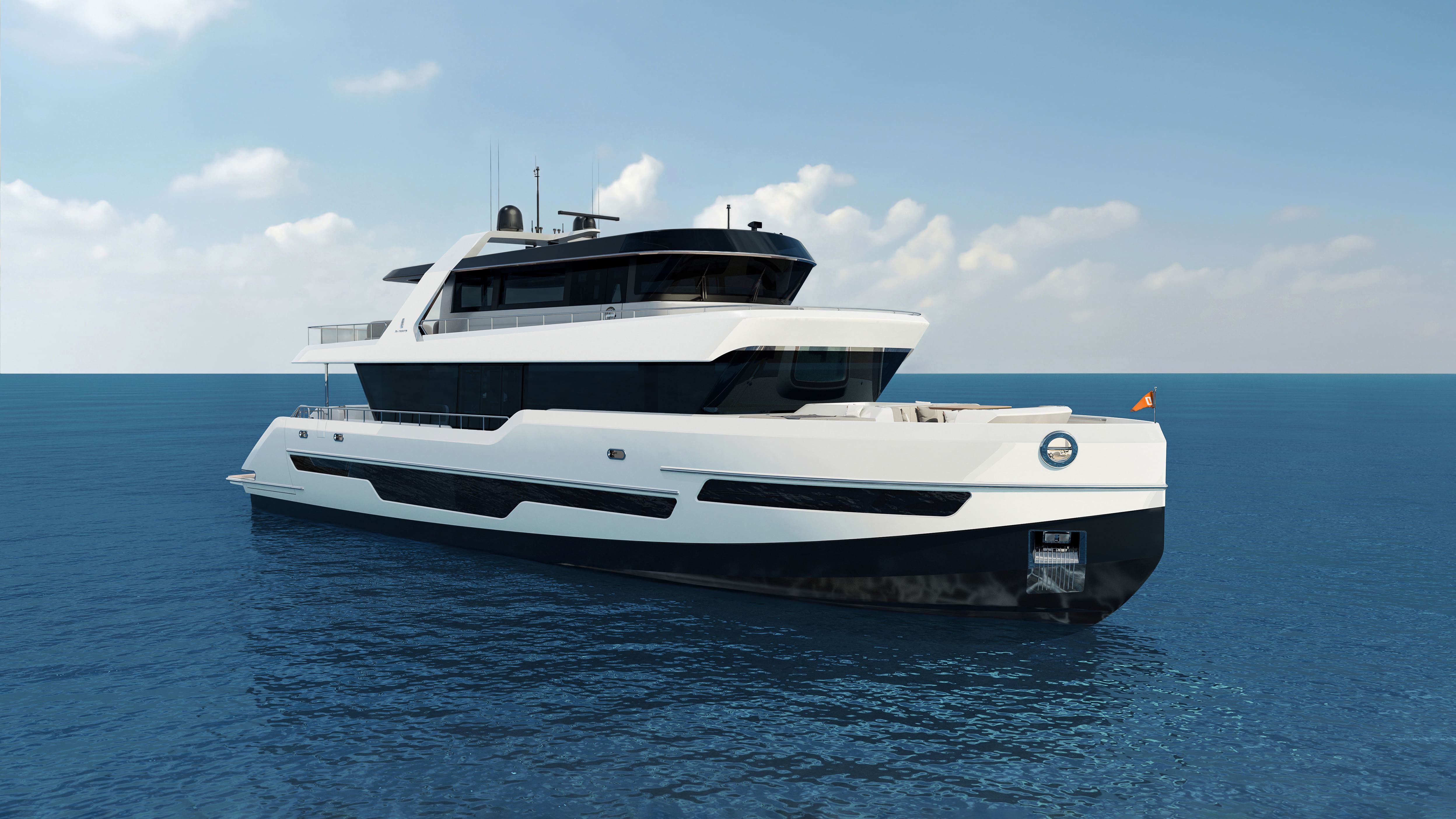
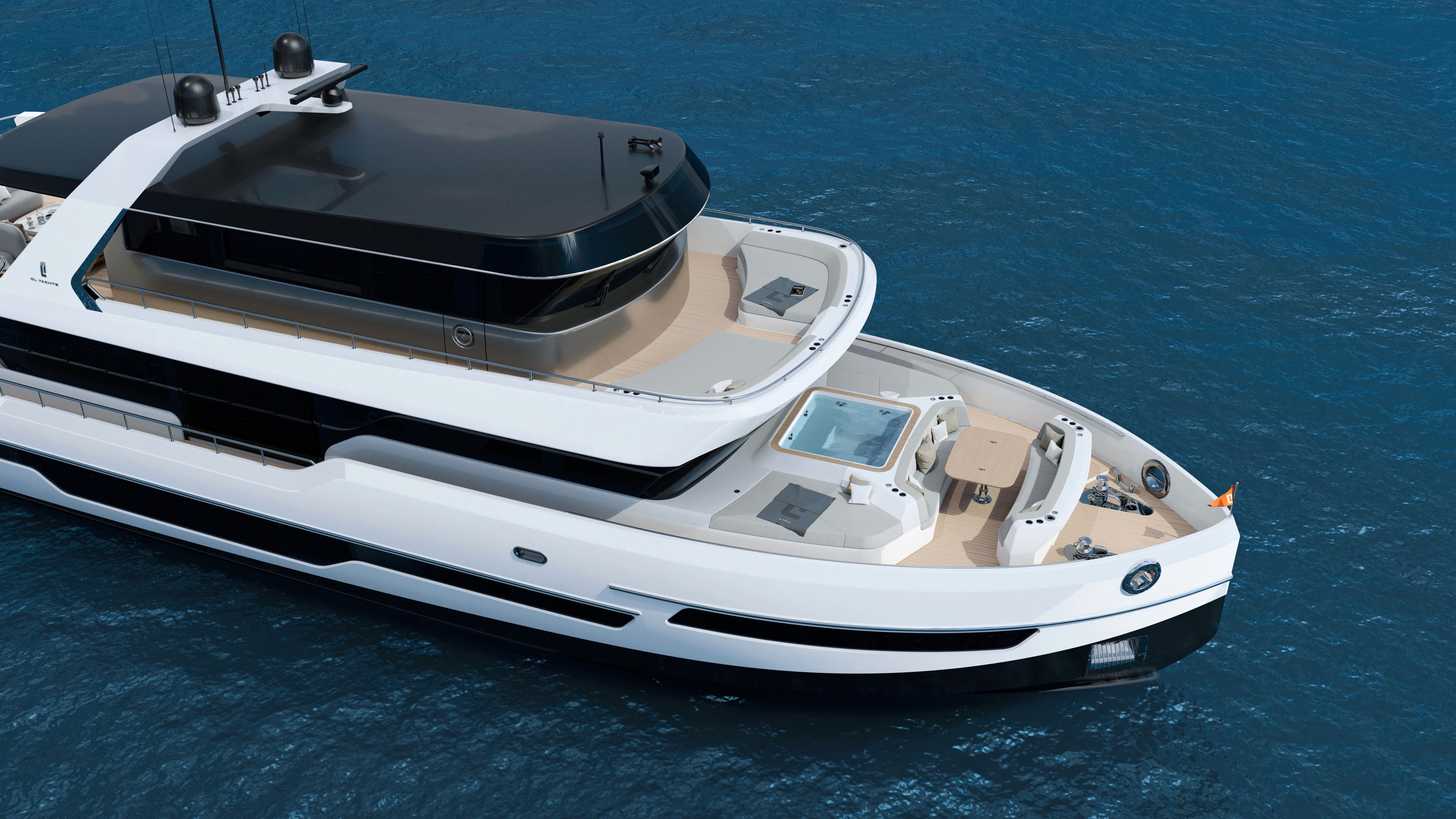
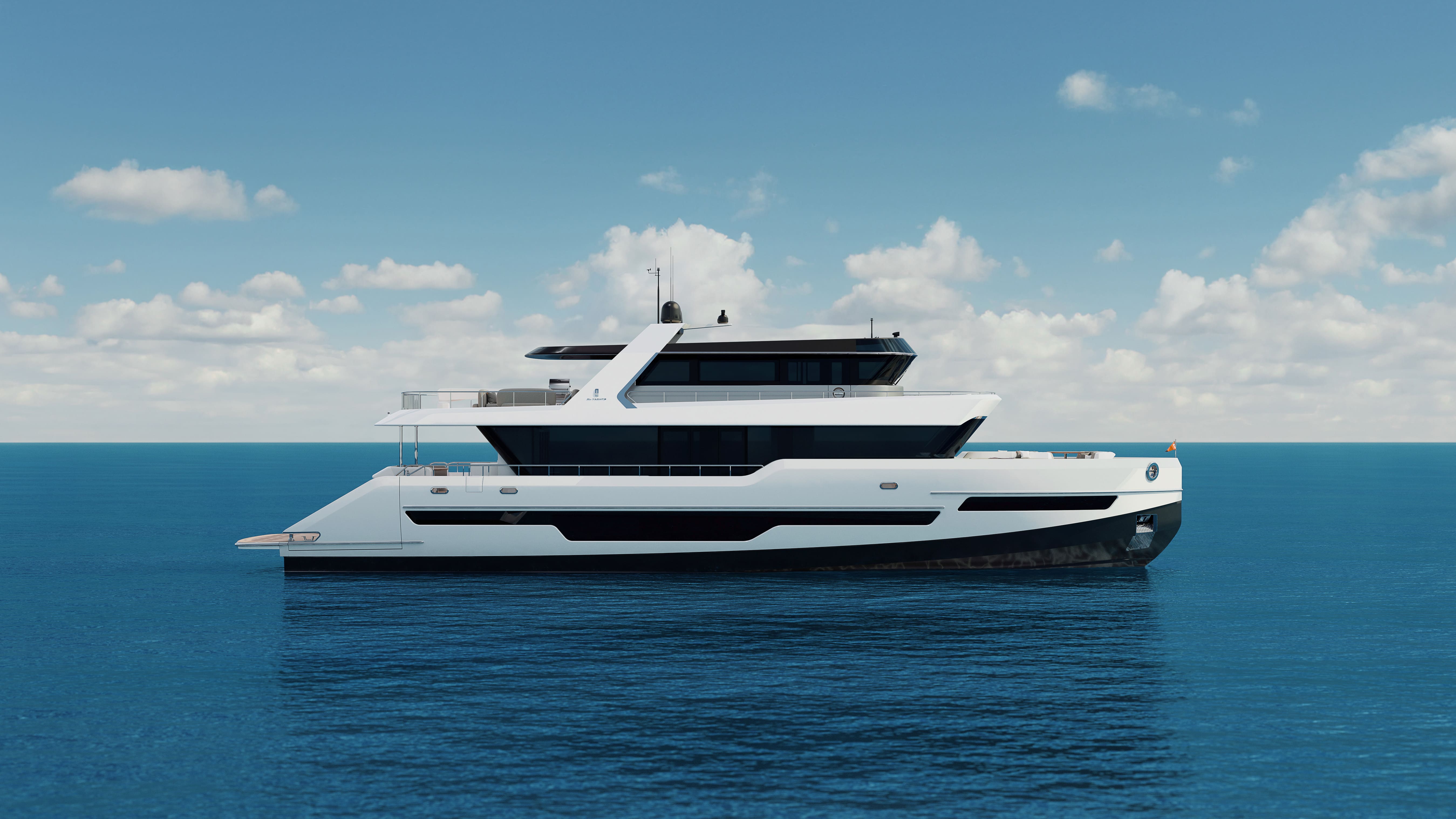
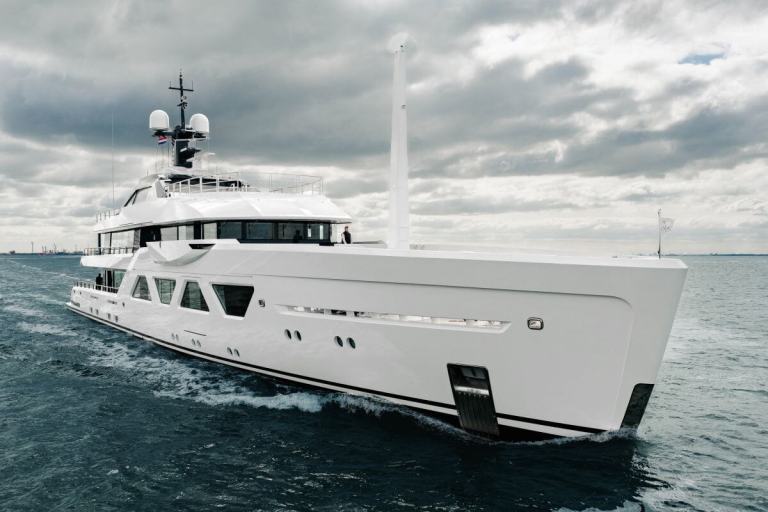
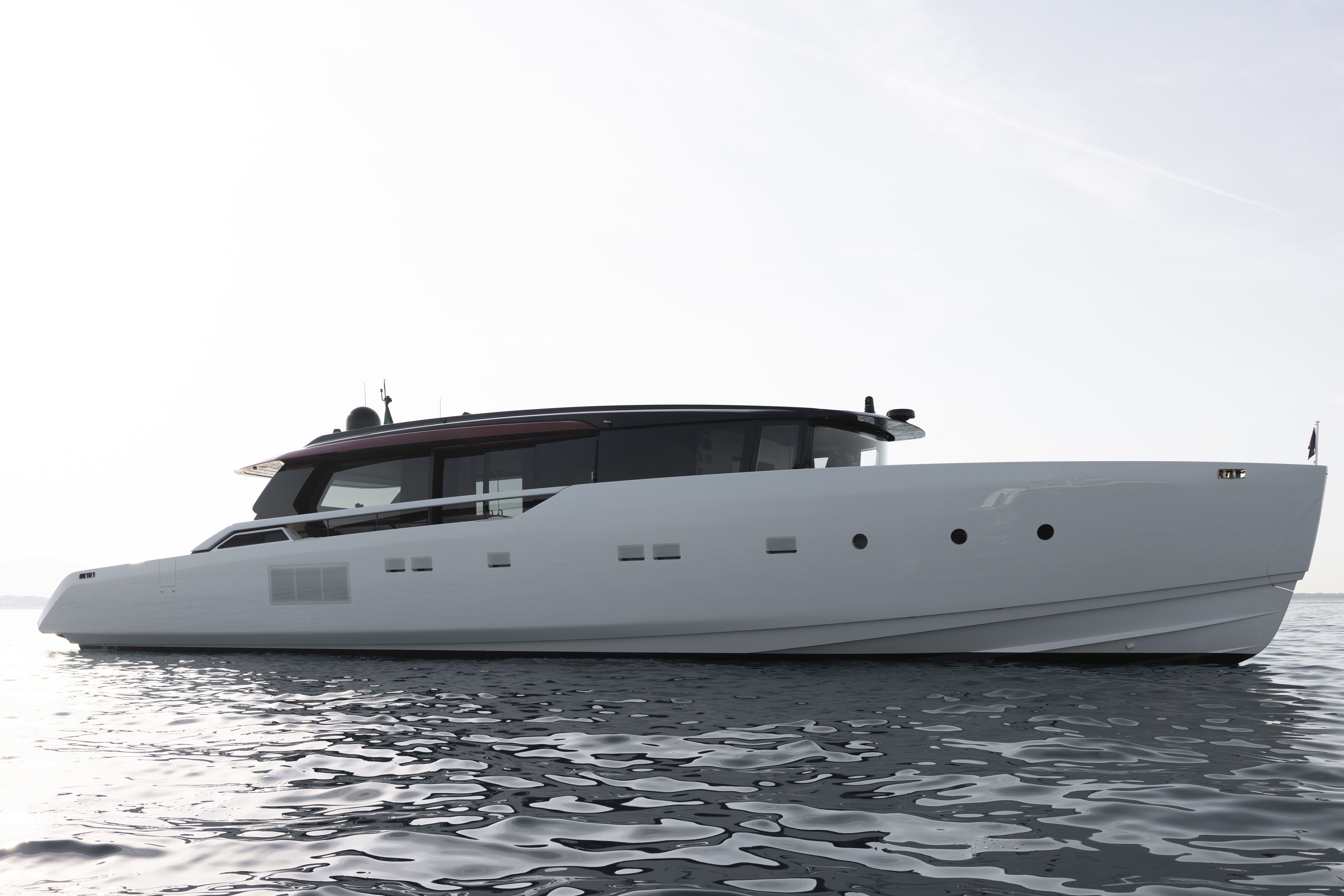
In the new flagship CLX99 are glimpses of a much-loved predecessor, but with revitalised exteriors, interiors and features this edition is a bold reimagination.
If the bold form and workboat-chic aesthetics of the CLX99 feel familiar, you have probably once, twice or more admired her earlier sibling, CL Yacht’s CLX96, a striking design that turned heads when it launched at the Fort Lauderdale Boat Show in 2022.
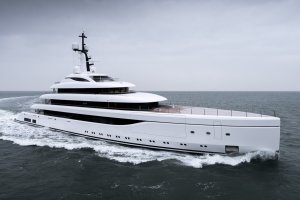
New flagship, the CLX99 sports a striking silhouette
A powerhouse combination that brought together the prolific product designer Jozeph Forakis’s vision for performance with an angular primary superstructure and strategic use of carbon fibre, the boat felt definitively different inside and out.
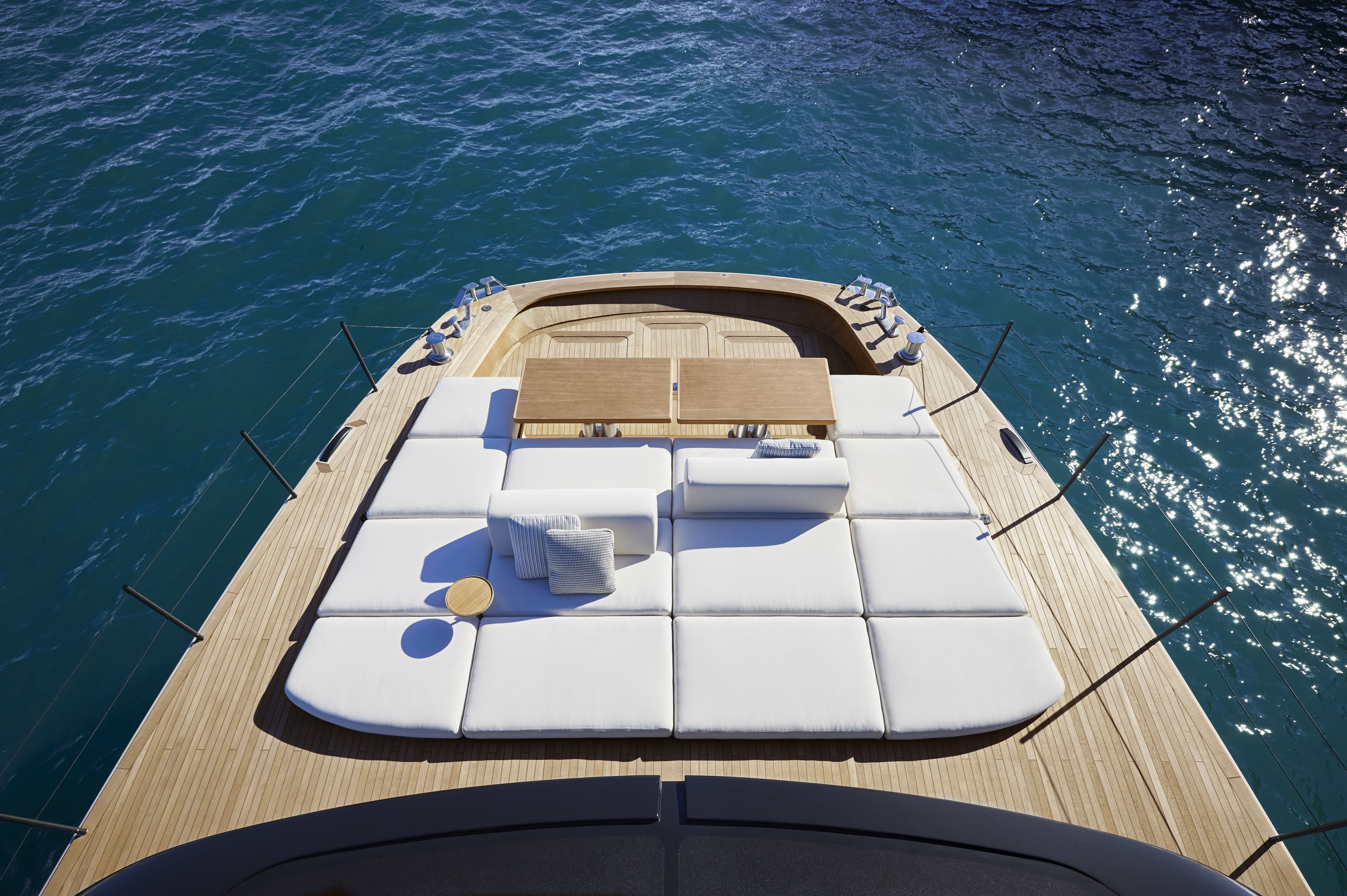
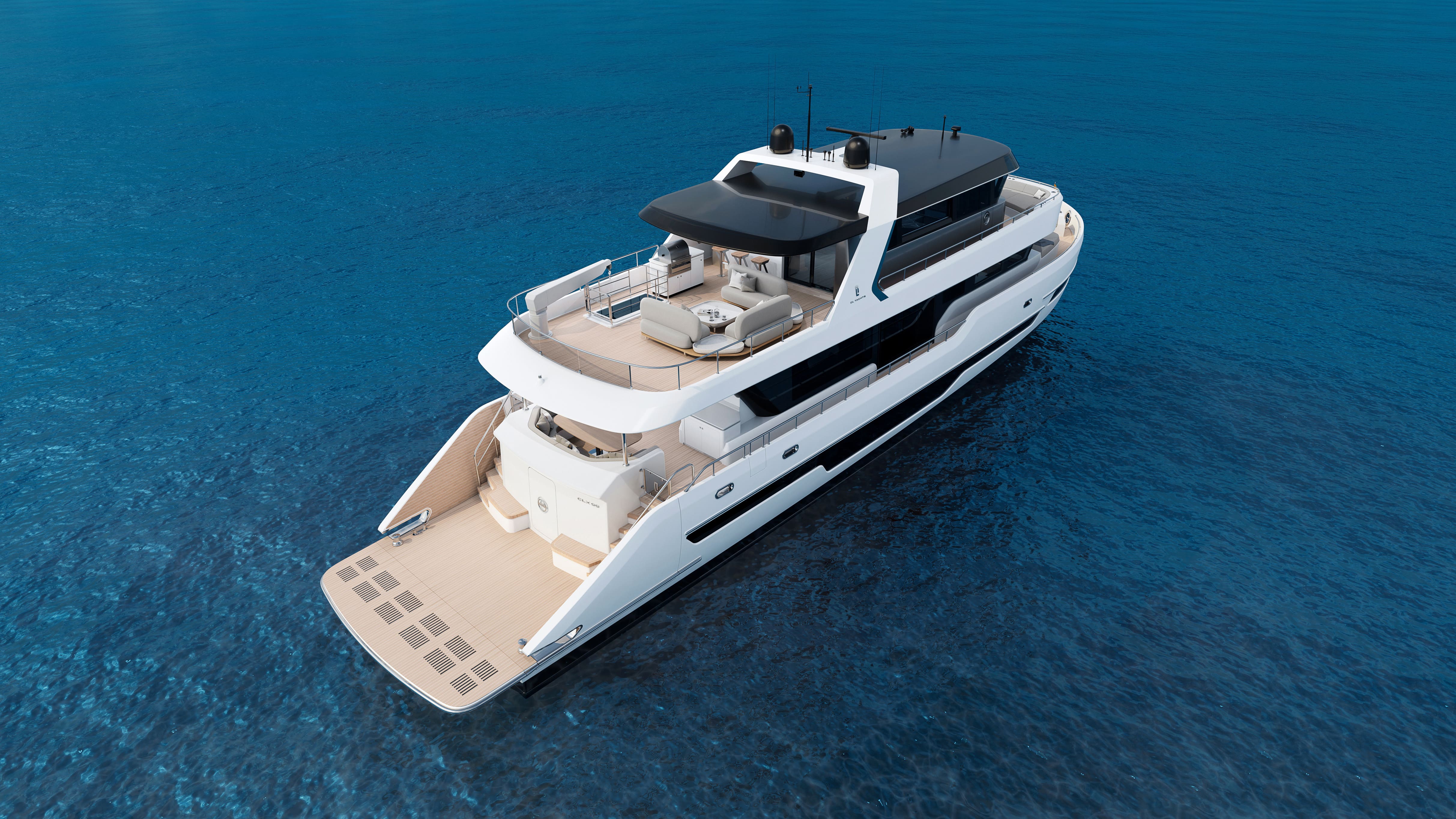
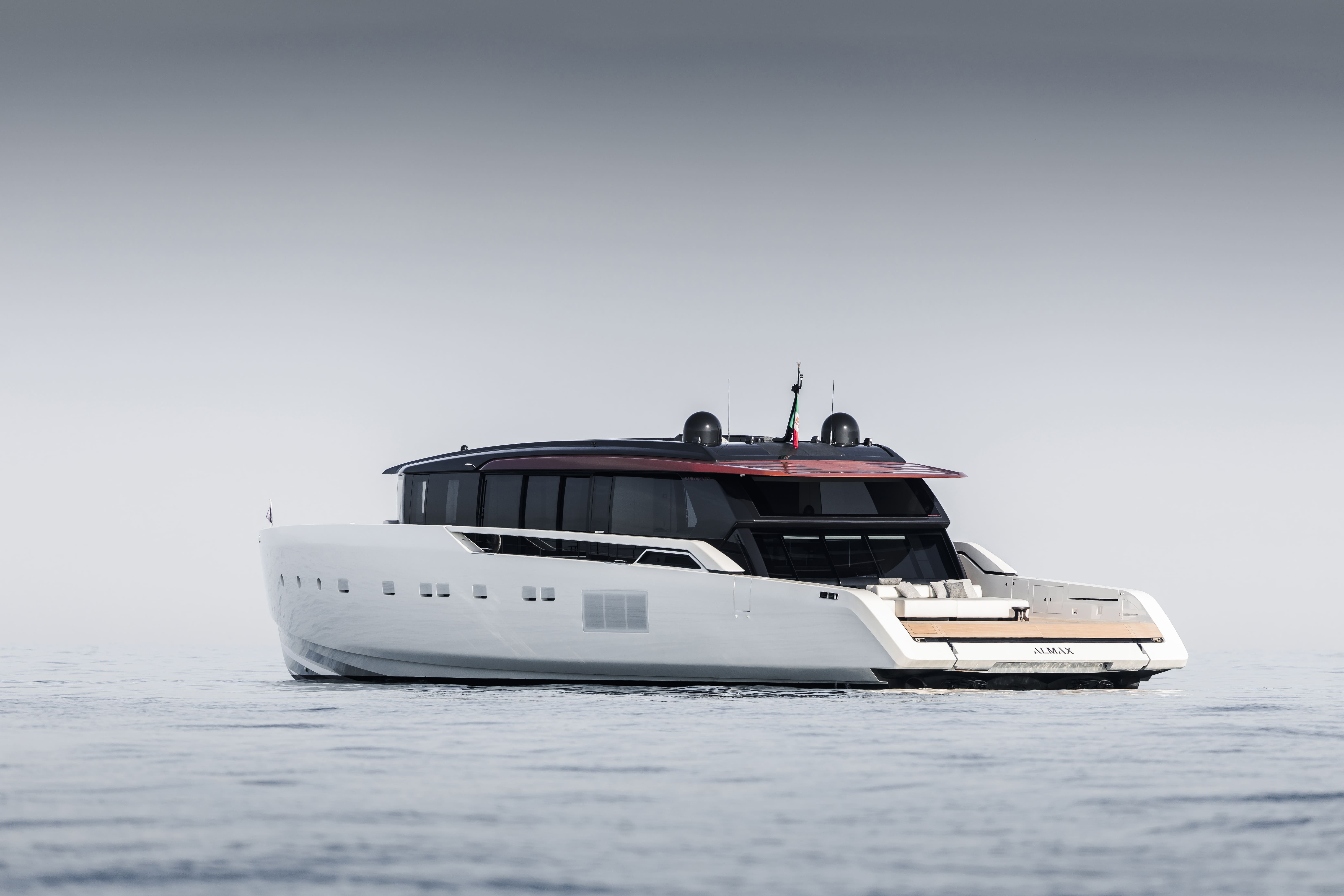
Many areas have been reimagined and extended, including the aft beach area and skylounge
Now Forakis, back on board and lending his unique point of view once again for the creation of the new flagship CLX99, appears to have taken the mould and reformed it.
Forakis, an award-winning designer whose pieces have been shown at New York’s MoMA, has retained a kind of core essence and ethos of the original onboard the CLX99, evident in its rugged good looks but while the first iteration was praised for its wide array of diverse spaces, this latest incarnation pushes the boundary with increasingly voluminous interiors and exteriors – and an overall length of 100 feet.
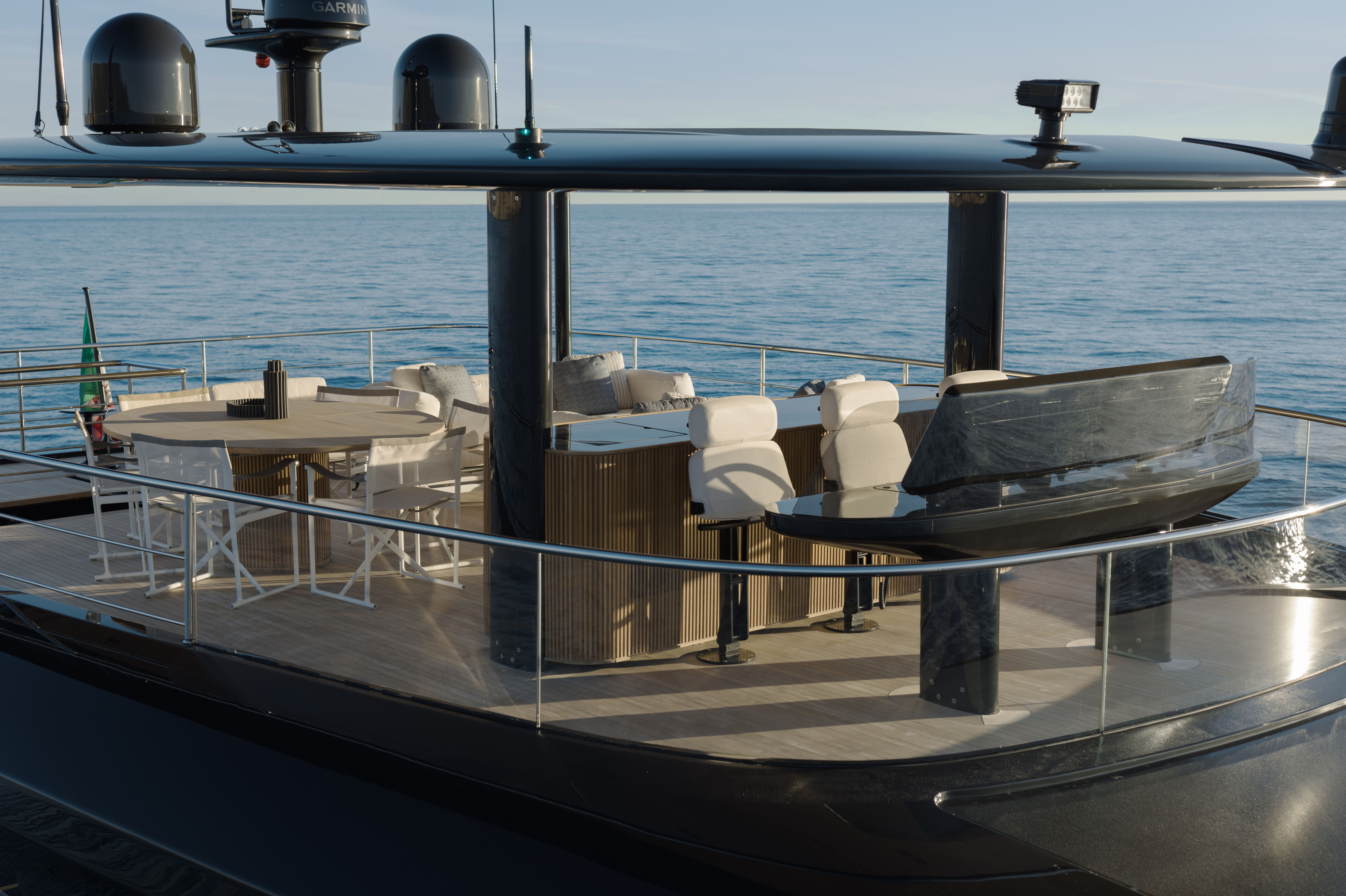
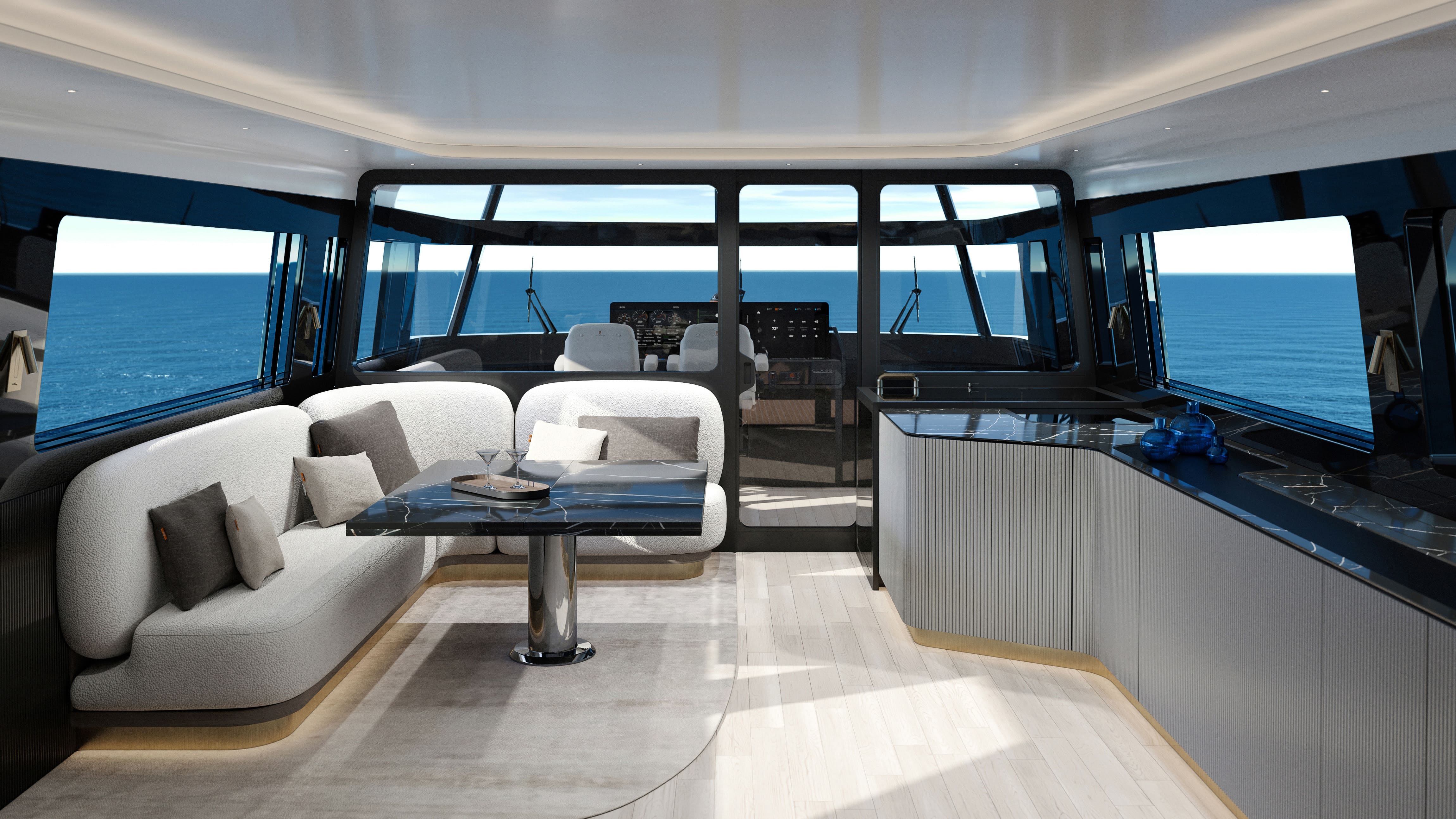
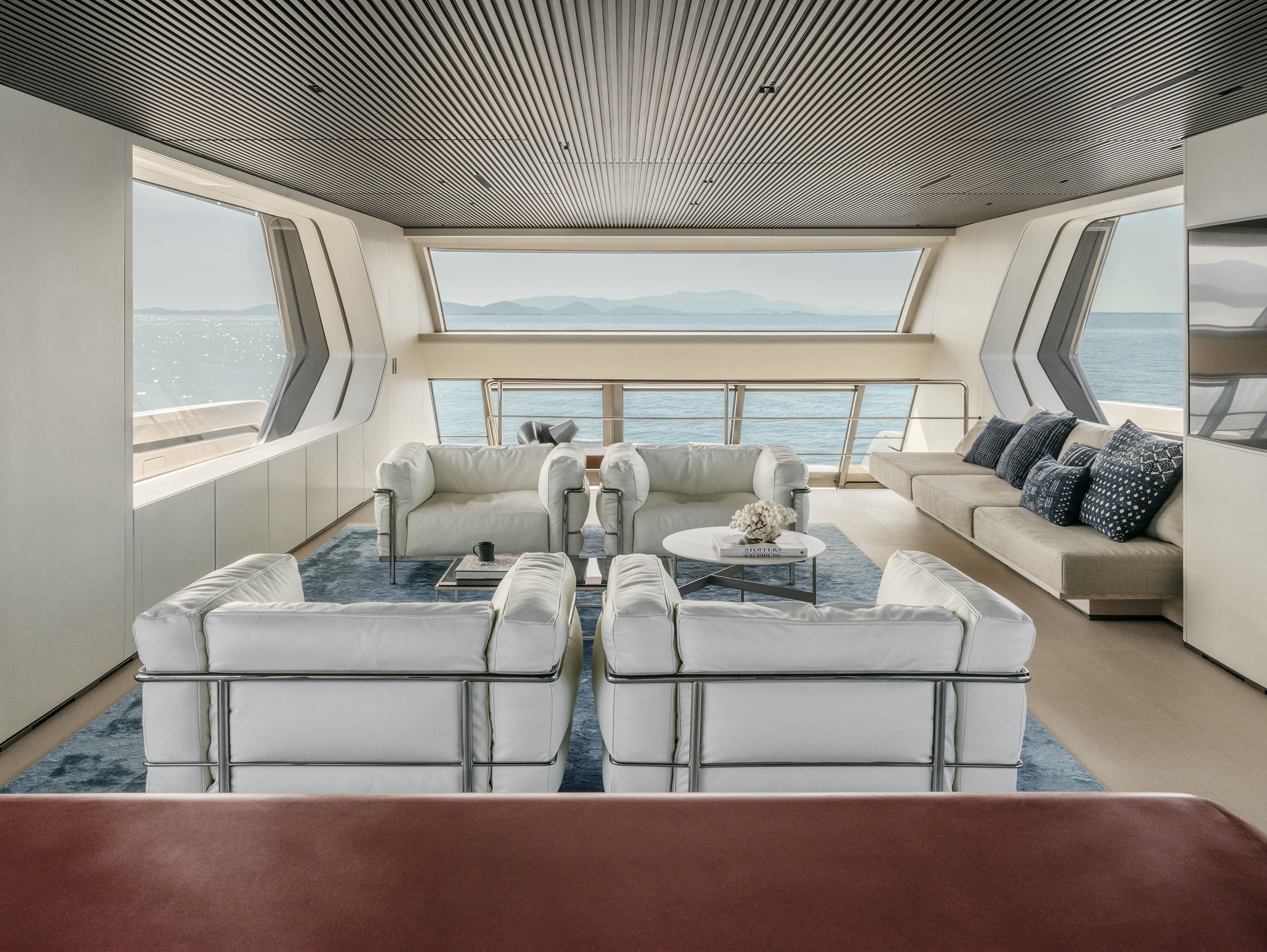
The designer prioritises light and 360-degree sea views in the sky lounge
“The hull is the same great hull as CLX96,” confirms Martin Lo, CL Yachts Director, but the superyacht displays a substantial difference in terms of naval architecture, layout and choice of materials, he says.
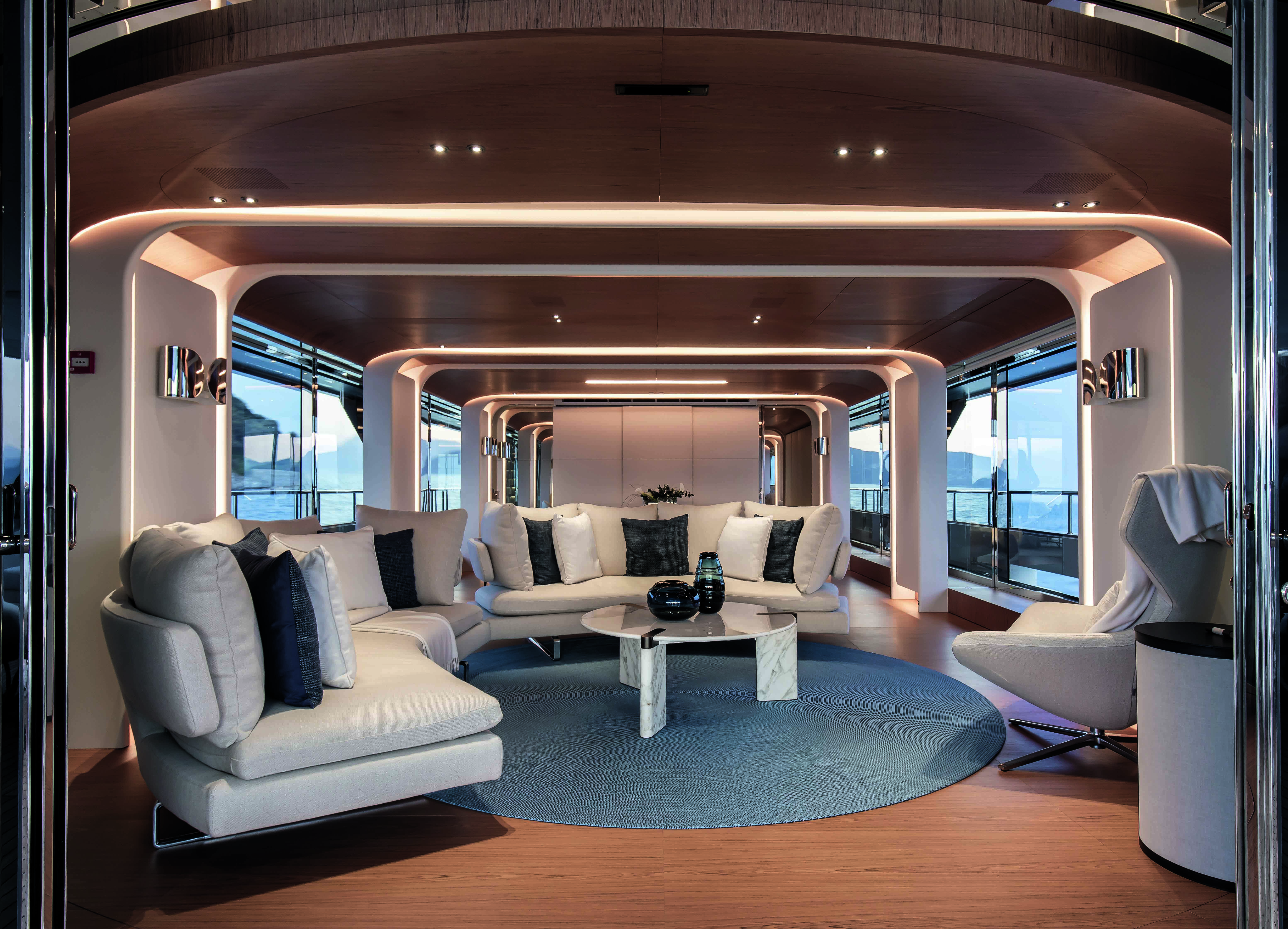
Among many refined features is a transformed skylounge aft of the forward-raked sunscreen, now extended an impressive three metres and featuring a same-level helm separated from the guest saloon. With a bulkhead crafted mostly from glass, guests are afforded good looks at the boat in operation, as well as 360-degree panoramic views that invite the outside in.
Calming styling features rounded edges and beach tones inspired by pebble-decked coastlines
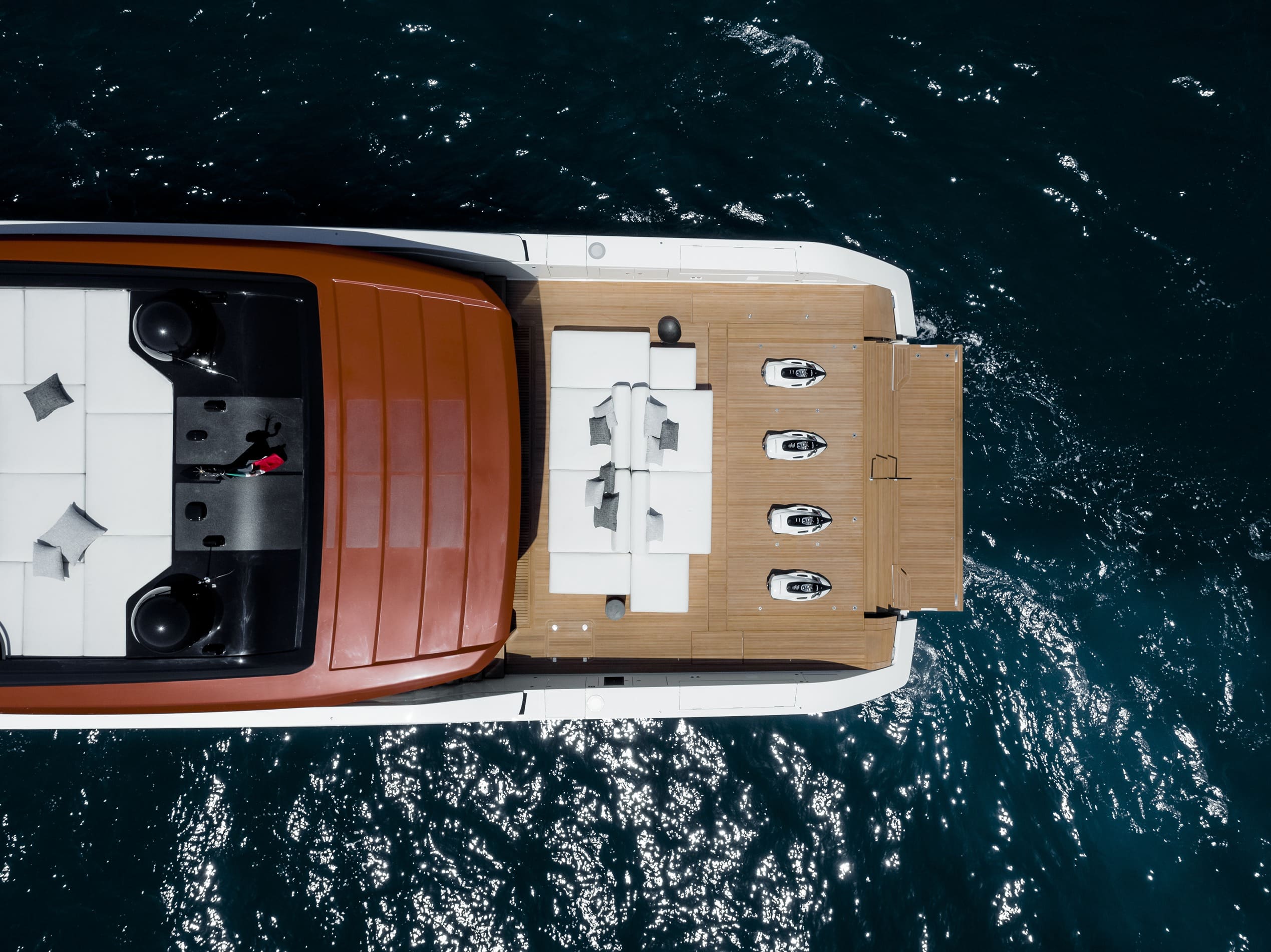
An arch incorporated into the bulwark on the aft-sundeck extends the space and with a dedicated lounge settee that invites relaxation or provides additional space for entertaining.
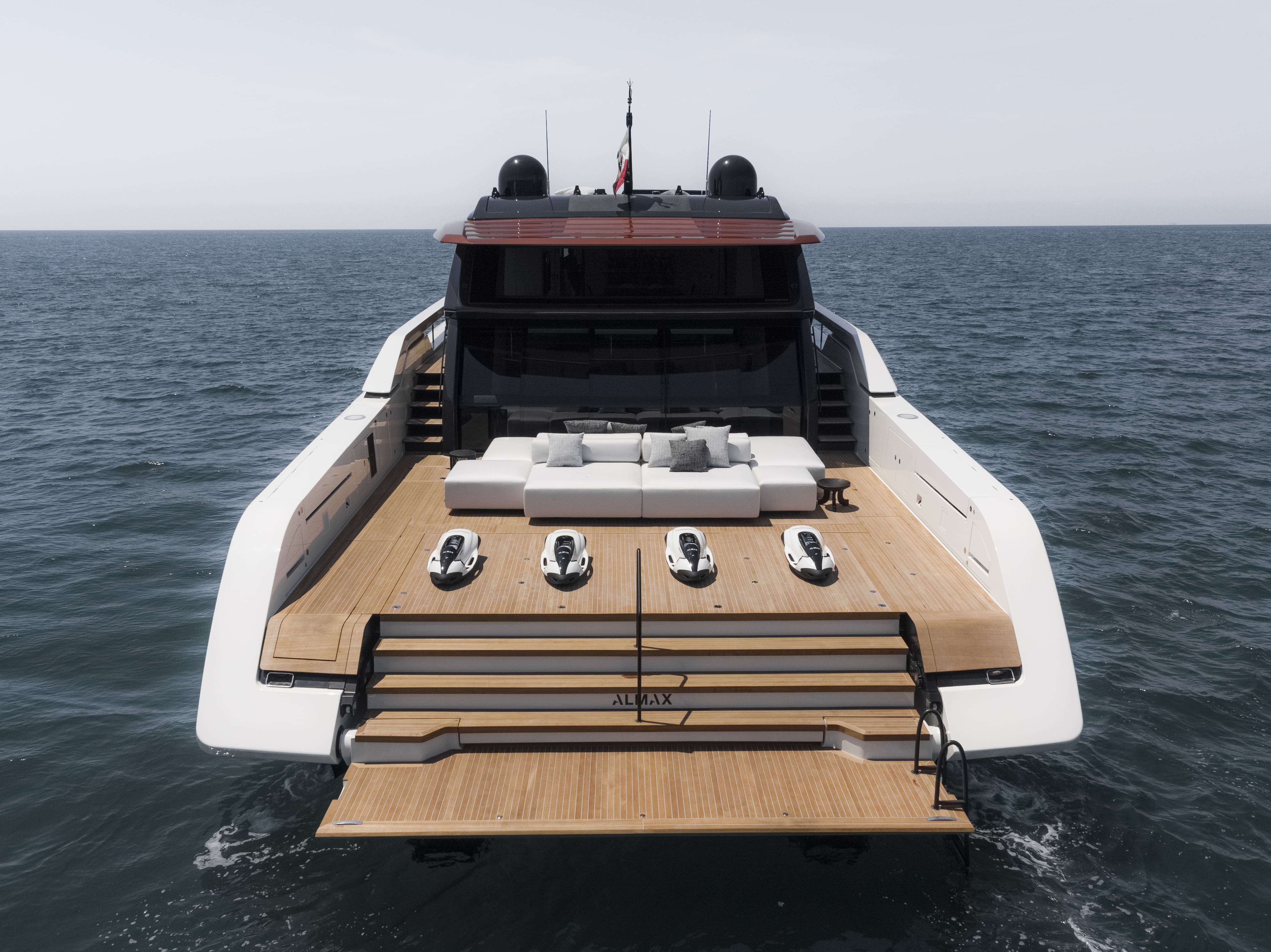
Meanwhile, the aft end has also been given a new twist, with the water-level beach and swim platform now boasting large drop-down bulwarks that create generous sea terraces on either side.
“The drop-down bulwarks really enhance the aft terrace, while there is an option for a spa pool on the foredeck,” Forakis says.
The skydeck is designed with relaxation and gatherings in mind
Extending space inside was also key for the designer. The main deck has received a two-metre extension, which in turn led to a reorganisation of the interior space.
A generous dining room forward has a galley adjacent, with portside access for the crew, while a spacious relaxation area features an enlarged sofa that runs from this sanctuary to the dining area to the observation lounge.
A redesigned lower deck offers five staterooms on the standard version, which include a large, full-beam master suite, two VIP doubles forward, and two guest twin or double cabins, which are all en-suite.
The aft water-level beach and swim platform has received a crowd-pleasing update
It’s also possible to add a main deck master suite in place of the forward dining and observation lounge, (while retaining five suites on the lower deck) to allow up to 12 guests.
Natural coastlines were a starting point in the comfortable interior styling, which has resulted in sensual curves, circular shapes and smooth finishes that the designer says are reminiscent of pebbles. Outside, hull windows on the lower deck have been redesigned with clean, continuous lines.
Forakis’ angular stylings were informed by rugged workboat design that nodded to the CLX96’s ultimate seaworthiness and reliability, but real functional design thinking is evident in technical spaces like the engine room, which on the new30.5mCLX99 is fitted with aft generators that makes maintenance on the engines more accessible.
Heralded product designer Jozeph Forakis has been given free rein on the CLX96 and CLX99
Five crew members can be accommodated in quarters located aft between the engine room and the aft bulkhead of the master, ensuring the CLX99 is suitable for fully-crewed charter trips.
If the CLX96’s unusual design was seen as a bit of a risk for CL Yachts on its release two years ago, then the new flagship CLX99, which continues the art of architecturally-refined disruptive design, is proof that the risk paid off.
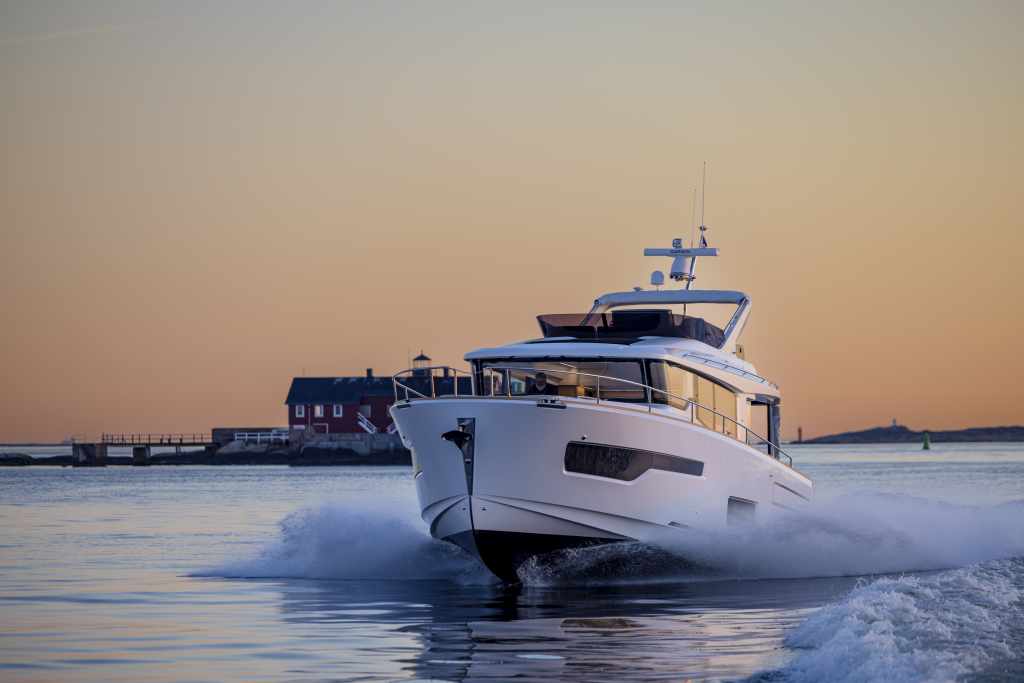
Created as an expedition vessel, the new Nimbus 495 Flybridge has been designed to allow for far-flung adventures, and a way to cruise in comfort for weeks rather than days.
Nimbus introduces the 15m Flybridge 495
Sweden-based Nimbus celebrated entering the explorer segment recently, with the arrival of its biggest flybridge to date, the Nimbus Flybridge 495. The voyager vessel touched water for the first time in an archipelago outside of Gothenburg this June.
Nimbus built the new coupé as a floating home away from home
Nimbus’ coupé models have been a favourite way to explore the Nordic region for more than 40 years, but as adventurous spirits grow and horizons broaden, so too do boat sizes. The new 15m flybridge is intended to provide passengers a floating home and an ideal vessel from which to explore further afield.
The yacht’s design centres on passenger flow
The Scandinavian shipyard notes seasons on the Mediterranean, the US East Coast or Alaska. To facilitate this, the 495 Flybridge’s expansive size prioritises social areas and free space. It provides mod-cons such as washing machine, dishwasher, and generator, plus an increased tank capability necessary for longer – and less stressed – voyages.
Large glass windows offer undisturbed views
This vessel also makes long harbour stays enjoyable thanks to freshwater accessibility and emission-free propulsion.
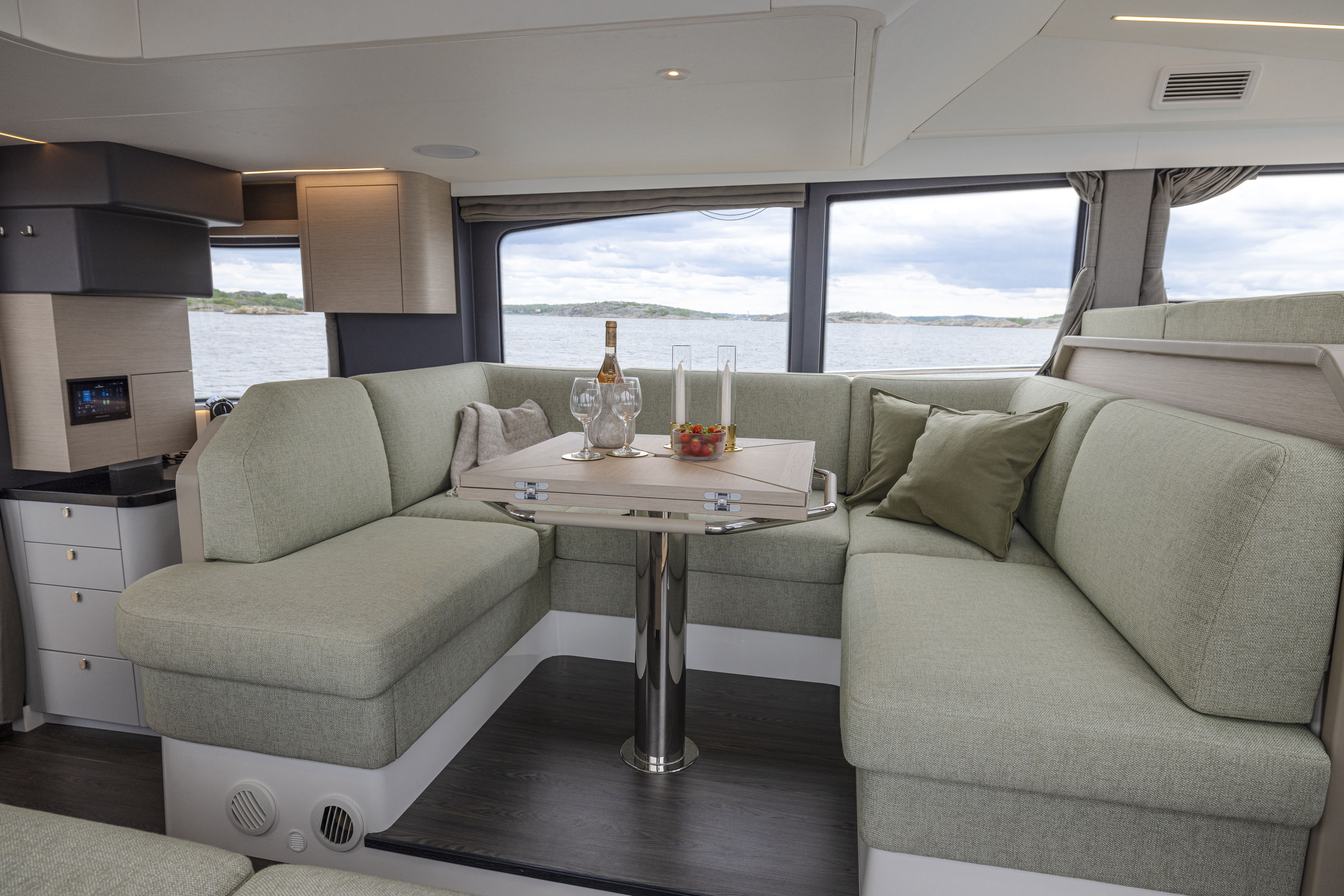
A spacious kitchen sits within the saloon
Considerations for the deck layout were to create a space within which it felt safe and easy to manoeuvre with a minimum of crew even in variable conditions. Accordingly, the design centres on making the boat easy to move to shore, and for passengers to flow easily between foredeck to aft deck, cabin to bathing platform – with ample views of the surrounding areas no matter where they are positioned.
The boat has been built with a seamless connection between the saloon, the large aft deck and a robust bathing platform on the same level.
Gather, drive, dine in the coupé’s salon
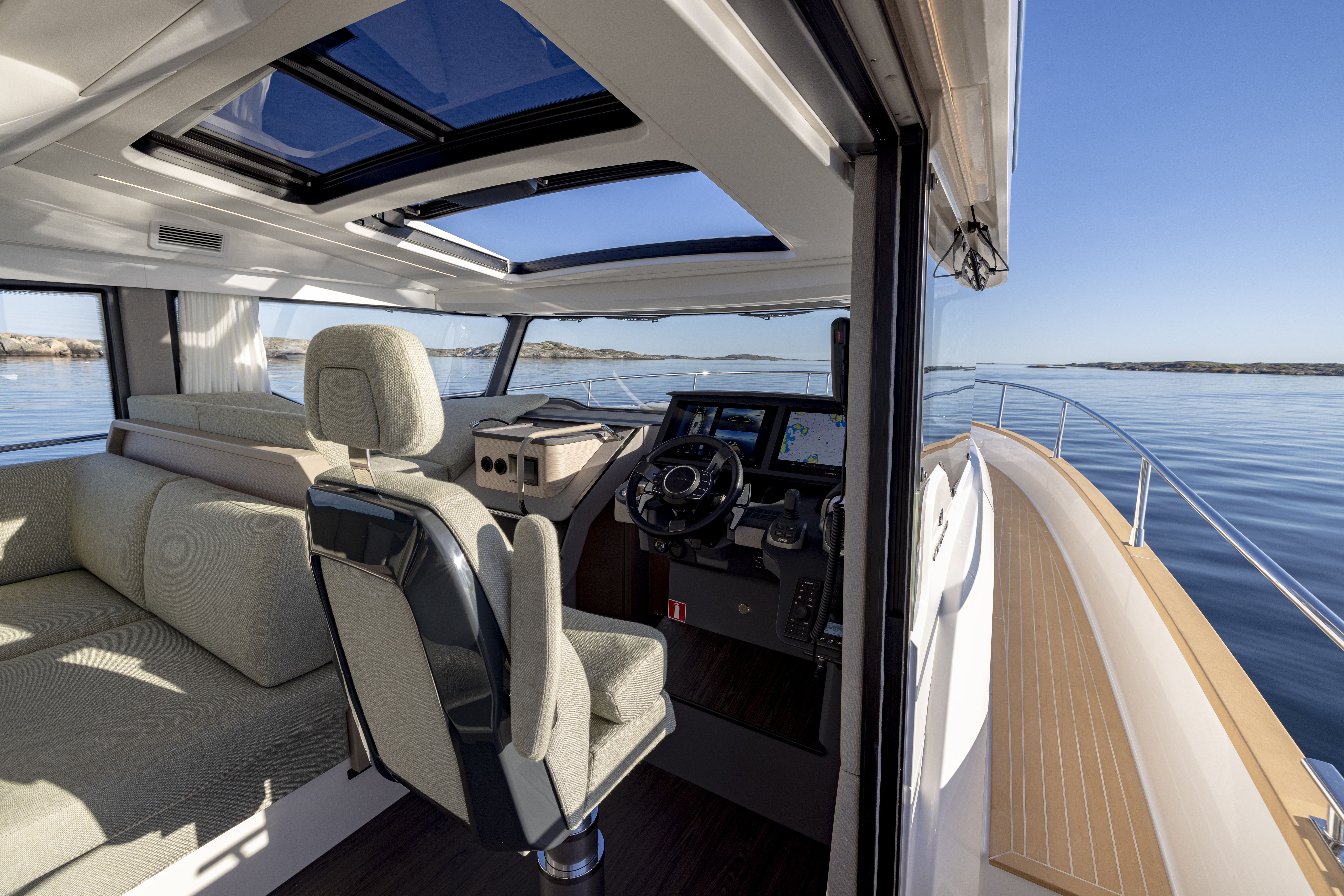
But it’s the salon that acts as the heart of the coupé boat, says Joacim Gustavsson, who is chief designer at Nimbus Group AB. “That’s where we live on board. That’s where we have the driver’s place, the dining area, the social lounge and the kitchen.”
Nimbus introduced theFlybridge 495 in Gothenburg
Distinguished by its size – the 495 is the shipbuilder’s biggest flybridge to date – the boat establishes a new standard for the Nordic coupé and responds to the increasing numbers of sailors that wish to live out in nature for longer stretches of time.
Wise Equity announces majority stake in Absolute Yachts
SHARE
Wise Equity’s funding will support new growth for Absolute, the Italian manufacturer of luxury motoryachts.
Absolute has built its success on navetta, flybridge and coupé yachts
Wise Equity has announced it will acquire a majority stake in Absolute, the northern Italy-based shipbuilder. The investment, which will be made via its Wisequity VI fund, will assist with the Italian manufacturer’s plans for growth and development.
With the agreement, Wisequity V1 will acquire a major stake in the luxury-yacht maker.
Absolute, founded in 2002 by Sergio Maggi and Marcello Bè, is a leading manufacturer of navetta, flybridge and coupé yachts from 47 to 75ft. All yachts are currently made in-house at its production plant in Piacenza.
The manufacturer has seen increasing growth and expects to close out this financial year in August with more than €110 million in revenue. It says of that sum, about 90 per cent was made abroad. The manufacturer, which has a sales subsidiary in the United States, operates in more than 30 countries.
The deal will support the Italian shipbuilder’s continued growth
The transaction involves the acquisition of a majority stake by Wisequity VI and its co-investors, the significant reinvestment of the majority of the existing shareholders and the presence of Angelo Gobbi as Absolute’s Honorary Chairman, to ensure the manufacturer’s strategic and managerial continuity.
Gobbi was jovial about the investment. “Absolute’s motto is: ‘he who hesitates, is lost!’” he said following the announcement. “That is why for some time now we have been reflecting on the future of Absolute. We must continue to evolve, as we have always done.”
Angelo Gobbi, current President of Absolute takes an Honorary Chairman role going forward
Wise Equity, he said, was an ideal partner to strengthen and support the manufacturer through its next phase of growth.
Wise Equity SGR manages closed-end investment funds that invest in small and medium-sized companies, with a special focus on Italy. It currently has three funds under management. Wisequity VI was launched in May 2023 with a total commitment of €400 million. The Absolute deal is its fourth investment.
Benetti shows off M/Y Legend with nods to nautical nostalgia
SHARE
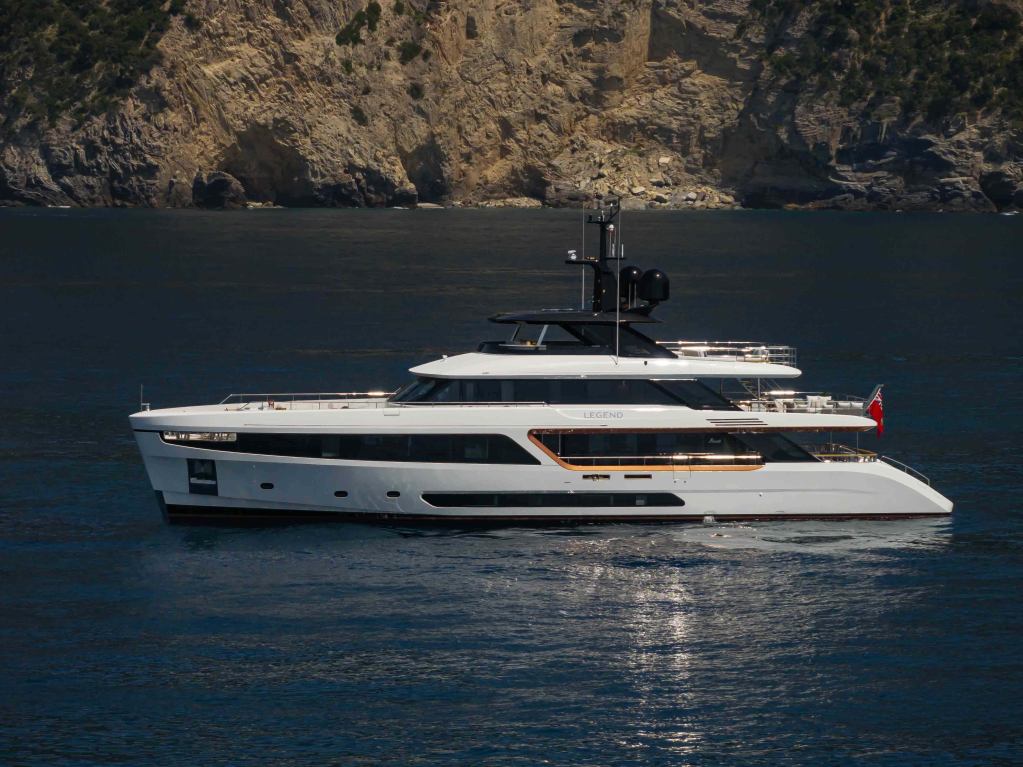
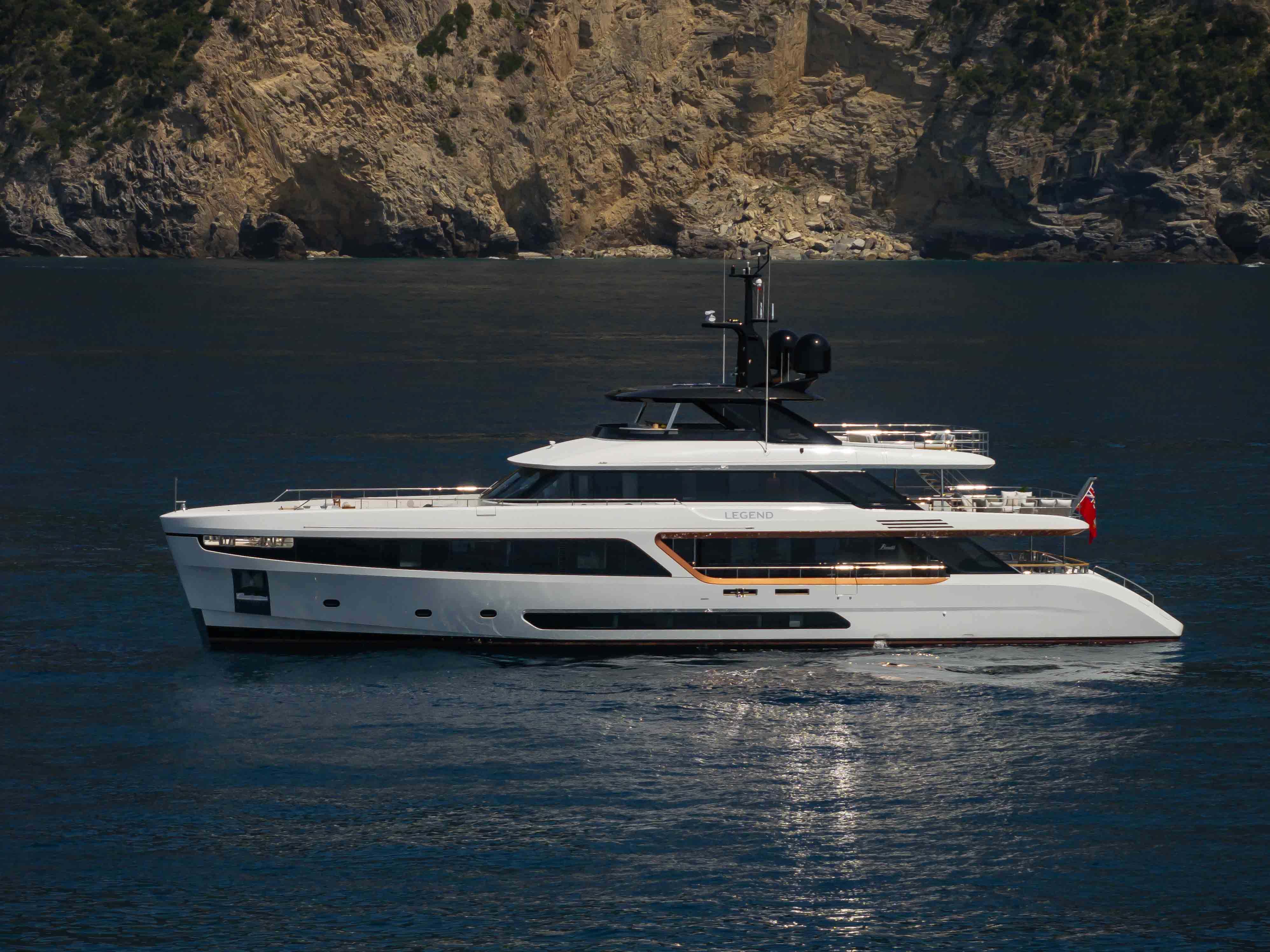
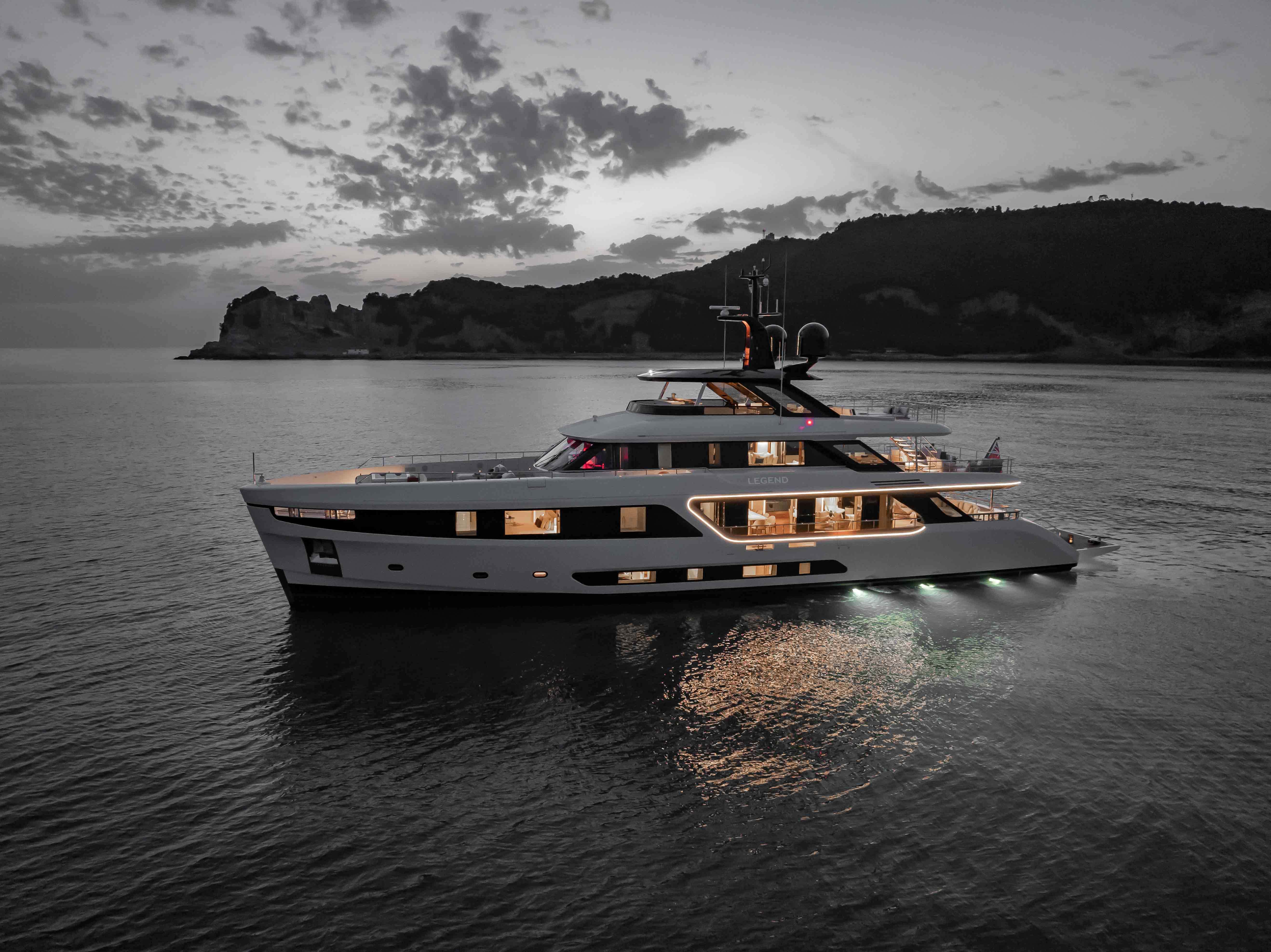
Italian shipbuilder Benetti has shared more on the design choices that went into the crafting of its Motopanfilo M/Y Legend. The 36.8m motoryacht is inspired by traditional navettas and is the sixth hull in this series.
Sharp angles and sinewy lines update the classic navetta style
Francesco Struglia’s design reinterprets the traditional features of iconic Benetti styling, and is inspired by the Italian shipyard’s alluring navettas of the 1960s and ’70s, which were loved by royalty and rock stars alike.
The yacht’s silhouette is characterised by sharp lines and elegant, elongated forms. Distinctive exterior lines bring continuity between the hull and superstructure, feature bronze highlights and are connected by an angled piece of fibreglass, set from amidships to the aft, that defines the profile.
The boat boasts a design that is ‘tradition meets tomorrow’
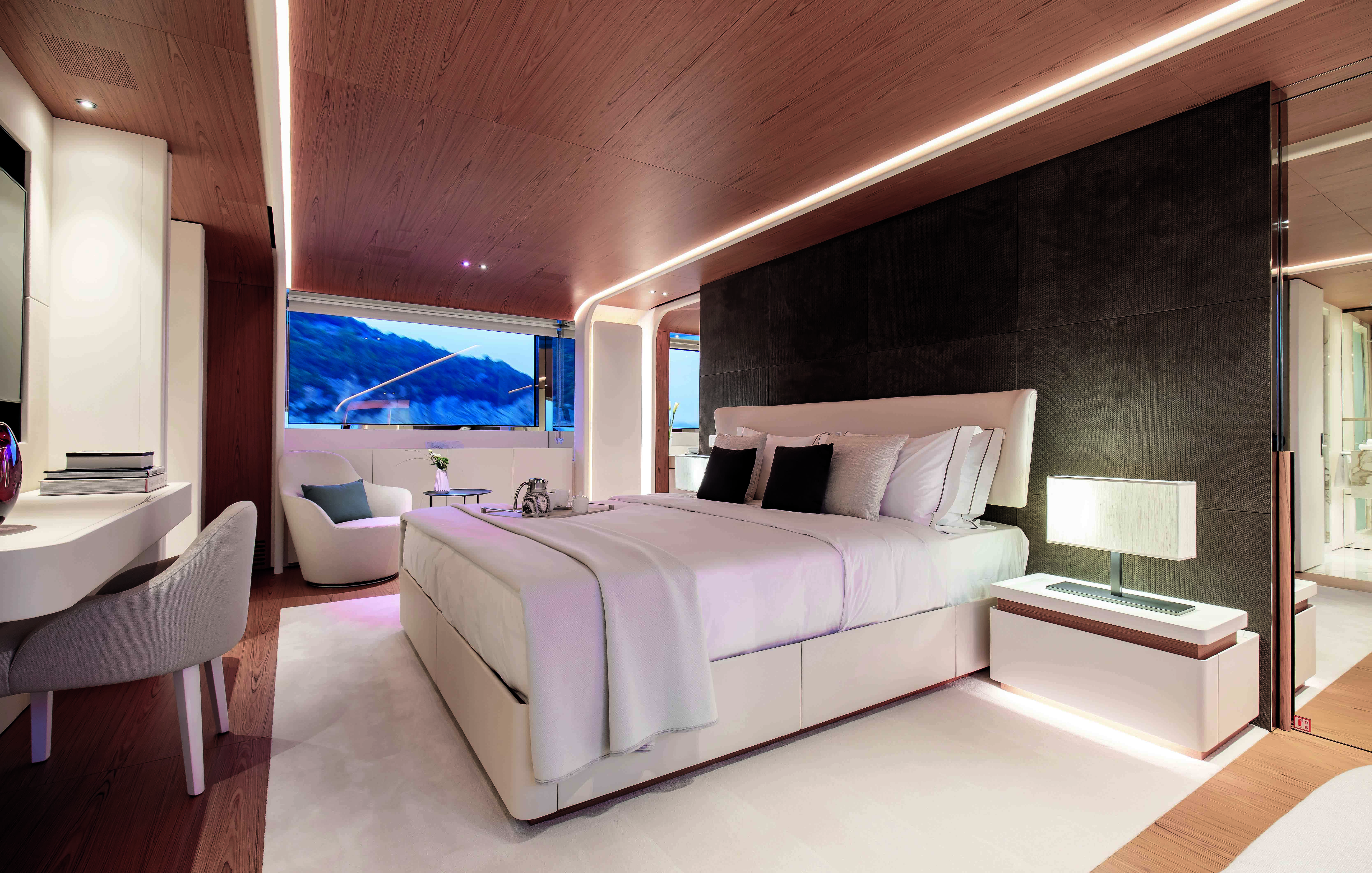
Claudio Lazzarini and Carl Pickering fashioned interiors that replay the elegance of classic motoryachts through a modern lens, creating a boat that feels like a boat, rather than an apartment at sea and is rich in nautical themes and motifs.
Warm woods and rounded edges are both modern and comforting
Light woods, white leather and neutral-coloured soft furnishings highlight the yacht’s architectural lines, and portlight-shaped lighting fixtures and a white-leather-clad mast feature in the central staircase add to the feeling of nautical heritage. In the saloon, Pickering has added white lacquered beams to wood ceilings, and wooden beams on white ceilings to evoke the feeling of standing inside the belly of a whale.
Fabrics, including summer linens, are by Lora Piana Interiors
Materials are light and luxurious. Warming Alpi teak adorns walls and floors, Tuscan Calacatta marble is used on the main deck and Italian Antartide pink marble below, with fabrics provided by Lora Piana Interiors.
The yacht can accommodate up to 10 guests across five cabins, with additional space for up to seven crew members in a layout that includes a large main deck owner’s suite forward and four guest suites on the lower deck, all featuring double beds.
The master suite is forward on the main deck
A spiral staircase from the lobby leads guests through two decks to the skylounge on the upper deck.
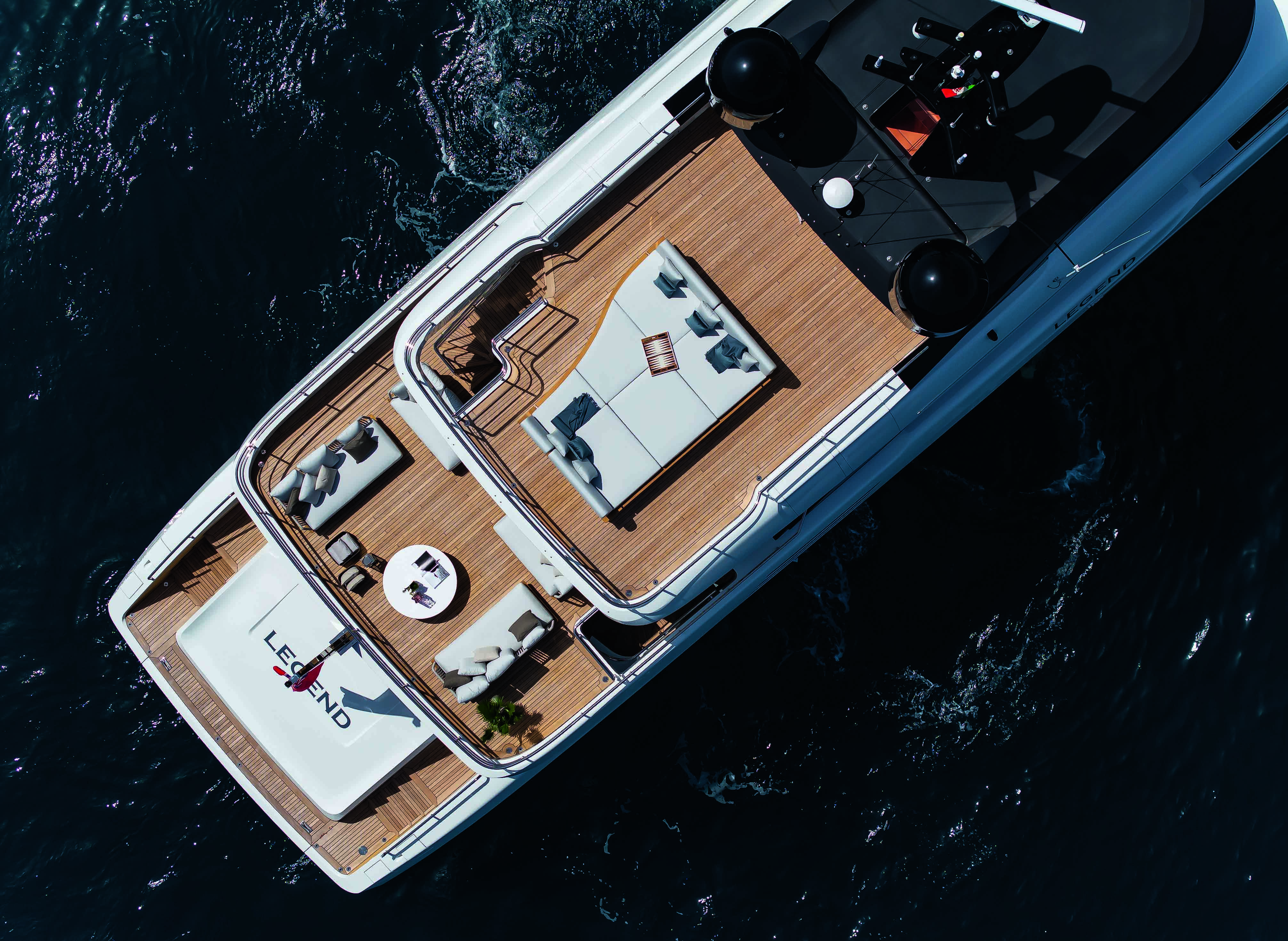
Outdoor living was a major focus of the design, and there are myriad places to enjoy life alfresco including the spacious sun deck and bow lounge, both of which can have spa pools.
A look at the whale rib-inspired beams
A spacious beach club captures the feel of a classic beach cabana with a collapsible, accordion-style bimini top and features a pull-out bar and a custom grand piano-shaped sunpad on the sundeck, which was requested by the owner and designed by Lazzarini Pickering Architects.
Designer Francesco Struglia wanted to create open, liveable spaces
A selective catalyst reduction system (to reduce nitrogen oxide in exhaust fumes and purify exhaust gases) is integrated to meet IMO Tier III regulations, and the yacht also has a double-capacity desalination plant so that she can spend extended periods anchored offshore.
M/Y Legend is powered by two MAN V12 engines and can reach speeds of up to 17 knots.
Electric boats set minds racing at the 11th Monaco Energy Boat Challenge
SHARE
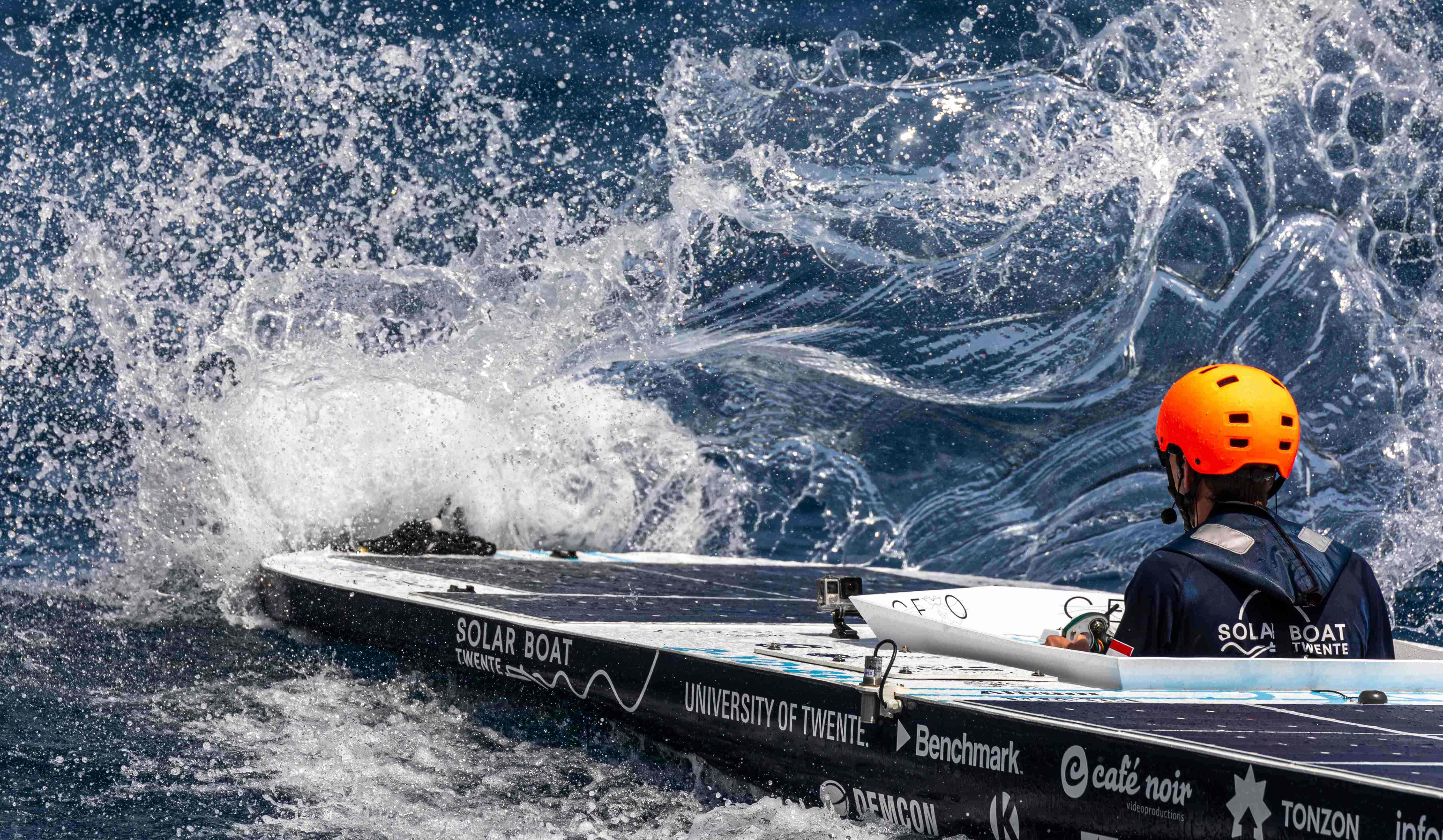
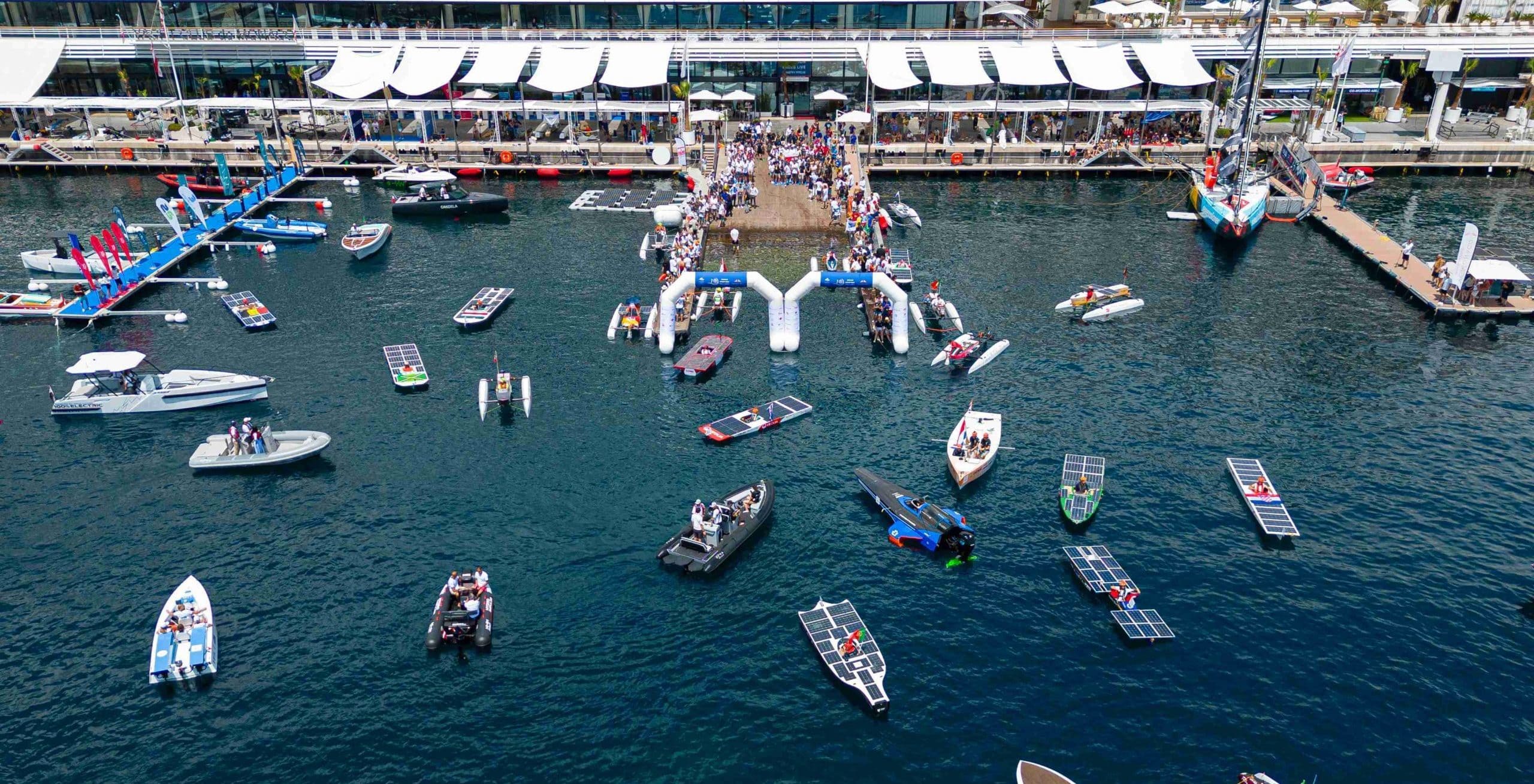
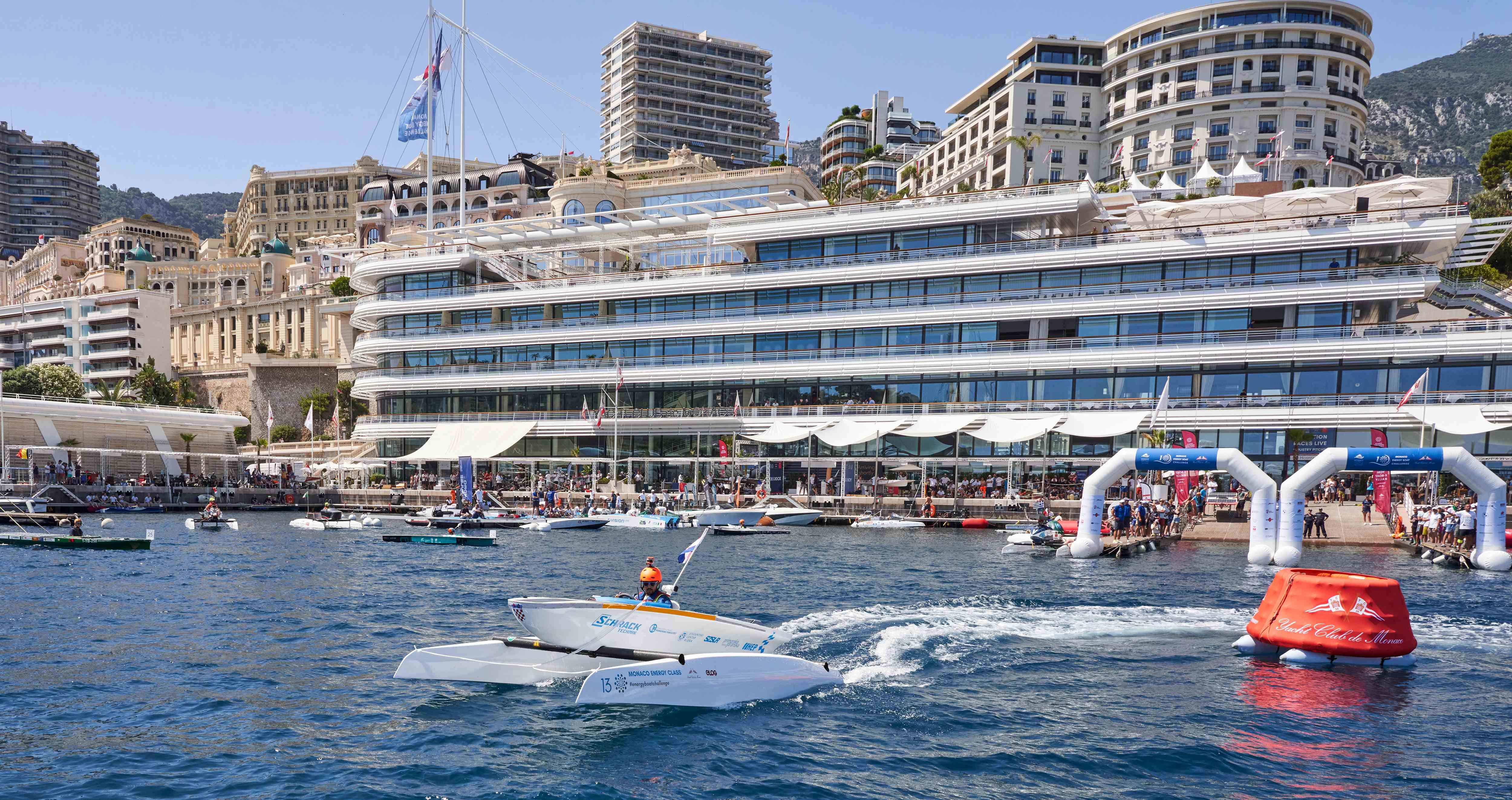
Quays will be buzzing in Monaco for a week this July as more than 700 students from more than 40 universities contribute to support 21 crews and 50 boats for the 11th Monaco Energy Boat Challenge.
The Monaco Energy Boat Challenge tests alternative propulsion methods using clean energy
The international zero-emission on-water event organised by the Monaco Yacht Club, in partnership with the Prince Albert II of Monaco Foundation, will take place from July 1-6, 2024 with a chief aim to showcase the efficiency of alternative propulsion and hull design innovations across three classes: Energy, Solar and Open Sea.
40 international universities will attend this year’s challenge in Monaco
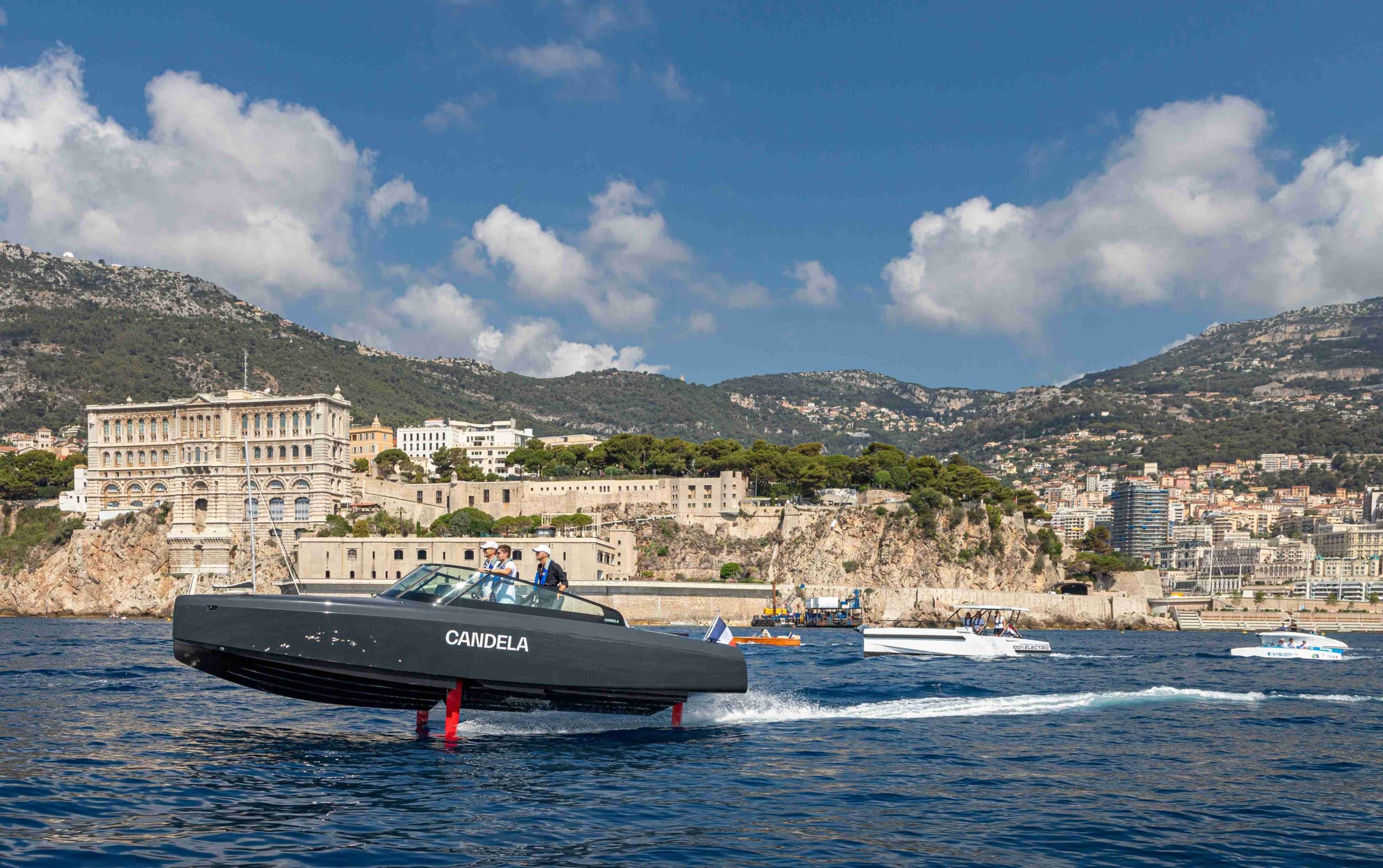
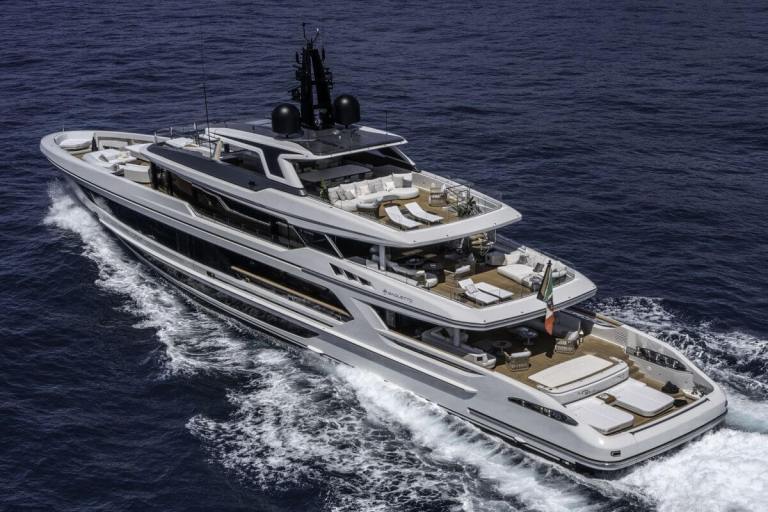
Electric boats already on the market will be featured at the event, which is open to the public, alongside prototypes and vessels due to launch. The challenge draws key industry players keen to advance the future of engineering by way of more sustainable alternative propulsion systems.
Teams have been selected from 21 renowned universities for the 2024 edition, including the University of Cambridge, the Pontifical Catholic University of Chile, the Politecnico di Milano and the Technical University of Berlin, with 14 nations represented, including China.
Speed trials and endurance tests are on the event line-up
They are challenged to use new technology, innovative materials, and alternative propulsion systems that reduce environmental impact all while maintaining nautical performance. Vessels are tested for manoeuvrability, endurance, sea trials, speed record and enter the YCM E-Boat Rally, where 15 commercially available electric boats will be on the start for this eight to 10 nautical mile course including El-Iseo, the first 100 per cent electric Riva designed by the Ferretti Group.
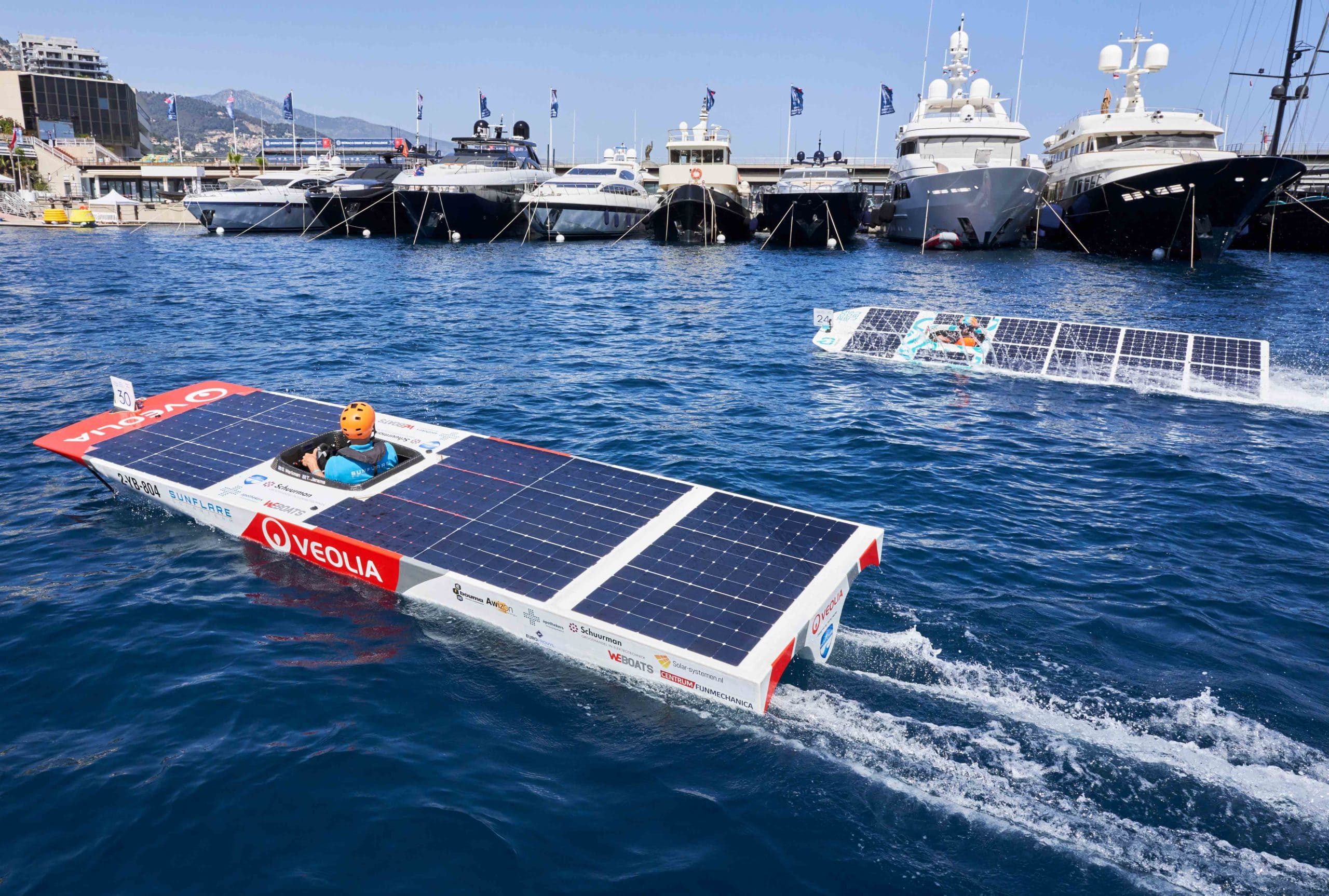
Boats use earth-friendly solar panels and hydrogen-based tech without sacrificing performance
Hydrogen appears to be a favoured choice among the participating teams, with hybrid hydrogen-based technologies fueling 10 projects, and 11 running on fully Lithium-Ion batteries.
Eighteen teams will compete in the energy class, putting on show some intriguing new innovations. From Institut Polytechnique de Paris (ENSTA) comes a three-engine project inspired by differential propulsion, while Britain’s Cambridge University Riviera Racing will showcase their hydrogen-powered foiling catamaran. This year’s competition is the first time foils have been permitted to be added.
Spain’s Universidade de Vigo will debut a unique hull design in the solar class with lines similar to a catamaran that should allow the boat to reach impressive speeds.
Sialia Yachts’ Deep Silence, one of the largest full-electric propulsion boats available on the market, will appear in the Open Seas category for boats already in the market, or about to launch, alongside hydrogen-powered boats, Madblue Marine P-01and Inocel-Poséidon, which will be supplied with hydrogen on July 5 by Natpower.
A new electric, high-performance day boat, the Tridente, developed in collaboration with marine technology company Vita, who are long-term supporters of the event, will no doubt cause a splash.
Green energy boats take the waves in the Monaco Energy Boat Challenge
The Monaco Yacht Club aims to be a major player in promoting sustainability in the yachting sector, and its Monaco Energy Boat Challenge has become a flagship event. Alongside races and on-water displays is scheduled a series called Tech Talks, to further the discussion on environmentally-aware boating.
The event is also an opportunity for the challenge’s young competitors to connect with industry leaders. They are invited to take part in a Job Forum that offers work placements and mentorship and last year resulted in over 80 interviews.
This year, contestants are eligible for a new award. The Prince Albert II of Monaco Foundation Sustainable Yachting Technology Award will award the competition’s best energy-efficient or carbon-reducing solution with a grant of €25,000 to further research and prototype development.
Sanlorenzo’s SP110 Wins Prestigious Compasso d'Oro 2024 Design Award
SHARE
Sanlorenzo’s open coupé SP110, launched in 2022, won at the 28th edition of the Compasso d’Oro 2024 awards held in Milan this June.
Launched in 2022, Sanlorenzo’s SP110 blends tradition and innovation
Part of Sanlorenzo’s “smart performance” range, the SP110 was honoured at this year’s Compasso d’Oro 2024 award ceremony, an important Italian design award, founded by Gio Ponti in 1954 and held at Milan’s ADI Design Museum on June 20, 2024.
The award has become a prestigious one in the design world, honouring Italian design.
The SP110 features exterior design by Zuccon International Project who incorporated aerodynamic shapes and a distinctive style that, alongside Piero Lissoni’s minimalist interiors, Tilli Antonelli’s product development and Marco Arnaboldi’s hull design, impressed the judges, who spent two years in the selection process.
Judges called the hull a “floating home”
Also considered were the hull’s commitments to sustainability. The 33m SP110 is a performance cruiser powered by three fractional propulsion engines with an SCR emissions control system and uses solar panels on its roof. These, alongside other eco-conscious features, reduce emissions.
Ample interiors merge light tones and lightweight materials such as lava stone
Spacious, open-plan design, thoughtful light surfaces and innovative design, highlighted through an expanded sundeck and equipped bow dinette, further swayed judges, who are made up of about 150 experts from varied disciplines.
Innovative design such as the SP110’s expanded sundeck impressed
An accompanying rationale published with the award praised what it said was “a new relationship between transparent and opaque surfaces, and new living solutions,” on the hull and said the cruiser “interprets the idea of a floating home through new proportions.”
Sanlorenzo’s awarded SP110 will join a display in Milan alongside other winning products
In total 20 products were awarded at the Compasso d’Oro 2024, with 39 honourable mentions. They will all become part of the Compasso d’Oro Collection, on display at the ADI Design Museum until Sept. 16, 2024.
Burgess has announced it will team up with China’s prestigious Wanda Yacht Management and Club Reign, part of Wanda Hotels & Resorts, to showcase the country’s yachting lifestyle.
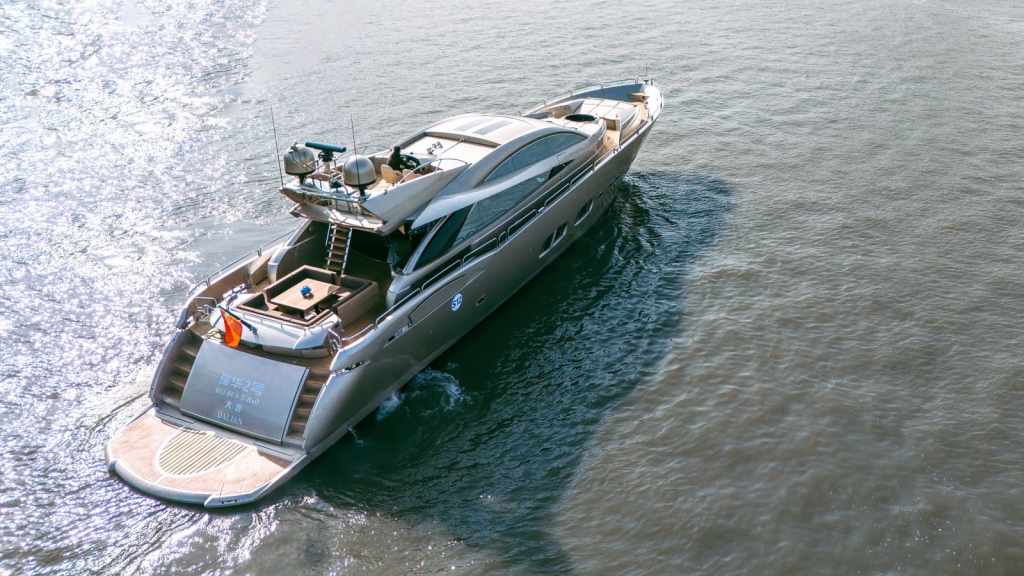
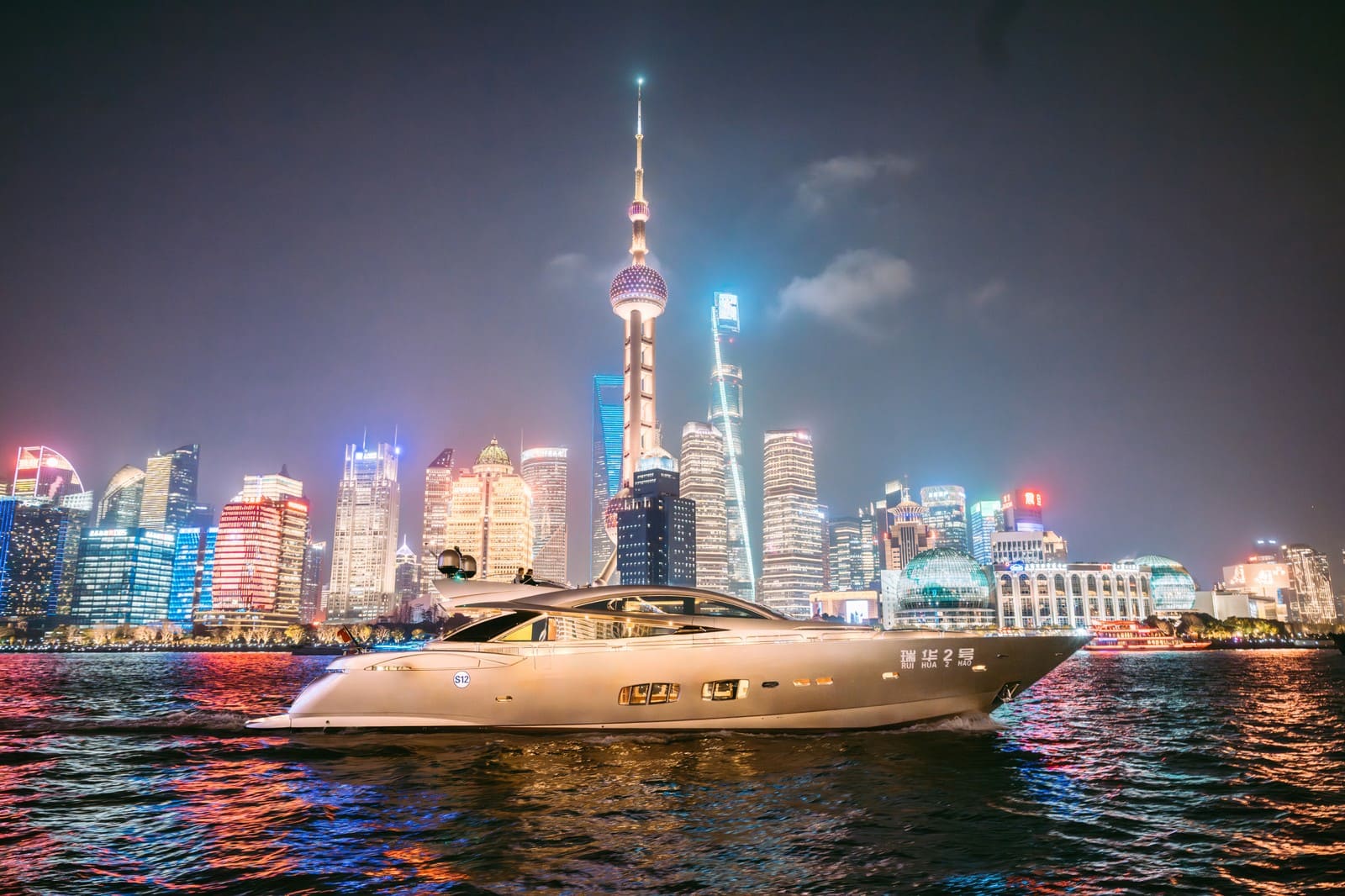
Burgess will tout Wanda’s Sunseeker RUI HUA 2 in their new partnership
Burgess is a veteran yacht supplier based in the United Kingdom, with multiple offices worldwide, including New York, Sydney and Dubai, and is a specialist in yachts of over 30m.
The broker will work alongside Shanghai-based Wanda Yacht Management General Manager Leo Yang, who becomes Burgess’ Chief China Representative, collaborating with teams in Hong Kong, Singapore and Monaco.
A key part of the broker’s marketing platform will be Wanda’s 33m (108ft) Sunseeker RUI HUA 2, which is the first private superyacht available to cruise the Hangpu River and cruises past the famous Bund and Pudong skyline.
Wanda Group’s Leo Yang will oversee teams in Asia in his new role
In addition to becoming RUI HUA 2’s exclusive international marketing agent, Burgess will also become yachting partner for Club Reign, an elite membership club with operations in 10 top cities in China, all located within Wanda’s flagship hotels.
Burgess’ Chairman in Asia, Jean-Marc Poullet, said he was delighted to partner with Wanda Group as the supplier is focused on building its presence in China.
Shanghai’s famous skyline is a draw for sailors on the RUI HUA 2
Leo Yang, who was Marketing Officer for China’s first America Cup challenge back in 2006, and has managed operations at Wanda for over a decade said the partnership was an exciting one at an exciting time for the industry. “Together we look forward to helping Chinese customers discover and enjoy the yachting lifestyle,” he said.
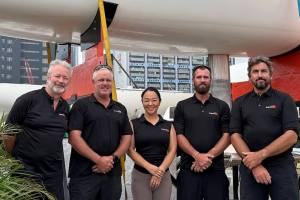
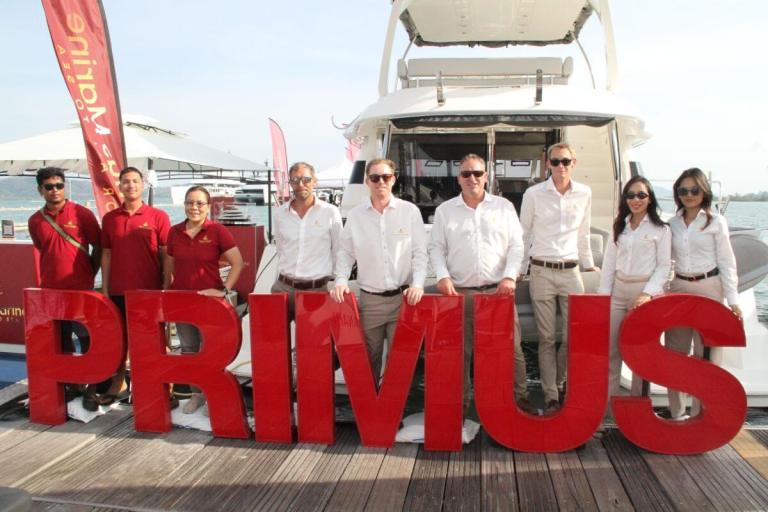
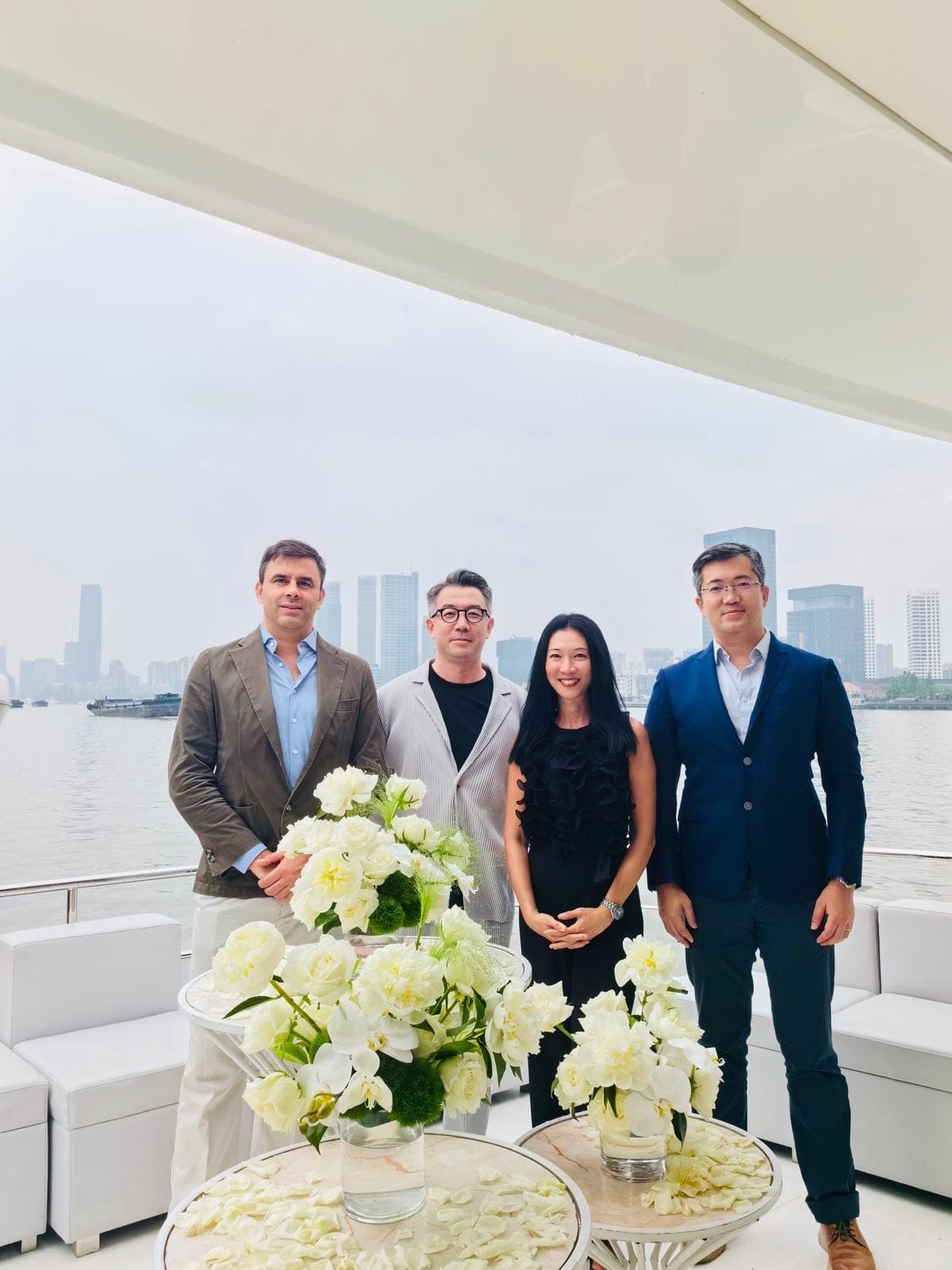
The Burgess in Asia boards the RUI HUA 2. Pictured are Mark Woodmansey, Head of Brokerage, Asia; Leo Yang, Chief Representative, Mainland China, Hwee Tiah, Head of Charter and Business Development and Jiyu Xie, Fleet Manager, Asia
Burgess started its operation in Asia in 2015 and now has offices in Hong Kong, Singapore, Thailand and Tokyo.
Rolex GMT-Master and GMT-Master II are the ultimate globetrotter companions
SHARE
For nearly 70 years, the GMT-Master and GMT-Master II have epitomised travel, and served as loyal companions for frequent fliers.
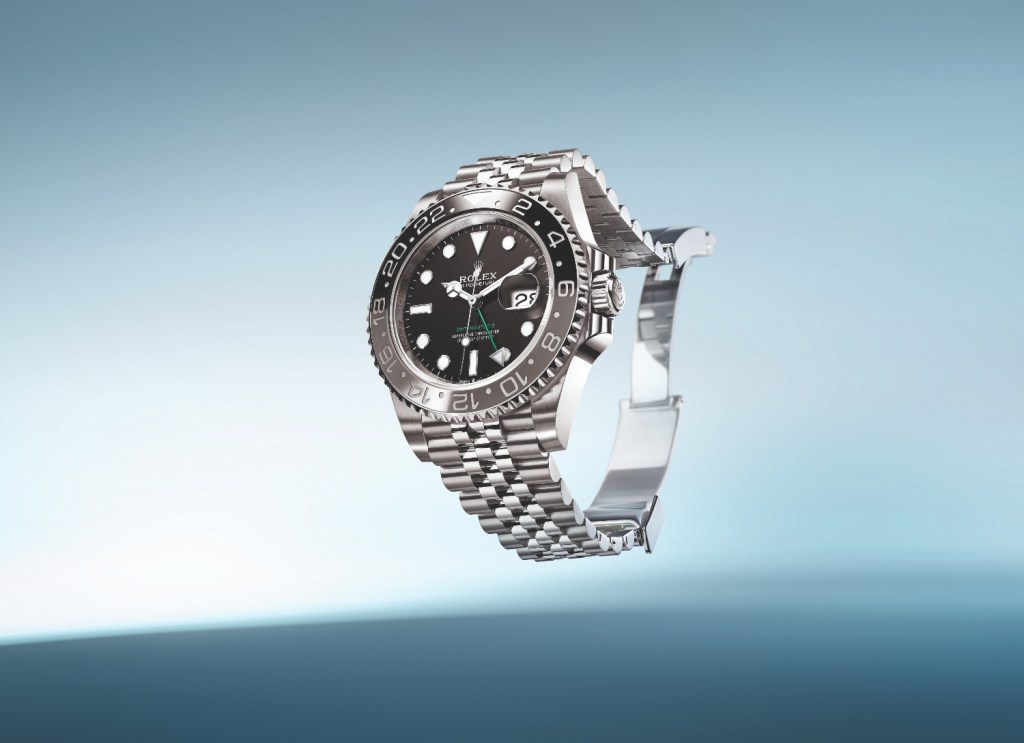
Oyster Perpetual GMT-Master II, 40 mm, Oystersteel
The Rolex Oyster Perpetual GMT-Master II is the ultimate cosmopolitan watch. Developed for professionals who criss-cross the globe, it debuted in 1982 as the successor to the GMT-Master, which was introduced in 1955.
Aesthetics-wise, the GMT-Master II speaks the same design language as the 1955 original – a testament to the brand’s perfection of the line’s style and technical design from the get-go. Meanwhile, decades of technical advancements have kept it at the forefront of watchmaking, where it remains as the GMT watch of choice for discerning connoisseurs.
The 1950s and 1960s were periods of great progress. Civil aviation, in particular, saw major advancements such as the development of passenger jets. This, coupled with the booming global economy, led to a burgeoning demand for air travel – for the first time in humanity’s history, large numbers of people were rapidly travelling across time zones.
Photo of lieutenant and engineer William J. Knight. On 3 October 1967, piloting the rocket-powered X-15, he set the highest speed ever recorded, 7,274 km/h (Mach 6.7), wearing a GMT-Master.
Against this backdrop, Rolex developed the original GMT-Master. It was a true tool watch, with a design that remains de rigueur for GMT-function models even today, featuring two anchoring characteristics. The first: a large triangle-tipped hand that circled the dial in 24 hours. The second: a bidirectional rotatable bezel with a 24-hour graduation, with the most classic iteration having red and blue halves to visually demarcate daytime and nighttime respectively.
Together, these features formed the GMT complication; by setting the bezel, the GMT-Master could display a second-time zone simultaneously for the wearer, who simply had to read the 24-hour hand. Professionals such as pilots and myriad others now had at-a-glance access to a second-time zone.
GMT-Master, stainless steel, red and blue Plexiglas insert, 1955, ref. 6542
Following its introduction, the GMT-Master quickly established its reputation in aviation and came to epitomise the aeronautical watch, accompanying many groundbreaking achievements. This included the first non-stop transatlantic flight from New York to Moscow made by a Pan Am Intercontinental Jet Clipper, as well as the Mach 6.7 speed record set by the hypersonic X-15 experimental aircraft.
The GMT-Master also found itself being relied upon in other fields, where it witnessed triumphs on the wrists of globetrotters, explorers, and adventurers alike. The Pegasus Overland expedition, for instance, was accomplished over 51 weeks across 34 countries with a GMT-Master on the wrist of each team member. Likewise, certain astronauts of Apollo 13, 14 and 17, wore GMT-Master timepieces on their respective missions.
GMT-Master, stainless steel, red and blue bezel insert, 1959, ref. 1675 (above)
Constant Progress
Never one to rest on its laurels, Rolex introduced a new movement in 1982, ensuring that the GMT- Master continued to evolve and adapt to the needs of a perpetually changing world. The calibre 3085’s defining feature was how its hour hand could be adjusted forward and backward in one-hour increments – independently of the other hands, and without stopping the movement. With this, local time could now be quickly and easily set by the wearer as they crossed the globe. To clearly mark this evolution, the watch with the new movement was named the GMT-Master II. The two models would be offered simultaneously until the discontinuation of the original in 2000.
Indeed, both the GMT-Master and GMT-Master II have seen a slew of technical innovations developed by Rolex, to ensure that the latest iteration of each watch would always be the most aesthetically and technically accomplished. And it is this constant march that has helped to forge the line’s reputation for excellence.
The 24-hour graduated bezel, an anchoring feature for the line, has unsurprisingly been a focus for various improvements. The original GMT-Master initially sported a Plexiglas bezel insert, which was shortly after updated to an aluminium one in 1959. In 2005, Rolex introduced the first bezel insert made of ceramic on a Rolex watch. This significant update did not just mean a virtually scratchproof bezel, but also confirmed Rolex’s place at the cutting edge of innovation for research and development into high-tech ceramic components.
Red and blue Cerachrom bezel insert during surface polishing, following coating of the inscriptions.
Rolex followed up with a two-tone, black-and-blue bezel in 2013. The release marked yet another milestone, as the brand had achieved the first two-colour monobloc Cerachrom bezel insert – it represented a triumph of engineering and applied research. The classic red-and-blue Cerachrom bezel insert was introduced the following year, with additional colours unveiled subsequently. They share the same crucial traits: even saturation for each coloured area, and a perfectly clear demarcation between them thanks to precisely controlled production parameters and processes that are patent-protected.
Integration of the oscillator in calibre 3186, with which the GMT-Master II was equipped from 2005 to 2018.
In the same vein, the 24-hour “GMT” hand has undergone various iterations over the decades. Initially slimmer and more discreet, it was given a bolder design after 1959 for enhanced legibility. The triangle at the tip, in particular, was enlarged for greater visual weight. Today, the “GMT” hand is recognised both for its legibility and balanced design, with perfected details including the luminescent material at its tip, as well as a main body that is lacquered in a matching colour with the lower half of the bezel for some references.
24-hour hands of different versions of the GMT-Master II.
Beneath the dial, Rolex has kept a steady pace of improvements to the movement too. In 2005, for instance, the brand upgraded the GMT-Master II’s movement to calibre 3186, which featured its proprietary Parachrom hairspring for greater resistance against magnetic fields, shock, and temperature changes. Calibre 3285 followed in 2018 and incorporated the Chronergy escapement for improved efficiency and magnetic resistance – with the oscillator mounted on Paraflex shock absorbers for enhanced shock resistance, no less. No details have been overlooked; since 2023, Rolex has fitted the movement’s oscillating weight with an optimised ball bearing.
The GMT-Master II Today
Calibre 3285, which powers the latest generation of GMT-Master II watches
Like every other model in Rolex’s line-up, the latest iteration of the GMT-Master II is always the best possible – both technically and aesthetically. The two references for the GMT-Master II in Oystersteel with grey and black Cerachrom bezel insert, which were unveiled earlier this year, showcase this perpetual quest for perfection.
Both references have been fitted with calibre 3285, of course, and benefit from Rolex’s latest technologies including the Chronergy escapement and blue Parachrom hairspring. The combination of the movement’s barrel architecture and its escapement’s efficiency gives the timepieces an approximately 70-hour power reserve.
GMT-Master II, Oystersteel, grey and black Cerachrom bezel insert, 2024, ref. 126710 GRNR
On the exterior, the most striking element of the new watches is their Cerachrom bezel insert in black and grey. This colourway blends in subtly with the familiar Oyster case – rendered here in Oystersteel – with the platinum-coated recessed graduations on the bezel tying all the details together. For a touch of visual interest, the black lacquer dial bears the inscription ‘GMT-Master II’ in green, echoing the colour of the triangle-tipped 24-hour hand – an element that features strongly in the model’s design.
The difference between the new references concerns the choice of bracelet, with both the Jubilee and Oyster bracelets available. The Oyster bracelet sports a three-link design and is known for its robustness. It is also the most universal bracelet within the Oyster Perpetual collection. The Jubilee bracelet, on the other hand, has five links that has given it a reputation for suppleness and comfort. Both bracelets have been fitted with the Oysterlock folding safety clasp, and feature up to five millimetres of fine adjustment with the Easylink comfort extension link.
Roger Federer, former tennis player and Rolex Testimonee, wearing a GMT-Master II in Oystersteel featuring a bezel with a grey and black Cerachrom insert.
The finishing touch concerns the certification standards that Rolex applies to all its timepieces. Each complete GMT-Master II, consisting of both the case and movement, is covered by the Superlative Chronometer certification redefined by Rolex in 2015. This builds and improves on the industry standard set by COSC – not just with an improved precision of +2/-2 seconds a day, but also with requirements for waterproofness, self-winding performance, and power reserve. Rolex backs this with an international five-year guarantee.
The GMT-Master line was envisioned as a tool for professionals to keep track of the time in two different time zones but has grown well beyond this original raison d’être. Today, it also represents a link to a location elsewhere – a place of significance for the wearer, whether as a memory, a plan, or something else entirely. For those who venture across time zones and frontiers, it will continue to be a loyal companion, as it has been for nearly seven decades.
This article is slated to appear in WOW’s Summer 24 Issue, out soon.
For more on the latest in watch reads, click here.
Represented in Asia by Simpson Marine, Bluegame has joined the multihull world with the BGM75, bringing together Philippe Briand, Bernardo Zuccon and Piero Lissoni to collaborate on the brand’s biggest yacht to date.
Words: Risa Merl; Photos: Bluegame
The BGM75 includes a clean aft deck
Moored stern-to quayside, it’s apparent that the new 22.7m BGM75 from Bluegame isn’t your typical multihull. Sitting lower in the water and with a narrower beam than a typical catamaran, you nearly have to do a double take to confirm that, yes, she does have two hulls beneath her.
Philippe Briand of Briand Yacht Design, which handled the boat’s naval architecture, says: “This is an evolution of the monohull, rather than an evolution of a sailing catamaran.”
Case in point, BGM75’s main deck doesn’t tower over the water the way that other catamarans do. Her midsection between the two hulls hovers only 90cm above the surface. It’s just enough clearance to allow her to reap the performance benefits of a multihull platform while keeping her profile low and sleek.
The reason for the difference, Briand notes, is that some powercats have simply been sailing catamaran platforms repurposed as motoryachts; not, like the BGM series, designed from the outset to maximise the benefits of a multihull motoryacht.
“So far, there aren’t too many powercats purposefully designed as a powercat,” he says.
Philippe Briand was the naval architect for the BGM75, which has a beam of 8.15m
Briand explains that sailing cats need to sit higher in the water to afford for slight heeling while underway, but a powercat doesn’t need this same provision. As such, the Frenchman was able to lower the decks and eke out as much space as possible when designing the BGM75 from scratch.
“What I like in life is a challenge,” he adds. “I like to design something that doesn’t exist yet but, of course, makes sense.”
THE CHOSEN ONE
Luca Santella, Bluegame’s founder and Head of Product Strategy, explains why Briand was selected, going on to cite the multiple benefits of a narrow catamaran platform, from performance and comfort to exterior aesthetics and interesting layout options.
“Between the five designers, Philippe gave the strongest answer to our brief,” Santella says. “His idea to have a narrower cat was fantastic. It felt like we didn’t have to compromise, which is rare when starting a new project.”
Another reason for choosing a catamaran over a monohull is comfortable seakeeping. Two hulls mean the yacht is more stable and less susceptible to rolling, and utilising a narrower platform maximises this, says Briand. This enhanced stability can also help to quell seasickness.
“Seasickness is actually a matter of acceleration – it’s amplitude multiplied by the speed,” Briand says. “A monohull has a big amplitude but low speed of rolling, and a wider catamaran has a small amplitude and quick-rolling reaction, which can also be bad for seasickness. But the BGM75 is in-between a cat and a monohull, so it has a moderate amplitude and a limited rolling period for added comfort in any sea state.”
Foredeck tables can be lowered and covered
In addition to the naval architecture, Briand Yacht Design presented a full concept, which changed slightly in terms of style and exterior lines after longtime Sanlorenzo collaborator Zuccon International Project stepped in to help shape the exterior to look like a natural addition to the Bluegame range.
The BGM75 has bountiful outdoor living spaces for its size, and the aft main deck features an interesting seating area with a modular settee with a wooden base so can sit one way looking aft, forward or starboard. There’s also a bow lounge and expansive flybridge with a bar area, cooktop and comfortable loose furnishings.
Lissoni & Partners designed the interior, which includes a helm-free saloon
The flybridge is protected by a fixed hardtop that has a shape reminiscent of a hull of a yacht – wide at the back and narrower at front. The ceiling of the hard top is finished in a teak-like wood that mimics the teak on the deck below. Santella says that for the Asian market, they could enclose the flybridge in plexiglass windows for protection from the elements.
The flybridge is covered but open, with six-seat dining and a triple-seat helm station forward
FULL-BEAM MASTER
Lissoni & Partners – another long-time Sanlorenzo collaborator – was called in to create the yacht’s interiors. An advantage of a multihull is, of course, enhanced volume, due to its beamier body and two hulls. While the BGM75 is narrower than other cats, at well over 8m it’s still wider than a monohull of the same length.
“Space-wise, it’s like a 30m monohull, in terms of volume and what you can offer to the clients in the layout,” Santella says.
It was important to Santella that the BGM75 have a special owner’s cabin. “Considering our level of product, we didn’t want an owner staying down in one of the hulls.”
By lowering the floor of the main deck to be close to the water, the design team was able to carve space for guest accommodation out of the space between the two hulls at the forward end of the main saloon.
An elegant dining area mixes an integrated sofa and chairs
Steps lead down from the saloon to an owner’s enclave where a cabin stretches the width of the superstructure. This nearly full-beam cabin is akin to what you might find in a monohull.
“So far in the cat market, you’ll find cabins in the hulls, but not in the space between the hulls,” says Santella. An en-suite bathroom is separated from the bedroom by tempered glass walls, which gives the illusion of space while still offering privacy.
The first unit has three cabins. In addition to the forward owner’s cabin, there are two cabins in the port hull, while the starboard hull holds a day head and galley that’s connected to the crew mess and crew cabins.
Port view of the stunning full-beam owner’s suite, which has a sloping forward bulkhead, aft-facing bed, and bathroom and walk-in wardrobe to port
Zuccon also consulted on the general arrangement and provided a layout option that has four cabins with the galley on the main deck. Lissoni & Partners designed the cabins to have a neutral and natural feel, with walls adorned in a stone-like surface, complemented by walnut joinery. In the guest cabins, the beds sit up on elevated wooden bases.
There are already plans to expand the fleet, with a BGM65 due to launch in 2025 followed by a BGM85 in the future. With the BGM series, Bluegame is on a mission to prove that two hulls are better than one.
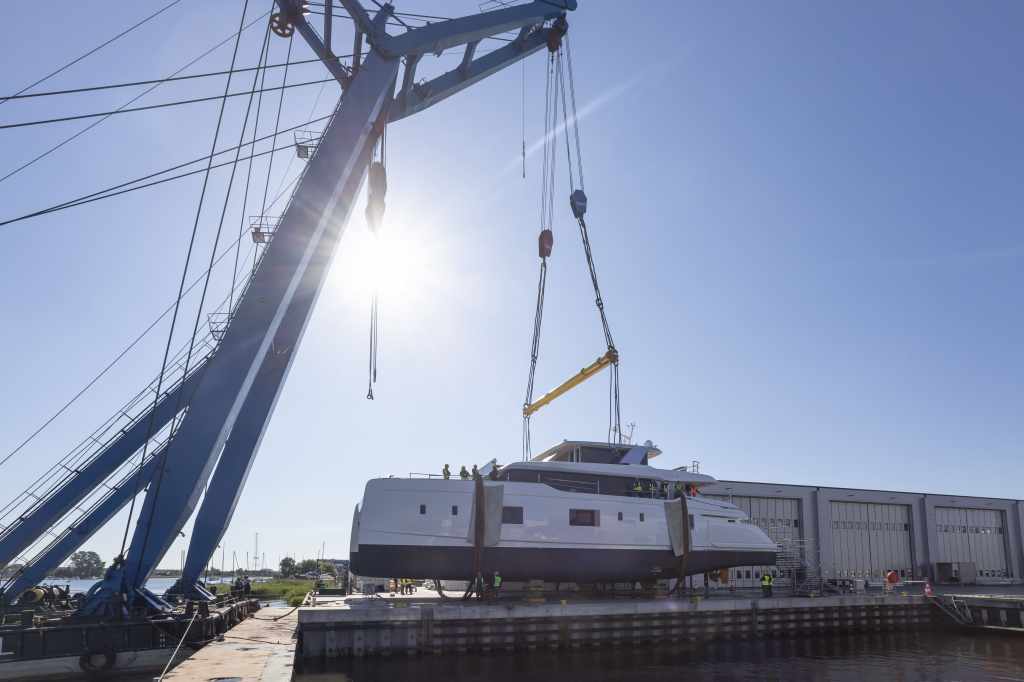
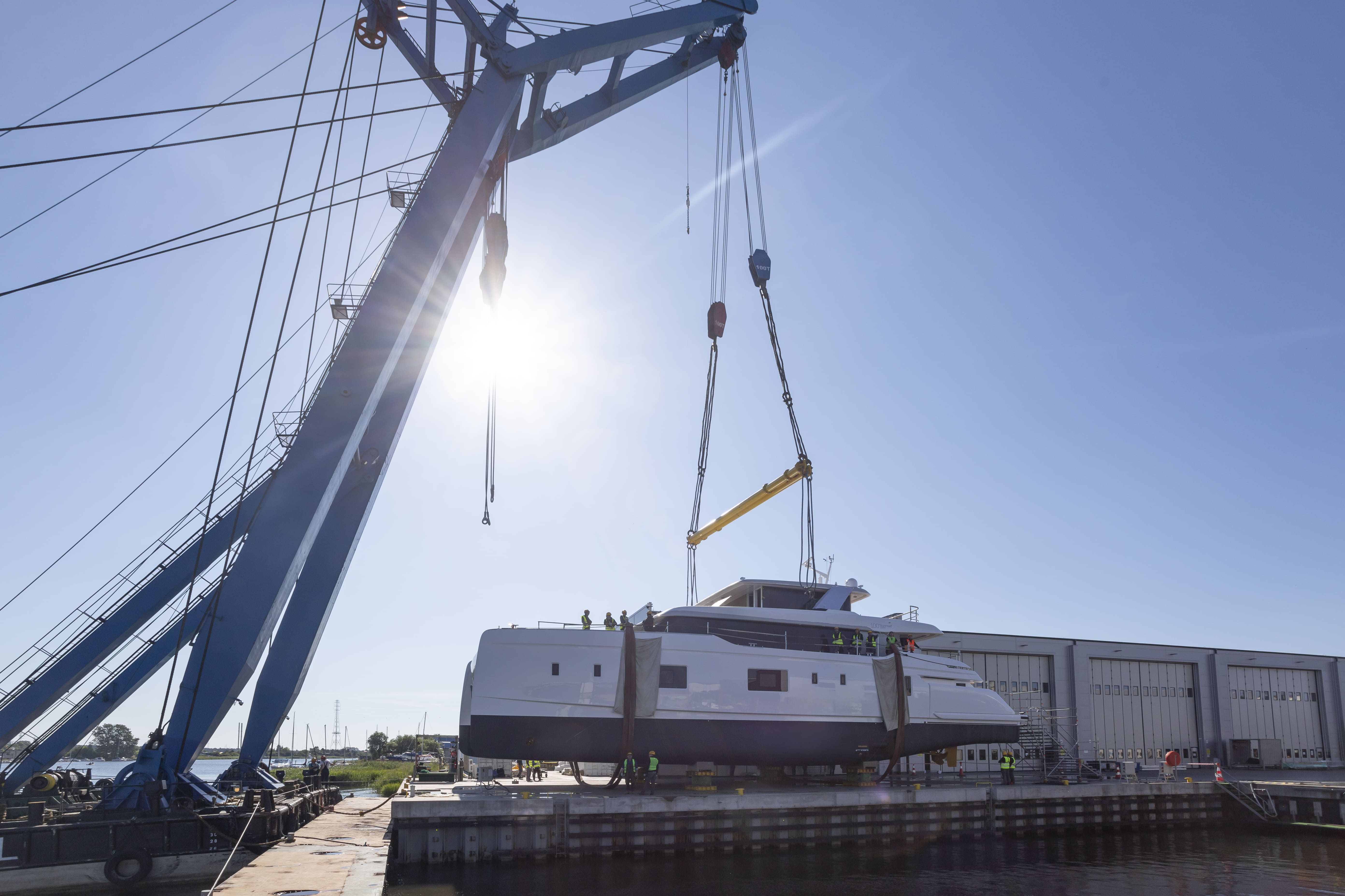
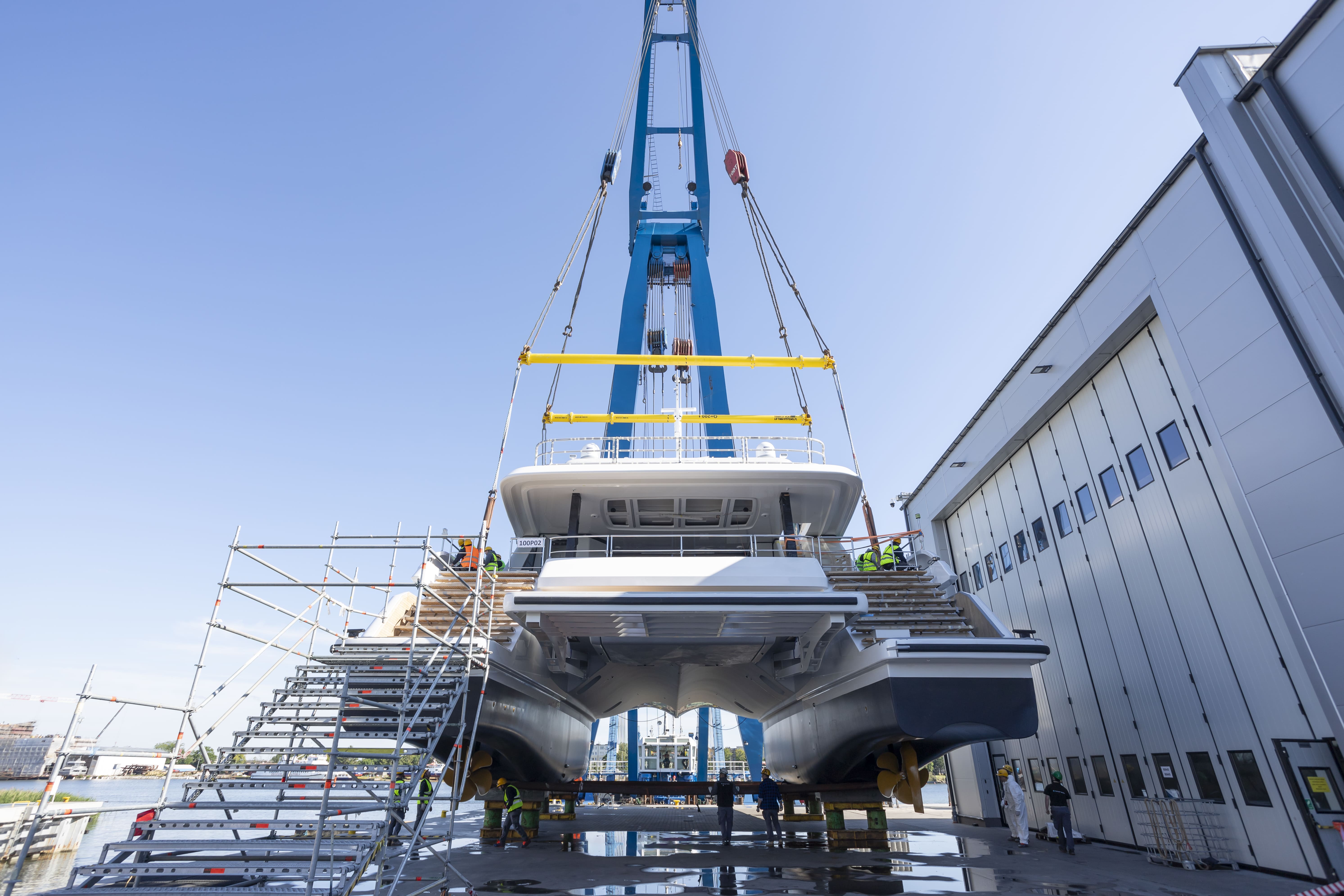
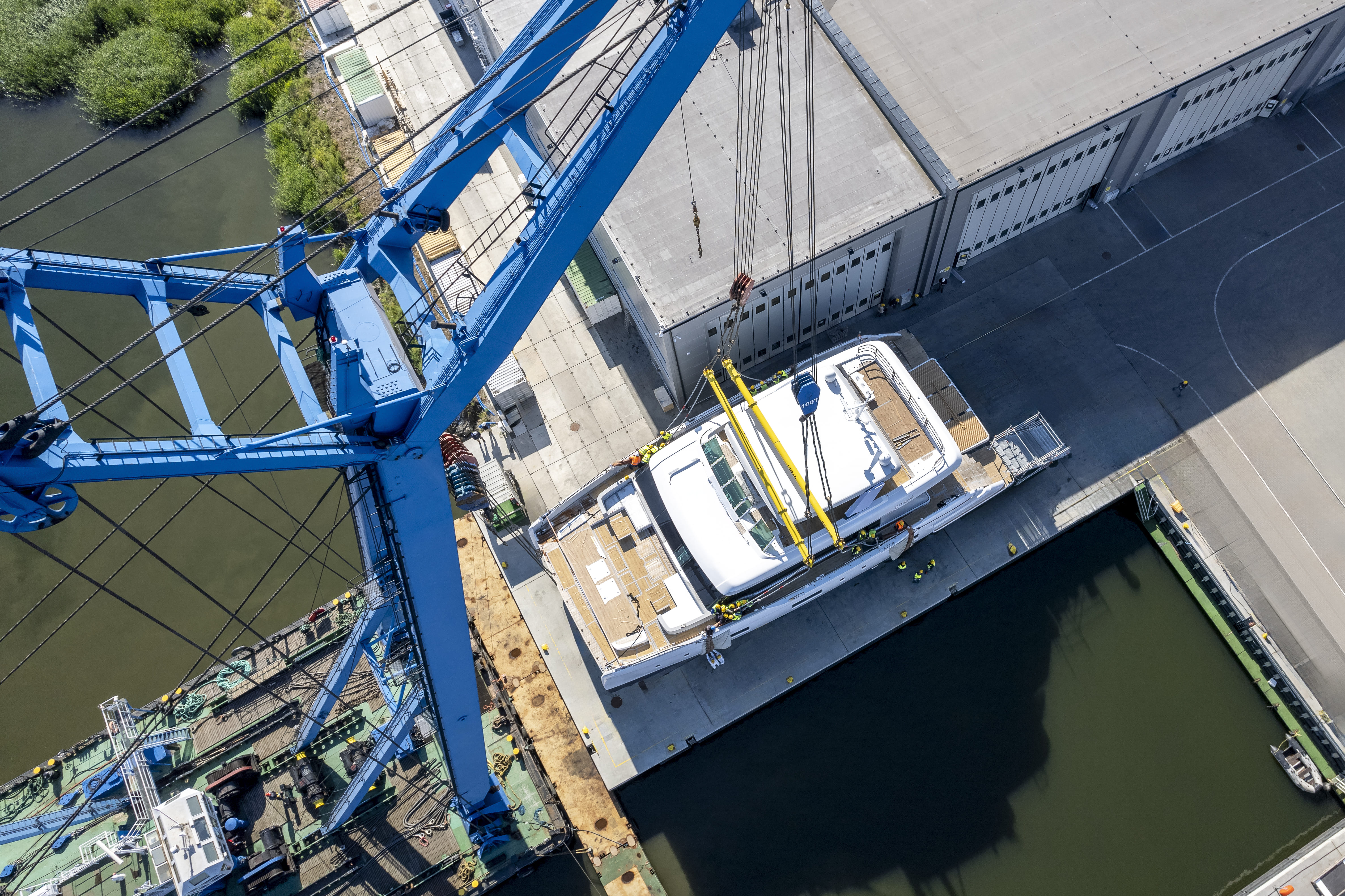
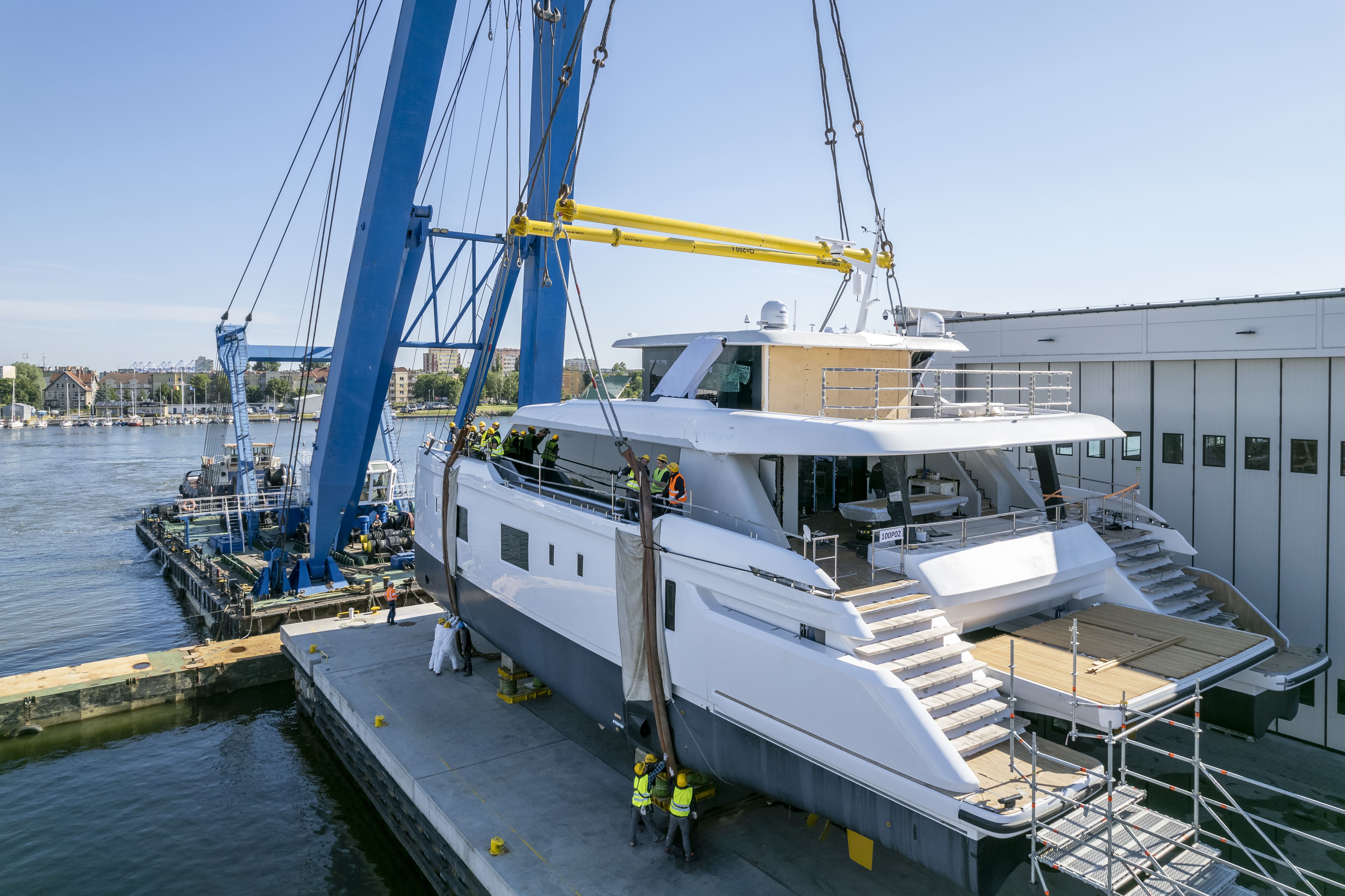
Polish shipbuilder Sunreef Yachts has just launched a second edition to its Sunreef 100 Power superyacht fleet, with the release of The 100 Sunreef Power 2.0.
On a bright and sunny day, Sunreef Yachts showed off the new 100 Sunreef Power 2.0
Sunreef Yachts has just shared the first shots of its latest luxury super cat, a second edition of its much-loved 100 Sunreef Power model, the new 100 Sunreef Power 2.0. With room for 12 – plus crew – the new multihull features a full-beam master stateroom on the main deck that comes with private access to the bow terrace.
Making a splash. Sunreef Yachts is headquartered in Gdansk, Poland.
The ultramodern catamaran also displays a 16m-wide walkaround beach club on the aft deck, with hidden aft garage providing plenty of space to tuck away two jet skis and a refuelilng station.
A first glimpse of the luxurious superyacht
And that’s not all for the bespoke features. An enclosed cigar lounge, with plush lounge sofas, an 85-inch TV and bar is fitted out on the flybridge.
Designed for all-year navigation, the superyacht is powered with twin 1300HP engines.
The second edition continues the popularity of the first, and contains expansive hideaways.
The latest release comes amid a time of expansion for Sunreef who have reported a 40 per cent growth in revenue over two years, with increasing demands for its 100 Sunreef Power model. Sunreef splashed its first 100 Power in late 2021.
The Louis Vuitton Escale journeys into the maison’s eminence of trunk making
SHARE
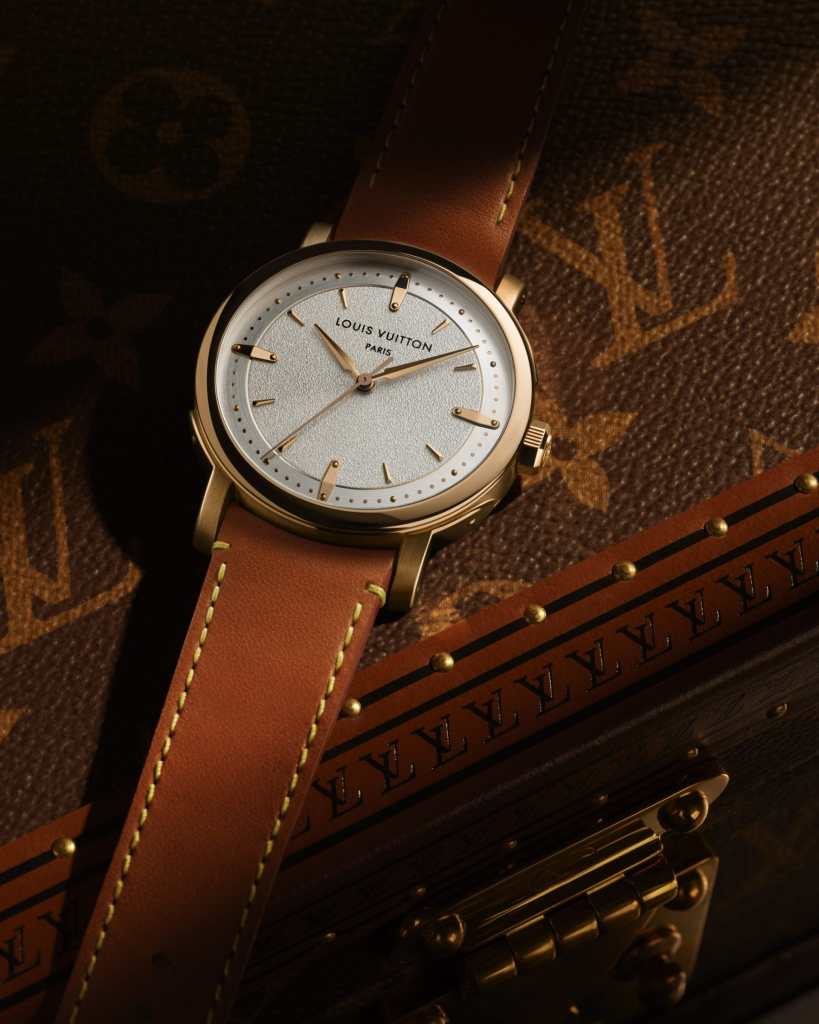
Louis Vuitton celebrates the 10th anniversary of the Louis Vuitton Escale with a three-hander iteration, a first in a decade.
There is a certain element of gamble when new interpretations are given to close and existing associations. Take the flaming Rosso Corsa (English for Racing Red) of Italian marque maker Ferrari, for instance. The iconic shade has dressed some of Enzo Ferrari’s finest racing machines since the 1920s, and understandably, there was quite a stir when the Scuderia Ferrari Formula One team announced and unveiled a blue livery for Charles Leclerc and Carlos Sainz’s cars at the Miami Grand Prix 2024. For Louis Vuitton, mention the Escale and its handpainted Worldtime flag dial or whimsical Spin Time complication come to mind. That is set to change as the French maison presents its latest iteration of the Louis Vuitton Escale, a three-handed watch.
2024 marks the 10th anniversary of the Louis Vuitton Escale, and this novelty will come as a shock to Louis Vuitton’s longtime clients as it is the Escale collection’s first-ever three-hander in a decade. However, the significance of such a release is more symbolic than one could ever imagine. While the Louis Vuitton Escale is steeped in Louis Vuitton’s art of travel philosophy, characterised by the more obvious Worldtime counterparts, this release is an ode to Louis Vuitton’s genesis — trunk making. Consider the three-handed Louis Vuitton Escale, a journey 170 years back to Monsieur Louis Vuitton’s eminence as a trunk maker.
Four models lead Louis Vuitton’s bold voyage into the classical realms of three-handed watchmaking, with the maison’s trunk-making savoir-faire serving as the foundations of the new Louis Vuitton Escale. Cursory glances suggest a simplistic approach, yet such designs are anything but, as summed by the late Steve Jobs, “Simple can be harder than complex: You have to work hard to get your thinking clean to make it simple. But it’s worth it in the end because once you get there, you can move mountains.”
The narrative of the new pieces trods the same path as its forerunners; their watch lugs are a continuous allusion to the iconic Louis Vuitton trunks. Born in the hallways of Asnières but reinterpreted on the watchmaking benches of La Fabrique du Temps, Louis Vuitton Escale’s lugs mimic the trunk’s angled form and riveted exterior. The visual code extends to the dial as the four quarter indices are shaped similarly, while gold studs lining the minute track are reminiscent of the lozine nails running along the Louis Vuitton trunk’s exterior.
Aesthetically, the four iterations of the Louis Vuitton Escale are broadly categorised into two categories. Two are clad in a 39mm rose gold case featuring a silver or blue textured, stamped centre dial. The other pair are outfitted in a 39mm platinum case and further ornamented with lavish touches, the first with a meteorite centre dial prized for its extraterrestrial nature and unique striations and the other with an onyx centre with a baguette-cut diamond set bezel and case. Given the vastness of Louis Vuitton’s all-encompassing divisions, other elements of the maison are captured in the Louis Vuitton Escale. A pair of reworked case-colour-matched gold hour and minute hands are shaped like the tapered needles of the maison’s couture and leather goods ateliers.
Flipping the watch over reveals yet another journey into haute horlogerie, epitomised by the 22k rose gold micro-rotor (a mark of watchmaking pedigree) seen on the automatic calibre LFT023. While the movement is not new, having debuted in the Tambour, its architecture meets modern watchmaking demands, with chronometry certified by the Geneva Observatory and guaranteed with a 50-hour power reserve.
Lürssen delivers its newest superyacht, the 82m Haven
SHARE
German shipbuilder Lürssen has delivered a new tri-deck superyacht, Haven. The 82m superyacht set sail on her maiden voyage from the shipyard on June 17, 2024.
Lürssen’s new tri-deck superyacht sets sail for the first time and sports a low profile and feminine lines
With concept and exterior designed by Jim Robert Sluijter in-house at Lürssen, the superyacht includes a 300sqm sundeck with a 2.5m ceiling height, moveable windbreak panels, and a generous beach club with single-step sea terraces.
Long, lean lines run from bow to stern, with sinuous concave patterns across the yacht’s superstructure, designed to reflect the movement of surrounding waves.
One of the world’s biggest superyachts, Haven features sleek, elegant lines
Such elegant, athletic exteriors are balanced with contemporary interiors, created by the British studio RWD and features complimentary asymmetrical shapes and a dynamic layout.
Haven was built with its owners in mind, and offers generous outdoor space, a family-oriented layout, and storage for water toys and diving gear
Design was informed by a journey shared by the yacht’s owners and designers, and has resulted in bold, personal and functional spaces subtly crafted with colourful curated pieces and striking artworks.
The superyacht made its maiden voyage from the German shipyard in June
Built for an experienced owner with an active lifestyle, the boat’s family-oriented layout and functional design places emphasis on outdoor living, with light and glazing crafted to connect interior spaces with the outdoors, alongside generous outdoor spaces and plentiful storage for water toys and diving gear.
Cutting an elegant figure en route to meet new owners
Haven boasts a LOA of 82m and a beam of 12.5m, placing it among the world’s largest tri-deck superyachts afloat today.





![[Alt Links] Majesty, yachts, superyacht collection, Majesty 145, Majesty 160, Majesty 175, Mohammed Alshaali, Erwin Bamps, Cristiano Gatto, Umm Al Quwain](https://yachtstyle.co/wp-content/uploads/2026/05/0-FEATURED-Majesty-145-Media-Preview_Approved-Photos-1-300x200.jpg)


















 Oyster Perpetual GMT-Master II, 40 mm, Oystersteel
 GMT-Master, stainless steel, red and blue Plexiglas insert, 1955, ref. 6542