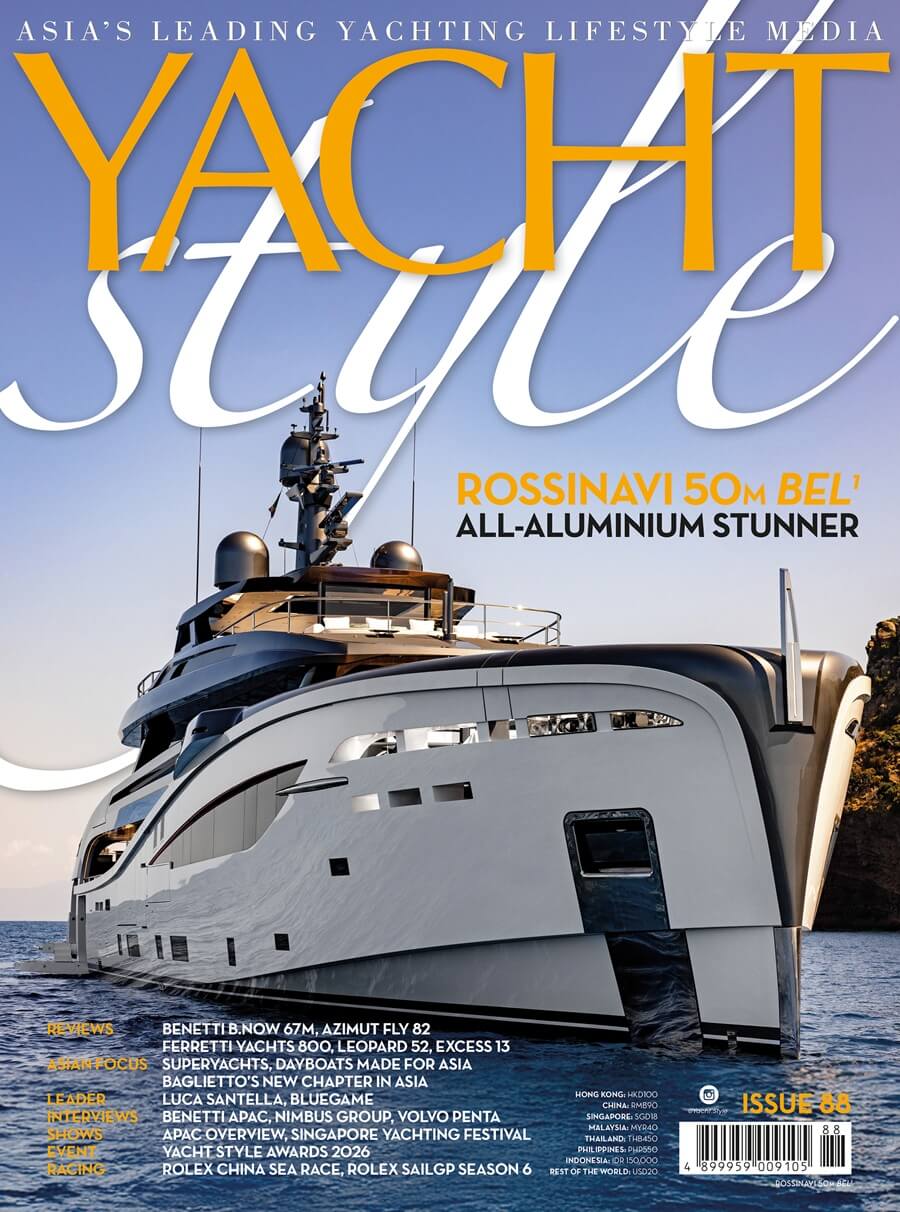
Yacht Style, Issue 88
Read and download copy
Yacht Style, Issue 86, Top 100 Superyachts of Indo-Asia-Pacific 2026, Jonathan Beckett, Burgess, Erwin Bamps, Gulf Craft Group, Fraser, Camper & Nicholsons, AB Yachts, AB 95, Van der Valk, Lalabe, Azimut, Grande 30M, Ferretti Yachts, 940, Absolute, Navetta 62, Cannes Yachting Festival, Genoa International Boat Show, Monaco Yacht Show, Lantau Yacht Club Boat Show - Festa Nautica, Rolex SailGP, Maxi Yacht Rolex Cup, Rolex Middle Sea Race, Phuket King’s Cup Regatta, Thailand, Port Takola Yacht Marina & Boatyard, Krabi, Yousuf Al Hashimi, Phoenix Yacht Management, Su Lin Cheah, ICOMIA, Suzy Rayment, Asia-Pacific Superyacht Association, APSA
Read and download copy

Asia's leading yachting lifestyle media

More results...

Generic selectors
Exact matches only
Search in title
Search in content
Post Type Selectors
Screenshot 2026-01-16 at 9.52.20 AM
Read your copy

More results...

Generic selectors
Exact matches only
Search in title
Search in content
Post Type Selectors

More results...

Generic selectors
Exact matches only
Search in title
Search in content
Post Type Selectors

Leaders

HSBC, Global, Private Banking, Jyrki Rauhio, Asia, Pacific, Hong Kong, yacht, superyacht, Singapore, Indonesia, Philippines, Commercial Banking, Global Banking, wealth, investment, ESG

HSBC Global Private Banking: Asian wealth at heart

HSBC Global Private Banking: Asian wealth at heart

SHARE

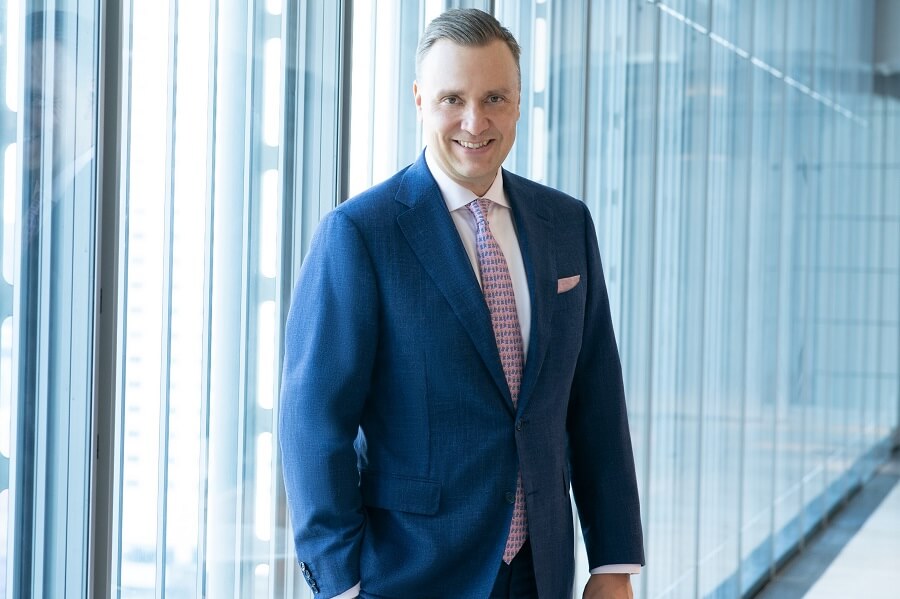
Jyrki Rauhio, Regional Head of Credit Advisory, Global Private Banking, Asia Pacific at HSBC, explains how the region’s ultra-wealthy benefit from the bank’s unique range of services including financing structures for superyachts and other ‘trophy assets’.
  •  
  •  
  •  


HSBC, Global, Private Banking, Jyrki Rauhio, Asia, Pacific, Hong Kong, yacht, superyacht, Singapore, Indonesia, Philippines, Commercial Banking, Global Banking, wealth, investment, ESG

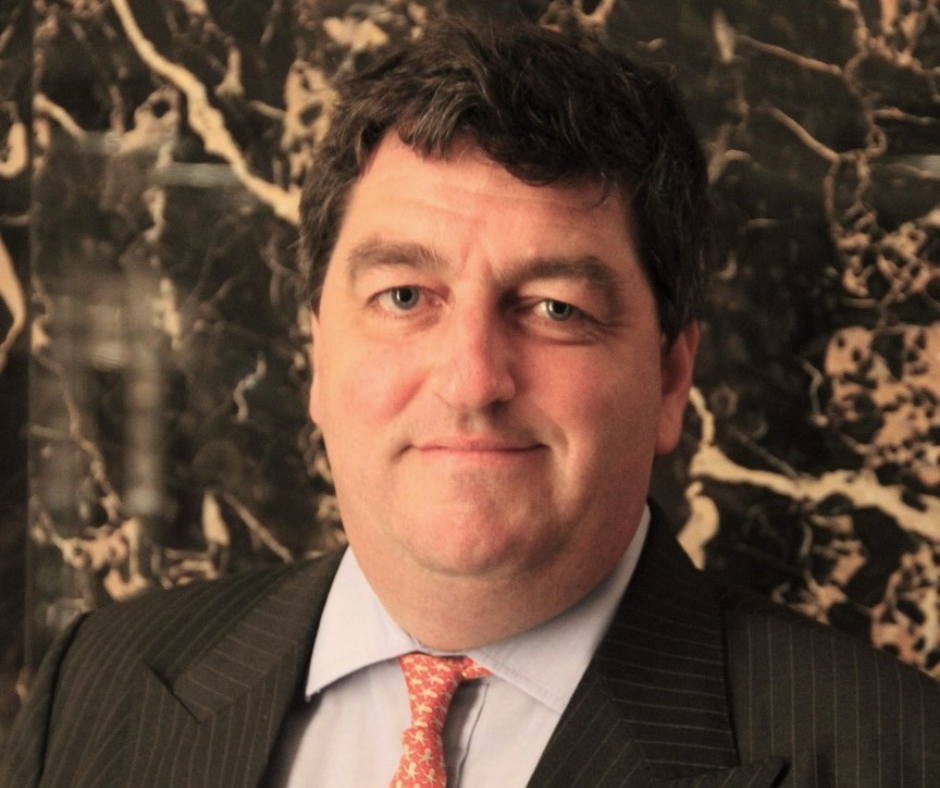
Jyrki Rauhio, Regional Head of Credit Advisory, Global Private Banking, Asia Pacific, HSBC


What’s the typical profile of HSBC Global Private Banking clients in Asia?

One of the core strengths of HSBC is our internal connectivity. We work closely with our Commercial Banking and Global Banking colleagues to support our clients across their corporate and personal banking needs.


For example, we’ll connect with an entrepreneur to discuss their wealth needs, from liquidity to financing, during the early stages of growth. We’ll work closely with our Commercial Banking partners to support the expansion of their business, including international growth. As they grow, they’ll either reinvest in their business or look to manage and protect their wealth, which is where Private Banking comes in with our investment and wealth solutions as well as our wealth planning and advisory team. It’s a very tried-and-tested model and sets us apart.


Of course, we also serve professionals and employees of companies. In Asia, sectors like finance, technology and healthcare are rising quite rapidly. And the wealth of these employees, which may be tied into shares as well, can blossom very quickly and unexpectedly. They need a trusted partner to help guide their long-term financial well-being.


We deal with clients from all backgrounds and industries. But the heart of our strategy is to support clients across their personal and corporate wealth needs, bringing human and financial capital to the table, to help them grow, manage and preserve their wealth.


What makes HSBC different to other banks in Asia dealing with such clients?

HSBC has been actively supporting Asia’s growth story for over 156 years. As part of the group, HSBC Global Private Banking is a leading global private bank, with a wide range of associations and established networks. We are unique in the industry by leveraging HSBC’s scale to provide end-to-end solutions and utilise the depth of HSBC’s global proposition and network.


As a global player with local expertise and our heart in Asia, we are committed to helping our clients grow, manage and preserve their wealth across generations and geographies. This year marks the 75th anniversary of HSBC Trustee in Asia. As one of the longest-serving Trustees in Asia, we are trusted by generations and have been a partner in helping many affluent families preserve their wealth and legacy for future generations to come.


Where does yacht financing fit in within HSBC’s services?

Yacht financing fits into what we call the trophy asset category. A couple of other key ones are private jets and art. They can all be categorised as ‘passion asset’ classes. I use that term because a yacht or plane can be hard to justify from a traditional investment return point of view, but they hold a different type of value, such as utility value, time-saving value or otherwise.


It’s a very important class of assets for our clients, especially the ultra-high-net-worth individuals (UHWIs), who have investable assets over US$30 million. It’s not about enabling purchase, like others would buy something on a payment plan. It’s about really making those assets work harder and releasing equity to get a return. We might suggest that instead of putting US$50 million into this boat or plane, why not put down a percentage of that and then put the rest to work to defray that cost.


Our clients, especially the UHNWIs, have collateral and a lot of debt capacity. They’re comfortable in having debt, even in assets like this, especially with low interest rates. A key is to make sure that the collateral is top end, whether it’s an aircraft or a yacht, and have a tight structure, so it’s being maintained and kept in top order.


HSBC, Global, Private Banking, Jyrki Rauhio, Asia, Pacific, Hong Kong, yacht, superyacht, Singapore, Indonesia, Philippines, Commercial Banking, Global Banking, wealth, investment, ESG

The new 70m Alfa built by Benetti is available for sale through Fraser


We’ve been very busy on the yacht financing side, talking to clients who are either buying their first vessel or upgrading. Since Covid, there has been a boom in demand for buying yachts, especially in Hong Kong, where getting out on a boat has been as close to having a holiday as you can get.


When clients seek to buy such assets, do you challenge them or pose questions to better understand the investment and costs?

We need to be realistic. We do often have a frank discussion with our clients when they’re looking to buy yachts or planes. For example, flying first-class is very affordable compared to owning a plane. For superyachts, we highlight the cost of ownership such as the classic rule of thumb, which is that annual running costs are about 10 per cent of the purchase price.


With Covid, people are feeling that ‘you only live once’ and are keen to own a yacht. It’s a fantastic way to spend your time and the types of clients that are looking at owning a yacht are in the wealth band where it works.


However, in my career, I’ve seen situations where people have had a windfall through an IPO or a liquidity event, and they rush to buy some of these assets. The reality is that buying a yacht or a plane is not like buying a sports car. It’s a very complex purchase, so we highlight that. When we structure the transaction and write up the analysis, we look into that and provide our take on the individual’s ability to service this.


At the end of the day, I’m not in the business of pure asset-based finance. We’re in the relationship banking business. We’re doing this because of who the client is. Our offering is quite unique in the market.


How are ESG (environmental, social and corporate governance) considerations changing among your clients?

ESG has been increasing in importance for quite some time and one of the reasons is the emergence of younger wealth, the tech and financial entrepreneurs, and the next generation. If you look at the traditional billionaire tycoons in places like Hong Kong, their children or grandchildren are now taking over. They may have a very different world view and background to their parents and grandparents. This is very important.


When we look at yachts and builders, are they taking ESG into consideration when sourcing the teak for the decks? What are the carbon emissions on a yacht or a plane? The awareness around this topic is rising rapidly and I can see it evolving more widely. ESG is now a factor in almost all the investments our clients are making.


Do younger clients have a different mentality when investing?

An increasing number of our clients in the regions, especially the Next Generation clients, express strong interest in the durability of sustainability-related themes, because climate change is a scientific fact which will take decades to address. And our clients also like the fact that all stakeholders now seem to be aligned: governments, regulators, voters and consumers are now all committed to the net zero transition.


What are the current business priorities for HSBC Global Private Banking in Asia?

I want to highlight three areas. Firstly, we’re investing a lot in ultra-high-net-worth individuals, as you have to offer a lot more beyond a Private Banking platform. You need to be able to connect Commercial Banking and Investment Banking, bringing top-grade products, services and solutions to these clients.


Secondly, we’re earmarking a third of our Private Banking investment for mainland China. We already have teams in Beijing, Guangzhou and Shanghai, but we’re aggressively growing on the ground to become embedded into the financial system within mainland China itself, as opposed to just relying on the offshore banking model. Investment opportunities for individuals on the mainland are starting to diversify, so we want to be there to capture that opportunity.


Thirdly, we’re scaling up in Southeast Asia which has over half-a-billion people and some of the fastest-growing economies in the world, especially pre-Covid. When we think about Asian wealth, we look at the entire Asian opportunity, not only China, but other parts of the region, such as Singapore as an international wealth hub.


What else should people know about Global Private Banking at HSBC?

The Asian consumer and their growing wealth are the heart of HSBC. We’re investing US$3.5 billion into the Asia wealth franchise over the next five years to accelerate the growth of the wealth and personal banking business. We want to be the leading wealth manager in Asia.


We have all the ingredients, unique in the industry, by leveraging HSBC’s global proposition and network, including access to capital financing, capital markets participation, pre-IPO/direct investments, real estate and a tremendous balance sheet, which is hugely important for the ultra-high-net-worth segment. All this enables our clients to put their money into motion, whether it’s to buy assets or dispose of assets.


So, if you’re looking for one of the world’s largest international banks with an extensive global network and its root and knowledge in Asia, which understands you as an entrepreneur, HSBC is the bank for you. Combined with our commercial heritage, global and regional reach, capabilities and expertise, that makes HSBC Global Private Banking unique.

www.privatebanking.hsbc.com

Disclaimer: The information contained in this article has not been reviewed in the light of your individual circumstances and is for information purposes only. It does not purport to provide legal, taxation or other advice and should not be taken as such. No client or other reader should act or refrain from acting on the basis of the content of this article without seeking specific professional advice. Issued by the HongKong and Shanghai Corporation Limited.
Yacht Style Issue 61 Out Now: The Premieres Issue

Yacht Style’s Issue 61 features New Models and World Premieres 2021, Cannes and Monaco show specials, Camper & Nicholsons CEO Paolo Casani, VP Yachts founder Vivian Chan, Galeon and Tony Castro, PMG Shipyard in Thailand, ONE°15 Marina Sentosa Cove, Reviews of Ferretti Yachts, Sanlorenzo, Aquila and Bali boats, and Yacht Style Awards 2021.

SHARE

HSBC Global Private Banking: Asian wealth at heart Read More »
Singapore, shipping, maritime, sailing, heritage, industry, GMBA, YP Loke, Global Marine Business Advisors, National Heritage Board

YP Loke: Maritime Heritage – A Singaporean context

YP Loke: Maritime Heritage – A Singaporean context

SHARE

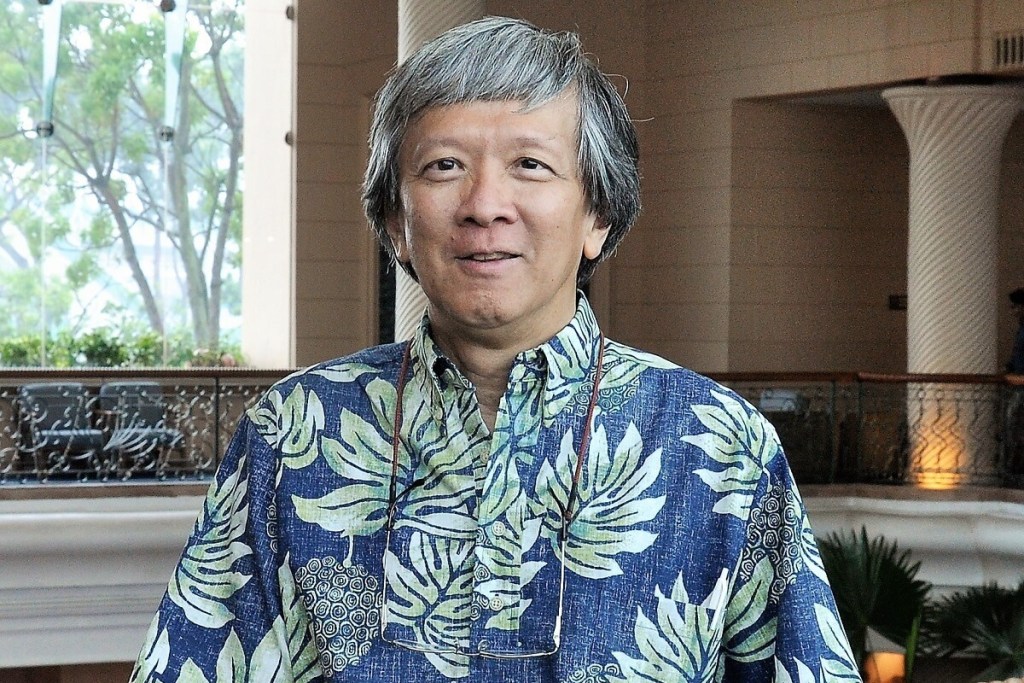
Singapore should do more to embrace its maritime heritage, writes YP Loke of Global Marine Business Advisors.

  •  
  •  
  •  

YP Loke, GMBA Singapore


In Asia’s relentless march towards economic prosperity and its bid to catch up with the developing world, many fundamental values important for evolution of the human condition and wellbeing are often cast by the wayside. This includes (among others) the arts, preservation of natural capital (the world’s stock of natural assets, which makes life possible), culture and heritage.


Asian parents – pushier than their western counterparts – besiege their children to eschew the liberal arts and social sciences in favour of the hard sciences. Assigning monetary value to the former is difficult but not impossible. Their exclusion from the gross domestic product in measuring economic development is a serious shortcoming.


In this article, my focus is on just one small part of this broad spectrum of fundamental values – maritime heritage. It is a subject I am familiar with, given my background in the maritime space, and the fact that I live in Singapore – a modern bustling port city that grew from a sleepy fishing village when the British came here and claimed it as a colony some 200 years ago.


While our journey of economic progress is often envied by others, our record on retaining our culture and heritage has been wanting.


Photo: c/o WRDE


The ideology and relevance of heritage in the search and articulation of identity is not new. The noted eighteenth century Danish philosopher Søren Kierkegaard was quoted to have said, “life can only be understood backwards; but it must be lived forwards”.


In the case of Singapore, it explains the genesis of our multicultural past and forms the cornerstone of a multiracial identity which engenders social responsibility, inclusiveness and a common sense of place. Weaving our maritime heritage into other cultural and economic aspects of our society enables us to resonate with our past and gives us a compass for moving forward as a community.


One would have expected that with maritime trade so firmly entrenched in Singapore’s economic lifeblood from ancient times until today – Singapore remains the world’s busiest port when measured by shipping tonnage – that some sense of maritime or seafaring ethos would become embedded into our cultural DNA.


Sadly, this is not the case. While the body of knowledge and public policy involving heritage and conservation on terra firma is generally healthy thanks to agencies such as the National Heritage Board, the state of its maritime cultural landscape is in desperate need of a makeover. Our maritime heritage warrants effective management at a national level.


Industry laments young people aren’t interested to come into the maritime workforce, which is in dire need of manpower. To be sure this isn’t the kind of cushy industry typical Singaporeans yearn to be in, but the lack of strategic overview and public policy surrounding the maritime cultural landscape certainly does not help. This lack of a maritime identity in the Singaporean cultural psyche is a stumbling block to its stated goal of becoming an international maritime centre.


Witness the other end of the spectrum, where Scandinavians (Norwegians and Danes in particular) have a clearly engendered maritime cultural identity rooted in their Viking past, which they proudly articulate. That these great seafaring nations can maintain a dominant position in global shipping up to today is due in no small measure to the link with their maritime cultural heritage.


Singapore’s predicament of getting young people into the maritime workforce can be neatly summarised in the following quote by Antoine de Saint-Exupéry: “If you want to build a ship, don’t drum up the men to gather wood, divide the work, and give orders. Instead, teach them to yearn for the vast and endless sea”.

http://www.gmba.blue

yp.loke@gmba.blue


Disclaimer: Global Marine Business Advisors and its associated website http://www.gmba.blue are not registered legal entities. GMBA is a network of independent marine industry advisors. In all articles the opinions expressed are those of the author and does not necessarily reflect those of GMBA.

SHARE

ONE°15 Marina Sentosa Cove in Singapore enters new era

Following a US$5 million upgrade and reconfiguration, ONE°15 Marina Sentosa Cove in Singapore more than doubled its superyacht capacity, improved berthing facilities and increased power and Wi-Fi, while development continues on nearby sister marinas.

MORE LEADERS

YP Loke: Maritime Heritage – A Singaporean context Read More »

Colin Dawson on troubled waters for insurance

Colin Dawson on troubled waters for insurance

SHARE

Boat fires in Hong Kong have compounded a difficult time for both the yacht insurance market in Asia and owners, who need sound advice to navigate a complicated period for coverage, writes Colin Dawson.

  •  
  •  
  •  


Colin Dawson, Expat Marine, yacht insurance, boat, fires, Hong Kong, Aberdeen Typhoon Shelter, APSA, San Fernando Race Foundation, The Elephant Foundation


The fire in the Aberdeen Typhoon Shelter in Hong Kong in the middle of 2021 came at a bad time for the city’s insurers and those who provide cover for yachts. Even with the changes in the yacht insurance market over the past two to three years, premiums and deductibles have only increased a relatively small amount while we have not seen anything put towards risk reduction. Losses have continued to increase, and the market now faces a very tough decision in how to move forward.


Of course, insurance is a pool of risk and it’s fully understood that premiums from the majority contribute to cover losses from the few. This is how the industry has survived for over 300 years. The problem at present is that premiums have been too low for too long and losses have been too great for too long.


Something needs to happen to put things right, otherwise we will see a situation where yacht owners simply can’t get insurance. It needs a concerted effort from both owners and the insurance industry to effect sensible changes that allow for an increase in the premium pool while at the same time reducing the number of losses occurring to insurers.


Many insurers are taking knee-jerk reactions by pulling out of the market or imposing steep premium and deductible increases, severely reducing cover available to owners. Unfortunately, some of these changes are based on perceived risk rather than actual risk and are being applied across the board to all owners, irrespective of the situation of their yacht. This is not likely to be helpful in creating a team approach to resolving the problem.


ILLEGAL MOORINGS

What may be even harder is that insurers are now beginning to crack down on illegal moorings and use of boats. This is likely to cause significant difficulties in a city where there’s a huge shortage of Marine Department-approved moorings and many feel they have no option but to use illegal moorings.


It’s a discussion I have had time and time again. If a yacht is breaking the law, insurers can walk away from the risk or a claim. It’s an owner’s responsibility to know they are acting within the law and the manager of the yacht also bears responsibility for this, being a professional advisor to the owner.


How much Professional Indemnity insurance cover do most managers in Hong Kong carry to (ultimately) protect their clients? Professional Indemnity insurance is a cover designed to protect a professional in the event he gives bad advice to the detriment of the client.


If, for example, a claim arises and the manager has been responsible for advising on a mooring that turns out to be illegal, resulting in insurers declining the claim, the owner is likely to turn to the manager for compensation. This is where the manager’s insurance cover comes into play. Of course, it would be far easier if the manager gave proper advice all the time, but mistakes do happen.


SOUND ADVISOR

In the coming weeks and months, owners need to expect premium increases and that obtaining insurance will become harder. Underwriters need to understand that 19 out of 20 owners do not have claims and to increase their premium pool, they’re going to have to retain existing clients and attract new business in offering a high-quality product to owners who see it as a genuine tool to assist in the operation of their yacht.


At the same time, owners need to be prepared to offer an olive branch to insurers and make a significant effort to reduce the risks that lead to claims. This includes the use of a good-quality risk advisor, otherwise known as an insurance broker.


A good broker understands underwriters, risks attached to what they’re arranging insurance for and where losses stem from. The broker should therefore be capable of advising an owner how to obtain good-quality cover and with whom it should be placed. They should also be able to advise an owner on how best to minimise risks that lead to claims, down time for the yacht, along with personal and financial risk.


There are many who offer advice on insurance to an owner. However, how many of those are legally doing so, insured to do so and have the depth of insurance knowledge and relationships to recommend a cover that delivers as it should do in the event of a loss?


The yacht insurance market in Asia is about to change in a way that has not been seen in many years. It’s best for an owner to be able to handle these changes with a professional advisor, operating legally and who is experienced in giving sound advice.


COLIN DAWSON

Colin Dawson, Expat Marine, yacht insurance, boat, fires, Hong Kong, Aberdeen Typhoon Shelter, APSA, San Fernando Race Foundation, The Elephant Foundation

Dawson is a specialist yacht insurance broker with Expat Marine. Based in Hong Kong since 1994, he looks after clients predominantly in Asia-Pacific and superyachts globally. A Founding Member of APSA (Asia Pacific Superyacht Association) and a Director of the San Fernando Race Foundation for underprivileged children in the Philippines, Dawson is also a passionate conservationist. In 2014, he set up The Elephant Foundation, which raises awareness through education of the plight of Africa’s iconic animals and the communities around them.
colindawson@tgg.com.hk
www.expathk.com

Yacht Style Issue 61 Out Now: The Premieres Issue

Yacht Style’s Issue 61 features New Models and World Premieres 2021, Cannes and Monaco show specials, Camper & Nicholsons CEO Paolo Casani, VP Yachts founder Vivian Chan, Galeon and Tony Castro, PMG Shipyard in Thailand, ONE°15 Marina Sentosa Cove, Reviews of Ferretti Yachts, Sanlorenzo, Aquila and Bali boats, and Yacht Style Awards 2021.

SHARE

Colin Dawson on troubled waters for insurance Read More »

Camper & Nicholsons, Paolo Casani, CEO, Monaco Yacht Show, Lady Moura, superyacht, charter, brokerage

Interview: Paolo Casani, CEO, Camper & Nicholsons

Interview: Paolo Casani, CEO, Camper & Nicholsons

SHARE

Camper & Nicholsons’ recent achievements include selling the 105m Lady Moura and adding the 126m Octopus to its charter and management fleets, but CEO Paolo Casani is most excited about the company’s focus on proprietary technology to engage clients in the new era.

  •  
  •  
  •  


Camper & Nicholsons, Paolo Casani, CEO, Monaco Yacht Show, Lady Moura, superyacht, charter, brokerage

Paolo Casani has been CEO of C&N since 2015


What have been the biggest changes at Camper & Nicholsons in your six years as CEO and how has the job compared to your time as CEO of Azimut-Benetti and President of Fraser?

Over the past six years, Camper & Nicholsons has evolved into one of the most important and complete luxury service companies for yachts for two main reasons. One, we’ve greatly improved the integration of all our departments, and two, we’ve been facilitated by the acquisition of a new technological platform that allows us to build new, ultra-modern tools for our sales teams.


Our technology gives us incredible strength and quality on the market and increases the value of the company assets. The technological advancements are not only one of the most important changes of the past few years but will also be increasingly important for the coming years as well.


As for my earlier roles, working for a shipyard and working for a brokerage are quite different. Probably the only common thing is that we work with the same clients, but everything inside the companies is totally different.


Why has C&N focused so much on its online presence, software and communication?

I think we are almost the leader in this area in the brokerage industry, but if you ask me if I’m satisfied, I’d tell you no. Camper & Nicholsons is growing well, thanks to the investment we’ve made, but our plans are more and more ambitious, so we plan to do much more.


Camper & Nicholsons, Paolo Casani, CEO, Monaco Yacht Show, Lady Moura, superyacht, charter, brokerage

C&N was founded in 1782 but is now a digital leader


The digitalisation level of our company will increase more in the coming years because we believe this is one of the most important ways to develop the company. We think the combination of technology and competencies – like experienced sales and charter brokers, experienced staff in all our different departments like yacht management and insurance, which is increasingly important for us – are of paramount importance to the success of the company in the future.


Camper & Nicholsons has an important characteristic compared to the other brokerage houses in that our technologies are proprietary technologies. We do not buy our software and services from other providers. We develop everything in-house. We have a team of engineers planning and building all our in-house software. They’ve been completely re-engineering the digital ecosystem of the company.


That’s the most important effect of acquiring a tech company, as we did in 2019. We’ve done a lot and there is a lot to do. We have quite an ambitious plan. It’s very important to stress this because we store all our data in-house, which is important because we manage very confidential information for our clients.


What are your thoughts on the changes to the Monaco Yacht Show following the 2020 cancellation and the reorganisation behind the scenes?

Firstly, let me say the Monaco Yacht Show is the most important megayacht show in the world by far and it’s a very important window for clients all over the world. It’s an occasion that everyone in this industry waits for to meet people and see megayachts.


Camper & Nicholsons, Paolo Casani, CEO, Monaco Yacht Show, Lady Moura, superyacht, charter, brokerage

Camper & Nicholsons is a major player at the Monaco Yacht Show


Having said that, we think the show should evolve more to attract a new generation of clients with different initiatives, with technology that’s more attractive to this new generation. The existing clients are already in touch with us, so we know how to interact with them and negotiate with them.


As such, the Monaco Yacht Show needs to attract the new, younger generation of clients with the possibility to buy or charter yachts but who don’t yet feel the need or the attraction to do so. We need to bring them, show them on board, to create the possibility to buy, show them the possibility of a different lifestyle. Connecting with the next generation of buyers is the biggest growth opportunity for the superyacht industry in the coming years.


How important is your Monaco office among your global network?

Monaco is not our headquarters, but it’s our most important operational office and has 60 staff out of our total of 140. Monaco remains the hub of megayachts, and many owners have houses or businesses there. Today, Camper & Nicholsons has offices around the world – five in Europe, three in the US and one in Asia, in Hong Kong.


Camper & Nicholsons, Paolo Casani, CEO, Monaco Yacht Show, Lady Moura, superyacht, charter, brokerage

The 60.5m Sarastar is among 70-plus superyachts in C&N’s charter fleet


Which departments generate the most revenue for C&N?

The two most important revenue generators are sales/brokerage and charter, which are almost at the same level. Under sales, I include our new build division, which was launched almost three years ago. After those two, we have yacht management, including the crew and crew placement divisions, and then insurance, which is increasingly important.


Camper & Nicholsons Insurance Solutions is a new 50-50 joint-venture with an insurance company. So far, it has worked with over 100 megayachts above 40m, which is an important achievement.


Do you believe new build is a sector with a lot of growth potential?

Absolutely. New build has a lot of potential growth. In the past, most new builds went through brokerage companies. Now, for various reasons, about 50 per cent don’t go through brokerage companies and go straight to the shipyards.


Camper & Nicholsons, Paolo Casani, CEO, Monaco Yacht Show, Lady Moura, superyacht, charter, brokerage

New build deliveries include Olokun, the 50m Tankoa


We really believe if a brokerage company is well organised and justifies the fact it’s in the middle of the transaction, it can bring great value for both the buyer and the shipyard. That’s why we created our new build division, or what we also call the project management division, composed of engineers.


Our activities in new construction have been quite intense. Just this year, we’ve delivered half-a-dozen new build projects and we’re confident of signing more deals by the end of the year.


How significant is the addition of the 126m Octopus to your charter and management fleets, and what can charter guests expect on her round-the-world tour?

We’re thrilled to have an iconic yacht such as Octopus join our yacht management and charter fleet because she is one of the most impressive explorer yachts in the world. It shows we are increasingly being recognised as an expert in megayachts, as we have other 100m-plus vessels in our fleet. It’s exciting that Octopus is preparing to charter for the first time.


Camper & Nicholsons, Paolo Casani, CEO, Monaco Yacht Show, Lady Moura, superyacht, charter, brokerage

The 126m Octopus will charter from January 2022


The new owner has said that she will be available for charter by very selected clients. It will be an incredible opportunity for guests to experience this sense of adventure. She will embark in January 2022 on a two-year journey around the world. Because she is ice-class, we can now take our clients anywhere they want to go in the world.


Camper & Nicholsons made headlines in the middle of the year with the sale of the 105m Lady Moura, which has long been a mainstay in Monaco. Can you talk about how this sale evolved?

It’s an important sale for Camper & Nicholsons, of course. It was the fastest sale of a 100m-plus yacht in the past decade, taking 554 days.


Camper & Nicholsons, Paolo Casani, CEO, Monaco Yacht Show, Lady Moura, superyacht, charter, brokerage

Lady Moura represented the fastest sale of a 100m-plus megayacht in the past decade


It was a great achievement thanks to great teamwork, starting from our senior sales brokers Fernando Nicholson and Arne Ploch to all the departments, from marketing, who put together a very detailed and refine marketing plan, to compliance and legal in the final stage of the deal, working with the buying and selling lawyers. It was a great company success. Nowadays, when selling a megayacht, it’s important to have a full team working on it.


Other brokerage houses have revealed record superyacht sales during Covid, especially in the pre-owned sector. How has your sales & purchase sector performed in the Covid era?

If we consider 2020, we can divide the year into two parts. The first part was the most difficult one. We had to face something virtually unknown to all of us.


Luckily, we had already thought about an emergency plan for the company for any sudden situation and realised we had to organise the company in a different way. We made an investment in securing the most important functions, including working with banks. It meant that when we had to close the offices in early 2020 and people had to work at home, most of our staff were already organised for this and were able to continue working the next day.


However, we were affected by the impossibility to meet with clients, to complete transactions. This included one for Lady Moura as we were waiting for the clients to come on board, but then their flight was cancelled. Much of the time, these transactions are emotional, so if you lose the momentum, you lose it forever. It was like that for many other negotiations in place.


Camper & Nicholsons, Paolo Casani, CEO, Monaco Yacht Show, Lady Moura, superyacht, charter, brokerage

Sea Huntress, a 55m Feadship, is among C&N’s yachts for sale


Of course, like everyone, we started to organise our video and webinar interactions, as well as improving photo and video shoots, videos with descriptions and voiceovers, all the other ways to

connect with clients and connect clients to the yachts.


The second part of 2020 was much better. Probably as a reaction to what had happened, people tried to go back to normal and the last quarter of 2020 was much better for sales. We started to experience selling yachts without welcoming clients on board – and that was an experience, honestly. If you asked me two years ago, I would have told you this was impossible.


Now, we’ve discovered nothing is impossible if you are very well organised. Covid has been negative overall, but it has taught us a lot and given us the sense that it is possible to change and do this

business in a different way.


This year has been even better. The first six months were the best we’ve had, certainly during my time. We sold a lot of yachts. In general, the industry has sold double the number of yachts it did in the first six months of 2019.


How was your charter business affected during Covid?

Charter had a different evolution to sales. In early 2020, we entered an almost worldwide lockdown, so we had to cancel or postpone almost all charters. This was financially a difficult period because we had to give up our income from charter, which is an important part of Camper & Nicholsons’ revenue and cash flow.


Camper & Nicholsons, Paolo Casani, CEO, Monaco Yacht Show, Lady Moura, superyacht, charter, brokerage

The 58m Benetti Illusion V is for charter


We were able to postpone 50 per cent of the charters already booked, but all in all, it was obviously not a positive year for charter. Then in the last quarter, we almost lost the Caribbean season as well,

so that was a double negative impact.


In 2021, we didn’t start very well, but from March, even charter started to change. April, May, June and July have been incredible months for charter. It was difficult to find a 40-50m yacht available for charter unless there was a late cancellation. We almost recovered our budget by the end of July.


In charter management, we are above the yearly budget and in charter retail, we’re just short of the yearly budget, so all in all, we’re extremely satisfied with charter as well, although the curve has been

different to sales.


We’ve also improved the quality of our charter fleet. Octopus is just a recent example. We have an incredible range of 70-plus yachts in our charter fleet, based in all the major charter locations around the world, such as Europe, the Caribbean, Florida in the US and Southeast Asia. Some have 100, 110 days, 140 days of charter a year, which is incredible. In these cases, the owners can offset their running costs.


How do you think the charter industry will evolve in the coming years?

Charter is one division that can be more positively affected than others by technology and we do it a little bit differently from other companies because of the tools we have in place. For example, the way we propose itineraries to our clients is unique and can be done very quickly and easily because of our technological platform.


Camper & Nicholsons, Paolo Casani, CEO, Monaco Yacht Show, Lady Moura, superyacht, charter, brokerage

La Pellegrina 1, a 49.5m Couach, is for charter


Our new website launched in late 2019 has also helped us receive more enquiries than before and we’ve also improved the team of charter brokers, which now number over 20 around the world. Honestly, our charter brokers include some of the best in the industry.


How important is Asia for Camper & Nicholsons in the long term?

Firstly, the company’s majority shareholder (Lai Sun) is based in Asia. For a long time, Asia has been the continent with the most growth potential. There’s still a lot to do, but there are a growing number of investors approaching the yachting business.


The number of tycoons investing in and buying yachts is increasing every month. If you look at the order books of some of the most important shipyards in Europe, there are many, many owners from

Asia. Some very important yachts have been delivered to Asian owners and there will be more in the coming months and years.


The number of multi-billionaires in Asia is growing, mainly but not only in China, which will eventually become more important than the US. If the trend continues as it does today, we think the Asia market

will be the most important market in the industry in the next 10 years.


Camper & Nicholsons, Paolo Casani, CEO, Monaco Yacht Show, Lady Moura, superyacht, charter, brokerage

The 65m Lamima is for charter in Indonesia


This is something we said 10 years ago and maybe 20 years ago, and it has evolved partially, but now there is an acceleration. The delay is because people in the north part of Asia are not that familiar with the sea. Yachts are used in a different way, as the owners are less passionate about spending time in the sea and more passionate about the asset.


Another obstacle in Asia to the growth of yachting is the infrastructure, which is quite poor in some of the countries. For example, in Hong Kong, there’s an important number of yacht owners but it’s difficult to moor a yacht above 40m for many reasons.


For some automotive and fashion companies, the Asian markets are some of the most important in the world. Yachting is part of the luxury industry, so just as it happened for cars and fashion, it will happen for yachting. However, due to the nature of the assets, it will take longer.


We only opened our office in Hong Kong in 2017, so we are still young there, but with an important strength – our owner is based in Hong Kong, so we’re in touch with some of the most important clients there. We very much count on Asia.
www.camperandnicholsons.com

Camper & Nicholsons agent for CLX96

The global brokerage house has been appointed as an agent for the sale of CLX96, the CL Yachts flagship set to debut at the Miami Yacht Show in February 2022.

SHARE

Interview: Paolo Casani, CEO, Camper & Nicholsons Read More »

Yunzhu Jin: Buying superyachts for Asia-Pacific passages

Yunzhu Jin: Buying superyachts for Asia-Pacific passages

SHARE

Yunzhu Jin, Asia Director for Amels and Damen Yachting, explains what makes the brands’ superyachts so suitable for travelling the region.

  •  
  •  
  •  


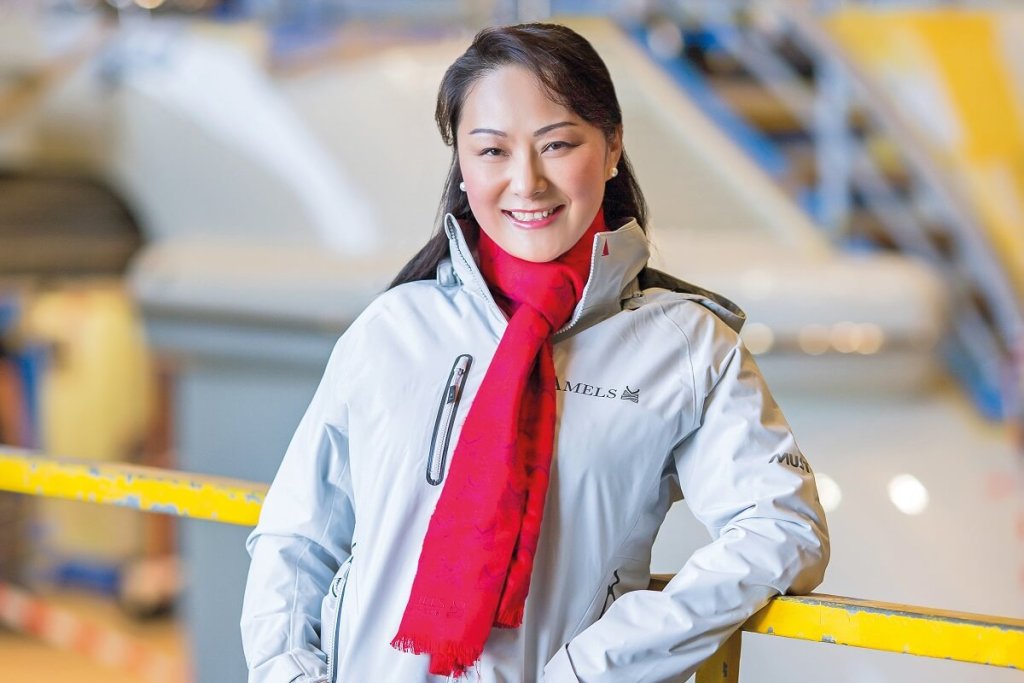
Yunzhu Jin is Asia Director for Amels and Damen Yachting


Amels and Damen Yachting now have the largest number of superyachts cruising Indian Ocean, Asia and Pacific waters. The upsurge is due to many factors.


First and foremost, the range is unique. Amels offers Full Custom superyachts and ultra-popular Limited Editions. The yard, established in 1918, became a member of Damen Shipyards Group in 1991. Damen Yachting Company was then formed in 2019 to handle Amels, as well as Damen Yacht Support vessels, Damen SeaXplorers and Yacht Refits.


Private yacht engineering and outfitting is focused at Vlissingen in the Netherlands, near the Belgian border, and is backed by the enormous Damen Shipyards Group, which has 35 shipyards worldwide including in China, Singapore, Vietnam, Indonesia and Australia, delivering nearly 200 commercial and naval vessels a year.


The Group’s sheer experience, quality standards and financial strength are thus very reassuring for buyers. They are hallmarks also of Damen Yachting, whose state-of-the-art innovations are developed with some of the world’s leading designers, including Tim Heywood, who has been closely associated with Limited Editions since the early 2000s, and the equally-renowned Espen Øino.


The 58m Amels Limited Editions Volpini 2


Limited Editions allows buyers to drastically reduce build times by choosing from pre-built and pre-engineered proven hull platforms, and then customising the fitouts of their yachts.


As Asia Director for Amels and Damen Yachting, I find that many Asian clients today just want to “get away from it all”. Their usual access to luxury hotels and resorts has been restricted by the pandemic,

so why not re-create their own floating resort to entertain family, friends and business associates?


Superyachts can be used as a floating office too. During meetings to complete contracts and select personal preferences, clients can see I have been with Damen Shipyards Group for many years and have long-term loyalty to the Group. I’m not likely to be here one day and gone somewhere else tomorrow.


Satisfying the curiosity of children during a recent cruise


I didn’t originally have a shipbuilding background, though. I was born in Changzhou, in the Yangtze Delta between Shanghai and Nanjing, and my first job was as a host and journalist for Changzhou City Radio Station. I covered the Athens Olympics for a Changzhou paper in 2004, became involved with the China National Youth Writers Association, and did some TV marketing, modelling and advertising.


Then I had the chance to study at the HZ University of Applied Sciences in Vlissingen, which is better known in English as Flushing. Flushing Meadows in New York, where the US Open Tennis takes place, is incidentally named after this Dutch port, stretching back to when Manhattan Island was known as New Amsterdam. It’s a long story.


My degree was a Masters in Business Administration. As part of that process, I did an internship at Damen Schelde Naval Shipbuilding in 2005. I passed with distinction, using the Damen experience for

my dissertation, and the Group offered me a role at their head office in Gorinchem, South Holland, where many Dutch East Indiamen sailing ships used to berth after passages from Indonesia in centuries past.


My focus was on sales support for the Asia-Pacific region. Damen sent me to their yard at Changde, on the Yuan River in Hunan, Central China, for training in 2006, and for the next nine years I was their Gorinchem-based Greater China Manager, and the first Asian in the Group’s HQ staff.


Yunzhu accompanies Annelies Damen (far left) to help select art works for an Amels owner in Hong Kong


For the last six years I have been Asia Director for Amels and Damen Yachting. This has kept me very busy, and it involves a lot of travelling in Asia. At the same time, our vessels have become a more formidable fleet in Asia-Pacific, as shown in the annual feature Top 100 Superyachts of Asia-Pacific in Yacht Style.


This regional impetus began back in the early 2000s, when two Australian businessmen bought large custom Amels yachts, Ilona and Boadicea, and around the same time the Limited Editions concept was launched at a press conference in Monaco.


The first vessel in that series, the 52m Deniki, cruised Asia-Pacific extensively last year and was lately in the Balearics for the Med summer season. She still has the same owner and captain, which is something of a testament to both Amels and Limited Editions.


The Indian Ocean, Asia’s exotic seas and straits, and the vast Pacific offer so much more than the relatively tiny and crowded Med and Caribbean, but longer passages are involved, as well as island-hopping. Owners want to feel safe, which is why so many have chosen to customise vessels from the tried-and-tested Amels and Damen Yachting ranges.


Damen Yachting 77m SeaXplorer La Datcha


La Datcha, the 77m Luxury SeaXplorer reviewed in Yacht Style Issue 58, was at 53°N in the Bering Sea when this column was written in mid-2021, visiting Russia’s Kamchatka Peninsula. The Limited Editions 55m Papa was in Kaohsiung, 61m Event in Hong Kong, and the 63m Stardust in Phuket.


The 75m Lady E had been on a charter to Lizard Island in Australia’s Coral Sea, 58m Dancing Hare was in Auckland, the 51m Damen Yacht Support Vessel Umbra in Fremantle after a refit for ocean research projects, and 67m Maria and 55 m Driftwood moved on from the South Pacific to San Diego and Mexico. That is only a brief snapshot of our Asia-Pacific story.


Ilona spends most of her time in the Med, and other regionally-owned Amels vessels like the 58m Volpini 2 and 55 m Lili were at Golfe Juan and Cannes respectively, the latter we’re told with some charter timeslots available.


Event, the Hong Kong-based Amels 61m Limited Editions


Chartering is a good way to find out if super yachting is for you. Amels yachts are much in demand. New and potential owners can opt to charter a Limited Editions, like Lili for example, and really experience the size, layout, and sea-keeping ability for themselves before buying. Many of our owners have enjoyed a charter on board an Amels before purchasing.


Chinese and other Asian owners are much more comfortable and assured in what they want out of super yachting now, compared with decades ago when the industry was in its infancy.


These days I work closely with Rose Damen, a shareholder and third generation of the Damen family, to support clients in many Asian countries, and speak Chinese Mandarin, and some other Chinese dialects, as well as English, Dutch and Japanese.


The whole process, from initial drawings to final delivery, can be a beautiful journey even before passages begin, and we aim to make it as smooth as possible.

http://www.damenyachting.com


Yunzhu Jin

Yunzhu Jin is Asia Director for Amels and Damen Yachting. Born in Changzhou in the Yangtze Delta, she obtained an MBA in the Netherlands and has worked for Damen Shipyards Group companies for 16 years. Responsible for sales and marketing in Asia-Pacific, she is based in the Netherlands and regularly commutes to Asian countries to develop business.
yunzhu.jin@damenyachting.com

Custom Amels 78 unveiled ahead of sea trials

The Custom Amels 78 has been unveiled for the first time since arriving at the Amels and Damen Yachting facilities in Vlissingen in 2020.

SHARE

Yunzhu Jin: Buying superyachts for Asia-Pacific passages Read More »

Ocean Purpose Project, Yacht Style, Mathilda D’silva, Singapore Idol, Pasir Ris, pollution, plastic to fuel, Boracay,

Ocean Purpose Project: From purpose to project

Ocean Purpose Project: From purpose to project

SHARE

Former Singapore Idol finalist and TV producer Mathilda D’silva explains how the Ocean Purpose Project evolved from what she saw on and around her hometown beach in Pasir Ris.

  •  
  •  
  •  


Ocean Purpose Project, Yacht Style, Mathilda D’silva, Singapore Idol, Pasir Ris, pollution, plastic to fuel, Boracay,

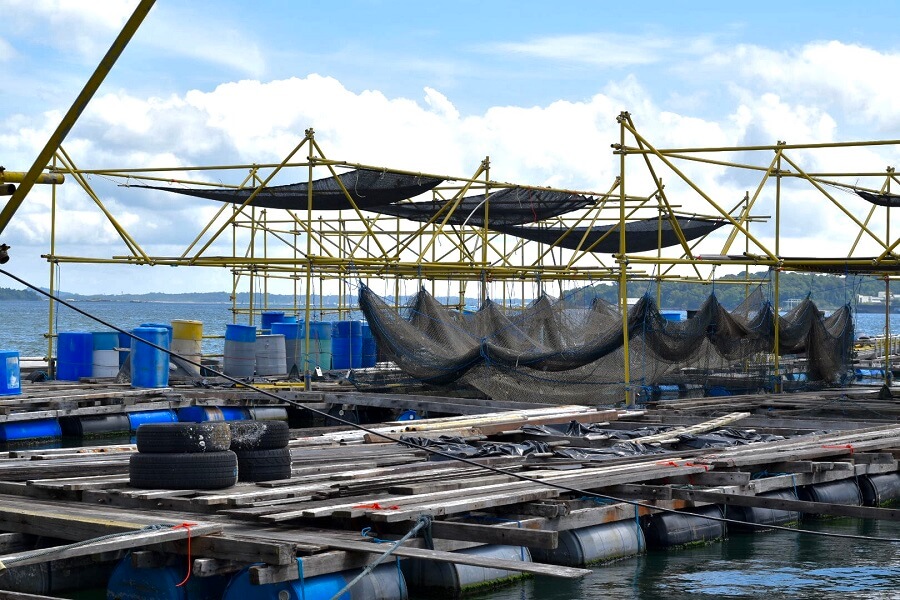
A kelong belonging to ‘Uncle Heng’


I’m floating in a small patch of ocean between Malaysia and Singapore, and all is quiet

except for the sound of water lapping against the side of the boat. Uncle Heng’s kelong (offshore fish farm) lies a distance away from me, backlit by the early morning sunlight.


When I look down, however, a less beautiful sight greets me: fragments of Styrofoam, bottle caps and bits of plastic packaging float in clusters, bobbing here and there with the waves. This comes as no surprise. I’ve grown up seeing rubbish on the shores of Pasir Ris, the beachfront neighbourhood I’ve lived in my whole life. Plastic has always been here, and it has always been a problem.


Ocean Purpose Project, Yacht Style, Mathilda D’silva, Singapore Idol, Pasir Ris, pollution, plastic to fuel, Boracay,

Rubbish gathers on the coast at Paris Ris


Globally, it has been found that about 8 million tonnes of plastic waste flows into the oceans every year, making up about 60-95 per cent of water pollutants. Plastic pollution is the most widespread problem affecting the marine environment today, as many marine animals die from ingesting or getting entangled in plastic debris. It also threatens food safety, human health and coastal tourism, and contributes greatly to climate change.


PLASTIC TO FUEL

I’ve experienced the devastating impacts of ocean pollution first-hand after one fateful dragon boat race in the Philippines in 2015. While paddling in the idyllic waters surrounding Boracay’s pristine white beaches, it was impossible to tell it was polluted with untreated wastewater from the sewage pipes of hotels and restaurants.


This triggered an intense autoimmune response in my body, which left me severely sick after the trip. My hair and skin turned white, and I had problems speaking and walking. I was shocked.


Ocean Purpose Project, Yacht Style, Mathilda D’silva, Singapore Idol, Pasir Ris, pollution, plastic to fuel, Boracay,

In 2015, D’silva fell ill after swimming in Boracay in sea contaminated by raw sewage


Until then, I’d depended on my voice as a former Singapore Idol contestant and fast-talking community manager in the media industry. Was my life about to be totally derailed because of just three days of exposure to polluted water?


More importantly, I couldn’t understand the reason behind the pollution itself. How could anyone allow sewage pipes to run directly into beaches that account for 20 per cent of the Philippines’ tourism industry?


This sickness afflicted me after just one weekend, so what about my Filipino friends who work as lifeguards and dive instructors, or the children who play in the waters every day? What health problems are lurking round the corner, waiting to strike?


Ocean Purpose Project, Yacht Style, Mathilda D’silva, Singapore Idol, Pasir Ris, pollution, plastic to fuel, Boracay,

A beach clean-up with Ocean Purpose Project


There’s no cure to the autoimmune issues I have; they will inevitably get worse and worse. And my days of paddling are over. But I kept asking myself: Could there be another purpose arising from all this? Could I rethink what I know about myself? Could I start doing something today to save tomorrow’s child?


This is why I started the Ocean Purpose Project. I love sitting in rooms with PHDs and ‘industry experts’ who question why a former Singapore Idol finalist is working on converting plastic to fuel. One asked me repeatedly: “Who do you think you are?” The doubters and belittlers are fantastic motivation for me. After all, I am a rebel at heart.


In the last year, Ocean Purpose Project has achieved the near impossible. We have brought together the best-in-class industry and research partners to create the world’s first Plastic to Fuel (PTF) unit that can remove tonnes of waste plastic pollution at a profit, even if oil drops to $0.


Ocean Purpose Project, Yacht Style, Mathilda D’silva, Singapore Idol, Pasir Ris, pollution, plastic to fuel, Boracay,

A Plastic To Fuel (PTF) unit by Ocean Purpose Project


Each unit can convert one tonne of plastic a day into pyrolyzed oil, carbon black and carbon nanotubes, which is the stuff inside your smartphones and computers. We aim to deploy the PTF units to landfills, polluted coastal communities, eco-resorts, vessels and numerous other locations to help clean up plastic waste.


FROM SEAWEED AND MUSSELS

Beyond transforming trash into treasure, Ocean Purpose Project is working to create a single-use plastic alternative from seaweed and mussels, which we grow in partnership with the kelong uncles and aunties of Pasir Ris.


These seaweed and mussel lines will also act as natural biofilters that help improve water quality and prevent algal blooms, a huge economic pain point for the kelongs because it wipes out fish stocks in an instant.


Ocean Purpose Project, Yacht Style, Mathilda D’silva, Singapore Idol, Pasir Ris, pollution, plastic to fuel, Boracay,

‘Uncle Heng’ holding a mussel line that acts as a natural biofilter


We complement these projects with educational programmes, where we galvanise the community to take action and ownership over their coastal environments through organising monthly beach clean-ups at Pasir Ris Beach.


On a broader level, however, Ocean Purpose Project goes beyond just converting plastic to fuel, creating bioplastics or organising beach clean-ups. It’s the purpose I’ve found to emerge from the lowest point in my life and it drives me to wake up every day to do what needs to be done for a cleaner, healthier and brighter tomorrow.


Sustainability as we know it needs to be disrupted. It’s not just the domain of tree-huggers or corporates trying to make themselves look good on the ESG spreadsheet. It’s about creating a Blue Ocean of possibility, rewriting what ‘business as usual’ is all about. Ocean Purpose Project’s goal is to bring about disruptive change in the way we manage the problems of marine pollution through test-bedding innovative projects.


Ocean Purpose Project, Yacht Style, Mathilda D’silva, Singapore Idol, Pasir Ris, pollution, plastic to fuel, Boracay,

Seaweed plastic (left) and normal plastic (right)


Everyone can find their own ways to connect with the environment, whether you’re a musician, a diver or an engineer, so don’t be afraid to just go out and try your own ideas. Organise your own beach clean-up, do the research, start your own movement. When people come together, great things can happen.


I’m proof that you don’t need an Environmental Science degree or years of experience in sustainability to change the way we live. Now is the time to ‘Start Today to Save Tomorrow’.

http://www.oceanpurposeproject.com


MATHILDA D’SILVA

Ocean Purpose Project, Yacht Style, Mathilda D’silva, Singapore Idol, Pasir Ris, pollution, plastic to fuel, Boracay,

Although now a professional environmentalist, D’silva wears many hats. In her career and personal life, she has been a singer, actress, TV producer, radio DJ, social media manager and athlete. Today she is the Chief Purpose Officer of the Ocean Purpose Project, driving change in the sustainability sector, beginning with the ocean in her backyard of Pasir Ris, Singapore.
mathilda@oceanpurposeproject.com / www.oceanpurposeproject.com

Yacht Style Issue 61 Out Now: The Premieres Issue

Yacht Style’s Issue 61 features New Models and World Premieres 2021, Cannes and Monaco show specials, Camper & Nicholsons CEO Paolo Casani, VP Yachts founder Vivian Chan, Galeon and Tony Castro, PMG Shipyard in Thailand, ONE°15 Marina Sentosa Cove, Reviews of Ferretti Yachts, Sanlorenzo, Aquila and Bali boats, and Yacht Style Awards 2021.

SHARE

Ocean Purpose Project: From purpose to project Read More »

Galeon, boat, yacht, motor, Tony Castro, design, MarineMax, 500, drop-down, wings, windscreen, bulwarks, 325 GTO, 400, Fly

Galeon spreads its wings with pioneering designs

Galeon spreads its wings with pioneering designs

SHARE

With Hong Kong welcoming its first Galeon 640 Fly and 325 GTO this year and Asia’s latest 500 Fly arriving in Singapore, Yacht Style looks at the builder’s 20-year relationship with Tony Castro that has resulted in some of the world’s most innovative production motor yachts.

  •  
  •  
  •  


Galeon, boat, yacht, motor, Tony Castro, design, MarineMax, 500, drop-down, wings, windscreen, bulwarks, 325 GTO, 400, Fly

Popular in Asia, the Galeon 500 Fly features drop-down bulwarks, a bar to port, rotating cockpit sofa and multi-functional, flexible foredeck


Tony Castro has been designing motor yachts for Galeon for 20 years. However, it was the drop-down sides introduced on the iconic Galeon 500 Fly – which premiered at the 2015 Cannes Yachting Festival – that helped the brand gain lift-off and expand into a global powerhouse.


In early 2016, MarineMax was announced as Galeon’s distributor in the Americas. Since then, with the support of the world’s biggest boat dealer, enormous customer demand in the US has been a major part of growing global orders that resulted in Galeon’s total production doubling within four years.


As Galeon’s fortunes soared, the signature ‘wings’ were included on new models including the 460 Fly, 640 Fly and 400 Fly. Furthermore, other innovations such as the rotating cockpit sofa introduced on the 500 and the foredeck door in the windscreen of the 640 have underlined Galeon’s reputation as pioneers and made it an increasingly in-demand brand – including here in Asia.


Galeon, boat, yacht, motor, Tony Castro, design, MarineMax, 500, drop-down, wings, windscreen, bulwarks, 325 GTO, 400, Fly

Tony Castro’s renders of the Galeon 500 Fly show the range of social areas on the ‘transformer’


Asiamarine has sold over 20 Galeon yachts since its appointment by the shipyard in 2016, with the recent delivery of the first 500 Fly into Singapore among nine sales into Asia of Galeon’s most famous model.


Headquartered in Hong Kong with offices around the region, the regional company has also sold multiple units of the 460 Fly and 400 Fly, while the first 640 Fly in Hong Kong was delivered in the first half of this year, with another already in Vietnam through another dealer.


Castro is proud of the impact his designs for Galeon have had and where they sit in his vast and diverse portfolio that ranges from sailing boats to motor yachts, from small boats and iconic one design models to custom-built megayachts.


Galeon, boat, yacht, motor, Tony Castro, design, MarineMax, 500, drop-down, wings, windscreen, bulwarks, 325 GTO, 400, Fly

Interior of the Galeon 500


“Obviously, I feel very happy that this relationship with Galeon has lasted 20 years and will hopefully last a few more,” says the Lisbon-born designer, speaking from his studio within a traditional thatched manor house in Hamble, outside Southampton on England’s south coast.


“I enjoy working with Galeon because they’ve always been really receptive to our ideas. I don’t remember them ever saying ‘no’ when we came up with something new. It was always, ‘yes’, ‘why not’, ‘sounds great’. There has always been a lot of enthusiasm from them to carry out some of the crazy ideas I came up with.”


GALEON AND CASTRO UNITE

Over the past four decades, an estimated 10,000 boats have been built to over 500 designs by Castro, who studied naval architecture and aero/hydrodynamics in Scotland in the 1970s before specialising in designing sailing boats.


Galeon, boat, yacht, motor, Tony Castro, design, MarineMax, 500, drop-down, wings, windscreen, bulwarks, 325 GTO, 400, Fly

Tony Castro pictured attending a client meeting


After working for Ron Holland in Ireland, Castro set up his own studio in 1981, moving to Hamble the following year and quickly earning a reputation for designing successful racing boats. His reputation blossomed as he designed models for some of the world’s biggest production boat builders including Jeanneau and Beneteau, while the Clipper 70 used in the Clipper Round the World Race is among many other notable designs.


Having started working on motor yachts from 1985, Castro has also designed superyachts and megayachts built by the likes of Oceanco, Royal Huisman, Jongert and Palmer Johnson.


Galeon, boat, yacht, motor, Tony Castro, design, MarineMax, 500, drop-down, wings, windscreen, bulwarks, 325 GTO, 400, Fly

Early sketches of the Galeon ‘balconies’


However, for two decades, his work in the 30-80ft motor yacht sector has been focused on Galeon, who first approached the designer in 2001 and arranged to meet at the Southampton International Boat Show.


“Galeon was exhibiting with a couple of small boats, quite basic,” Castro recalls. “Galeon and the local dealer were wondering what to do next and how to compete in the international market. They needed something better and, looking ahead, something bigger. They wanted a good designer to help them achieve this.”


The show marked Castro’s first meeting with Wieczyslaw Kobylko, also known as ‘Janek’, who founded the Polish shipyard in 1982 after a notable career at sea. Castro quickly warmed to a man who understood the importance of safety first.


Galeon, boat, yacht, motor, Tony Castro, design, MarineMax, 500, drop-down, wings, windscreen, bulwarks, 325 GTO, 400, Fly

Innovations evolved to include the walk-through windscreen


“I got on very well with Janek. He had spent many years at sea,” Castro says. “He had a lot of respect for the sea and the way he was intending to build boats sounded very logical. He had a very honest approach to how important it was for the boats to be seaworthy, strong and so on. I immediately took a liking to him.”


Another reason Castro enjoyed working with Galeon was that he was playing a role in not only designing boats but building a brand, helping grow an identity that would grow in the long term.


“I’ve always been very interested in strategy and at that time, I had already started a couple of other companies. I was interested in Galeon’s strategy, the brand, the DNA of its boats. I was mindful of the characteristics the founder had told me about, making strong, well-built, seaworthy boats, honest in every way,” Castro says.


Galeon, boat, yacht, motor, Tony Castro, design, MarineMax, 500, drop-down, wings, windscreen, bulwarks, 325 GTO, 400, Fly

The Galeon 640 was unveiled at Boot Dusseldorf in January 2018


“Once I started designing for them, there was a lot of communication, especially at the beginning. We were exchanging ideas, giving sketches and getting feedback. Little by little, we reached something we were happy with. It has been like this for all the models we’ve done.”


While Galeon is best known for its innovations of the past few years, Castro is proud of all his designs for the Gdansk shipyard over the past two decades.


“I think they were all notable, especially how the designs progressed over the past 20 years,” he says. “Each one we did was important for them and fulfilled a certain criteria to get to the level of the other competitors, be it British or Italian or French, for example.”


Galeon, boat, yacht, motor, Tony Castro, design, MarineMax, 500, drop-down, wings, windscreen, bulwarks, 325 GTO, 400, Fly

The Galeon 640 Fly in Gdansk, where Galeon is based


PRODUCER TO PIONEER

For most of the past decade, Jacek Kobylko, Janek’s son, has been heading Galeon, overseeing the dramatic transition of the family-owned business into a global brand that’s taking on the likes of Azimut, Sunseeker and Ferretti.


Castro says he enjoys the dynamics of the evolving working relationship between him and Galeon, which has rapidly expanded its production facilities while the management has grown in experience and confidence.


“Jacek is young, very dynamic, very interested. He’s very studious and likes to study the competition. He has his own opinions, so we keep exchanging ideas. I sometimes try to come up with the solutions and alongside that, come back with new ideas,” Castro says.


Galeon, boat, yacht, motor, Tony Castro, design, MarineMax, 500, drop-down, wings, windscreen, bulwarks, 325 GTO, 400, Fly

There are multiple units of the 640 Fly in Asia


“Obviously, in recent years, Galeon’s experience has increased enormously and they’ve also started to get into this theme of doing something different, which is why the boats have all these notable features.”


The most notable of these ‘notable features’ is arguably the dropdown sides first seen on the 500, which also featured a rotating cockpit sofa and a flexible, multi-functional foredeck, helping the model earning the ‘Transformer’ nickname.


There are many other notable design features, but it was these that particularly grabbed the attention of luxury yacht buyers across the globe, excited by the new social spaces and views presented on a 50ft yacht.


Galeon, boat, yacht, motor, Tony Castro, design, MarineMax, 500, drop-down, wings, windscreen, bulwarks, 325 GTO, 400, Fly

The port drop-down side on the Galeon 400


“I came up with this idea of having the drop-down balconies, which I had originally drawn on some bigger boats. The idea of applying these to much smaller boats, especially like a production flybridge boat like the Galeon 500, was quite new and innovative,” Castro says.


“Alongside the balconies and the rotating cockpit sofa, there are quite a few other innovations on Galeon yachts. We had patio doors that disappeared completely underneath the floor and nowadays we have sliding windows in the saloon, which not many others do.”


The drop-down sides were included on the 460 introduced at Cannes in 2016 and the 640 Fly unveiled at Boot Dusseldorf in January 2018. However, the latter’s signature innovation was a foredeck door through the windscreen.


Galeon, boat, yacht, motor, Tony Castro, design, MarineMax, 500, drop-down, wings, windscreen, bulwarks, 325 GTO, 400, Fly

The Galeon 800 will be the shipyard’s new flagship


“The reason for the windscreen door was to try to give a new life to the foredeck, to improve the forward part of the boat into a more connected area to enjoy,” Castro says. “We’re still never 100 per cent satisfied. We’re still pushing to improve some of the detailing and how to make these innovations more purposeful.”


Designs have been revealed for the Galeon 800, the brand’s upcoming flagship, but the shipyard’s newest model is at the smaller end of the size scale.


GRAND TOURING OUTBOARDS

Unveiled in the US in January, the 325 GTO is the first model in the brand’s new Grand Touring Outboards collection and the first unit into Asia is scheduled to arrive in Hong Kong in the fourth quarter of the year.


Galeon, boat, yacht, motor, Tony Castro, design, MarineMax, 500, drop-down, wings, windscreen, bulwarks, 325 GTO, 400, Fly

Dramatic image of the Galeon 325 GTO unveiled in early 2021


Powered by twin Mercury Verado 350hp outboard engines, the sporty motor yacht has an overall length of almost 33ft, a nearly 11ft beam and a hardtop with an extendable sunblind. Flexible features include a fold-down platform on the port side and aft bench seating that can face fore or aft, while other attractions include a multi-colour lighting package and integrated audio and speaker system.


The sunken bow area offers a large seating area, where U-shaped seating can be filled in with cushions to create a sunbathing area. Below deck is a dinette that can be converted to a bed, a double cabin and a full-height bathroom with shower, while the stairs can be folded up to create more room.


“The 325 GTO is a little bit different. In my view, it’s more multipurpose and covers a greater market than a lot of these open boats where it’s easy to get wet, which isn’t nice. I think the GTO series will be successful and we’re launching bigger models, which will be quite exciting.”


Galeon, boat, yacht, motor, Tony Castro, design, MarineMax, 500, drop-down, wings, windscreen, bulwarks, 325 GTO, 400, Fly

The Galeon 325 GTO is the first model in a new Grand Touring Outboards series; a unit is scheduled to arrive in Hong Kong in late October


Castro turns 70 next year but remains committed to helping Galeon remain a leader of the pack as the designer-builder relationship moves into its third decade.


“We’ve introduced new features on model after model for Galeon and our relationship has grown organically over 20 years,” Castro says. “Every day we come to work, we are under pressure to design something new, something better, but everyone in the team is very keen to do it. Obviously, we have the ideas and have a few more coming in the future.”
www.galeon.pl
www.tonycastroyachts.com
www.asiamarine.com

Singapore to welcome first Galeon 500

Regional dealer Asiamarine expects the first Galeon 500 Fly in Singapore to arrive in October, underlining continuing regional demand for the innovative builder.

SHARE

Galeon spreads its wings with pioneering designs Read More »

Dakar Rally: Audi Puts The RS Q e-tron to the Test in Morocco

Dakar Rally: Audi Puts The RS Q e-tron to the Test in Morocco

SHARE

High temperatures have brought new issues to light.

  •  
  •  
  •  
  •  
  •  
  •  
  •  
Audi RS Q e-tron Dakar Rally
Image: Audi

Ahead of the Dakar Rally, Audi Sport has put its Audi RS Q e-tron through its paces in the deserts of Morocco.

With its three driver crews, Audi pushed the car to its extremes to test its capabilities. Sven Quandt, team principal of Q Motorsport said that at times, the temperatures soared to over 40 degrees Celsius, which brought some new issues to light. He also said that sandstorms hampered the tests.

Andreas Roos, who oversees factory motorsport projects at Audi Sport, added that the team expects lower temperatures at the Dakar Rally. “Nevertheless, we deliberately went to Morocco to test our concept under the most extreme conditions,” he said. “Components for the MGU, for example, were basically not developed for use in high ambient temperatures, but the drivetrain and other components were also pushed to their limits, or even beyond the heat.”

Dakar Test Morocco
Audi RS Q e-tron. Image: Audi

He also said the insights gained in Morocco were “invaluable” but admitted there was still a lot to do before the Dakar Rally, and there’s not much time left.

Audi RS Q e-tron Dakar RallyÉdouard Boulanger, Stéphane Peterhansel. Image: Audi

On the driver side of things, one of Audi’s main objectives in Morocco was to test a new cockpit configuration. The new modification was meant to provide the driver and co-driver with more space in the tight cockpit so the team can perform and communicate more effectively. In this regard, Roos shared that feedback was “positive”.

Audi RS Q e-tron Dakar Rally
Audi RS Q e-tron. Image: Audi

Audi Sports driver teams are as follows: Mattias Ekström/Emil Bergkvist (Sweden), Stéphane Peterhansel/Edouard Boulanger (France) and Carlos Sainz/Lucas Cruz (Spain). Peterhansel is regarded as the most successful Dakar driver of all time, with the record for the most wins (14) at the rally. Sainz, the father of F1 driver Carlos Sainz Jr, has won the Dakar Rally three times (2010, 2018, 2020).

The 2022 Dakar Rally is a 12-stage event that will take place from 2-14 January 2022. It will take place in Saudi Arabia, starting in Ha’il and ending in Jeddah — going through canyons, cliffs, coastline, and stretches of dunes. This will be the third time the event has been hosted in Saudi Arabia.

SHARE

Dakar Rally: Audi Puts The RS Q e-tron to the Test in Morocco Read More »

Leopard 50, sailing, catamaran, TC Wong, Wong Tet Choong, Minqi Wong, Ximula, Sail, Fiji, Tuvalu, Singapore, Indonesia, Port Denarau Marina

Leopard 50 owner TC Wong shows wandering spirit

Leopard 50 owner TC Wong shows wandering spirit

SHARE

TC Wong made global headlines when the rapid spread of Covid left him stranded at sea in his Leopard 50 for months until he was eventually allowed into Fiji, where he has remained since. Now, the Singaporean is waiting for borders to open so he can continue his journey around the South Pacific on his beloved Ximula III.


Leopard 50, sailing, catamaran, TC Wong, Wong Tet Choong, Minqi Wong, Ximula, Sail, Fiji, Tuvalu, Singapore, Indonesia, Port Denarau Marina

Wong has owned his Leopard 50, Ximula III, since 2018


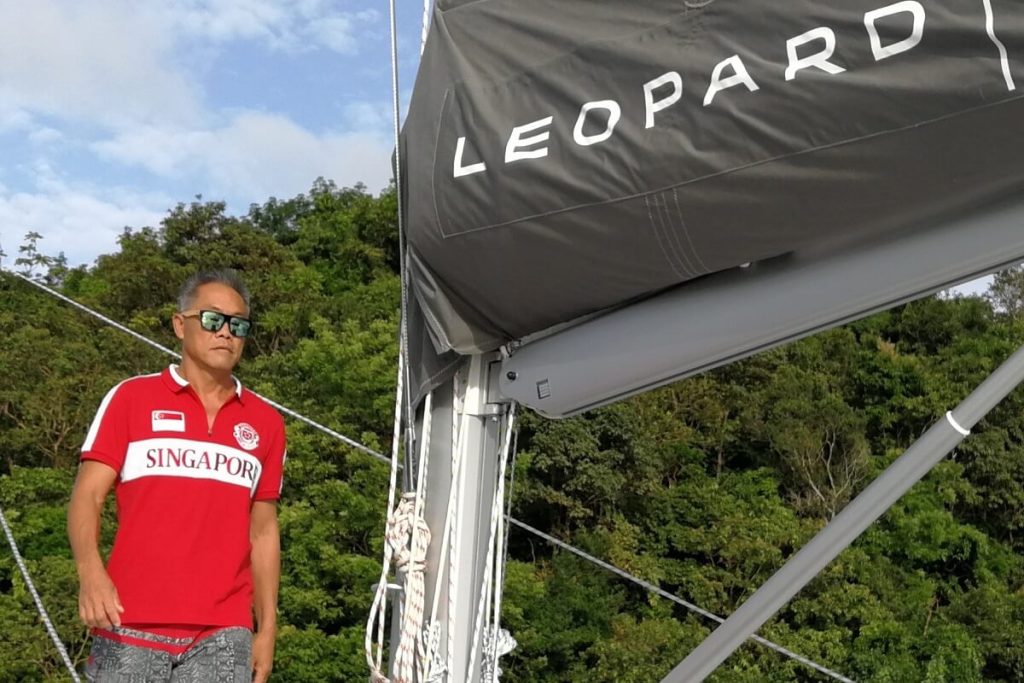
Wong Tet Choong, better known as ‘TC’, became one of Singapore’s most famous sailors last year. Having explored much of Southeast Asia in the past decade, he set off in early February 2020 for his biggest trip yet, sailing his Leopard 50 Ximula III through Indonesia on his way to the South Pacific.


However, as Covid rapidly spread around the world, borders quickly closed around him. His family back in Singapore were among those worried about him alone at sea, with nowhere to berth. Turned away in Indonesia, Papua New Guinea and Tuvalu – where he was able to buy and receive fuel and food from a distance – he was eventually allowed into Fiji in late April.


The episode generated news in Fiji, Singapore, Australia and elsewhere, even making international headlines through the likes of the BBC and The Guardian. However, if his situation seemed dramatic then, Wong couldn’t be more relaxed now.


Leopard 50, sailing, catamaran, TC Wong, Wong Tet Choong, Minqi Wong, Ximula, Sail, Fiji, Tuvalu, Singapore, Indonesia, Port Denarau Marina

Wong with his wife and children, who live in Singapore


Living on his Leopard, often at Port Denarau Marina, he has been away from his family in Singapore for over 20 months and appears in no rush to return home.


“I’ve been sailing around the islands in Fiji and I video call my family almost every day. There are so many beautiful islands to explore here,” says Wong, who had been in the country for just over a year when he turned 60 this May.


“Once the borders reopen, I’ll resume my journey towards Tahiti, visiting as many islands and atolls as I can. I believe this will take two to three more years. I’ve received many messages and well wishes from people telling me they’d love to embark on a similar lifestyle. Actually, there are many people already living the life I do.”


THE CALL OF THE SEA

Wong began boating three decades ago, picking up a small second-hand powerboat in 1992. At the same time, he picked up an interest in sailing and rented boats to cruise around Singapore with the staff of his company, Zhaplin Work.


Leopard 50, sailing, catamaran, TC Wong, Wong Tet Choong, Minqi Wong, Ximula, Sail, Fiji, Tuvalu, Singapore, Indonesia, Port Denarau Marina

Wong (top) started sailing in the 1990s


“That was when I started to learn more about the boating lifestyle and community,” recalls Wong, who also enjoys rock and mountain climbing. “When I was sailing, I really enjoyed being able to play with the elements, harnessing the power of the wind and adapting as it changes.”


Still, his next purchase was another powerboat, a 34ft Riviera he had from 1996-97 when he often cruised south to the nearby Indonesian island of Batam with his young family. However, as money was tight, he was unable to sustain upkeep of the boat and had to let it go, vowing to return to sea when his finances were more stable.


“When I sold off the Riviera, I promised myself I’d get a sailing boat once I had the money and time. I wanted to sail further, as there were so many beautiful islands I wanted to visit and explore.”


Leopard 50, sailing, catamaran, TC Wong, Wong Tet Choong, Minqi Wong, Ximula, Sail, Fiji, Tuvalu, Singapore, Indonesia, Port Denarau Marina

Wong owned a couple of powerboats


Wong’s company started to grow on the back of the innovative Ximula wardrobe system, an award-winning product still used throughout condominiums and other residences today. In 2013, after almost two decades of “working hard and saving up”, he was able to buy his first sailing catamaran, Ximula, a Lagoon 400 S2.


Wong used the boat regularly, sailing almost every week during the first year with family, friends or staff – “whoever was available and keen”. He typically sailed in Singapore and Indonesia, although early trips included a one-month expedition from Singapore to Phuket with his family.


He also joined several convoy trips organised by Nongsa Point Marina, where he learned from other sailors about Indonesia’s waters. Trips opened his eyes to the amazing islands around Singapore including the Anambas to the northeast and Tambelan and Badas to the east, off the west coast of Borneo.


Leopard 50, sailing, catamaran, TC Wong, Wong Tet Choong, Minqi Wong, Ximula, Sail, Fiji, Tuvalu, Singapore, Indonesia, Port Denarau Marina

Wong’s Leopard 50 Ximula III (left) and Darren Lim’s Lagoon 400 S2 (right)


“We discovered so many amazing islands in Indonesia. They’re so beautiful and the islanders were very welcoming towards us, so after these trips, I revisited these places to explore them at my own time and pace. I sailed everywhere around Southeast Asia.”


In 2014, Wong started a charter business, Ximula Sail, skippering and taking care of the yacht as his daughter Minqi ran the business and worked as crew during trips. When possible, the family still used the boat for personal trips including taking two months off in 2016 to sail to Koh Samui together with Darren Lim and his family, who were then living aboard Gracefully, Ximula’s sister boat.


Leopard 50, sailing, catamaran, TC Wong, Wong Tet Choong, Minqi Wong, Ximula, Sail, Fiji, Tuvalu, Singapore, Indonesia, Port Denarau Marina

Wong’s daughter Minqi on the Leopard 50


As Wong wanted more time to explore the region, he stopped skippering Ximula and Lim joined forces with Ximula Sail, which now has two catamarans and 10 staff, and is among Singapore’s most respected charter companies.


LEAPING TO LEOPARD

With Ximula occupied by charter business, Wong briefly owned a Beneteau monohull in 2017, frequently sailing to Phuket with his staff and participating in regattas. However, it was only a stop-gap measure as he resumed his search for a catamaran, a design he liked because of the comfort and space but also because the saloon and galley are much higher above the water than on a monohull.


“My wife gets seasick easily, so this allows us to have a view of the horizon even while we’re indoors, relaxing or preparing meals. I only sail for leisure from island to island, and don’t intend to cross long distances across oceans, so I prefer a catamaran for comfort compared to a monohull for performance.”


Wong’s search ended when he met Kit Chotithamaporn, Leopard’s Yacht Sales Manager – Asia, at the Singapore Yacht Show in 2017. Wong originally showed interest in the Leopard 48 on display, but when he visited Kit again on the last day, he found out it had been sold just hours earlier. Kit then informed Wong about the new Leopard 50 and Wong ordered a unit that arrived the following year, which he named Ximula III.


Leopard 50, sailing, catamaran, TC Wong, Wong Tet Choong, Minqi Wong, Ximula, Sail, Fiji, Tuvalu, Singapore, Indonesia, Port Denarau Marina

Wong and Lim cruised together to Indonesia’s Anambas Islands


“I really like the layout and design of the Leopard 50. Firstly, I love the door at the front which enables me to easily access the foredeck from the saloon and allows smooth airflow through the interior. The forward cockpit is a nice area to chill at while we’re at anchor, as it faces the breeze and is sheltered from the sun,” Wong says.


“Secondly, the galley and furniture are forward-facing, which is especially important for me when I sail alone for long distances, as I can keep a lookout while preparing my meals. The panoramic view also helps reduce my wife’s seasickness.


“Thirdly, I like the helm at the side so I can have visibility of both the flybridge and the aft cockpit and saloon. It also makes berthing much easier for me, as I can have a clear view of the berth without running between port and starboard.”


Leopard 50, sailing, catamaran, TC Wong, Wong Tet Choong, Minqi Wong, Ximula, Sail, Fiji, Tuvalu, Singapore, Indonesia, Port Denarau Marina

Wong’s family and friends on his Leopard 50, his second sailing cat


Wong sailed his Leopard 50 up and down both the west and east coast of Peninsular Malaysia during multiple trips to both Phuket in the Andaman Sea and Krabi in the Gulf of Thailand, spending between one and three months there each time and exploring the area.


He also revisited his favourite cruising grounds in Indonesia while becoming increasingly attracted to exploring remote areas and engaging with people not typically used to visitors.


“My favourite part about sailing is the opportunity to visit remote islands not normally accessible by plane or other forms of transport. I’ve learnt a lot about life through the eyes of islanders, who always show us amazing hospitality. Some even brought us on a tour around their islands or invited us to their homes and treated us to delicacies like freshly caught lobsters,” he says.


Leopard 50, sailing, catamaran, TC Wong, Wong Tet Choong, Minqi Wong, Ximula, Sail, Fiji, Tuvalu, Singapore, Indonesia, Port Denarau Marina

Wong has become an experienced all-weather sailor


“I used to think about what I can give back as a gift of appreciation for their warm welcome but learnt that material items were not meaningful to them since they lived very simply. Eventually, I decided to bring along an instant printer on board so I could take and print photos of them so they could keep them as memories. I felt this was more meaningful.”


THE ADVENTURE BEGINS

Having visited much of Thailand, Malaysia and Indonesia’s Riau Archipelago, Wong started to expand his horizons. “I realised I still had so many more destinations I wished to explore so started to set my sights on the South Pacific, which I’d heard so much about.”


Wong painstakingly planned and mapped out a three-year journey that would take in Tahiti and other islands in French Polynesia, researching online and consulting friends who had sailed in the area. Finally, on February 2, 2020, he embarked on his journey from Singapore with two friends, although he was soon sailing alone after they disembarked in Indonesia at the end of the month.


Leopard 50, sailing, catamaran, TC Wong, Wong Tet Choong, Minqi Wong, Ximula, Sail, Fiji, Tuvalu, Singapore, Indonesia, Port Denarau Marina

Wong can live for months alone at sea


“I had the opportunity to spend time at many remote islands that were over 100nm away from the mainland, islands with no electricity or Wi-Fi, islands I don’t even know the names of. As always, I met many amazing islanders who never hesitated to show me around.”


Wong was heading towards Papua New Guinea, where he planned to stock up on fuel and food, but his Raymarine auto-pilot broke while still in Indonesian waters. Seeking a harbour, he was sent away as lockdown had just begun.


As he neared PNG, his family informed him that it had also closed its borders. Soon, all the South Pacific islands were in lockdown. He continued east to remote Tuvalu, where he couldn’t land but was

allowed to buy food and fuel, using his rubber dinghy on a line to make the exchange at sea.


Leopard 50, sailing, catamaran, TC Wong, Wong Tet Choong, Minqi Wong, Ximula, Sail, Fiji, Tuvalu, Singapore, Indonesia, Port Denarau Marina

In Tuvalu, Wong was able to buy food from local authorities


As if things weren’t tough enough for Wong, strong winds from Cyclone Harold a full 500nm away led to Ximula III hitting coral and damaging a propeller. Back home, his family contacted Singapore’s Ministry of Foreign Affairs, which tried to secure a place for him to dock in Fiji.


“My family were very worried when borders started closing and I was facing trouble, being chased out of islands where I was trying to seek shelter,” he says. “I constantly kept them updated on my location and status whenever I had some data connection, but it was still a scary situation when things were breaking down and I could not find shelter to fix these issues.”


FINDING FRIENDS IN FIJI

Good news finally arrived when he was informed that he would be allowed into Fiji if he passed a Covid test, which he was confident of passing after spending three months at sea and two months completely alone.


Leopard 50, sailing, catamaran, TC Wong, Wong Tet Choong, Minqi Wong, Ximula, Sail, Fiji, Tuvalu, Singapore, Indonesia, Port Denarau Marina

Wong, who has been in Fiji since the end of April 2020, wants to continue exploring the Asia-Pacific


“We’re still very thankful to our Singapore Government for responding to our call for help and reaching out to various countries to allow me entry. The wait was stressful, but we managed to get special approval from Fiji, considering the good relationship both countries have and the desperate condition I was in,” Wong says.


“We’re also immensely grateful to the Fiji Rescue Coordination Center for taking over the whole situation. They monitored my location, communicated with my family and provided them with updates, and eventually towed me out of the strong winds and currents to safe harbour. They were super professional and helpful.”


Due to the media coverage, Wong was contacted by and met many international sailors and fellow Singaporeans based in Fiji, where he has made himself at home, living on Ximula III.


“On my journey, I’ve met and been inspired by many Singaporean couples or families who live on the water and many international sailors who have sailed around the world,” he says. “There’s an amazing sailing community here in Fiji and I’ve made many friends from many different countries.”


Leopard 50, sailing, catamaran, TC Wong, Wong Tet Choong, Minqi Wong, Ximula, Sail, Fiji, Tuvalu, Singapore, Indonesia, Port Denarau Marina

Wong will continue his South Pacific journey on Ximula III once borders open


Wong has also had ongoing support from Leopard, which continues to advise on repairs and offer help on his travels, having also assisted with parts and spares before he set off.


Once borders open, Wong still plans to use Fiji as his base as he resumes his journey around the South Pacific before eventually sailing back to Singapore and stopping at islands he visited on his outward leg. As of now, Wong doesn’t harbour any dreams of crossing the Pacific or travelling around the world.


“I have not even covered the Philippines, which has over 7,000 islands, so I believe Southeast Asia and the South Pacific are enough to keep me excited for at least 10 more years.”
www.leopardcatamarans.com
www.facebook.com/tc.wong.98

Leopard adds new spot on 42

One of seven models reviewed in Issue 60 that will appear at the Cannes Yachting Festival, the new Leopard 42 has evolved from a proven design and added a new hangout spot with its upper lounge to offer a practical, seaworthy and spacious entry-level model. By Kevin Green.

SHARE

Leopard 50 owner TC Wong shows wandering spirit Read More »
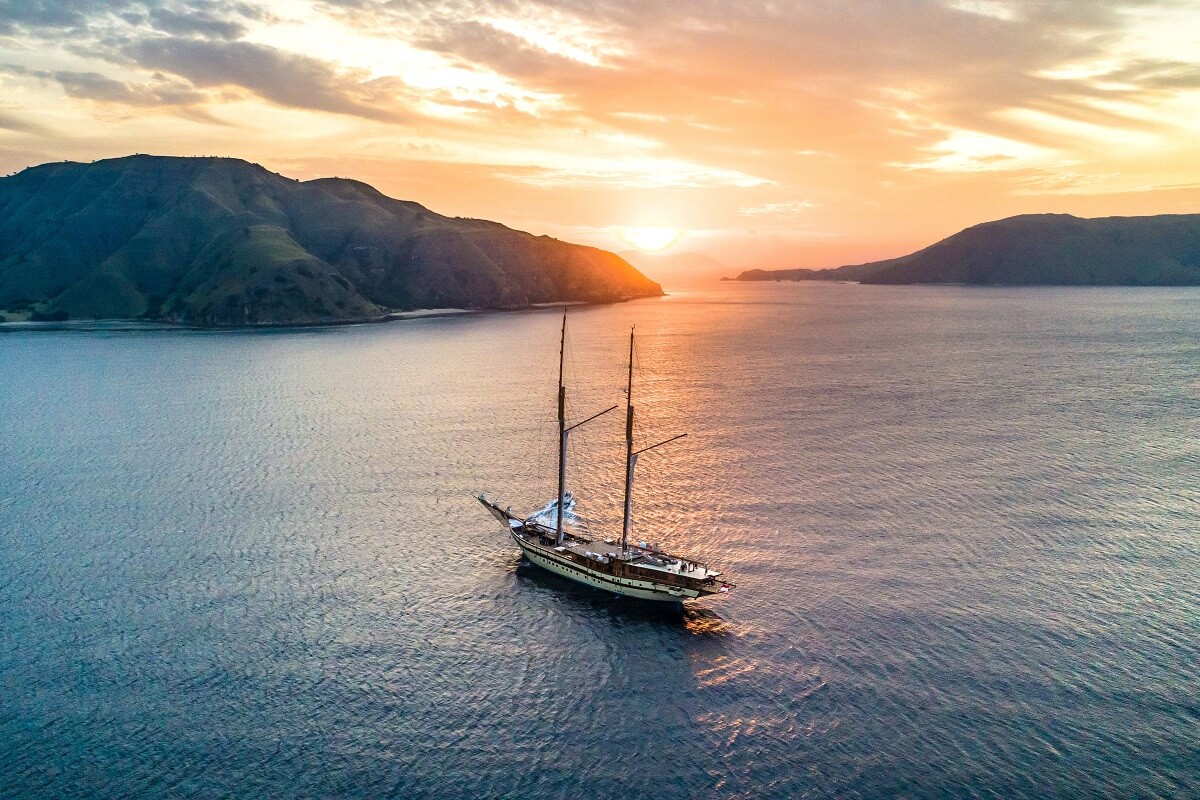
Gulf Craft, yacht, boat, superyacht, builders, UAE, Mohammed Alshaali, Majesty, Nomad, Oryx, Silvercraft, dealer, Farfalla Marine, Jason Hawkes

Farfalla Marine: Majesty and more in Asia

Farfalla Marine: Majesty and more in Asia

SHARE

Farfalla Marine represents the Majesty, Nomad, Oryx and Silvercraft brands as Gulf Craft’s Brand Ambassador in Hong Kong and four Southeast Asian countries. As it bids to raise the UAE builder’s presence in this region, offering models from 31-175ft, the well-connected dealership is offering special packages including yacht management, crew training and even marina berthing.

  •  
  •  
  •  


Gulf Craft, yacht, boat, superyacht, builders, UAE, Mohammed Alshaali, Majesty, Nomad, Oryx, Silvercraft, dealer, Farfalla Marine, Jason Hawkes

The Majesty 100, one of Gulf Craft’s most popular superyachts


When Gulf Craft announced the delivery of the 10th hull of its Majesty 100, one of the best-selling models of its flagship brand, the builder’s management team were proud that the yacht would be spending time in Turkey before exploring the Mediterranean.


Mohammed Alshaali, the shipyard’s co-founder and Chairman, said the new delivery would “take Gulf Craft’s flag to more exotic destinations”. Meanwhile, CEO Talal Nasralla outlined the wide spread of markets the Majesty 100 had been delivered to since the 104ft, 199GT superyacht made her debut at the 2017 Dubai International Boat Show in the UAE, where Gulf Craft was founded in 1982.


“The Majesty 100 has become one of Gulf Craft’s best-selling superyachts,” Nasralla said. “With deliveries made to Europe, Australia, Russia, Middle East, Africa and America, we continue to build our geographic footprint with this amazing vessel.”


Gulf Craft, yacht, boat, superyacht, builders, UAE, Mohammed Alshaali, Majesty, Nomad, Oryx, Silvercraft, dealer, Farfalla Marine, Jason Hawkes

Beach club on the Majesty 120


One notable area missing from the list was Asia. However, Farfalla Marine is looking to raise the profile of Gulf Craft in this region following its appointment as a dealer for Majesty and three of the builder’s other brands: Nomad long-range yachts, Oryx sport cruisers and Silvercraft fishing and day boats.


ASIA NETWORK

Co-founded by Managing Director Mark Denny-Fairchilde and the late David Neish, Farfalla Marine represents Gulf Craft in Hong Kong as well as Thailand, Vietnam, Cambodia and Laos.


Jason Hawkes, Group General Manager, explains that since Farfalla Marine was founded, the company has been working hard and fast to set up an expansive network of offices and partners as it prepares to help Gulf Craft and its yacht brands gain market share in Asia.


Gulf Craft, yacht, boat, superyacht, builders, UAE, Mohammed Alshaali, Majesty, Nomad, Oryx, Silvercraft, dealer, Farfalla Marine, Jason Hawkes

Jason Hawkes, Farfalla Marine’s Group General Manager


“Farfalla Marine is a bespoke yacht services company and unique in the region in terms of the breadth of services and partnerships we offer our clients,” says Hawkes, who has been based in Hong Kong since 1994, also working in Shanghai for three years.


“The company was founded on the principles of providing an exceptional level of customer service, offering bespoke luxury yacht hospitality management and advanced crew training services to satisfy the needs of yacht owners seeking the ultimate luxury lifestyle experience.”


In Hong Kong, where Michael Shaun Poon is a Partner and Executive Director, the company plans to open a new office and showroom later this year. In Thailand, the dealer has a base in Bangkok, a new office in Phuket Boat Lagoon and is set to open a location in Ocean Marina Yacht Club near Pattaya in the Gulf of Thailand.


Gulf Craft, yacht, boat, superyacht, builders, UAE, Mohammed Alshaali, Majesty, Nomad, Oryx, Silvercraft, dealer, Farfalla Marine, Jason Hawkes

Farfalla Marine has opened an office in Phuket Boat Lagoon


In Vietnam, Farfalla Marine has offices in Ho Chi Minh City and Halong Bay, while in neighbouring Cambodia it operates in the capital of Phnom Penh. Brett Matthews, Michael Aumock and Caroline Le oversee operations in Thailand, Vietnam and Cambodia.


The company even has a European presence in the UK, where Simon Toombs works as Group Customer Relationship Director in London, while there are plans to add a new office in Southampton, at Ocean Village Marina.


MAJESTIC RANGE

Farfalla Marine is among a global network of dealers representing Gulf Craft, which is well established as one of the world’s leading yacht builders. North of Dubai, its 4.3-hectare facility in Umm Al Quwain is supported by a service centre in nearby Ajman, while it also has a one-hectare production facility in the Maldives.


Gulf Craft, yacht, boat, superyacht, builders, UAE, Mohammed Alshaali, Majesty, Nomad, Oryx, Silvercraft, dealer, Farfalla Marine, Jason Hawkes

Gulf Craft’s Majesty 140


Initially manufacturing small pleasure craft from 1982, Gulf Craft moved up to building yachts about a decade later and since 2000 has been a leading builder of superyachts. Having built over 10,000 boats over almost four decades, the company today builds models across a remarkable range from 31-175ft and has stated its ambition to be among the world’s top-five superyacht builders by 2025.


Internationally, Gulf Craft is best-known for its Majesty Yachts brand and in late May it staged the world premiere of its flagship Majesty 175, the world’s largest composite production superyacht.


Earlier this year, the brand delivered the first hull of the Majesty 120, while other recent models from its superyacht range include the Majesty 140, which exhibited at the Fort Lauderdale International Boat Show in 2019 as part of the company’s strategy to grow in the US market.


Gulf Craft, yacht, boat, superyacht, builders, UAE, Mohammed Alshaali, Majesty, Nomad, Oryx, Silvercraft, dealer, Farfalla Marine, Jason Hawkes

The Majesty 120 is a new model


However, Farfalla Marine is currently excited about a yacht at the other end of the brand’s size scale, the new Majesty 49, part of the brand’s yacht line that also includes the Majesty 62 and the new Majesty 62 Maldives, which has been designed for tropical resort environments so is ideal for Farfalla Marine’s Southeast Asian markets.


Hull one of the Majesty 49, fitted with twin Volvo Penta IPS650 engines, is ready for immediate delivery, having been launched over the summer. Hull two of the new 48ft model is expected in November and will feature three or four Mercury Verado V8 400hp outboards.


Farfalla Marine is offering a special deal for the Majesty 49 in two of its key markets in Asia. In Hong Kong, the purchase price includes a three-year membership at the new Lantau Yacht Club, a 12 month management package, advanced crew training and AGlaze hull treatment.


Gulf Craft, yacht, boat, superyacht, builders, UAE, Mohammed Alshaali, Majesty, Nomad, Oryx, Silvercraft, dealer, Farfalla Marine, Jason Hawkes

Gulf Craft’s new Majesty 49


In Phuket, the offer includes 12 months of berthing at Boat Lagoon, as well as the 12-month management package, crew training and AGlaze hull treatment that Farfalla Marine offers as standard on all yachts it sells.


MORE BRANDS

While Majesty is Gulf Craft’s flagship brand, Farfalla Marine sells several other yacht brands, products and services. Both Gulf Craft and Farfalla Marine have high hopes in Asia for Nomad Yachts.


Nomad’s collection of long-range models from 55-95ft include the explorer-style 65 SUV, 75 SUV and 95 SUV, which each feature vertical windshields on both the main deck and enclosed skylounge, as well as a main-deck master suite.


Gulf Craft, yacht, boat, superyacht, builders, UAE, Mohammed Alshaali, Majesty, Nomad, Oryx, Silvercraft, dealer, Farfalla Marine, Jason Hawkes

Gulf Craft’s Nomad 65 Fly with solar power


Nomad also produces the 55, 65 and 75 Fly models, which have open flybridges and a more conventional superstructure. Farfalla Marine is a strong supporter of the new Nomad 65 Fly with a solar-power system, three guest cabins, two crew cabins and a grand range of 2,500nm at eight knots.


In terms of smaller models, the dealer believes the Oryx 379 sports cruiser and Silvercraft’s brand-new SilverCat Lux 40 with solar power – hull one was recently launched – could prove popular in Asia.


“Gulf Craft models are perfect for Farfalla Marine’s Asian regions because of their specs,” Hawkes says. “With the extreme heat in the UAE, Gulf Craft produces yachts particularly well suited to hot and humid climates, just like in Hong Kong and Southeast Asia. On all its models, it provides superior air-conditioning units that are often 30-40 per cent more powerful than those supplied by typical European shipyards.”


Gulf Craft, yacht, boat, superyacht, builders, UAE, Mohammed Alshaali, Majesty, Nomad, Oryx, Silvercraft, dealer, Farfalla Marine, Jason Hawkes

The Nomad 75 SUV from the line of long-range yachts


Farfalla Marine is also a Brand Ambassador for Dominator Yachts and enjoys a close relationship with the European builder’s principals. Models include the Ilumen 28M, other Ilumen yachts and the new Mini-Ilumen bespoke luxury tenders.


“Bespoke services are the main strength of Farfalla Marine Group, so Dominator Yachts is an ideal partner,” Hawkes says. “Dominator is a renowned international shipyard that creates fully-customised superyachts, and the Farfalla Marine ethos is to establish a bond with its clients that goes beyond the simple shipyard-owner relationship.”

Silent-Yachts appoints Farfalla Marine

Silent-Yachts, a global leader in solar-electric catamarans, has appointed Farfalla Marine as its official dealer in three Southeast Asian countries.

 In August, Silent-Yachts, a pioneer in sustainable yachting, appointed Farfalla Marine as its official dealer in Thailand, Vietnam and Cambodia. Silent-Yachts is currently building a new generation of models starting with the Silent 60, which is being built by the brand’s own shipyard in Italy and PMG Shipyard in Thailand, and will premiere at the Cannes Yachting Festival from September 7-12.


“Silent-Yachts is a perfect, modern brand to add to Farfalla Marine’s portfolio,” Hawkes said. “They produce the most ‘silent’ yachts out there with their superb, beautiful and fully solar-powered catamarans.”


TOYS & PARTNERS

Along with its emphasis on yacht management and service, the dealership has also secured representation of several electric water toys that can easily be carried on most of the yachts it sells.


Gulf Craft, yacht, boat, superyacht, builders, UAE, Mohammed Alshaali, Majesty, Nomad, Oryx, Silvercraft, dealer, Farfalla Marine, Jason Hawkes

Farfalla Marine’s toy portfolio includes Sublue underwater scooters


Farfalla Marine’s toy store includes Sublue underwater scooters and Wave Jam jet boards, both of which are hand-held and can operate for about an hour on a single charge. The company also sells Waydoo hydrofoils, which allow users to ‘surf’ above the water at up to 42kmh.


Partners are another of the dealer’s strengths and include AGlaze and MMaximus Yacht Hospitality Academy, which supplies silver-service crew training and can train crew to the highest level in any of their territories.


Farfalla Marine believes it’s essential to offer customers a global network of partners that unite the luxury yachting sector and the luxury product and luxury lifestyle industries. Already, it has collaborated with 30-plus high-end brands, which provide added benefits for yacht owners and shared branding.


Gulf Craft, yacht, boat, superyacht, builders, UAE, Mohammed Alshaali, Majesty, Nomad, Oryx, Silvercraft, dealer, Farfalla Marine, Jason Hawkes

Interior of the Gulf Craft Majesty 120


In the luxury yachting sector, the company’s extensive partner network covers services such as naval architecture and yacht design, charter, superyacht fuel, superyacht accessories, insurance, financing, registration, administration, customs support, marine consultation, management, marina development and even yacht scents.


Other partners represent private jets, chauffeur services, travel, hospitality, lifestyle management and legal advisory through to shopping, fashion, linens, chandeliers, sculptures and bespoke corporate gifts.


Gulf Craft, yacht, boat, superyacht, builders, UAE, Mohammed Alshaali, Majesty, Nomad, Oryx, Silvercraft, dealer, Farfalla Marine, Jason Hawkes

Majesty is Gulf craft’s flagship range


“Our clients are our friends and they’re taken care of through personalised customer-care programmes such as our exclusive Farfalla Marine Club,” Hawkes says.


“This is available worldwide to both existing and future yacht owners and to our partners, offering special benefits from exclusive dining events to private jet charter offers and bespoke VIP shopping. A client once, a friend forever!”

www.farfallamarinegroup.com

www.gulfcraftinc.com

www.silent-yachts.com

Gulf Craft orders soar in 2021

The Middle East builder announced that orders in the first half of 2021 are already well above its total for all of 2020, as it looks ahead to the world premiere of its flagship Majesty 175 at the Monaco Yacht Show.

SHARE

Farfalla Marine: Majesty and more in Asia Read More »
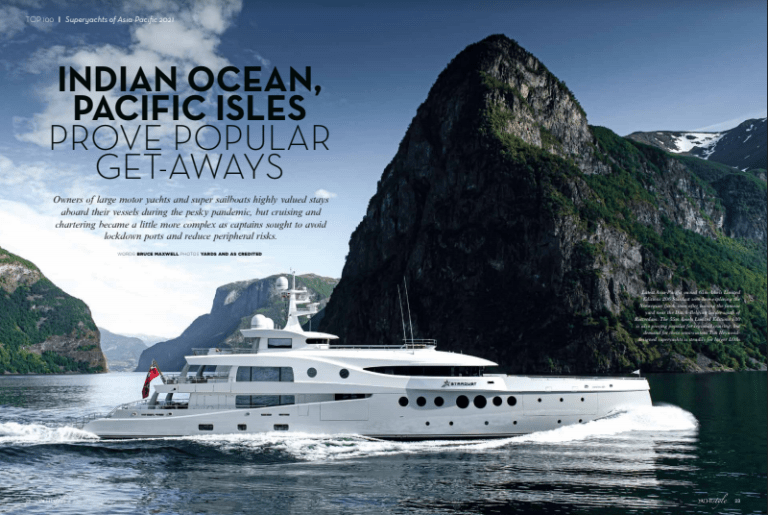
Lex Raas, Aquila, Power, Cats, Catamarans, Sino Eagle, MarineMax, Bill McGill, Brett McGill, Leopard

Aquila’s Lex Raas: Driving the Cat Pack (Part 1)

Aquila’s Lex Raas: Driving the Cat Pack (Part 1)

SHARE

Lex Raas of US-based MarineMax has spent the past decade driving the global popularity of powercats with Aquila. It’s the South African’s latest industry-shaking move, having also helped create Leopard Catamarans and led the rapid growth of charter multihulls with The Moorings during a 50-year career in building boats.

  •  
  •  
  •  


Lex Raas, Aquila, Power, Cats, Catamarans, Sino Eagle, MarineMax, Bill McGill, Brett McGill, Leopard

Raas at his home in Maui, where he regularly paddles and races in the Pacific Ocean on his multihull outrigger canoe


How did your boating journey around the world begin?

I grew up in South Africa, moved to France, then moved to the US, France and US again, and spend much of the year in Hawaii. We’ve dragged our kids through three continents, which has been fun and good for everybody, I believe.


I’ve been in the boating game all my life, really. My dad was very much into sailing and racing, so I grew up sailing and skiff rowing in South Africa. I dropped out of school and started building boats, building my first trimaran when I was 15. I’m now 65, so I’ve spent the last 50 years in the industry!


I went to college for a while and sort of finished up school, but didn’t enjoy it, so went back to building boats. My wife and I had a factory with about 80 staff. We were building small production sailboats, based on Quarter Ton Cup and Half Ton Cup, and I was also racing. In the early 1980s, we became the South Africa importer for Beneteau and that went so well that we shut down our own factory.


Lex Raas, Aquila, Power, Cats, Catamarans, Sino Eagle, MarineMax, Bill McGill, Brett McGill, Leopard

The 44 is among Aquila’s Yacht flybridge range featuring inboard engines; Aquila 44 photos by Nicolas Claris


In 1984, sanctions were taking effect, there was a recession and by 1985 the exchange rates divided by three, so it was ‘game over’ for importing boats. One of my kids had finished high school, one was close and the other two were young, so it was time to think what we should do as a family. I saw the challenges in the future in South Africa for my kids.


I reached out to Beneteau and they said I’d have a job with them as soon as I got to France. I didn’t even have it in writing, but we took the kids over to France.


Tell us about your time at Beneteau, which involved more big moves.

At that time, Beneteau was setting up its operation in the US (in Marion, South Carolina). I was about nine months into my job in France when they asked if I wanted to move to the States and I said, let’s go. A lot of my job was almost Americanising the brand, so I was able to learn a lot about the American market. There were significant differences, although there are less today.


Lex Raas, Aquila, Power, Cats, Catamarans, Sino Eagle, MarineMax, Bill McGill, Brett McGill, Leopard

The 44 Yacht has been Aquila’s best-selling model


I was CEO of Beneteau USA for a short while, then they asked me to take charge of the entire development office in France, so I went back and spent the last year-and-a-half of my eight years with Beneteau in this role. In those days, Beneteau was the trend-setter by a long shot, so it was a cool role.


What led to the move to The Moorings?

I was selling Beneteau boats to The Moorings, so got to know them well. Because my kids were in high school and university, we wanted to go back to the US and The Moorings offered me a job in 1994. It was a more junior position, Logistics Director, which I’ve done a couple of times when moving companies – take a step down but look up at where we can go. I eventually became CEO and later oversaw the merger with Sunsail. I was with them until 2010, just after the global economic meltdown.


What led to the production of Leopard catamarans at Robertson & Caine in South Africa?

When I joined The Moorings, I oversaw purchasing the boats, specs and customer service. The Moorings had six or seven French-built catamarans. I had always been a bit of a multihull guy and thought catamarans was the way to go.


Lex Raas, Aquila, Power, Cats, Catamarans, Sino Eagle, MarineMax, Bill McGill, Brett McGill, Leopard

As shown on the Aquila 44, the high platform steps double as seats


At that point, there was only a handful of catamarans in the Caribbean and I surveyed people who used them. Fundamentally, they loved catamarans, but they didn’t like certain aspects like the galley being below deck, the traveller in the cockpit and engines too small for when they wanted to motor upwind.


I realised catamarans were the future of charter, made a presentation to build some new designs and got the go-ahead from the Executive Committee. Then they asked who was going to build them. I needed to find a builder, but nobody was interested. I approached the big catamaran builders in France, but they wouldn’t make the changes I wanted, which included a big platform at the back, traveller on the top and a lot of other things that are normal on catamarans today.


Lex Raas, Aquila, Power, Cats, Catamarans, Sino Eagle, MarineMax, Bill McGill, Brett McGill, Leopard

Aquila’s signature features include the cockpit bar connected to the aft galley


In the end, I called up my buddy John Robertson in South Africa, where we had built some racing boats together and asked him if he was interested in building some cats. We talked and that’s how it started. The Moorings placed an order for 18 Leopards.


We launched the Moorings 4500 (Leopard 45) in 1997 and it won Boat of the Year straight out of the block and the huge growth in catamarans in The Moorings began. We went from cats making up a few per cent of our fleet to 60 per cent by the time I left in 2010. Sailing cats had been super niche, but now they’re mainstream.


So, what led to the power catamarans?

That’s a fun story as well. At The Moorings, we started a power charter business called Nautic Blue. We bought some monohull motor yachts because we thought powerboat owners wouldn’t even think of power catamarans – there were no powercats back then. However, we had a lot of issues with reliability, props, shafts, because they just weren’t built for charter.


Lex Raas, Aquila, Power, Cats, Catamarans, Sino Eagle, MarineMax, Bill McGill, Brett McGill, Leopard

The forward stairs from the flybridge to the cockpit are another signature Aquila feature


The interesting thing is that the boat would break down and we’d tell the customers they could use a sailing cat, but don’t put up the sails – just drive it. Then guys were coming back, saying, ‘Wow, we’re back next year! This is the best vacation we’ve had.’ And that was all because they’d been on a catamaran. So, then we just converted the sailboat hulls, added to a flybridge, and that’s how Leopard powercats started in 2005.


We changed the name Nautic Blue to Moorings Power. We originally chose Nautic Blue, a different brand, because we thought powerboaters and sailors don’t really mix, but that was rubbish. They do mix because they all just want to have a good time in the Caribbean. By the end of 2010, after 16 years, I left on a one-year non-compete clause and then started working for MarineMax.


Lex Raas, Aquila, Power, Cats, Catamarans, Sino Eagle, MarineMax, Bill McGill, Brett McGill, Leopard

A cabin on the Aquila 44 Yacht


How did joining MarineMax lead so quickly to Aquila?

We started MarineMax Vacations and Aquila at pretty much the same time. As MarineMax is a powerboat company, we decided to focus on building powercats because there were already a lot of sailing cats in the Caribbean and Leopard were the only real powercats. I was lucky to have the support of Bill McGill, co-founder and then-CEO and the father of current CEO Brett McGill.


We asked quite a few builders, but each said they didn’t see a future for powercats, so there I was again, looking for a builder. This time, we approached Sino Eagle because they had built some Leopards, so there was a relationship. I called Frank Xiong of Sino Eagle and put him together with Bill McGill and we started Aquila, with MarineMax placing some orders.


Lex Raas, Aquila, Power, Cats, Catamarans, Sino Eagle, MarineMax, Bill McGill, Brett McGill, Leopard

The Aquila 36 Sport became one of the best-selling motor yachts in the US of its size


On both occasions (starting Leopard and Aquila), if I hadn’t really believed in what I was doing, it could easily have not happened. However, I’ve been very fortunate in having great support each time. I’ve worked for the world’s biggest sailboat builder, the biggest charter boat business, now I work for the biggest boat retail business and all of them had incredible people to work with.


I could never have done what I’ve done without these people and CEOs like Bill McGill, who supported me even when there was a lot of opposition in the industry and sometimes internally. They’ve all changed their minds now. And I’m still here at MarineMax, heading development at Aquila and keeping the relationship with Sino Eagle on a strong footing.


How did Aquila grow from building powercats for MarineMax Vacations?

I need to emphasise that the charter business is such a small piece of Aquila. We’ve probably only got about 20 or so boats in the MarineMax Vacations fleet, so charter is a tiny piece of our business compared to other catamaran builders.


Lex Raas, Aquila, Power, Cats, Catamarans, Sino Eagle, MarineMax, Bill McGill, Brett McGill, Leopard

The hugely popular Aquila 36 is available in multiple versions


The Aquila boats were really developed as private boats and adapted a bit for charter, the opposite to some other brands. What I quickly realised when I joined MarineMax is there is no better company to sell boats. They are amazing, ultra-professional. They have everything covered for a boat owner.


I always say, no stool stands on one leg. To have a successful business model in the boating industry, you need three legs: innovation, distribution and manufacturing. If any of those aren’t working, it’s not a long-term play. We’ve used J&J Design from the beginning and now we’ve expanded to other designers because we’re moving into different segments of the industry.


Lex Raas, Aquila, Power, Cats, Catamarans, Sino Eagle, MarineMax, Bill McGill, Brett McGill, Leopard

Aft view of two versions of the Aquila 36 Sport


Which models and features have established Aquila’s reputation?

The 44 Yacht was the first boat of that size with a full-beam master cabin, so that was a real breakthrough. The forward stairs from the flybridge to the foredeck became part of our DNA for the inboard boats and it’s so practical, so you see it on the new 54 Yacht and 70 Luxury.


Innovation is sometimes taking two good ideas and making them into a great idea. Quite often, a lot of the things I did, I wouldn’t say it was completely my idea. Probably someone has already done it, but they didn’t do the other three things that connected to it and brought it all together.


Lex Raas, Aquila, Power, Cats, Catamarans, Sino Eagle, MarineMax, Bill McGill, Brett McGill, Leopard

The 32 is currently Aquila’s entry-level Sport model


The aft bar connecting the cockpit and the galley was new when we started but is common now. Because you have so much room on cats, you need to create different places to hang out. Another feature I like is our steps from the swim platform. They’re high but if you turn around, you’ll see they’re big enough to use as seats and face the water. We have almost stadium seating at the back of the boat.


For our bigger boats, we have bulbs at the front of the hulls. Cats have quite narrow bows and carry a lot of weight due to the flybridge and hardtop. For example, the 44 is a relatively short boat with a lot of height. If you’re going into chop, the bulb creates an enormous amount of additional buoyancy, which dampens the motion, so all our inboard yachts have bulbs.


Lex Raas, Aquila, Power, Cats, Catamarans, Sino Eagle, MarineMax, Bill McGill, Brett McGill, Leopard

The Aquila 32 Sport was relaunched in 2021 with an extended hull, fixed swim platform plus new seating configuration and hardtop


Our next most popular boat was the 36, a fast outboard with two cabins; it’s like a crossover with motor yachts. It created a completely new position in the market and took a lot of market share against established monohull yacht brands in the US. We can’t build them fast enough.


We recently created the Cruiser version by adding aft sliding doors, so you can enclose the saloon. We now have three versions: the real sporty version with the low windscreen; the full-height windscreen with the back open, which I call ‘semi-sport’; and now the full windscreen with sliding door, like a proper cabin cruiser.


Note: Part 2 of the Lex Raas ‘Leader’ interview from Yacht Style Issue 60 will follow soon

Multihulls Special 2021: Aquila joins ‘big league’

Yacht Style’s annual Multihulls Special highlights how Aquila has joined the big league of catamaran builders with the releases of its fast-selling 54 and flagship 70 models.

SHARE

Aquila’s Lex Raas: Driving the Cat Pack (Part 1) Read More »

Sanlorenzo, Asia, Simpson Marine, Nick Stratton, 52Steel, Singapore

GMBA’s Oscar Siches on superyacht rules and regulations

GMBA’s Oscar Siches on superyacht rules and regulations

SHARE

Oscar Siches of Global Marine Business Advisors (GMBA) sheds light on large yacht certifications, the main classification organisations and other yachting bodies.

  •  
  •  
  •  


Superyacht, rules, regulations, Lloyd’s, Oscar Siches, Global Marine Business Advisors, GMBA, classification societies, MARPOL, ICOMIA, SOLAS American Bureau of Shipping, ABS, Bureau Veritas, China Classification Society, ClassNK, DNV, Indian Register of Shipping, Korean Register, Lloyd’s Register, RINA, Russian Maritime Register of Shipping


When we see ‘Lloyd’s’ in any boat or ship documentation, images arise of engineers wearing helmets and contorting themselves in cramped places within ship’s bilges or a yacht’s engine room – and this association is fair. Lloyd’s is the oldest marine classification society, assuring quality in the design, construction and maintenance of a vessel.


To confirm, Lloyd’s Register does not have any connections with Lloyd’s insurance and Lloyds Bank, although it does share some history with Lloyd’s List shipping intelligence. In London almost 300 years ago, Edward Lloyd was the owner of Lloyd’s coffee house on Lombard Street, where ship owners and insurers got together to exchange news about their ships. In 1734, Lloyd circulated a sheet with all the shipping news he had, which would become the Lloyd’s List.


In 1760, he and his customers created the Register of Shipping, where all events of each ship were recorded to evaluate risk and provide information about the condition of the vessel. Through various changes of protocol and of the organisation itself, it became the Lloyd’s Register of Shipping (LR) in 1914. Ships were qualified by quality of hull (with a letter) and quality of mast, rigging and other equipment (with a number).


As an example, a ship or boat qualified as Lloyd’s

100 A1 LMC today means:

New ship built under special survey in compliance with LR rules

100 Suitable for sea-going service

A Hull built or accepted into class by LR rules and maintained in good and efficient condition

1 Good and efficient condition of anchoring and mooring equipment as per LR rules

LMC Propelling and auxiliary machinery constructed, installed and tested under LR rules


CLASSIFICATION SOCIETIES

Most other classification societies started in the 19th century, copied the concept, and the protocols are similar. Lloyd’s is the toughest, which often means it can be more expensive to fulfil their requirements, and some users prefer their yachts to be qualified by other societies that are ‘softer’ in their conditioning, while always respecting safety and quality.


Superyacht, rules, regulations, Lloyd’s, Oscar Siches, Global Marine Business Advisors, GMBA, classification societies, MARPOL, ICOMIA, SOLAS American Bureau of Shipping, ABS, Bureau Veritas, China Classification Society, ClassNK, DNV, Indian Register of Shipping, Korean Register, Lloyd’s Register, RINA, Russian Maritime Register of Shipping


Examples of this can be the time between full inspections or the wear allowed for the links in an anchor chain. But Lloyd’s is still Lloyd’s, recognised everywhere and the one calling the shots. IACS (International Association of Classification Societies) is constantly trying to harmonise the classification terms.


The 12 current members are American Bureau of Shipping (ABS), Bureau Veritas (France), China Classification Society (CCS), ClassNK (Japan), Croatian Register of Shipping (CRS), DNV (Norway), Indian Register of Shipping, Korean Register, Lloyd’s Register (UK), PRS (Poland),

RINA (Italy) and Russian Maritime Register of Shipping.


Most classification societies created a special yacht department to deal with the recreational marine sector, where UK-based Lloyd’s and US-based ABS together share more than 60 per cent of the international large yacht fleet.


Lloyd’s Register class has been issued to boats (ships) larger than 24m or 100GT since the 1970s. GT is a cargo (space) volume calculation and should not be mistaken for displacement, which is the weight (mass) of the boat. For example, a rectangular barge with a length of 50m, a 10m beam and a height of 4m would have a volume of 2,000 cubic metres.


Allowing for 100 cubic metres of machinery and crew space, its remaining volume would measure 1,900GT, the space dedicated to ‘cargo’. The exact formula is a little more complicated, but this should explain the basic concept.


SUPERYACHTS AND MEGAYACHTS

Over a decade ago, the aim of an ICOMIA (International Council of Marine Industry Associations) meeting in Fort Lauderdale was to establish an international agreement on what was a ‘superyacht’ and what was a ‘megayacht’.


A load-line length of 24m was the agreed size to establish the start of the superyacht category. It was easy as some countries already used that measurement to define skipper licensing or areas

of navigation.


Building a yacht above 24m affects various issues including using certified welders for constructing the hull, stability requirements, shaft material and diameter, fuel tanks, feeding pipes and vents. There is little room to ‘cut corners’ on technical design quality and building standards, which affects design and construction costs. The actual classification process is a small cost when embedded from the outset of the project.


Superyacht, rules, regulations, Lloyd’s, Oscar Siches, Global Marine Business Advisors, GMBA, classification societies, MARPOL, ICOMIA, SOLAS American Bureau of Shipping, ABS, Bureau Veritas, China Classification Society, ClassNK, DNV, Indian Register of Shipping, Korean Register, Lloyd’s Register, RINA, Russian Maritime Register of Shipping


However, defining a megayacht was a bit more difficult, with 60m (200ft) viewed as a reasonable starting point. However, in the USA, it’s still common to call a yacht of over 60m a superyacht, while across whole of Europe, 24m is viewed as the starting point for such yachts.


To complicate things further, The Superyacht Report, as the leading source for large-yacht news, published their large yacht fleet data starting from 30m (100ft). Due to the list’s popularity, lots of people associate superyachts as starting from 30m. The inconsistency of the definition remains to this day. No global body has managed to make a standard prevail and be globally accepted.


KEY ORGANISATIONS

Aside from classification societies, I’d like to highlight some other organisations relevant to yachts. MARPOL (‘Maritime Pollution’) is The International Convention for the prevention of Pollution from Ships and is under the IMO (International Maritime Organization), a body formed by 174 countries, 80 NGOs (non-governmental organisations) and 74 GOs (governmental organizations).


MARPOL started in 1973 and entered into force in 1983. It is the main international convention covering prevention of pollution of the marine environment by ships from operational or accidental causes. MARPOL covers possible pollution under six annexes: oil, noxious liquid substances in bulk, packaged harmful substances, sewage from ships, garbage from ships, and air pollution from ships.


A misconception is that MARPOL only applies to big ships or large yachts. This is not the case. MARPOL applies to every ship or craft on the water, whether it’s a small rowing boat or a supertanker. Pollution is pollution.


The International Convention for the Safety of Life at Sea (SOLAS) is an international maritime treaty which sets minimum safety standards in the construction, equipment and operation of merchant ships. The convention requires signatory flag states to ensure that ships flagged by them comply with these standards.


The first version of SOLAS Treaty was passed in 1914 in response to the sinking of the Titanic passenger liner. Yachts must comply with SOLAS chapter V independent of size or tonnage.


SOLAS Chapter V: Safety of Navigation:

This chapter requires governments to ensure that all vessels are sufficiently and efficiently manned from a safety point of view. It places requirements on all vessels regarding voyage and passage planning, expecting a careful assessment of any proposed voyages by all who put to sea. Every mariner must take account of all potential dangers to navigation, weather forecasts, tidal predictions, the competence of the crew and all other relevant factors. It also adds an obligation for all vessels’ masters to offer assistance to those in distress and controls the use of lifesaving signals with specific requirements regarding danger and distress messages. It is different from the other chapters, which apply to certain classes of commercial shipping, in that these requirements apply to all vessels and their crews, including yachts and private craft, on all voyages and trips including local ones.


All other SOLAS regulations apply to commercial yachts over 12 passengers and yachts over 500GT (+/-50m/180ft). The 500GT SOLAS compliance is like a classification but concentrates on safety issues of human life at sea. A yacht over 500GT can’t use wood over a certain thickness within the guest or crew accommodation.


Superyacht, rules, regulations, Lloyd’s, Oscar Siches, Global Marine Business Advisors, GMBA, classification societies, MARPOL, ICOMIA, SOLAS American Bureau of Shipping, ABS, Bureau Veritas, China Classification Society, ClassNK, DNV, Indian Register of Shipping, Korean Register, Lloyd’s Register, RINA, Russian Maritime Register of Shipping


Fire prevention and fighting systems are specified, and GMDSS (Global Maritime Distress and Safety System) must be implemented, with increased provisions and regulations for radio systems, electronic emergency call devices, liferafts, life jackets, other safety floating devices and so on. SOLAS-approved equipment can be easily identified with a small rudder wheel mark.


International Ship and Port Facility Security Code (ISPS) is part of SOLAS and compulsory for any yacht over 500GT and its flag. ISPS is a safety protocol both for the yacht and for the harbour, which should adjust the security levels accordingly. A yacht with a lower security level should increase it (eg. by posting more crew on watch).


A harbour with a lower security level should act accordingly (eg. by creating a fenced perimeter around the quay where the yacht is tied up). Each ISPS harbour and yacht must have a security officer within their crew or personnel who is responsible for the adequate set-up of the security measures.


The International Safety Management (ISM) Code was triggered by the sinking of the Herald of Free Enterprise ferry in 1987. The accident was the result of a sum of onboard actions that were neglected or incorrectly executed.


ISM takes care of procedures for conducting both internal and external audits to ensure the ship is doing what is documented in the procedure’s manual. That includes but is not limited to crew training, periods of watches, maintenance, certification of safety equipment or regular management reviews.


Finally, if you’d like a compact summary of such regulations, download Manta Maritime’s ‘The rules and regulations applicable to yachts over 24m in length + engaged on international voyages’: www.mantamaritime.com/downloads/compliance_chart.pdf


OSCAR SICHES, CMP


Superyacht, rules, regulations, Lloyd’s, Oscar Siches, Global Marine Business Advisors, GMBA, classification societies, MARPOL, ICOMIA, SOLAS American Bureau of Shipping, ABS, Bureau Veritas, China Classification Society, ClassNK, DNV, Indian Register of Shipping, Korean Register, Lloyd’s Register, RINA, Russian Maritime Register of Shipping


With a background in navy school, offshore racing and cruising, Siches has broad experience in the boating industry, having skippered sail and power yachts in the Mediterranean and the Caribbean for private and charter clients. Born in Argentina and based in Spain, he was a partner and manager of two marinas in Palma de Mallorca. He’s now a consultant for the design and operation of marina projects and a designer of customised marina elements, and has been a speaker at more than 30 marina conferences in 12 countries.


A Certified Marina Manager and Certified Marina Professional, he is also a member of ICOMIA’s Marinas Committee and the PIANC Recreational Navigation Commission, Convenor of ISO/TC 228 Working Group 8 – Yacht Harbours and a founding member of the Asia Pacific Superyacht Association (APSA) and the Global Marina Institute, where he was Director for six years. He’s also one of the founding members of the Global Marine Business Advisors (GMBA), a network of 18 industry senior experts located in 17 countries across five continents available individually or in teams to help expand marine-related businesses.
www.gmba.blue
oscar.siches@gmba.blue

GMBA celebrates first anniversary

Global Marine Business Advisors marks its one-year anniversary with an expanded network of members in 17 countries in five continents.

SHARE

GMBA’s Oscar Siches on superyacht rules and regulations Read More »