Read and download copy
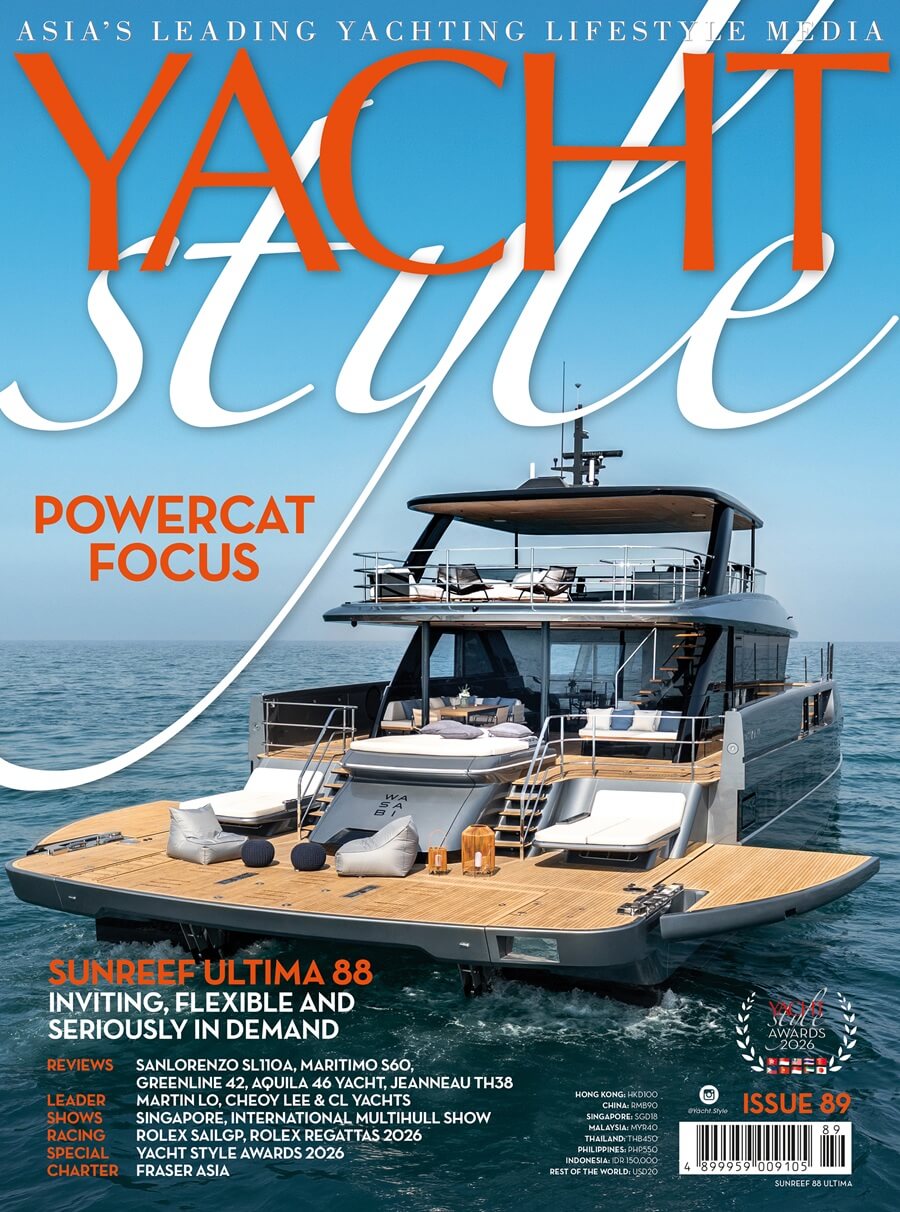
Yacht Style, Issue 89, powercat, third issue, 2026, Sunreef, Aquila, Jeanneau, Sanlorenzo, Maritimo, Greenline, Yacht Style Awards 2026, Martin Lo of CL Yachts, charter, Fraser Asia, Rolex, regattas, Hong Kong Yachting Association, Chairman, Tommy Ho, Singapore Yachting Festival
Read and download copy
Yacht Style, Issue 88
Read and download copy

Asia's leading yachting lifestyle media

More results...

Generic selectors
Exact matches only
Search in title
Search in content
Post Type Selectors
Yacht Style, Issue 89, powercat, third issue, 2026, Sunreef, Aquila, Jeanneau, Sanlorenzo, Maritimo, Greenline, Yacht Style Awards 2026, Martin Lo of CL Yachts, charter, Fraser Asia, Rolex, regattas, Hong Kong Yachting Association, Chairman, Tommy Ho, Singapore Yachting Festival
Read your copy

More results...

Generic selectors
Exact matches only
Search in title
Search in content
Post Type Selectors

More results...

Generic selectors
Exact matches only
Search in title
Search in content
Post Type Selectors

Leaders

Ian Harris, Phoenix Yacht Management, yacht, superyacht, refit, crew, AV/IT, HVAC, engineering, P&O, Maersk, Fred. Olsen

Ian Harris on the modern yacht refit

Ian Harris on the modern yacht refit

SHARE

In a Column for Yacht Style, Phoenix Yacht Management’s founder and CEO outlines the trends shaping today’s refit projects.

  •  
  •  
  •  

Photo: Phoenix Yacht Management


For an owner considering a change, a refit can offer a faster and, in the right circumstances, more intelligent route to a yacht shaped around their requirements. It can preserve a proven platform, avoid the delivery time of a new build and represent a sound financial decision. Much, however, depends on selecting the right yacht and understanding what can realistically be achieved.


Age alone is rarely the deciding factor. A well-maintained, 20-year-old yacht with a sound hull, good volume and documented technical history may offer considerably greater potential than a younger yacht requiring extensive engineering replacement.


I have seen older, well-engineered vessels provide excellent foundations for major transformation simply because the original naval architecture, machinery spaces and construction quality were right.


RETHINK RATHER THAN REPLACE

One of the greatest opportunities in a modern refit is often missed when equipment is replaced like for like. Technology has advanced considerably over the past 10 or 20 years, and the yacht should be reconsidered accordingly.


Electrical, automation, navigation and particularly AV/IT equipment can now perform considerably more while occupying a fraction of the space required by earlier systems. On major refits, it is not unusual to remove racks of obsolete equipment and discover that their modern replacements require substantially less volume, consume less power and produce considerably less heat.


That creates a useful engineering chain: less equipment means less space, less heat and less cooling, in turn reducing electrical demand, generator loading, fuel consumption and noise.


Importantly, valuable volume can sometimes be reclaimed for storage, access, crew facilities or operational purposes. The same thinking should apply throughout the vessel. A successful refit is not

simply a collection of new systems; it is an opportunity to reconsider how those systems interact and whether assumptions made when the yacht was originally designed still make sense today.


DESIGNING FOR HOW THE YACHT ACTUALLY OPERATES

Crew spaces are a good example. Circulation, pantries, laundry facilities, storage, waste routes and technical access can appear secondary to the owner’s areas, but in operation, they have a direct effect on the guest experience.


I have seen yachts where relatively modest changes to crew flow made service noticeably calmer because crew members were no longer crossing guest routes unnecessarily, travelling excessive distances between working areas or continually working around poorly positioned storage areas and pantries.


Better working conditions also matter. A crew that can work efficiently, rest properly and maintain the yacht without unnecessary obstruction will generally perform better and remain onboard longer. Good crew design is therefore not simply a welfare consideration; it is an operational one.


Photo: Phoenix Yacht Management


The owner may never see the improved laundry facilities, technical access or crew circulation, but will experience the results through better service, fewer interruptions and a calmer, more professionally operated yacht. On a vessel intended to provide effortless hospitality, that distinction matters.


DESIGNING FOR RISKS THAT DID NOT PREVIOUSLY EXIST

A refit also provides an opportunity to address risks that may barely have existed when the yacht was designed. Lithium-ion batteries are perhaps the clearest example. E-bikes, scooters, water toys, dive equipment, tools and numerous rechargeable devices create a significant concentration of stored energy on board.


Storage and charging arrangements should address segregation, ventilation, temperature monitoring, detection, containment, emergency access and isolation, and should be developed alongside class, flag, insurers and specialists. The objective must be to reduce risk to as low a level as reasonably practicable, rather than waiting for regulation or an incident to force the issue.


REDUCING THE LOAD BEFORE INCREASING THE MACHINERY

Materials and coatings have also evolved. Modern solar-reflective coatings use specially formulated pigments to reflect a greater proportion of infrared energy rather than allowing it to be absorbed by the vessel’s structure and converted into heat. Marine trials have demonstrated reductions in exposed surface temperatures exceeding 20°C under certain conditions compared with conventional coatings.


Across the considerable exposed surface area of a large yacht, the principle becomes particularly interesting. Reducing solar heat absorption through decks and the superstructure means less heat entering the vessel and, therefore, a potentially lower HVAC cooling demand, with corresponding reductions in electrical and generator loads.


The actual benefit will, of course, depend on factors such as colour, coating system, insulation, glazing, vessel construction, climate and operating profile, so should be properly modelled rather than assumed. Nevertheless, when considered alongside modern insulation, glazing and HVAC technology, the cumulative effect can become significant.


THE RIGHT FOUNDATIONS

A refit should ultimately do considerably more than make an older yacht look new. Done properly, it allows a proven platform to benefit from perhaps two decades of advances in technology, materials, safety, energy management and operational experience.


The best projects consider the yacht as one interconnected system: technical spaces affect cooling; cooling affects electrical demand; electrical demand affects generator operation; machinery operation affects noise and vibration; and crew arrangements affect service. All these ultimately affect the experience of the owner and guests.


This is where good feasibility work and experienced refit management earn their value, by understanding not only whether an individual modification can be achieved but also what its consequences and opportunities are elsewhere on the yacht.


With the right platform, a clear purpose and disciplined management, a thoughtful refit can produce something more valuable than a renewed vessel: a fundamentally better yacht.


IAN HARRIS


Ian Harris, Phoenix Yacht Management, yacht, superyacht, refit, crew, AV/IT, HVAC, engineering, P&O, Maersk, Fred. Olsen


Ian Harris is a maritime engineer and yacht management executive with more than 25 years’ experience spanning military service, commercial shipping, subsea engineering, offshore energy and the luxury yacht sector. His career includes senior engineering and project management roles with organisations including P&O, Maersk and Fred. Olsen, progressing from Chief Engineer aboard large commercial vessels to the management of complex international engineering projects. Harris subsequently moved into the superyacht industry, where he has overseen the operation, management, refit and development of significant yachts for leading yacht-management companies and private family offices. He founded Phoenix to provide owners with technically informed, commercially disciplined and accountable yacht management.
phoenix-yachts.com

info@phoenix-yachts.com


Note: The above article first appeared in Yacht Style Issue 91

SHARE

Ian Harris on the modern yacht refit Read More »

Jerry Rollin, sailing, Philippines, World Sailing, International Race Officer, Philippine Hobie Challenge, Philippine Sailing Association, Philippine Inter-Island Sailing Federation, Offshore Racing Club of the Philippines, Philippine Sailing Association, Phuket King’s Cup Regatta, Thailand, Raja Muda Selangor International Regatta, Malaysia, Southeast Asian Games sailing competition, Subic Bay

Jerry Rollin 1949-2026

Jerry Rollin 1949-2026

SHARE

A World Sailing-appointed International Race Officer, Rollin was a lynchpin of the Philippine yacht racing scene for decades.

  •  
  •  
  •  

Jerry Rollin, sailing, Philippines, World Sailing, International Race Officer, Philippine Hobie Challenge, Philippine Sailing Association, Philippine Inter-Island Sailing Federation, Offshore Racing Club of the Philippines, Philippine Sailing Association, Phuket King’s Cup Regatta, Thailand, Raja Muda Selangor International Regatta, Malaysia, Southeast Asian Games sailing competition, Subic Bay


It is with great sorrow that we learned of the passing of Michael Jeremy ‘Jerry’ Rollin in Manila on September 21, 2026. He was 77.


Beloved within the sailing community in the Philippines, his adopted home, and in the regional Asian circuit and beyond, Jerry was a staunch supporter of yacht racing, a visionary and an indefatigable leader of the sport. From local grassroots level to Philippine Hobie Challenges, to grand prix yacht racing, he generously lent himself.


A consistent eminent honouree of Yacht Style’s annual list of ‘Asia’s Yachting Leaders’, he might as well be a ‘Hall of Fame’ lister, yet Jerry always remained humble and a decent gentleman.


Jerry Rollin, sailing, Philippines, World Sailing, International Race Officer, Philippine Hobie Challenge, Philippine Sailing Association, Philippine Inter-Island Sailing Federation, Offshore Racing Club of the Philippines, Philippine Sailing Association, Phuket King’s Cup Regatta, Thailand, Raja Muda Selangor International Regatta, Malaysia, Southeast Asian Games sailing competition, Subic Bay

Beni Gomez and Jerry Rollin


Having retired from the position of World Sailing Race Officer in 2024, Jerry concentrated on assisting local organisations to raise their standards in race management and technical skills, event logistics and management, handicap systems and safety services.


His roles included Technical Director and Trustee of the Philippine Sailing Association, President of Philippine Inter-Island Sailing Federation and Offshore Racing Club of the Philippines, and Director of the Philippine Sailing Association. Jerry also provided consultancy services to resorts and marinas.


Formerly in the British Army and resident in the Philippines since 1987, Jerry officiated at dozens of different regattas across Asia including the Phuket King’s Cup Regatta in Thailand and Raja Muda Selangor International Regatta in Malaysia. He was the Competition Manager for the 2019 Southeast Asian Games sailing competition at Subic Bay.


Jerry Rollin, sailing, Philippines, World Sailing, International Race Officer, Philippine Hobie Challenge, Philippine Sailing Association, Philippine Inter-Island Sailing Federation, Offshore Racing Club of the Philippines, Philippine Sailing Association, Phuket King’s Cup Regatta, Thailand, Raja Muda Selangor International Regatta, Malaysia, Southeast Asian Games sailing competition, Subic Bay


There has been an outpouring of messages and touching tributes for Jerry, including Club Punta Fuego setting the Philippine Flag at half-mast this week. A true loss to all of us.


Our Yacht Style team and publisher convey our deepest condolences to Cynthia and family, and friends.


Sail away and rest in peace, Jerry. Salute! You will be sorely missed.


SHARE

Jerry Rollin 1949-2026 Read More »

Azimut Seadeck: An owner’s perspective

Azimut Seadeck: An owner’s perspective

SHARE

Based in the UAE for over 13 years, Marco Tedeschi and his family enjoyed a 2,000nm tour of the Mediterranean on their Seadeck 6 this summer.

  •  
  •  
  •  


Cinzia and Marco Tedeschi


Marco Tedeschi is happy to admit that he’s in his early 60s. However, he may qualify as being among the ‘new generation’ of yacht owners, having never owned a boat until recently.


“Four years ago, I remember saying that whoever wants to buy a boat is stupid because there are so many better investments,” he laughs. “We were thinking of buying a house in Ibiza, but then we thought about buying a boat that we could use as our summer house and base it in Sardinia (Italy) one year, then Greece the next, the Balearics (Spain) and so on.”


Based in Dubai since 2013, having spent three years in the emirate in the late 1990s, Tedeschi and his wife Cinzia are the owners of Smart Renovation, a company specialising in Italian-themed home and office renovations.


My Estate, Azimut Seadeck 6


Typically returning to Italy for a month each summer and a couple of weeks in winter, Tedeschi selected an Azimut Atlantis 45 as his first yacht, gaining his RYA powerboat licence in the UAE. He skippered the two-cabin cruiser himself as the family toured around the likes of Corsica and Sardinia in the summer.


“For me, a boat is better than having a summer house because it really brings the whole family together. Everyone gets involved, whether it’s helping with mooring, tying up the lines, cooking, cleaning the boat and so on,” Tedeschi says. “It was great and I loved the Atlantis 45, but then I moved to the Seadeck 6, which has been 10 times better!”


Tedeschi selected the Seadeck 6 with a specific journey in mind: a four-month, 2,000nm Mediterranean cruise with family and friends – and a captain, Francesco – starting in May 2026.


My Estate, Azimut Seadeck 6


“We have a lot of friends and we socialise a lot, so we needed at least three cabins, which led to us choosing the Seadeck 6,” Tedeschi recalls. “Also, we really wanted to experience a proper tour around the Med.”


Named My Estate (‘my summer’), the 57-footer was loaded with toys: a Yamaha JetBlaster jetski, an Awake electric surfboard, an inflatable tender with a Mercury electric motor, two Seabobs, two Sublues, plus snorkels, masks and flippers.


Starting from Imperia, the Italian province neighbouring France, Tedeschi first headed west along the Cote d’Azur, taking in the likes of Saint-Tropez and the island of Porquerolles. Heading south to Spain’s Balearic islands, the family toured many parts of Mallorca, Menorca, Ibiza and Formentera.


My Estate, Azimut Seadeck 6


My Estate then headed east as the family finished their magical summer in Sardinia and then Sicily, Italy’s two biggest islands.


For Tedeschi, the Seadeck 6 played its part, firstly for its fuel consumption of just 4 l/nm at 9-10 knots, giving the boat a 540nm range (with 10 per cent reserve). However, it’s the yacht’s ‘Fun Island’ aft deck with dropdown sides and hydraulic platform that truly caters to his family’s water-loving lifestyle.


“In my opinion, Seadeck 6 is more of an experience than a boat. When you’re outside during the day and you have the sides open, it’s amazing, especially if you have a lot of toys like we do,” Tedeschi says.


“Then you have a very comfortable living room for the evening and watching TV. Inside is like a home. I’m an interior designer and I really appreciate the layout and style. It’s very well designed, really a 360-degree concept.”


My Estate, Azimut Seadeck 6


While Tedeschi’s suggested improvements to the yacht include adding ventilation in the saloon and helm access to the side deck, he’s delighted to have chosen Azimut for the boating chapter of his life.


“First, I chose Azimut, because I’d rather have a better boat from a reliable brand than a cheaper or bigger boat without the right service or such an enjoyable experience,” Tedeschi says.


“Even if Azimut is the world’s largest yacht manufacturer, it’s really like a family. Whenever you have a problem, they react. I’ve had great support and service wherever we have been. And the boats are amazing.”

azimutyachts.com


SHARE

Azimut Seadeck: An owner’s perspective Read More »

Motoryacht, superyacht, yacht charter, Phuket, Thailand, Alexandr Kovalev, Horizon Cruises Phuket, Technema 89 Say Yes, Ferretti 80 Sofia, Beluga 88

Phuket yacht charter: prices, routes and seasons – Alexandr Kovalev of Horizon Cruises Phuket

Phuket yacht charter: prices, routes and seasons – Alexandr Kovalev of Horizon Cruises Phuket

SHARE

Alexandr Kovalev, co-owner of Horizon Cruises Phuket, details what a private yacht rental in Phuket costs in the 2026-27 season, how to choose the boat and the departure point, and what to ask before paying a deposit for a crewed charter. 

Motoryacht, superyacht, yacht charter, Phuket, Thailand, Alexandr Kovalev, Horizon Cruises Phuket, Technema 89 Say Yes, Ferretti 80 Sofia, Beluga 88

Alexandr Kovalev, co-owner, Horizon Cruises Phuket


Horizon Cruises Phuket is a private yacht charter company based in Chalong, Phuket, Thailand. Over 12 years it has run around 2,400 charters in the Andaman Sea, and guests rate it 5.0 on Google.


Its three yachts are all over 24m: Technema 89 Say Yes and Ferretti Yachts 80 Sofia depart from Chalong Pier, Beluga 88 from Ao Po Grand Marina. The catalogue adds around 80 boats, from speedboats and catamarans to larger motor yachts and superyachts.


Following is an interview with Alexandr Kovalev, co-owner of Horizon Cruises Phuket. 


TwelvE years on one island 


How did Horizon Cruises Phuket begin?

We started in Phuket with one boat: a Silverton 45 Convertible, an American sportfishing yacht. She took our first charters, and the company grew from there – through returning guests, personal recommendations and the experience of every trip.


Technema 89 (Say Yes)


The principle has not changed. The person who answers a guest’s message should know the boats physically, know the crews by name and be able to say why one itinerary makes more sense than another. That local knowledge is a large part of what guests are booking.


What difference does it make that you run yachts yourselves?

On the day of a charter, it is the difference between a decision and a phone call. On our three yachts we work directly with the crews and prepare the boat ourselves, so if the weather shifts or guests want to change the route, the decision is made on board, immediately. On a partner boat we make that call on the guest’s behalf – one step shorter than booking through a platform in another time zone, but still a step.


Running yachts every day also changes how you look at every other boat. When you deal with engines, generators, antifouling and crews yourself, you learn to look past the photographs and see quickly which yachts are genuinely maintained.


Choosing the boat


Speedboat, catamaran or motor yacht: how should guests choose?

Start with the day you want. A speedboat is the cheapest private boat and the fastest way to distant islands, from THB21,000 a day for four guests, but it is an active day: no saloon, limited shade and in a chop a light hull at speed rides hard. 


Technema 89 (Say Yes)


A sailing catamaran is the cheapest way to take a large group to sea – some carry 35 or 40 guests from THB26,000 for a low-season morning – and the day revolves around one or two anchorages rather than a route. 


A power catamaran adds speed to the same wide, stable platform, from THB39,115 a day, and the faster ones reach Racha Yai and Phi Phi as full days. Motoryachts give the widest choice: from 42-139ft, for six to 50 guests, from THB33,900 a day.


The rule I give guests is simple: catamarans win at anchor; monohulls win in a seaway. If the day is about swimming, lunch and a quiet bay, take a catamaran; if it is about covering distance in comfort, take a motoryacht. And choose the boat for the whole itinerary, not for how it looks in a photograph of a quiet bay.


Can you give an example?

A birthday party for 30 guests: Technema 89 Say Yes takes up to 30 on a day charter and has three decks, so the group spreads across the aft deck, the saloon and the flybridge instead of sitting in one space. 


Technema 89 (Say Yes)


Then the question is what matters most to them. If it is swimming, lunch and being together, a shorter itinerary out of Chalong leaves more of the day for the celebration. If it is particular islands, we talk about passage times and the length of charter that makes them comfortable.


Change one detail and the answer changes. The same yacht sleeps eight, not 30, so an overnight request is a different conversation about a different boat. We settle the format of the trip first and choose the yacht second. 


Phuket yacht charter prices


How much does a private yacht charter in Phuket cost?

In the 2026-27 season, a private boat with crew starts from THB21,000 a day, and a superyacht can cost 20 times that. Every price is for the whole boat, in Thai baht – not a seat on a shared excursion.


Compare like for like: a named boat, a stated route, the same duration and the same number of guests. Yachts of a similar size can differ by two or three times. 


A 27m yacht such as our Technema 89 Say Yes starts at THB140,000 for an eight-hour high-season day trip to Coral Island and Promthep Cape, outside the peak dates. The Princess 78 Maritimus in our catalogue starts at THB320,000, and a 102ft Astondoa at THB440,000.


Technema 89 (Say Yes)


That rate covers 12 guests, and each additional guest is THB 2,000 up to the licensed 30, so a full boat of 30 comes to THB176,000, so under THB6,000 per person. On a large yacht, guest numbers work in your favour.


What moves the price?

Four things: season, route, guest numbers and duration. The route matters because fuel does, so a distant island is priced differently from a day in a nearby bay. Guest numbers matter on the yachts that include 10 or 12 people in the base rate and charge per person above it. Duration matters less than people expect: a half day costs less than a full day, but not half as much, because crewing and provisioning a boat do not halve.


Season is the largest. Across the roughly 40 yachts in our catalogue that publish seasonal rates, the high season from November to April is typically about 10 per cent above the low season, and the peak over Christmas and New Year about another 10 per cent above that; on some yachts each step reaches about 30 per cent. 


Each yacht sets its own peak dates. They start between December 15-22 and end between January 5-20. Some boats do not sell half days or sunset cruises during that period.


What is included in a crewed charter?

With us: the captain and crew, fuel for the agreed route, passenger insurance, drinking water and soft drinks, snorkelling gear and towels. Lunch is included on full days on most boats and generally not on half days, and 7 per cent VAT is included on some boats and added on others, so the quotation should say which.


Beluga 88


National park fees are always separate and paid in cash on the day: THB300 per person for Ao Phang Nga, nothing at Coral Island or the Racha islands, and on Phi Phi the Maya Bay fee only when the boat lands there. 


Paid water toys, a private chef, decorations and crew gratuities are extra as well. Ask for one written quotation with the total for your group, the planned route and the exclusions before you pay a deposit. 


Routes and departure points


Which departure point should guests choose?

The one closest to the route. Phuket has no single harbour for charters. Boats in our catalogue leave from Chalong Pier, Ao Po Grand Marina, Royal Phuket Marina and Boat Lagoon. 


For Phang Nga Bay, Ao Po Grand Marina on the northeast coast is the natural start. Hong Island is about 13km away, Koh Yao about 16km and James Bond Island about 20km, against roughly 53km from Chalong to James Bond Island. Coral Island, the Racha islands and Phi Phi are natural days out of Chalong on the south coast.


Beluga 88


It’s not about ‘which yacht’ but about ‘which yacht, which departure point, which route’. A company that works with real boats answers it immediately, because it knows where each one is berthed.


How much travelling should guests expect?

Coral Island is the shortest island day out of Chalong, which is why it works as a four-hour half day or an unhurried eight hours. Racha Yai makes a half day of four-five hours, and both Racha islands a full eight to nine. Phi Phi is about an hour-and-a-half each way on a fast catamaran. A classic 27m motoryacht cruising at 11 knots takes longer, so it becomes a nine-hour day with an earlier start.


That is a trade, and we explain it before booking. Time in transit in exchange for shade, a saloon and several deck areas. A good itinerary leaves enough time at the islands instead of spending the day moving between them. 


Groups, overnights and celebrations


How many guests can a yacht take?

As many as its licence allows, and the number can depend on the route. A 42ft power catamaran licensed for 20 guests on most routes may be licensed for only 15 on the Phi Phi crossing. That is a licensing and comfort limit, not a suggestion. A group of 18 heading for Phi Phi needs a different boat, and an honest operator says so before taking a deposit.


Beluga 88


Day capacity and overnight capacity are different things. A yacht that takes 30 guests by day sleeps eight, and the deck layout matters as much as the number. Two boats with the same permitted capacity can feel completely different once everyone is aboard.


What does an overnight or a week onboard cost?

On the larger yachts in our catalogue, two days with one night run from THB360,000-770,000 in the high season, and a full week on a 26m motoryacht from about THB1.5 million in the low season to about THB1.9 million in the high. 


It is the way to see Phang Nga Bay and Krabi without returning to the pier every evening. It should be planned around the yacht and the group, rather than treated as a day charter with extra hours added.


What about birthdays, proposals and corporate days?

Choose the boat around the occasion. A company group of 10-50 guests needs licensed capacity first and deck space second. A birthday leans on deck space, music and water toys. 


A proposal or an anniversary suits a two-hour sunset cruise in the bays near the marina, where most of the time is spent at slow speed or at anchor. A DJ, decorations, photography and video are arranged separately, so they belong in the quotation from the start. 


Four questions before a deposit


What should a guest ask before paying a deposit?

Four questions. They take five minutes on WhatsApp and decide how the day goes, and they work on us as well as on anyone else.


Ferretti Yachts 80 (Sofia)


Which boat, exactly? Ask for the name of the yacht, not a category. ‘A 60-foot luxury yacht’ is a promise. A named yacht is a boat with a page, a licence, current photographs and a berth. If the answer is a category, the boat has not been chosen yet – and the one at the pier may not be the one in the photograph.


Who is behind the boat, and who answers on the day? Ask which company holds the licence. In Thailand, a charter operator has a TAT licence number, and it should be easy to find. Ask who your contact is once you are on the water. A good answer is a name and a number that picks up at 7.00am, not an inbox in another time zone. With us that contact is in Phuket, around the clock, and the same office that took your booking is the one that speaks to the captain.


How much in total, and what is not in it? One figure in Thai baht for the whole boat, and the exclusions written out: national park fees, lunch on a half day, alcohol, transfers, water toys, VAT. A ‘from’ price without that list is not a price. Fuel for the route and passenger insurance belong inside the figure, not on a bill at the pier.


Where does it leave from, and what does the day look like? The marina decides how much of the day you spend in transit. Phang Nga Bay from Ao Po Grand Marina, Coral Island, Racha and Phi Phi from Chalong. Ask for the departure time, the stops and the time back: a good day has more hours at anchor than under way.


Ferretti Yachts 80 (Sofia)


A company that works with real boats answers all four quickly and precisely. And ask to see the boat. With us, any yacht in the catalogue can be viewed in person, free of charge, before a deposit, and a viewing at the marina takes about half-an-hour.


Seasons


When is the best time to rent a yacht in Phuket?

November to April is the classic season, with the calmest water and the most reliable forecasts. From May to October, the green season, there are noticeably fewer visitors. The Similan Islands national park closes for the monsoon every year, roughly from mid-May to mid-October, so a Similans itinerary must sit inside that window. 


Phang Nga Bay is sheltered by hundreds of islands and works all year, which makes it the most reliable choice in the green season. 


Superyachts in Southeast Asia


Is Phuket a superyacht destination?

Southeast Asia is becoming one of the most interesting regions for superyacht charter, especially Phuket and the islands around it, and Singapore. The region also hosts major events such as the Formula 1 Singapore Grand Prix, which draws huge numbers of visitors. 


Ferretti Yachts 80 (Sofia)


Phuket itself is one of the best bases in Asia for the dry season. The distances are short, Phang Nga Bay offers flat water among dramatic limestone, and the island’s marinas take large yachts. 


Crew and service


What ultimately makes a charter memorable?

The crew. The captain reads the weather and finds the right bay at the right hour; the deck team makes boarding and the whole day look effortless; the hostess notices what guests need before they ask. The yacht provides the setting. The people looking after it make the day.


Horizon Cruises Phuket is a private yacht charter company in Chalong, Phuket, Thailand, operated by Marine Cruise Andaman Co., Ltd. It arranges private crewed day charters, overnight stays and multi-day itineraries, with support in English, Russian and Thai. TAT licence 34/02188.

info@horizoncruisesphuket.com
horizoncruisesphuket.com


SHARE

Phuket yacht charter: prices, routes and seasons – Alexandr Kovalev of Horizon Cruises Phuket Read More »

Teji | Cowie, London, Hong Kong, Alex Teji, Antony Cowie, lawyers, Singapore Yachting Festival, Palma International Boat Show, Cannes Yachting Festival, Monaco Yacht Show, anniversary

Teji | Cowie marks first year with €1.5 billion of yacht deals

Teji | Cowie marks first year with €1.5 billion of yacht deals

SHARE

The specialist superyacht law firm is celebrating its first anniversary, having advised on more than 25,000GT of vessels in its debut year.


  •  
  •  
  •   

Teji | Cowie, London, Hong Kong, Alex Teji, Antony Cowie, lawyers, Singapore Yachting Festival, Palma International Boat Show, Cannes Yachting Festival, Monaco Yacht Show, anniversary

Teji | Cowie, the superyacht law firm launched in September 2025, is celebrating its first anniversary after a year in which it advised owners on matters representing approximately €1.5 billion in yacht value and more than 25,000GT of vessels.


The firm opened its doors with a straightforward proposition: that owners, family offices and industry professionals want lawyers who are as commercially minded as they are technically expert; and who are ultimately judged on whether the deal gets done. 


In practice, that has meant an end to the hourly rate, a technology-led approach to how the work is delivered, and a senior team on every matter. Twelve months in, the model is working. 


“We set out to build the firm we would have wanted to instruct – quick to respond, clear on cost, and focused on getting to signing,” said Alex Teji, Founding Partner. “The most satisfying part of year one hasn’t been the numbers. It’s the clients and referring intermediaries who have come back to us a second and a third time.”


Teji | Cowie, London, Hong Kong, Alex Teji, Antony Cowie, lawyers, Singapore Yachting Festival, Palma International Boat Show, Cannes Yachting Festival, Monaco Yacht Show, anniversary


That growth has been matched by rapid recruitment. Teji | Cowie has made a series of hires across both its London and Hong Kong offices during its first year, with further appointments to be announced in the coming months as the firm continues to build capacity in both hubs. 


“Our clients and their yachts move between Europe and Asia constantly, so having real strength in both London and Hong Kong isn’t a nice-to-have, it’s the job,” added Antony Cowie, Founding Partner. “We are hiring in both offices, and we’re not finished yet. We’re building a firm for the people who work here, not for the people who founded it. Get that right and the rest follows.”


It has also been an active year across the international superyacht calendar. The team attended the Singapore Yachting Festival, Palma International Boat Show and Cannes Yachting Festival, and will be at the Monaco Yacht Show (September 23-26), where it will mark the anniversary with clients and friends of the firm.

Teji | Cowie enters its second year with the same focus: supporting owners and their advisers across the full lifecycle of superyacht ownership and doing it in a way that makes life easier for everyone around the deal table.

tejicowie.com


SHARE

Teji | Cowie marks first year with €1.5 billion of yacht deals Read More »

Eric Noyel on Asiamarine’s Mediterranean pivot

Eric Noyel on Asiamarine’s Mediterranean pivot

SHARE

The Asiamarine founder and CEO explains the company’s expansion to Saint-Tropez, describing it as a “response to the globalised lifestyles of Asian yacht owners”.

  •  
  •  
  •  


Jeanneau Sea Loft 480


The global yachting map has long been defined by a familiar trajectory. For decades, the narrative flowed almost exclusively from West to East, with heritage European shipyards, brokerages and service houses establishing outposts in Hong Kong, Singapore and Phuket to cultivate a developing Asian market. It was a logical progression driven by shifting economic centres and an emerging demographic of maritime enthusiasts.


Recently, however, a counter-current has emerged through Asiamarine. With an established multi-country presence across Hong Kong, Singapore, Thailand and the Philippines, our company has now reversed the traditional geographical flow. By establishing a permanent, fully operational office in Saint-Tropez, the historic heart of the French Riviera, the group is charting a new path.


Far from a symbolic branding exercise, this expansion represents a calculated response to the globalised lifestyles of Asian yacht owners, a deep immersion into the roots of leisure boating, and a deliberate commercial strategy designed to capture value at both ends of the classic yachting migration.


ACCOMPANYING THE TRANSNATIONAL CLIENT

Establishing a permanent base on the French Riviera directly reflects the shifting behavioural patterns of contemporary Asian yacht owners. The high-net-worth individuals who frequent the marinas of Hong Kong, Singapore or Phuket are transnational citizens whose lifestyles adjust fluidly with the seasons. For many of them, the summer months belong entirely to the Mediterranean.


Our clients from Hong Kong and Southeast Asia are truly global citizens. During the summer, their lifestyle centre of gravity shifts decisively to Europe. A substantial number of them own secondary residences along the southern coast of Europe and keep vessels permanently moored in premium Mediterranean slips, or choose to arrange extensive charters for the season.


Historically, managing these assets across two hemispheres introduced operational friction. Owners were forced to rely on separate European brokerages that, while technically proficient, frequently lacked a nuanced understanding of Asian service expectations and personalised management styles.


Our team in Asia observed a steady increase in direct enquiries from its core client base regarding Mediterranean charters and localised vessel management. By opening a year-round office on the quay in Saint-Tropez, Asiamarine removes this geographic disconnect.


Asiamarine’s Saint-Tropez office at 36, Rue du 11 Novembre 1918


Yacht owners can step off a flight from Asia with the reassurance that their technical standards, crew requirements and luxury hospitality preferences are being overseen by the same company they trust back home.


ENVIRONMENTAL PREDICTABILITY

The selection of Saint-Tropez as the anchor point for this European expansion was driven by precise environmental factors and consumer dynamics. While the town holds immense cultural significance, its practical, microclimatic attributes as an operational hub provide the foundations for the move.


A primary advantage lies in the meteorological predictability of the Western Mediterranean summer. Boating in East and Southeast Asia is highly rewarding, yet it demands constant vigilance against volatile monsoons, high tropical humidity and unpredictable typhoon seasons that complicate the cruising calendar.


The Mediterranean summer presents a remarkably stable counterpoint. With minimal sea-state variance and highly reliable forecasting, operational scheduling becomes exceptionally efficient. This predictability allows for optimised vessel utilisation, lower maintenance volatility and precise logistical planning, ensuring assets are maintained in peak condition with little weather-induced downtime.


PEDESTRIAN VELOCITY

Beyond the weather, the spatial dynamics of Saint-Tropez contrast sharply with the structural layout of Asian maritime hubs. In Asia, yachting culture is typically private and decentralised, revolving around exclusive, gated marinas that isolate vessels from the public sphere.


In Saint-Tropez, leisure boating is woven into the public fabric as a mainstream lifestyle pursuit. The physical location of the office on the active quay places the team directly within the daily path of active boat owners, seasoned charterers and qualified international buyers.


The volume of qualified, genuinely interested individuals walking past the Saint- Tropez office in a single afternoon routinely exceeds the annual pedestrian traffic seen at premium marina offices in Hong Kong.


Asiamarine’s Saint-Tropez office


This high-density environment creates an organic arena for client acquisition and real-time market intelligence that’s structurally impossible to replicate within enclosed Asian marina formats.


RETURNING TO THE CRADLE OF LEISURE BOATING

The move to the French Riviera also serves an essential educational and institutional purpose. The fundamental concepts of modern pleasure boating – from dayboat usage patterns and beach-club lifestyle design to structured charter management and fractional ownership models – were largely conceived, tested and refined along the coastlines of Southern Europe.


While the Asian yachting market has developed at an impressive pace over the last two decades, it remains relatively young, continuing to navigate evolving regulations, infrastructure limitations and differing cultural approaches to leisure time. In many Asian financial hubs, a yacht is still primarily viewed through the lens of corporate entertainment or exclusive, short-duration weekend getaways.


Entering Saint-Tropez represents a deliberate return to the historical roots of leisure boating. On the Riviera, spending weeks or months living aboard a vessel, or utilising a high-performance dayboat as a standard mode of coastal transport, is normal.


This lifestyle is supported by a mature ecosystem of specialised shipyards, marine engineers and highly trained crew networks who view yachting as a legitimate career.


Crucially, establishing this physical footprint on the global stage serves as vital preparation to expose our company internationally. By embedding our team directly within the world’s most competitive and mature maritime culture, the organisation systematically grows the intangible value of Asiamarine as a brand.


Navigating the stringent operational, regulatory and commercial standards of the Mediterranean enhances the brand’s global equity, transforming it into a highly capable cross-border entity recognised far beyond its original regional boundaries.


BEYOND CHARTER

While establishing a robust charter and boat management presence forms the operational baseline for Asiamarine in Saint-Tropez, the expansion is built on a much more comprehensive commercial foundation.


In addition to facilitating summer charters and managing vessels for visiting clients, the new office functions as a primary regional dealership hub, introducing a multi-layered business model that makes financial sense.


SAY 52


Central to this strategy is the group’s role as the dealer for SAY Carbon Yachts for the Côte d’Azur region. Rather than a singular focus on carbon efficiency, this partnership represents a highly pragmatic commercial alignment.


These high-performance dayboats are perfectly calibrated for the swift coastal transits, villa commutes and specific lifestyle demands of the Riviera’s dayboat market. The financial viability of this arrangement was validated even before the Saint-Tropez office officially opened, when the very first unit of a key SAY Carbon Yachts model was purchased by an Asian customer.


This early transaction proved that the appetite for these specialised vessels bridges both regions seamlessly, allowing the local team to support existing owners while capturing new European sales.


Alongside the dayboat dealership, Asiamarine is leveraging its localised presence to deploy an entirely new project called Aquaïa. Available both for rent and for sale as a smart yacht investment model, Aquaïa is a turnkey solution built around the Jeanneau Sea Loft 480 platform.


This innovative yacht features a ‘monomaran’ hull that pairs the stability of a catamaran with the optimised mooring footprint of a monohull.


Measuring 14.1m in length with side balconies that open to expand the beam to 5.9m, it accommodates up to four double cabins with private bathrooms, creating the floating equivalent of a luxury four-bedroom residence in the Gulf of Saint-Tropez.


Available with quiet, optional electric propulsion and backed by structured financing from a 10 per cent deposit via SGB Finance, the project is generating exceptional rental yields in a market where traditional real estate faces severe environmental and capital constraints.


Jeanneau Sea Loft 480


By acting as the localised dealer and asset manager for these units, Asiamarine provides a turnkey investment project for its clients, ensuring that the entire Saint-Tropez operation functions as a profitable, self-sustaining ecosystem.


GLOBAL MARITIME SERVICES

The establishment of the Saint-Tropez office marks a mature phase in the evolution of international maritime services, demonstrating that the exchange of operational enterprise is no longer a one-way

street running from West to East.


By blending the client-centric service models developed in Asia with the mature infrastructure, predictable climate and high market density of the French Riviera, a rational, dual-continent business model emerges. This move functions as a deliberate statement of international capabilities, bridging the historical gap between two major yachting arenas.


I’m proud to call it Asiamarine, even though many people think it doesn’t make sense in France. On the surface, operating an Asian-named entity in the heart of the Mediterranean looks like a contradiction.


However, it’s our clearest differentiator. We are transparently bringing our operational

heritage and established cross-border network to the European market, proving that our enterprise possesses the maturity and technical discipline required to operate at the absolute highest level of the global industry.


Supported by targeted commercial projects like Jeanneau’s Sea Loft and the distribution of SAY Carbon Yachts, the group is establishing a streamlined, value-driven framework for the modern cross-border yachting enterprise.


ERIC NOYEL


Noyel is the founder and CEO of Asiamarine. Fuelled by his lifelong passion for yachting, the French entrepreneur created the company in Hong Kong in 2013, after building and selling a successful manufacturing and distribution company in Asia. One of the region’s leading yacht brokerage, dealership, charter and management firms, Asiamarine has expanded across Southeast Asia, winning multiple awards and providing Fraser with a solid partner in the region. Noyel is also Managing Director of Fraser Asia.

asiamarine.com


Note: The original article appears in Yacht Style Issue 91


SHARE

Eric Noyel on Asiamarine’s Mediterranean pivot Read More »

Veya Yachts, Veya 53, catamaran, powercat, Couach Catamarans, Gujan-Mestras, France, Florent Battistella, Fountaine Pajot, Cannes Yachting Festival, Fort Lauderdale International Boat Show, world premiere, Veya 4X

Florent Battistella on Veya Yachts

Florent Battistella on Veya Yachts

SHARE

Battistella, President of Couach Catamarans, talks about the evolution of Veya, whose 53 powercat has a world premiere at Cannes and a US debut at Fort Lauderdale.
Interview: John Higginson; Images: Veya Yachts

  •  
  •  
  •  


Veya Yachts, Veya 53, catamaran, powercat, Couach Catamarans, Gujan-Mestras, France, Florent Battistella, Fountaine Pajot, Cannes Yachting Festival, Fort Lauderdale International Boat Show, world premiere, Veya 4X

Florent Battistella


For many years, Fountaine Pajot’s powercats were built in the Couach shipyard in Gujan-Mestras on France’s west coast. Why did the two shipyards decide to collaborate and create Veya, a new brand of powercats?

The decision came from a shared conviction: the power catamaran market is entering a new phase. For many years, Fountaine Pajot developed strong experience in multihulls, while Couach brought deep expertise in motoryacht construction and industrial craftsmanship. We had already worked together on power catamarans, so there was a natural foundation.


However, we felt the market now required a dedicated brand with its own identity, its own design language and its own ambition. Veya was created to address a specific demand from owners who are moving towards power catamarans for their space, stability and comfort, but who also expect the refinement, service and finish of a premium motoryacht.


Rather than simply extending an existing range, we wanted to create a brand fully focused on this new generation of power catamarans.


What was Veya’s ‘mission statement’ and why do you believe its models are different to other flybridge powercats in this size sector?

Veya’s mission is to create premium power catamarans that bring clarity, comfort and confidence to life at sea. We often speak internally about ‘yachting above the noise’: a quieter, more considered approach to luxury.


Veya Yachts, Veya 53, catamaran, powercat, Couach Catamarans, Gujan-Mestras, France, Florent Battistella, Fountaine Pajot, Cannes Yachting Festival, Fort Lauderdale International Boat Show, world premiere, Veya 4X

Veya 53 in build


The difference is not one single feature. It is the balance of the whole boat. The Veya 53 has been designed for owners who want generous living spaces, excellent stability and easy circulation but also elegant proportions, refined finishes and a more elevated ownership experience.


In this size sector, many powercats focus either on volume or function. Veya brings volume and function together with a more sophisticated design approach. We are not trying to create the largest-looking boat. We are trying to create the right boat: well proportioned, comfortable, easy to use and immediately recognisable.


Which of the Veya 53’s design and technical aspects would you highlight to potential owners?

I would highlight five points. First, the space and stability. The Veya 53 gives owners the comfort of a much larger motoryacht but in a platform that remains easy to handle and very practical for private cruising.


Veya Yachts, Veya 53, catamaran, powercat, Couach Catamarans, Gujan-Mestras, France, Florent Battistella, Fountaine Pajot, Cannes Yachting Festival, Fort Lauderdale International Boat Show, world premiere, Veya 4X

Veya 53 in build


Second, the circulation. The yacht has been designed so that movement between the aft cockpit, saloon, foredeck and flybridge feels natural. This is essential on board, especially when owners are cruising with family or guests.


Third, the flybridge. It is a real living area, with a helm station, dining space, lounge and summer kitchen options. It is not only a navigation space; it is one of the main social areas of the boat.


Fourth, the interior light and visibility. The large glazing and open saloon create a very calm atmosphere on board, with a strong connection to the sea.


CGI of Veya 53


Finally, the technical platform. The Veya 53 is fitted with twin 440hp Yanmar engines as standard, with optional 550hp upgrades. The boat also offers generous fuel capacity, with 2,000 litres as standard and the option to increase to 2,800 litres.


Can you talk about the cockpit options? What led to the starboard table version?

We wanted to give owners two different ways to use the aft cockpit because not every owner lives on board in the same way. The central table version is the more classic arrangement. It works very well for owners who want a traditional dining area in the cockpit, with a clear social focus around the table.


The starboard table version is more original, and it came from the idea of creating greater flexibility in the aft area. By moving the table to starboard, the cockpit becomes more open and versatile. It improves circulation and creates a stronger connection between the saloon, the cockpit and the aft platform.


CGI of Veya 53


This layout is particularly interesting for owners who use the boat for swimming, watersports or relaxed entertaining at anchor. It gives the aft cockpit a more lounge-like feeling, while keeping a proper dining space.


What options have the first owners chosen for cockpit layouts, cabins, engines and fuel capacity?

The first hulls confirm what we expected: owners are using the Veya 53 in different ways, and the flexibility of the model is important. Across the first units, we see demand for both three-cabin and four-cabin layouts.


For engines, the standard twin Yanmar 440hp configuration is already very well suited to the yacht’s programme, while the 550hp option is attractive for owners who want additional power and flexibility.


CGI of Veya 53


The same applies to fuel capacity: the standard 2,000-litre arrangement meets the needs of many owners, while the optional 2,800 litres is relevant for those planning longer passages or more remote cruising.


What are your hopes for the Veya 53’s world premiere at this year’s Cannes Yachting Festival (September 8-13) and the US debut at the Fort Lauderdale International Boat Show (October 28-November 1)?

Cannes will be an important show for us because it will be the first time the market can experience the yacht in person. Fort Lauderdale will then allow us to introduce Veya to the American market, which is strategically very important for power catamarans.


What can you tell us about the Veya 4X?

The Veya 4X will be the second model in the range and is planned for 2027. It will be smaller than the Veya 53, but it will follow the same philosophy: premium design, generous space, easy handling and a very clear connection to the sea.


CGI of Veya 4X


We see strong potential in this size segment because many owners want the comfort and stability of a power catamaran, but in a format that remains very approachable. The Veya 4X will be designed for owners who want a refined, modern powercat that is easier to manage, while still offering the sense of space and lifestyle that defines Veya.


We will share more technical details closer to the official presentation, but the Veya 4X is an important part of our strategy to build a coherent power catamaran range, not just a single model.


Veya also announced it would launch a third model in 2028. What can you tell us about it?

The third model is part of our long-term development plan. Our ambition is to create a complete and consistent Veya range, with each model serving a clear owner profile. At this stage, it is too early to disclose details, but the third model will continue the same principles: catamaran space and stability, premium motoryacht comfort, refined design and a calm, confident ownership experience.


CGI of Veya 4X


We do not want to grow the range too quickly or without purpose. Each Veya model must have a reason to exist and must strengthen the identity of the brand.

veya-yachts.com

SHARE

Florent Battistella on Veya Yachts Read More »

Marine2Go, Charles Wan, Jack Wong, marine, marketplace, online, mobile, app, hand, palm, AI

Marine2Go: The marine market in the palm of your hand

Marine2Go: The marine market in the palm of your hand

SHARE

Charles Wan and Jack Wong tell Yacht Style about an app designed to be the ‘world’s first all-in-one yachting ecosystem platform’.
Interview: Gael Burlot; Photos: Marine2Go

  •  
  •  
  •  

Marine2Go, Charles Wan, Jack Wong, marine, marketplace, online, mobile, app, hand, palm, AI

Charles Wan (left) and Jack Wong of Marine2Go


What are the specific USPs of the Marine2Go app?

Charles Wan: Marine2Go makes the world of yachting simple, seamless and connected. Whether you are buying or selling a yacht, exploring charter opportunities or looking for trusted professionals, parts, services or insurance, Marine2Go brings everything you need together in one place. 


Our platform connects owners, buyers, dealers and service providers across the entire yachting ecosystem, making every step easier to navigate.


For dealers, Marine2Go offers a powerful new channel to showcase listings and reach highly relevant audiences. For users, it provides a smarter, more convenient way to discover the yachts, products, services, and industry experts that fit their needs. From finding the right yacht to enjoying life on the water, Marine2Go keeps your journey moving forward.


When did you start your project and what have been the most challenging moments during this journey?

Jack Wong: Marine2Go began with a clear objective: to turn real marine-industry needs into a practical digital experience. 


Marine2Go, Charles Wan, Jack Wong, marine, marketplace, online, mobile, app, hand, palm, AI


One of the biggest challenges has been translating a complex, relationship-driven industry into an app that remains clear and easy to use, while also considering different regional requirements. It taught me the importance of combining industry knowledge with strong communication and keeping the user at the centre of every product decision.


Who are your targeted users?

Charles Wan: Our audience covers the wider marine community including shipyards, dealers, service providers, yacht owners, buyers and people entering the boating world. 


Our early growth strategy is centred on industry partnerships, dealer participation, professional communities and direct engagement at yacht shows. These channels help us build trust and attract users with a genuine interest in marine products and services.


What is the monetisation model?

Jack Wong: Our model combines brand partnerships and advertising, yacht charter and listing services, and value-added services for merchants. The aim is to keep the platform accessible while building a sustainable commercial model that supports continued product development and better services for the marine community.


Marine2Go, Charles Wan, Jack Wong, marine, marketplace, online, mobile, app, hand, palm, AI


Who is the team behind Marine2go and how do you plan to maintain a fast-paced, collaborative startup culture as the company scales?

Charles Wan: Marine2Go is supported by a dedicated development team that continuously updates the app and improves its features. As we grow, we want to preserve a close connection between the product team, industry partners and users. Regular feedback and focused development cycles help us move quickly while keeping each update relevant to real market needs.


How do you plan to leverage emerging technologies like AI and spatial computing?

Jack Wong: Our immediate focus is on practical uses of AI including smarter matching, more efficient search and more relevant recommendations. These tools can help users find vessels, products and services with less effort. We are also open to exploring spatial-computing applications where they can add clear value to the way users discover and experience marine products.


Will the company exhibit at any boat shows?

Charles Wan: Yes, Marine2Go will be at this year’s Cannes Yachting Festival at Jetée 150 with the Vieux Port. Visitors will be able to see the app in action, meet the team and discuss potential business opportunities. Looking ahead, we plan to attend major yacht shows in other regions so we can stay close to users and industry partners in different markets.


How do you see the Marine2Go app evolving in the coming years?

Jack Wong: Over the next three to five years, we plan to expand Marine2Go into new regions while continuing to strengthen the platform and grow an active international user community.


Marine2Go, Charles Wan, Jack Wong, marine, marketplace, online, mobile, app, hand, palm, AI


Our focus remains on serving our users well by improving the experience through practical technologies such as AI while keeping the platform relevant, intuitive and easy to use. Our aim is to become a trusted digital connection point for the marine industry, supported by a sustainable and proven commercial model.


What advice would you give to a young entrepreneur in the tech / app field?

Charles Wan: My advice is to understand the industry before trying to change it. Focus on a specific problem, listen closely to the people who experience it and build something that reduces friction in their daily work or life. In technology, innovation is most valuable when it is useful, simple and easy for people to adopt.

marine2go.com


SHARE

Marine2Go: The marine market in the palm of your hand Read More »

Godfrey Zwygart, yachting, China, Sanya, Hainan, coastline, Taiwan, China Cup, Shenzhen, Greater Bay Area, Pearl River Delta, Shenzhen, Guangzhou, Zhuhai, Tianjin, Dalian, Qingdao, Shanghai, Ningbo, Xiamen, Yangtze River, Zhoushan, Ningbo, Free Trade Port

The future of yachting in China – Godfrey Zwygart

The future of yachting in China – Godfrey Zwygart

SHARE

In a Column for Issue 90 of Yacht Style, Hainan-based Godfrey Zwygart checks China’s aspirations in yachting against the realities.

  •  
  •  
  •  


In recent years, considerable enthusiasm has surrounded the development of yachting in China. Industry reports and forecasts from major intelligence firms are, to put it mildly, excessively optimistic. These projections are frequently founded upon flawed data and a misinterpretation of existing laws and regulations, while systematically overlooking on-the-ground facts and figures.


China possesses 14,500km of coastline and a population of 1.4 billion. It also features an expanding middle class, and the number of billionaires has just surpassed the 1,000 mark. China appears to offer immense potential, but what can we realistically anticipate?


EVOLUTION

The first recreational boats emerged in China in the early 2000s, but yachting truly began to gain traction with the inaugural China Cup in Shenzhen in 2007 and the Summer Olympics in Qingdao in 2008. Thereafter, a surge of new yacht clubs and marinas sprouted across major coastal cities, igniting high hopes for the marine industry and yacht brands. 


Yet this excitement soon waned due to several critical factors:

• Some events were tarnished by scandals in 2013.

• Most marinas were originally built as appendages to real estate projects; a lack of planning and professional management led to financial failures.

• The Chinese government’s vigorous anticorruption campaign stifled large yacht sales, and ultra-high-net-worth individuals (UHNWI) became wary of ostentatious displays of wealth.

• The pandemic delivered the final, decisive blow.


In the post-Covid era, the Chinese economy has struggled to regain momentum, and consumers are hoarding their assets, restricting spending to essentials only.


ROADBLOCKS

Several additional factors constitute serious obstacles.


Culture: There is a profound absence of maritime culture in China, and very little has been undertaken in terms of education. Likewise, youth sailing instruction remains embryonic, and there are only a handful of sailing events, races and competitions.


Regulations: Navigation in China is still hampered by numerous, stringent limitations and controls. Even in the Greater Bay Area (Pearl River Delta), where navigation between Shenzhen, Guangzhou and Zhuhai has been opened, very few yachts enjoy this newfound freedom due to the complexity of administrative procedures.


Destinations: Yachting is not merely about sailing in circles; there must be a purpose or destination. Whereas in Greece one can anchor at a different island each day, in China this is scarcely feasible because of the vast distances between ports, difficult access or lack of supporting facilities.


Geography: From north to south, the primary yachting hubs are Tianjin, Dalian, Qingdao, Shanghai, Ningbo, Xiamen, Shenzhen, Guangzhou, Zhuhai and Hainan. However, the north is mostly navigable only in summer; Shanghai has very limited facilities and sits on the Yangtze River.


Zhoushan, near Ningbo, shows promise, being surrounded by numerous islands. Xiamen and Shenzhen are performing reasonably well, and since 2020, Hainan – with the implementation of its Free Trade Port – has been regarded as a pilot zone for the yachting industry.


THE HAINAN CONUNDRUM

Hainan, particularly tropical Sanya, was poised to become a year-round, active yachting hub. The number of vessels increased rapidly (Sanya alone hosts several marinas and approximately 1,500 boats), but the last few years have witnessed a downturn.


Large yacht sales have declined dramatically. The new zero-tariff policy for imported yachts has proven inefficient, as only charter boats benefit from this tax exemption. Charter companies – which mostly operate day charters in three or six-hour slots – have shifted their focus to locally custom-built vessels that better suit charter operations and offer better ROI.


Why have buyers turned away from yachts? Here are several indications: 

• High-net-worth individuals (HNWI) strive to maintain a low profile and avoid using flashy yachts to entertain business partners and clients.

• Lack of destinations: Sanya has no access to nearby islands, and many owners have grown weary of sailing in circles or merely dropping anchor in the bay.

• The seabed around Hainan is unsuitable for big-game fishing (some fishing boats now operate as far as the Xisha Islands).

• Sanya is the gateway to the South China Sea; consequently, border controls and navigation restrictions are extremely stringent.


NEWCOMERS

Recently, large corporations have been acquiring stakes in the marine industry: JD’s billionaire founder is investing heavily in his new venture, Sea Expandary; Xpeng has just announced a project to enter yacht manufacturing; and CATL has partnered with Sanlorenzo to produce marine batteries. Will this be sufficient to boost the marine economy in China?


Honestly, I believe we must still wait several more years to witness a market explosion. In the post-Covid period, corporations have refocused on industrial production and economic sustainability. Nothing crucial will ever happen unless tensions with Taiwan and in the South China Sea de-escalate.


GODFREY ZWYGART

Godfrey Zwygart, yachting, China, Sanya, Hainan, coastline, Taiwan, China Cup, Shenzhen, Greater Bay Area, Pearl River Delta, Shenzhen, Guangzhou, Zhuhai, Tianjin, Dalian, Qingdao, Shanghai, Ningbo, Xiamen, Yangtze River, Zhoushan, Ningbo, Free Trade Port


Zwygart is a marine consultant based in Sanya and the China representative of GMBA (Global Marine Business Advisors).

gz@marevisio.com

www.gmba.blue


SHARE

The future of yachting in China – Godfrey Zwygart Read More »

Why charter could be China’s yachting breakthrough – Samuel Xu

Why charter could be China’s yachting breakthrough – Samuel Xu

SHARE

Samuel Xu believes China has the technology, scalability and new-energy expertise to become a leading supplier of boats and hardware for international charter operators.

  •  
  •  

The 54 Yacht by Aquila, whose catamarans are built in China by Sino Eagle


In the global yachting industry, charter companies have long been an underestimated buyer group. Compared with private owners, their purchasing logic is much closer to asset operation.


They are not focused on brand stories, design language or luxury specifications. They are more concerned with whether a boat can generate stable charter income, whether it is easy to maintain, whether spare parts are interchangeable and whether the return on investment is controllable.


This is why I believe Chinese yacht brands and China’s marine manufacturing supply chain are now entering a window of opportunity that deserves serious attention.


In the past, Chinese yacht brands were often perceived as affordable but average in quality. In particular, brand perception was a major weakness. However, in today’s charter market, the real opportunity for Chinese brands is no longer simply about being cheaper. It is about whether they can develop products around the actual operating logic of charter companies and provide boats that are better suited to fleet-based operation.


Looking at the global charter market, leading operators have already built mature destination networks. The Moorings operates in more than 20 charter destinations worldwide, covering key cruising areas such as the Caribbean, Mediterranean, Thailand, Tahiti and the Seychelles. Dream Yacht Charter also offers services across multiple global destinations and operates a large scale fleet.


Beyond these major players, there are countless small and medium-sized yacht charter companies across the world’s cruising destinations. Large-scale yacht charter is therefore not a one off leisure transaction but a global asset operation system spanning destinations, seasons and boat types.


PRACTICAL PRODUCT

Within this system, a boat is first and foremost a productive asset, much like a car in a car rental company. For charter operators, the key question when selecting a boat is not simply whether it looks beautiful.


More practical questions matter: Is it suitable for multi-person holidays? Is it easy for non-professional users to handle? Can the local maintenance team service it efficiently? Can it maintain a high utilisation rate during peak season? Does it have a predictable resale value?


Aquila 54 Yacht


This is where Chinese brands may find their entry point. One proven example is Aquila’s power catamarans. Aquila was initially developed by Sino Eagle and MarineMax around the charter market, going on to develop a dedicated production facility in Hangzhou for scaled manufacturing.


Several Aquila power catamaran models have long been present in the MarineMax Vacations fleet in the British Virgin Islands, with 44-54ft power catamarans among its representative products.


If a boat is designed from the outset around the needs of charter companies, it will naturally place greater emphasis on space efficiency, cabin count, pipework layout, equipment commonality, ease of maintenance and ease of use for guests.


These may not always be the first priorities for a private owner, but they are critical for charter operators seeking to control operating costs and reduce downtime risk. Chinese yacht builders also tend to have advantages in responsiveness and flexibility when working with customers.


CATAMARAN EXPERTISE

Catamarans are showing increasingly clear advantages in the charter market. They offer better stability, larger decks and cabin spaces, and are more suitable for families and small groups. Their shallower draft allows them to access more cruising areas, and they make it easier to deliver a ‘floating hotel’ experience within a limited hull length.


For many first-time yacht charter guests, power catamarans are easier to accept than traditional monohull sailing yachts, especially in markets such as Southeast Asia.


Many established Italian and British yacht builders have yet to fully respond to the growing demand for catamarans. In my view, if Chinese shipyards continue to develop in this direction, they could redefine products around the operational pain points of charter companies.


Catamarans in the 40-60ft range, as well as charter-oriented yachts suitable for island hopping and coastal sightseeing, could become important breakthroughs for Chinese brands entering the overseas charter market.


Based on my experience, when a charter company purchases a batch of boats, it often implies several years of follow-up service: maintenance, spare parts, training, refurbishment, second-hand disposal and fleet renewal.


The China-built Oceanwalker S60, for charter in Dubai through Sky Walker Yachts


If Chinese brands can build up both complete-boat sales and a reliable aftersales network, they will no longer be merely boatbuilders. They will become long-term fleet operation partners.


ELECTRIC FUTURE

Another important change is the rise of electric propulsion. Many global yacht charter destinations are now being shaped by zero-emission, low-noise and environmental protection policies.


Amsterdam introduced a zero-emission zone for recreational boats in its central inland waterways from April 1, 2025, encouraging electric and hydrogen-powered vessels to enter its core waterways. Norway’s World Heritage fjords have also set clear zero-emission requirements for passenger vessels below 10,000GT from 2026, with the rules expanding to larger passenger ships from 2032.


Such policies will first affect short-distance yacht charter operations. These scenarios have relatively controllable cruising ranges, fixed berthing points, more feasible charging infrastructure, and customers who place greater value on quiet and environmentally friendly experiences.


This aligns well with the strengths of China’s new energy supply chain. The quality and value-for-money of Chinese electric vehicles have already helped break some of the old stereotypes around Chinese products, and China’s yacht industry can also benefit from this shift in perception.


China not only has a mature ecosystem for batteries, electric drives, electronic control systems and charging infrastructure but also several companies already moving into marine applications.


Battery companies such as CATL, CALB, EVE Energy and Sunwoda, together with electric propulsion brands such as ePropulsion, are gradually transferring the scale advantages accumulated in electric vehicles and energy storage into the marine and yachting sectors.


Last year, the cooperation between ePropulsion and Marathon Boat Group was a signal worth watching. The American company owns aluminum boat and canoe brands including DuraNautic Boats and Grumman Canoes.


The China-built NYX 42CEP with electric power by ePropulsion


Under the partnership, ePropulsion’s electric outboard systems will be offered across these product lines, supported by Mack Boring & Parts Co, a North American distributor. This is not simply the export of an electric motor. It’s a Chinese electric propulsion brand entering overseas OEM product systems, distribution networks and after-sales ecosystems.


SUPPLY PARTNERS

The lesson for Chinese yacht exports is clear. In the future, Chinese brands do not necessarily have to enter international markets only as complete boat brands. They can also participate as new energy system providers, co-development partners, hybrid-platform suppliers or OEM solution providers, helping international brands develop electric, hybrid or new-energy series.


For the charter market, this opportunity is even more realistic. Charter companies may not be willing to take the risk of purchasing an entirely unfamiliar boat brand. But they may be willing to purchase an electric or hybrid version of a proven platform, or a new-energy boat sold under a local brand but deeply supported by the Chinese supply chain.


In other words, Chinese companies can first enter the ‘system layer’ and ‘platform layer’, and then gradually move into the ‘brand layer’.


Aquila has shown that Chinese manufacturing can enter international charter operations. The ePropulsion case shows that Chinese new energy brands can enter overseas boating systems through OEM and channel partnerships.


Meanwhile, the zero-emission trend across global charter destinations, together with rising concerns over energy security, is further amplifying this opportunity.


The future of Chinese yacht exports may not lie in competing immediately for the most elite private owners. A more pragmatic path may be to first enter the charter fleet market: a market that is more rational, more scalable and more focused on operational efficiency.


For Chinese brands, this route may not be as glamorous as the superyacht market, but it’s closer to the real logic of industrialised global expansion: using stable products, clear standards, sustainable service and calculable costs to become long-term suppliers to the world’s yacht charter companies.


SAMUEL XU


Yacht, charter, Dream Yacht Charter, The Moorings, China, Aquila, Catamarans, Oceanwalker, Sky Walker Yachts, Dubai, ePropulsion, NYX 42CEP


Xu is the founder of Chao Yachting, a China-based yacht media and consultancy platform focused on connecting Chinese yacht companies with the global industry. He was previously Editor-in-Chief of China Boating and has worked with leading boat shows in China and overseas, supporting international promotion, forums and industry engagement. Xu represents and advises Chinese yacht builders and marine companies on international market development, while also helping global yacht brands understand and enter China. He currently serves as President of the Sanya Yacht Import & Export Trade Association.

samuel@chaoyachting.com


SHARE

Why charter could be China’s yachting breakthrough – Samuel Xu Read More »

Primus Marine, CEO, Howard Prime, General Manager, Sten van Aardt, Thailand, Southeast Asia, Aquila, Beneteau, Excess Catamarans, Maritimo, SAY Carbon Yachts, Bangkok, Pattaya, Phuket, Singapore, Thailand International Boat Show, Singapore Yachting Festival

Primus Marine’s regional objectives

Primus Marine’s regional objectives

SHARE

CEO Howard Prime and General Manager Sten van Aardt share their thoughts on what the full-service yachting company offers clients across Thailand and elsewhere in Southeast Asia.
Words: Andrew Dembina; Photos: Primus Marine

  •  
  •  
  •  


Primus Marine, CEO, Howard Prime, General Manager, Sten van Aardt, Thailand, Southeast Asia, Aquila, Beneteau, Excess Catamarans, Maritimo, SAY Carbon Yachts, Bangkok, Pattaya, Phuket, Singapore, Thailand International Boat Show, Singapore Yachting Festival

Primus Marine won the ‘Expanding Dealer in Asia’ category at Yacht Style Awards 2026


Primus Marine was co-founded in August 2024 by CEO Howard Prime and Tanon Varaya, an investor, entrepreneur, philanthropist and experienced sailor. Now with three offices in Thailand and one in Singapore, Primus Marine currently represents renowned power and sailing yacht brands including Aquila, Beneteau, Excess Catamarans, Maritimo and SAY Carbon Yachts.


Prime and General Manager Sten van Aardt, who have spent collective decades in Southeast Asia’s yachting and marine industry, answer questions about the fast-growing company that won the ‘Expanding Dealer in Asia’ category at the 2026 Yacht Style Awards in Singapore.


Howard Prime, co-founder and CEO, Primus Marine


As well as representing Beneteau (sail and power in Thailand; power in Singapore), Excess (in Thailand) and Aquila (power and sail in Thailand and Singapore; sail in Malaysia), Primus Marine has added Maritimo and SAY Carbon Yachts to its portfolio in 2026. How would you describe the most sought-after types of yacht in Thailand, since setting up the company two years ago?

Sten van Aardt: The catamaran market has been particularly strong, encompassing both power catamarans and performance cruising sailing catamarans. Clients increasingly favour additional living space, stability and versatility that a catamaran provides, also recognising the potential improvements in fuel consumption compared with similar-sized monohulls.


The suitability of catamarans for Thailand’s cruising grounds is also an important factor. Their shallow draught, generous outdoor areas and comfortable accommodation make them well-suited to island cruising and extended time aboard.


Primus Marine, CEO, Howard Prime, General Manager, Sten van Aardt, Thailand, Southeast Asia, Aquila, Beneteau, Excess Catamarans, Maritimo, SAY Carbon Yachts, Bangkok, Pattaya, Phuket, Singapore, Thailand International Boat Show, Singapore Yachting Festival

Sten van Aardt, General Manager, Primus Marine


We have also seen increased interest in the luxury segment of the market. Clients are not only looking for more space but also higher levels of finish, technology, comfort and personalisation. They are increasingly clear about how they intend to use their yacht and what they expect of the yacht and surrounding support.


Howard, have Thailand and Southeast Asia’s owner preferences changed since your previous role heading Simpson Marine in Thailand?

Howard Prime: During the last seven years, there have been extreme market behavioural differences. The solid buyers’ market became a sellers’ market through the pandemic period. Then, over the last couple of years of various global conflicts, it settled back towards a buyers’ market.


While some channels have reported a market which has tanked, has very high inventory with respectively low market-interest levels, Primus Marine has remained on a steady keel, developing and growing our business in tumultuous times.


Steady orders for new boats and a healthy level of brokerage yachts – listed and sold – prove that the market is still there across Asia. However, in times such as these, it is ever more important to hone our customer service skills to an exceptional level.


Primus Marine’s Thailand International Boat Show 2026 display comprised Aquila’s 42 Coupe, 32 Sport and 44 Yacht, Beneteau’s Antares 11 Fly and Oceanis 40.1, plus an Excess 11


Brokerage yachts must be valued correctly and prepared for sale in retail condition. Simply agreeing with a client’s preferred listing price and posting a vessel online can be fruitless if all angles of its potential sales equation have not been analysed correctly and the seller briefed on current market conditions, with the correct route to market.


In a developing tech world, the yachting market has been too slow in general replying to customer online enquiries, and Primus Marine ensures that all enquiries for both sales and aftersales are replied to in market-leading record time.


Looking back to the planning and launch of Primus Marine, how challenging was it to find your first suitable showroom location, key staff, providers of mechanical, electronic, refurbishment and crew services, and partner marinas for client berths? And how have your key staffing and services that your company offers changed since launching?

Howard Prime: Our first office was established in Pattaya. One of the initial challenges was finding a location that provided suitable exposure to prospective clients while also being somewhere that employees would find convenient and attractive to work from.


Primus Marine’s first office in Ocean Marina Jomtien in Pattaya


The original team consisted of only three people, including Alfie Rowson, who is now our Head of Brokerage in Phuket, together with a small number of service personnel.


Primus Marine was established during a period when Simpson Marine was reducing a significant part of its operations in Thailand. This meant that several highly experienced marine-industry professionals were facing uncertain futures. Primus Marine was fortunate to recruit some of these people and provided continued employment opportunities to individuals who possessed valuable knowledge of the local market and industry.


Our initial services focused on new-yacht sales, brokerage and after-sales support. Since then, the company has grown from three employees to more than 20.


Primus Marine later added offices in Phuket Boat Lagoon (pictured) and Singapore


Our first major sales office was subsequently established at Phuket Boat Lagoon. We wanted to provide clients with a comfortable, professional environment while remaining centrally positioned within Phuket’s yachting industry and close to the yachts, marinas, contractors and technical services that support our clients.


As the company grew, we continued to expand our technical, administrative, sales and operational capabilities. The objective has always been to support clients, extending well beyond the initial purchase of a yacht.


Earlier this year, Primus Marine was appointed to exclusively represent Maritimo motoryachts. How have you noted Asia’s interest in this established Australian monohull brand?

Sten van Aardt: Maritimo is a distinctive brand that does not aim to produce yachts in extremely high volumes. It therefore tends to attract knowledgeable owners who already understand what they want from a yacht and place significant value on engineering, practicality and genuine cruising capability.


Primus Marine’s portfolio includes Maritimo, whose models include the M50 flybridge


These are yachts for owners who look beyond appearance alone. They consider factors such as long range performance, onboard comfort, build integrity, engine-room access, storage and how the yacht will perform during extended cruising.


Maritimo is particularly well known for its enclosed flybridge motoryachts, which combine a climate-controlled upper helm and living area with internal staircase access. The brand places a strong emphasis on long-range cruising efficiency, offshore performance and practical liveability.


Maritimo debuted the S50 at the 2026 Sanctuary Cove International Boat Show


This proposition is highly relevant to Asia, where owners may use their yachts for longer passages between countries and cruising destinations rather than limiting their use to short trips from one marina.


Maritimo occupies an important position within our portfolio. It will not necessarily be the yacht for every buyer, but it can be an extremely compelling choice for experienced clients who know exactly what they want.


Tell us your opinion on the appeal of SAY Carbon Yachts motoryachts for owners in Thailand and regionally, as this is to be the latest brand to be distributed by Primus Marine across Asia.

Sten van Aardt: Primus Marine began representing SAY Carbon Yachts throughout Asia in July 2026, and a stock SAY 42 Sport will soon be arriving in Singapore.


SAY Carbon Yachts is the latest addition to Primus Marine’s new yachts portfolio, with models starting from the 32


The simplest way to describe a SAY yacht is as a supercar for the water. The models combine distinctive styling, extensive use of carbon-fibre, low weight and very impressive performance.


They are designed for owners who want something exciting, technologically advanced and noticeably different from more conventional production yachts. Reduced weight is not only about speed – it also contributes to efficiency, handling and a more responsive driving experience.


We expect SAY to appeal to a focused but important part of the Asian market: owners who value performance, design, exclusivity and advanced construction. It is not intended to be a conventional yacht, and this is precisely where much of its appeal lies.


SAY Carbon Yachts’ range includes the 42 (pictured), 42 Sport and 52


In addition, we are further strengthening our new relationship with SAY Carbon Yachts through a dealership venture in France, supported by an office in Saint-Tropez.


This represents an important step in expanding our relationship with the brand beyond Asia and establishing a presence in one of Europe’s most prominent yachting markets. A SAY 52 is also expected to arrive in Saint-Tropez in the coming months, allowing prospective clients to experience the brand first-hand.


Howard, with seven years in yacht distribution and services in Thailand now, how much do you feel the leisure marine sector has evolved, and how close to the scale of Hong Kong and Singapore markets has it become?

Howard Prime: The market in Thailand is both similar and different to that of Hong Kong and Singapore. With the latter being mature markets that have a high number of yachts and limited marina spaces, this increases ownership costs to a high level.


Howard Prime (second left) at the 5th Hospitality Thailand Conference in Bangkok


Thailand remains not just a beautiful cruising location but one that also has attractive ownership costs. With many new yacht owners in Thailand realising that they can move their yachts between the Andaman Sea and the Gulf of Thailand, depending on the seasonal weather, it is becoming more well known that in Thailand you can enjoy boating year-round.


This, coupled with visits to some beautiful islands on both the east and west coast of Malaysia and a short distance to Singapore, makes much of Thailand a perfect revolving base for a yacht in Southeast Asia.


Are you still involved with the Thai Yachting Business Association?

Howard Prime: Primus Marine is a member of the TYBA and wholeheartedly supports efforts by this organisation to further develop yachting in Thailand. We are keen to support all areas of the yachting market in such ventures and regularly attend meetings.


Brokerage is a large part of sales in Thailand and Asia generally. What are Primus Marine’s most regular and unusual client requests?

Sten van Aardt: Brokerage clients generally fall into two broad categories. Some clients have a very specific requirement and need us to find a yacht that closely matches their intended use, preferred layout, budget and operating requirements. Other clients simply know that they want to own a yacht and are more flexible regarding the exact model or configuration.


Aquila 44 Yacht


Our recent experience has confirmed that clients in Thailand are increasingly knowledgeable. They normally understand what they want from a yacht and, importantly, what they intend to do with it. This allows us to provide more targeted advice rather than simply presenting a broad selection of available boats.


A notable recent example was the sale of a brokerage Aquila 44 Yacht that was purchased specifically for use as a crewed charter yacht in the Andaman Sea. The client’s intended commercial use was therefore an important part of identifying the right yacht and structuring the transaction.


The role of a broker is not merely to locate a yacht. It is to understand the client’s objective, identify any practical limitations and help ensure that the selected yacht is genuinely suitable for its intended purpose.


Please tell us about your future hopes for Primus Marine, beyond maintaining the best service and business acumen.

Sten van Aardt: Primus Marine intends to continue growing both its service and brokerage departments while remaining true to our goal of becoming a genuine one-stop shop for yacht owners.


Primus Marine hosted public and private premieres of the Aquila 42 Coupe in Phuket in early 2026, a year after the model debuted in Miami


Although no firm timelines have been confirmed, we are planning to introduce a comprehensive yacht-care service, followed by an in-house charter-management operation.  These services would allow us to support clients throughout more of the ownership cycle, from purchasing and commissioning through to maintenance, management, charter and eventual resale.


However, growth for its own sake is not our main objective. Our immediate focus is on strengthening our existing presence in Phuket, Pattaya and Singapore and ensuring that the quality of our service develops alongside the size of the company.


We want Primus Marine to be recognised not only for the yachts and brands we represent but for providing a gold-standard level of service. Maintaining that standard while the company grows will remain one of our most important priorities.


Can you talk about expansion to Singapore?

Sten van Aardt: In April 2026, we opened our Singapore office at Raffles Marina. We have been extremely encouraged by the response, with a yacht sale closed through the office just two months after opening.


Primus Marine, CEO, Howard Prime, General Manager, Sten van Aardt, Thailand, Southeast Asia, Aquila, Beneteau, Excess Catamarans, Maritimo, SAY Carbon Yachts, Bangkok, Pattaya, Phuket, Singapore, Thailand International Boat Show, Singapore Yachting Festival

Primus Marine exhibited Aquila’s 54 Yacht, 42 Yacht and 42 Coupe at the 2026 Singapore Yachting Festival in ONE°15 Marina Sentosa Cove


Our initial focus in Singapore is on yacht sales and serving clients in one of Asia’s most important financial and commercial hubs. At the same time, the office represents Primus Marine’s long-term commitment to the market and is a significant investment in our regional future.


We also made our first appearance at the Singapore Yachting Festival in April 2026, where Primus Marine presented a strong display of three Aquila yachts. The show provided an excellent platform to introduce our growing regional presence and connect with clients from Singapore and across Southeast Asia. We very much look forward to returning next year with an even broader display and more of our represented brands showcased.


Can you highlight any other upcoming deliveries?

Sten van Aardt: We are very excited that Aquila 45 Sail and 50 Sail models are expected to arrive before the end of 2026.


Primus Marine, CEO, Howard Prime, General Manager, Sten van Aardt, Thailand, Southeast Asia, Aquila, Beneteau, Excess Catamarans, Maritimo, SAY Carbon Yachts, Bangkok, Pattaya, Phuket, Singapore, Thailand International Boat Show, Singapore Yachting Festival

Aquila’s 50 Sail is due in Southeast Asia in late 2026


These will be the first models from Aquila’s new sailing-catamaran range to join us in the region, and we look forward to introducing both existing and prospective clients to this exciting new chapter for the Aquila brand.


Are there any further points you’d like to share?

Sten van Aardt: The yacht market is currently experiencing one of its quieter periods since the peak activity during the pandemic. Despite these wider market conditions, Primus Marine continues to experience a very busy period. We believe this is a testament to the industry’s need for a dynamic company capable of supporting clients throughout the full ownership journey, rather than focusing solely on the initial sale of a yacht.

primus-marine.com


SHARE

Primus Marine’s regional objectives Read More »

David King, Princess, Will Green, CEO, Plymouth, British, yacht, motoryacht

Remembering David King, founder of Princess Yachts

Remembering David King, founder of Princess Yachts

SHARE

Princess has issued a touching tribute to King, who created the Plymouth shipyard in 1965 and remained involved with the company for over six decades.

  •  
  •  
  •  


David King, Princess, Will Green, CEO, Plymouth, British, yacht, motoryacht


Princess Yachts has announced the passing of its founder, David King, following a period of illness. King founded Princess in Plymouth in 1965 and dedicated more than six decades to building the company into one of the world’s most respected yacht manufacturers.


Although he stepped back from the day-to-day leadership of the business, King remained actively involved until very recently, continuing to spend time with Princess’ development teams and contributing to the future direction of its products.


Will Green, CEO of Princess since August 2023 and who has worked at the shipyard since January 2003, spoke glowingly of King’s influence on him in an interview with Yacht Style published earlier this year in Issue 87 and online.


Following King’s recent passing, Green said: “For many people, it is difficult to think of Princess without thinking of David. That says everything about the contribution he made over more than six decades, but it only tells part of the story. Characteristically, David never took credit for what Princess has become. He was always the first to recognise the contribution of others, and that humility earned him enormous respect throughout our industry.


“I’m sure the tributes for David will be about the company he founded or the yachts he created, and rightly so. Those achievements speak for themselves. What I’ll remember most, however, is the time he gave so generously to others. I was fortunate to know David not only as our founder but also as a mentor. Particularly as I took on the role of CEO, his guidance, encouragement and quiet support meant a great deal to me and are something I will always be grateful for.


“David always looked to the future, so I believe the greatest tribute we can pay him is to continue the work he cared so deeply about by building exceptional yachts with the same curiosity, humility and attention to detail that defined his life, ensuring the company he loved continues to flourish for generations to come.”


Below is a full tribute by Princess Yachts celebrating King’s life and his remarkable contribution to the shipyard and wider marine industry.


David King 1942-2026

For many people, it is difficult to think of Princess without thinking of David King. For more than six decades, David dedicated his life to the company he founded, helping transform a modest boatbuilding business on Plymouth’s waterfront into one of the world’s most respected luxury yacht builders. Yet to define him simply by the success of Princess would be to overlook the qualities that made that success possible.


Those who knew David best remember a man of quiet determination, endless curiosity and genuine humility. He never stopped asking questions, never stopped looking for a better way and never lost his enthusiasm for the next yacht.


Even after stepping back from the day-to-day leadership of the business, he remained a familiar figure around the Princess shipyard, discussing ideas with designers, engineers and the leadership team, encouraging the next generation and challenging them to make every new yacht better than the last.


He believed exceptional yachts could only ever be created by exceptional people. That belief shaped not only the yachts Princess have become renowned for but the culture of the company itself.


Born in Dundee in 1942, David studied engineering at the Royal Naval College, Dartmouth, while serving in the Royal Navy. It was there that he developed the technical understanding that would underpin his career and help shape his future.


In 1965, together with two friends, David founded Marine Projects from a modest waterside shed in Plymouth. Few could have imagined that this small venture would become the Princess Yachts of today, with British-built yachts enjoyed by owners in more than 100 countries around the world.


The company’s first boat, Project 31, sold for £3,400. It was only afterwards that the three founders discovered it had cost £3,460 to build. By then, however, it was too late. They had sold two more boats, and, almost before they realised it, they had become boat builders. It became one of David’s favourite reminders that every successful business begins with lessons learned and that the willingness to keep improving matters far more than getting everything right first time.


This was certainly true of the early years, which demanded ingenuity as much as ambition. Britain’s specialist marine supply chain was still in its infancy, so many of the skills and capabilities needed to build world-class yachts had to be developed from within.


What began as necessity became one of David’s defining philosophies. By investing in people, craftsmanship and engineering expertise, Princess evolved into one of the most vertically integrated yacht builders in the world, with designers, engineers and craftspeople working side by side to achieve standards that others would seek to emulate.


For David, that philosophy extended well beyond the shipyard gates. Whether quietly arranging for Princess craftspeople and boat moulds to help communities in Sri Lanka rebuild their fishing boats following the devastating Indian Ocean tsunami in 2004, supporting local charities close to his heart such as St Luke’s Hospice, or discreetly backing causes that mattered to Princess employees, David did this without the desire for public acclaim. He believed that if he had the means to help, then he should. His kindness was practical, personal and almost always unseen.


He also remained steadfast in his commitment to Plymouth as the home of Princess Yachts. Rather than relocating production overseas as many British manufacturers were doing at the time, he continued to invest in the city and the surrounding region, creating thousands of skilled jobs over six decades while supporting a network of specialist suppliers throughout Plymouth and the southwest.


His belief in developing talent was equally enduring. Through apprenticeships and close partnerships with local education providers, he helped ensure traditional craftsmanship and advanced manufacturing skills would continue to thrive for future generations.


David’s influence soon extended far beyond Plymouth. His ambition helped redefine Britain’s place in the international yacht market. In 1982, Princess launched the Princess 45, then the largest production motoryacht built in the United Kingdom. Its success demonstrated that British manufacturers could compete at the very highest levels of the global market, opening significant new export opportunities and helping establish Princess as a truly international brand.


In 1988 the company received the Queen’s Award for Export Achievement in recognition of its international success. By the early 1990s, exports accounted for more than 60 per cent of production and. Today, Princess exports 90 per cent of its production to more than 100 countries worldwide, carrying British design, engineering and craftsmanship across the globe.


Yet for all these achievements, David remained remarkably uncomfortable with personal recognition.

He believed Princess was not built by one person. Whenever praise came his way, he instinctively redirected it towards the people around him. Designers. Engineers. Craftspeople. Apprentices. Colleagues. He saw Princess as the work of thousands of talented individuals, each contributing to something far greater than themselves.


That humility became one of his defining characteristics. When honoured with numerous Lifetime Achievement Awards by the marine industry, David accepted them with characteristic grace but devoted much of his acceptance speeches to recognising the people who had helped build Princess. He was far more comfortable talking about the achievements of others than his own. It was entirely typical of a man who measured success not by personal accolades but by the achievements of those around him.


Although David built one of Britain’s great manufacturing businesses, those closest to him will remember something simpler. They will remember a man who was happiest talking about the next idea, the next improvement and the next yacht. His curiosity never diminished. Long after many founders would have stepped away, David remained fascinated by what lay ahead.


His legacy is measured not only in the thousands of yachts that carry the Princess name around the world but also in the countless lives he quietly influenced through his generosity, the people whose careers he shaped, the skills he helped preserve and the culture he created. His influence can be seen in every yacht that leaves Plymouth, in every apprentice beginning a career in boatbuilding and in every designer, engineer and craftsperson who shares his uncompromising commitment to excellence.


David always looked to the future. He never sought recognition for what he had achieved, simply wanting to build the very best yachts he could alongside people he respected and admired. Those conversations, that curiosity and that quiet encouragement will be deeply missed but the values he instilled remain woven into Princess and will continue to shape the company for generations to come.


Perhaps the greatest tribute we can pay David is not simply to remember what he achieved but to continue the work he cared so deeply about. To keep asking questions. To keep striving for better. To continue building exceptional yachts with the same curiosity, care, humility and attention to detail that defined his beliefs.


Everyone at Princess Yachts extends their deepest sympathies to David’s wife, family and loved ones.

princessyachts.com


SHARE

Remembering David King, founder of Princess Yachts Read More »