



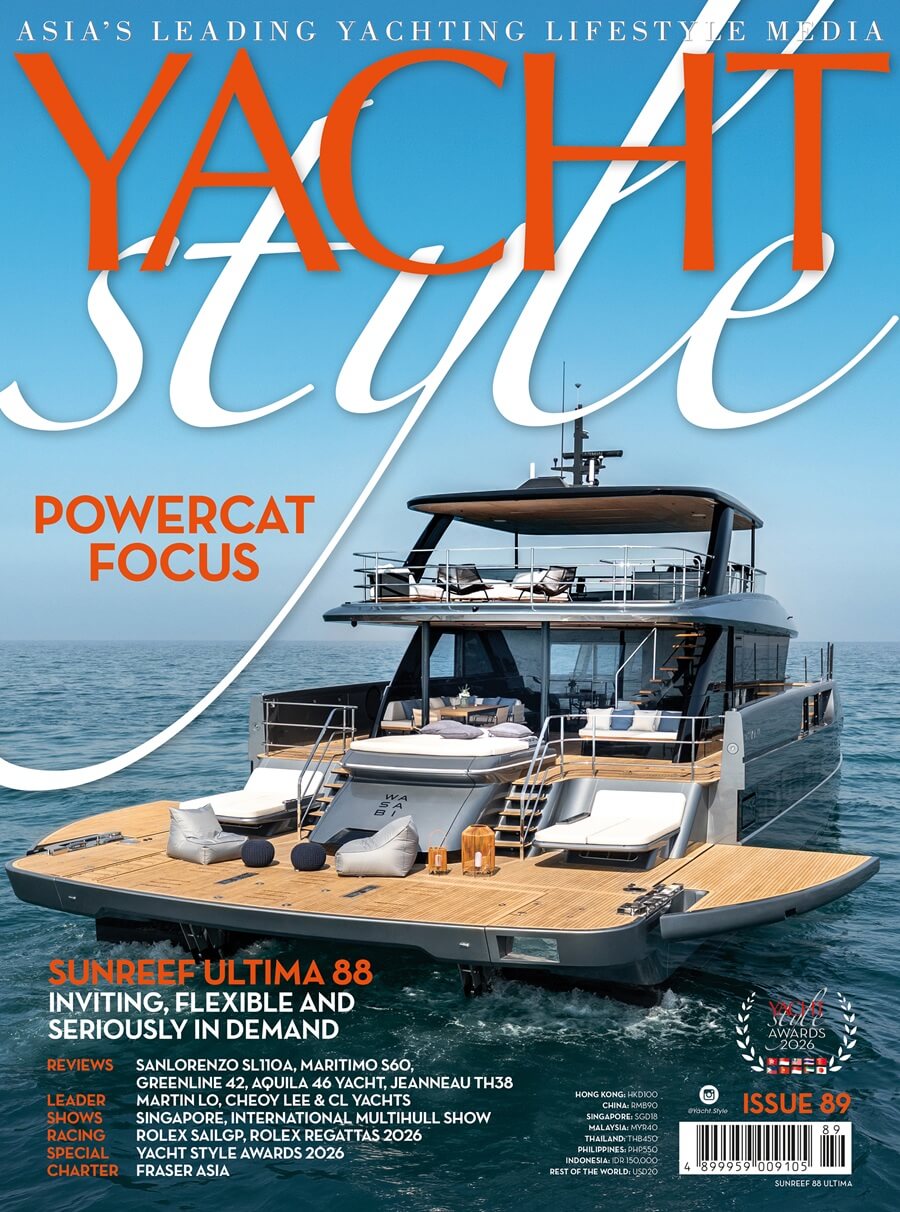
Founder and CEO of Archipelago Yachts, Dr Stephen Weatherley explains in a Column for Yacht Style why he believes methanol is the yachting industry’s best option among alternative fuels.

As the marine industry faces growing pressure to decarbonise, methanol is emerging as a realistic, scalable solution, bridging today’s technology with tomorrow’s zero-carbon ambitions.
From container ships to superyachts, the maritime industry accounts for nearly 3 per cent of global greenhouse-gas emissions. Regulators are tightening standards, consumers are demanding cleaner alternatives, and the window for action is narrowing. For decades, diesel has dominated, but its reign is ending.
A fuel once overlooked, methanol is now surging to the forefront of the decarbonisation debate. Its appeal lies in practical versatility of cleaner combustion, relative safety and ease of storage, and renewable production potential. Recently, Archipelago Yachts was part a consortium of marine companies that secured UK Government funding to launch Methanol Pathfinder UK, a methanol range-extension project, signalling that innovation is accelerating from theory to reality.
For the leisure boating sector, methanol offers unique advantages. Unlike hydrogen, which requires high-pressure storage tanks or cryogenic systems, methanol remains liquid at ambient temperature and handles easily. Batteries offer zero local emissions, yet limited range makes them impractical for extended cruising. Methanol bridges these gaps, balancing performance, safety and environmental responsibility.
DECARBONISATION CHALLENGE
International shipping produces nearly 1 billion tonnes of CO2 annually. Beyond carbon dioxide, pollutants such as nitrogen oxides, sulphur compounds and particulate matter contribute to air pollution, while some of them also play a role in ocean acidification, leading to far-reaching consequences.
The International Maritime Organisation has mandated a 40 per cent reduction in carbon intensity by 2030 and a 50 per cent reduction in total emissions by 2050, both compared to 2008 levels. Upcoming regulations may impose carbon pricing and emission standards that make business-as-usual untenable. Even luxury yacht markets, once insulated from scrutiny, now face pressure.
As a result, high-net-worth individuals are increasingly demanding vessels that reflect their values, emphasising that sustainability credentials matter as much as performance. Marinas and ports are also introducing green berth incentives and, in some cases, restricting high-emission vessels.
Despite this, diesel remains entrenched in the industry. Its energy density, established infrastructure and proven reliability have made it the default choice. But beyond emissions, diesel carries a reputational burden. Plumes of black smoke and visible environmental impact have become increasingly difficult to justify in an era of heightened ecological awareness.
METHANOL’S RISING STAR
Methanol’s credentials are compelling. Liquid at room temperature and traded globally for decades as an industrial feedstock, it offers infrastructure familiarity that reduces adoption barriers.
What distinguishes methanol is its production pathway. While conventional methanol derives from natural gas, renewable e-methanol can be synthesised from captured CO2 and green hydrogen produced via electrolysis powered by renewable energy.
This circular approach means combustion CO2 emissions are balanced by the CO2 captured during production, achieving net-zero emissions over the full lifecycle. As renewable energy costs fall, e-methanol economics improve, making it genuinely scalable.
Methanol also delivers tangible combustion benefits: significantly lower nitrogen oxide and particulate emissions than diesel, zero sulphur emissions, and carbon dioxide reductions of up to 15 per cent even with fossil-derived methanol, approaching zero with renewable variants.
Crucially, methanol integrates with existing engine technologies. Modified internal combustion engines can run on methanol with minor adjustments, avoiding wholesale redesigns. It also works with fuel cells, where methanol reforms into hydrogen onboard, enabling zero-emission propulsion without pure hydrogen’s storage challenges.
All alternative fuels come with drawbacks, especially for the leisure yachting industry:
· Hydrogen requires storage at -253°C or extreme pressure, creating unsuitable safety and space challenges for leisure vessels
· Ammonia is highly toxic and corrosive, presenting risks difficult to mitigate in confined yacht spaces
· Battery-electric propulsion remains hobbled by limited range and lengthy charging times
· Liquefied natural gas (LNG), once a transitional fuel, is losing favour as methane leakage undermines climate credentials, and it remains a fossil fuel
· Bio-diesel and synthetic diesel face feedstock availability and lifecycle emission questions, alongside potential storage challenges at low temperatures
Methanol strikes a pragmatic balance: safe, scalable, available now, with a clear pathway to full decarbonisation as production matures. Commercial shipping has already taken notice, with Maersk now committing to methanol dual-fuelled vessels, with multiple containerships operational or under construction. This trickle-down effect is reaching the leisure market, where yacht builders explore how methanol technologies proven at commercial scale can adapt for private and charter vessels.
FACING HURDLES
Despite its promise, methanol faces its own challenge, with renewable e-methanol remaining in limited production. Scaling requires substantial investment in renewable energy, carbon capture and electrolyser facilities.
Equally, bio-methanol – where breakdown of organic matter produces methane gas, which can be converted to methanol – is in its infancy. Both current ‘green’ methanol prices are several times higher than fossil methanol, although costs are expected to fall.
Safety and regulatory frameworks also present various hurdles. Methanol is toxic if ingested and mildly corrosive, requiring robust handling procedures. Certification bodies are still developing comprehensive standards for methanol-fuelled vessels, particularly in leisure markets. Without clear guidelines, uncertainty slows adoption.
Infrastructure is perhaps the most immediate constraint. Methanol refuelling facilities are sparse outside industrial ports, and leisure marinas lack incentive to invest without critical mass. This creates a chicken-and-egg problem: owners hesitate without convenient refuelling, while operators won’t install infrastructure without guaranteed demand.
Integrating methanol systems within yacht confines also presents engineering challenges. Methanol has roughly half diesel’s energy density, requiring larger tanks for equivalent range. This impacts weight distribution, storage and interior layout. These trade-offs require careful management to preserve performance and comfort.
Government support is critical, with programmes like Innovate UK’s funding helping to de-risk early development, enabling prototyping that would otherwise be financially prohibitive. Grants, incentives and regulatory frameworks favouring low-carbon fuels can accelerate adoption.
COMMERCIAL TO LEISURE
The leap from commercial vessels to leisure yachts requires translating industrial robustness into elegance and comfort. Technologies proven in harsh commercial environments must be refined and integrated where aesthetics and user experience are paramount.

Archipelago zero.63
The Archipelago zero.63, designed in collaboration with Chartwell Marine, exemplifies this evolution. Designed as a methanol-hydrogen hybrid, it combines parallel hybrid propulsion with onboard reformers and fuel cells alongside a methanol combustion engine, enabling long-range, zero-carbon cruising.
The vessel’s design is centred on flexibility and resilience. The methanol engine provides reliable propulsion and range extension, while fuel cells offer silent, emission-free operation for coastal cruising and harbour manoeuvring. Reformers convert methanol into hydrogen on demand, eliminating high-pressure storage needs, an elegant solution prioritising practicality without sacrificing ambition.
With the Archipelago zero.63, we’re demonstrating what’s possible when you combine existing technologies innovatively. Methanol gives us the range and reliability clients expect, while the hybrid architecture allows zero emissions when it matters most.
BLUEPRINT FOR CHANGE
Methanol’s value lies in being a bridge. It’s practical enough to deploy today, while offering a clear pathway to full decarbonisation as renewable production scales. This dual character suits an industry in transition.
For yacht builders, methanol represents a differentiation opportunity. As regulations tighten and preferences shift, early adopters gain competitive advantage. Collaborations such as our work with Chartwell Marine are essential, combining expertise to cut risk and bring solutions to market faster.
Ports and marinas must evolve in tandem. Installing methanol infrastructure requires investment but positions facilities as leaders in the green transition.
Demonstration vessels are essential for building confidence in new maritime technologies. Projects like the Methanol Pathfinder UK provide empirical data on performance, reliability and emissions that inform both regulatory frameworks and commercial decisions. Each successful voyage strengthens the case for wider adoption.
ROAD AHEAD
Methanol’s journey is accelerating, but mainstream adoption requires coordinated action: expanding production, building infrastructure, refining safety standards and demonstrating real-world performance.
The yachting sector has an opportunity to rewrite its narrative. By embracing methanol and sustainable technologies, the industry can position itself as a leader where innovation and environmental stewardship coexist, where luxury is redefined not by conspicuous consumption but by responsible excellence.
DR STEPHEN WEATHERLEY

Weatherley is the founder of Archipelago Yachts, a British yacht builder specialising in innovative aluminium hybrid motor-catamarans. A lifelong sailor, he combines a deep passion for the sea with British engineering expertise to create capable, efficient and sustainable vessels designed for adventure seekers and long-range cruising.
info@archipelago-yachts.co.uk


