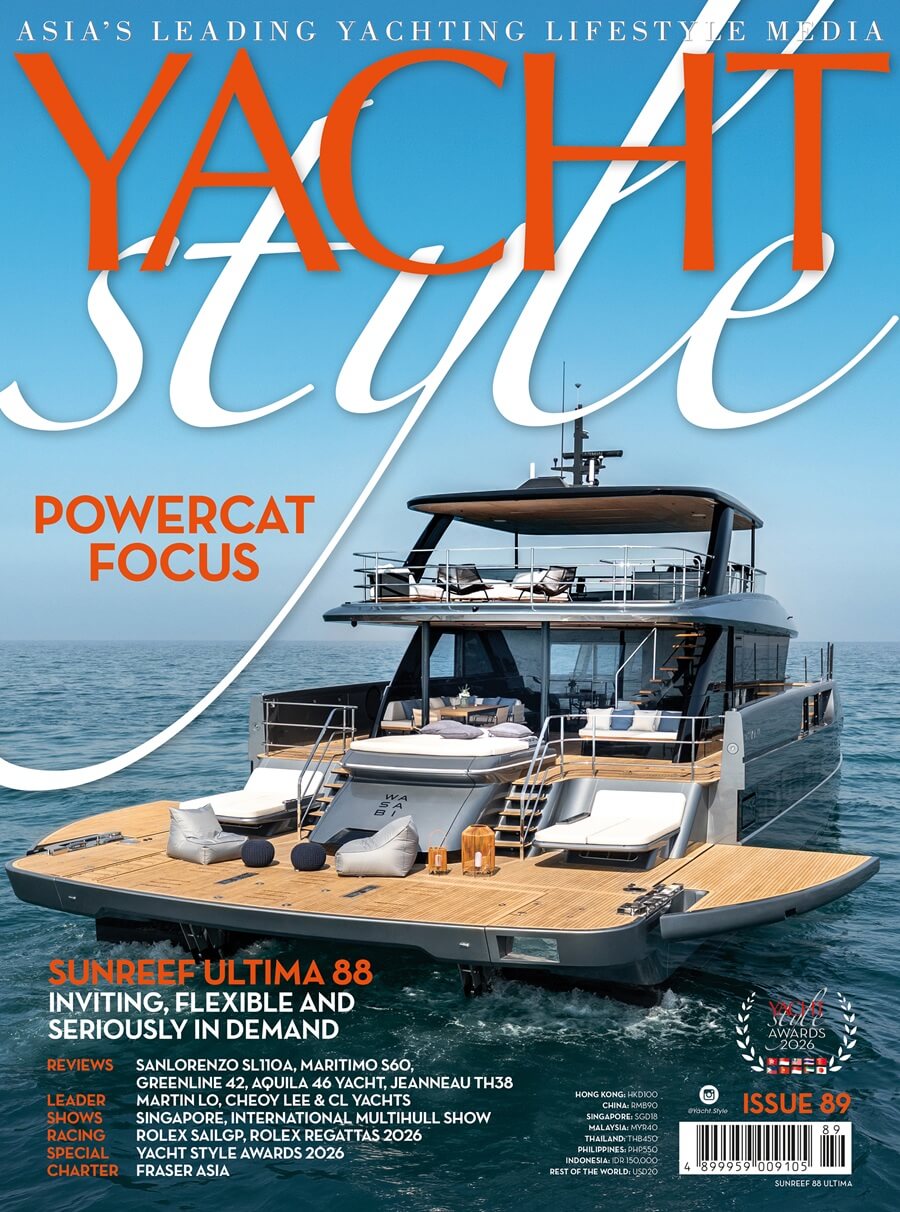
Yacht Style, Issue 88
Read and download copy
Yacht Style, Issue 86, Top 100 Superyachts of Indo-Asia-Pacific 2026, Jonathan Beckett, Burgess, Erwin Bamps, Gulf Craft Group, Fraser, Camper & Nicholsons, AB Yachts, AB 95, Van der Valk, Lalabe, Azimut, Grande 30M, Ferretti Yachts, 940, Absolute, Navetta 62, Cannes Yachting Festival, Genoa International Boat Show, Monaco Yacht Show, Lantau Yacht Club Boat Show - Festa Nautica, Rolex SailGP, Maxi Yacht Rolex Cup, Rolex Middle Sea Race, Phuket King’s Cup Regatta, Thailand, Port Takola Yacht Marina & Boatyard, Krabi, Yousuf Al Hashimi, Phoenix Yacht Management, Su Lin Cheah, ICOMIA, Suzy Rayment, Asia-Pacific Superyacht Association, APSA
Read and download copy

Asia's leading yachting lifestyle media

More results...

Generic selectors
Exact matches only
Search in title
Search in content
Post Type Selectors
Screenshot 2026-01-16 at 9.52.20 AM
Read your copy

More results...

Generic selectors
Exact matches only
Search in title
Search in content
Post Type Selectors

More results...

Generic selectors
Exact matches only
Search in title
Search in content
Post Type Selectors

Leaders

Theo Loock, Robertson and Caine, Leopard Catamarans, V&A Waterfront, African Boating Conference, Veda Pretorius, Maryanne Edwards, Marguerite Vockerodt

Theo Loock: People before product

SHARE

Theo Loock: People before product

SHARE

Managing Director of Robertson and Caine, builder of Leopard catamarans, Loock focused on the shipyard’s philosophy of craft, care and collaboration in his keynote speech at the first African Boating Conference.
Words: Maryanne Edwards; Photos: African Boating Conference


Theo Loock, Robertson and Caine, Leopard Catamarans, V&A Waterfront, African Boating Conference, Veda Pretorius, Maryanne Edwards, Marguerite Vockerodt

Theo Loock, Robertson and Caine


When Theo Loock, Managing Director of Robertson and Caine, took the stage at the sold-out African Boating Conference in Cape Town, his message was clear: boatbuilding in Africa is not just an industry – it’s a story of skill, pride and shared purpose.


As one of the continent’s largest and most successful yacht manufacturers, Robertson and Caine has become synonymous with the Leopard Catamarans brand, exporting luxury sailing and power catamarans to a global market that spans the Caribbean, Mediterranean, Americas, Asia and beyond.


This year, the company celebrated a major milestone, the launch of its 3,000th vessel, an achievement that speaks volumes about South African capability and consistency on the world stage.


“For us, boatbuilding is more than a craft. It’s a reflection of our values: respect, responsibility, reliability, innovation, teamwork and excellence,” Loock said. “This achievement represents more than just a number; it’s about the 3,000 families who have chosen Robertson and Caine over the past 34 years.”


One Team, One Vision

At the heart of that success is a philosophy Loock calls ‘R&C One Team’ – a people-first approach that underpins every stage of design, build and delivery. With over 2,600 team members, the company functions as a “learning organisation”, investing deeply in training and skills development to ensure that every catamaran launched in Cape Town meets the highest international standards.


“We build people who build award-winning catamarans, safely and sustainably,” Loock said. “Our team is the real engine of this company.”


That focus on people and process has earned R&C a reputation for reliability and innovation. From the aerodynamic hulls of the Leopard 53 Powercat to the seamless flow and natural light of its sailing catamarans, each vessel blends performance and comfort in a way that reflects both global trends and local ingenuity.


Cape Town: The Perfect Port

Loock’s presentation, ‘Boatbuilding in the African Context’, highlighted why Cape Town has become a leading location for yacht construction. With its deepwater port, skilled workforce and strong support infrastructure, the city has nurtured a thriving boatbuilding ecosystem.


Theo Loock, Robertson and Caine


Facilities like the V&A Waterfront and the Royal Cape Yacht Club play a vital role in this network, offering berthing, commissioning and export support for local manufacturers.


“The V&A’s partnership with the marine industry demonstrates how strategic collaboration can fuel both industry growth and job creation,” Loock said. “It’s a model that shows how private enterprise and infrastructure can work together to drive blue economy opportunities for Africa.”


Local suppliers also feature prominently in R&C’s success story. Longstanding partners such as Seascape Marine Services – which has supplied over 5,000 Yanmar engines to the shipyard over the past 35 years -– ensure that world-class quality remains accessible within South Africa.


Meanwhile, homegrown manufacturers like NCS South Africa, producing advanced polymers and composites, underscore the industrial maturity that underpins the sector.


An Industry on the Rise

Robertson and Caine is far from alone in its achievements. Loock’s talk generously spotlighted other South African builders shaping the global market, from Southern Wind, known for its high-performance carbon sailing yachts, to Two Oceans, Nexus, Royal Cape Catamarans, Forty Knots, Gemini Marine, Jacobs Bros and Hammer Yachts.


Together, these companies are redefining what it means to build boats in Africa: not as a niche or emerging industry but as a world-class manufacturing sector driven by expertise, resilience and creativity.


“The most beautiful boats in the world are being built here — by African hands, in Africa’s most beautiful city,” said Loock, closing his presentation with quiet pride.


In that statement lies the essence of the message – that Cape Town is more than a production hub. It’s a place where craftsmanship, community, and coastline combine to create vessels that sail far beyond the shores where they were made, carrying with them the spirit of a continent on the rise.


The Personal Touch

African Boating Conference Director, Veda Pretorius, and I were privileged to be invited by Marguerite Vockerodt, General Manager of Quality and Customer Relationships at Robertson & Caine, for a personal cruise through the V&A Waterfront aboard one of the company’s latest catamarans, a sleek new model being commissioned and readied for shipment to the USA.


Veda Pretorius, Marguerite Vockerodt and Maryanne Edwards


What an experience, and what a vessel. It’s immediately clear why these catamarans enjoy such global popularity. The ride offered not only a glimpse of outstanding craftsmanship but also the pride and passion behind every Robertson & Caine build.


It was equally rewarding to see the company’s strong support for the inaugural African Boating Conference (ABC), with Theo Loock serving as keynote speaker and several senior team members, including Marguerite, in attendance. Marguerite’s depth of knowledge, professionalism and warmth make her an exceptional ambassador for the brand.


Veda was also delighted to receive a personal note from Theo after the event, congratulating her on what he called “a great conference”. He added with characteristic wit: “I think the ABC is missing a D – D for delightful.”


In many ways, his comment captured the spirit of the event: a dynamic, well-attended and genuinely uplifting gathering, where more than 200 industry stakeholders from across Africa came together to chart a new course for the continent’s boating future. With this kind of enthusiasm and collaboration, the African boating industry’s horizon looks brighter than ever.

leopardcatamarans.com

robertsonandcaine.com

africanboatingconference.com


Theo Loock: People before product Read More »

Yacht services, yacht management, yacht brokerage, Singapore, APAC, Asia-Pacific, DCH Marine, Sunseeker, Saxdor, Willams Jet Tenders

DCH Marine’s growing presence in Southeast Asia

SHARE

DCH Marine’s growing presence in Southeast Asia

SHARE

Andy Toh, DCH Marine’s Singapore Country Manager, explains how the company is developing in the Lion City and other Southeast Asia markets.


Andy Toh, Singapore Country Manager, DCH Marine


DCH Marine is a growing Hong Kong-based, Asia-Pacific yacht services business which regionally distributes the Sunseeker, Saxdor and Willams Jet Tenders brands. Singapore Country Manager Andy Toh spoke to Andrew Dembina about the company’s expansion, with recent highlights including hosting VIPs on a Sunseeker Manhattan 68 at a privileged berth during the Formula 1 Singapore Grand Prix.


Andy, what has been your focus since DCH Marine opened its Singapore office in June 2024?

As Country Manager, my responsibility is primarily to take care of and manage the Singapore office, and to also work on sales of both new and brokerage boats. Singapore is near Malaysia and Indonesia, where we expect more marinas will be opening soon, so I’m also taking care of these markets. Vietnam is another market, and is growing slowly.


Yacht services, yacht management, yacht brokerage, Singapore, APAC, Asia-Pacific, DCH Marine, Sunseeker, Saxdor, Willams Jet Tenders

Sunseeker Manhattan 68


However, our focus remains on Singapore because we manage parts of our Southeast Asia business through this office. As a yacht hub, we have all the after-sales tech and logistics situated locally.


Previously, I worked in marine components sales in Singapore including for the distributor of Swedish OXE outboard engines, and for the company selling US-made Seakeeper stabilisers.


Sunseeker 90 Ocean


What are DCH Marine’s plans for adding to its offices in Asia-Pacific?

Singapore was the first office outside of Hong Kong, and not within the Hong Kong and China market. We have offices due to open soon in Thailand and coming up after that in Australia. The Thailand operation that we’re setting up now will be in Phuket and will be run by my colleague Danny Zheng as the Thailand Country Manager.


Danny Zheng, Thailand Country Manager, DCH Marine


Across the region, the current yachting market is experiencing a period of steady adjustment since the Covid pandemic’s over-supply of yachts. But after-sales services are going well, which is very important for us and owners, and we are now seeing some light at the end of the tunnel.


Yacht services, yacht management, yacht brokerage, Singapore, APAC, Asia-Pacific, DCH Marine, Sunseeker, Saxdor, Willams Jet Tenders

Sunseeker 90 Ocean saloon


DCH Marine presented the Asia-Pacific premiere of the Sunseeker 90 Ocean at Singapore Yachting Festival 2025 and will do likewise in Hong Kong with the 90 Ocean Enclosed at this year’s Lantau Yacht Club Boat Show – Festa Nautica (October 17-19). How do these models suit regional owners?

These 90-footers have generated a lot of interest in our market – they are totally different boats. They not only have the capability of long range but are also spacious and luxurious. In terms of volume and deck space, they’re comparable with 100ft-plus yachts. The enclosed-flybridge version has caught a lot of interest because in our region’s tropical climates, some owners want full air-conditioning.


Yacht services, yacht management, yacht brokerage, Singapore, APAC, Asia-Pacific, DCH Marine, Sunseeker, Saxdor, Willams Jet Tenders

Sunseeker Manhattan 68 saloon


What are the attractions of the Sunseeker Manhattan 68 in your inventory?

It has the same key factors as the upgraded Manhattan 68 (2025) in terms of performance and luxury. Its Asia-Pacific layout has three cabins, instead of the four that are standard. This allows for a very large, luxurious master suite with separate study and lounge areas. Also, there’s one staircase to the lower deck, rather than the standard two, which allows more social space in the saloon.

dch-marine.com


DCH Marine’s growing presence in Southeast Asia Read More »

Colin Dawson, The George Group, Asia, yacht, insurance, premiums, yachts, Yacht Style

Taking care to live the good life

Taking care to live the good life

SHARE

To maximise value and enjoyment of owning a yacht, there are important issues that, if not handled correctly, can turn the dream into a nightmare. Colin Dawson from The George Group has 30 years’ experience of looking after insurance and risk management matters for yachts, their crew and owners. In a Column for Yacht Style, he takes a view from both sides of the coin.

  •  
  •  
  •  


Colin Dawson, The George Group, Asia, yacht, insurance, premiums, yachts, Yacht Style

100 Sunreef Power; Photo: Sunreef Yachts


Moving towards the end of the European summer, we reflect on a Mediterranean season of fun, high jinks and sublime relaxation, quiet evenings on the aft deck alongside raucous parties celebrating something or other … or simply the fact that there doesn’t always need to be a purpose to party. All this catered to by exceptional service from amazing crew.


In parts of Asia, we move from a very hot summer to cooler weather where cruising and racing are altogether more pleasant. The southern hemisphere moves from winter woollies to T-shirts. There are yacht owners cruising between these areas, seeking untouched, almost private waters without a care (or seemingly another soul) in the world.


The above can only reliably be achieved if a vessel is well catered for operationally wise, including properly trained and qualified crew. Having been around the yacht industry for the past 30 years, the happiest owners I’ve come across are those who realise the true value of putting the right resources into their yachts to gain maximum enjoyment from them, while also ensuring a premium resale value.


I often compare a yacht to a racehorse. If it’s not given the best-possible attention, it will fail and cost you more in the long run.


In Asia, I think the single biggest challenge we have is persuading owners to put the right resources into their yacht. The owner and his office are constantly being approached by people who promise the earth for a discounted price. It’s hard to ignore this. However, it’s too late by the time owners realise that these people were not the saviours they promised to be.


To be honest, anyone basing service on a discounted price should raise big red flags anywhere. A pedigree yacht is not bought based on a low price and neither should the running of it be. Often, we find that decisions are left to admin staff who don’t understand the yacht or the complex contracts that surround it.


Important discussions should be taken together with the owner, captain and the staff handling the day-to-day side of yacht operations.


When contracts are to be signed, a lawyer should be involved, looking after the owner’s best interests and protecting those in the owner’s employ who are not legally minded. Before an insurance quote is obtained, a broker should be interviewed well in advance of the inception date, so their true level of knowledge and experience can be assessed.


Colin Dawson, The George Group, Asia, yacht, insurance, premiums, yachts, Yacht Style

100 Sunreef Power; Photo: Sunreef Yachts


I’m often told that another quote has been received that has identical cover, but a cheaper price. Price is plain to see, but the level of cover provided, the experience and integrity behind the person offering it, along with the insurer’s ‘willingness to pay claims’, are not.


All too often in our industry we see a purely price-based decision that comes back to haunt people. Of course, I generalise and there are fantastic owners out there who really do place a great importance on the operational requirements of their yachts. I’m lucky enough to count a number of these as my clients and am very grateful for them.


Generally, people I speak with worry about increased premium, less cover and higher deductibles. The yacht insurance market has been a ‘hard market’ since 2017. As we see other areas of insurance fall into a ‘soft market’, yacht insurance continues to struggle to find a happy place.


This said, today the average cost of insurance is about 5 per cent of the annual cost of running a yacht. Thus, even if a quote is 20 per cent higher than the next, the dollar amount won’t make a difference in real terms to the yacht’s operating costs.


Underwriters have relied on increased premiums, higher deductibles and reducing cover to mitigate claims. Certain risks are excluded, although often these exclusions are slapped on without any examination into the ‘real risk’ versus ‘perception of risk’. While these will help a bit, the real difference will come if the numbers of claims are reduced. This would benefit insurers and owners.


To achieve this, insurers, brokers and owners need to work together to reduce the likelihood of claims arising. This involves higher standards all round, from maintenance to crew, and more trust in the quality providers of services rather than cheaper ones. With this, insurers need to be on hand to give incentives to owners who make the effort to reduce the risks to their yachts.


In March 1799, Patrick Henry’s last public speech included the phrase: “Let us trust God and our better judgment to set us right hereafter. United we stand, divided we fall.” All of us in this industry have a part to play in its future, and by working together everyone will get the best out of it.


COLIN DAWSON


Colin Dawson, The George Group, Asia, yacht, insurance, premiums, yachts, Yacht Style


Based in Hong Kong since 1994, Dawson is a specialist yacht insurance broker with three decades of experience in the Asia-Pacific market. In 2009, he set up The George Group, which partnered with Expat Marine until Howden Group acquired the latter in 2021. The George Group now partners with Howden’s Hong Kong and regional offices. Dawson is also a member of Global Marine Business Advisors and was the Founding Chairman of the Asia-Pacific Superyacht Association, a post he held until 2016. A passionate conservationist, he set up The Elephant Foundation in 2014, hosts the annual Elephant Week in Hong Kong, and runs the San Fernando Race Foundation for underprivileged children in the Philippines.

colindawson@tgg.com.hk / www.howdenhk.com


SHARE

Taking care to live the good life Read More »

Lürssen, 1875, 2025, book, Friedrich Lürssen, Peter Lürssen, Azzam, Dilbar, Limitless, Michael Breman, Octopus, Rising Sun, Eos, Cosmos, Kismet

History: Lürssen’s First 150 Years

History: Lürssen’s First 150 Years

SHARE


The world’s leading builder of very large superyachts has published a coffee table book to mark its first 150 years from 1875 to 2025.
Words: Bruce Maxwell; Photos: Lürssen

  •  
  •  
  •  


Lürssen, 1875, 2025, book, Friedrich Lürssen, Peter Lürssen, Azzam, Dilbar, Limitless, Michael Breman, Octopus, Rising Sun, Eos, Cosmos, Kismet

Cover of the book released in Monaco


Shipyards and superyacht owners tend to be aficionados of expensive, well-bound coffee table books. An artform in itself, Lürssen has published a second such tome to mark its first 150 years from 1875 to 2025, scheduled for release at Monaco Yacht Show this year.


An earlier 240-page private volume simply called Lürssen covers the period from 1875 to 2000, but so much has happened in the first quarter century of the new millennium that a broader sweep was thought necessary.


The renowned German yard has, in this period, firmly established itself as by far the world’s leading builder of very large superyachts, while retaining a strong presence in the 60-100m market, and

introducing new eco-fuels and eco-systems to power its fast-growing fleets of custom-designed vessels.


Lürssen, 1875, 2025, book, Friedrich Lürssen, Peter Lürssen, Azzam, Dilbar, Limitless, Michael Breman, Octopus, Rising Sun, Eos, Cosmos, Kismet

Lürssen founder Friedrich Lürssen


Surprisingly it is still family-owned. Rival Dutch yards like Van Lent, Rotterdam’s Oceanco, Heesen, Royal Huisman and Moonen have been sold to diverse investors, but Lürssen has instead acquired acclaimed yards like Blohm & Voss in the last decade, with its substantial facilities in Hamburg.


Fourth-generation Peter Lürssen quotes his founding forebear Friedrich Lürssen in the first book: “My firm shall be known as a leader in both quality and performance.”


Then he comments: “That’s what Friedrich said in 1875. It is still our policy today. We have remained, and will continue to remain, faithful to his promise. This shipyard is proud to have built ships, boats and yachts which have won praise throughout the entire world.”


Lürssen, 1875, 2025, book, Friedrich Lürssen, Peter Lürssen, Azzam, Dilbar, Limitless, Michael Breman, Octopus, Rising Sun, Eos, Cosmos, Kismet

Peter Lürssen, Friedrich’s great grandson, has carried on the family tradition of quality and innovation


Boat International says online that Lürssen built 14 of the current top 25 largest yachts in the world, although that magazine includes decidedly oddball entries like the classic El Mahrousa constructed in the mid-19th century and being kept afloat, allegedly, by the Egyptian Navy in Alexandria.


Wikipedia opts for 29 of the top 100 being Lürssens, and doubtless the Dutch digital site superyachttimes.com has updated figures, but we all agree that Azzam at 180.6m (Lürssen, 2013) leads the way, followed by Eclipse 162.5m (Blohm & Voss), Blue 160.6m (Lürssen), Dilbar 156m (Lürssen), Al Said 155m (Lürssen), A+ 147.7m (Lürssen), Prince Abdulaziz 147m (1984, one-off Danish yard), Opera 146.4m (Lürssen, 2023) and Dragonfly 142m (Lürssen, 2024).


Then come a brace of Italian Fincantieris, a yard that mostly produces cruise ships. Blue is a quite recent launch, and Dragonfly, one of the largest and most impressive yachts delivered last year, is a familiar name in the South Seas, where her predecessor played a welcome leading role in cyclone relief for remote islanders.


Lürssen, 1875, 2025, book, Friedrich Lürssen, Peter Lürssen, Azzam, Dilbar, Limitless, Michael Breman, Octopus, Rising Sun, Eos, Cosmos, Kismet

Middle East-owned Azzam at 180.6m is presently the world’s largest superyacht by LOA, seen here at part of Lürssen’s extensive facilities


Another parameter arises here, as to whether ‘largest’ should mean length overall (LOA) or volume. By the latter yardstick, the latest Dilbar would be #1 and other contenders are long but comparatively narrow-beamed, thus have far smaller volume. Gross tonnage is another measure.


Next up in the #1 LOA spot is expected to be the 195m Rev Ocean designed by Espen Øino and being built in Norway, due for delivery in 2026. She is a kind of expedition ship with ocean ecology ventures in mind and potentially large groups of scientists aboard.


Lürssen has eight yards in Germany, but only three are used for superyachts, the rest being employed for naval and commercial ship construction, and refits and repairs. Some naval vessels for other countries are built under licence in those countries, but are still called Lürssens.


Lürssen, 1875, 2025, book, Friedrich Lürssen, Peter Lürssen, Azzam, Dilbar, Limitless, Michael Breman, Octopus, Rising Sun, Eos, Cosmos, Kismet

Latest Dilbar is 156m LOA but measured by volume, she is the world’s largest superyacht


Whether these yards can all be kept profitably utilised is the obvious challenge, but Peter Lürssen has delivered detailed occasional lectures to the International Superyacht Society and other groups addressing precisely this topic, and his underlying message is clear. If a project doesn’t stack up financially from the outset, don’t do it, advice that not a few superyacht yards in the past quarter century may rue not having taken.


His own roots stem from the small towns of Lemwerder and Vegesack, which face each other across the River Weser, just outside Bremen CBD, and upriver of its principal port Bremerhaven in northern Germany.


Design Awards were a forte of the ISS, and America’s Showboats and Europe’s Yachts International began prestigious award schemes for such vessels. YI was bought in the Naughties by American interests, and its awards are continued today by Yachts France, while Boat International, also originally French-owned, was purchased by British shareholders, and has, relatively recently, started its own much-hyped awards.


Lürssen, 1875, 2025, book, Friedrich Lürssen, Peter Lürssen, Azzam, Dilbar, Limitless, Michael Breman, Octopus, Rising Sun, Eos, Cosmos, Kismet

Limitless, delivered in the 1990s, introduced hybrid propulsion


In the very active 1990s Feadship, a combine of De Vries, Van Lent and naval architects De Voogt in the Netherlands, spent five years on the design and build of an innovative Double Haven for an Asia-based buyer, while one of Lürssen’s most striking contributions was the then-enormous 96m Limitless, delivered in 1997, which had the world’s first energy-efficient hybrid propulsion system aboard.


Two Caterpillar gensets, each of 2,680 horsepower, gave the ship a speed, via electric motors, of up to 17 knots, providing options distinct from those of the bigger diesels also fitted. The crew needed 19,000 pages of instructions on three CD-ROMs to fathom the hybrid concept and its uses.


Other deliveries in this decade included 59m Ronin built for a Japanese owner, 73m Coral Ocean currently being chartered as part of Australian Ian Malouf’s Ahoy Club, and the 139m Al Salamah.


Lürssen didn’t have a Yachts Division per se until 1988, when ebullient Malcolm Forbes of Forbes financial magazine started sailing around the world with Elizabeth Taylor on his Highlander IV, so the 1990s were still formative stages for private yacht sales and construction.


Lürssen, 1875, 2025, book, Friedrich Lürssen, Peter Lürssen, Azzam, Dilbar, Limitless, Michael Breman, Octopus, Rising Sun, Eos, Cosmos, Kismet

Engaging Sales Director Michael Breman


Michael Breman came across from Italian yard Baglietto as Sales Director, and Sylke auf dem Graben later arrived from Dutch superyacht yard Jongert and German superyacht dealer Herbert Dahm to handle media and related aspects.


Breman is the son of Dutch diplomatic parents, and during our first lunch in Vegesack he confided that he had been born in New Zealand, a fact that he was surprised I recalled in a subsequent piece decades later.


He is a bright, lively, knowledgeable and practical individual who fitted like a chameleon with Lürssen’s broadly-based clientele, and he and Peter Lürssen became famous for their parties in a national park during the Fort Lauderdale Boat Show.


Services such as foot massages were popular with invitees who had been walking around a boat show all day, but when they introduced Everglades alligator wrestling as another feature, and the alligators started winning, with ambulances called, the party program had to be tempered a little.


At first, we spent most time on the Lemwerder side of the river, only venturing to Vegesack to wine and dine via an irregular ferry service or car across a bridge upstream, but as Lürssen facilities grew on the Vegesack bank, this plus the enchanting little Havenhaus Hotel came more into focus.


Lürssen, 1875, 2025, book, Friedrich Lürssen, Peter Lürssen, Azzam, Dilbar, Limitless, Michael Breman, Octopus, Rising Sun, Eos, Cosmos, Kismet

Octopus ushered in the explorer vessel era


Our account thus reaches the 2000-2025 additional span of the latest book. The 71m Skat and 97m Carinthia VII were both delivered in 2002, and the late Paul Allen’s 126 m Octopus the following year. A founder of Microsoft with Bill Gates, Allen did much ocean research in the South Seas before his untimely passing, cruising in both Micronesia and the Philippines archipelago.


The IT revolution was getting into full swing, and 115m Pelorus and 138m Rising Sun for Oracle’s Larry Ellison followed in short order. Pelorus was often parked in the Viaduct Basin in Auckland when the Kiwis defended the America’s Cup in 2000 and 2003.


Lürssen, 1875, 2025, book, Friedrich Lürssen, Peter Lürssen, Azzam, Dilbar, Limitless, Michael Breman, Octopus, Rising Sun, Eos, Cosmos, Kismet

Rising Sun saw the emergence of new-breed IT-savvy owners


Ellison had earlier taken line honours in the 1998 Sydney Hobart Race in the maxi Sayonara, with Lachlan Murdoch as one of his foredeck crew.


Lürssen delivered the stately 93m schooner Eos in 2006, and other notables included 155m Al Said in 2008 and 110m Al Raya the same year. The Middle East continued as a thriving market, backed by old and new money in Europe and America, stacks of nouveau riche Russians, and more emerging buyers in Asia-Pacific waters.


Lürssen, 1875, 2025, book, Friedrich Lürssen, Peter Lürssen, Azzam, Dilbar, Limitless, Michael Breman, Octopus, Rising Sun, Eos, Cosmos, Kismet

Lovely schooner Eos showed Lurssen was equally capable of building classic super sailboats


The Naughties was completed with 85m Pacific, 90m Phoenix 2 and 124m Katara. Rival firm Amels, run by the also family-owned Dutch firm Damen, had by now launched its Limited Editions idea, reducing delivery times for private superyachts pre-built on proven hulls and outfitted platforms, which required some investment, but Lürssen stuck to its full custom strategy.


Stand-out Lürssen launches in 2010 to 2020 include 87m Ace, 147m Topaz, 180.6m Azzam, 86m Quattroelle, 85m Solange, 104m Quantum Blue, 95m Kismet, 156m Dilbar, 106m Amadea, 123m Al

Lusail, 85m Amatasia ex-Areti, 136m Crescent, 136m Flying Fox, 111m Tis, 98m Madsummer and 140m Scheherazade. Many of these vessels have Asia-Pacific connections.


In the last five years there has been the 142m Nord, 56m Moon Sand for an Asian owner, 115m Ahpo for an Asia-born owner, 160m Blue, 90m Norn, 146m Opera, 138.8m Luminance, 122m Kismet – the largest vessel at Monaco Yacht Show last year – for an Asian-American, 82m Haven and 142m Dragonfly.


Despite a setback because some but by no means all Russian owners have been ‘sanctioned’ due to Putin’s war on Ukraine, these measures are proving very expensive for would-be sanctioneers, and some cases are regarded as virtually unenforceable, so it is doubtful if they will cause more than a significant blip when viewed long-term, but the situation remains unsettled.


Apart from private yachts getting inexorably larger, as can be seen in Lürssen launches in the last quarter century, impressive technical and eco-innovations continue apace.


After the hybrid Limitless, by 2002 Lürssen was leading research into underwater exhaust systems, reducing back pressure and noise. Then, in 2005, it delivered the 90m Air, now Ice, which was the world’s first yacht with a pod drive. Four years later Lürssen introduced an advanced waste water system based on membrane technology, first used on the 60m Arkley, later called Caipirinha, and now standard on all its yachts. The 147m Topaz, now A+, was the first to feature a ballast water treatment system.


As part of its drive toward more responsible and sustainable solutions, Lürssen patented an innovative exhaust after-treatment system that reduces nitrous oxide emissions without affecting space, weight, noise or vibration. This has been standard on every Lürssen since 2016. It also launched Tesumo – a sustainable teak alternative – in 2020, which is now readily available in the industry, and was notably laid across the helideck of a recent vessel.


Lürssen, 1875, 2025, book, Friedrich Lürssen, Peter Lürssen, Azzam, Dilbar, Limitless, Michael Breman, Octopus, Rising Sun, Eos, Cosmos, Kismet

The owner of Cosmos, designed by Australian Marc Newson, agreed to a research installation of a methanol fuel cell


In 2026, Lürssen is delivering the 114m Cosmos, another immensely important breakthrough. The client has agreed to the research-installation of a methanol-powered fuel cell system. The methanol produces hydrogen, which is then converted into electricity.


This ground-breaking technology is intended to allow the yacht to remain effectively carbon neutral for up to 15 days at anchor and while cruising for 1,000 nautical miles at slow speeds. It has yet to be economically proved in some applications.


Comments Peter Lürssen: “It was my great grandfather who built the first motor boat in 1886, paving the way for yachting as we know it today. My dream is to ultimately build the first yacht without a combustion engine, marking the beginning of a new era for the industry.”


Lürssen, 1875, 2025, book, Friedrich Lürssen, Peter Lürssen, Azzam, Dilbar, Limitless, Michael Breman, Octopus, Rising Sun, Eos, Cosmos, Kismet

Lürssen and Daimler combined to build a ground-breaking motor boat, before cars had come into vogue in the early 20th century


What better reason for the latest book? By the time 2050 rolls around, and the whole fleet is running on methanol or whatever else has evolved, with others following suit, a third volume will probably not be out of place.


Lürssen has produced 70 bespoke yachts since the Yachts Division was launched in 1988, with a total length exceeding 6,500m, and its own statistic is that Lürssen yards today have built 35 of the world’s top 100 yachts.


These include 180.6m Azzam as the longest, 156m Dilbar as the largest by volume, and 126m Octopus as the world’s first explorer yacht, thus starting yet another trend that opened a productive new period.


“We don’t set out to build the biggest yachts,” says Peter. “We set out to build the best yacht for each client. Clients choose us for our engineering excellence, our ability to think outside the box, and our determination to fulfil their wishes, no matter how unreachable they may seem.”


Lürssen, 1875, 2025, book, Friedrich Lürssen, Peter Lürssen, Azzam, Dilbar, Limitless, Michael Breman, Octopus, Rising Sun, Eos, Cosmos, Kismet

Kismet at 122m was the largest yacht shown at Monaco last year; available for charter, she is owned by an Asian-American, and is sumptuously outfitted


The owner of award-winning 122m Kismet, reviewed in Yacht Style Issue 80, concurs: “Lürssen’s position is simple. If you can conceive it, they can do it, no constraints. I love that. The shipyard hits every metric to perfection, especially with technology. The seaworthiness of Kismet is incredible, and I am awestruck by the spaces and workmanship.”


Every decade or so, Lürssen invites a small group of specialist media to Germany to contemplate latest initiatives. During the last one in 2018, which also allowed me to attend the nearby 50th anniversary of Sir Robin Knox-Johnston’s first solo, non-stop passage around the world in 1968-69, we had a look at the Rendsburg superyacht yard near the Danish border, and the huge Blohm & Voss facility in Hamburg now under Lürssen ownership.


But despite a few other outliers, the undoubted heartlands of Lürssen remained in that Lemwerder-Vegesack bend of the River Weser. On the final afternoon, gazing from my quaint little hotel room window at ships voyaging upriver toward Bremerhaven, it wasn’t hard to imagine the future that Peter Lürssen had in mind, nor the admirable drive and experience that should see it to fruition.


In addition to yard activities, Lürssen currently supports 30 global projects to protect vast swathes of our oceans, through the Blue Marine Foundation, and has recently launched the Lürssen Foundation to support talented engineers and invest in startups and other organisations making a positive impact on the industry and related endeavours. Long may such worthy efforts continue.

yachts@lurssen.com

www.lurssen.com


SHARE

History: Lürssen’s First 150 Years Read More »

In Situ & Partners, Yacine Bensalem, Philippe Grasset, Galeon, 640 Fly, 620 Fly, 570 Sky, Skydeck

Hong Kong’s In Situ elevates Galeon interiors

Hong Kong’s In Situ elevates Galeon interiors

SHARE

Galeon has enlisted Hong Kong-headquartered In Situ & Partners – a specialist in hospitality, retail and residential interior design – to bring elevated aesthetics aboard its motoryacht lines. In Situ’s Yacine Bensalem and Philippe Grasset illuminate the exciting collaboration.
Interview: Andrew Dembina; Photos: In Situ & Partners

  •  
  •  
  •  


Yacine Bensalem, Principal and Founding Partner, In Situ & Partners; Photo: Giovanni Malgarini


Galeon, founded in Gdansk in 1982, has a global reputation for its wide variety of motoryachts ranging in overall length from 33-83ft. Over the past decade or so, the Polish builder’s Fly (flybridge), Skydeck (sportsbridge) and GTO/GTI (Grand Touring Outboard/Inboard) lines have impressed with pioneering innovations such as dropdown sides, waterside bars and forward saloon doors.


The shipyard’s collaboration with In Situ & Partners began when Galeon’s leadership was in Hong Kong and sought a fresh design perspective. A meeting was arranged with Yacine Bensalem, In Situ’s Principal and Founding Partner. Galeon was particularly interested in the studio’s extensive expertise in luxury and high-end design for top-tier hospitality, commercial and residential projects, valuing their outside perspective from the yachting world.


Philippe Grasset, Interior Design Director, In Situ & Partners; Photo: Giovanni Malgarini


A partnership was swiftly formed, with the project leadership assigned to Philippe Grasset, the studio’s Interior Design Director, a French designer whose aesthetic has been shaped by years living and working in Japan and Hong Kong.


This international mindset is at the core of In Situ’s identity. The studio is a cultural melting pot, a Hong Kong-based company with a global team that delivers designs for a local and worldwide clientele.


This ethos is personified by Bensalem, who was born in Algeria with Bulgarian heritage, grew up in Milan, and studied architecture in Paris. His professional journey, which included living and working in Brussels and Singapore before establishing himself in Hong Kong in 2007, reflects a deeply global outlook.


In Situ & Partners’ extensive portfolio includes the bar and lounge at Clarence


The diverse backgrounds of the team – including key designers Pietro Peciccia (Italian and German heritage), Frederic Nouvel (French with Polish and Spanish heritage) and Terri Yau (Australian Chinese designer with Hong Kong heritage) – were an ideal fit for Galeon’s global market ambitions.


The 640 Fly was your first Galeon model. What was your brief, when did it launch and what have been some highlights of the working process?

Bensalem: That first meeting with Jacek was a very open conversation. I explained that we had no experience in yachting. I had helped people with some fit-outs and styling on existing yachts but that was not redesigning a whole yacht [interior].


Jacek said Galeon had enough in-house technical and design resources to guide us and fill the gaps in our knowledge. He was looking for designers with an international vision who could understand different markets, particularly China and Asia, as well as Europe and North America, which are Galeon’s main targets.


In Situ & Partners designed the interiors of Galeon’s refreshed 640 Fly, a world premiere at Boot Düsseldorf 2025


He needed people who could understand and federate these three markets through design, perhaps with different palettes, and who understood the luxury markets and expectations of ultra-high-net-worth individuals.


After our discussion, he felt we had this understanding and that we could be the right company for the job. I immediately knew Philippe, our Design Director, was the perfect person to lead this exciting new challenge. It also helped that we get things done very quickly in Asia. Hong Kong’s efficiency, combined with our international exposure, would all be a good fit.


Galeon gave us a fairly free hand. Our plan was to reinterpret traditional boat design codes in a more contemporary fashion. Our ingredients would be high-gloss marine lacquers, mirror stainless steel, walnut and teak wood. The lines we created are very contemporary, with curves, intricate junction details, shadow gaps and invisible light sources, more commonly found in luxury retail or homes rather than in boating design.


We had weekly meetings with their design department starting June 2024, and our first redesigned Galeon interior, the 640 Fly, was presented at Boot Düsseldorf in January this year.


The studio then worked on Galeon’s new 620 Fly, which debuted at the Cannes Yachting Festival


Grasset: Yes, and we have completed six designs including five from the Fly series: the 640, followed by the 620 then three more. More recently, we’ve done the 570 Sky, which looks sportier, and there will be more Skydeck models to come.


We’ve just started on the smaller GTO/GTI dayboat series, which is quite sporty and party style. For the upcoming model, we are aiming to make it more colourful and joyful. The Fly series now has five different interior options, the Skydeck line has three, and we are working on design options for the GTO/GTI.


What truly distinguishes Galeon in the European market is its fully integrated, in-house production. Unlike many historically established yards that rely on subcontractors, Galeon employs 1,600 professionals across two large manufacturing facilities, and operates dedicated internal workshops for metalwork, woodworking, glass, leather and upholstery.


We recognised early that the shipyard’s philosophy was to showcase this master craftsmanship, often by artfully combining materials like wood, metal and leather.


Forward view across the aft cockpit dining table and into the saloon on the Galeon 620 Fly


Bensalem: This point Philippe makes is a very important competitive advantage for Galeon. Subcontracting these crafts would incur astronomical costs. Because it’s done in-house, it can be coordinated perfectly as all the trades are in the same facility. This makes coordination possible and allows for certain impressive details to be achieved at a very reasonable price.


Have your interior commissions for Galeon included any discussions with their naval architecture and exterior design collaborators, UK-based Tony Castro Yacht Design or Roberto Curtò’s Italy-based RC Design?

Bensalem: Not really. We’re working directly with the Galeon design team. But it’s interesting that although Galeon is a Polish shipbuilder that started during the communist era, it has become very open to the world, now using a Southampton-based Portuguese naval architect, Tony Castro, and a Hong Kong-based international company for interior design.


As Galeon models were your studio’s first full yacht interiors, what could you draw from in terms of commercial, club and residential spaces that In Situ has designed, besides the lighting you mentioned earlier?

Bensalem: There was quite a lot we could draw upon. As Philippe noted, Galeon possesses remarkable in-house artisanal know-how and craftsmanship, which is something we always strive to highlight in our projects, whether it’s a restaurant, residence or now a yacht.


We deeply enjoy creating designs that celebrate skilled workmanship. This often means combining materials in unexpected ways and incorporating intricate details that elevate the entire space. That philosophy translated very naturally to the yacht interiors.


The Galeon 620 Fly’s master suite has direct access to the drop-down bulwark on the port side


Grasset: And there was a learning curve on ergonomics. For hospitality or residential projects, we always consider dimensions for comfort and reach. On a yacht, with its tighter environment, we still try to bring those comforts that we are used to implementing in other environments.


What other yacht-specific aspects has In Situ had to address in the interior, considering objects on board move when underway, materials need to hold up to saline, sometimes wet conditions, and other challenges changing from on-land to on-water design?

Grasset: We received invaluable support from Galeon’s in-house team on these practical challenges. They were essential in vetting our material choices, advising against those that couldn’t withstand the marine environment. This guidance was constructive. They introduced us to a range of suitable, high-performance alternatives including impressive synthetic materials that are exceptionally durable without compromising on style.


How would you describe differences between In Situ’s designs for new Fly models compared to the series’ previous interiors?

Grasset: I’m proud of them all, especially the first two we did – the 640 Fly and 620 Fly. After these models, our work was about finding ways to simplify smaller vessels and speed up the execution while keeping the spirit of these two initial yachts.

Bensalem: Yes, the 640 Fly and 620 Fly were really breakthrough moments.

Grasset: Then, when we moved to the 570 Sky, we began looking for design consistencies we could use across the different series.


In Situ started developing designs for the 570 Sky after working on the new 640 Fly and 620 Fly


When is the 570 Sky expected to launch?

Grasset: The 570 Sky is on track to be completed by the end of the year, with the intention for it to be presented at the Boot Düsseldorf show.


So far, across models, have there been any differences to interiors designed for use in the Asia-Pacific compared to models sold in Europe and North America?

Bensalem: There are options aimed at the American market: a larger fridge, a very substantial barbecue area and more TVs, seating and lounging areas where possible. We haven’t had a similar brief for Asia-Pacific.

Grasset: We expect Asia-Pacific and Europe to share similar aesthetics and interior arrangements.


Forward and port view of the saloon on Galeon’s 570 Sky


Has this collaboration with Galeon inspired In Situ to diversify further in the realms of interior design – for instance, into the cruise ship, automotive or other sectors?

Bensalem: In a short period, we’ve managed to produce six new designs. We’d like to design more boats. An end-user for a custom superyacht would be very interesting. With more space, it might even be easier than designing for a smaller yacht. Private jets and luxury trains would also be interesting areas to explore.

insituandpartners.com

galeon.pl

asiamarine.com


SHARE

Hong Kong’s In Situ elevates Galeon interiors Read More »

Azimut, m2atelier, interior design, yacht design, yacht designer yachts, superyachts, motoryachts, Azimut Grande 30M, Azimut Grande 36M, Azimut Grande Trideck, Azimut Grande 44M Marco Bonelli, Marijana Radovic, Federico Lantero, Alberto Mancini

M2atelier evolving Azimut Grande interiors

M2atelier evolving Azimut Grande interiors

SHARE

A design and architecture studio founded in Milan by Marco Bonelli and Marijana Radovic, m2atelier is bringing ‘barefoot luxury’ to the interiors of Azimut’s Grande series.

  •  
  •  
  •  


Azimut, m2atelier, interior design, yacht design, yacht designer yachts, superyachts, motoryachts, Azimut Grande 30M, Azimut Grande 36M, Azimut Grande Trideck, Azimut Grande 44M Marco Bonelli, Marijana Radovic, Federico Lantero, Alberto Mancini

Marco Bonelli and Marijana Radovic, m2atelier


Already a couple in life, designers Marco Bonelli and Marijana Radovic made the brave decision to go into business together in 2011, joining their respective studios to co-found m2atelier in Milan.


Bonelli’s design career had kicked off with an architecture degree from the University of Genoa, in the city where he was born. Moving to Paris, the Italian collaborated as an industrial product designer for the likes of Philippe Starck, while in Barcelona he developed his architectural experience in urban and residential projects with experience at Ricardo Bofill’s RBTA.


Moving to New York, where he stayed for nine years, Bonelli obtained a master’s degree from Columbia University and worked with artist Gaetano Pesce, with Steven Holl’s studio, and for six years with Michael Gabellini, focusing on fashion retail and high-end residential projects. In 2000, he founded BAM and specialised in bespoke projects for fashion brands from Giorgio Armani and Dolce&Gabbana to Tom Ford and Jil Sander, returning to Italy in 2003 to open an office in Milan.


Radovic grew up in Serbia without exposure to boating or design, but went on to obtain a degree in architecture from the University of Belgrade and a master’s degree in yacht design from the Milan Polytechnic. The designer furthered her experience in yacht design with Lazzarini Pickering in Rome before heading to Geneva and Athens to work for SETE, owned by Greek shipping magnate Spiros Latsis.


In 2006, Radovic founded the Standby studio in Belgrade and Athens as she deepened her research into yachting and interior design, before moving the studio in 2009 to Milan, where she and Bonelli now head m2atelier. After working for over a decade across multiple architectural and design fields including yachting, m2atelier began collaborating with Azimut on the next generation of interior designs for the Italian shipyard’s Grande series of superyachts.


Azimut, m2atelier, interior design, yacht design, yacht designer yachts, superyachts, motoryachts, Azimut Grande 30M, Azimut Grande 36M, Azimut Grande Trideck, Azimut Grande 44M Marco Bonelli, Marijana Radovic, Federico Lantero, Alberto Mancini

Federico Lantero, Head of Product Design, Azimut


This year, m2atelier’s first collaborations with Azimut have been unveiled on the all-new Grande 30M, hull 30 of the Grande Trideck (38m) and hull 23 of the Grande 36M, with all three superyachts exhibiting at the Cannes Yachting Festival and Monaco Yacht Show. Bonelli, Radovic and Federico Lantero, Azimut’s Head of Product Design, spoke to Yacht Style about the partnership, which also includes the interiors of the flagship Grande 44M debuting in 2026.


Marco, Marijana, having already been a couple, what made you think about combining your studios to work together? It seems a brave decision.


Radovic: It was risky, but we’re still here, so it has worked out fine.


Bonelli: Yeah, you could call it ‘risky business’. However, there was a lot of common ground in our careers. We had both worked internationally and were both exposed to many different types of architecture and design. We enjoy working across different fields within the design world, such as yachting, fashion, retail, industrial design, residential and so on.


Today, we have a team of about 50 people, and we work across many of these different fields, which enriches us. We may not have the same people working on furniture design and yachting interiors, but there’s a lot of collaboration across the company and it works very well.


What were your first yachting designs?


Radovic: When I was at Lazzarini Pickering, the 118 Wallypower was one of the first major projects I was exposed to, so that helped me become open minded when thinking about designing interiors for boats. At m2atelier, we’ve worked on a range of superyachts including 65m and 58m superyachts for Codecasa, a 56m Vitters sailing yacht plus a 63m in build, two 44m motoryachts for Conrad in Poland, Mangusta’s third 165 REV (50m), along with 80m and 89m yachts in build at Feadship.


Azimut, m2atelier, interior design, yacht design, yacht designer yachts, superyachts, motoryachts, Azimut Grande 30M, Azimut Grande 36M, Azimut Grande Trideck, Azimut Grande 44M Marco Bonelli, Marijana Radovic, Federico Lantero, Alberto Mancini
Hull 30 of Azimut’s Grande Trideck features m2atelier interiors, including a saloon with an ‘unveiling wall’


Federico, why did Azimut seek to work with m2atelier?


Lantero: We thought it was the right time for an evolution. It had been a long time since we refreshed our interior design following a long relationship with Achille Salvagni, for more than 12 years. We were ready for a new design language, so were looking for studios that offered this while being able to retain Azimut’s distinctive DNA.


We were particularly interested in some of m2atelier’s work on mega sailing yachts and residential projects, which led us to discussions. We wanted to talk about how the lifestyle of such clientele has been evolving over the years. It’s evident all around us, in hotels, restaurants, resorts and so on. We wanted our superyacht interiors to reflect this informality, now evident in the way people spend their time onboard their yachts. We started working together about three years ago.


What was the brief you gave m2atelier?


Lantero: We started by discussing an overall language for the Grande line, then we did a timetable of products to be developed. Their first project – the base for defining the new design language – was the Grande Trideck, which is currently the Azimut flagship and has an exterior by Alberto Mancini Yacht Design.


However, they were basically working on three models in parallel. At the same time, they also developed the Grande 36M. Like the Grande Trideck, this was another interpretation of an existing model with an Alberto Mancini exterior but with completely renovated interiors.


Azimut, m2atelier, interior design, yacht design, yacht designer yachts, superyachts, motoryachts, Azimut Grande 30M, Azimut Grande 36M, Azimut Grande Trideck, Azimut Grande 44M Marco Bonelli, Marijana Radovic, Federico Lantero, Alberto ManciniThe upper-deck skylounge on the new Grande Trideck


The other project was the Grande 30M, which is an all-new model, both from Mancini’s point of view and for m2atelier. It started with a blank sheet for both studios. Mancini drew the lines and the concept, but it was important that there was a strong connection with m2atelier from the start.

It’s worth noting that m2atelier’s work for Azimut is not limited to interiors, as it may have been in the past. Now, the interior designers are also collaborating on layouts, and the design and furnishings of the outdoor social areas.


This is because there needs to be a smooth flow between the indoor and outdoor areas, with a clear definition of how all the areas will be used. This creates continuity and coherence, and I’m very proud to coordinate these connections. We’re really boosting this communication between designers because it’s part of Azimut’s integral design philosophy


Marco, Marijana, what have been the biggest challenges working with Azimut?


Bonelli: It was a huge positive to be approached by Azimut. We were inheriting a superyacht series that was already very much appreciated by owners and the market, so we were already starting in a good place. The challenge was to take it to the next step and focus on the evolution, reflecting the new lifestyle and behaviour of today’s yacht owners.


Azimut, m2atelier, interior design, yacht design, yacht designer yachts, superyachts, motoryachts, Azimut Grande 30M, Azimut Grande 36M, Azimut Grande Trideck, Azimut Grande 44M Marco Bonelli, Marijana Radovic, Federico Lantero, Alberto ManciniThe studio developed a new layout for the Grande Trideck owner’s stateroom


It was a long process. I was surprised when Federico mentioned it was only three years because I was thinking 12 years! We’ve compressed a lot of work and hours into those three years. At the beginning, we were focused on better understanding the Azimut brand. They have a very defined image and DNA, so we spoke with a lot of people within the company but also with their customers around the world, in the different markets. That was very educational.


Radovic: We learned a lot because before that we specialised in one-off custom boats for clients, so were focused on the vision of one owner. Now, we’re working with an established series of models, so the design must appeal to a broader clientele. Giving a new interior design language to the whole Grande family was very challenging.


How would you describe m2atelier’s interior style for Azimut?


Bonelli: We’re going for what we call ‘barefoot luxury’. We want customers to go onboard and feel at ease. We use a limited range of materials, so we don’t want guests to be overwhelmed by any specific decoration but more notice the overall experience and laid-back atmosphere. We like our details to whisper.


Azimut, m2atelier, interior design, yacht design, yacht designer yachts, superyachts, motoryachts, Azimut Grande 30M, Azimut Grande 36M, Azimut Grande Trideck, Azimut Grande 44M Marco Bonelli, Marijana Radovic, Federico Lantero, Alberto Mancini

The Grande 30M debuted at Cannes Yachting Festival


Radovic: Common features include a feature wall in each main saloon, such as the Grande Trideck’s ‘unveiling wall’ that opens to reveal the TV. The Grande 30M’s feature wall is a bit see-through to showcase the staircase. We’ve worked a lot to ensure there’s a common design language across the series, but also that each model has its own character, so there are differences between each.


What was it like interpreting interior designs of existing models, like the Grande Trideck and Grande 36M, compared to working on the all-new Grande 30M, where both exterior and interior design studios are working together from the start?


Radovic: It’s easier to work from the beginning than to already have a design in place, but we find an opportunity in every challenge. Even though we were working on existing models with the Trideck and 36M, we managed to improve the layout.


It was as much about architecture, not just décor, so we changed the layout of the master cabin and how it flows, which we’re proud of. We worked on the staircases, offering some more perspectives. We have an architectural background, so everything must have a reason for being there.


Lantero: Exactly. One of the key points of Azimut’s integral design approach means that we’re giving the interior designers the opportunity to express themselves by working on every single layer and element of the design. We’re talking about the architectural framework, the layout, the flow, the furniture and the details, such as the height of every bedhead and sofa backrest.


Azimut, m2atelier, interior design, yacht design, yacht designer yachts, superyachts, motoryachts, Azimut Grande 30M, Azimut Grande 36M, Azimut Grande Trideck, Azimut Grande 44M Marco Bonelli, Marijana Radovic, Federico Lantero, Alberto ManciniCGI of Azimut Grande 30M saloon


Integral design is key because we want Azimut to have a substantial, distinctive style that I call the firma de la maison, the signature of the house. It’s our interpretation of style and it must be recognisable. To do this, you need to provide the design teams with all the tools. They need to be able to envision and personalise the architectural framework, otherwise their contribution would be limited. They’re invested from the start and are free to design whatever they consider appropriate.


How do you feel knowing your interiors for the Grande 30M, Grance 36M and Grande Trideck will be at this year’s Cannes Yachting Festival and Monaco Yacht Show?


Bonelli: Pressure!


Radovic: We’re happy to have these three yachts at the shows. We hope the impact will be positive and the message will spread. Lantero: They’re both humble with their answers. Market wise, we’ve already received a very positive appreciation for their product. To give you an idea, we pre-sold eight units of the Grande 30M [as of late July], a yacht that’s a perfect combination of Alberto’s innovative concepts and m2atelier working from the beginning to optimise the spaces and create the special atmosphere they’ve described.


We also sold seven units of the new Grande Trideck with the m2atelier interior. This response from the market already testifies to the new ‘barefoot luxury’ style and language, which is deeply connected to how people live onboard in a more relaxed way today.


What’s next for the Azimut-m2atelier collaboration?


Lantero: We’re looking forward to launching the largest-ever Azimut model, the Grande 44M, in 2026. This will be another yacht designed from scratch by both Alberto Mancini and m2atelier. It’s quite an impressive boat at 44m, full of innovation and has a new way of using the space on four decks, including alfresco dining in the forward part of the upper deck.


Azimut, m2atelier, interior design, yacht design, yacht designer yachts, superyachts, motoryachts, Azimut Grande 30M, Azimut Grande 36M, Azimut Grande Trideck, Azimut Grande 44M Marco Bonelli, Marijana Radovic, Federico Lantero, Alberto ManciniCGI of Azimut Grande 44M


It’s imposing in terms of volume but intriguing in the way it creates a new atmosphere because of the way the designers have shaped the spaces, which shapes the guest experience. We’ve already seen the interest from owners when we talk them through the design. We can talk for hours with them, and you can see the interest in their eyes as they visualise new ideas for their yachting experience. It will be another milestone for the brand.

m2atelier.com

azimutyachts.com


SHARE

M2atelier evolving Azimut Grande interiors Read More »

Sylvie Ernoult, Cannes Yachting Festival, Cannes, yacht show, boat shows, motoryachts, superyachts, sailing yachts, yacht sales, yacht brokerage, Groupe Bénéteau

Sylvie Ernoult on her final Cannes Yachting Festival as Director

Sylvie Ernoult on her final Cannes Yachting Festival as Director

SHARE

Ernoult outlines changes and improvements for the 48th Cannes Yachting Festival, which will mark her swansong as the show’s Director, having held the role since 2013.
Interview: John Higginson; Photos: Cannes Yachting Festival

  •  
  •  
  •  


Sylvie Ernoult, Cannes Yachting Festival, Cannes, yacht show, boat shows, motoryachts, superyachts, sailing yachts, yacht sales, yacht brokerage, Groupe Bénéteau

Sylvie Ernoult, outgoing Director of the Cannes Yachting Festival


How successful was last year’s show, considering the adjustments to the layout due to the renovation programme?

The 2024 edition was a real success, both in terms of visitor attendance and exhibitor satisfaction. Of course, the renovation of Vieux Port (Old Port) meant we had to make major adjustments to the space organisation and distribution, but we anticipated as much as possible to limit the impact on the overall experience.


Our exhibitors were really understanding and showed incredible collaborative spirit. As for visitors, they came in large numbers and were complimentary about how the route flowed despite the constraints. The show’s organising teams took up the challenge brilliantly and it will be the same again in 2025.


As the renovation and upgrades are continuing, how will the layout differ at this year’s show?

This year, there won’t be much change to the show’s layout, which remains organised by sector and by type of boat. The impact of this second year of work is in terms of the logistics we need to put in place to build the exhibition and its infrastructure, while also welcoming our exhibitors and getting their stands set up.


Sylvie Ernoult, Cannes Yachting Festival, Cannes, yacht show, boat shows, motoryachts, superyachts, sailing yachts, yacht sales, yacht brokerage, Groupe Bénéteau

View over Port Canto to Vieux Port (Old Port), which between them host about 700 boats at the Cannes Yachting Festival


It’s a real challenge for us. We’ve had to completely rethink our organisation. The exhibition has been divided into large areas – which each have a logistics manager – to improve vehicle traffic flow and enable our technical teams and exhibitors to get as close as possible to unload their equipment. This new organisation has been made possible thanks to working closely with the City and the managers of Vieux Port and the works.


Do you still expect the usual number exhibitors and yachts?

Registrations are still being made, but we’re again heading towards an edition that’s very close to the show’s maximum capacity, with more than 600 exhibitors and around 700 boats expected at both ports. This is a strong indicator of how attractive the Cannes Yachting Festival is.


How are different types of boats being separated?

The show is still structured around two sites that complement each other: Vieux Port and Port Canto, each dedicated to well-defined yachting worlds. Vieux Port is still the home port for the motorboat industry and in the water we’ll have 350 new boats from 12-45m – monohulls and multihulls, with rigid or semi-rigid hulls – exhibited by the greatest names in French and international yachting. The in-water yachts are exhibited alongside boat equipment manufacturers and service companies.


Sylvie Ernoult, Cannes Yachting Festival, Cannes, yacht show, boat shows, motoryachts, superyachts, sailing yachts, yacht sales, yacht brokerage, Groupe Bénéteau

Visitors cross the swinging pontoon linking the two ‘ends’ of the C-shaped Vieux Port


Large in-water yachts will be moored in their usual locations at the Jetée and the Super Yachts Extension. All the motor multihulls will be grouped together in the Power Cat Village on Quai Max Laubeuf to showcase this type of boat, which more visitors are asking for.


The 12-16m motorboats of various types – including new generation fast and designer models, as well as various medium-sized open and flybridge motor boats – will be exhibited in the other part of Quai Max Laubeuf, on Quai Saint-Pierre and on the Pantiero.


Indoors, in the Palais des Festivals, visitors will find the turbine boats, large yacht equipment manufacturers, and discover all the different destinations of the marinas and flags presented.


Sylvie Ernoult, Cannes Yachting Festival, Cannes, yacht show, boat shows, motoryachts, superyachts, sailing yachts, yacht sales, yacht brokerage, Groupe Bénéteau

The Sailing Area is the traditional heart of Port Canto


Port Canto, to the east, welcomes the world of sailing with 120 new boats from 10-25m, and is also home to the show’s brokerage section, which has 50 or so pre-owned yachts from 25m upwards. Port Canto also has the dynamic Power Boat Marina, with 170 rigid or semi-rigid boats up to 12-13m.


This meets a sharply growing demand for high-performance, compact and versatile boats, often equipped with the latest technological innovations. On land, the quays will be occupied by sailing equipment manufacturers, engine manufacturers and many toys, as before.


This organisation enables visitors to easily find out about the latest trends, according to what they’re looking for, their needs or projects, while enjoying the backdrop that Cannes provides. Although we don’t have a specific sector dedicated to electric boats, visitors will be able to find several in Vieux Port as many boat builders are presenting their latest models with electric propulsion. In Port Canto, some models in the Sailing Area and the Power Boat Marina will have hybrid propulsion.


Are there any sectors or sizes of boats that appear to be increasing in popularity?

We’re seeing strong demand in the motorised multihull segment and in the 8-12m boats exhibited in the Power Boat Marina, as well as increasing interest in electric or hybrid models, reflecting the transition that’s underway in the yachting industry.


Sylvie Ernoult, Cannes Yachting Festival, Cannes, yacht show, boat shows, motoryachts, superyachts, sailing yachts, yacht sales, yacht brokerage, Groupe Bénéteau

Port Canto is now also home to the Power Boat Marina


Also, despite the show having a similar number of boats to previous years, we’re having to increase the in-water exhibition area because the size of boats is increasing in most sectors.


How are you developing the entrances for this year’s show, as well as the sea shuttle services between Vieux Port and Port Canto?

Continuity in the boat show organisation and sectorisation remains a priority to improve the visitor journey, by promoting each boat category and the equipment associated with it. The aim is to ensure the best flow and a complete, seamless path in each of the two ports. We are changing the main entrance to Vieux Port, which will be located by the sea along the ‘Majestic beach’, allowing us to expand the area dedicated to onshore tenders.


As a result of customer feedback, the capacity of both the small and large sea shuttles has been significantly increased, by 25 per cent. We’ve also improved the smooth running of people getting on and off by having more staff on land. This makes it possible to optimise how full each shuttle is before it departs.


The improved transfers between Vieux Port and Port Canto will enable waiting times to be significantly reduced, especially during peak times, and will provide a smoother and more enjoyable experience for visitors.


Can you explain more about the Innovation Route introduced last year?

The Innovation Route highlights the most significant technological and environmentally-friendly advances in the yachting industry. Through specific signage, visitors will be able to easily identify projects that make technological breakthroughs for a more responsible and sustainable industry.


Sylvie Ernoult, Cannes Yachting Festival, Cannes, yacht show, boat shows, motoryachts, superyachts, sailing yachts, yacht sales, yacht brokerage, Groupe Bénéteau

The Innovation Route highlights green-focused companies


The yachting industry, like many other business sectors, is having to deal with major environmental challenges and the need to meet decarbonisation needs. As such, the Innovation Route brings together innovative solutions in the areas of engines, propulsion, waste management, eco-design, energy optimisation, recyclable composite materials and much more.


This initiative aims to highlight the efforts our exhibitors are making to build the future of the yachting sector. Visitors will discover innovations such as more environmentally-friendly engines, recyclable resins and work on composites, as well as designs optimised for aerodynamics and connectivity, ensuring greater efficiency. The Innovation Route is an unmissable part of the show for anyone wanting to understand how yachting is evolving towards a more sustainable and responsible industry.


What can you tell us about the show’s ongoing commitment to being increasingly eco-friendly and sustainable?

From the beginning to the end of the Festival, we make exhibitors as aware of ecological issues as possible.


As an organiser, we act in concrete terms by organising webinars in advance with reminders of the importance of responsible solutions, reducing printed media, selecting service providers who use recyclable or sustainable materials, vegetarian options offered systematically by caterers with local and seasonal products, and implementing a reinforced sorting plan for exhibitor waste during the build, show and breakdown.


Sylvie Ernoult, Cannes Yachting Festival, Cannes, yacht show, boat shows, motoryachts, superyachts, sailing yachts, yacht sales, yacht brokerage, Groupe BénéteauThe show is categorised into colour-coded sections


This is a global, gradual approach that the whole team carries out to support the sector’s transformation. During breakdown, our partner GreenBee is at the show to support our exhibitors in managing their waste and to recover as much material as possible, which will then be donated to organisations for recycling. This includes all wood, the brushed cotton for the tents, the carpets on the aisles, and so on.


Beneteau plans to host several world premieres at this year’s Cannes Yachting Festival, while the Lagoon Eighty 2 sailing cat will also be a major debut. How closely do you cooperate with Groupe Bénéteau, which usually has one of the biggest displays in terms of number of boats?

Groupe Bénéteau is one of the historic, unmissable exhibitors at the Cannes Yachting Festival. Across all its brands, the Group will be exhibiting more than 45 models this year. We’re in constant and constructive discussion with the teams to respond to their requests and accommodate their many brands and boats as best as possible.


Each year, the impressive presence – both in terms of number of boats and world premieres – demonstrates how strategically important the Cannes Yachting Festival is for the Group. We work closely together to ensure the best possible presentation of their new products and to provide a high-quality experience for visitors. We work closely with each of our exhibitors to best meet their expectations and offer them a suitable exhibition area.


Sylvie Ernoult, Cannes Yachting Festival, Cannes, yacht show, boat shows, motoryachts, superyachts, sailing yachts, yacht sales, yacht brokerage, Groupe BénéteauConstance Brément, Deputy Director of the Cannes Yachting Festival


Constance Brément spent 11 years with Groupe Beneteau before joining the Cannes Yachting Festival as Deputy Director earlier this year. How significant was her appointment?

The arrival of Constance marked an important transition phase for the Cannes Yachting Festival. Her appointment marks a strong desire to ensure continuity in the show’s management while also bringing new momentum to it. Constance has a thorough understanding of the nautical world, combined with a wealth of experience in strategic marketing and the customer experience.


Since she joined us, she has been actively involved in all aspects of the project: exhibitor relations, team coordination, managing key moments, and so on. We work in tandem, in a spirit of building the boat show together and handover. It’s a real pleasure to be able to work with her on this edition before I leave.


With the sun setting on your time as Director, how are you feeling about this year’s show?

The 2025 edition is particularly symbolic for me as it will be the last one that I’ll have the honour of managing. The last few years have been rich, demanding and exciting. I’ve been fortunate enough to support the show’s growth, see it develop, reinvent itself, and open to new challenges such as innovation and the ecological transition.


Sylvie Ernoult, Cannes Yachting Festival, Cannes, yacht show, boat shows, motoryachts, superyachts, sailing yachts, yacht sales, yacht brokerage, Groupe Bénéteau

The VIP Club at Port Canto


I’m proud of the journey I’ve taken with the teams, partners and loyal exhibitors, and I’m sure Constance will ensure the continuity of the Cannes Yachting Festival and that it will continue to have an extensive presence on the international yachting scene for many years.

cannesyachtingfestival.com

SHARE

Sylvie Ernoult on her final Cannes Yachting Festival as Director Read More »

Giovanna Vitelli, Azimut, Benetti, Lusben, shipyard, yacht builder, boat builder, yachts, superyachts, motoryachts, Seadeck, B.Yond, Siemens, Volvo, Yasuda Shipyard, Marco Valle

Giovanna Vitelli on Azimut|Benetti’s green focus and APAC expansion

Giovanna Vitelli on Azimut|Benetti’s green focus and APAC expansion

SHARE

The Chair of Azimut|Benetti Group explains the shipyard’s expanding array of eco-friendly solutions and its focus on the Asia-Pacific market, in the conclusion of a two-part interview.

  •  
  •  
  •  


Note: To read Part One of the interview, click here


Giovanna Vitelli, Azimut, Benetti, Lusben, shipyard, yacht builder, boat builder, yachts, superyachts, motoryachts, Seadeck, B.Yond, Siemens, Volvo, Yasuda Shipyard, Marco Valle

Giovanna Vitelli, Chair, Azimut|Benetti Group


How are you continuing to drive forward with your focus on eco-friendly solutions and sustainability initiatives?

We have believed in this path for a long time and are committed to meeting the targets set by both the International Maritime Organization (IMO) and the European Union, both of which we strongly support. These objectives are essential, and it would be disappointing if Europe were to abandon them under pressure from the American government, which has shown little real interest in this area.


While it is true that the European approach – with its ambitious legislative goals and tight timelines – has led some companies to respond superficially or resort to greenwashing, this should not distract us from the critical importance of maintaining a strong focus on reducing emissions.


On one side, our R&D department is focused on the best solution for tomorrow. However, the main approach has been to concentrate on providing the best solutions today, in order not to talk only about the future. We partnered with companies developing state-of-the-art technology, so we can share figures and tell people how they can reduce consumption and emissions, and therefore money.


What aspects are you focusing on?

We focus on three main pillars: reducing weight, developing high-efficiency hulls, and employing innovative propulsion systems. The efforts for reducing weight led to a significant investment in internal production and use of carbon-fibre.


In Avigliana, we have a huge oven to post-cure carbon-fibre we produce in-house. For yachts 60ft and above, all our superstructures are in carbon-fibre, which alone means 30 per cent less weight. Secondly, we’re testing the use of cork instead of teak to also reduce weight. The Seadeck offers the option of cork decking.


The second big element is hull shapes. Our R&D team has focused on designing good, efficient hull shapes that can improve efficiency by 15 per cent or even more. Some of our best designs are the patented hull on Azimut’s flagship 38m Grande Trideck and the one for the latest Seadeck.


Giovanna Vitelli, Azimut, Benetti, Lusben, shipyard, yacht builder, boat builder, yachts, superyachts, motoryachts, Seadeck, B.Yond, Siemens, Volvo, Yasuda Shipyard, Marco Valle

Azimut’s Seadeck 7 is the first yacht to feature the hybrid version of Volvo Penta’s IPS technology


The third pillar is propulsion. The discussion here is very similar to cars. Is electrification the best possible solution? Probably not as a whole, but yes during this transition phase. For this reason, our current focus is on combining hybrid architectures with the use of biofuels, and more specifically HVO (Hydrogenated Vegetable Oil), as a concrete and available solution.


Can you provide examples of your current propulsion options?

Azimut has continued to invest in electrification and is offering distinct levels of electrification, each tailored to the yacht’s size, market segment and owner’s needs: from Zero Emission Hotel Mode to Mild Hybrid and Full Hybrid.


The Seadeck 7, for instance, is the first full hybrid yacht in its segment, as it features the first installation of a hybrid Volvo Penta IPS propulsion. Thanks to state-of-the-art sustainable solutions, it can reduce CO2 emissions by up to 40 per cent over the course of a year of average use.


As a result of the combination of extensive use of carbon-fibre, high-efficiency hulls, and innovative propulsion systems, half of Azimut’s range falls under the ‘Low Emission Yachts’ family, meaning they reduce consumption and therefore emissions by 30 per cent compared to similar vessels featuring a traditional hull and shaft line propulsion. We believe this is a significant, tangible, proven achievement and the most serious approach.


Finally, as part of our comprehensive approach to low-impact yachting, we’ve partnered with ENI – Italy’s leading energy group in biofuel production – to fully transition to HVO, a biofuel derived from agricultural sources that do not compete with the food-supply chain, capable of achieving up to a 90 per cent reduction in emissions on a well-to-wake basis.


Today, we use it for testing, deliveries and transfers to boat shows. We’ve also verified that all our yachts are fully HVO-compliant.


How successful have these options proven?

With the combination of moving to an available fuel, HVO, and by focusing on weight, hull shapes and electrification in general, I can proudly say we’re offering real solutions available today. Hydrogen, methanol, ammonia and alternative fuels in general are technologically possible, but they’re not always applicable to any size of boat, and at this stage are not a widespread option.


Giovanna Vitelli, Azimut, Benetti, Lusben, shipyard, yacht builder, boat builder, yachts, superyachts, motoryachts, Seadeck, B.Yond, Siemens, Volvo, Yasuda Shipyard, Marco Valle

Vitelli made a sustainability-focused keynote presentation at this year’s World Yachting Summit in Monaco


They are a fascinating alternative that we’re closely looking at with our R&D department, but not a widely applicable solution for today. I believe legislation might become stricter, so we need to be prepared. We need this technology shift in our yachting world, the same way the car industry needs it, although yachting is a very small player in terms of emissions.


Although some of the current generation of owners are not so concerned about this topic, the stakeholders and the new generation of owners are.


I remember a story about a potential client coming to a boat show with his family and telling me he was thinking about buying a boat from another shipyard, but then the 20-year-old daughter said to the father: “No, we should go with Azimut because they are truly investing in green technology.” That was the sign for me that the new generation are much more aware.


Is the Seadeck 7 Azimut’s most eco-friendly offering?

Yes, it’s the epitome today. The Volvo Penta IPS hybrid technology is not yet for sale because it’s still under testing and will only be available on the market in 2026. It’s expensive, but the hybrid propulsion is only responsible for a small part of the emission reductions. Most of the savings are due to all the other technology and materials, so it’s a good solution even without the hybrid system.


What about Benetti’s eco-friendly advancements?

As Seadeck is for Azimut, B.Yond is Benetti’s most eco-friendly production series, while the 108m Luminosity is one of the world’s largest hybrid yachts.


Overall, all the Benetti fleet can operate with hybrid propulsion, and we currently have 10 yachts under construction with hybrid solutions. However, we’re not focusing only on propulsion, because consumption on megayachts is much more related to onboard systems.


Giovanna Vitelli, Azimut, Benetti, Lusben, shipyard, yacht builder, boat builder, yachts, superyachts, motoryachts, Seadeck, B.Yond, Siemens, Volvo, Yasuda Shipyard, Marco Valle

Featuring the E-Mode Hybrid system by Siemens Energy, the B.Yond 37M launched Benetti’s most eco-friendly series


These yachts don’t cruise so much, so the focus is on air-conditioning, lighting and so on. We’re moving towards a new system of air-conditioning that reduces consumption by 50 per cent. We’re doing a lot of studies, including with AI, to improve power management, so that, for example, lights are turned off in cabins when no one is there.


We’re looking at intelligent systems that study your behaviour – such as the temperatures you like in your cabin, suitable temperatures when you’re not in the cabin – to drastically cut your bill.


How do owners know what’s being achieved?

To make all this clear, we’ve been working a lot with indexes. For instance, when you buy a washing machine, you have labels – A+, A++ and so on – that tell consumers the efficiency grade. If you want to buy a car, you open a magazine and you can compare one car’s consumption to another’s.


I believe it should be the same in yachting. Today, there are two indexes, YETI for the big yachts and SEA Index for the smaller segment, and we’ve been using both. We collaborate with Lloyd’s Register and other third parties to certify all our yacht consumptions; this is not marketing. I’ve been inviting the industry to follow this approach, so it becomes like other industries. We need a professional approach, transparent communication and certifications by third parties, so it’s clear for the consumer.


We’re in a transition phase but eventually I can say that Seadeck is eligible for the SEA Index three stars. It can give you a clear, immediately recognisable parameter. Benetti’s 67m Kasper has a three star index. Little by little, if such a rating becomes part of a customer’s request, it will push shipyards in that direction. There will be a common, independent rating instead of shipyards just saying they’re green.


You have an extensive network of dealers across Asia, but no regional company headquarters. Is this a deliberate choice?

Actually, we do. Our long history in Asia was due to the vision of my father. By the 1990s, we had a Hong Kong-based Benetti customer buying a minority stake in the group. From early on, Asia was a focus and that partnership with a Benetti client helped accelerate our entry into markets in Asia.


Giovanna Vitelli, Azimut, Benetti, Lusben, shipyard, yacht builder, boat builder, yachts, superyachts, motoryachts, Seadeck, B.Yond, Siemens, Volvo, Yasuda Shipyard, Marco Valle

Vitelli in Tokyo with Italian Ambassador Gianluigi Benedetti, Yasuda Shipyard CEO Takayuki Nozawa and Azimut|Benetti CEO Marco Valle


It’s a long-established venture. With Azimut, we have about 10 dealers covering the whole of Asia from Japan, mainland China, Hong Kong and Taiwan to Singapore, Thailand, the Philippines, Vietnam, Indonesia in Southeast Asia. We cover the whole spectrum of opportunities in Asia, as we believe in a strong dealer network.


Our dealers are headed by entrepreneurs, such as Mr Takayuki Nozawa, President and owner of Yasuda Group in Japan. Our dealers are deeply rooted in the local economic and cultural environment, providing services for their covered areas, so it’s a very diverse organisation with key people that are not only managers but entrepreneurs. They talk to our prospects and customers at the same level. We believe in this model, which is why we’ve been supporting long-time dealers and establishing new dealers.


Tam Son Yachting in Vietnam is a relatively recent appointment and doing very well. More recently, we appointed Europa Yachts for Indonesia and Short Marine for all of Australia, so we believe we have a good mapping as they complement existing distributors.


On top of this framework, we have dedicated people based in Asia, coordinating the sales and marketing network and supporting local dealers including for after-sales service. Being in a region that’s so spread out, we have an on-site, mobile regional structure for both Azimut and Benetti.


We used to have offices in Shanghai for Azimut and in Hong Kong for Benetti. We kept the people, but we didn’t feel the need for offices. We still have the people based in the region, but travelling around because they support the network.


How would you describe the Asia-Pacific market and its importance to Azimut|Benetti Group?

It’s key. The overall Asian market is very fond of Azimut flybridges. Clients here like the design and the volume that the flybridge provides, with a lot of interior space and different socialising areas. Azimut’s Grande range has been doing very well and it’s a fact that the average size of yachts sold in Asia has been growing.


Compared to decades ago, when the Asian consumer was asking for a dedicated layout – such as our Azimut Dragon series – today I see a new generation of more cosmopolitan customers. They don’t necessarily want a completely different product, but are more inclined toward international design and lifestyle, while still appreciating some layout customisations.


Giovanna Vitelli, Azimut, Benetti, Lusben, shipyard, yacht builder, boat builder, yachts, superyachts, motoryachts, Seadeck, B.Yond, Siemens, Volvo, Yasuda Shipyard, Marco Valle

Tokyo hosted the inaugural Azimut Asian Rendez-Vous in late May 2025


Very often, they don’t want a saloon and a dining area but an all-in lounging area, maybe with low tables, so more socialising areas. Unlike in the US, we don’t sell open galleys in Asia because the kitchen should remain separate.


In terms of layout, there are still specific requirements and customisation, but I’d say there’s a move towards contemporary global aesthetics. ‘Made in Italy’ is very much appreciated, especially how it evolved. It’s now cleaner and more harmonious, which is typically Asian, especially Japanese, but with a little bit more decoration and ‘warmth’ than the minimalistic approach.


How does the Asia-Pacific market compare to others?

We launched the Seadeck 7 in Asia at this year’s Singapore Yachting Festival and although we already have parameters from the rest of the world, it’s still very fresh in this region. The trend towards bigger boats is like the rest of the world. When we talk about Asia, there are many different countries and facets.


Chinese customers overseas remain active, but mainland China is still not a big market due to culture, infrastructure and coastline regulations. A few years ago, when some of our competitors sold partly or fully to Chinese groups, they announced they would start production in China for the local market. This never happened.


In Asia, all of us should work on fostering the yachting culture, which has moved forward but not as much as Russia, for example. From the time Russia opened to the Western world, it instantly jumped into the marine lifestyle. More time is needed in Asia and probably better crew quality. There’s a great opportunity for well-paid jobs in this sector and I believe the area has the manpower, but high-quality training is needed.


Is your current focus on Asia influenced by the US-led trade war?

We’ve been experiencing an interesting position in recent years. The fact we could organise this year’s Azimut Asian Rendez-Vous in Japan, with 10 yachts on display, was very encouraging. We’ve seen an increase in sales and interest, so we want to boost it.


Hopefully, we won’t have to substitute the US, because it represents 25-30 per cent of our global market. A major part of our sales in the US are 24m-plus yachts that aren’t normally US-flagged, so it’s not such a big issue.


Giovanna Vitelli, Azimut, Benetti, Lusben, shipyard, yacht builder, boat builder, yachts, superyachts, motoryachts, Seadeck, B.Yond, Siemens, Volvo, Yasuda Shipyard, Marco Valle

Vitelli cuts the ribbon at the opening of Azimut’s new headquarters in July


In the smaller segment, fortunately, we are a truly premium brand in the US, so we believe this perception will make the difference. It’s like a Ferrari car or an Hermes bag: customers will be ready to buy even if there’s a 10 per cent increase in price.


Can you give us an update of Azimut|Benetti Group’s facilities and any changes?

We recently made some acquisitions. We expanded in Tuscany, around Pisa and Massa. We created a hub for building fibreglass and another for building small yachts in steel and aluminium. Previously, these were normally purchased externally or outsourced. The decision was made not to buy suppliers but to control quality by transforming those areas into production sites.


We’ve invested in 100,000sqm close to Avigliana, Piedmont, to be ready for potential new activities. Even in the boom years, the strategy was to expand our facilities. Whenever it was possible, we enlarged all our production sheds in Avigliana, Livorno and Viareggio. We believe in organic, internal growth by building on what we have.


Refit is another focus and area of expansion. In Livorno, we’ve invested €12 million for Lusben to become one of the big refit players in southern Europe, competing with France and Spain, including in the 100m-plus yacht segment and sailing yachts, due to the addition of a dedicated shed for the booms in Lusben’s Livorno facility.

azimutyachts.com

benettiyachts.com


SHARE

Giovanna Vitelli on Azimut|Benetti’s green focus and APAC expansion Read More »

Paolo Vitelli, Giovanna Vitelli, Azimut Benetti, Lusben, shipyard, yacht builder, boat builder, yachts, superyachts, motoryachts, Paolo Vitelli Foundation

Giovanna Vitelli outlines the success of the family-owned Azimut|Benetti Group – Part 1

Giovanna Vitelli outlines the success of the family-owned Azimut|Benetti Group

SHARE


Having succeeded her father as Chair of Azimut|Benetti Group, Giovanna Vitelli explains how the company maintains its leadership in the yachting industry, in the first of a two-part interview. Interview: Gael Burlot; Photos: Azimut|Benetti Group


Giovanna Vitelli, Chair, Azimut|Benetti Group


How has Azimut|Benetti Group managed to top the Global Order Book for 24m-plus yachts for 25 years in a row?

First of all, I believe in a privately owned, family-led company. This is a business model where we have the pleasure and privilege to look at long-term vision and not have to make short-term decisions. We don’t have to answer to a private equity fund or the stock exchange. I believe this is key, especially in this industry where investments and decisions might impact in a medium or long term. Consequently, we have three main strategy pillars deriving from this framework.


To start with, we have a very wide product range. Again, this is a very long-term vision because there are times in the market where you have more success with a certain size of yachts and others when smaller boats are the answer. We’re a group, but we are two companies with Azimut and Benetti, even three, if we take Lusben [refit company].


For each, the management, marketing and sales approach are very different, but the fact we have  such a wide portfolio covering all the high-end motoryacht segments has been one of our keys to success.


Second is geography. Our presence is very capillary, with a very widespread presence in the Asian markets, for instance. We manage the whole world with a clear strategy, by never depending too much on one market. We are well spread between the Americas, Europe and the rest of the world, which in many cases has proven to be successful.


Benetti launches XWave, a new hull from the B.Now 50M series


For example, when there was the Russian issue, some Northern European shipyards faced major problems, as the market was their number one customer. I believe we applied a clever strategy. The sales network is completely different between Azimut and Benetti. Each brand has its own sales model.


Azimut has exclusive dealers, which we believe in when we see other companies switching to direct sales. This can look attractive in terms of apparently higher margins, because you don’t have to pay a commission, but we believe there’s nothing stronger than a local entrepreneur who’s absorbed in the local scene, interpreting the brand with the local culture and therefore adding value to the sales proposition. Also, even though we coordinate it from both Italy and locally, aftersales services managed by the dealers provide an immediate and very local answer to customers’ needs.


On the Benetti side, it’s a different story because we have Area Managers based in the different regions. Either we sell directly or we sell through a broker’s network, not through dealers. This strategy, which has been very clear and consistent, is also obvious for our people in terms of where we are heading – to the helm and to keep our leadership.


What else is key to the Group’s success?

Another essential element is product innovation. With reference to our large product range, in this business, you win if you have the right product and you lose if you don’t. In other luxury businesses, if you’re good at marketing, you might be able to get away with it, but in our business, a good yacht is a good yacht.


Giovanna worked with her late father Paolo at Azimut|Benetti Group from 2000, succeeding him as Chair in early 2023


From my father’s vision, we are a product-based group, and this is a key element of concentration. I’d say we had an interesting journey in this respect. Over the decades, innovation has had different interpretations. At the pioneering time of my father, it was more concentrated on pure technology and materials.


For example, the Azimut Targa was the very first yacht with an opening roof on top of your head. In early 2000, we had the first windows in hulls. The approach was to blend function and beauty. However, the challenge there was how to put a piece of glass in the hull, a structural element.


Nearer to my time with the company, innovation has not been forgotten on the technological side but there has been a switch, an evolution of the market. Over the last 10 years, our winning approach has been technology but combined with lifestyle, so we’ve introduced different concepts and ways of living onboard. This has been the key element of our success. It’s not me saying this: the sales speak for themselves.


Think about beach clubs. Up to the 1990s or even 10 years ago, remember those boxes down some steps we used to call ‘beach clubs’? They were ‘caves’! The idea was to completely revolutionise that concept, with a platform open on every side, and the connection between indoor and outdoor becomes completely different with windows surrounding you.


Paolo Vitelli, Giovanna Vitelli, Azimut Benetti, Lusben, shipyard, yacht builder, boat builder, yachts, superyachts, motoryachts, Paolo Vitelli Foundation

CGI of Benetti’s B.Loft 65M, which includes an enormous waterside beach club


Benetti’s Oasis Deck embodies this, while Azimut’s Grande Trideck offers another interpretation. Other design innovations include Azimut’s Grande 26M with its deck-to-deck terrace, the Seadeck Series by Azimut, or the Veranda Deck in Benetti’s upcoming Motopanfilo. Benetti’s B.Loft is another interpretation of the beach club.


Would you say Azimut|Benetti Group was a pioneer in this area?

Absolutely, we’ve reinterpreted the on-board experience by ensuring that the joy of being close to the sea is built into the very essence of the yacht. There’s no need for the crew to reconfigure spaces or move furnishings. Thanks to innovative solutions, the connection with the sea is always there, effortless, immediate and deeply immersive. That’s the true value of our approach.


For instance, when the sides are up on a Benetti Oasis Deck, there are descending terraces, an infinity pool in front of you, the social life around that pool. In the evening, even if you’re sitting in a port and sipping your cocktail right there, you’re enjoying a certain lifestyle. In other examples we see, the beach club needs to be cleared of toys or a tender, or you have the presence of cranes or other stuff, so the area requires a total transformation.


CGI of Benetti’s B.Now 67M with the Oasis Deck option


Again, having a family owned or privately owned company can make a difference. The Oasis series did not sell for two years – from the initial renderings presented to the market to when the boat was ready – before becoming one of our major international successes. These are the risks and investments you can take if you’re free to decide yourself.


Do you agree that your self-confidence and stability is linked to your family heritage, which we also see in such long-serving staff, including a CEO who has been with Azimut|Benetti Group for almost three decades?

I think this is a very big compliment and I believe it has always been the signature not only of my family but the spirit of the company. This is about touching the people.


I’ve been offered huge amounts of money to sell the company, which I decided not to pursue because I would like to give continuity. I feel I learned from the best mentor in this industry and can rely on a solid company foundation that has grown with me and involved many key people. This is certainly a strength.


My wish would be to succeed in something that is not common in Italy, and certainly not in this industry. Yachting is a big passion for many entrepreneurs. It’s a world where we have very good entrepreneurs, but in most cases, it’s a one-man show. It’s difficult to pass it on or to transform it into a more professional, managerial, team-led structure.


Paolo Vitelli, Giovanna Vitelli, Azimut Benetti, Lusben, shipyard, yacht builder, boat builder, yachts, superyachts, motoryachts, Paolo Vitelli Foundation

The aft ‘Fun Island’ on Azimut’s Seadeck 7


However, I believe this is not an industry where you can easily manage without a clear vision, so that’s why I still act as an Executive Chairman. I believe the family needs to steer the strategy, but we’re a company heading towards €1.5 billion turnover with an order book valued at €2.6 billion and 2,500 employees. We’re playing in the ‘big league’.


Most of my colleagues in the industry didn’t succeed when the company size reached a point where one person was no longer enough to direct it. This was a message from my father. The founder and owner normally has the company in their heart, so often they never leave the company until the very end.


My father’s succession plan started 20 years ago by building up how the company should grow, even after me. In fact, long before his passing, he had given the helm to me and the management, which was an extremely good thing. It was seamless.


What are the most important words of advice your father gave you?

One of his great mottos was ‘rich company, poor family’, which means every profit must be reinvested in the company. In a way, the family is at the service of the company, so the wealth should be used to grow the company. This remains a strategy of the Group. Staying humble, not getting full of oneself, and working hard to keep success going are other principles.


Paolo Vitelli, Giovanna Vitelli, Azimut Benetti, Lusben, shipyard, yacht builder, boat builder, yachts, superyachts, motoryachts, Paolo Vitelli Foundation

Matteo Thun and Antonio Rodriguez have focused on natural and sustainable materials for Azimut’s Seadeck Series interiors


Among the many messages I received when he passed away, one called him ‘the humble giant’, which I like as a definition. Many people recall him not only as the greatest in the industry but also as somebody always listening, always sharing some teachings and as a gentleman. I think this is generally part of the company: not to be arrogant, not to overdo it and work hard.


You created the Paolo Vitelli Foundation, which has been renovating the Asilo Picco Nursery in Avigliana, a kindergarten used by children of many Azimut employees. What other such initiatives are you behind?

There are some we started together and others I’ve been working on during this recent period. The Foundation was active two years ago and has promoted areas where we have group activities and supported local communities. Local associations can bid for support. The Foundation’s committee – including my son, who was involved during my father’s time – looks at all the bids we receive and chooses the project to sustain.


The founding idea was that there are already many volunteering associations, so there was no need to add one more but rather support the best ones in place. This is the focus of the Foundation.


The kindergarten in Avigliana was ready to close its doors because there was not enough support, but will be reopened for the children of the local area and of our employees. Also in Avigliana, we’ve acquired 100,000sqm in front of our shipyard for future developments. One idea is to possibly develop an area for social activities, for people.


Paolo Vitelli, Giovanna Vitelli, Azimut Benetti, Lusben, shipyard, yacht builder, boat builder, yachts, superyachts, motoryachts, Paolo Vitelli Foundation

Fabio Fantolino started collaborating with Azimut on the interior of the Fly 72


In Tuscany, the company already supports employees by providing support for the kindergarten, social welfare and scholarships for employees’ children who get the highest marks in school. We also organise cancer-awareness visits at the shipyard and arrange visits for employees’ children.


This year, we added a unique element by giving supplementary health insurance to all employees, not only at the top level but to all blue-collar workers. This has been quite an investment, but we really wanted to share a little of the company’s success over these years by providing true support where people need it.


Can you outline your journey to becoming Chair of Azimut|Benetti Group?

I started as a lawyer working in Milan in a major Italian law firm (Bonelli Erede Pappalardo), specialised in M&A transactions. In 2000, as I was about to leave for New York and join a partner firm, my father told me: “Ah okay, you’re going to do your own career. I’m happy for you. In that case, I might consider selling the company.” I asked why and he said he had a good offer from a repeat Asian customer, so I said: “Wait a minute … ”


That’s why I moved back home and started my career in Azimut|Benetti Group, and was appointed a Board Member in 2000. At the beginning, I was assigned to a marinas division, which was still a small company in a big Group. I had the chance to see everything. We then built up the legal department due to my background and subsequently we both agreed that product development was key, the essence of this business.


Paolo Vitelli, Giovanna Vitelli, Azimut Benetti, Lusben, shipyard, yacht builder, boat builder, yachts, superyachts, motoryachts, Paolo Vitelli Foundation

Vitelli has worked for Azimut|Benetti Group since 2000


I then joined Azimut, fully responsible for the Magellano range, then the Atlantis range and key functions of the brand. I eventually moved to Benetti.


About a decade ago, I became Head of the Product Development Committee. My father told me: “I’ve been the pioneer in the past. I could see new trends and even anticipate them, but I feel I don’t have that freshness anymore. Now it’s your time.” He gradually gave me full responsibility for that aspect. I think it was also a smart way to see if I could manage, while supported by key people in the company.


How did you respond to the increase in responsibility?

We did well. Actually, there were extremely good years. One of the first big changes was considering a shift in the lead designer for Azimut after 25 years of cooperation with Stefano Righini. One of my very first decisions was to appoint Alberto Mancini, which was a good step in refreshing the Azimut range and make it evolve.


I started considering interior designers from outside the industry, before anyone else. We moved from Carlo Galeazzi to Achille Salvagni, who was mostly in retail. That was a shock to the industry, to see a designer being a bit disruptive, with interiors being completely different.


Paolo Vitelli, Giovanna Vitelli, Azimut Benetti, Lusben, shipyard, yacht builder, boat builder, yachts, superyachts, motoryachts, Paolo Vitelli Foundation

CGI of Azimut’s upcoming flagship Grande 44M, with exteriors by Alberto Mancini and interiors by m2atelier


As Azimut and Benetti both have many series of yachts, my clear idea was to grow those brands while making the ranges very distinct, to appeal to different customers. That’s why, as in the case of Azimut, while different Series may share the same exterior designer, each has its own dedicated interior designer.


I think we played a big role in switching the interpretation of luxury on board, as each range has its own personality, its own style. The interiors of Azimut’s flybridge motoryachts were designed with Salvagni, but are now with Fabio Fantolino for Fly models (below 80ft) and to m2atelier for the Grande Series (above 80ft). These are different to a Magellano model, which needs to be cosy, more like ‘home’ because these yachts are for long cruises.


They’re also completely different from the Seadeck Series, the contemporary interpretation of wellbeing and harmony. These interiors are very ‘zen’, almost with an Asian touch, so we chose Matteo Thun and Antonio Rodriguez, who were pioneers of eco resorts, interpreting the idea that interiors and systems should focus on low consumption and recyclable materials.


I think their interpretation – which is proving very successful in terms of sales – is a good mixture of this contemporary approach with an elegant, yachting touch.


Paolo Vitelli, Giovanna Vitelli, Azimut Benetti, Lusben, shipyard, yacht builder, boat builder, yachts, superyachts, motoryachts, Paolo Vitelli Foundation

Benetti works with Lazzarini Pickering on Motopanfilo models, introducing the Veranda Deck on the Motopanfilo 45M (CGI above)


In Benetti, we chose the incredible duo of Bonetti/Kozerski for the Oasis interiors to broaden the brand’s appeal and capture a younger demographic. They are based in New York, therefore acquainted with the American market, but also have an Italian and British blend as they came from the Peter Marino Architect studio, with a fashion and retail background.


For the Motopanfilo line interiors, we work with Lazzarini Pickering Architetti, again giving a modern interpretation of the historic navettas, so the design language must be focused on yachting. These are just examples of how much we’ve benefited from the design world outside of yachting.


As a woman, would you say your mindset and vision helped open these external influences?

I’m passionate about this field and very attracted to it. I’ve been called ‘The Queen of Contest’ within the company because every now and then I’ll say, “let’s start a contest again”, to bring new fresh air.


Not every designer or every interior architect is suited to yachting, because you can’t interpret it like a house or a Milan loft. It still needs to be a boat. We declined some famous talents, but I think it has become part of our DNA, our new style evolving from the past.

azimutyachts.com

benettiyachts.com

SHARE

Giovanna Vitelli outlines the success of the family-owned Azimut|Benetti Group – Part 1 Read More »

Lagoon Yachts, Lagoon Seventy 7, sailing yachts, catamarans, Babac, yacht owner, Boris Diaw, charter yacht

Boris Diaw living the life aboard his Lagoon

Boris Diaw living the life aboard his Lagoon

SHARE

An NBA champion and former France captain, Boris Diaw is living the dream, spending half of each year as General Manager of the men’s national team and the other half aboard Babac, his Lagoon Seventy 7 catamaran.

  •  
  •  
  •  


Lagoon Yachts, Lagoon Seventy 7, sailing yachts, catamarans, Babac, yacht owner, Boris Diaw, charter yacht

Diaw set up Babac for scuba diving, with an advanced compressor and dedicated tank storage


It’s easy to think that Boris Diaw is truly living the dream. A former NBA champion with the San Antonio Spurs, the 43-year-old now spends half of each working year as General Manager of the France men’s team, having represented and captained Les Bleus during his exceptional playing career.


At last year’s Paris Olympics, the current team delighted home crowds by reaching the final, although their dream of gold was ended by the hot favourites, an all-star US team featuring Lebron James, Steph Curry and Kevin Durant. But don’t feel too sorry for Diaw. The Frenchman spends the other six months of each year aboard Babac, the customised Lagoon Seventy 7 he has owned since 2018.


Diaw’s original plan for the yacht was a 13-year tour of the world. Babac spent its first year in the Mediterranean then crossed the Atlantic to spend two years in the Caribbean as well as Central and South America. For the past four years, the boat has been based in the South Pacific, where Diaw has travelled around the likes of French Polynesia, Fiji and Bora Bora.


Lagoon Yachts, Lagoon Seventy 7, sailing yachts, catamarans, Babac, yacht owner, Boris Diaw, charter yacht

Babac, Diaw’s customised Lagoon Seventy 7


“It has been perfect so far. I really feel like I’m at home when I’m on the boat,” says Diaw, who is a qualified diving instructor and sailboat skipper, complementing his former role as capitaine of France.


“We do a lot of exploration and we’re able stay for weeks at a time at remote islands, away from civilisation. The boat was principally made for me to enjoy, so it only charters when I’m not using it. We could charter it more, but I use it a lot!”


BIG LEAGUE

At 6ft 8in, Diaw towers over most of us and comes across as the archetypal ‘gentle giant’ – relaxed, with an easy smile and seemingly happiest when talking about his darling Babac. But he’s no pushover.


Lagoon Yachts, Lagoon Seventy 7, sailing yachts, catamarans, Babac, yacht owner, Boris Diaw, charter yacht

The 6ft 8in Diaw is a French basketball icon


The son of Issa Diaw, a Senegalese high jump champion, and the former France centre Elisabeth Riffiod, herself 6ft 2in, Diaw had athletic genes and international-calibre sport in his blood. Born and raised in Bordeaux, he was 21 when he moved to the US to play in the NBA, one of the world’s most high-profile and competitive sports leagues.


His ambition to reach for the top drove the power forward to compete in the league for 14 years, initially for Atlanta Hawks, Phoenix Suns – where he won NBA Most Improved Player in 2006 – and Charlotte Bobcats. His career peaked at the San Antonio Spurs, where he spent four years as teammates with superstar Tim Duncan and close friend Tony Parker, Diaw’s long-time France teammate. Diaw had even been best man at Parker’s wedding to actress Eva Longoria.


In Diaw’s first full season with the Spurs, the team reached the 2013 NBA Finals, eventually losing 4-3 to a stacked Miami Heat side starring Lebron James, Ray Allen, Dwyane Wade and Chris Bosh. However, when the teams met again in the Finals a year later, Spurs ran out 4-1 winners, with Diaw leading the assists table and ranking second in rebounds across the best-of-seven series.


Lagoon Yachts, Lagoon Seventy 7, sailing yachts, catamarans, Babac, yacht owner, Boris Diaw, charter yacht

Babac’s itinerary included periods in the Mediterranean and Caribbean before the South Pacific


Diaw was also a long-time captain of France, making 247 appearances for the national team and helping Les Bleus win EuroBasket in 2013, plus silver and two bronzes in the biennial event, as well as a bronze at the 2014 FIBA World Cup in Spain. Off the court, he was President of JSA Bordeaux and Metropolitans 92 basketball clubs, during and after his NBA career respectively.


BIRTH OF BABAC

Diaw eventually called a halt to his competitive basketball career at the age of 36 in 2018, the year he took delivery of Babac. However, the self-confessed perfectionist had been carefully preparing for his retirement for several years before that.


For much of his NBA career in the US, Diaw’s base in France between basketball seasons was in Arcachon Bay, where he made the most of his love of the sea and water sports by enjoying many days out on his RIB, diving and fishing. However, his decision to buy a yacht to enjoy after the end of his playing career was prompted by a diving trip aboard a friend’s Lagoon 420 sail cat in Martinique, part of the French West Indies.


Lagoon Yachts, Lagoon Seventy 7, sailing yachts, catamarans, Babac, yacht owner, Boris Diaw, charter yacht

Diaw is a qualified dive instructor and boat skipper


“I was only on the boat for a couple of days, but it was like a life revelation,” Diaw admits. “I was still playing basketball, and played for another five or six years. However, I realised in the future that I could buy a boat and have the freedom to travel the world and go diving whenever I wanted, so I decided to get into boating.”


Despite his positive impressions of Lagoon and having been raised in Bordeaux, where the Groupe Beneteau brand builds its 50ft-plus models in the Construction Navale Bordeaux (CNB) facility, Diaw is adamant that Lagoon wasn’t an automatic choice for his first yacht.


“I was a perfectionist when I was playing, so I also wanted to be a perfectionist at retirement! I had a long career, so I wanted to have the best retirement I could,” Diaw smiles.


“I didn’t know much about boating and owning a yacht was a new world for me, so I wanted to make sure I had the right one for what I wanted to do. I did a lot of my own research and looked at many different builders. I also learned boats are very expensive!


Lagoon Yachts, Lagoon Seventy 7, sailing yachts, catamarans, Babac, yacht owner, Boris Diaw, charter yacht

Babac is equipped with a 16ft Williams DieselJet 505 tender, plus a wide range of water toys


“However, I fell in love with Lagoon and the brand, visited the CNB shipyard, and learned more about how they make the boats and their focus on ecology. I also managed to see some older Lagoon catamarans that had aged well, and this was important to me because I was in this for the long run.”


EXPLORING THE BIG BLUE

When Diaw was looking to buy a sailing catamaran, the 620 was Lagoon’s largest model, which led him to consider a custom version, although he was ultimately looking for something bigger.


He was then alerted to Lagoon’s plans to build bigger yachts, with a model provisionally entitled the 720 eventually expanding into the Seventy 7. The new flagship premiered at the 2016 Cannes Yachting Festival and was the brand’s biggest sail cat until the Eighty 2, which will debut at Cannes this September.


During his research period, Diaw even travelled with Lagoon Brand Director Thomas Gailly to the Monaco Yacht Show with the mission to find a submersible, but was soon made aware that a sub-80ft sailing catamaran would struggle to carry and deploy a 5-tonne sub! However, the Seventy 7 did have more than enough space and headroom for a man standing 2.03m tall, with Diaw only requiring one change due to his size: the lowering of the shower floor by 15cm.


Lagoon Yachts, Lagoon Seventy 7, sailing yachts, catamarans, Babac, yacht owner, Boris Diaw, charter yacht

An avid traveller and explorer, Diaw says he feels “like I’m at home when I’m on the boat”


Diaw had Babac set up for long, autonomous diving trips. Customisations included the installation of a scuba compressor, including for Nitrox and Trimix, while the forepeaks are dedicated to storing tanks and other diving equipment. A qualified diving instructor, Diaw soon learnt to sail and became a qualified skipper after taking ownership of Babac.


“I wanted a boat that’s functional for diving because a lot of the cruising programme and itinerary is about diving,” he says. “And although Babac wasn’t made for a charter programme, I think it fits perfectly for charters and Babac has a lot of returning clients, which is the biggest compliment I can pay to the boat and Lagoon.”


Just past the halfway mark of his 13-year circumnavigation, Diaw seems truly happy with his purchase, which has maintained its condition as well as he hoped, an aspect commented on by charter guests. “The boat has aged really well and people that come on don’t believe that it’s seven years old,” Diaw says. “So far, so good.”

catamarans-lagoon.com


SHARE

Boris Diaw living the life aboard his Lagoon Read More »

Yacht sales, yacht brokerage, yachts, yachting, superyachts, Thailand, Primus Marine, sailing, sailing school, sailing yacht, motor yacht, Beneteau, Aquila and Excess

How Primus Marine is navigating Thailand’s boating scene

How Primus Marine is navigating Thailand’s boating scene

SHARE

As co-founder of Primus Marine, Howard Prime explains how representing established yacht brands is just one aspect of a company focused on the entire boat ownership journey of its clients.

  •  
  •  
  •  


Yacht sales, yacht brokerage, yachts, yachting, superyachts, Thailand, Primus Marine, sailing, sailing school, sailing yacht, motor yacht, Beneteau, Aquila and Excess

Howard Prime (second left) and Primus Marine colleagues


Having worked in both the yachting and automobile industries before coming to Asia, I’ve been solely dedicated to boating since moving to Thailand six years ago, which led to me co-founding Primus Marine last year. Already, we have operations across the Kingdom and a reputation built on expertise, service and passion. We’ve become synonymous with quality experiences on the water.


Our profile benefits from representing global brands such as Beneteau, renowned for both its power and sailing monohulls, while we also cover other sectors with Aquila and Excess, leading builders of power and sailing catamarans respectively.


But what exactly makes us more than just a showroom for sleek vessels? The answer lies in our holistic approach, offering not just boats but entire lifestyles centred around the sea.


CRAFTING NAUTICAL EXPERIENCES

At the heart of our success is dedication to matching clients with the right vessel for their needs, whether it’s a high-performance sailing yacht, a family-friendly catamaran, or a powerboat built for exploration. Rather than focusing solely on specific brands, our team curates a broad selection of internationally respected options, offering something for seasoned captains and first-time buyers alike.


Yacht sales, yacht brokerage, yachts, yachting, superyachts, Thailand, Primus Marine, sailing, sailing school, sailing yacht, motor yacht, Beneteau, Aquila and Excess


Our customer-first philosophy is reflected in every stage of the process. From the initial consultation to delivery and beyond, we provide tailored advice and personalised support, ensuring buyers feel confident and excited – not overwhelmed – when stepping into yacht ownership.


PLAYGROUND FOR BOATERS

It’s no surprise that Thailand has emerged as a dream destination for yachting. With its turquoise bays, scattered islands and tropical coastlines, it’s one of the most scenic boating environments in the world.


What’s perhaps more notable is the steady growth in domestic interest – and the demand is incredibly diverse. We’ve helped place everything from compact sailboats to superyachts over 40m.


It shows that people across Thailand – from Bangkok to Phuket – are embracing the boating lifestyle. With our strategically located offices in major hubs, we ensure that support is never far away, no matter where a client is based.


Yacht sales, yacht brokerage, yachts, yachting, superyachts, Thailand, Primus Marine, sailing, sailing school, sailing yacht, motor yacht, Beneteau, Aquila and Excess

RIDING THE WAVE OF GROWTH


Thailand’s marine sector is benefitting from more than just good weather and postcard-perfect waters. Ongoing investment in tourism and infrastructure is transforming the Kingdom into a regional hub for boating, making it an increasingly attractive home base for both local and international yacht owners.


And as the number of high-net-worth individuals grows in Southeast Asia, so does interest in premium leisure activities including yachting. We’re ideally positioned to meet that demand by offering a gateway to the region’s waters backed by international experience and local insight.


SERVICE THAT LASTS BEYOND THE SALE

Perhaps what really sets us apart is our commitment to what happens after the sale. Maintaining a yacht is no small task, but with Thailand’s expanding marina network and advanced service facilities, the challenge can become a pleasure – with the right partner.


Our company has heavily invested in service infrastructure at key locations such as Ocean Marina Jomtien near Pattaya and Phuket Boat Lagoon, ensuring comprehensive care wherever owners dock. Whether it’s routine maintenance or a complex refit, our experienced team ensures each vessel remains in peak condition.


Yacht sales, yacht brokerage, yachts, yachting, superyachts, Thailand, Primus Marine, sailing, sailing school, sailing yacht, motor yacht, Beneteau, Aquila and Excess


SAILING SCHOOL AND SEAMANSHIP

We also play a key role in growing the country’s sailing culture. Our sailing school is among the most respected in Thailand, offering internationally recognised instruction for beginners and advanced sailors alike. It’s a natural extension of our mission to make life on the water accessible, enjoyable and safe for all.


Whether you’re learning to hoist your first sail or refining your offshore skills, our certified instructors provide a hands-on, confidence-building experience, set against the backdrop of some of the world’s most beautiful cruising grounds.


A PARTNER IN EVERY JOURNEY

As I’ve outlined, our company isn’t just about selling boats. We want to open the door to adventure, leisure and freedom on the sea. With a solid foundation of knowledge, a passion for customer care, and a finger on the pulse of Thailand’s marine evolution, we do it well.


So, whether you’re dipping your toes into the boating lifestyle or planning your next big upgrade, Primus Marine will ensure the journey is every bit as rewarding as the destination

primus-marine.com


HOWARD PRIME

Yacht sales, yacht brokerage, yachts, yachting, superyachts, Thailand, Primus Marine, sailing, sailing school, sailing yacht, motor yacht, Beneteau, Aquila and Excess

Following multiple roles within the yachting and car industries, representing many of the world’s leading brands in both, Prime has spent his last six years in Thailand working in marine company management, developing yacht sales, aftersales, charter and tuition in Southeast Asia. In 2024, Prime co-founded Primus Marine, which represents Beneteau, Aquila and Excess for sales and aftersales.

howard.prime@primus-marine.com

SHARE

How Primus Marine is navigating Thailand’s boating scene Read More »

Rossinavi, Federico Rossi, Nolimits Yachts, Viareggio, Italy, Pisa, Fort Lauderdale, United States, Bel¹, Solsea, Alchemy, Fulvio De Simoni Yacht Design, Team For Design, Enrico Gobbi, Yves Behar, Camper & Nicholsons, No Stress Two

Federico Rossi explains why Rossinavi is ‘one of a kind’

Federico Rossi explains why Rossinavi is ‘one of a kind’

SHARE

Now COO of Rossinavi and Nolimits Yachts, the son of company co-founder Claudio Rossi explains how the family-owned shipyard has carved its own niche creating one-off masterpieces.
Interview: John Higginson; Photos: Rossinavi

  •  
  •  
  •  


Rossinavi, Federico Rossi, Nolimits Yachts, Viareggio, Italy, Pisa, Fort Lauderdale, United States, Bel¹, Solsea, Alchemy, Fulvio De Simoni Yacht Design, Team For Design, Enrico Gobbi, Yves Behar, Camper & Nicholsons, No Stress Two

Federico Rossi, COO, Rossinavi


Since Rossinavi was founded in Italy 45 years ago, how did it evolve to specialise in custom superyachts?

My father Claudio co-founded the company in 1980 as a mechanical workshop in Viareggio. Over time, it specialised in metal carpentry, supplying turnkey hulls and superstructures to other shipyards.


In 2008, following the financial crisis and a drop in third-party demand, we decided to enter the market with our own brand. We debuted with two yachts, of 54m and 70m, which were both sold on design and immediately put into construction.


Focusing on one-off builds came naturally. We were already used to working on customised specifications and adapting to the most diverse requests. This approach allowed us to enter an exclusive niche, offering unique and highly personalised yachts. To date, we’ve built yachts ranging from 40m to 75m. Our largest yacht is currently under construction.


Rossinavi, Federico Rossi, Nolimits Yachts, Viareggio, Italy, Pisa, Fort Lauderdale, United States, Bel¹, Solsea, Alchemy, Fulvio De Simoni Yacht Design, Team For Design, Enrico Gobbi, Yves Behar, Camper & Nicholsons, No Stress Two

One of Rossinavi’s two facilities in Viareggio


How big is the company today?

We have about 150 direct employees and 650 external collaborators. We are active in three cities and two continents, with two main shipyards in Viareggio, five production sites in Pisa and an after-sales department in Fort Lauderdale, United States.


How did you rise to COO of the shipyard?

I grew up in the family business. When I started working with my father, there were just seven of us. As often happens in family enterprises, each of us found our own specialisation. Today, my father, my sister and I run the shipyard together, each with complementary responsibilities.


What can you tell us about the 50m Bel¹, which Rossinavi is exhibiting at this year’s Monaco Yacht Show?

Bel¹ is a reinterpretation of the displacement yacht concept, entirely built in aluminum to ensure lightness and high performance. The yacht offers exceptional volumes, with very spacious guest cabins and a fully equipped 135sqm sundeck including a pool, outdoor kitchen and operational bar. The beach club has been redesigned with a mezzanine deck, creating the visual perception of a yacht over 60m.


Rossinavi, Federico Rossi, Nolimits Yachts, Viareggio, Italy, Pisa, Fort Lauderdale, United States, Bel¹, Solsea, Alchemy, Fulvio De Simoni Yacht Design, Team For Design, Enrico Gobbi, Yves Behar, Camper & Nicholsons, No Stress TwoThe all-aluminium 50m Bel¹


Thanks to its efficient hull and reduced weight, Bel 1 reaches 18 knots with the same propulsion system that, on a steel displacement yacht, would barely allow for 15 knots, while also reducing fuel consumption by up to 50 per cent at cruising speed.


For Bel¹, can you outline the design process with Fulvio De Simoni Yacht Design and Team For Design – Enrico Gobbi, and how long you’ve worked with each studio?

We’ve been working with Team For Design – Enrico Gobbi since 2009 and with Fulvio De Simoni since 2014. Bel¹ stems from a concept developed with De Simoni, called Infinity, designed for sporty high-volume yachts. Bel¹ is like an SUV version of that line, like what happened in the automotive world with brands like Porsche or Lamborghini.


Rossinavi, Federico Rossi, Nolimits Yachts, Viareggio, Italy, Pisa, Fort Lauderdale, United States, Bel¹, Solsea, Alchemy, Fulvio De Simoni Yacht Design, Team For Design, Enrico Gobbi, Yves Behar, Camper & Nicholsons, No Stress Two

Seawolf X is Rossinavi’s first catamaran


What was it like working with Fulvio De Simoni and Meyer Davis on the design of the 43m Seawolf X, the shipyard’s first catamaran?

It was an exciting experience. We started from a high-performance naval platform, adapting the lines of the Infinity 42 to the proportions of a catamaran. Once the hull was defined, we brought in Meyer Davis for the interior design, working closely with the owner. The collaboration worked immediately, blending creative vision with meticulous attention to detail.


Since Seawolf X was launched and presented in 2024, what has been the reaction to the yacht?

Seawolf X generated a strong wow effect thanks to its sporty lines, a rare feature in a catamaran. The interior spaces – from the owner’s cabin to the saloon – were compared to those of much larger yachts. Visitors appreciated the comfort and spaciousness, as well as innovative approach of the design.


The 66m diesel-electric Alchemy


Can you tell us about the hybrid technology on Seawolf X and how it compares to other hybrid systems you’ve used for other yachts, such as on the 66m Alchemy (Vitruvius/Gobbi) and the 50m No Stress Two, both 2023 launches?

Alchemy uses a diesel-electric system, while No Stress Two features a hybrid setup with a thermal propulsion focus.


Seawolf X uses a truly battery-dominant hybrid system, integrating solar, diesel and batteries within a single intelligent architecture managed by AI. This system optimises energy and consumption, can absorb or return power to the marina, and is designed for maximum flexibility and sustainability.


Why has Rossinavi focused so much on AI?

Artificial intelligence is a strategic tool for us in the energy transition. AI manages consumption in real time, activates only necessary systems, and optimises energy use based on the route, weather and tides. It also collects useful data to develop increasingly efficient yachts. Our goal is to significantly reduce consumption and prepare the industry for real, measurable sustainability.


CGI of Solsea, designed by Yves Behar


You’ve unveiled the Solsea catamaran concept, designed by Yves Behar. What are the similarities to Seawolf X and what are the main differences?

Solsea shares the technical platform, hybrid approach and AI integration with Seawolf X. The main differences lie in the style and interior design, which reflect Yves Behar’s personal and artistic vision.


In 2024, Nolimits Yachts was launched and was followed by the news of Camper & Nicholsons representing the brand in Asia-Pacific. Can you please give us an update on the market reaction to the designs?

Nolimits Yachts represents a new generation of explorer yachts from 30-45m: robust and ocean-going but with the comfort and finishes of a superyacht. The market responded with interest, particularly for the larger size. A first unit of the NL45, sold in America, is already under construction and will be delivered in 2026.


The collaboration with Pininfarina for the interiors, together with Fulvio De Simoni for the exteriors, has been crucial for the Asian market. We are developing a distinctive and international design language, further reinforced by Pininfarina’s direct presence in the region.


CGI of NL45, Nolimits Yachts’ first build


Having visited Hong Kong as part of the Nolimits Yachts and Camper & Nicholsons announcement, can you tell us about your learnings on this visit and other trips to Asia?

A key difference is that yachts are often used for social activities, rather than as tools for isolation at sea. These are two entirely different perspectives. A yacht designed for the Asian market is far more complex, equipped with more features, with volume and interior spaces maximised and used in every corner. These yachts are typically lived in more indoors than outdoors.


Finally, can you pinpoint what Rossinavi stands for and why someone should choose your shipyard to build their yacht?

Rossinavi’s DNA is uniqueness. Every yacht is a one-of-a-kind project, tailor-made for the owner. Those who choose us want to create something that reflects their lifestyle and their way of experiencing the sea.


Building with Rossinavi means entering an immersive experience where every detail – from materials to layout – is defined together with the client. It’s a bespoke process that puts the owner’s needs, and often those of their family, at the centre, turning an idea into a tangible and deeply personal reality.

rossinavi.it

nolimits.yachts

cn.nolimits.yachts


SHARE

Federico Rossi explains why Rossinavi is ‘one of a kind’ Read More »