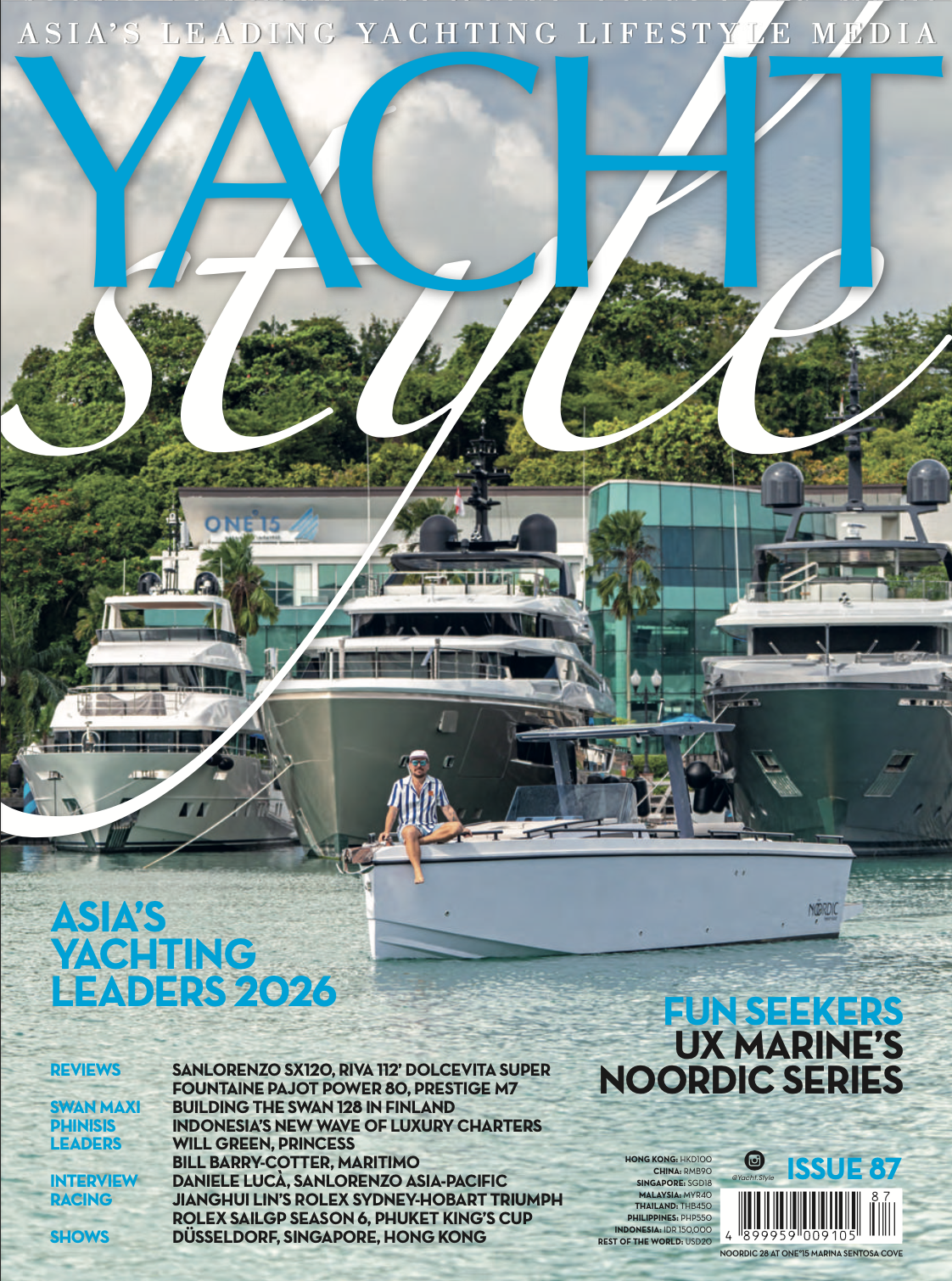
Yacht Style, Issue 88
Read and download copy
Yacht Style, Issue 86, Top 100 Superyachts of Indo-Asia-Pacific 2026, Jonathan Beckett, Burgess, Erwin Bamps, Gulf Craft Group, Fraser, Camper & Nicholsons, AB Yachts, AB 95, Van der Valk, Lalabe, Azimut, Grande 30M, Ferretti Yachts, 940, Absolute, Navetta 62, Cannes Yachting Festival, Genoa International Boat Show, Monaco Yacht Show, Lantau Yacht Club Boat Show - Festa Nautica, Rolex SailGP, Maxi Yacht Rolex Cup, Rolex Middle Sea Race, Phuket King’s Cup Regatta, Thailand, Port Takola Yacht Marina & Boatyard, Krabi, Yousuf Al Hashimi, Phoenix Yacht Management, Su Lin Cheah, ICOMIA, Suzy Rayment, Asia-Pacific Superyacht Association, APSA
Read and download copy

Asia's leading yachting lifestyle media

More results...

Generic selectors
Exact matches only
Search in title
Search in content
Post Type Selectors
Screenshot 2026-01-16 at 9.52.20 AM
Read your copy

More results...

Generic selectors
Exact matches only
Search in title
Search in content
Post Type Selectors
Yacht Style, Issue 88
Read and download copy

More results...

Generic selectors
Exact matches only
Search in title
Search in content
Post Type Selectors

Leaders

Bali’s Olivier Poncin: Catman

Bali’s Olivier Poncin: Catman

SHARE

Since launching Bali Catamarans in 2014, Catana Group CEO Olivier Poncin has shaken up the world of cruising catamarans, building a brand that’s challenging the long-established leaders.

  •  
  •  
  •  


Olivier Poncin, founder of Bali Catamarans


What was your background in the industry before you created Bali Catamarans?

I’ve always been passionate about sailing boats. When I was young, all my holidays were spent on the water. A few years after completing my studies, in 1983, I had the opportunity with some friends to take over the Kirie shipyard in Les Sables d’Olonne, a magnificent port in the Vendée region on France’s west coast that became famous thanks to the Vendée Globe race.


Five years later, I bought the Dufour shipyard in La Rochelle, which I redeveloped, notably by creating the Nautitech range of catamarans. The turnover of the Dufour group increased by a factor of 50 in the space of 13 years, making it a major player in the market. Poncin Yachts Group was born in 1988 and five years later we took over the Catana shipyard in Canet-en-Roussillon in the south of France.


The Bali 4.6 was the third of the French brand’s new models to debut in 2020


Specialising in high-performance catamarans for blue water cruising, it was the undisputed leader in its niche, but had been in difficulty for several years. In 2013, I took the decision to create the Bali brand to have a new range built to appeal to a wider market. In 2014, we renamed Poncin Yachts Group as Catana Group.


Considering the cruising sailing catamaran market was well served by established builders like Lagoon, Fountaine Pajot, Leopard and Sunreef, why did you think there was ‘space’ in the market when you set up Bali?

Unlike the niche market in which Catana had evolved for 30 years, between its creation date in 1984 and 2014, the consumer cruising catamaran market is 10 times larger, now producing around 1,500 units per year.


With Catana being renowned all over the world, and with it being born at a similar time as Lagoon and Fountaine Pajot, I always thought we could add a second brand if we showed innovation and differentiation in relation to the existing boats on this market. My experience, after more than 7,500 leisure boats built, has certainly confirmed this conviction.


Bali’s signature features include a solid foredeck


What kind of sales were you expecting and have you been surprised by Bali’s success since launching the 4.5 and 4.3 sailing cats in 2014?

We set ourselves the objective of conquering a 10 per cent market share and we achieved that in five years. Today, our ambition for the next three years is to reach the 20 per cent threshold, so selling at least 300 units per year.


Which models were most important in establishing the brand’s presence?

To build an international sales network, you need to create a range, hence the fact that today there are seven Bali sailing models and soon there will be three motor yacht models. We are fortunate that all our models have sold well, but obviously it’s the boats under 45ft that sell the most. We’ve sold 360 Bali 4.1s and 4.3s. Their successor, the Bali 4.2, which in my opinion is even more attractive, is arriving on the market this spring.


Can you tell us about Bali’s signature designs such as the tilt-and-turn ‘garage’ door?

Xavier Faÿ, Bali’s architect, and I knew we had to be different to succeed against established competitors, so from the second Bali model, the 4.3, we created the Open Space concept, which brings together the saloon and cockpit in a single volume. What a pleasure to enjoy such a large and friendly living space!


The tilt-and-turn garage-style door, as shown on the 4.6


A little later, our team was joined by a second naval architect, Samer Lasta, who brought us a lot in terms of design. With these two talents and a very experienced design office, we are equipped to meet the challenges ahead.


Why did you choose to build with a solid foredeck when other catamaran builders chose not to?

Xavier convinced me of the architectural interest of the full foredeck. It’s a great idea, as it provides safer sailing and a living area that’s bigger than anything previously seen. Today, Bali models offer up to 20 per cent more living space than competitors of the same size, which is one of our great assets.


What other features do you think Bali is known for?

A series of points have helped to differentiate Balis from other catamarans. As well as the tilt-and-turn door and solid foredeck, there are quite a few others such as the aft platform and sliding windows. Strangely enough, one of the greatest qualities of Bali models is not well known. I attach a lot of importance to the fact that Balis are very seaworthy catamarans and fast, too.


The Bali 4.8 was the biggest of the brand’s new models that debuted in 2020


It was obvious to me that their relationship with Catana required that they be more efficient under sail than their direct competitors. To achieve this, we use the same construction materials as for Catana, which makes them lighter and much stiffer.


We use fine-entry bows, ensuring a better glide through the water, with a chine above the waterline that provides the volume required inside to give the comfort expected by Bali owners. We also use sail plans generous enough to suit their displacement. My satisfaction comes from the feedback from yachtsmen who are very often surprised by the performance of our Balis. And I know that, over time, this quality will be recognised by the market.


Can you talk about why you decided to move into powercats with the 4.3 MY and now the Bali Catspace MY?

Catamarans offer yachtsmen a unique art de vivre (lifestyle). On a catamaran, you aren’t crowded together. On the contrary, their wide rectangular platforms provide incredible space. This is why many yachtsmen are giving up on sailing monohulls and traditional motor boats.


The MY 4.3 was Bali’s first motor yacht and has since been joined by the Bali Catspace MY


However, a good number of sailing catamaran owners use their sails infrequently. As such, many realise they’re better off with a catamaran without sails, which will go up to three times faster than a sailing catamaran and with reasonable fuel consumption because catamarans need less engine power due to their two hulls. I am convinced this sector of catamarans has a promising future.


Moreover, in the next 15 months, we will be developing a third Bali MY, fully Open Space and larger than the two existing models.


What kind of response has Bali had in Asia and what can we expect in the coming years with your growing network of dealers?

Over the last 10 years or so, the Asian yachting market has begun to catch up. Bali is contributing to this with several agents based in Japan, Thailand, Hong Kong, Vietnam, the Philippines, South Korea and Taiwan. Our intention is to intensify our network to best meet the specific expectations of this growing market.


Asiamarine has delivered a Bali Catspace Sail to an owner in Hong Kong


What led to your decision to hold a physical boat show, Les Rendez-vous Bali, in Canet-en-Roussillon last July?

The Covid-19 pandemic bruised our economies, restricted our freedom of movement and prohibited gatherings, so for more than a year now, almost every boat show has been cancelled. Typically, boatbuilders used to make a large proportion of their sales during these events.


We therefore had to find other means to meet our prospects, hence the regular organisation of these open days at our yard in Canet and through our agents around the world. We invite prospects interested in our boats and organise sea trials with them, so we have more time to understand and meet their expectations.


The 5.4 debuted in 2018 and remains Bali’s biggest model with an overall length of 55ft


How much has the company’s overall business been affected by Covid?

In 2020, we closed our four production plants for 10 weeks and had to work with a reduced number of staff for several more weeks purely for health reasons. As a result, we reduced our annual production capacity by 25 per cent, representing 55 units.


How has Covid changed the company’s way of working and communicating with customers?

Like many companies around the world, we’ve had to adapt to movement restrictions and reinvent the way we communicate with teams at other production sites, our networks, agents, customers and suppliers. Videoconferencing meetings have become the norm. I think this pandemic is marking a turning point in terms of corporate communication.


The Bali 4.2 was designed to succeed the popular 4.1


So far, your biggest boat is the 5.4 that debuted in 2018. Many of your competitors are building much bigger now, so do you have plans to build larger models?

We have started to work on this subject. Our objective is to provide a very innovative response to the expectations of boaters within two years.


How do you expect 2021 to be different to 2020?

Industrialised countries have understood that the pandemic should not block their economies, which would have much more serious consequences than just the public health effects. Most governments are therefore urging companies to stay in business, subject to common-sense barrier gestures.


Bali’s upcoming models include the 4.4


Catana Group hopes that in 2021 we will not be forced to close our production sites again, allowing us to produce 25 per cent more catamarans than last year, which we will have no difficulty in selling thanks to strong demand from private individuals and despite a sluggish market among professional charter companies. This situation should enable us to significantly exceed the €100 million (about US$120 million) threshold and consolidate our profitability.
www.bali-catamarans.com
www.catanagroup.com
www.asiamarine.com

Bali Catspace debuts in Asia

One of three Bali sailing catamarans introduced in 2020, the 40ft Catspace features brand signatures like the retractable cockpit door and solid foredeck, plus a fun flybridge and up to 10 berths. By Richard Martin.

SHARE

Bali’s Olivier Poncin: Catman Read More »

NextWave flying Sunseeker flag in Hong Kong

NextWave flying Sunseeker flag in Hong Kong

SHARE

NextWave was already one of Hong Kong’s largest yachting companies, but its recent appointment as the city’s Sunseeker dealer has raised the profile of a dealer now developing a ‘Seek More’ showroom in Repulse Bay and bringing a special Manhattan 68 to the city.

  •  
  •  
  •  


NextWave staff including (from third left, front row) brothers Conrad and Frankie Chau, Howard Chen, Raymond Sze and Jeffrey Chan


NextWave Yachting is preparing to open a new showroom in Repulse Bay following its appointment as the exclusive Sunseeker dealer for Hong Kong. Now employing about 50 staff, NextWave has a sales office in Club Marina Cove in Sai Kung to the east, an administration office in Kwai Fong to the west, and a Kwun Tong service facility in Kowloon Bay.


However, to represent one of the world’s most famous motor yacht brands, NextWave has targeted Hong Kong Island’s glamorous south side, where it’s creating a Sunseeker showroom at The Pulse in Repulse Bay.


“This is a very exciting time for us. Sunseeker is one of the biggest yacht brands around the globe, so we feel truly fortunate and honoured to be appointed as the official dealer in Hong Kong,” says Frankie Chau, one of a group of friends who co-founded NextWave in March 2012 to turn their love of life on the water into a business.


Frankie Chau, one of the founders of NextWave


“The theme of our showroom is to create a ‘Seek More’ Sunseeker experience with new technologies. We aim to bring the feel, sound and smell of being onboard a Sunseeker to our showroom. Repulse Bay always reminds me of Cannes in the south of France, with its heritage, beautiful beach and restaurants with amazing views.


“The Pulse is a popular hangout spot and tourist attraction. The beach is the place to be seen or show off and is crowded with yachts. The pier is perfect for boarding and links the water and on-land activities. I can’t think of a better location for our Sunseeker office in Hong Kong.”


NextWave’s expansion is not stopping there, as the company is also looking to acquire a shipyard to strengthen its yacht management and services division. Currently, its service work is carried out on its barge in Kwun Tong and with partners around Hong Kong. “It would be beneficial to own a shipyard as a base to provide service more promptly and efficiently,” Chau says.


BROTHERS AND FRIENDS

NextWave is unusual in the sense that it has a team of leaders. Chau, who has a Master’s degree in Corporate Finance and Accounting, is the company’s CFO and also manages sales and marketing. CEO Howard Chen has a background in mechanical engineering and project management, while the entrepreneurial Raymond Sze, a former restaurateur in the US, heads Business Development.


Sunseeker is well established in Hong Kong


Conrad Chau, Frankie’s younger brother, owns a shipyard and a theming construction company in China, while William So, who has a background in finance and F&B, is an avid wakesurfer who has helped NextWave grow its market-leading water toys division.


Sales Director Jeffrey Chan, who has a finance and investment background, has enjoyed boating and watersports since a young age, and is an experienced JetSurf racer who competed in MotoSurf WorldCup series events in 2017 and 2018.


“NextWave is run by a group of young veterans, who are passionate about the yachting industry,” says Chau, who emphasises that the company has never strayed from its DNA of ensuring clients have as much fun on the water as they do. “We are lucky to have a group from diverse backgrounds and each of us brings expertise to the business in a very dynamic way.”


SUNSEEKER’S NEW MODELS

Having started as a dealer for Sealine, NextWave has expanded its portfolio of brands from across Europe and the USA over the past nine years. At the same time, it has developed multiple business divisions including brokerage, after-sales and maintenance, charter, crew services, a remarkable water toys division and more recently a thriving yacht-management division.


NextWave has high hopes for the new Manhattan 55, one of Sunseeker’s ‘Famous Five’ new models


Chau says the company’s all-round offering made it appealing to Sunseeker, which has a rich history in Hong Kong, where it’s one of the most established luxury motor yacht brands.


“Over the nine years since NextWave was founded, our company has transformed from a single-brand dealership into a full-fledged yachting solution provider,” he says. “All these functions within our

company creates a massive synergy that allows us to share resources among our departments, which translates to value for our clients and now all Sunseeker owners.”


Chau is also excited about the timing of the Sunseeker appointment, which comes on the heels of the British builder’s announcement of a £38 million (about US$53 million) investment in new product development, which will expand its selection of models to 22 by 2023.


Sunseeker, which builds from 38-161ft across six ranges, is kicking off this year with the release of its ‘Famous Five’ new models – Manhattan 55, Predator 55 EVO™, 65 Sport Yacht, 88 Yacht and

90 Ocean. The Manhattan 55 follows the design and styling of the Manhattan 68 in Sunseeker’s classic flybridge range, while the 55 EVO™ follows the 60 EVO™ in the iconic Predator range.


Sunseeker showcased the new Predator 55 EVO at the Palm Beach International Boat Show


The 65 Sport Yacht complements the 74 in a range distinguished by a dynamic new sportbridge, while the 88 Yacht and 90 Ocean are distinct offerings in the larger Yacht range, both featuring Sunseeker’s automated X-Tend aft sunbeds. Furthermore, all new models are benefiting from fresh interior designs and a new level of detailing and interior craftsmanship.


“Sunseeker leads the market from 50-100ft, the mainstream range for the Hong Kong market, which has resulted in the brand’s consistent growth in sales here all these years. Now, with these new models, Sunseeker is again pushing forward and we believe local buyers will appreciate the new designs,” Chau says.


“Traditionally, flybridge yachts are most appealing to Hong Kong buyers because of space and versatility, so we have high expectation for the new Manhattan 55. However, the Predator line-up has also been hugely popular because of their sporty and sleek design, which Sunseeker is well known for.”


MASTERFUL MANHATTAN 68

However, the first Sunseeker that the dealer is bringing to Hong Kong is the first Manhattan 68 featuring the new ‘Pacific’ layout, a new configuration designed by the shipyard in collaboration with NextWave.


NextWave is bringing a Pacific version of the Manhattan 68 to Hong Kong


The Manhattan flagship debuted at Boot Dusseldorf last year, where it showed off a new-look Beach Club with a huge sea-facing locker with racks for storing water toys plus an easy-access storage area for two Seabobs with charging docks.


The unit heading for Hong Kong features revised main and lower decks. On the main deck, the aft dining area has a more flexible setup to further connect it to the cockpit. Forward, the saloon features much more seating with two facing C-shaped sofas, instead of one starboard sofa facing the TV and private stairs to the master cabin in the standard version.


Instead of four cabins on the lower deck, the ‘Pacific’ layout features a forward VIP, a starboard guest cabin and an enormous master suite made up of a full-beam bedroom and a lounge occupying the space previously used for the port twin.


The Manhattan 68 features a toy cupboard, Seabob storage, fold-out seating, a submersible swim platform and a transom door with shower


“The Pacific layout offers an exceptional amount of space for a boat of this size,” Chau says. “It strikes a perfect balance between ample social spaces for entertaining and generous private quarters.

The master cabin benefits from its own private lounge and bar, a relaxing retreat for the owner.”


TOYS GALORE

Considering Sunseeker’s increasing emphasis on waterside entertaining and access, NextWave’s distributorship of some of the world’s most exciting water toys creates a nice synergy. Its best-selling products include the world-famous Seabob, Lift eFoil hydrofoil surfboards, JetSurf motorised surfboards, and Aquaglide and Yachtbeach ocean pools that attach to a yacht’s swim platform.


NextWave is the dealer for a huge range of water toys including Seabobs, a popular product on Sunseeker yachts


NextWave said its sales of the Lift eFoil soared last year and expects the hydrofoil surfboard to continue to be the company’s bestselling toy following the launch of the brand’s new E3 third-generation models.


The company also rates JetSurf’s new Titanium DFI 2021 as “the most powerful and reliable model in the world of motorised surfing” and highlight’s the new Electric model, a fully electric alternative to the brand’s petrol-powered boards. And it doesn’t end there. NextWave is also a distributor for Belassi jetskis, JetXTender, Oxoon and Scubajet.


Lift e-Foil hydrofoil surfboards is NextWave’s best-selling toy


Best demonstrated by Jeffrey Chan’s MotoSurf WorldCup experience, most of NextWave’s founders and division staff are familiar with the water toys they sell and frequently use the products, so are in a good position to advise yacht owners.


“Our staff in the water toys department are passionate and familiar with our products. Testing and training with the range means we can see and feel the full capabilities of each product and how they vary. Our customers appreciate that because we always provide a fun experience with their friends and family,” says Chau, who confirms that many buyers seek personal tutorials on using the products.


JetSurf’s motorised surfboards are among NextWave’s most popular products


“Our training sessions are included with any new purchase, so each owner can learn the best and safest ways to enjoy their product and understand all the functions. This enables each owner to maximise their experience on the water and make the most out of every product’s features.”


BRANDS AND SERVICES

Chau admits Sunseeker is now NextWave’s key brand for new yacht sales, yet Sealine remains a key brand in its portfolio, offering models ranging from 34-53ft designed by Bill Dixon. NextWave has represented the brand since 2012, a year before the British builder was acquired by Germany’s HanseYachts AG, which also owns Fjord, another of NextWave’s key brands.


“NextWave has a full range of models to enable customers to move up to bigger sizes. Sealine specialises in building spacious family-style yachts with innovative design. The brand covers a size range that many first-time boat owners are keen on, so this complements Sunseeker’s range from over 50ft,” Chau says.


NextWave has represented Sealine since 2012 and sales include an F430


“Fjord builds industry-leading luxury pleasure powerboats. With a strong demand for luxury tenders from bigger Sunseeker yacht owners, Fjord becomes an ideal option to cater their needs.”


NextWave’s portfolio also includes Bavaria (Germany), Chris-Craft (USA), Heyday Wake Boats (USA) and Vanquish (Netherlands).


While the new Sunseeker appointment will raise the profile of NextWave’s new yachts division, the company has traditionally prospered due to its variety of businesses, so higher-performing sectors can compensate for under-performing ones in any particular year.


The dealer also represents Fjord and has sold a 40 Open in Hong Kong


Last year, NextWave had its best-ever year for brokerage sales, selling 22 yachts for a record year in revenue, while its yacht-management and water toys departments also thrived due to Covid encouraging people in Hong Kong to spend more time with friends and family on the water.


“We had one of our best years in 2020, as our yacht sales, yacht management and water toys departments thrived,” Chau says.


“With the social-distancing measures and restrictions on travel and entertainment venues, people realised owning a yacht is the best way to safely enjoy family time, which led to demand to own a yacht. However, Covid slowed production at European builders and delayed stock delivery, lengthening the lead time for new yachts, so pre-owned yachts increased in popularity.”


The same reasons that drove people to buy yachts also led to a charter boom in the second quarter of the year before a ‘third wave’ of Covid in Hong Kong then dramatically reduced yacht hire during its traditional peak season in the summer.


NextWave is confident of a bright future following the addition of Sunseeker to its portfolio


“When the ‘second wave’ of Covid alleviated in May, all of our chartered boats were fully booked for weekends until August,” Chau says. “Unfortunately, everything halted with the ‘third wave’ that started in July. The measures and bans by the government resulted in zero business for what could have been a profitable summer, not only for us but for most charter companies in Hong Kong.”


Like brokerage, the yacht-management department had its best-ever year and NextWave expects it to continue growing. Before NextWave launched the division, Chau admitted to being sceptical of its worth, but by providing clients with tailored, hassle-free ownership, it has proven to be one of NextWave’s anchor operations.


“Our yacht-management clients are very satisfied with our services, so most of our new customers are referrals by existing ones. We provide a one-stop-shop to cater to all the needs of an owner,” Chau says.


“Yacht management is gaining in popularity as it’s a proven model for maintaining a boat’s condition and eventually a solid resale value. With more owners upgrading to bigger yachts, I envision a strong demand for professional, value-added yacht management, so I think this division will continue to have organic growth in the coming years.”
www.nextwaveyachting.com
www.sunseekerhk.com

Sunseeker Manhattan 55 leads ‘Famous Five’ to Asia

The first of Sunseeker’s ‘Famous Five’ new models to be sold in Asia, the Manhattan 55 features a refined exterior along with a sophisticated interior styling and detailing that reflects the upgraded look and feel of the British builder’s new generation of yachts.

SHARE

NextWave flying Sunseeker flag in Hong Kong Read More »

Imperial’s Julia Stewart looks at the big picture

Imperial’s Julia Stewart looks at the big picture

SHARE

The Director of Imperial explains how the Monaco-headquartered company has risen to manage some of the globe’s most spectacular superyachts and work so closely with many of the world’s leading builders.

  •  
  •  
  •  


Julia Stewart, Director of Imperial


Can you paint an overview of Imperial and how it has become associated with so many of the biggest superyacht projects?

We believe in a detail-orientated approach as we are handling legendary superyachts. We leave nothing to chance and supervise every detail. Our yachts are very popular choices for charter because of high service standards, safety without compromises and perfect technical condition.


Our Monaco office is the heart of our activity and we also have offices located at leading shipyards in Germany, Netherlands and Italy to supervise new builds and refits on a day-to-day basis to protect owners’ interests. We have large new build and operational teams managing over 1,000 crew members worldwide. In addition, we have skilled HR and in-house legal teams.


How has Imperial’s business changed in the last few years as you’ve become known for working with some of the world’s biggest new superyachts?

We have sold more new-build projects and are currently supervising constructions at major European yards. Imperial is doing more hulls in the 100m-plus segment because we have proven management expertise and the specialist knowledge to control budgets as well as deliver the best result for the owners.


Imperial is the exclusive charter agent for the 136m Flying Fox, built by Lürssen; © Imperial Yachts (Photo: Guillaume Plisson)


Our delivered yachts speak for themselves. Imperial supervised construction and are Exclusive Central Charter Agents for Lana (Benetti 107m) and Flying Fox (Lürssen 136m). Furthermore, we are also experts in new construction such as Amadea (Lürssen 106.1m).


How would you rank the value of your various business divisions?

Imperial does not rely on one area of business, yet we have a firm core foundation based on the supervision of new builds and management, as well as strong sales and charter departments.


What are some of the projects that have elevated Imperial in term of recognition and earned the respect of your competitors?

Imperial respects the success of all brokerage firms as we believe healthy competition inspires us to do our best, not simply ‘good enough’. Imperial is unique because we have delivered more new build projects than any other brokerage house in the past decade.


Friedrich Lürssen, Imperial CEO Evgeniy Kochman, Julia Stewart and Peter Lürssen


We have technical, operational and interior managers that follow a meticulous management style. Our success stands out among the industry, with vessels such as Flying Fox, Lana, RoMEA (Abeking & Rasmussen 81.8m) and Lili (Amels 55m) creating a new standard of charter. Imperial is the owner’s representative and supervisor for operational, technical and interior aspects.


Imperial is smaller than some other companies in your sector. Would you like to scale up in terms of staffing and offices?

We utilise a different strategy as we have less sales offices but more on-site offices at major German, Dutch and Italian shipyards. Imperial supervises the new construction from these offices and therefore has real-time updates and can facilitate the owner’s requests right away.


Having all hands on deck is a real strength of ours. With the development of Covid-19, it became even more evident that we do not need many sales offices to succeed but we must have substance and a strong operational core.


Flying Fox features exterior styling by Monaco-based Espen Øino; © Imperial Yachts (Photo: Guillaume Plisson)


Which builders have you worked with most often in new builds?

Imperial has had the privilege to work with pioneers among the leading European shipyards. We have learnt from each other and share the same qualities of being detail-orientated, as well as to always protect the owner’s interest. In close collaboration with these shipyards, we have set high expectations and standards with the yards we choose to work with in the future.


Can you tell us about Imperial’s role as owner’s representative and build supervisor for the 120m Project Signature with Amels/Damen?

Imperial has a long-standing relationship with Amels/Damen as together we have built over 10 successful hulls over the past years. We have huge respect for the leaders of the Damen family and high regard as to how they support their clients with warranty and assistance. We firmly believe that Amels/Damen was the right shipyard for this ingenious vessel. Project Signature will raise the bar for design complexity within the yachting industry.


Imperial is the owner’s representative and build supervisor for the 120m Project Signature designed by Espen Øino


Project Signature will be a ‘green’ superyacht prepared for the Lloyd’s Register of Shipping EP (Environment Protection) notation, powered by diesel-electric engines and Azipod propulsion. Do you notice more owners showing more interest in the environment?

As a result of constructing larger vessels, future owners will continue to seek out new destinations and new platforms for adventure. With a shift in demographic, younger clients are looking for more experience-led activities through unique itineraries and on-board amenities. Wanderlust also comes with a desire to be environmentally conscious.


Our oceans, marine life and the surrounding shores are under threat. Today, the industry is more in tune with the climate change and clients request or are open to innovative engineering solutions or sustainable yacht designs with the end goal of reducing their yachting footprint.


Imperial is the exclusive central charter agent for Lana, the 107m Benetti build delivered in 2020; © Imperial Yachts (Photo: Breed Media)


Can you tell us anything about other upcoming builds that Imperial are involved in?

Imperial is dedicated to the protection of our client’s confidentiality. Imperial can confirm we have major new construction projects at leading German, Dutch and Italian shipyards. All I can say is, stay tuned!


Espen Øino designed Project Signature, Flying Fox and many other builds Imperial has worked on. Why does the company have such a special relationship with him?

Imperial is a Monaco-based company and is proud to have Monaco as part of its company heritage. We firmly believe in supporting the local economy and working with local talent. Espen Øino is the man behind some of the most iconic superyachts. He has an extraordinary talent and is effectively in sync with Imperial.


Building a superyacht to fit your needs is an exciting experience. The first footstep to constructing a new vessel is to find the right designer who understands your requirements. Espen’s success is how he manages expectations, establishes priorities and finds the balance between each space on board. In partnership with Espen Øino, Imperial has delivered many recognisable superyachts such as Amadea and Flying Fox.


The 106.1m Amadea, designed by Espen Øino and built by Lürssen, is exclusively listed for sale with Imperial; © Imperial Yachts (Photo: Guillaume Plisson)


How has Covid changed your business and impacted the different sectors of your business?

Covid-19 has been a major challenge for everybody. Nobody is exempt. We were the first management company to do mass testing for all crew on a regular basis to ensure the safety of guests and crew. Imperial developed Covid-19 prevention measures for the managed fleet. Given the high standards of safety on board the managed fleet, all charter yachts managed by Imperial are in high demand.


With the closure of many destination retreats, Imperial has found the perfect answer for those who are seeking a place to detach and improve their wellbeing while being in a clinically clean environment.


The wellness centres on board Flying Fox and Lana incorporate all aspects of personal wellness, using both a holistic and scientific approach. Imperial’s charter team has carefully selected safe destinations to charter where guests can choose how much interaction they want with life on land while adhering to local Covid regulations.


The 82m RoMEA was built by Germany’s Abeking & Rasmussen and is part of Imperial’s charter fleet; © Imperial Yachts (Photo: Guillaume Plisson)


Overall, what do you think are the biggest challenges to the superyacht industry?

Indeed, the global recession presents new complexities to the superyacht industry. In our opinion, true professionals that are meticulous in advancing in operational and new build management will prevail. Overall, the quality and expertise of the industry will gradually improve.


What more should the superyacht industry be doing to make the yachts and their operations more environmentally friendly?

Technological advances in design and build of superyachts has helped bring more sustainable solutions on board. More money and time are being spent on building greener vessels to lessen their impact on the marine environment. This is encouraging and demonstrates that technology can help. Imperial is providing its support by partnering with Blue Marine Foundation (BLUE) and joining the Blue Marine Yacht Club (BMYC) to help save and protect our ocean.


Prince Albert (centre) attended BLUE’S BMYC event on Amadea at the 2019 Monaco Yacht Show


BLUE’S BMYC private event on board Amadea in 2019, kindly supported by Imperial and Lürssen, was the most successful BMYC event that BLUE has held to date. The event was extremely well attended with BMYC supporters and new supporters from the industry. A large sum of money was raised that night including a very large donation by Imperial.


The evening marked a turning point in financial support for many of BLUE’s projects, especially its work in the UK Overseas Territories and Ascension Island.


What are the biggest opportunities for growth in the superyacht sector in the coming years?

We live in a world where the only constant thing is change. Developments in technology allow the ability to innovative and enhance just about any sector. The yachting industry is no exception. At Imperial, ‘Luxury Yachting 360 degrees’ is not just our company motto, it is what sets us apart. We provide a full-spectrum approach from initial concept, finance, design and construction to management, charter, maintenance and marketing.


‘Luxury Yachting 360 degrees’ is Imperial’s motto


What are your plans for the coming years?

Imperial has changed the future of yachting by delivering some of the most advanced superyachts. Imperial orchestrates the relationship between client, designer and shipyard, so we will continue with our proactive and inspired approach to superyachts delivered and currently in construction.


We push boundaries with the future in mind. We have a detail-orientated approach in everything we do including new build supervision at major yards, operational and technical management, and a very successful charter operation.
www.imperial-yachts.com

Imperial announces 100m Project Titanium

Winch-designed Project Titanium marks Monaco brokerage’s third collaboration with The Italian Sea Group – Admiral shipyard

SHARE

Imperial’s Julia Stewart looks at the big picture Read More »

Nico Rosberg plugs into e-mobility’s winning formula

Nico Rosberg plugs into e-mobility’s winning formula

SHARE

Rosberg moved into the yachting spotlight last year as the ambassador for Sunreef Yachts’ Eco range of solar-powered catamarans. Meanwhile, the 2016 F1 champion turned sustainability entrepreneur also owns a team in the new Extreme E off-road series for electric SUVs, in which the use of hydrogen offers a window into the fuel’s potential use for yachts.


Rosberg at the helm of a Sunreef 60 E near Monaco


Sunreef Yachts made global headlines in early June last year when tennis legend Rafa Nadal received his 80 Sunreef Power Great White at his home port in Mallorca.


Soon after, on World Oceans Day on June 8, the Polish builder announced a tie-up with another sporting icon when it named Nico Rosberg as the ambassador for its new Eco range of luxury solar-powered sailing and power catamarans.


Rosberg is best-known for a high-profile Formula One career that included 23 wins in 11 years, including nine in 2016 when he won a gripping World Championship, pipping Mercedes teammate Lewis Hamilton after finishing runner-up to the Brit the previous two years.


Joint 12th in all-time Formula One wins with 23, Rosberg has over 8.5 million followers on social media


However, just five days after securing the championship at the season-ending race in Abu Dhabi, the Monaco-based German announced his surprise retirement from the sport at the age of 31.


Since then, Rosberg has established himself as a successful e-mobility and green tech entrepreneur and investor, leading to his ongoing partnership with Sunreef. However, despite a globe-trotting sporting career that overlapped with Nadal’s for many years, Rosberg never met the Spaniard until a chance encounter in the Balearic Islands late last year.


“It was funny,” he smiles. “I was in a bay in Formentera, south of Ibiza, and Rafa suddenly arrived on his new yacht. I had never met him before, but we both had the Sunreef connection, so I swam over to his boat.


“It was really nice. He said, ‘Oh, it’s so cool that you’re also in partnership with Sunreef for their Eco range. Let’s have a chat.’ He was super happy to have his boat, so we just sat on the back and had a nice conversation.”


Rosberg’s new career in sustainable technology led to his ambassador role for Sunreef’s Eco range


The son of Keke Rosberg, the 1982 Formula One champion, Rosberg was born into racing and became a global superstar during seven years with Mercedes, partnering compatriot Michael Schumacher and Hamilton – F1’s two most successful drivers – for three and four years respectively.


Yet despite a sporting career based on power and speed, Rosberg prefers to sail when on the water and has enjoyed spending time testing a Sunreef 60 E from his base in Monaco, where he has lived for much of his life.


“I love sailing. The sheer beauty of it is just unbelievable. When I was on the Sunreef, letting the sails out, using the power of the wind and enjoying the silence just gives you this amazing way of enjoying nature,” says Rosberg, whose luxury brand partnerships also include Kempinski Hotels.


“But there’s a responsibility. I’ve been enjoying our oceans so much throughout my life because I’ve been so fortunate to be on boats, and anyone building yachts has a responsibility to take care of the oceans and that’s what Sunreef is doing so well. This is definitely the right path for luxury yachting.”


Since retiring from Formula One as world champion, the Monaco-based German has since invested in over 20 e-mobility and green tech companies


Rosberg’s partnership with Sunreef stemmed from his father introducing him to Francis Lapp, founder and President of Sunreef, passionate rally car driver and Formula One fanatic.


“Francis is a huge racing fan, so we met in the paddock and got talking. It only really kicked off when I realised how passionate about sustainability Francis and the Sunreef crew were, because that’s my path as an entrepreneur. I was like, wow, we have so many synergies, we should do something with this. The partnership with Sunreef Yachts totally fits into my mobility ecosphere.”


SUNREEF’S ECO PATH

Rosberg is impressed with what he has seen at the builder’s facility in Gdansk on Poland’s north coast, where Lapp’s background as an electrical engineer has ensured that Sunreef has always prioritised the most advanced technology in its luxury catamarans.


“Francis is an engineer at heart, so they have engineering excellence as one of their highest priorities. That’s why it’s fascinating what Sunreef is coming up with, to make luxury yachting sustainable, and why it’s a pleasure to work with them. In the factory, they have a whole innovation space where innovators are trying new technologies and making progress all the time.”


Rosberg with Sunreef founder Francis Lapp at the shipyard in Gdansk


In just a few years, Rosberg has quickly got up to speed on a whole variety of sustainable technologies and was quick to recognise the brand’s cutting-edge work in combining electric propulsion with a remarkable solar-power system and super-light, high-performance batteries.


“It’s all really, really innovative and trailblazing. I love that they’re pushing boundaries. Their solar powered solution is particularly innovative, how they’re covering the hull of the boats with tiny solar cells. They’re focused on reducing weight, using carbon a lot and introducing more sustainable materials,” he says.


“At the moment, they’re working on building future hulls with a basalt and linen material combination, which would be a huge step in sustainability. They’re really trying everything, using recycled teak instead of new teak and many other examples. It’s really awesome and very fascinating.”


As well as making yachts and boat operations more eco-friendly, Rosberg says it’s important that sustainability in yachting starts to make the move from niche and idealistic to mainstream, even ‘cool’. Although he’s involved with and surrounded by green tech pioneers, he does believe that sustainability in yachting is becoming more than good PR.


“I think what’s changing is that a yacht owner can impress people if their yacht is ultra-sustainable, because that’s just cool. Having petrol-burning black smoke coming out the back just doesn’t impress anyone,” he says.


Rosberg visits the Sunreef shipyard in Gdansk on Poland’s north coast


“In the next couple of years, you’ll be able to impress with a yacht that’s super innovative in terms of sustainability, like Sunreef’s solar-panel solution, especially when you see the drive-train solution integrated into the yacht and maybe even wind power generators. That’s going to be the way to impress in future.


“People are more conscious of our environment and every yacht owner wants to impress with their boat, so I think that’s a strong power.”


Rosberg says the appeal of eco-friendly yachts and other vehicles is only going to increase with both future generations demanding the technology and the technology itself improving over time.


“If the owner’s kids are coming on board and the yacht’s blowing smoke out the back, they’re going to be like, ‘Hey, what are you doing?!’ All these different powers are coming into play and it’s becoming a big trend, which is amazing because we’re facing such a big threat to the environment.”


FORMULA E TO EXTREME E

Rosberg’s business portfolio includes being an investor and shareholder in Formula E, the global electric-car series that started with its first race in Beijing in September 2014 and whose venues in Asia have also included Putrajaya, Hong Kong and Sanya.


Sunreef branding on the Rosberg Xtreme Racing Odyssey 21 E-SUV


However, he has a more personal involvement in the brand-new Extreme E as the founder and CEO of Rosberg Xtreme Racing, one of 10 teams competing in the 2021 series featuring male-and-female duos racing electric SUVs off-road in remote locations.


Spanning four continents, the five-stop series is designed to highlight the impact of climate change and human activity on some of the world’s remote locations, while promoting sustainability and the adoption of electric vehicles to help protect the planet.


Covering a variety of environments, the schedule features the Desert X Prix in Saudi Arabia (April 3-4), Ocean X Prix in Senegal (May 29-30), Arctic X Prix in Greenland (August 28-29), Amazon X Prix in Brazil (October 23-24) and Glacier X Prix in Argentina (December 11-12).


In late February, the RMS St Helena, Extreme E’s floating paddock and base, departed the UK for Saudi Arabia carrying the series’ freight and infrastructure, including race cars.


As well as Rosberg, high-profile team owners include Hamilton, the seven-time F1 world champion, and Jenson Button, the 2009 world champion who will be one of his team’s two drivers. Like Rosberg, Hamilton won’t be at the wheel, but his team’s drivers include Sebastien Loeb, the nine-time World Rally Championship winner.


Rosberg and fellow Formula One world champions Lewis Hamilton and Jenson Button are among team owners in the new Extreme E global series


Sunreef has come on board as a corporate partner of Rosberg Xtreme Racing, a natural sponsorship considering Lapp’s long history of rally driving including two editions of the Paris-Dakar Rally and last year’s Africa Eco Race, which Sunreef partnered. For Rosberg, the Sunreef synergies just keep on coming.


“It’s such a coincidence,” Rosberg laughs. “When I came to him with the project, he was like, ‘I can’t believe it, that’s so cool, I want to support’. He even came to the first official test we had.”


Rosberg says the involvement of three recent Formula One world champions and rally legend Loeb show that sustainability is increasingly a cause worth promoting.


“The Extreme E line-up is really impressive now, with some big names and big car manufacturers. It’s because everyone is searching for a platform where they can really affect positive change and this is what Extreme E provides.”


Extreme E is also set to showcase the potential of hydrogen power, which could have a much larger role in yachting in the future. In January, Extreme E unveiled the hydrogen fuel cell generator developed with AFC Energy that will be used at each race location to charge the race fleet using zero emission energy, with the only by-product being water for utilisation elsewhere.


“We’re going to have hydrogen power stations, so the electricity in the cars is going to be powered by hydrogen fuel cell chargers. This is really innovative and massively reduces the emissions of the championship. It’s really forward thinking and that’s what makes Extreme E so special.”


Extreme E’s hydrogen fuel cell generators by AFC Energy


Rosberg is also excited about hydrogen’s potential use in yachting, but in contrast to how sailing yachts and solar power rely on wind and sun respectively, hydrogen power requires a lot more man made infrastructure.


“Hydrogen is most likely to be the future solution. The problem is the whole yachting ecosystem needs to be geared to hydrogen. A yacht built to be powered by hydrogen would be fantastic, but you must think about the whole supply chain and how the hydrogen gets to the harbour and this system isn’t there yet,” he says.


“You’d need to get a renewable energy source, which is perfect near the water as you can use either an offshore wind farm, wave energy or tidal energy. If you have something like that next to a harbour and then an electrolysis plant that converts the water into hydrogen, that would be a fantastic solution to power the boats. I believe hydrogen is the future, but it’s very far away.


“In the interim, Sunreef is doing it the right way, having solar power and electric batteries as a large range extender and making the yacht totally self-sufficient. You have the hybrid solution for the worst case scenario, using the generators for extra range if needed.”


PETROL HEAD TO ECO-HERO

Overall, it has been a remarkable few years for Rosberg, whose transition from petrol head to e mobility pioneer was as surprising as the timing of his retirement.


Rosberg is an investor in German flying taxi company Volocopter, which has performed test flights in Singapore; Photo: Nikolay Kazakov for Volocopter


“During my racing days, I had no interest in anything else apart from winning the next race and my family. I had achieved my dream and it was the perfect moment to make the exit and to look back totally fulfilled. I also wanted to spend more time with my family,” says Rosberg, who has two daughters with his wife Vivian.


“It was only after my career finished that I really opened my eyes to sustainability. I made a promise to pursue a life of purpose and dedicate myself to the greater good while supporting others doing good for us as a society.”


Now employing 20 staff in his head office in Monaco, Rosberg is co-owner of TRE (Team Rosberg Engineering) and has invested in a portfolio of more than 20 green tech and e-mobility companies and start-ups. These companies include Volocopter (air taxis), Lilium (electric jets) and Tier Mobility (e-scooter sharing startup).


“Mobility is my ‘home’, but as a sector, it causes one-fifth of the global emissions, so there’s huge potential to do good by accelerating the necessary change. We can now see how e-mobility is coming in and it’s a huge accelerator to making mobility more CO2-neutral and emission-free. That’s why I’m very passionate about being active in the mobility space as an entrepreneur.”


Rosberg with fellow Greentech Festival co-founders Marco Voigt and Sven Krüger, and CEO Judith Kühn


Rosberg is also the co-founder of the Greentech Festival in Germany, which has been held annually in Berlin since its debut during the city’s Formula E event in May 2019, was simultaneously held online last September, and this year is scheduled to be held again at the Kraftwerk venue from June 16-18.


Overall, Rosberg has engineered a bold and widespread move into the world of business, but one that has proved financially successful so far.


“It was a steep learning curve, but I’ve got a nice team around me with a lot of experience. It’s also about building a strong network of other VCs (venture capital firms) who have a lot of experience, knowledge and competence, and leverage on their experience. This path has been very successful,” he says.


“We recently had a big exit from one of our first investments, so it’s an exciting time. If you look at the ‘unicorns’ (privately held startups valued at over US$1 billion) from our early investments like Lilium, Tier Mobility, which is very close to being a unicorn, and Formula E, things have gone very well. Some don’t do well, but on average, it has been a very successful journey.”


Rosberg’s influence even extends to playing a part in Monaco’s decision to introduce electric buses. Other cities he praises include Copenhagen for the way it has integrated cycling into the city’s infrastructure and Singapore, which he sees as a potential leader in e-mobility, with Volocopter among companies looking to unveil operations in the city-state.


Rosberg at the World Economic Forum in Davos


In fact, Rosberg is scheduled to participate at this year’s World Economic Forum in Singapore from August 17-20 in his role as a Young Global Leader, having spoken at previous editions in the Alpine town of Davos in Switzerland.


“Sustainability is now one of the biggest topics at the World Economic Forum, whereas it used to be geo-political matters or things like that,” he says. “Now, sustainability is number one, which gives us all a lot of hope.”
www.sunreef-yachts.com
www.nicorosberg.com

Sunreef 80 Eco to launch in summer

Poland’s Sunreef Yachts is targeting a summer premiere for the first model from its Eco range, which features solar power, electric engines and a hydro-generation system.

SHARE

Nico Rosberg plugs into e-mobility’s winning formula Read More »

Richard Lofthouse on Southeast Asia’s ‘big three’ superyacht hubs

Richard Lofthouse on S.E.A’s ‘big three’ between two ‘hot spots’

SHARE

As head of Catalano Shipping Services’ Asia-Pacific operations, Richard Lofthouse has witnessed Covid play havoc with the expected superyacht surge for the Tokyo Olympics and America’s Cup, but says Southeast Asia can re-emerge again.

  •  
  •  
  •  


The Maldives is a world-renowned superyacht destination


As I outlined in my presentation in this year’s APSA Grand Tour webinar, the past 12 months have really disrupted the flow of superyachts in our region. Typically, they’d move from the ‘hot spot’ of the Maldives in the Indian Ocean through Thailand, Malaysia, Singapore and Indonesia. They’d continue east to the other ‘hot spot’, Tahiti, with stops in PNG, Australia, Fiji and New Zealand along the way.


Before Covid-19 became a global pandemic, myself and my partners around the world were expecting a lot of superyacht traffic to Japan for the now-postponed Olympics and then New Zealand for the 36th America’s Cup, which at least has been held, although without the influx of visitors we anticipated.


There would have been a lot of activity centred around those two major events, but the way it has panned out has changed the dynamics of superyacht activity in Southeast Asia. On the flipside, I think it’s fair to say that Southeast Asia appears to be the market that will emerge most strongly out of all of this. And to a point, I think that’s already starting to happen.


Catalano Shipping Services manages Benoa Marina in Bali


Surprisingly, over the last six months or so and despite a couple of recent changes, Indonesia has generally been about the most straightforward place in the region for yachts to come into – and I don’t think that’s a statement we generally tend to make!


Whether by design or mistake, the Visa process became easy. We were able to apply for Visas and when people arrived, whether by seaport or airport, there was no quarantine if the PCR test was done within seven days. Indonesia has been about ‘the best show in town’ over the last half-year or so and Catalano Shipping Services has been managing a busy marina at Benoa Marina, so we feel lucky to be in that position.


Overall, Indonesia has presented itself well and shown what’s possible, which is a positive way to get the wheels rolling again in the region.


ONE°15 Marina Sentosa Cove is Singapore’s best-known marina


Singapore has never shut and has remained as a key hub throughout, although it has not been an easy time to be an agent there. There have been huge amounts of legislation and regulations that have been a little tricky to navigate. However, Singapore has managed to at least remain open and remain in control of its seaport, which has been positive.


Thailand is just starting to re-emerge, and I know agents there have been bringing boats in again, which is fantastic. Phuket is a key hub for Southeast Asia and the draw card that brings people across the Indian Ocean. As such, it’s key that Thailand begins to re-emerge again as it appears it will. Thailand, Singapore and Indonesia are the ‘Big Three’ draw cards for Southeast Asia and are all showing positive signs.


Southeast Asia is sandwiched between the two ‘hot spots’ of Maldives to the west and Tahiti to the east, which have both pulled in an awful lot of business over the last 12 months. A lot of boats have come to those two areas and some are at the point of wondering what to do next, so Southeast Asia could – and should – have a good influx of boats coming in.


Many superyachts cruising through Asia head east to Tahiti


It’s also worth noting the phenomenal brokerage results, particularly in places like Hong Kong, which has meant there are now a lot more locally owned yachts around the region. There will be a trickle-down effect with some of them, as they begin to push out beyond their current positions.


I think the number of local owners who want to explore the region has increased during this last 12 months, which is incredibly positive. Between them and the international yachts looking for options in this part of the world, I think we can look forward to an upswing for Southeast Asia once the various governments get a strategy together and look at what’s possible.


On this note, it was great to hear the Thai Government announcing its intention to remove the VAT on visiting superyachts wanting to charter, which could give this region a big boost. Having worked a bit in Thailand, I appreciate the easy adaptability of Thai people to situations. They have quickly realised that marine tourism and not mass tourism is the most effective path to recovery, and they will reap the rewards, as will the region.


RICHARD LOFTHOUSE

Lofthouse is Managing Director of Catalano Shipping Services (CSS) Indonesia and Regional Coordinator for CSS’s Asia Pacific network, which has offices in Singapore, Indonesia and New Zealand. Lofthouse has lived and worked around Asia and been based in Bali since 2008, when he established Indonesia’s first superyacht agency.
richard@catalanoshipping.com
www.catalanoshippingasia.com

New Zealand expansion for Catalano Shipping Services

Looking ahead to the 36th America’s Cup, Catalano Shipping Services has acquired Superyacht Support NZ to create the company’s new Pacific base in the Auckland Viaduct.

SHARE

Richard Lofthouse on Southeast Asia’s ‘big three’ superyacht hubs Read More »

APSA’s Superyacht Tour of Asia-Pacific

APSA’s Superyacht Tour of Asia-Pacific

SHARE

Nigel Beatty, Chairman of the Asia-Pacific Superyacht Association, believes this year’s APSA Grand Tour covering Oceania, East Asia and Southeast Asia underlined the region’s potential to rival the Med and the Americas as a cruising destination.

  •  
  •  
  •  


The APSA Grand Tour launched the organisation’s 10th birthday celebrations


Part of the 10th anniversary celebrations for the Asia-Pacific Superyacht Association (APSA), this year’s APSA Grand Tour webinar series showed there’s a viable and vibrant year-round cruising circuit for superyachts in this region.


Over the last 10 years, we’ve seen a huge upswing in the business of yachting in Asia fuelled by many yachts visiting from the west and a swell of domestic demand. As we were unable to kick off 2021 with a big birthday party, we staged the webinars to highlight the Asia-Pacific region and let a global audience know more about this cruising circuit.


For the three-part series, we adopted a simple concept of having a superyacht, M/Y APSA, cruise around Asia-Pacific. The three 1½-hour sessions covered Oceania, East Asia and Southeast Asia respectively, featuring 13 expert panellists and profiles on nine countries.


OCEANIA

David Good, CEO of Superyacht Australia, kicked off the Oceania session by underlining that the Asia-Pacific region has much to offer, from destinations to service yards and refit facilities. “We’d like the superyacht industry to know that they can come to Asia-Pacific, enjoy wonderful exploring and cruising, and not have to go all the way back to the Med for a maintenance, refit or a paint job.”


David Good, CEO, Superyacht Australia


Good stated that changes to Australian charter regulations were finally achieved in December 2019 after a long period of lobbying. “One of our biggest weapons was to show that Fiji, Tahiti and New Zealand were already welcoming charter operators, while Australia was missing out,” Good said.


“With our fantastic cruising grounds such as the Kimberley coast, Great Barrier Reef and Sydney, we should be welcoming superyachts to stay for several seasons. Being able to charter is key to keeping superyachts in the region.”


Trenton Gay, CEO of Gold Coast City Marina and Shipyard, took the audience on a whistle-stop cruise around Australia, pausing in Tasmania, along the Victorian coast, near the Margaret River vineyards in Western Australia and in the northwest Kimberley region where the land just falls into the sea, tides reach 14m and waterfalls are horizontal.


Kimberley is one of Australia’s most spectacular regions


And of course, the Great Barrier Reef. “The biggest living thing in the world and still one of the top must-see places in Australia,” Gay said. “How better to see it than on a superyacht?”


Crossing the Tasman Sea, Mark Wightman of Integrated Marine Group reminded the audience that New Zealand boasts some of the world’s most picturesque, spectacular cruising scenery.


“There’s unique fauna when you step ashore – mountains, volcanoes and fjords to visit, fabulous produce and world-class wines to sample. The superyacht service industry is mature, top class and world-renowned,” Wightman said. “The work ethic is casual but professional – and owners like it.”


Papua New Guinea (PNG) is just north of Queensland, Australia’s northeast state, and was presented by PNG-born Angela Pennefather of Melanesian Luxury Yachts, who’s working to change any misconception that it’s a ‘difficult’ destination. “We don’t have the yacht-support infrastructure in PNG, but Australia is really very close.”


The population of 8 million speak a total of 850 languages – yes, languages, not dialects. “People in today’s bay may not speak the same language as those in yesterday’s mooring,” she said.


Angela Pennefather in Papua New Guinea


PNG is an adventure destination calling for self-sufficiency and Pennefather said that in the last few years she can remember sharing a bay with another yacht on only two occasions. The diving in Milne Bay is spectacular, the coastline breathtaking.


New Britain is the volcanoes-and-hiking sector, but above and beyond everything else, PNG is about the people. As Pennefather said: “It’s the biggest anthropological museum in the world.”


EAST ASIA

APSA Grand Tour focused on East Asia in session two. I presented a summary of cruising in Japan, which stretches 1,800km from Hokkaido island in the north to the south of Kyushu island, while Ishigaki in Okinawa is a further 1,000km south. It’s a substantial climatic range, the equivalent of Montreal in Canada down to the Bahamas.


Japan’s northwest coast is an adventure land, while an exhaustive cruise in the Seto Inland Sea, surrounded by the islands of Honshu, Kyushu and Shikoku, could take months. For warm-water cruising, volcanic islands, coral reefs and spectacular diving, head south to Okinawa and beyond. The country imposes precious few restrictions on visiting yachts and when you go ashore, it’s a delight.


The sights, sounds, food, culture, sports, history, people and scenery of this clean, safe and friendly country are legendary. Even better, the shipyards are squeaky clean, the quality of workmanship first class, imported parts can be easily moved around the country, and almost every sizeable port – there are lots – is a port of entry. Crew can come and go with relative ease, with visas, waivers and

passes not a problem.


Japan is one of Asia’s most varied cruising destinations


Presenting Taiwan, Captain Paul Brackley of Central Yacht admitted: “Most people know very little about cruising here.” However, destinations include the Penghu Islands in the Taiwan Strait, just 50nm northwest of Tainan, known locally for diving and seafood but also beloved by the international sailing and windsurfing set, attracted by the strong, steady breezes.


Taiwan’s real strength is in repair and refit facilities, and it has long been ranked among the world’s top 24m-plus superyacht builders. Although some smaller yards are far from glamorous, Taiwan permits easy access for foreign specialist contractors, while the skill level among local subcontractors is top drawer.


“It’s a good place to stop between cruises for maintenance,” Brackley said. Furthermore, the island allows crews to sign on/sign off, there’s plenty of crew R&R opportunities, English is widely spoken, taxes are low, while customs and immigration are neither complicated nor difficult.


Hong Kong-based Mike Simpson, founder and Managing Director of Simpson Marine, talked about his home city as well as the Greater Bay Area on the mainland and Hainan, ‘China’s Hawaii’.


“Hong Kong could be the ‘Monaco of the East’ if the Government would wake up to the possibilities. There’s much more to Hong Kong than the bustling financial and business hub, high-rise buildings and great shopping, for which the city is generally known. Hong Kong has a beautiful, hilly coastline, great hiking trails and over 250 islands to explore.”


Although there has been a lack of berthing for yachts of all sizes for many years, there are now berths available for visiting superyachts at the newly opened Lantau Yacht Club. Port entry and crew regulations are straightforward, with cruising in Hong Kong waters allowed once permits and crew with valid local licences are in place. Although superyachts are recognised as non-commercial vessels, there’s still a lot to do to make regulations easier for visiting superyachts and crew.


Mike Simpson, founder and Managing Director of Simpson Marine


The Greater Bay Area consists of Hong Kong, Macau and nine cities around the Pearl River Delta, yet cruising in mainland China remains complicated. For example, if a motor yacht is sold into China, 42 per cent tax will have to be paid. Moving from one province to another is subject to inconsistent inter province cruising regulations.


Generally, there’s a shortage of qualified crew in China, and limited repair and refit facilities, although exceptions include Kingship Marine and Heysea Yachts, both of which have shipyards in southern China.


Hainan has been designated as the main boating hub for China and a Free Trade Zone, with a particular emphasis on the city and surroundings of Sanya opening to ‘marine tourism’. There will be no import tax on boats arriving in Hainan, and there are financial incentives for companies and businesses opening offices or ancillary boating facilities there. Simpson Marine has an office in Sanya at Serenity Coast Marina. “Hainan has huge potential, but the rules are not entirely clear yet,” Simpson said.


SOUTHEAST ASIA

To introduce session three, Richard Lofthouse of Catalano Shipping Services Asia-Pacific presented an overview of the region – and beyond. Then it was the turn of Phuket-based Gordon Fernandes of Asia Pacific Superyachts, who has been beating the ‘Come to Asia’ drum for more than two decades. Phuket is often the first port of call for yachts travelling east from India, Sri Lanka and the Maldives – and before that, the Med.


Ao Po Grand Marina in Phuket; Photo: Asia Pacific Superyachts


“Phuket is a draw card in its own right,” Fernandes said. “Once upon a time it was an idyllic backpacker destination, but today it’s a highly sophisticated lifestyle destination offering luxury villas, golf courses, spas, international sporting events including sailing regattas, medical tourism, beach clubs and high-end brand shopping.”


Phuket has five marinas with big-boat capability and there are two more in nearby Krabi, with more on the drawing board. Support services are more ‘agency’ than ‘shipyard’. On the east side of the country, the Gulf of Thailand’s yachting hubs include Pattaya, Koh Chang and Koh Samui.


Singapore is more about backup services than about cruising, said Scott Walker of NABS Engineering and APS. Dry docks, graving docks, engineering facilities, repairs, painting, refits, bunkering – you name it, you can get it done in this busy port city.


Leaving aside Covid complications, access to facilities is easy and hassle-free. Immigration and quarantine are straightforward. Even under Covid, contractors are allowed on board, although

crew must always remain on board.


Andy Shorten of Lighthouse Consultancy presented on Indonesia


For Indonesia, Andy Shorten of The Lighthouse Consultancy had the difficult task of summing up cruising in an archipelago of 17,500 islands stretching over 5,000km from west to east. “Actually, it’s quite easy,” Shorten said. “Indonesia is a magnificent, beautiful, wonderful, spectacular, thrilling, cultural and everything-else destination.”


Shorten made special mention of Raja Ampat in the country’s east, which provides some of the world’s richest diving environments, and nearby Cenderawasih Bay, with its almost-tame population of whale sharks and where “the pace of life is zero”.


Heading south, the Banda Islands are the historical heartbeat of the 17th century spice trade and especially nutmeg, while further west, the Bali-Komodo region is well known as the home of the Komodo dragon.


“This is what Indonesia is all about – unspoiled beauty, both under the water and ashore,” Shorten said. “There are only limited service facilities, so yachts come here prepared. It’s only a short hop north from Bali to Singapore and an even shorter one south from Kupang to Darwin.”


Eastern Indonesia is among the world’s most pristine cruising grounds


With the APSA Grand Tour, our panellists and APSA itself were keen to demonstrate that in terms of infrastructure, destinations, support, transport and supplies, there’s a year-round cruising circuit in Asia-Pacific equal to the more mainstream cruising circuits in Europe and the Americas.


We will be presenting more webinars covering other destinations such as the South Pacific swing and the Indian Ocean, as well as focus sessions on superyacht-repair facilities, yacht builders, brokerage and charter, all focused on this wonderful part of the world.


Anything superyachts want in Asia- Pacific can be supplied by at least one of our members. APSA is here to help businesses connect with Asia from a superyacht perspective. The region’s superyacht scene is growing fast, so don’t miss the boat!


NIGEL BEATTY

Following an early 1990s career in the UK’s Royal Navy, Beatty became an MCA Master (Y) 3,000GT on various large private and charter yachts around the world. In 2004, he came ashore and started the following companies, all of which continue under his ownership or part ownership: Super Yacht Logistics (Japan, Australia, US, UK), Fathom Supply (US, Japan), Yotfix (US) and Azure Yacht Crew Health (Hong Kong, Japan, US, France). Beatty is a licenced yacht broker, joining YACHTZOO in Monaco in 2016 and establishing Yachtzoo Japan in 2017. He divides his time between homes in the Cotswolds, UK and Tokyo, Japan.
www.apsuperyacht.org / nb@superyachtlogistics.com

SHARE

APSA’s Superyacht Tour of Asia-Pacific Read More »

Fraser’s take on record year

Fraser’s take on record year

SHARE

Global brokerage house Fraser looks back on 2020, an extraordinary year for yachting that set new records for superyacht sales.

  •  
  •  
  •  


Raphael Sauleau, CEO, Fraser


In Fraser’s latest contribution to Yacht Style, CEO Raphael Sauleau commented on the remarkable record-setting year of 2020, which not only witnessed a spectacular recovery from the onset of the Covid-19 pandemic but produced record sales in various sectors and parts of the world.


“Last year, more people turned to yachting than in any other year since records began,” Sauleau said. “In the recreational pleasure craft market, the National Marine Manufacturers Association (NMMA) recorded US boat sales reaching a 13-year high. This trend was also reflected in the 24m-plus sector, which recorded the most yachts sold and the greatest total value of yachts sold since records began in 2009.”


The number of superyacht sales was up 18.2% on 2019 and 2.9% on 2018 – the sector’s previous best year – and almost 40% higher than the average for the past 12 years, according to data supplied by Fraser. The total value of sales was up 15% on 2019, 1.6% on 2018 and 32.8% on the 12-year average.


“As the data shows, the 24-50m segment showed a strong increase, with many first-time buyers finally committing to enjoying the benefits of ownership last year,” Sauleau continued.


“The global trends were reflected in Fraser’s internal performance. Fraser brokers closed more sales for their clients than the previous best year (2017). In fact, sales in the last two years have seen the company outperform its 12-year average both in total value of yachts sold (up 45%) and the average asking price of yachts sold (up 40%).
www.fraseryachts.com

Phuket-based Sunseeker 86 joins Fraser sales fleet

Fraser Asia is selling the Sunseeker 86 Maxxx, which is lying in Thailand and features a hot tub on the flybridge.

SHARE

Fraser’s take on record year Read More »

Frank Coles on mariners suffering in a Covid world

SHARE

Frank Coles on mariners suffering in a Covid world

SHARE

Merchant mariners around the world are among Covid’s forgotten victims, as governments fail to deal with a crisis that prevents hundreds of thousands from returning to shore.

  •  
  •  
  •  


Coles on Genco Liberty in Shanghai in his role as CEO of Wallem Group


As people shop and eat each day, I wonder how many will think about how the produce reached the shelves and food arrived on their tables? How many will appreciate the industry behind the world continuing to trade and operate during the torrid period affected by Covid?


How many will appreciate the fact the goods have been delivered by an industry with 400,000 seafarers suffering human rights contraventions and mental health issues?


Since early 2020, ship owners, operators and managers have struggled against a wave of indifference from governments around the world to bring the plight of the maritime industry to their attention.


Of the 1.2 million seafarers in the world, over 400,000 have suffered from not being able to get home when their contracts are over or join a ship when their contracts were supposed to start. In many cases, seafarers have been on board ships for over a year, well out of contract. They are not even allowed to have shore leave when the ship arrives in a port.


They are the hostages of Covid and prisoners of government indifference. Safety at sea is a critical matter and mental health is part of this safety. The extended periods at sea have greatly increased the mental stress on the seafarers. In some cases, there have been suicides and in others, there have been dangerous accidents like the Mauritius oil pollution.


Despite many appeals to the relevant bodies and governments, it has been impossible to get any sort of traction for a uniform response to this crisis. Crew changes have been low on the priority of most governments and they have placed complex rules and restrictions on any ship, the owners, managers and its crew for such purpose.


Some countries have restrictions for certain nationalities; others allow crew changes but have no flights; others will penalise the owners if the ship arrives with an overdue crew but will not allow a crew change. Hypocrisy and irrational stupidity abound, while they enjoy the fruits of the seafarers’ hard labour.


Australia is strict on ships coming to the country with overdue crew, yet it places heavy restrictions on any sort of crew change. Some Australian ports require chartering a plane for crew as they won’t let them travel on commercial flights. Don’t forget, these sailors have been at sea and are generally physically healthier than anyone ashore.


For a long time, India wouldn’t even allow Indian crew to return. China only allows Chinese seafarers to change ship in China, so others are stuck waiting for a port from where they can head home.


Many have called for seafarers to be deemed ‘essential workers’ to enable a passage home. In fact, some countries have designated them essential, but it has made no difference. Borders are closed to the seafarers but not the food, drink and gifts they have delivered to that country.


Not only do merchant mariners find themselves being persecuted for their profession but those choosing to sail around the world as cruisers are also being prevented from free and safe passage. Hundreds of cruisers are also stranded by illogical regulations that do not consider the safety of life at sea or the fact that time at sea is effectively quarantine.


Merchant mariners stuck at sea are enabling others around the world to feast and carry on with their lives, but their own situation remains a case of hypocrisy and human rights abuse by governments far and wide.


FRANK COLES

Frank Coles, CEO of Wallem Group

Based in Hong Kong for the second time in his career, Frank Coles is CEO of Wallem Group and the owner of a Lagoon 46 sailing catamaran (see Owner, Issue 56). Born and raised in Zimbabwe, Coles moved to the UK after school and was a merchant seaman for 12 years before working as a maritime lawyer for Richards Butler in London for five years. From 1995-98, Coles was General Manager of Pacific Basin Shipping in Hong Kong and CEO of Canada-based Rydex, owned by Pacific Basin. In 1999, he moved to Florida to become President and CEO of Globe Wireless, a job he held for 12 years. He was President of Inmarsat Maritime in London (2011-14) and CEO of Transas Marine in Ireland (2015-18) before returning to Hong Kong in 2018 to join Wallem.

Frank Coles on mariners suffering in a Covid world Read More »

Nicolas Lapp on Sunreef’s green vision

Nicolas Lapp on Sunreef’s green vision

SHARE

In a Column for Issue 57, Nicolas Lapp explains why Sunreef Yachts is developing its own solar panels, batteries and green materials for its new range of Eco catamarans.

  •  
  •  
  •  


Nicolas Lapp, Sunreef Yachts


The yachting industry’s biggest and most important challenge for the years to come should be the development of green technologies. I feel that, all in all, we’re not doing enough to reduce the negative impact boating can have on the environment.


Being at sea has always been part of people’s lives. Whether it’s leisure, exploration, transportation or fishing, humans have always had a special connection with the seas. If we love and need the seas so much, we also owe them more respect.


As boat builders, we feel this sense of responsibility should be a fundamental element of boat design, build and use. Companies should do whatever they can to come up with more sustainable craft. Our response at Sunreef Yachts is the Eco range that we had been developing for quite some time before we outlined it globally in April 2020.


My father and I had long discussions with the team about the solutions we could envision for our Eco yachts. After launching two fantastic electric sail cats, we were ready for another big step forward: redefining solar panels for yachts.


The Sunreef 60 E electric sailing catamaran launched in 2019


Some time ago, my father had the idea to fit a mast with solar panels throughout. As we started working on this somewhat eccentric idea, we realised there was a way to integrate solar panels with composite.


This sparked another idea: solar panels all over the hulls, superstructure and every surface possible. It was a gamble, but today our R&D office has the know-how and integration is under way.


All of this wouldn’t be possible without top-quality cells. We found solar cells that ticked all the boxes for us: they are unbelievably light, flexible and shock resistant.


We now have a system that can maximise solar power generation and, on top of that, is easy to maintain and repair. We also wanted it to look nice as we didn’t want any compromise on aesthetics. If you want sustainability to be ‘cool’, the appeal of the product is vital.


Energy storage is just as important as energy generation. We wanted our Eco boats to be as efficient as possible, so we use custom-engineered batteries.


The 70 Sunreef Eco power catamaran


We considered a lot of factors in the process. Of course, capacity is vital and so is density. You don’t want heavy batteries, as this will impact the performance and autonomy of the boat. We reached a density that made our batteries close to 30 per cent lighter than those typically used in the industry.


Lastly, the lifespan of our batteries was also on the priority list. After 10 years of use they will still have 80 per cent of their original capacity. Durable components are what make your boat sustainable.


The manufacturing process is another crucial matter for bringing more sustainability into the yachting world. We’ve been studying the characteristics of basalt and flax fibre for some time and made some important progress towards building furniture using greener composites.


The process of sourcing flax and basalt is energy efficient and clean, and the physical properties of both are amazing. It’s clear to me that this is the way forward for composite yachts and we are already conducting tests to use flax and basalt for bigger structural elements.


The Sunreef 70 Eco sailing catamaran


While working on the Eco range, we did our best to make every aspect of our boats more environmentally friendly. We knew we wanted something more than catamarans with electric engines.


We also thought the moment was right to reassess the way we think of yacht interiors. Our team of designers did a great job sourcing sustainable décor materials. We realised it only takes a little bit of goodwill and some research to be able to provide our customers with a wide selection of sustainable luxury materials.


There are mineral and plant-based structures that can be used for sinks or bathtubs. We can use compressed recycled paper for our countertops. Tiles can be made of recycled monitors, while curtain fabrics can be made of old t-shirts and plastic bottles. It sounds incredible, but all of this is possible without any compromise on quality.


We are on the right path now. I feel optimistic because I can see that our client base shares the same point of view. Ultimately, it’s the owners who will shape the future of the industry. If the demand is there for sustainable yachts, then we’re bound to see a positive response from builders worldwide.


NICOLAS LAPP

Lapp is R&D Strategy Consultant at Sunreef Yachts, overseeing the green technology created for the Polish builder’s new Eco range of solar-powered luxury catamarans. He has been involved with the company since it was founded in 2002 by his father, Francis, the company’s President, and worked in various departments including design, construction and charter.
www.sunreef-yachts.com
www.sunreef-yachts-eco.com

Asia’s first 80 Sunreef Power

Polish catamaran builder delivers new unit to China.

SHARE

Nicolas Lapp on Sunreef’s green vision Read More »

Sharly and Stephen Chun on their Absolute 58 Fly

Sharly and Stephen Chun on their Absolute 58 Fly

SHARE

Sports car lover Stephen Chun and his wife Sharly are hands-on owners of an Absolute 58 Fly, which they keep between Aberdeen and Sai Kung, and take out up to four times a week.

  •  
  •  
  •  


Stephen is an Absolute and Ferrari lover


When you see Stephen Chun at the wheel of his Absolute 58 Fly, you see a man who loves to drive. After all, before he and his wife Sharly owned a boat, Stephen owned a black Ferrari 430 Spider, a car notable for many things including a top speed of 315kmh.


The Italian sports car may have been Stephen’s pride and joy, but after the pair married, Sharly was quick to mention that the sleek speedster wasn’t the most family-friendly vehicle.


“Sharly told me a sports car is only for two people and we have to think about our family. It made sense to have a boat instead of a sports car, so we started looking into it,” says Stephen, who turns to his wife. “Then what happened?”


“We started having our own kids and our friends had started buying yachts, small ones,” says Sharly, not missing a beat. “We realised owning a small yacht doesn’t cost that much, especially if you get a licence and drive it yourself, like we do. You don’t need to hire crew, except maybe part-time to keep it clean.”


Both Stephen and Sharly enjoy driving their Absolute 58 Fly


As their interest firmed up, Stephen started researching yachts online just as he had researched sports cars. But before deciding on a yacht, they needed somewhere to keep it, so were fortunate when a friend offered them a swing mooring in Aberdeen Typhoon Shelter.


“It’s very hard to get a berth in Hong Kong, so we were very lucky our friend was able to rent a mooring to us cheaply,” says Stephen, who works in the garment industry. “This reduced one major cost.”


It also influenced the size of their yacht as the mooring only allowed for up to 50ft. After a lot of research, Stephen found a pre-owned Ferretti Yachts 500 that fit the bill, buying the yacht in 2013.


The pair both obtained a pleasure vessel operator licence, but needed a little time and help to become confident of making their way in and out of the crowded Aberdeen Typhoon Shelter.


Both Sharly and Stephen have powerboat licences


Says Stephen: “We had a part-time boat boy who assisted us for the first month as we were driving the boat. We were a bit nervous at first because the typhoon shelter is so tight, but after a month we got used to it and were confident enough to do it by ourselves after that. We drove the boat ourselves for five years.”


ABSOLUTE CONVERTS

During this time, the pair – who regularly attend the Cannes Yachting Festival – became increasingly aware of Absolute. Many of their friends owned models by the Italian builder, represented by Absolute Marine in Hong Kong, Macau and Guangdong since 2014.


“I’d seen many Absolute models such as the 45, 50 and 52 Fly because my friends had them. I found them very spacious. The 45 was bigger than our Ferretti 500,” Stephen says. “I started liking the brand and their designs. We found out the boats were very stable, with easy maintenance. Two of our friends had the 58 and we went on their boats many times.”


Stephen says the couple spent time on 58 Fly models owned by friends


Sharly recalls the 58 Fly making a strong impression on them, so they started visualising having their own. Then they began talking details with Thomas Woo of Absolute Marine, which has sold 40 Absolute yachts in the last seven years.


“When we were visiting our friends’ 58, we started looking at the options we wanted for when we moved into our own,” says Sharly, who works in finance. “Thomas gave us a lot of suggestions such as a hard top with an electric sunroof and an extendable sunshade at the back. The price was very reasonable, good value for money.”


The yacht arrived in 2018, just two months after they finally secured a mooring at Aberdeen Boat Club after being on the waiting list for six years. As the 58 Fly was brand-new and a bit bigger than they were used to, they hired a full-time captain and boat boy to drive and maintain the boat.


The couple met in Hong Kong, having both studied abroad


Stephen and Sharly still both drove as often as they could and said an initial challenge was switching from shaft drives to the Volvo Penta IPS system, then in its third generation.


“We weren’t too familiar with IPS, but once you get used to it, it’s easy, especially for the berthing,” Sharly says. “You can choose which side to be when you park because the flybridge helm is on the left and downstairs it’s on the right. Also, the visibility of the lower helm station is really good compared to other boats and I love having a door there because it helps with lines and berthing.”


FAMILY TIME

The family lives in Kowloon Tong, which has good tunnel access to Aberdeen, while in the summer, they sometimes berth the boat at Club Marina Cove for access to Sai Kung. After receiving the 58, they used it regularly, once or twice a week, yet last year they began to use it even more often, up to three or four times a week.


“We go out a lot. From Kowloon Tong, it can sometimes take only 15 minutes to drive to Aberdeen without traffic,” says Stephen. “From Aberdeen, we often cruise to Deep Water Bay or if we’re in Sai Kung, we love going to Tsam Chuk Wan. It’s a different experience in Sai Kung to the South Side.”


Sharly studied in Australia and New Zealand, Stephen studied in the US


Like many in Hong Kong, Stephen and Sharly have enjoyed many more overnight trips since last year and their favourite activities include fishing at night, including for squid in May and June.


The whole family enjoys swimming and playing with their water toys, which include a Sea-Doo jetski, paddleboard, kayaks and an inflatable Fiesta Island, which is ideal for kids – and adults armed with champagne.


“We do a lot of overnights,” says Sharly. “Our kids love it and it’s like going on a vacation. The kids love kayaking and paddling. All of us love the Fiesta – we let the kids go first and have fun, then once they’ve finished, the adults go in and drink our ‘bubbles’.”


Although it’s typically only the four of them who stay on overnight trips, Stephen and Sharly often invite their parents, brothers and sisters for the day and hook up with other boat-owning friends, many of whom have an Absolute.


The pair are regular visitors to the Cannes Yachting Festival


“Sometimes when we take my family and Sharly’s family, we can have 12 or 16 people on board in the day,” Stephen says. “Sometimes, friends join us and we all park together. It’s a fun crowd.”


HONG KONG FRIENDLY

Sharly enjoys hosting family and friends, saying the 58 Fly is ideal for entertaining in Hong Kong, where many enjoy the outdoors but not direct sunlight.


Just the flybridge itself has three separate social areas. Add in the large foredeck, the covered aft cockpit and the swim platform, and there’s plenty of places for cocktails on board, once you’ve had enough of floating in the Fiesta.


Says Sharly: “The extra cover on the flybridge is really useful, especially for me and my friends because there are many places in the shade we can go when it’s happy hour! It’s really good for my female friends, who don’t want too much sun. We have so many areas on the boat we can hang out.”


Sharly says the flybridge offers multiple areas for entertaining


As the couple have become comfortable driving the 58-footer by themselves, they’ve only had a boat boy look after the yacht since last year and don’t employ a captain anymore. Viewing the boat’s design from both the perspective of owners and crew, they highlight the engine-room access from the aft crew cabin as another key feature.


“A lot of other boats this size don’t have this and they need to enter the engine room from a cockpit hatch, which is not ideal if you have guests,” he says.


“Overall, it’s easy for us to take the boat out. Most of the time I drive while Sharly looks after the kids. Our only regret is not ordering the sky anchor (Dynamic Positioning System). When we ordered the boat, we thought a captain would drive the boat most of the time, but now we’re doing it all ourselves.”


As happy as the couple are with the 58 Fly, it doesn’t stop them casting an eye around for another yacht in the future. They’ve already taken a strong fancy to Absolute’s new Navetta 64, which debuted in late 2020. The model has already received over a year’s worth of orders due to many innovations including the option of an interior beach club in the stern that can convert to a waterfront cabin.


The large swim platform is a hub of daytime activity and another area for drinks


“We like the Navetta 64. We love the beach club. It’s the first time we’ve seen this,” Stephen says. “One day, if we upgrade our boat, we’d like to use it in and around Italy before it comes over to Hong Kong. We’ve been to the Cannes show many times and we love this part of Europe.”


After all, Stephen has a track record of upgrading within a brand. He may have given up his 430 Spider to get his first boat, but that didn’t stop him from buying another black Ferrari last summer, this time a 488 Spider, packing over 600hp and a top speed of 325kmh.


It seems like you can take the boy out of the sports car, but you can’t take the sports car out of the boy.
http://www.absoluteyachts.com
Note: The original article appears in Yacht Style Issue 57


Absolute Yachts’ Asia appeal

Hong Kong-based distributor for Absolute Yachts, Thomas Woo took a leap of faith seven years ago after his first encounter with the brand’s Fly series.

SHARE

Sharly and Stephen Chun on their Absolute 58 Fly Read More »

Angelo Gobbi on Absolute’s spirit of innovation

Angelo Gobbi on Absolute’s spirit of innovation

SHARE

Absolute President Angelo Gobbi explains why the Italian builder is inspired by the need to keep improving its boats along with its in-house design and production systems.

  •  
  •  
  •  
  •  
  •  
  •  


Absolute’s Asian dealers include Hong Kong-based Absolute Marine


Every creative process is driven by an inspiration of some sort. For Absolute Yachts’ designers, there exists just one well from which our work springs from – innovation.


The company’s business model requires the entire lifecycle of our products to be controlled by our own hands. This is rather unusual for the pleasure boat industry, where a handful of renowned naval architects dominate the mainstream creation of new yachts.


In Piacenza, an inland city in Italy’s northwest, my colleagues and I walk a different path, where consistency and independence motivate us more than anything else. It has worked, since this approach has rewarded Absolute with two-digit percentage growth throughout the last decade.


Gobbi has been President of Absolute since 2008, having founded Cantieri Nautici Gobbi in the 1960s


Sergio Maggi and myself lead the R&D team, which includes not only skills of genuine Italian style and décor but also deep knowledge of advanced engineering and lean manufacturing processes. Yet the leitmotiv Absolute has expressed since its birth in 2002 is innovation, as shown by recent developments.


At the Boat Builder Awards during METS 2018, our exclusive Integrated Structural System (ISS) won the ‘Innovation in a Production Process’ category. ISS is an effective, efficient method for creating the lightweight, robust, vibration-free, modular, scalable and serviceable structural body of our Navetta and Fly series of yachts.


The trick is as easy as only truly gifted ideas can be. At the early stage of manufacturing, the hull and deck are laminated in their own moulds, while an advanced 3D CNC machine prepares the components for the multiaxial internal grid.


Absolute’s new models included the Generation 2021 version of the 50 Fly


Once the latter is fully assembled and stiffened by structural bonding, it is inserted into the hull, where it is coupled to the stringers with millimetric precision. Then the deck is put on top, again with high-precision coupling with the structural grid, and eventually all these three pieces are sealed to one another.


The result delivers a lightweight body with all the benefits listed previously. Also, the internal grid deploys all the expected features – tongue-and-groove, holes, tracks and more – to host all the components of on-board systems such as pipes, hoses, electric junction boxes, lamps and so on, thus bringing a highly industrialised quality.


Another impressive feature is that hull number one of each new model is fully engineered before laying the first gelcoat surface on the moulds. No kind of improvisation is expected nor needed. Our technical office develops detailed handbooks for all the workshops and manufacturing departments during the early stages of design.


Absolute’s new Navetta 64 features the iconic beach club cabin


This is almost impossible when an outsourced, third-party designer drives the main development. It becomes totally unfeasible when one external consultant moves independently on external skins and layouts, and another on internal systems and arrangements. That’s why Absolute keeps full control of the products’ definition, concept design, engineering and manufacturing, under their own watch.


This also allows the company to have an incomparably short time to market. From the first pencil sketches to hull one hitting the water, Absolute spends no more than 12 months on units, even as large as 73ft. It also enables an impressive number of new products to appear each season, with no less than 28 truly new models hitting the marketplace in the past nine years.


Furthermore, during the next lifecycle of every product – essentially the season after its launch – Absolute has shown itself to be reactive by anticipating the new trends and adapting the existing products to new components, technologies and materials that become available.


The beach club sofa can be converted into a double bed


In one year, no less than 1,000 ‘minor’ improvements were made to existing models, with in-house product management allowing yachts to always reflect the most up-to-date innovations available.


ISS delivers not only the technical qualities mentioned above but also allows daring design choices not viable otherwise, such as awesome master cabins in the bow and full-beam VIP cabins midships, where you’ll find the master cabin on most other vessels.


It also enables large windows and windscreens for the main deck, the largest flybridges for yachts of their size, extensive use of sliding doors for the lower-deck accommodation, full-size square or rectangular king and queen-size beds in every cabin, and many other rare features.


Late last year, we launched the game-changing Navetta 64 featuring an aft beach club that converts into the fourth ensuite stateroom. This year, new models will include the 60 Fly and the 48 Coupé, the first model in our new range featuring solar power. To cut a long story short, for Absolute, innovation really is of the essence.


ANGELO GOBBI

Gobbi has been President of Absolute SpA since 2008, having joined the company two years earlier. He has been working in the marine industry since the early 1960s and was the founder of Cantieri Nautici Gobbi.
www.absoluteyachts.com

Absolute Navetta 64: Marrying rational and romantic

Scheduled to debut in Asia in 2021, Absolute’s new Navetta 64 has the clean, vertical exterior lines that characterise this distinctive range. However, on a design where logic and intelligence rule, a poetic touch shows that even the most rational of us appreciate the romance of life at sea.

SHARE

Angelo Gobbi on Absolute’s spirit of innovation Read More »

Marco Valle: Pole Position

Marco Valle: Pole Position

SHARE

After well over two decades with Azimut Yachts, Marco Valle is settling into his new role as CEO of Azimut-Benetti Group, overseeing motor yacht models ranging from 34ft-354ft and a family-owned dynasty that has topped the Global Order Book for 21 straight years.

  •  
  •  
  •  


Marco Valle officially began his new role at Azimut-Benetti CEO on September 1, 2020


After 24 years with Azimut including four years as CEO, how has your role changed now that you’re CEO of both Azimut and Benetti?

When the Vitelli family offered me the position of CEO of the Group, I was both anxious because of the complexity of the role and fascinated by the challenge. And it was the latter emotion that prevailed.


Leading the entire Group is much more than manging two brands. Benetti and Azimut Yachts are completely different entities and must remain so. My task today is to capitalise on the best practices of both, optimising flows and functions so there’s no unnecessary overlapping and the whole company becomes more agile and efficient.


I travel a lot between the two locations, Avigliana and Livorno, to actively participate in their main activities. Paradoxically, the restrictions linked to Covid that discourage international travel are allowing me to divide my work week equally.


Giovanna Vitelli, Vice President of Azimut-Benetti, welcomes Valle as Group CEO


Which parts of the new job have most tested you?

I’ve spent over two decades in Azimut Yachts, so I’m familiar with all the internal mechanisms and most of my senior colleagues. Benetti is a complex reality, with its centuries-old history and production logistics. I am trying to learn the ‘family vocabulary’, which is not to be taken for granted. At the same time, I feel I’ve already established a great relationship with my new colleagues, perhaps because I’m a familiar face.


Did the launches of the Azimut Magellano 25 Metri and Benetti Oasis 40M, soon after you started your new role on September 1, help provide a positive end to a 2020 plagued by Covid?

I think the whole company deserves credit for having had a particularly timely reaction when the pandemic broke out. We were all aware of the need for an immediate change of pace. Each initiative that resulted from this approach is the outcome of a precise strategy. I’m very satisfied with all the initiatives being a great success, which allowed us to close the year more than satisfied.


The Azimut-Benetti Group’s 2020 press conference and gala evening was held in Portofino


In late October, the Group announced an increase in annual turnover in Asia-Pacific including many Azimut Grande deliveries and four Benetti Oasis sales. Why do the Group’s large models hold such a big appeal in this region and how important are dealers such as Marine Italia in

Hong Kong?

I believe our success in Asia-Pacific can be attributed to three main factors. One, we know this market very well because we have been present locally long before our competitors. Two, we’re good at distinguishing the tastes and expectations of the market’s customers, so push those models that will most likely meet their approval. Three, we’ve built an excellent network of dealerships – Marine Italia in particular, but not only them – that oversees the area better than most of the competition.


How much has the Group’s overall business been affected by Covid?

Like all Italian shipyards and many other European ones, we stopped for almost two whole months in March and April 2020. When we got back up and running, it was extraordinary to see how much enthusiasm and passion each staff showed on their return, with the firm intention of doing their part to make up for lost time. And we ended the nautical year in substantial balance with the previous fiscal year.


Azimut closed the sale of an S6 at its first e-Boat Show


How did Azimut’s Virtual Lounge and its e-Boat Show change the way the shipyard communicates with existing and potential owners, as well as dealers?

When we realised many boat shows would be postponed or cancelled, we immediately thought we had to create a virtual experience for our customers, a space we could present our models in detail and an arena for interactive exchanges. That’s how the Virtual Lounge was born. It was then filled with images and videos, leading to a virtual boat show.


The Azimut e-Boat Show event gave interested and potential customers the opportunity to ask questions directly to dealers and sales managers, and we even closed the sale of an S6! As for our dealers, we’ve increased contacts and appointments through virtual meetings and sales-school sessions, and are developing introductions to the new models entirely dedicated to them.


Can you tell us more about Azimut’s use of BCool engineering?

Our collaboration with the company that produces the BCool system had already been in place before the Covid pandemic, yet we were happy to offer customers the option on the Magellano 25 Metri at a

time when they felt its real usefulness.


BCool engineering was first used on Azimut’s new Magellano 25 Metri


This innovative Marine Mechanical Ventilation System (MMVS) is based on a NASA patent and was originally developed for use on aerospace missions to sanitise the air on board. The system imitates and reproduces the process that takes place in nature, exploiting the combined action of the rays produced by a special UV lamp and a catalytic structure, without affecting the yacht’s power and consumption. After the success experienced on the Magellano 25 Metri, we are now evaluating how to extend this offer to other models.


Why did Azimut choose to work with Vincenzo De Cotiis and what has been the reaction to his interiors on the Magellano 25 Metri?

At Azimut-Benetti, we like to continually raise the bar. After about a decade of collaborations with designers from sectors other than ours such as retail, luxury real estate and hotels, we met Vincenzo, who is an architect, a designer and a prominent exponent of collectible art.


Vincenzo De Cotiis made his yacht-design debut on the Magellano 25 Metri


We were fascinated by his artistic use of fibreglass, the basic material for the development of yachts up to a certain size. Vincenzo put extraordinary passion and great enthusiasm into the project, despite it being his debut in the nautical world.


We worked with four hands, combining his poetic creativity and our constructive know-how, but at no time did Vincenzo forget that the result had to be a yacht, not a house, and he respected all the essential needs of on-board life. I guess this is why clients love the yacht and Vincenzo is already working on the bigger sister, the 30 Metri.


Is the Magellano range now more relevant because of the current desire for greater volume and economy?

The Magellano 25 Metri is selling well and we also proposed a ‘Timeless’ version customised by the Azimut style office to respond to US clients’ tastes. I believe that, like the whole Magellano line, this model meets the needs of those who love long cruises.


Magellano is a very seaworthy line. It has large spaces and immense windows. Usually, where there’s technology there’s little aesthetic appeal, but on this yacht, you are surrounded by beauty. The Magellano line is as silent and reliable as craft intended for long voyages should be.


The aft cockpit on the Magellano 25 Metri


The model features a great cockpit design that offers an infinity view when the aft panel is lowered. Will we see this on other models?

According to many customers, the cockpit is becoming increasingly important. I’d say there’s a great demand for a subdivision of spaces that blend external and internal areas, a request that arises from a less formal way of living on board. If the cockpit is well designed and finished, it becomes a natural extension of the main saloon, only closer to the waterline. So, for sure, we will see this on the next Magellano and other Collections of both brands.


How is the Azimut Grande Trideck progressing?

The Trideck will be launched in spring, hopefully during our annual Yachting Gala if it’s possible to stage it. It’s the largest boat ever built by Azimut Yachts, at 38.2m in length and with a 7.9m beam. It’s also the brand’s first three-deck yacht and a symbol of the shipyard’s capacity for design, stylistic and construction innovation. It has a highly innovative layout, designed for a contemporary owner who seeks constant contact with the outside environment and thinks of their boat as a place of conviviality. Informality, dynamism and flexibility of spaces are the fundamental concepts of this yacht.

Azimut completing Grande Trideck

The Italian builder is busy finishing the 38.2m Grande Trideck, its biggest-ever yacht, for delivery in early 2021.

What can you tell us about the new Azimut 53 Fly?

The 53 Fly is the new entry model of the Flybridge Collection, so part of a market segment in which Azimut Yachts is a leader. It’s a yacht of almost 17m that entails stylistic content and a layout typical of much larger boats. It offers large volumes while maintaining a sporty appearance and slender lines, with the characteristic Azimut style immediately recognisable.


Alberto Mancini has managed to create a yacht that is aesthetically very refined yet defined by functional, comfortable environments that allow the owner to live on board without needing crew. Maximum functionality is combined with refined aesthetics down to the smallest detail.


The upcoming Azimut 53 Flybridge


Which Collection is the most important for Azimut in terms of annual turnover?

The success of the brand is guaranteed by the good balance in terms of sales of all Collections. Indeed, one of the distinctive points of the Azimut-Benetti Group and the reason for its success is the breadth and completeness of its range, which starts from 34ft and goes up to 100m and beyond.


With three 100m-plus ‘gigayachts’ built by Benetti, how has the perception of the shipyard changed and are there more megayachts or gigayachts to come?

The ‘gigayachts season’ – as we’ve defined this extraordinary adventure – represents a milestone in the history of Benetti and an achievement that no one would have imagined possible for the Group even five years ago. Building three gigayachts over 100m in parallel and launching them in the space of just 100 days sounds like an epic tale, made possible only by audacity and supreme determination.


With a volume of 5,844GT, Luminosity is the biggest of three 100m-plus gigayachts built by Benetti


It rightfully brings Benetti into the Olympus of the international builders of gigayachts. The creation of these three giants required putting together a brilliant team of experts, a massive investment in terms of advanced industrial processes, and constant attempts to progress.


Numbers don’t lie. The FB272 Luminosity, which has a volume well above 5,500GT, required over 2 million working hours with spikes of more than 400 workers per day and the cooperation of more than 150 specialised international companies. Having acquired this know-how, we are now committed to repeating the experience and we already have something down the road.


Why do you think the new Oasis 40M has proved so popular?

The Benetti Oasis is in line with the changing tastes of customers, who are beginning to value peace and relaxation over formal opulence. In my experience over the last couple of decades, tastes have always changed, but I think we’re now looking at a bigger shift in what people want. They still want something unique but at the same time they want something more relaxed.


Four of the first 12 sales of Benetti’s new Oasis 40M are to Asia-Pacific


The owner and guests can have much easier access to the water, while services on board are much less formal, as are their lives. I think the Oasis platform jumps onto that at just the right time, evidenced by the number of units already sold. However, the yacht is more than a trendy floating beach club. The Oasis is also great for cruising between ports. It has a cruising speed of 14.5 knots, with a top speed of 15 knots, and a range of 4,000nm at 11 knots.


Which Benetti models are most suitable for Asia?

Benetti is a brand characterised by a great heritage that has always fascinated yacht owners from all over the world. Clients in Asia are no different, although large and custom models are the most popular in the region. In fact, we recently sold a 65m Custom yacht, FB270, which will be the first Benetti built under China Classification Society and Lloyd’s Registry rules. Yet I see Oasis holding a strong appeal, especially for young owners with an idea of life on board being closer to the Mediterranean lifestyle.


On the Oasis 40M, the sides drop to expand an already enormous beach club


What and who is the upcoming B.Yond series most suitable for?

The B.Yond is a new generation of expedition yacht. The project aims to offer an unprecedented level of rationalisation of onboard volumes due to the strict separation of the functions of each deck – lower deck for the crew, main deck for the owner and his guests, upper deck dedicated to the living area. It boasts volume like a 500GT yacht in only 37m and offers an open design for better views and closer contact with the sea. Yet I think its main feature is the use of new hybrid propulsion expressly created by Siemens for our Group. This meets the expectations of owners who love to live on board in full privacy and are particularly attentive to the issues of sustainability and energy saving.


Which designs or technologies are increasingly important to yacht owners?

Some common traits have emerged in recent years. There’s increased interest in proximity to the sea and making the area close to the water into a real beach club with seats, sofas and so on. Also, there’s a desire for greater connection between interiors and exteriors, using large windows and opening doors, and removing visual obstacles to create a flow. There’s also increasing attention to consumption and sea pollution.


The 108m Luminosity is the world’s largest hybrid yacht


We are the proud builders of Luminosity, the world’s largest hybrid private yacht, and the exclusive users of the best system developed so far in the nautical sector, created by Siemens. There’s growing interest in gyms and areas intended for yoga, even in prominent areas of the boat. Finally, luxury is now expressed more as attention to details than ostentation or overabundant aesthetics.


Finally, how do you expect 2021 to be different to 2020?

The Group already has a very promising order backlog and will also launch nine new products in the next 12 months. We have done our part, but if causes of force majeure intervene – changing not only the scenario of the nautical market but everyone’s future – we will have to deal with it. We can only do our best not to be caught unprepared.
www.azimutyachts.com
www.benettiyachts.it


Azimut finalising 53 Flybridge

The upcoming Azimut 53 features an Alberto Mancini exterior, a roomy flybridge, three guest cabins and a top speed of 31 knots with Volvo’s IPS propulsion.

SHARE

Marco Valle: Pole Position Read More »