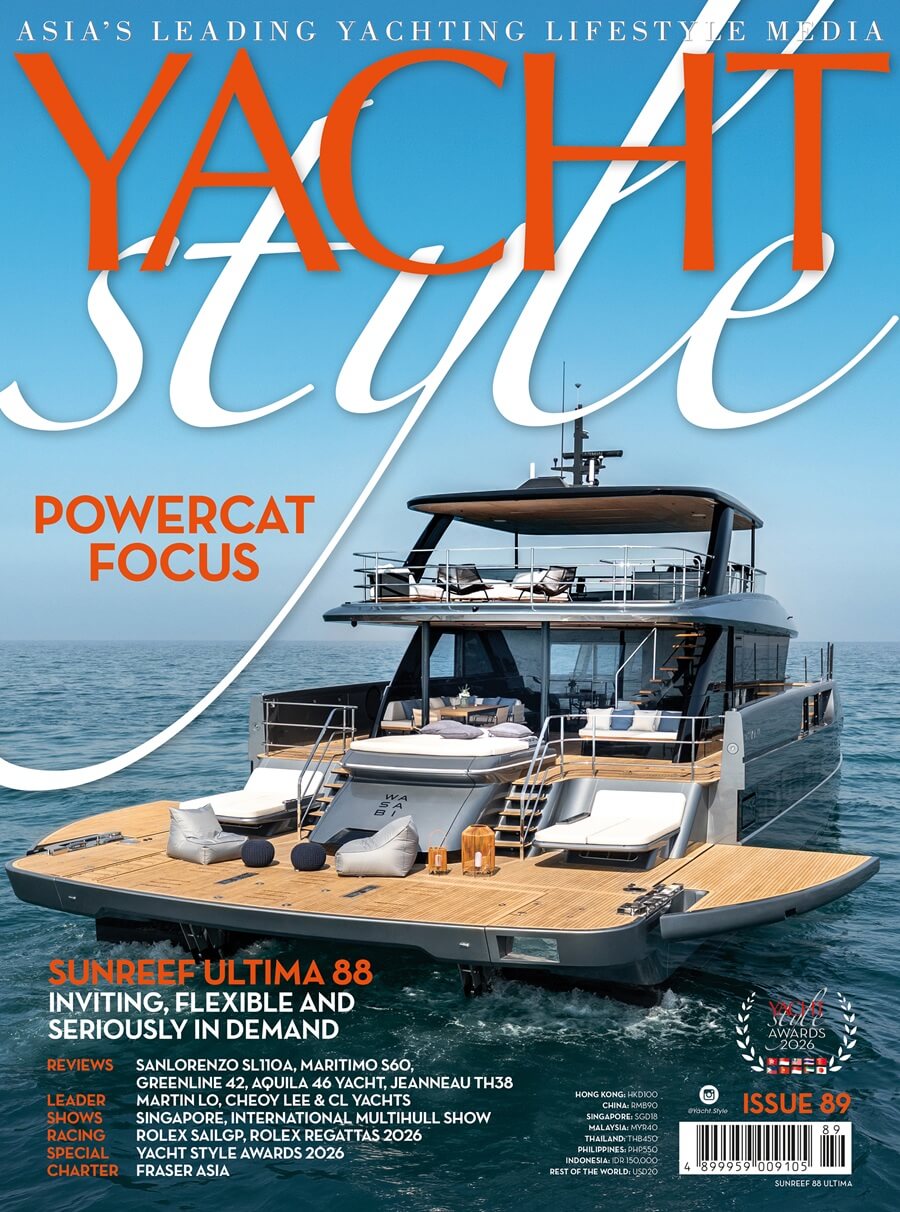
Yacht Style, Issue 89, powercat, third issue, 2026, Sunreef, Aquila, Jeanneau, Sanlorenzo, Maritimo, Greenline, Yacht Style Awards 2026, Martin Lo of CL Yachts, charter, Fraser Asia, Rolex, regattas, Hong Kong Yachting Association, Chairman, Tommy Ho, Singapore Yachting Festival
Read and download copy
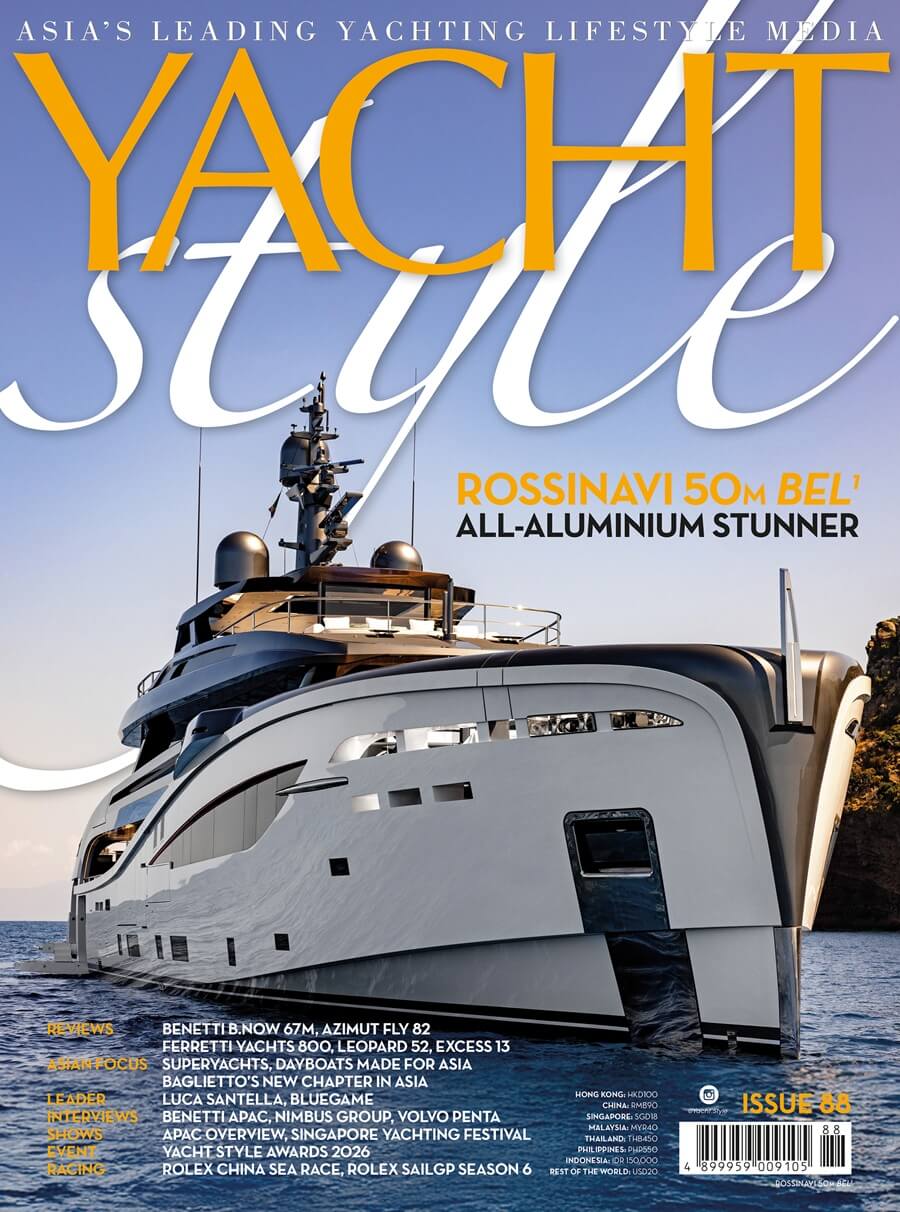
Yacht Style, Issue 88
Read and download copy
Yacht Style, Issue 86, Top 100 Superyachts of Indo-Asia-Pacific 2026, Jonathan Beckett, Burgess, Erwin Bamps, Gulf Craft Group, Fraser, Camper & Nicholsons, AB Yachts, AB 95, Van der Valk, Lalabe, Azimut, Grande 30M, Ferretti Yachts, 940, Absolute, Navetta 62, Cannes Yachting Festival, Genoa International Boat Show, Monaco Yacht Show, Lantau Yacht Club Boat Show - Festa Nautica, Rolex SailGP, Maxi Yacht Rolex Cup, Rolex Middle Sea Race, Phuket King’s Cup Regatta, Thailand, Port Takola Yacht Marina & Boatyard, Krabi, Yousuf Al Hashimi, Phoenix Yacht Management, Su Lin Cheah, ICOMIA, Suzy Rayment, Asia-Pacific Superyacht Association, APSA
Read and download copy

Asia's leading yachting lifestyle media

More results...

Generic selectors
Exact matches only
Search in title
Search in content
Post Type Selectors
Yacht Style, Issue 89, powercat, third issue, 2026, Sunreef, Aquila, Jeanneau, Sanlorenzo, Maritimo, Greenline, Yacht Style Awards 2026, Martin Lo of CL Yachts, charter, Fraser Asia, Rolex, regattas, Hong Kong Yachting Association, Chairman, Tommy Ho, Singapore Yachting Festival
Read your copy

More results...

Generic selectors
Exact matches only
Search in title
Search in content
Post Type Selectors

More results...

Generic selectors
Exact matches only
Search in title
Search in content
Post Type Selectors

lifestyle

New Octo Finissimo Tourbillon Chronograph is Sixth Record in Six Years

New Octo Finissimo Tourbillon Chronograph is Sixth Record in Six Years

SHARE

Fusing its vivacious Italian soul with the technical expertise of Swiss watchmaking, the new Bvlgari Octo Finissimo Tourbillon Chronograph brings unprecedented development to an industry that is broadly playing it safe

  •  
  •  
  •  
  •  
  •  
  •  
  •  

Bvlgari continues to shift the paradigm of modern watchmaking with its sixth World Record: the New Octo Finissimo Tourbillon Chronograph. The skeleton tourbillon chronograph is the latest in the saga of Bvlgari’s penchant for exceptional horology, this time, building upon it’s last feat – an ultra thin Chronograph GMT and for 2020, developing a self-winding ultra-thin skeleton monopusher tourbillon chronograph.

“2020 is the year of the World records at Bvlgari with this new ultra-thin Octo Finissimo Tourbillon Chronograph Skeleton Automatic. It is the 6th World record in a row for Octo Finissimo. We already launched last January in Dubai Serpenti Seduttori Tourbillon, the smallest ladies watch Tourbillon on the market which complements Diva Finissima Minute Repeater, the thinnest chiming ladies watch available on the market. Complication and records are without genders at Bvlgari!” – Jean-Christophe Babin, CEO of Bvlgari.

New Octo Finissimo Tourbillon Chronograph is Bvlgari’s Sixth Watchmaking Record in Six Years

Adding a sixth watchmaking record in six consecutive years is nothing short of prodigious, especially when one considers the relative youth of Bvlgari as a fully integrated manufacture in an industry spanning centuries. From the first model launched in 2014, the Bvlgari Octo Finissimo been a showcase platform of groundbreaking records in thinness and horological complication and a commercial success as well.


At 7.4mm, the latest Octo Finissimo Tourbillon Chronograph Skeleton Automatic is an unprecedented combination of complications in such ultra-thin proportions – it is simply the Le Sentier manufacture’s know-how distilled into one potent watchmaking emblem and a re-affirmation of the Finissimo’s pre-eminent position as this generation’s premier sports luxury watch.

Launched during the Geneva Watch Days, the 42mm Bvlgari Octo Finissimo Tourbillon Skeleton Automatic is an openworked, monopusher (yes it looks like it has two buttons) chronograph tourbillon movement with a 50-hour power reserve, ably provided by the 3.50mm thick calibre BVL 388.  this is the flattest tourbillon chronograph wristwatch ever made, there is simplu no equivalent including these horological complications in the market within such a reduced thinness while still delivering high horology features such as a horizontal clutch and a column wheel.

From the first model launched in 2014, Bvlgari Octo watch has built a saga of groundbreaking thinness records. But beyond those successive prowess’s, Octo Finissimo has reset the codes of watch design to become a new cult watch model.

Where the Bvlgari Octo Finissimo Tourbillon Chronograph Excels

To comprehend this technical accomplishment, one needs to consider the milestones before this latest world record: the Octo Finissimo Tourbillon’s BVL 268 is 1.95mm thick; however, it is a hand-wound movement. The Finissimo Automatic’s calibre BVL 138 is at 2.30mm and currently the world’s thinnest self-winding movement.

Keep in mind, that sandwiched between these accomplishments, is the fact that Bvlgari managed to figure out creating the Octo Finissimo Tourbillon Automatic’s BVL 288 movement with the same thickness as the hand-wound Finissimo tourbillon. By introducing elements like a peripheral rotor which swivels in the same level as the movement plate itself and using a flying tourbillon which doesn’t require an extra tourbillon bridge, the easiest way to develop an automatic Octo Finissimo Tourbillon Chronograph like what Bvlgari has done for 2020 is to literally add a chronograph module upon the existing BVL 288 – but that would be a totally inelegant, brutish solution, incompatible with the Italian brand’s sophisticated ethos.

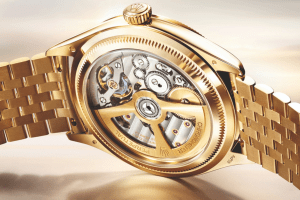
What Bvlgari has achieved in the calibre BVL 388 of the Octo Finissimo Tourbillon Chronograph Automatic is essentially include all the elements while using a traditional rather than a flying tourbillon hence the presence of an upper bridge. Peripherally geared (as visible from the gear teeth on carriage) rather than via a lower pinion, it is from the tourbillon escapement that Bvlgari has organised the rest of its components, including a column wheel device which manages chronograph functions, around rather than on-top in a sandwich-style architecture – it’s ingenious really, since the lateral clutch is flatter than the vertical clutch, the clutch lever of the chronograph rests beside the tourbillon, on the same plane as the movement plate.

Bvlgari: Roman Jeweller of Time?

For the longest time, editorials surrounding jewellers who also have a hand in haute horlogerie have often had to answer questions on whether [insert brand] can be considered a legitimate watchmaker. Such questions stem from a place of provenance, given the centuries of history rather than as true investigation into whether a brand truly knows how to make watches. Where Bvlgari has carved its niche is a special one: having established itself as a master of L’Estetica della Meccanica, fusing its vivacious Italian soul with the technical expertise of Swiss watchmaking and mechanical movements and in doing so, it has led its own revolution in watchmaking, uniting cutting-edge aesthetics with technical mastery in a way that is utterly unique to the brand.

The Octo saga, and the continuation of the story with yet another world record breaking Finissimo, highlights the exceptional nature of Bvlgari: the new Bvlgari Octo Finissimo Tourbillon Chronograph is an example of what arises when technical mastery is joined with an unbridled visionary approach.

SHARE

New Octo Finissimo Tourbillon Chronograph is Sixth Record in Six Years Read More »

This $90M Full-Floor Aerie Is New York City’s Most Expensive Home For Sale

This $90M Full-Floor Aerie Is New York City’s Most Expensive Home For Sale

SHARE

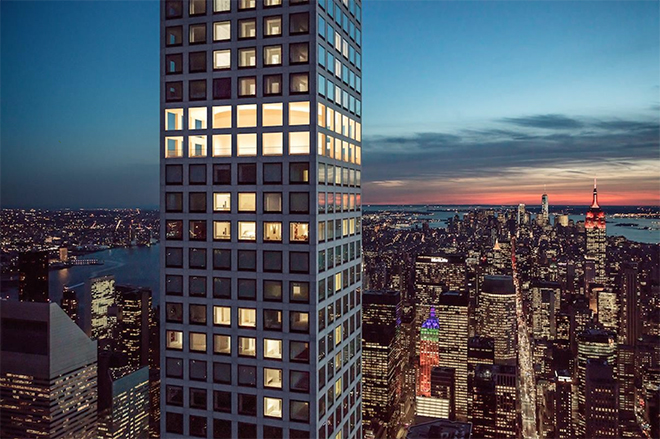
Located on Park Avenue between 56th and 57th Streets, 432 Park Avenue is not only the tallest residential tower in the Western Hemisphere, but home to a lavish, 8,000 square feet aerie.

  •  
  •  
  •  

Merging two adjacent units on the 82nd floor to form a lavish aerie spanning an estimated 8,000 square feet, these conjoined apartments hang more than 1,100 feet above ground. Located on Park Avenue between 56th and 57th Streets, 432 Park Avenue is the tallest residential tower in the Western Hemisphere. Designed by Rafael Vinoly, this extraordinary 96 story tower rises 1,396 feet, redefining the Manhattan skyline, as the apartment’s increased footprint boasts a large primary office, a personal assistant’s office, a laundry room, a palatial main bedroom suite with two enlarged dressing areas, two bathrooms and a dedicated ‘shoe room’.

This $90M Full-Floor Aerie Is New York City’s Most Expensive Home For Sale

Fully equipped for both remote work and luxury living, the residency features abundant natural light and spectacular views of Central Park, the Hudson and East Rivers, Atlantic Ocean, and many iconic Manhattan buildings and avenues, through expansive 10 feet by 10 feet windows, with additional centrally controlled climate, media and security systems.

Complete with an interior conceptualised by renowned architect Deborah Berke, all residents are treated to 30,000 square feet of prestigious amenities, including a lounge, private restaurant, outdoor terrace for dining and events, 75-foot indoor swimming pool, fitness centre and spa with sauna, steam, and massage rooms, library, billiards room, screening / performance venue, conference room, children’s playroom, yoga studio, in-residence dining and room service, concierge, 24-hour doorman, onsite parking garage and valet services provided by the building staff.

Showcasing a sweeping southwest-facing great room, and a separate eat-in kitchen and 12-and-a-half-foot ceilings, these $61.9 million renovated apartments are now worth at least $90 million, with two separate, smaller and negotiable condominiums by the same owner, available on the 29th floor for an estimated $4.67 million.

SHARE

This $90M Full-Floor Aerie Is New York City’s Most Expensive Home For Sale Read More »

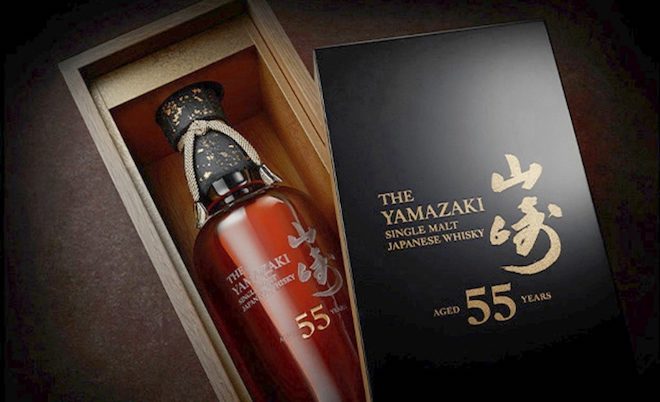
The Collectibility of Whisky proven in Bonhams sale of Yamazaki 55-Year-Old

The Collectibility of Whisky proven in Bonhams sale of Yamazaki 55-Year-Old

SHARE

Whisky is becoming ‘liquid gold’, reflecting its growing status as a collectible asset that appreciates strongly in value due to its rarity

  •  
  •  
  •  
  •  
  •  
  •  
  •  

Wiping out an estimated 100.8 million travel and tourism-related jobs worldwide, the ongoing Covid-19 pandemic has effectively brought the industry to an abrupt standstill, currently accounting for a mere 10% of global GDP. Hitting the Asian Pacific region the hardest with an approximate 63.4 million jobs lost, many cling to fleeting hopes of a potential vaccine capable of diminishing this fatal disease. However, while the outbreak may inevitably end, innumerable reports have suggested the tourism industry may take up to 10 months, or longer depending on each individual nation’s restrictive measures, to recover from the heaviest economic blow yet.

New Normal Experiential Luxury Travel

Chambre Séparées

Beyond disrupting the international flow of medical supplies and other essential needs, the disastrous pandemic may change the way civilians work, live, and play, long after the dust settles. Whether it’s short getaways reachable by car and on foot, or opting for an increasingly isolated accommodation, much of our newly acquired social distancing habits are here for the long-haul.

The Hialeah Park Casino

With everything from restaurants, cinemas, casinos and the Las Vegas Strip shuttered up for lockdown, businesses aren’t left with any other choice but to adapt their operations, facilities and marketing strategies to a demographic of highly unnerved and health-conscious consumers.

SHARE

The Collectibility of Whisky proven in Bonhams sale of Yamazaki 55-Year-Old Read More »

Haris Rashid’s Art Begs The Question, “Is There Any Humanity Left?”

Haris Rashid’s Art Begs The Question, “Is There Any Humanity Left?”

SHARE

Revolving around ideas of human atrocities, Haris Rashid showcases wild and endangered animals exhibiting human characteristics.

  •  
  •  
  •  
  •  
  •  
  •  
  •  

An artist by blood, Haris Rashid began his journey at a young age, and was encouraged by his mother who at the time, was his school’s art teacher. Since obtaining a diploma in illustration from The One Academy, Rashid has continued to develop his visual language, by not only experimenting with various mediums and surfaces, but in establishing and working collectively with Studio Mekar. His current work which revolve around ideas of human atrocities, showcase wild and endangered animals exhibiting human characteristics. His work thus probes spectators to wonder whether there is more humanity to be found in his animal subjects than in mankind itself.

Haris Rashid’s Art Begs The Question, “Is There Any Humanity Left?”

The Final Form 2016 (244x122cm), Mixed media on wood panel.

You are now 28 years old, born in Kedah province (Malaysia), raised in Damansara and you actually started painting and drawing from a young age. You even used coffee to paint portraits and landscape, which is rather unusual. Tell us about your first steps as an artist?

I was definitely influenced by mother who was an art teacher. Therefore I was exposed to art from a very young age but I never thought to be an artist myself. I still thought of more conventional careers because I saw first hand how challenging it can be to be a full time artist and I wanted myself to be stable.

Pray I 2017, 90x60cm, Acrylic on canvas 2017.

Have floral and animal patterns commonly used on textile fabrics influenced your art?

I have always been inspired by floral and animal patterns, there is a connection with nature that I find irresistible. Studying illustration, I was drawn to art movements like art nouveau , impressionist painters and ancient paintings from Egypt, China and Turkey and incorporate them in contemporary settings.

Sun bear 2015, Mixed media on wood.

You have a deep fascination for wild animals and wildlife. Your latest artworks embody the idea of animals exhibiting human characteristics. You actually coined the concept of “Humanimals”. What message do you wish to convey there?

The animal series “Humanimal” was actually done in 2016. At the time Humanimal was an exploration of the similarities or differences. I used the animals as metaphors of the human condition. Animals act on instinct , whilst humans can be clouded by expectations and politics. I am interested in the natural world because it is the purest of forms.

As years pass, my work has evolved to nature and human forms. I am constantly using metaphors and symbolism in my work to convey my own narratives that include self discovery, spirituality and Malaysian culture.

Mural 2019 at Toppen Shopping Centre, Johor, Malaysia.

In your art, you are experiment with various mediums and surfaces: canvas, wood, textured pressed paper, and even plastic. What is your selection process when creating an artwork?

Yes I love experimenting with different materials in my work. Typically the medium will be decided after I come up with the concept and the look I want to achieve. I’m always finding new ways to create my art pieces to keep me on my toes.

Pakai Buang 2019 Watercolor, color pencil and plastic on paper.

Are there any current or past Pop Art artists who have influenced you?

I see myself as pop surrealist artist. I am influenced by artists like Frida Kahlo and Guztav Klimt. I am also influenced by current artists like James Jean ,Mar Ryden and Andre Salgado.

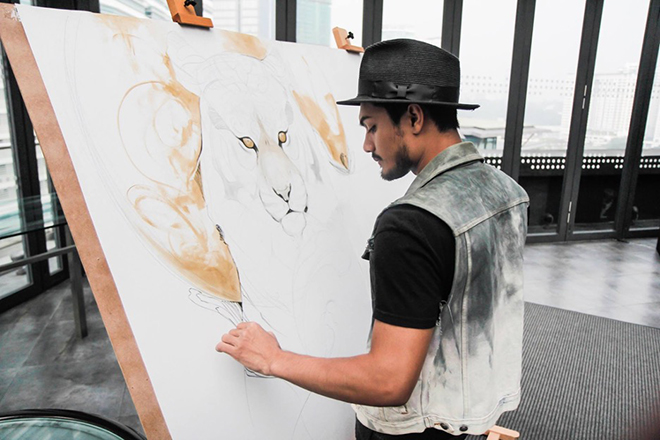
Coffee Art live painting at Le Meridien, Kuala Lumpur.

How do you view the current art scene in Malaysia? How important is the space given to artists in modern Malaysian society?

The scene I would say is improving with more and more new talents and shows going around. Though we still have a long way to go, to have more people to be aware of art in Malaysia, I am hopeful for the future. It is very important to give more space and opportunity to the art scene in Malaysia and to spread it out to more rural areas and have it become accessible to the masses.

Evolution series, wood panels, mixed media. 2019, Group exhibition at Badai Art Studio Yogyakarta, Indonesia with Artemis Art Gallery.

You have had a tight relationship with Artemis Art Gallery from your very first steps as an artist. How important has been the gallery in your developments and promotion?

I started initially through opening bazaar and booths selling my artworks and prints for 3 years. Then I started my first solo exhibition with Artemis Art Gallery in 2015. Yes it has helped me tremendously to pave my way as a full time fine artist. As an artist that did not study Fine Art , Artemis Art Gallery has helped me exhibit overseas as well as, open my eyes to the possibilities.

Haris Rashid 2019, Nocturnal color pencil and acrylic on paper.

Tell us more about the purpose & mission of Studio Mekar (Artist Collective) which you founded?

Studio Mekar was founded by me to initially have group exhibitions. It then evolved into a platform to help upcoming artist regardless of age and experience, giving them an opportunity to exhibit and meet other like minded people. It is also used to talk about our journey and struggles as a support system to navigate through the art scene. The collective itself is organic and is project based. I am always open for proposals and ideas to collaborate.  It is important for me that artists support one another.

Details of Art installation called “Nature?” 2019 Young Contemporaries(BMS) at Balai Seni Visual Negara.

The five words that best describe your art?

Colorful , symbolic , nature , floral, wild.

In which city can we expect to see your next solo exhibition?

I will be having my next solo exhibition this coming November in Zhan Art Gallery, Jaya One, Petaling Jaya.

Where can we see some of you work online, are these for sale?

Yes some works are for sale through my website or via Instagram.


Haris Rashid, Survive 2018, 80x80cm, Acrylic on canvas.

If you were to name one mentor who has inspired you in your life and path as an artist, who would that be?

Honestly I couldn’t name one constant individual, but I have always been surrounded strong figures and inspiring artists that we inspire and push each other. My mentors are collectives.

For my information, Haris Rashid is contactable via Email @ hrydin@hotmail.com or through his website.

SHARE

Haris Rashid’s Art Begs The Question, “Is There Any Humanity Left?” Read More »

OPA Architects Craft An Award-Winning Shapeshifter House Amid The Nevada

OPA Architects Craft An Award-Winning Shapeshifter House Amid The Nevada

SHARE

Built amidst a sandbox that changes forms to fit the imaginations of the user, the Shapeshifter residence represents a space of ambivalence.

  •  
  •  
  •  
  •  
  •  
  •  
  •  

Armed with the foundational beliefs that architecture poses significant impact over our perceptions and emotions, whilst acting as a physical framework for thought, San Francisco-based OPA architects have conceptualized their every design based on progressive builds, driven by ideas. Through identifying and crafting spatial experiences, architectural duo, Luke Ogrydziak and Zoë Prillinger, have successfully created the Shapeshifter home on Reno, Nevada.

OPA Architects Craft An Award-Winning Shapeshifter House Amid The Nevada

Awarded the AIA San Francisco Unbuilt Design Citation in 2015, and the Chicago Athenaeum American Architecture Award in 2018, this residence caters to a couple of art collectors and dealers, specializing in contemporary art and art of the American West. As a result of their work, they desired a house that would both reflect the contemporary moment and explicitly embody the ‘West’.

Taking on the natural environment as more than a ‘site’ for construction, OPA architects referenced the desert as an ambivalent component of the overall cultural imagery. Framed as a barren wasteland, the desert has long been appointed the perfect test site, a place for all genres of experimentation, such as, military, scientific, and social. The desert is rarely seen for itself, instead acting as a mirror for various projected fantasies: wilderness, frontier, and heterotopia. Enduringly mercurial, Luke Ogrydziak and Zoë Prillinger believe it is a sandbox that changes forms to fit the imaginations of the user, a space of ambivalence and uncertainty.

Therefore, this project began by treating the ground as a fluid material that allows different forms to emerge, then flicker or dissolve into other forms – exploring the idea of a slippery form through the lens of a mutable, protean material, an untapped unconscious foundation. Working tirelessly to reshape the site into anticlines, synclines, dunes and blowouts, the Shapeshifter residence sports an extreme difference in shape without discontinuity, allowing each element of the house to slide into each other with shifting relationships of fractured symmetries, local axes, and embedded parallelisms.

SHARE

OPA Architects Craft An Award-Winning Shapeshifter House Amid The Nevada Read More »

Filipino Artist, Darel Betita Javier’s Surreal Visual Illusions

Filipino Artist, Darel Betita Javier’s Surreal Visual Illusions

SHARE

Forever endowed with the pleasure of experimenting in every aspect of his work, Darel Betita Javier comes from a long line of esteemed Filipino artists.

  •  
  •  
  •  
  •  
  •  
  •  
  •  

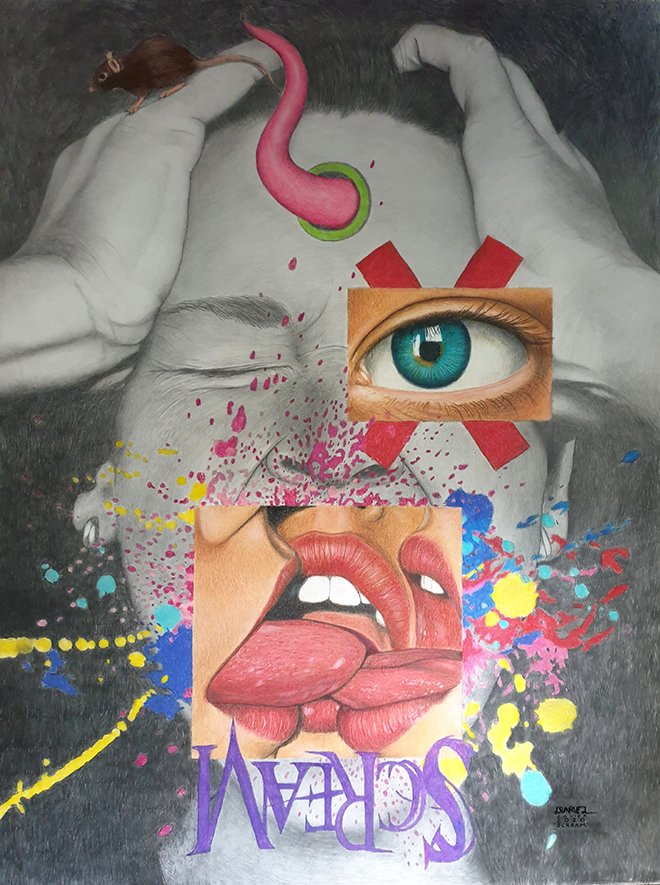
SCREAM. Colored, pencil, 40inx30in.

Born and raised in a family of artists, Darel Betita Javier, unlike his two siblings, was not quick to follow in the footsteps of their parents. Graduating with knowledge of architecture in 1992 from La Consolacion College- Bacolod, Darel spent much of his time in North Carolina, working on construction projects, before finally returning to the Bacolod City of Philippines. Finally pursuing what he was always meant to, Darel is now a full time evolving artist, forever endowed with the pleasure of experimenting in every aspect of his work.

Filipino Artist, Darel Betita Javier’s Surreal Visual Illusions

KING, QUEEN & THE PRINCE.

You grew up in the Philippines in a family of artists. How important has been this positive family environment in allowing you to express your art?

Art for me is just like a sport. It’s a playful thing. I never imagined that someday I will be just like my late dad doing art and enjoying it. I did not take art seriously when I was younger. My two brothers were already joining art competitions from the time we were elementary and high school, but not me. It was only after I came back from the US that I became a full time visual artist.

You then emigrated to the US for a few years (North Carolina). A major culture shock and a substantially different environment from the Philippines. What major learning(s) did you bring back from the US?

To be on time. In the US, it is important to be on time for an appointment or a meeting. The people there are always punctual and they always respect everybody’s time.

THIS GIRL IS ON FIRE.

How important for you, was the recognition of your talent in 2014 when you won the Philippines Art Awards- Visayas (Juror’s Choice Awards)?

2014 is the one of my most memorable years of my life. This award is important to me, as this is where I gained confidence to work harder in my field. This was the first time my work was displayed in Manila and the first time I saw and met famous visual artists in a show. It was the time I realized that the art world in the Philippines is alive and I’m so excited to be part of it.

SELF PORTRAIT.

You are always looking for new techniques in your art (coloured pen, pen and ink, paper cutting). How would you describe your style?

For me looking for a new style and technique in art should be continuous. I’m always curious and it’s a never ending learning experience. I want to explore learning new things and styles. I think I will never be content in doing or discovering new techniques, materials and ideas.

Some of my work looks like a collage but actually it’s a painting. I often use surrealism, conceptual realism, and collaged styles.

MOTHER’S PARADOX.

You were born and brought-up in the Philippines, a Catholic country where religion is a central pillar within society. How important is religion in your art? What religious references do you like to refer to?

I am a christian, I respect all kinds of beliefs and I don’t really touch religions in my art.

What is your creative process like? Where do you find your inspiration?

I usually draw it first on paper or tracing paper before finalizing it on a canvas. I often find my inspiration from my family especially from my wife, who has always believed in my work, since the beginning. She is a very supportive wife, and for an artist that is a very important thing.

ARISE.

Which is the role the artist plays in the society? How do you view the current art scene in the Philippines? How important is the space given to artists in modern Filipino society?

Artists help people and communities find their voice to be heard through art. It helps people express their feelings and learn to appreciate colors, textures, emotions and the beauties around them.

The Art scene in Philippines is very alive! A lot of new art galleries have opened, and more art exhibitions are happening. More young people have begun to appreciate art, and there are more younger art collectors emerging. The art scene in the Philippines is getting more exciting every year.

STUDIO.

Any current or past Filipino artist who has influenced you?

I have a lot of present Filipino artists who influenced me a lot. I call them my art idols or the “masters”. Some of which are, Ronald Ventura, Rodel Tapaya, Andres Barrioquinto, Lynyrd Paras, Jon Jaylo and Jason Montinola.

Can you let our readers know of your favorite Art Museum in the Philippines?

Ilomoca, Bencab & The Pinto Museum but I have never been there. The Pinto Museum is on my wishlist for when this pandemic ends. It’s the most instagram-worthy museum of Asia. As it is an hour from Manila, I tried to go there many times when I have group shows in Manila but it was to no avail, I’m always short of time. Because I usually stay only for 2 to 3 days and then go back again to Bacolod. Manila is so crowded, it’s a big city. I don’t belong there. I only go there when I have group shows.

SANCHUPAPA. Oil on canvas with Toilet Pump.

The five words that best describe your art?

Exceptional unique, expressively composed, and evolving.

In which city can we expect to see your next solo exhibition?

In Manila. I have upcoming solo shows but because of the pandemic, they were rescheduled.

Where can we see some of your work online, are these for sale?

You can find my artworks and upcoming shows on my Instagram. Each post is labelled ‘available’ or ‘sold’.

SELF PORTRAIT SERIES.

If you were to name one mentor who has inspired you in your life and path as an artist, who would that be?


Of course my late dad, Eng. Eduardo D. Javier. He was an engineer, a visual artist, a muralist (who made the longest wood mural in Asia 1969), a sculptor, a Dad and a mentor.

SHARE

Filipino Artist, Darel Betita Javier’s Surreal Visual Illusions Read More »

New Rolex Sky-Dweller with Oysterflex Bracelet: Sportive Sophistication

New Rolex Sky-Dweller with Oysterflex Bracelet: Sportive Sophistication

SHARE

Bracelets and clasps play a full part in the unique pleasure of wearing a Rolex and the new Oyster Perpetual Sky-Dweller now comes equipped with their innovative Oysterflex, a first in the classic collection

  •  
  •  
  •  
  •  
  •  
  •  
  •  

For the first time, the Rolex Oyster Perpetual Sky-Dweller is fitted with an Oysterflex bracelet, the innovative, high-performance elastomer bracelet we saw introduced in 2015 on the 40mm and 37mm Yacht-Master. Fives years on, the Oysterflex strap and clasp is still divisive among watch fans but there’s no denying that on the new 18 ct yellow gold and Everose gold Oyster Perpetual Sky-Dweller the Oysterflex strap with Oysterclasp and the Rolex Glidelock extension system adds a sportive touch much like it did the Rolex Daytona in 2017.

New Rolex Sky-Dweller with Oysterflex Bracelet: Sportive Sophistication

The new 2020 Rolex Oyster Perpetual Sky-Dweller is the first in the Classic category to include this innovative bracelet made of high-performance elastomer. Let it be said, though silicone and rubber straps had became de rigueur thanks to brands like Hublot and later on, Audemars Piguet, Rolex was never one to blindly follow suit, or worse, cater to some trend for trend’s sake.

The Sky-Dweller, Rolex’s most complicated timepiece, was previously available on both a leather strap and Oyster bracelet, 2020 sees the new yellow gold Oyster Perpetual Sky-Dweller equipped with the Oysterflex strap, one of the industry’s most comfortable silicon bracelets to date. The same attention to detail that went into the silicon strap went into the in-house calibre 9001 with dual time and annual calendar functions.

Off the Cuff, On the Wrist: Latest Rolex Sky-Dweller

Bracelets and clasps play a full part in the unique pleasure of wearing a Rolex. Their ergonomics are carefully studied, while their robustness and reliability, aesthetics and lustre are all inherent to the personality of the timepiece. Indeed, the Oyster Perpetual Sky-Dweller, either in yellow gold or pink gold variants, is ably accompanied by the Oysterflex bracelet giving the heavy watch head unprecedented support and supreme wearability while secured on the wrist.

At the heart of this innovative bracelet is a super-elastic metal blade providing the robustness and reliability of a metal bracelet while preserving the comfort and suppleness of an elastomer strap; this pliancy is aided by another unique feature: longitudinal cushions on the underside which increase comfort and wearability (but most importantly, provide much welcomed air circulation for those wearing the watch in hotter climates). One of the added benefits of this strap system is the Glidelock adjustment system allowing easy re-sizing of the bracelet on the fly, ably demonstrated on the new 41mm Rolex Submariner.

Oyster Perpetual Sky-Dweller

This new version of the Sky Dweller is equipped with calibre 9001, making it an immensely elegant yet practical watch for frequent travellers. The Sky-Dweller displays the time in two time zones simultaneously and has an annual calendar. The reference time, in 24-hour format, is shown via an off-centre disc, and the local time is read using conventional centre hands. The annual calendar, named Saros, automatically differentiates between 30- and 31-day months. It is operated by a patented mechanism and stands out for its innovative display: the months of the year are indicated in 12 apertures around the circumference of the dial, with the current month marked in red. This intelligent movement is operated via Rolex’s Ring Command system.

New Rolex Sky-Dweller with Oysterflex Price & Specs

Movement Automatic Calibre 9001 with 70 hours power reserve
Case 42mm yellow gold or Everose Gold with 100 metres water resistance
Strap Oysterflex
Price  US$41,500 or S$55,720 for Everose, US$40,000 or S$53,730 for Yellow gold

SHARE

New Rolex Sky-Dweller with Oysterflex Bracelet: Sportive Sophistication Read More »

Vijayaraghavan Kannan of Sathguru Catalyser Advisors on Agribusiness investing and Covid Game Changers

Vijayaraghavan Kannan of Sathguru Catalyser Advisors on Agribusiness investing and Covid Game Changers

SHARE

India’s agricultural sector provides livelihood to more than 50% of the population and contributes 17-18% to the country’s GDP, yet it lags in agri-productivity, Vijayaraghavan Kannan of Sathguru Catalyser Advisors tells LUXUO what’s next for agribusiness investing and potential covid game-changers

  •  
  •  
  •  
  •  
  •  
  •  
  •  

Augmenting innovative and relevant technology across the agri value chain leading to strategic growth for progressive agribusinesses is one of the many projects handled by Sathguru Catalyser Advisors Private Limited (SCA); a particularly crucial sector considering the Covid-19 crisis has immediate negative effects on food and agricultural supply chains.

The food and agricultural sector accounts for ten percent of global GDP and employs an estimated 1.5 billion people worldwide, the global pandemic will likely have far-reaching and noticeable social and economic consequences for the sector and Hyderabad-based advisory services firm believes in generating long term value for stakeholders by selectively hand picking investments and transforming them into flourishing businesses. LUXUO spoke to Mr Vijayaraghavan Kannan, General Partner of Sathguru Catalyser Advisors, on what’s next for the fund.

Interview with Vijayaraghavan Kannan, General Partner of Sathguru Catalyser Advisors, on Agribusiness investing and Covid Game Changers

You are based in India, tell us more about your Company and its mission?

Sathguru Catalyser Advisors is the Asset Management Company that is spearheading creation of an alternate investment fund, focused on growth driven food and agriculture sector in India. The Fund is registered with SEBI, the Indian securities regulatory agency as a closed-end fund with a tenor of eight years. The fund aims to propel growth in innovation driven, market focused food and agri ventures with investments that can take their products to wider Indian and international markets. India is increasingly embracing innovation in agriculture and health that are providing affordable products to the rest of the world. The fund has unique focus on steering companies that have unique intellectual property that can drive their growth with disruptive products and services. The agri business in India is dominated by Small and Medium enterprises. The new generation enterprises are adopting innovation to challenge established giants. Our focus is to propel the enterprise growth that have potential to enlarge their market presence due to intellectual assets they possess. Since these enterprises are already in the market place, they are not prone to pre-seed or seed stage technology risk.

You were known in the nineties for successfully leading multiple firms through their IPO process. What led you to focus these past years on technological innovations & applications in life sciences ?

India opened its economy to the world in the ‘90s. I had the opportunity to steer some of the global company entry into India, that brought serious competition in a market place that was non-existent in the post-independence socialistic era. The challenge was for domestic companies to face the competition and realize their full potential in the light of unprecedented competition they were subjected to due to market opening. They all built sound enterprises over long years. Many of the Indian enterprises were family owned and constrained by limited family capital they could deploy. Their enterprises had significant intrinsic value due to competitive products they created. These family jewels were taken to public markets to harness the capital needed for them to stay competitive and enlarge their scale by accessing global markets and by creating strategic partnership with global leaders. The ‘90s witnessed focus on basic needs of a growth economy and Indian investments in health, food and agriculture were driven by expanding markets and the opportunity provided by the policy planners to let these companies embrace innovation to gain global competitiveness. India emerged as the world’s largest pharmaceutical exporter of generic medicine. India also accessed innovation in agriculture and food with several companies securing significant capital from the offer of securities to general public. India today commands a market size of over $ 500 Billion, third largest in size  in the farm to market segment.  The equity markets propelled this unprecedented transformation of the Indian life sciences sector to stay competitive and emerge as global players.

India is primarily an agricultural country. The sector provides livelihood to more than 50% of the population and contributes 17-18% to the country’s GDP. However, India lags behind many other countries in agriculture productivity

What are the critical issues India and the whole subcontinent are facing resource-wise ?

The key challenge in India is to meet the long-term capital needs to sustain the high growth in domestic consumption and to deploy natural resources in a responsible manner for sustainable development. With two decades of high growth in the range of 5 to 8 percent, The Indian economy has become three-fold in less than 15 years. The demand for investment in innovation is high to compete with global front-running enterprises that invest 10 to 12 percent of their enormous revenue in innovation. These investments cannot happen from short term funding and would require long term capital for enterprises to create high growth competitiveness. The Private equity investments are one such source and the public equity are another source to propel such growth. Indian public equity markets have attracted global attention, but the private equity investments in India have so far been focused on market brands, online-platforms and real estate. We need to get the private capital to focus on creating highly competitive real assets driven manufacturing entities that can continue to lead global production with affordable products. In the realm of life sciences, we see this transformation in human health, agriculture and animal health sector. Our farm productivity is still one of the lowest though Indian leads in quantum production of food products globally. If we double our farm productivity, we can feed the whole of Africa in addition to meeting the food demand of India and still have surplus produce for rest of the world. Investing in equity in these enterprises requires informed decision making with understanding of relevance of contemporary technologies and a clear understanding of the changing dynamics of markets. Investment in alternate capital assets can provide high returns far above market returns if focused on these high growth segments that have the opportunity to grow due to high demand for market affordable products produced competitively.

Your fund invests in innovation driven growth ventures with potential to transform the agricultural production process. How do you select these firms? 

Our investment selection is driven by rigorous multiple criteria.  The contemporary innovation they bring to the fold is a fundamental drive for growth. The technology savviness of the  entrepreneur and the ability  to drive the innovation to market is another criterion. Intellectual assets in the possession of the company needs adequate global protection for the innovator to drive growth by warding-off competition. Since market disrupting products are subject to regulations, understanding of the regulations and the potential restrictions on the products to reach to wider global market is another element we focus during due diligence. Many of the agricultural innovations have multiple applications across crops and product segments and therefore understanding the whole gamut of the value contributors is another necessity. Our unique ability to holistically assess the enterprise wide advantage factors helps us to attribute optimal value for the investment. Entering at optimal value helps us to build on that value and create value gains when the enterprise market reach is optimized with full application potential of the product in the markets.

Our inter-disciplinary fund management team with expertise in agriculture and food sector innovation, investment modelling, market assessments and valuations, enterprise governance and risk assessment provide us ability to bring a consensus on enterprise valuation with the founders. Our ability to bring in experts from within and outside to steer the growth of the investee company accelerates their ability to reach the growth goals faster. Our pedigree in Sathguru as a global sector advisor provides us the access to proprietary and superior deal references.

How key is the concept of “sustainability” when selecting agricultural projects and companies your fund invests into?

The sustainability of agriculture and food production is seriously impaired by climate change threats that are looming every part of the world but more specifically the tropical agriculture region such as India. The shrinking ground water resource, excessive carbon emission, accumulating salts on soil and the depleting organic matter on soil impact farm productivity significantly. In the post farm arena, food wastage and fossil fuel driven, in-efficient production processes enhance the methane release and carbon accumulation.

Contemporary technologies in crop input needs such as seeds, crop protection products and farm mechanization solutions can help smart adaptation to climate change challenges. Our investments are focused on bringing these changes to farm input needs. In the realm of post-harvest, non-fossil fuel driven solutions and adherence to safe food practices can reduce the methane emission and absorption of carbon. Focus on water use efficiency, energy optimization and soil enrichment help to ensure sustained farm productivity. We assess all our investments to measure judiciously the contribution they make to these sustainability factors. Several innovations in farm productivity enhancement without jeopardizing the soil characteristics or the ground water potential is introduced by product makers in agri-input segment. In the animal health arena, sustainability in poultry production or dairy or meat production is ensured by farm animal nutrition, access to fodder crops that are resilient to climate challenges and animal care with preventive vaccination that can provide higher resilience to diseases in milk producing animals. Our focus on investment ensures that we measure these contributing factors and aim at quantum improvement over the baseline during the effective span of our investment.

How important are human health-focused projects in your fund?

Our investments contribute significantly to enhance human health.  Food and health nexus is age-old. The nutrition is the key driver for a growth economy such as India. Indian middle-income population aspires to consume higher quality food with more protein content. Indian average protein consumption is at the level of 30 grams a day, far lower than the optimal percapita protein consumption. The lower income communities engaged in farm labor save their farm produce to feed their family and it is important for them to secure adequate nutrition with access to diversified farm produce by them to avoid stunting in children and adult anemia.

We focus on investing in processed food ventures that can meet the growing demand for protein. While the world is focusing on alternate protein sources from non-meat ingredients, Indian protein demand is largely met by these alternate non-meat plant sources. We focus on investments that can enhance the access to protein rich plant sources. We focus on investments that can generate health healing, preventive and curative actives that are extracted from Indian spices and farm products. These nutraceuticals drive the pharma innovation currently in multiple areas such as cancer prevention, obesity and diabetes. We focus on investing in animal vaccines and protein rich feed that can ensure animal health and hygiene.

The world is focusing on alternate protein sources from non-meat ingredients, Sathguru Catalyser Advisors hopes to meet Indian protein demand with alternate non-meat plant sources.

Who are your backers? How do you select the financial institutions and private investors investing in your fund and trusting your vision?

Our initial investors are funds and family funds that have gained from investing in life sciences in the past. The investors in Asia understand the small farm agriculture and the demands of the Asian food requirement. Additionally, investors from Europe are focused on sustainability and the future of agriculture in the light of climate change challenges and would like to see enterprise innovation drive climate change adaptation in small holder farms. We have focused on investors who believe in the power of India as an emerging market for growth and the ability of Indian ventures to turn innovation to markets with global footprint.

Where do you see your fund in five years? 

We would like to invest in growth driven life science ventures that can meet changing  human needs and help to provide a better living for all. As human mortality age rises, we would like to see disease free healthy living and our investments will contribute to the healthy living needs. We would like to see successive funds building on the power of innovation to get superior game changing products with wide global acceptability and provide superior return to our investors.

If investors are interested in joining your fund, what are the key principles governance-wise you will inform them of? Who should they contact? 

Our fund is a SEBI Registered alternate investment fund with a tenor of eight years. Investors will be called to subscribe to units in our feeder fund domiciled in Luxembourg or directly into the Trust Fund established in India, depending on their choice of contributing destination. Our investments are focused on growth oriented, real assets driven food and agri enterprises with average investment size of 5 to 8 Million US Dollars. Our global investors can contribute in any currency and are provided with the fiscal advantage of investing in a pass-through fund that will enjoy no tax deduction at source. The subscribers will be contributing to calls that will be predominantly deployed within 18 months of subscription or sooner.  Our key contact will be Venu Gopal, the Investment management Partner in the fund ( venu@sathguru.com)

Has the Covid-19 global pandemic put the spotlight on what you have been advocating for years in terms of resource-control and sustainability?

Yes. In fact, the COVID has brought back the focus on the need for sustainability and access to food in an affordable manner duly deploying natural resources in a most prudent manner. Indeed, two of our investments that we have invested in the last months from our early closure have done exceedingly well during COVID not just financially but in providing all vital inputs to the farmers during the time of pandemic to continue to grow their crops. They have indeed gained higher market share during COVID. In  food and agriculture products, what is needed is real investments that can make crop production with competitive cost advantage providing higher gains to the growers and creating affordable products in the market. The ecommerce can build on that to provide higher accessibility to consumers. However, tons of money invested in ecommerce in the last 18 months in India and other markets will be relying on expensive farm output if competitive crop production is not ensured. Similarly, consumer focused superior food and health products are needed to meet the growing demand for food and health care products in times such as the pandemic. Food and agriculture sector and pharmaceuticals are the only ones that have established growth in India during the last five months.

If you were to name one mentor who has inspired you along your career, who would that be?

I had the opportunity to engage with Dr.Norman Borlaug, the legendary scientist and Nobel Peace prize winner who has revolutionized agriculture in India and South Asia during the green revolution. I am inspired by his vision of bringing innovation to farms to support small farmers gain from contemporary innovation. I am also inspired by Bill Gates who has taken his philanthropic investment to bring food and health care to millions of masses who are denied of basic needs in several countries. Bill Gates has focused on innovation in agriculture and health care delivery to ensure affordable access to food and health care in number of countries in Asia and Africa. My organization is contributing to delivering some of these initiatives funded by the Foundation in needy regions of South Asia and Africa. These two visionaries have contributed to transformation of life in number of countries with their focus on knowledge transfer and investment in healthy living.


SHARE

Vijayaraghavan Kannan of Sathguru Catalyser Advisors on Agribusiness investing and Covid Game Changers Read More »

How Petek Sutrisno Uses Art To Talk Pop Culture and Politics in Indonesia

How Petek Sutrisno Uses Art To Talk Pop Culture and Politics in Indonesia

SHARE

Petek Sutrisno is part of the generation of artists whose works are heavily influenced by comics, cartoons, illustrations, and pop culture, thus mixing a variety of modern and traditional mediums to create a distinct work of art.

  •  
  •  
  •  
  •  
  •  
  •  
  •  

“Fanatik” – Acrylic on Canvas, 140cm x 180cm, 2019

Part of the young artist generation whose works are heavily influenced by comics, cartoons, illustrations, and pop culture, Petek Sutrisno was born in 1988 and has graduated from the Indonesian Institute of The Art in Yogyakarta. Through blending modern and traditional means, Sutrisno deliberately incorporates his daily life into each piece of work, to portray an intended and relatable message.

How Petek Sutrisno Uses Art To Talk Pop Culture and Politics in Indonesia

“Nothing to Fear” – Acrylic on Canvas, 130cm x 170cm, 2020

You are now established in Yogyakarta which can be considered as the art capital of Indonesia. Tell us more about your first steps as an artist?

I’m interested in art since I was a kid, back then during my childhood my big brother always bring me to art exhibition in Yogyakarta and I always express my interest in art by drawing on all of my school textbooks and on the wall at home. I started to pursue my dream in art by studying art in high school (SMSR) in my city. Then I continue my study in Indonesia Institute of The Arts of Yogyakarta and then I decided to be an artist. That decision bring me a dream, in a bigger picture that one day I want the world see my paintings.

“Regal” – Acrylic on Canvas, 150cm x 120cm, 2020

You art is vibrant colors! Tell us more about the symbolic imagery we can find across your art: from Indonesia divinities & traditional motives to cosmonauts & robot?

Most of my work talk about my childhood experience and current political issues. The cosmonauts and robot symbol came into my mind when during my nostalgic session I contemplated my toys when I was a child. I also gave some traditional culture and modernity touch in my paintings like wayang, batik and I mixed them with few characters and some symbols from pop culture like movies, comic books, animation and illustration. Whenever I paint I feel that I need these exposures, the modernity and my traditional roots, for me they create a harmony on my paintings.

“Finding Home” – Acrylic on Canvas, 140cm x 180cm, 2020

Why this fascination for flowers which are prominently featured in almost all of your artworks?

Love, beauty and peace. I tried to put these 3 elements on my work and I choose flower as the symbol of these 3 things. I always think that I have to put nature element in my work since what I see nowadays so many bad news about our planet. This flower is to remind us that we have to preserve nature and the world where we live now.

“Teenage Fantasy No. 1” – Acrylic on Canvas, 140cm x 180cm, 2020

You are always looking for new techniques in your art. How would you describe your style?

I like to try new technique during the process, I don’t like to repeat the same thing all the time, sometimes it bores me and It’s fun to explore many techniques and possibilities during the painting making. It’s true that it affects my style but honestly I don’t really care about style because I don’t want to set a border in my creativity and set a limit for all the new ideas just because it doesn’t suit my style. So, I decided to freed my imagination and doing what I feel right.

“Teenage Fantasy No. 2” – Acrylic on Canvas, 140cm x 180cm, 2020

You works contains social and political themes. Do you see yourself as an engaged artist.

The influence of social – politic issues reflect the condition of my country, it affects me during the process I create my paintings, it’s like I can’t get those things out of my head so I decided to put all what I had in my mind on canvas. I like to use my work as a media to reflect what I thought. I like being critical, not all of the time but you can see I show what I feel about political injustice and some political issue. for me art is one of some ways to speak about the truth, and we can also fight for what we believe through art.

“Identity No.2” – Acrylic on Canvas, 150cm x 120cm, 2019

Any current or past pop artists who has influenced you?

To be honest I don’t know who is the most influential artist during my career but I really like the work of several artists like Jeff Koons,Takashi Murakami,Andy Warhol,I Nyoman Masriadi & Eko Nugroho, they are amazing and they give me good and  positive influence.

“Diantara” – Acrylic on Canvas, 140cm x 180cm, 2019

How do you view the current art scene in Indonesia? How important is the space given to artists in modern Indonesian society?

In my opinion art in Indonesia has been developed over time and you can see there are many galleries where you can find the work of some young artists. Not only that, the society appreciate art a lot better nowadays. Art in Indonesia already take a part in their life, and we see it as a lifestyle. So I’m very glad see how Indonesians especially the young generations taking part on the art development here.

“Toys Story” – Acrylic on Canvas, 140cm x 200cm, 2020

The five words that best describe your art?

Fun, Funny, Beauty, Interesting and Curious

In which city can we expect to see your next solo exhibition?

Currently I don’t have any plan for solo exhibition because I still have to finish many projects till the end of the year. I hope next year I’ll be able to have my next solo exhibition.

Artotel Surabaya 2015

Where can we see some of your work online, are these for sale?

You can check out my Instagram account, but some of them are already sold.

“Sebelum Hujan Turun” – Acrylic on Canvas, 150cm x 200cm, 2019

If you were to name one mentor who has inspired you in life and path as an artist, who would that be?

The reason why I become an artist is my family, but if I have to mention someone who has encouraged me during my early career is Bambang Toko. He was my lecturer when I was studying in university.


SHARE

How Petek Sutrisno Uses Art To Talk Pop Culture and Politics in Indonesia Read More »

Luxury Destinations Every Post-Pandemic Traveller’s Been Missing

Luxury Destinations Every Post-Pandemic Traveller’s Been Missing

SHARE

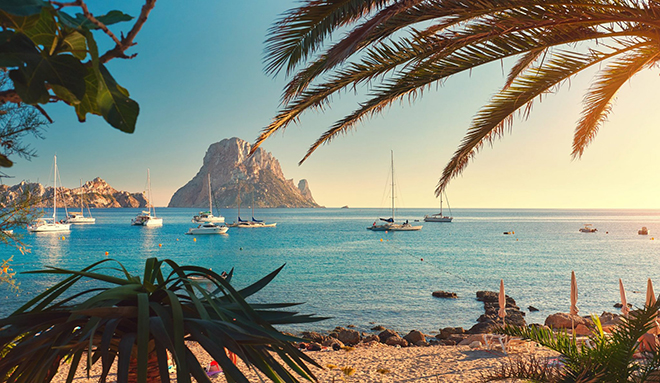
Portofino, Saint Tropez, and Ibiza are just a few Insta-worthy destinations some of the world’s super-rich are keenest to head back to.

  •  
  •  
  •  
  •  
  •  
  •  
  •  

Whether it’s ideas for a date night, the trendiest fits, adventure or vacation, Instagram users have long established the site as the go-to platform for all things inspiration. With the world barely recovering from a severe global pandemic and lockdown, here are a few Insta-worthy destinations some of the world’s super-rich are keenest to head back to.

Luxury Destinations Every Post-Pandemic Traveller’s Been Missing

Saint-Tropez

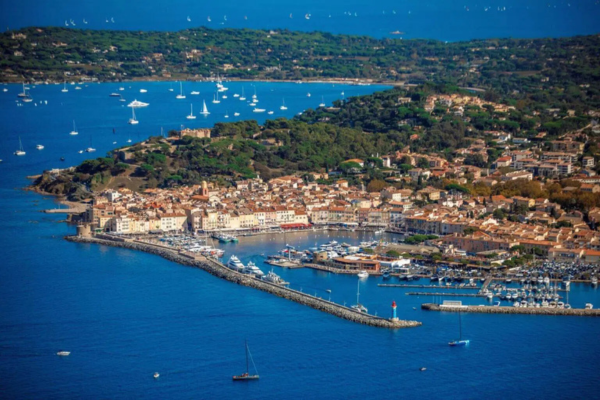
In the Provence-Alpes-Côte d’Azur region of south-eastern France, lies a coastal town on the French Riviera, revered for its long lineage of esteemed artists and international “jet setters”, dating as far back to the 1960s. Remaining known for bustling its beaches and nightlife, the miniscule fishing villages of Saint-Tropez have since evolved and expanded to accommodate a multitude of million dollar yatchs.

Showcasing a collection of beaches, each measuring an estimated 30 metres wide with their own private huts and public tanning areas, along its five-kilometre shore, Saint-Tropez is the ideal destination for windsurfing, sailing, canoeing, and other motorized water sports such as, power boats, jet bikes, water skiing and scuba diving.

Most popularised by the film ‘And God Created Woman’ featuring Brigitte Bardot, Saint-Tropez has earned its reputation an artistic and hedonistic town, but also as a clothing-optional safe-haven.

Antibes

Revered for its old town enclosed by 16th-century ramparts with the star-shaped Fort Carré, the resort town of Antibes between Cannes and Nice on the French Riviera, overlooks a sea of luxury yachts moored at the Port Vauban marina. Generously dotted with grand villas, Antibes borders along the chic resorts of Juan-les-Pins and the Jazz à Juan music festival, buzzing enthusiastically all night long.

Ibiza

Considered one of Balearic islands, and an archipelago of Spain in the Mediterranean Sea, Ibiza is well known for its ideal balance of innumerable European nightclubs, hotels, bars, shops, quiet villages, yoga retreats and beaches of sandy coves backed by pine-clad hills.

Shop the quirkiest fashion, and one-of-a-kind jewellery, accompanied by tasty local food stalls, and live music entertainment, every Wednesday at Es Canar – or stop by the highlight of Ibiza’s daytime party scene, Bora Bora for the ideal mix of music, social gathering, drinks, relaxation, and water-sport.

Sardinia

Boasting coastlines, sandy beaches and a mountainous interior crossed with hiking trails, the rugged landscape of Sardinia spans nearly 2,000km, dotted with thousands of mysterious Bronze Age stone ruins. Rich with a tumultuous history, the Italian island has seen influence from the Arabs, Greeks, and Catalonians, amongst many others who have left their mark.

Home to picturesque town of Ozieri, the atmospheric cliffside ruins of Tharros, and the flavourful San Teodoro, Sardinia is renowned for its architecture, food, culture and heritage – offering an expansive variety of local delicacies, including shellfish mixed platters, with gelato, and the region’s famous fish zuppa, a light seafood stew crammed with crustaceans and fresh catches of the day.

Portofino

Pastel-coloured houses, high-end boutiques and seafood restaurants fringe its Piazzetta, as a small cobbled square overlooks the super-yacht-lined harbour of Portofino. Once a humble fishing village southeast of Genoa city and along the Italian Riviera coastline, Portofino is regarded a 16th-century fortress, encompassing museums with art exhibitions, luxury shopping, panoramic views of the town and the Ligurian Sea, and an array of outdoor activities along the marine reserve.

SHARE

Luxury Destinations Every Post-Pandemic Traveller’s Been Missing Read More »

Yogyakarta-Based Artist, Lugas Syllabus Paints Life in Captivating Stories

Yogyakarta-Based Artist, Lugas Syllabus Paints Life in Captivating Stories

SHARE

Revered for his paintings and sculptures that address the ironies of modern and contemporary society, Lugas Syllabus is a gifted and engaging storyteller, with a greater vision for peace and justice.

Lugas Syllabus, ‘The Garden of Triumph’, 300cm x 200cm. Acrylic on linen. 2015. Exhibited ‘garden of thriump’ solo show Lugas Syllabus. Art Stage 2016, Element art Space Singapore. Collection of Mr. Alim

As a contemporary artist, living and working in Yogyakarta, Indonesia, Lugas Syllabus is highly revered for his paintings and sculptures; His work address the ironies and contradictions in modern and contemporary society. Drawing inspiration from a variety of mediums, Syllabus’ work often incorporate elements of pop culture, media and technology; coupled with memories and folklore. Armed with an undergraduate degree in painting from the Institut Seni Indonesia (ISI) of Yogyakarta, Lugas Syllabus has participated in a multitude of artist-in-residency programmes in Passau, Germany; Brisbane, Australia and Singapore, with a selection of work showcased globally.

Yogyakarta-Based Artist, Lugas Syllabus Paints Life in Captivating Stories

Legenda Pendekar dari Bukit Asia. 200cm x 150cm . Acrylic on Linen. 2014. Collection of Mr. Kevin.

You grew up in Bengkulu, Indonesia, and are now established in Yogyakarta, the art capital. Tell us about your first steps as an artist?

I’ve loved art since I was a kid, and decided to be an artist since senior year in high school after a visit to Yogyakarta with my family. It was my father and my uncle Idran Yusuf, who were both artists as well, who showed me ISI (Indonesia Institute of Art at Yogyakarta). Since then, I pushed myself to make many sketches and paintings everyday, neglecting other subjects, in order to achieve the best results to qualify for admission into ISI.

Living construction in the Garden of Memory. 120cm x 150cm. Acrylic, gold leaf on linen, 2018. Exhibited at Solo Show of Lugas Syllabus. We dance together, curated by Khai Hori. Chan+Hori contemporary Singapore, 2018. Image courtesy of the Artist n Chan+Hori, and Collection of Mr Tan Hon Yik.

You seem to take inspirations from very diverse sources – pop music, television series, movie posters, even video games – how would you describe your style?

I love storytelling, describing through painting, explaining with poetry, and using my own daily life for inspiration.

‘Work Eat Work’ Reconsumerism auto machine. Mural on Lugas Syllabus Solo Show ‘Natural Born Worker’ curated by Patrick D. Flores, Finale Art File Philipine. 2016. Image courtesy of Artist and Finale Art File, Manila.

Your art is vibrant with vivid colours and a palette of images sampled from domains as diverse as nature documentaries, art history and religious icons. Tell us more about the “psychedelic imagery” you are using and the “hidden” messages you seem to be trying to push across?

I like to push my art beyond galleries, fairs, auctions and collector walls. I’m happy if it appears in the public space and is given more attention and contribution. I began expressing myself using hidden messages after I showcased Davinci Codex in Milan during my residency in Europe 2012 and also Goya’s Paper in Madrid. I’m working on my own paper now about the sign and I’d like to keep my upcoming ‘hidden message’ a mystery.

Golden Limousine in the heaven of Art, 200cm x 300cm, Acrylic on Linen, (2016) . Auctioned @Christie’s Hongkong 2017. Price realised HKD 325,000, Collection of Mr. Sunyata Wangsadarma

A lot of your work deals with a sociological observation of societal power structures. Your work also contains political themes (your large-scale artwork “Golden Limousine in the Heaven of Art” or “Golden Prayer” for instance). Do you see yourself as an “engaged” artist?

You are right. I feel an artist should engage in political themes but should not be controlled by it. We describe him as a “knight of social betterment”. This knight considers himself a hero who has given over the meaning of life to his God, he lives focusing on the delight of his extended family and thrives on a just society; he is the one who rallies to drive mankind towards a more beautiful and noble world. I try to work on my own beliefs as well, I want to live a meaningful life for my God also. I believe if society is organised cooperatively, socioeconomic resources can benefit all, there would no longer be corrupt governments as dirty politics would vanish and there would be no more racism. Like in Golden Limousine: I dream of myself driving with my heroes like Michelangelo, Leonardo da Vinci, Raden Saleh, Picasso, Chang Ta Chien, Warhol, Affandi, to name a few. Therefore, with no more racism, no need for power. There would be no additional burdens on a citizen’s obligations to society.

Royal Wedding Series ‘Blessing Family on the Golden Tree’.
Dr. Oei Hong Djien on The Royal Wedding stage.
Set of Painting , Bridal Stage, Photobooth, and Interactive Photo Contest via Media Social. 2019.

Your primary medium of expression is through painting and sculpture. How do you decide which media to use over others?

The concept or story controls the medium. I also like to work across media, for example, in my work ‘royal wedding series’, I made a bridal stage and photo booth contest. In this work, the audience and space are both equally important.

Nature inside Nature. 200 cm x 300 cm. Acrylic, Gold Leaf On Linen. 2018. Collection of TOTO Indonesia.

What is the most challenging aspect about creating your artwork?

To make it similar to my imagination…, there are limits to the material but no limit on my fantasies…

Berbatas tapi tak Terbatas tapi Berbatas’. Interactive Room ‘mushola’ Prayer Room set of Copy Raden Saleh painting ‘Merapi dipagi hari & malam hari’ Medium Variable. 2019. Exhibited at ArtJog MMXIX Jogja National Museum 2019. Image courtesy of the Artist n Art+Jog

You have collectors around the world. You are referenced amongst the leading global art websites. What does such recognition inspire in you?

As Warhol said if Art is a business make a good business, Art Business is more about trust and joy of process. I make many mistakes but I keep learning and I want to enjoy my progress and I don’t want to stop learning.

Title: The Relationship between hope and blood. Medium: Teakwood, Fiberglass, Silicone Rubber, Dand Colouring Car Paint. Year: 2014 – 2017. Size: 160cm x 130cm x 260cm + Variable Dimension Small Stone Sculpture. Exhibited Jogja Biennale XIV ‘stage of Hope’ Jogja national Museum 2017

How do you view the current art scene in Indonesia? How important is the space given to artists in modern Indonesian society?

The Indonesian art scene has made good improvement but it needs more support from the government and art collectors. In Indonesian modern society, artists have more wide space, as they work across many disciplines. But we also need to give more support for artists and Art Promoters (curator, gallery, dealer etc) who try to push their careers onto international platforms, and we promote Indonesian art globally as well.

Lugas Syllabus.
Standing,Running,flying #2. 200cm x 300cm. Acrylic on Linen. 2015.
Exhibited: The Prophet ‘Solo Exhibition Of Lugas Syllabus. Curated by Hendro Wiyanto. Sangkring Art Project.
Collection of Mr Hosiyadi.

The five words that best describe your art?

Theatrical, Landscape, Poetry of Hope.

Forbidden tree and the Golden Age. Acrylic, Gold Leaf on Linen. 200cm x 300cm. 2017.
Exhibited at ‘Lugas Syllabus Solo show’ tomorrow must be better. Art021 Shanghai, Element art Space. 2017. Collection of Micky Tiroche.

In which city can we expect to see your next solo exhibition?

I am working on some plans for a solo show with galleries overseas, perhaps China since it’s the closest. Since my successful sold out solo show at Art021 Shanghai and Museum show at Nanjing, I keep in contact with China Collectors, Curators and Art Friends, and am happy to still sell some work to them even during Covid.

Where can we see some of your work online, are these for sale?

You may find my work on Ocula, through selected auctions at Christie’s, online galleries such as Chan+hori and on my personal page. There is artwork for sale, some is collected, while some is only for visual documentation.

Lugas Syllabus, Pinky Rainbow in the Beautiful Day, 2019. Acrylic on canvas. 200 x 150 cm.exhibited Sea Focus 2020 Singapore. Image courtesy of the artist and Chan+Hori.

You are a very sociable person, far from the cliché of an introvert artist. Who are your best artist friends on the Indonesian art scene?

I have some art friends that often get together in my studio. My studio has a ‘Joglo’ cottage where we drink coffee and discuss art. I don’t want to name names in case of envy, but they are all good friends who inspire each other but there’s also some friendly rivals. We like to debate art .Sometimes the debates get a little salty…and it becomes never-ending, continuing up till late at night. I find that they are all smart but not as genius as me…so i leave them to go to sleep. Sometimes they stay until really late and in the morning. I start work in the morning, I heard a story about them from my studio assistant while they were all still sleeping. I really enjoy listening to stories while I’m painting and drinking coffee, especially when I feel like I’m the winner of night’s debate.
Lugas Syllabus, Better Land for a Better Home, 2019 – 2020. Acrylic, gold leaf, decorfin on linen. 150 x 200 cm. Exhibited ‘where the sidewalk end’ Chan+Hori Contemporary. Collection of Mr. Aaron Teo.

If you were to name one mentor who has inspired you in your life and path as an artist, who would that be?

It would be my father who taught me how to sketch and write. But I also like Goya as he can put his hidden message in his work and show his feelings in many situations. In Indonesia I like S Sudjojono as he can show the true colour of Indonesian Art from his era. But I want to be more than they are, I want to talk about history, the present and the future, that’s why I put no borders on my art.

SHARE

Yogyakarta-Based Artist, Lugas Syllabus Paints Life in Captivating Stories Read More »

Art Republic of Kongo: Q&A Part 2

Art Republic of Kongo: Q&A Part 2

SHARE

Paris-based Cyril Kongo is returning to his Southeast Asian roots with creative platforms in Vietnam and Singapore.

  •  
  •  
  •  
  •  
  •  
  •  
  •  

Following is the conclusion of a two-part interview by Nina Starr on YachtStyle.co

Kongo, whose grandfather in Vietnam was blinded after he stepped on a mine, painted a vintage Nord 1000 to raise funds to produce The Little Prince tactile art book

Tell us about your partnership with the Antoine de Saint Exupéry Youth Foundation and painting a vintage Nord 1000 airplane.
The idea was to raise funds to produce The Little Prince tactile art book with drawings for the blind. My grandfather was blind. He had jumped on a mine in Vietnam and lost his eyes.

As a kid, I read the newspaper to him, so when the Saint Exupéry Foundation proposed this project, I accepted because it served others. I believe the most important thing in the life of a person is to serve a cause and inspire people.

Art Republic of Kongo: Q&A Part 1

Kongo emerged from the Parisian graffiti art scene and still uses a wide array of colours in his work Describing himself as a 'true citizen of the world', Kongo is a regular visitor to Asia, where he spent his early years before living in Africa and settling in Europe.

How did your connection to Asia lead to presenting street art in China?
I am half Asian. My dad is Vietnamese, so I have always been linked to Asia, especially Southeast Asia, by half my family. I had the chance to progress between Europe, Africa and Asia, so I am a true citizen of the world.

In 2004, I created the Eating Frogs Tour in southern China with a group of friends comprising big names in graffiti, dance and deejaying to present French hip-hop in Guangzhou, Shenzhen and Hong Kong. It’s funny how it takes time, how tightly closed the borders were. It’s opening drop by drop and there is still a lot to do there.

Kongo, whose father is Vietnamese, is opening a gallery in Vietnam

What are your favourite places in Asia?
Each experience is magnificent. I have a special fondness for Singapore, which impresses me by the modernity of its vision. The country is managed like a company and everyone follows the same path. I find it interesting as a Parisian where everything is all over the place. Sometimes it feels good to have some boundaries for the common good and Singapore impresses me a lot in that regard and with its quality of life.

I also love Indonesia, especially Bali, where I find a lot of spirituality and a bit of the disorder of Paris. I particularly like Vietnam because it’s part of my blood. I love Japan for its modernity, the total change of scenery you can have and the vision they have of art.

Kongo’s work has even featured in fashion for Chanel

I am very impressed by China, by its power, how it managed to rebound and become a major force in the world, knowing how to mix politics, industry and capitalism.

Tell us about your collaboration with Singaporean tailor Kevin Seah.
Kevin is above all a friend. Once again, it was an encounter. I held my first exhibition in Singapore in 2012 and Kevin was working in the same building. He is very well dressed and very British, but he was a skateboarder who understands urban culture, so there was mutual respect.

I was impressed by his know-how and that all his suits are sewn by hand. He asked me to make a painting for him and I asked him to make me a jacket, so that’s how it started. He made me a denim jacket, and for the inside lining, he used the silk scarf I’d done for Hermès. It was super chic yet casual, and I loved it. He also made me a camouflage jacket.

A tailored jacket by Kongo

Then we had the idea of making jackets out of linen canvases. He has a linen that is very fine, so I can’t put a lot of paint on it. He sent the linen to me in Paris, I painted the canvases, sent them back to Singapore and he reinterpreted my paintings, cutting them to make unique jackets. We did that in 2013.

I did the collection with Karl Lagerfeld in 2019. It was a completely insane experience, but I didn’t make the collection for Chanel. I met Karl and he asked me to make a whole series of paintings at his atelier on Quai Voltaire, then he chose the paintings to make dresses and bags. It was a real meeting between creators.

After your successful pop-up studio in Paris’s chic 8th arrondissement in 2017, you opened one in Singapore, too.
In November 2018, I told Kevin [Seah] about my ephemeral workshop on Rue François 1er. He asked me about doing one in Singapore and told me to look at a place available next door. The landlord of The Mill, Roy Teo, left me the space to create my workshop for a month, so I did the same pop-up studio concept.

Kongo at work in his studio in Paris

However, it’s no longer ephemeral since I kept it to set up a showroom-atelier because I feel good in Singapore and I’m planning to settle there to create my works to continue the Asian adventure. It will be a private atelier-showroom where people can visit by appointment.

Finally, how is the boutique in Hanoi progressing?
It’s a partnership with a financier who’s opening a Cyril Kongo brand boutique for me to highlight Vietnamese and Southeast Asian artists. He told me that in Vietnam, north and south, many family members went overseas, travelled far and were immigrants in the US, England, Canada, Europe.

He said: “Your case is very special because Vietnamese and Asians who have succeeded consume the brands that have recognised you, so you’re like a hero to them. We know the pain that all families who left Vietnam suffered to get back on track, but very few have succeeded in doing what you have done, like collaborating with Richard Mille and Chanel. You’ve made us proud and we’d like you to express yourself in Vietnam.”

The man, the myth, the enigma …

It will be a store-gallery. I will present objects and original drawings, but I also want to develop the savoir-faire of Southeast Asia like Vietnamese lacquer and carvings, and Indonesian batik. I’ll go around Southeast Asia and reinterpret savoir-faire, much like I interpreted traditional French skills through my work with Daum or La Cornue.

I want to give my contemporary vision on traditional skills we are proud of, but which seem a bit old-fashioned. For example, I want to give my take on sang-de boeuf ceramics and remake batik, which is very traditional and coded. I will present all this exclusively in the boutique in Vietnam and an e-commerce website linked to the store.

SHARE

Art Republic of Kongo: Q&A Part 2 Read More »