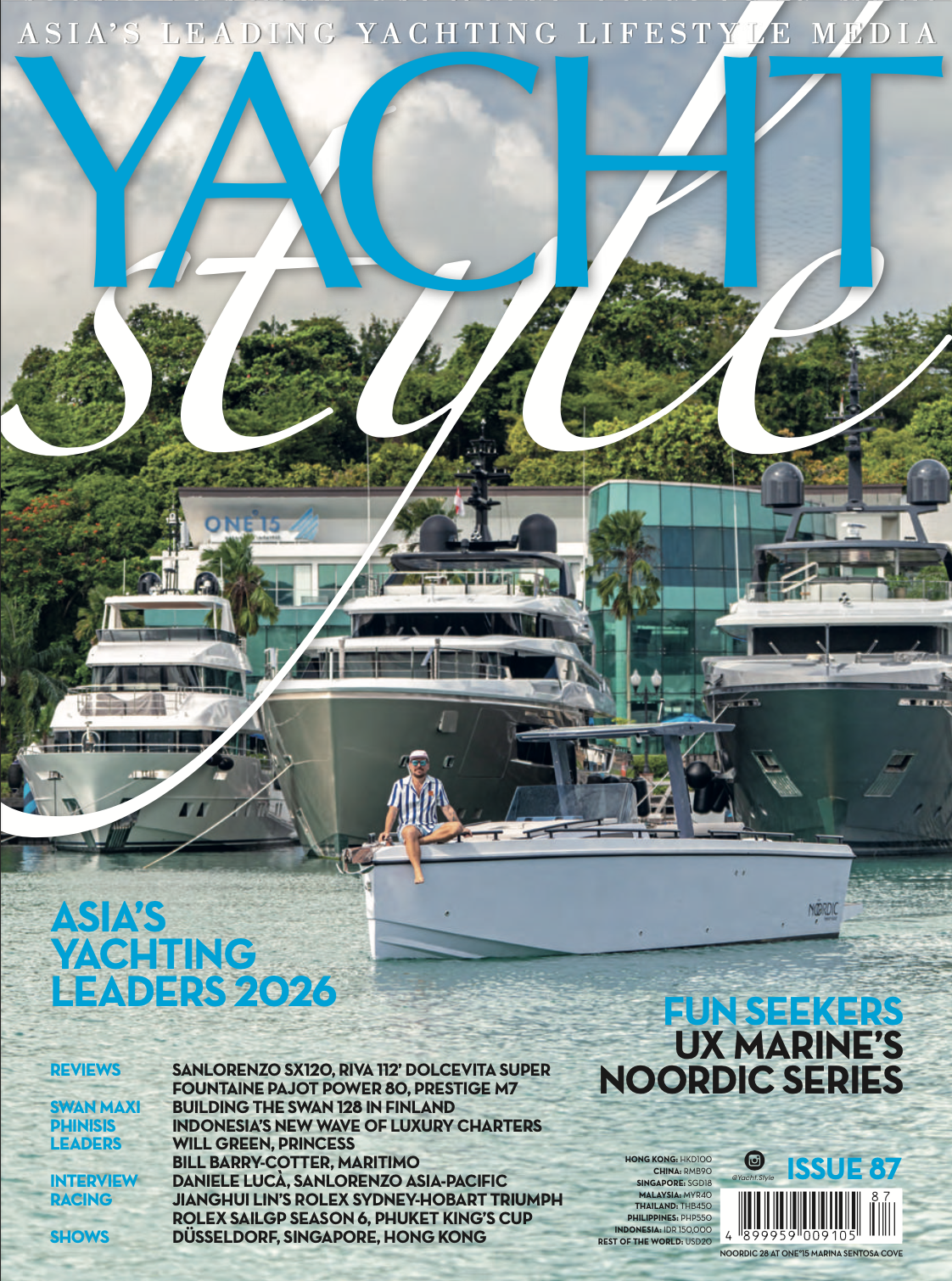
Yacht Style, Issue 88
Read and download copy
Yacht Style, Issue 86, Top 100 Superyachts of Indo-Asia-Pacific 2026, Jonathan Beckett, Burgess, Erwin Bamps, Gulf Craft Group, Fraser, Camper & Nicholsons, AB Yachts, AB 95, Van der Valk, Lalabe, Azimut, Grande 30M, Ferretti Yachts, 940, Absolute, Navetta 62, Cannes Yachting Festival, Genoa International Boat Show, Monaco Yacht Show, Lantau Yacht Club Boat Show - Festa Nautica, Rolex SailGP, Maxi Yacht Rolex Cup, Rolex Middle Sea Race, Phuket King’s Cup Regatta, Thailand, Port Takola Yacht Marina & Boatyard, Krabi, Yousuf Al Hashimi, Phoenix Yacht Management, Su Lin Cheah, ICOMIA, Suzy Rayment, Asia-Pacific Superyacht Association, APSA
Read and download copy

Asia's leading yachting lifestyle media

More results...

Generic selectors
Exact matches only
Search in title
Search in content
Post Type Selectors
Screenshot 2026-01-16 at 9.52.20 AM
Read your copy

More results...

Generic selectors
Exact matches only
Search in title
Search in content
Post Type Selectors
Yacht Style, Issue 88
Read and download copy

More results...

Generic selectors
Exact matches only
Search in title
Search in content
Post Type Selectors

Reviews

Motoryacht, superyacht, Ferretti Yachts 800, IdeaeItalia, Filippo Salvetti, flybridge

Ferretti Yachts 800 embodies balance

Ferretti Yachts 800 embodies balance

SHARE

The Ferretti Yachts 800 completes the design renewal of a Flybridge line designed by Filippo Salvetti with interior options by IdeaeItalia –


Motoryacht, superyacht, Ferretti Yachts 800, IdeaeItalia, Filippo Salvetti, flybridge

The Ferretti Yachts 800 had its world premiere at Cannes Yachting Festival 2025


Plenty of yachts try to impress at first glance. The Ferretti Yachts 800 does something rarer: it arrives with ease. No theatrics, no posturing, just a clear sense of proportion and purpose that speaks louder than any flourish.


This model closes the loop on Ferretti Yachts’ design renewal, a process that began in 2018 and gradually reshaped the brand’s modern identity. The 800 stands as the final expression of that evolution, familiar in footprint, but elevated in its execution and intent.


Motoryacht, superyacht, Ferretti Yachts 800, IdeaeItalia, Filippo Salvetti, flybridge

The foredeck has a C-shaped sofa facing an optional table and a large sunlounger with backrest


Guided by Ferretti Group’s Strategic Product Committee chaired by Piero Ferrari and brought to life by the company’s Engineering Department, the yacht carries the joint signatures of architect Filippo Salvetti on the exterior and IdeaeItalia on the interior. The dimensions reflect the category, but the experience feels distinctly more curated.


The 800 also reflects a clear understanding of how owners in this size bracket use their boats. Increasingly, they’re seeking something that balances professional crew support with the freedom of an owner-driver experience.


Motoryacht, superyacht, Ferretti Yachts 800, IdeaeItalia, Filippo Salvetti, flybridge

The full-beam platform can become a waterside lounge, complemented by a fold-down sofa


This yacht makes that balance look effortless. The deck flow, the discreet crew routing and the thoughtful separation of service and leisure areas all contribute to a sense of personal space rarely achieved on an 80-footer.


Families can settle in without ever feeling managed, while owners who prefer to take the helm from time to time won’t feel overshadowed by the operational side of the boat. It’s a yacht designed for real life, not just for spec sheets, and that practicality ultimately becomes part of its understated charm.


Motoryacht, superyacht, Ferretti Yachts 800, IdeaeItalia, Filippo Salvetti, flybridge

Aft view of the 15sqm cockpit with flybridge stairs


The 800’s profile is defined by poise rather than drama. Salvetti introduces a subtle shift: the flybridge line slopes gently toward the stern instead of running parallel to the hull, giving the yacht a natural sense of movement even at rest. Small as it is, this gesture shapes the whole attitude of the design.


Large, uninterrupted glazing stretches across the hull and superstructure, drawing in light and dissolving the barrier between interior and horizon. The lines remain clean, confident and unmistakably contemporary – proof that design restraint can be every bit as expressive as embellishment.


Motoryacht, superyacht, Ferretti Yachts 800, IdeaeItalia, Filippo Salvetti, flybridge

The flybridge includes a covered area with wet bar, dining and a lounging area by the twin-seat helm

Motoryacht, superyacht, Ferretti Yachts 800, IdeaeItalia, Filippo Salvetti, flybridge


The 40sqm-plus flybridge embodies the yacht’s approach to outdoor living. It’s generous but never showy. A relaxed aft lounge, a natural-feeling dining area to starboard, and a discreetly equipped bar to port form the backbone of the space.


Forward, the helm enjoys clear visibility and sits beneath a choice of fixed-glass or louvred hardtop, both maintaining the yacht’s sleek profile while ensuring usability throughout the day. The design reads as purposeful and composed, exactly as the rest of the yacht does.


The saloon’s starboard side can feature a storage unit with high-low TV (pictured), cabinet with free-standing TV or another sofa


Inside, IdeaeItalia approaches the main deck as a study in proportion and flow. The atmosphere depends not on volume alone but on balance: tall glass, uncluttered sightlines and a calm, measured layout. Two décor moods – Classic and Contemporary – guide the palette without defining it. In both, the materials remain subtle and tactile, with an emphasis on warmth, clarity and Italian restraint.


The saloon carries a natural ease, more shaped by light and flow than decoration. Whether arranged for a sociable dual-sofa layout or a more formal lounge, the space encourages ease. You notice how it works because nothing gets in the way.


Motoryacht, superyacht, Ferretti Yachts 800, IdeaeItalia, Filippo Salvetti, flybridge

A sliding glass door starboard of the dining area is optional


Where the 800 excels is in how it manages people and movement. The galley sits between the dining area and helm zone, able to open or close with a sliding section that changes the dynamic of the entire deck. Crew can access the galley and wheelhouse without crossing guest areas, a subtle architectural decision that pays dividends on long stays aboard.


It’s a layout that particularly benefits the kind of owner drawn to the 800: often still an owner-driver, but one who appreciates the support of a small crew without feeling their presence. This separation keeps family life undisturbed and movement around the yacht effortless and quiet, with privacy designed into the very structure rather than managed off the cuff.


Motoryacht, superyacht, Ferretti Yachts 800, IdeaeItalia, Filippo Salvetti, flybridge

Port view of the Minotti smoked-glass dining table with Alf DaFré-designed chairs


The wheelhouse itself is a highlight, with a single-pane windscreen, uninterrupted by uprights, creating a full panorama. The effect is cinematic and immersive, enhancing both comfort and situational awareness underway.


The lower deck continues the 800’s measured tone. The full-beam master suite is proportioned around comfort, calm and privacy – an 18sqm retreat softened by ribbed wood, warm lighting and acoustic separation from the machinery aft.


Motoryacht, superyacht, Ferretti Yachts 800, IdeaeItalia, Filippo Salvetti, flybridge

The master suite has a desk and bathroom to starboard, and a walk-in wardrobe and daybed to port


The VIP cabin forward and two flexible guest cabins maintain the same philosophy: considered, welcoming and free of unnecessary flourish. Each has its own bathroom, and the twin cabins shift easily between doubles and singles.


A discreetly accessed crew area aft houses three single cabins and a proper shower room, with direct engine-room access ensuring practicality without disturbing guest spaces.


Motoryacht, superyacht, Ferretti Yachts 800, IdeaeItalia, Filippo Salvetti, flybridge

The VIP is one of four en-suite guest cabins on the lower deck


Power comes from either 1,550hp or 1,800hp MAN V12 engines. The latter pushes the top speed to around 31 knots, but speed isn’t the story here. What stands out is the composure: low noise, little vibration, and a hull that feels unhurried even when asked to move fast. It’s performance shaped for comfort, not spectacle. A sense of control that mirrors the yacht’s broader character.


What distinguishes the Ferretti Yachts 800 is cohesion. Design, engineering, comfort and movement all align into something balanced and quietly expressive. It doesn’t try to outshine anything around it. It simply shows what confidence looks like when it’s built on clarity, not excess.


Motoryacht, superyacht, Ferretti Yachts 800, IdeaeItalia, Filippo Salvetti, flybridge

Bird’s eye view of the louvred hardtop and the foredeck


As the final chapter in Ferretti’s renewed design era, the 800 sets a clear direction: modern, assured and deeply considered. In a market segment full of yachts vying for attention, it finds its strength in understatement. Sometimes the most powerful statement a yacht can make is knowing exactly what it is – and saying nothing more.
ferretti-yachts.com
ferrettigroupasiapacific.com


SHARE

Ferretti Yachts 800 embodies balance Read More »

Motoryacht, superyacht, flybridge, Catamaran, Powercat, multihull, Prestige M7, Groupe Beneteau

Prestige M-Line widens choices with M7

Prestige M-Line widens choices with M7

SHARE

The M48 put Prestige firmly on the multihull map, before the M8 offered a grand 65ft option. Now, the M-Line offerings grow with the M7, a 58-footer with a palatial beach club and cockpit, plus vast flybridge, foredeck and cabin spaces that underline the appeal of multihull motoryachts.

Words: Clare Mahon; Photos: Prestige

  •  
  •  
  •  
  •  
  •  
  •  
  •  


The M7 features naval architecture by France’s Marc Lombard Yacht Design Group


Having entered the multihull motoryacht sector in 2022 with the M48, now totalling 70-plus sales, Prestige surprised the yachting market the next year by scaling up to 65ft with the ultra-luxurious M8. Recently the Groupe Beneteau-owned shipyard followed up with the slightly smaller but equally beautiful M7, which marries its 58ft length with a near-25ft beam.


“It’s not a secret that while we have always been very strong in the 40-60ft flybridge range, we need to grow our customer base and we want to do that in steps,” says Michelangelo Casadei, General Manager of Groupe Beneteau’s Motor Yachts Business Unit. “The M8 was a big jump. Now with the M7, we are filling out the range and showing our clients that we can grow with them, step by step.”


Italy’s Garroni Design handled exterior and interior design


The ‘M’ in M-Line stands for multihull, a growing sector of the motoryacht market and one in which Prestige has already made strong inroads. “We don’t hide our ambition to be the best in class in the multihull motoryacht segment. When I say multihull motoryacht, I mean something that isn’t derived from a sailing catamaran because those are completely different animals,” he explains.


“Sailing catamarans need to have a wide beam to provide a good righting moment, thin hulls to minimise wet surface, and low headroom to maximise the mast and boom above. On multihull motoryachts, you don’t have these constraints. For one, your beam can be a bit narrower overall, so it’s easier to enter a marina.


The vast hydraulic platform can be aligned with the cockpit or aft transoms, or even lower


“Also, you can have larger hulls because you can have more wet surface. This allows for more comfortable cabins with beds placed transversally looking out to the water and you can have a master cabin on the main deck. Above all, you can get good headroom because you don’t have the constraints the mast brings.”


Comfort and the quality of customer experience are the main factors driving Prestige’s development of multihull motoryachts.


There’s also a retractable yacht ladder


“If you want to move fast, turn on your chine or like a sporty look, those are monohull features,” Casadei states. “If you want a spacious interior and an excellent quality of life with comfort and space for family living, and your typical navigation is just moving from one beautiful spot to another, then a multihull is right for you.”


GRAND ENTRANCE

The exteriors of the M7 contrast the verticality of the architectural elements with sinuous lines used in elements such as the hull glass. These eliminate the sense of bulkiness that sometimes plagues wider boats and balance out the proportions.


Offered with several furniture variations, the full-beam cockpit is situated two steps up from the transoms and three below the saloon


Balance and proportion – generous proportion at that – is what you feel when boarding the M7. The boat’s stability on the water is excellent, and the feeling is of quality and solidity. Symmetrically placed couches overlook a hydraulically operated central swim platform. Steps into the boat are wide, easy and feel practically palatial.


The saloon is tastefully set up like a city apartment with sectional couches to starboard and an open-plan galley to port – but just try finding an apartment with views like the ones you get through the M7’s huge floor-to-ceiling windows. The colour palette is neutral, but a variety of materials and textures keeps visual interest high.


Starboard view of the saloon, where the forward helm controls can be covered


After the initial ‘wow’ effect wears off, closer inspection reveals a TV screen hidden behind a mirror, Miele appliances, and everything you need for entertaining, from a wine cellar to an icemaker.


The lower helm station is in the saloon. However, when the M7 is at anchor, the helm can be enclosed in cabinetry that matches the rest of the panelling, as this is a boat meant more for living than for navigating. All that you perceive is tonnes of space, including the headroom that Casadei mentioned, and the best sea views you can find.


Forward, the full-width master suite with aft-facing bed includes wardrobes and a twin-sink bathroom to port


There are just four steps down to the owners’ cabin fore, a space where you can really wallow in the luxury of the 25ft beam, and enjoy the light and views through the long hull windows. The bed is aft facing and centrally placed, and there’s plenty of room for a desk and a couch to starboard, and elegant closets with frosted glass doors to port.


Behind the closets there’s still enough space for a well-appointed bathroom with twin sinks open to the cabin, and separate shower and toilet compartments concealed behind glass doors. “This is the type of master suite you just can’t have on a 70ft monohull,” Casadei says with notable understatement.


The master suite also has a daybed and a desk to starboard


Four more steps down from the master cabin is an en-suite VIP with a centrally placed bed facing port windows, a real invitation to spend too much time relaxing in bed watching the world go by. Another en-suite double cabin and a twin with bunk beds are in the second hull, accessed via a separate staircase. A crew cabin in the port hull has an independent access route to ensure guests’ privacy.


OPEN SPACES

The outdoor living features on the M7 are also exceptional. The foredeck is accessed by wide and comfortable side passages and has large sunpads with flip-up backrests and drinks holders.


Able to be shaded by a bimini, the foredeck features two large, symmetrical sunpads with integrated backrests and drinks holders


The flybridge has sunpads fore, a galley area with a grill and sink aft, and a dining area under the hardtop. The hardtop comes with the option for installing 16sqm of solar panels that can provide up to 3.6kW of energy to run the boat for up to 10 hours in hotel mode. This isn’t the M7’s only environmentally friendly feature, as Casadei points out.


“If you compare cubic living volume to wet surface, you use a third to half of the amount of installed power to get from one place to the other on a multihull motoryacht compared to a similar monohull.”


The flybridge features covered alfresco dining for eight, while to port is the yacht’s main helm station


In fact, the M7 has twin Volvo Penta D8-550 V-Drive diesel engines that lower consumption and operational costs. Plus, there’s no need for stabilisers on a multihull, so that also saves energy.


“With the M-Line we’re not just moving up in size,” Casadei says. “It’s a completely different product segment and we think that there’s a space for us to become leaders and best in class with this type of boat.”


So, is Prestige effectively splitting into two different shipyards, with the M-Line so different from the F-Line and X-Line series of monohull motoryachts?


Motoryacht, superyacht, flybridge, Catamaran, Powercat, multihull, Prestige M7, Groupe Beneteau

The aft end of the flybridge includes an outdoor galley with grill


“No,” Casadei emphasises. “While the M-Line is very different from our flybridge boats, we’ll keep the same brand because we think that the brand DNA of quality of life and home-like feeling is shared across the product line, albeit with a different soul.”


And maybe “soul” is the word that best captures the feeling you get aboard the M7. This is a boat where spaces, amenities and movement through the water offer all it takes to really soothe your soul.

prestige-yachts.com


SHARE

Prestige M-Line widens choices with M7 Read More »

Motoryacht, superyacht, powercat, catamaran, Fountaine Pajot Power 80, Berret-Racoupeau Yacht Design

Fountaine Pajot’s new flagship powercat

Fountaine Pajot’s new flagship powercat

SHARE

A 2025 world premiere and Fountaine Pajot’s biggest powercat to date, the Power 80 has built on the Thira 80’s popularity and is helping drive the French builder’s growing focus on larger catamarans.
Words: Risa Merl; Photos: Fountaine Pajot

  •  
  •  
  •  
  •  
  •  
  •  
  •  


Fountaine Pajot debuted the Power 80 at the 2025 Cannes Yachting Festival


When Fountaine Pajot set out to create its latest powercat flagship, it wasn’t just thinking bigger – it was thinking smarter. The challenge was to craft a motoryacht that could rival larger vessels yet still showcase the performance and liveability the French builder is known for.


The result is the Power 80, a 24m power catamaran that punches well above its length, marrying superyacht style with the stability and spaciousness of a multihull. Berret-Racoupeau Yacht Design is responsible for the exterior design and naval architecture of many of Fountaine Pajot’s catamarans including the Power 80 and its sailing sibling, the Thira 80, which debuted in 2023 and is currently the builder’s flagship sailing cat.


“The shipyard’s specifications were fairly simple: to create an 80ft boat whose exterior and interior spaces could rival some of its competitors, some of which are larger,” says Olivier Racoupeau, cofounder of Berret-Racoupeau Yacht Design. “It also had to feature lifestyle elements worthy of superyachts. All this had to be achieved with an exterior design in keeping with the ‘FP style’.”


The Power 80 reaches 17 knots with standard propulsion and 22 knots with the option of twin 900hp engines


For nearly five decades, Fountaine Pajot – which celebrates its 50th anniversary this year – has been among the leaders in multihull innovation. After making its name in the 1980s with sailing catamarans, the builder decided wind alone wasn’t enough. In 1998, it launched the Maryland 37 and Greenland 34, bringing its sailing savoir-faire to the burgeoning power catamaran market.


In recent years, Fountaine Pajot’s motoryacht portfolio ranged from the MY4.S coupe and MY5 and MY6 flybridge models to the Power 67 and Power 80, the latter pair based on hulls of the brand’s two largest sailing cats. Currently going through a transitional phase, the brand’s Motor Yachts division currently comprises the MY6, Power 80 and upcoming FPY70, while the Veya 53 is coming soon as part of a collaboration with Couach.


DOUBLE PLATFORM

The Power 80 is built on the same platform as the Thira 80, but with modifications to accommodate bigger engines and improve hydrodynamics. The family lineage between the sail and power versions of the 80 is clear. The lines have the same spirit – elegant, with a low profile and a subtle sense of speed.


Solar panels are integrated into the flybridge hardtop and overhangs plus the forward coachroof


“The exterior of the Power 80 is sleek and sporty, keeping the Fountaine Pajot style, with its large signature portholes,” Racoupeau says. “The hulls have been designed to adapt to two different versions, whether in the sailing configuration or the motoryacht version, which guarantees excellent performance in both cases.”


The Power 80 cruises at a respectable 13.7 knots and has a top speed of 16 knots with the 600hp Volvo engines. Upgrading to the optional 900hp engines, she tops out at 22 knots. At lower economic cruising speeds, the Power 80 offers welcome efficiency and a lower fuel burn, with the catamaran offering transatlantic range.


Solar panels discreetly integrated into the flybridge hardtop and overhangs as well as the forward coachroof generate enough energy to power onboard systems and reduce reliance on generators.


Motoryacht, superyacht, powercat, catamaran, Fountaine Pajot Power 80, Berret-Racoupeau Yacht Design

The flybridge offers 40sqm of shaded social area


The two yachts are twin reflections of one idea that puts a priority on intelligent space planning, maximising the beamy body of a multihull without sacrificing seakeeping and performance. After all, catamarans offer a far wider beam than monohulls of the same length – the Power 80’s wingspan is over 11m – which translates into more floor space for a comparable length.


With more than 400sqm of living space for guests and crew, the Power 80 is ideal for hosting family and friends in droves. Wide decks, multiple lounges and shaded areas – including a wide, covered 40sqm flybridge – naturally lend themselves to entertaining.


Racoupeau says: “The outdoor spaces are vast and offer many small islands of privacy, whether in the beach club, the side wings, the flybridge or the forward cockpit.”


Motoryacht, superyacht, powercat, catamaran, Fountaine Pajot Power 80, Berret-Racoupeau Yacht Design

On both sides, an outward-facing sofa offers sea views and is complemented by a drop-down balcony


The enhanced stability of two hulls can also make multihulls more appealing to those who might not be accustomed to a boat’s movement. Then there’s the shallower draft. The Power 80 draws only 1.5m, making it easier to access shallow anchorages, so expanding cruising possibilities.


The Power 80 also has a well-designed crew area with a dedicated mess and good-sized cabins, although it’s able to run with just a handful of staff.


STERN TO BOW FLOW

On the Power 80, social areas abound, including eight sofas in the cockpit area alone. Each aft corner has a sofa that faces inward to back-to-back central sofas: one overlooking the high-low swim platform and one facing forward. The latter looks complements two L-shaped settees before the saloon, with a dining table beside the port one.


The high-low swim platform is overlooked by a wide, aft-facing sunpad and inward-facing sofas in each aft corner


Furthermore, at the start of each side deck is an outward-facing sofa, which offers guests fantastic sea views and is complemented by a fold-out platform.


When the saloon doors are opened, the well covered cockpit blends into the welcoming, open-plan interior, designed by Isabelle Racoupeau in collaboration with the shipyard. When stepping inside, it’s the light that first steals the show, as expansive glazing and open sightlines create a space that feels airy and infinite.


A convertible lounge/dining area to starboard enjoys sweeping 360-degree views, while a forward door leads to the expansive foredeck, where there’s multiple seating and sunbathing areas, plus a spa pool option.


Connecting seamlessly with the interior, the aft cockpit offers alfresco dining to port and three inward-facing sofas


Benjamin Lachaise, Fountaine Pajot’s 80 Sales Project Manager, says: “Our design philosophy focuses on brightness and openness to the sea. The Power 80 is conceived as a yacht that offers a seamless connection between the interior and exterior, with panoramic views and direct access to both the aft and forward cockpits.”


CHOICES ABOUND

Key to Fountaine Pajot’s USP is the range of options available for their clients, from interior decor to layouts, so each yacht can meet an owner’s unique needs for on-water living. Owners can choose among dark, grey or white flooring tones, as well three furniture finishes: Stripped White, Velo Natural or American Walnut.


Durable fabrics are available in a variety of colours and textures so the yacht can be matched to a client’s personal style. All materials are marine-grade, chosen for their resistance to humidity and UV exposure.


The interior, shown in the galley-down version; alternatively, the galley can be located on the port side of the saloon


“Our interiors are designed to be stylish, customisable and durable,” Lachaise says. “The design emphasises natural light, soft textures and refined finishes to create an atmosphere that feels both comfortable and sophisticated.”


With a sailor’s sense of sustainability at its core, Fountaine Pajot also offers a wide selection of vegan leathers and eco-friendly materials.


Layout options abound as well. The Power 80 is typically offered in an ‘owner’s version’, with a master suite occupying most of the starboard hull. The cabin feels downright residential, with ample storage, a vanity or desk area and a full-size bathtub in the forward en-suite, an indulgence not usually seen on a yacht of this size.


View of the saloon’s port side social area


Other layout possibilities can forgo an owner’s suite to include up to six double cabins in the galley-up version, while the galley-down version includes the kitchen towards the aft end of the port hull. The latter option creates space in the saloon to offer another social zone to port, so expanding the entertaining abilities.


While Fountaine Pajot offers an impressive degree of personalisation for a production builder – the VIP cabin, for instance, could become a large office, massage room or gym – Lachaise notes that the structure itself remains sacrosanct.


“We can discuss specific requests and customisation within the available volumes, but we do not modify the structural design of the boat,” he says. “Maintaining the strength and integrity of the structure is essential. Our catamarans are recognised for their solid construction and safety at sea.”


Accessible from the saloon, the foredeck has multiple seating and lounging areas


It’s this balance of creative freedom and technical discipline that gives the Power 80 its distinctive character: airy and open, yet reassuringly robust. Furthermore, with the Thira 80 and Power 80 selling close to 20 units between them to date, Fountaine Pajot is expanding the size and range of its larger catamarans, with sail and power versions of both the FPY70 and FPY110 underlining the brand’s growing ambitions.

fountaine-pajot.com


SHARE

Fountaine Pajot’s new flagship powercat Read More »

The making of BeCool, the first Swan 128

The making of BeCool, the first Swan 128

SHARE

 As Nautor Swan celebrates its 60th anniversary in 2026, Yacht Style looks back at the build process in Finland for the first Swan 128, which this year will be joined by a hybrid version of the brand’s all-carbon flagship.

Words: Sam Coleman & John Higginson; Photos: Nautor Swan


On May 14, 2025, Nautor Swan prepared to launch the first Swan 128


This far north in Finland, the morning air is laden with cold, even in May. The weather is unpredictable, especially in the Gulf of Bothnia where the town of Jakobstad (Pietarsaari in Finnish) sits on a latitude of 63° 40’N. On this particular morning, a team of shipyard workers sit anxiously studying the movement of the thin clouds that hover above the bay, wondering if the conditions will be right for their slated mission.


“For sure, the weather is an important factor on a day like this,” says Kim Sundkvist, Project Manager at Nautor Swan, one of the world’s premier sailing boat builders and certainly the most famous one in the upper latitudes. From Jakobstad, you could reach the Arctic Circle (66° 34’N) by lunchtime if you started driving early in the morning.


However, the launch was postponed due to bad weather 

“We can’t have too much wind, which was actually the case two days ago,” he notes, as the shipyard prepares its second attempt to launch the first Swan 128, named BeCool.


The massive crane, one of Havator’s biggest, can lift 600 tonnes and needs to be booked months in advance as it’s one of the only models in the Nordic region that can handle such a job.


The different parts of the lattice boom crawler crane had arrived on multiple lorries and been assembled onsite in preparation for the job of taking the 128ft-long hull from its cradle, hoisting it into the morning sky, over concrete and into the sea.


A second launch attempt was held on May 16


“One thing that gets the adrenaline going is when the boat is lifted off the build cradle,” he says. “We make a lot of calculations, so the slings are well positioned on the crane and it’s well balanced. However, it’s still exciting to see whether we got our calculations right!”


The slings are placed in their appointed position. The crane operator – having raised the massive lattice boom – awaits the crew on the deck to fasten the lifting brace. The final check is done: heads nod, walkie talkies give the signal. It’s time and the lifting of the 39m hull begins.


DESIGN, PLUG AND MOULD (2022-23)

Launch day was among the latter landmarks in the build story of the first Swan 128. The model features naval architecture by veteran Germàn Frers – who has designed for Swan since 1981 – while Lucio Micheletti handled deck and coachroof styling, with Misa Poggi designing the interiors.


CGIs by naval architect German Frers (above) and interior design Misa Poggi (below)


To tell a fuller story of what goes into building a Swan 128, we look back at the design and build process, which in this case stemmed from a Swan 98 owner looking for a bigger yacht. “This owner was very much involved in the design process, mainly on the general arrangements and the exterior,” Sundkvist says. “He had input on how he would like to see the boat.”


The design process went through what Sundkvist describes as a ‘couple of loops’, as a hull was designed and provisional interior layouts drawn, before additions such as the requirement of a laundry room added 4ft to the original 124ft hull.


As it was the first model of an all-carbon yacht, a mould was required. In fact, Nautor Swan is one of the few shipyards in the world able to build a full-carbon mould of this size. (In contrast, no mould was needed for the aluminium hull built in the Netherlands for Swan’s upcoming Alloy 44, which is being finished in Italy and scheduled to debut in 2028.)


The mainly wooden plug from June 2022 (photo taken October 31, 2022) was produced in Nautor Swan’s plug-and-mould facility in Kållby


In June 2022, half a year since initial discussions and designs began, Nautor Swan began producing the largely wooden plug for the Swan 128 mould at its plug-and-mould facility in the small village of Kållby, about a 15-minute drive southeast of the shipyard’s main Boatbuilding Technology Center (BTC) in Jakobstad.


As the base shape for the mould, the plug is built upside-down or ‘bottom up’ and is eventually sanded and laminated to become vacuum tight. The full-carbon mould was then created by laying up and infusing a monolithic full carbon laminate over the plug.


The plug-and-mould process continued through January 2023, when the still-upside-down plug and mould, as well as external supports, were transported by road to the BTC at the end of the month.


On February 8, 2023, the two halves of the mould were separated from the plug


In their new home in Jakobstad, the plug-and-mould structure was rotated 180 degrees until it was the ‘right way up’, before the mould was then separated from the plug in two halves on February 8, 2023. (Prepared for hull one, the mould was also used later for the second Swan 128, which is scheduled to launch in May 2026.)


HULL AND DECK (2023)

Like all Maxi Swans, the Swan 128 is built in full carbon and requires multiple steps, starting with lamination of the hull shell. Both hull and deck manufacturing is based on Sprint© with carbon prepreg fabrics and epoxy resin in a sandwich featuring Corecell core. All materials are engineered and produced by Gurit.


The hull and deck manufacturing process includes a two-stage post-curing process in a digitally controlled oven for about 20 hours, with a characteristic temperature curve up to 90°C, then a final structural assembly post-cure.


On August 1, 2023, the full-carbon laminated hull was demoulded


With the cured hull still in the mould, Swan installed carbon bulkheads, girders, keel floors, topside stringers and other parts of the internal skeleton. Once the hull structure was effectively self-supporting, it was ‘de-moulded’ in August 2023, with the mould halves removed, like they were earlier from the wooden plug.


In November 2023, the fully faired, pinkish hull was transported by lorry to the paint shed, where it received what Sundkvist describes as the blue ‘show coat’, which allowed imperfections to be viewed and corrected before the final paint job about 10 months later.


OUTFITTING (2024)

In early 2024, Nautor Swan began outfitting the hull, focusing initially on tanks, batteries, piping and cabling. In February, the carbon deck was carefully lowered onto the hull for ‘dry fitting’, before being lifted off and moved back beside the hull, where teams continued to work on it.


The hull is shown in January 2024 at the start of outfitting and installation of systems


By March, the team had started installing furniture and joinery in the hull, with Nautor Swan having started preparing all woodwork onsite from mid-2023.


Starting from the ends of the hull – to give more time for teams to work on the engine room below the saloon – the installation of all wooden components took about six months. This period of the build is about efficiency and coordination, as many teams are working inside and outside the boat at the same time.


In parallel, Nautor Swan was working on completing much of the deck and coachroof structure, which was being assembled beside the hull. Work included laying it with teak, installing winches and sail handling systems, and painting.


In late February 2024, the full-carbon deck and coachroof was temporarily lowered onto the hull for a ‘dry fitting’


There was also a lot happening outside Finland, with North Sails responsible for the yacht’s sails including a 444sqm main sail, 369sqm fore triangle, a 402sqm jib and a 1,180sqm asymmetric spinnaker.


Southern Spars was busy producing the 57m mast tube in New Zealand and the 18m furling boom in Spain, both in preparation for shipping to Finland, while the Future Fibres rigging, including AEROsix laterals and ECsix fore and aft stays, was being produced in Sri Lanka.


The enormous mast was eventually transported from New Zealand to Belgium as deck cargo on a ‘fruit ship’, Sundkvist explains, before it was reloaded onto another ship to the Jakobstad port, close to the Nautor Swan facility.


In September 2024, the sanded-down hull was moved into the spray booth (above) for painting; the newly painted dark-blue hull (below) was then taken back to the shed


Back in Jakobstad, the Swan 128’s sanded-down hull was moved in September 2024 to the paint shed, where it was sprayed with its final base coat and a clear coat on top before returning to its shed.


On October 11, the almost-complete deck was fitted and glued to the hull, a milestone for the project, with the subsequent period referred to as ‘after deck’.


Now laid with teak and almost finalised, the deck is lowered and joined to the hull in October 2024


AFTER DECK (2025)

In the final months ahead of the launch, work continued inside and outside the boat, with power systems tested in the first quarter of 2025.


To prepare for installation of the keel, the hull was then moved outside in April 2025 to be lifted by two cranes onto a much-higher support structure and returned to its shed on the same day.


In late April 2025, the hull was taken out of the shed and lifted onto a higher support structure, then returned to the shed


After all, the enormous telescopic keel on the Swan 128 gives the boat a draft ranging from 4.4m up to 6.7m when down – that’s 22ft below the water.


“The draft is quite impressive,” smiles Sundkvist, who explains that the keel is the biggest built by its supplier to date. The weight of the ballast – telescopic keel, lead bulb and fins – totals almost 35 tonnes.


Shown in May 2025, the raised hull was fitted with the 35-tonne telescopic keel system, which gives a draft ranging from 4.4m to 6.7m


As well as the keel, the garage door was also installed, showcasing the BeCool movie typeface emblazoned in gold and silver. Antifouling work followed, while the shipyard fine-tuned all systems and components ahead of the scheduled launch date in May.


With one attempted launch already scuppered by bad weather, everyone involved was hoping for the best. “I think everybody put it in their evening prayers,” Sundkvist notes with a chuckle.


On May 16, 2025, all went smoothly, as the crane lifted the Swan 128 on two sets of orange slings before turning 180 degrees and lowering the hull into Nautor Swan’s specially designed water ‘pit’.


On May 16, 2025, the 600-tonne Havator crane successfully launched BeCool into the ‘pit’


Days later, the high modulus mast tube was stepped, which was another major, weather-permitting operation, albeit one requiring a slightly lighter but almost-as-tall Havator crane.


An impressive sight, the mast towers an impressive 57m above the design waterline. Add in the nearly 3m lightning spike (and burgee pole) and the Swan 128’s air draft is close to 60m, making the yacht more than 50 per cent taller than it is long. And that’s just above the water.


With the boom and rigging also fitted, engine trials then took place in the Gulf of Bothnia, before the team awaited a calm day for the sails to be fitted offshore, which allows the boat plenty of room to manoeuvre during what can be a lengthy process the first time. Once everything was set, BeCool’s extensive sea trials period commenced, and the first photos of the boat sailing were taken and shared around the world.


After engine trials and the fitting of the sails offshore on a calm day, the first sea trials were held in June 2025


After relocating to Costa Smeralda in Sardinia, BeCool was well used by her active owner over the summer before the first Swan 128 headed north for its world premiere at the 34th Monaco Yacht Show in late September. Sundkvist, for one, was delighted to see BeCool in such a spectacular setting. “It’s not every day you get to visit Monaco,” he smiles, as he recalls the yacht’s global debut. “It was my third time to the show, and it was nice to see the boat in her element.”


After Monaco, BeCool headed west along France’s south coast to participate in Les Voiles de Saint-Tropez. This year, her schedule includes an Atlantic crossing to the Caribbean, where she’s signed up for the St Barths Bucket Regatta (March 12-15), before returning to Europe for the summer.


BeCool’s 2026 calendar could include the Maxi Yacht Rolex Cup and Rolex Swan Cup


In September, Porto Cervo – the beating heart of Costa Smeralda – hosts both the Maxi Yacht Rolex Cup and Rolex Swan Cup, with the latter gearing up to be a momentous edition with Nautor Swan celebrating its 60th anniversary this year.


Before then, the shipyard’s activities include preparing for the launch and delivery of the second Swan 128, which features the same hull, deck, mast and boom designs used for BeCool, but with hybrid propulsion and a slightly amended sail plan. Let’s all pray for good weather.

nautorswan.com


SHARE

The making of BeCool, the first Swan 128 Read More »

Motoryacht, superyacht, flybridge, Riva 112’ Dolcevita Super, Ferretti Group, Officina Italiana Design

Riva reveals the 112’ Dolcevita Super

Riva reveals the 112’ Dolcevita Super

SHARE

A leading light in Riva’s five-strong Flybridge family, the 112’ Dolcevita Super keeps the exterior styling consistent with its predecessor while introducing market-leading features.
Words: Katia Damborsky; Photos: Ferretti Group

  •  
  •  
  •  
  •  
  •  
  •  
  •  


Motoryacht, superyacht, flybridge, Riva 112’ Dolcevita Super, Ferretti Group, Officina Italiana Design

Riva 112’ Dolcevita Super is a 34m, 150-tonne flybridge motoryacht


It’s hard to supersize a Riva. For anyone not in the yachting world, the brand conjures up an image of a mahogany-clad speedboat tracing elegant lines across a glassy Italian lake, mountains in the background, and a James Bond-style character behind the wheel. That kind of old-school glamour is what Riva is synonymous with, and that legacy continues to fare well for the heritage yacht builder, which forms part of yachting giant Ferretti Group.


But as gorgeous as they may be, those glossy runabouts are now just a part of the Riva fleet of offerings, which include the Open, Sportfly and Flybridge ranges, as well as the 50m-plus metal superyachts built at the Ferretti Group Superyacht Yard in Ancona.


Motoryacht, superyacht, flybridge, Riva 112’ Dolcevita Super, Ferretti Group, Officina Italiana Design

The 112’ Dolcevita Super tops 25 knots with two 2,638hp mtu 16V engines


According to recent data, Riva delivered around 30 superyacht units in 2024, and the builder recently announced the 70Metri, which will succeed the 54Metri as the brand’s flagship. However, the brand’s perennial problem has always been: how do you go bigger while keeping the Riva essence?


On the 112’ Dolcevita Super, one of Riva’s multiple new models in 2025, the brief was clear: keep it simple. No fuss, no trends, no fanfare. Take the Riva silhouette and elongate it, and try to keep the lines faithful to the early models, but without sacrificing the ‘standard’ requests that clients require from their yachts.


Motoryacht, superyacht, flybridge, Riva 112’ Dolcevita Super, Ferretti Group, Officina Italiana Design

The beach club’s drop-down bulwarks and integrated sunpad are among notable differences to the 110’ Dolcevita


Produced at Riva’s La Spezia shipyard, dedicated to the brand’s yachts from 70-130ft, the 112’ Dolcevita Super had its world premiere at the 2025 Cannes Yachting Festival.


WATERSIDE LIVING

Design of the 34m flybridge motoryacht is by Officina Italiana Design, which has been working with Riva since 1994, when the studio was co-founded by Mauro Micheli (Chief Designer) and Sergio Beretta (Sales Director). The studio will continue its long-held partnership with the brand until at least 2030, following a recent renewal.


Motoryacht, superyacht, flybridge, Riva 112’ Dolcevita Super, Ferretti Group, Officina Italiana Design


The 112’ Dolcevita Super condenses all those years of collaboration with a particular nod to its predecessor, the 110’ Dolcevita, which hit the market in 2018. But there are some clear refinements at play here, too.


One of the key evolutions is the beach club. At the stern, a generous 35sqm waterfront area folds out over the water, with lateral platforms on port and starboard that provide both sunbathing area and water access.


Overview of the beach club and aft end of the flybridge


The three-side waterside zone has been designed to sit ‘ultra-low’, ensuring the best-possible connection to the water, and benefits from a sweep of sunpads that create a veritable chill-out zone that extends well beyond what you can create with loose furniture alone.


This is one of the best uses of alfresco spaces on the yacht, but Riva doesn’t overlook all the other waterfront living opportunities available.


At the bow, clients are invited to choose whether to have a second sofa or to install a jacuzzi, and the jacuzzi can be smartly hidden away when not in use.


The foredeck includes a C-shaped sofa, triple sunpad and a further two-person sunpad two steps down; a spa pool is optional


Meanwhile, up on the two-level flybridge, the entire deck has been rethought to feel like an open-air saloon.


Up here, there’s a large living area aft, a central section with a cocktail bar, barbecue, stools, a drop-down television, and a dining space. All of this is shaded by an interesting hard-top with louvred slats for airflow and a snaking segment of glass that lets natural light stream down during the day.


The hardtop zone includes a dining area, galley-bar, upper helm and access to the pilothouse


INTERIOR OPTIONS

Big windows and natural light were a consideration from the get-go. “We have a lot of light throughout,” points out Massimo Jannone, Ferretti Group’s Sales Director for Serial Business.

In the main saloon, full-height glass flanks both sides of the saloon.


Riva “enhanced the windows at the bow, not only to strengthen and highlight the exterior design but also to have much more light inside,” Jannone explains.


On hull one, the saloon features the optional aft-dining layout, which offers an expansive lounge midships shown here with three Poltrona Frau sofas


As you enter, you’re greeted by the formal dining area aft and a lounge forward, a flipped version of what you might predict. That’s because the hull displayed at Cannes (and which is pictured) shows one of the two main layout options Riva offers for the saloon, along with the more conventional aft lounge and midships dining.


It’s “always a personal choice,” confirms a Riva spokesperson, and “in this case, the owners decided to have the dining area aft”.


The selected option works well as the midships lounge includes a forward-facing sofa and two longer, facing sofas, with the area benefiting from the breeze and views provided when sliding doors to port are opened. In the optional layout, the aft lounge includes an L-shaped sofa in the port corner.


The saloon includes opening doors on the port side


In another play with conventions, the galley is on the starboard side. Surprisingly bright and generous, it leads down to the crew area. The crew mess features an extendable table in a comfortable mess and three cabins for a total of five crew.


For guests, the cabin count is five, including a main-deck owner’s suite that sprawls across a single level with an aft-facing berth and a well-sized en suite. It’s accessed via the port-side corridor, where you might usually expect to find the galley access, but on this model, the layout was inverted “to create a bigger area on that side, for the owner’s cabin,” explains a Riva spokesperson.


RIVA SIGNATURES

Across the yacht, high-gloss rosewood, black hammered leather trims, and lacquered surfaces work alongside classic Riva accents like stainless steel, turquoise linens, and mahogany touches.


The master suite is accessed from the port side of the saloon


The Riva emblem is engraved in the door handles, the tabletops, and the treads of the doors, adding an elegance and level of detail that reminds you why Rivas are still so highly regarded. It’s the kind of element, like the glass section on the sundeck, that doesn’t necessarily add any practical use, but serves as a purely aesthetic touch.


Elsewhere, acoustic comfort has been addressed. The bulkhead between crew and guest zones has been reinforced on the lower deck, and the flooring has been redesigned to reduce vibrations and slamming.


Flanked by two wardrobes, the owner’s bed faces aft to a large TV and the door to a wide bathroom with twin sinks and large, sea-view shower


Under the hood, the standard propulsion package comprises twin 2,638hp mtu 16V 2000 M96L engines, which power the yacht to a top speed of 25.5 knots and a cruising speed of around 23 knots. Alternatively, for owners subject to tighter emissions or simply seeking the optional spec, twin MTU 16V 2000 M97L units with SCR system are available.


The 112’ Dolcevita Super is a cleverly scaled translation of Riva’s DNA, but done with a light hand. This boat isn’t flashier, but it’s certainly more generous in its volumes and more comfortable in its selection of spaces.


The starboard hallway leads to the stunning, all-white galley


By ticking all the boxes that today’s yacht owners are looking for, but with the added benefits of performance and pedigree, the 112’ Dolcevita Super delivers. And does so with the kind of quiet confidence that says: “Yes, this is a Riva – but bigger.”

riva-yacht.com

ferrettigroupasiapacific.com


SHARE

Riva reveals the 112’ Dolcevita Super Read More »

Sanlorenzo SX120 raises series to new heights

Sanlorenzo SX120 raises series to new heights

SHARE

The new flagship of Sanlorenzo’s ice-cool ‘crossover’ line, the SX120 is notable for a 70sqm beach area with a retractable pool cover, while it’s also the world’s first yacht to feature the Volvo Penta IPS Professional Platform.
Words: Risa Merl; Photos: Sanlorenzo

  •  
  •  
  •  
  •  
  •  
  •  
  •  


Zuccon International Project designed the SX120


Some yachts are born from a single idea; others emerge from a meeting of worlds. Sanlorenzo’s new SX120 – the 36.6m flagship of the Italian builder’s crossover line – belongs firmly to the latter category, combining the style of a flybridge yacht with the adventurous spirit of an explorer.


Tommaso Vincenzi, Sanlorenzo’s CEO, explains: “The SX line represents a synthesis between the classic motoryacht with a flybridge and [our] explorer range.”


Like other yachts in the SX series, exteriors are from Zuccon International Project and interiors are by Lissoni & Partners. As the biggest SX yacht yet, the SX120 boasts a volume of 270GT, yet the project was about more than simply going larger.


The SX120 is the new flagship of Sanlorenzo’s crossover series


“Sanlorenzo’s ambition was to develop a yacht that transcended mere enlargement of previous designs,” Vincenzi says. “The idea was to create a new flagship that would embody and elevate the core values of the line – combining functionality and aesthetics, simplicity and elegance, performance and sustainability in a forward-thinking yacht.”


The exterior profile itself showcases a combination of styles, blending architectural forms and organic softness.


Bernardo Zuccon, chief architect of Zuccon International Project, says: “The exterior expresses a controlled dynamism – clean, horizontal lines that give the yacht a sense of composure. These combine with sculptural surfaces that bring warmth and identity drawn from organic architecture, where form is shaped as a continuous, harmonious volume.”


When the drop-down sides are lowered, the extensive beach area expands from 40sqm to 70sqm


For the exterior design team, the SX120 project began with a specific request from the shipyard. “Sanlorenzo asked us to take the SX lineage a step further, pushing its founding principles – fluidity, openness and a strong dialogue between indoor and outdoor spaces – to a new scale,” Zuccon says.


“Beyond the natural evolution of the range, the shipyard expressly requested the introduction of new features capable of enriching the onboard experience, with particular attention to the sundeck.”


Zuccon highlights that the SX120’s sundeck has been completely re-imagined to improve the functional liveability of the space.


The sunroof is centred around ‘Smart Island’ modular furniture


This enhanced versatility is underscored by the debut of the ‘Smart Island’, a freely configurable modular seating system designed with Lissoni & Partners and introduced for the first time on an SX yacht.


BEACH CLUB SUPREME

The SX120 preserves the lineage of the SX line, namely stepping up from the SX112, while preserving the DNA of the family with an integrated bow area, seamless connection between decks, and an open stern conceived as a multifunctional terrace on the sea.


Indeed, one of the yacht’s most striking architectural gestures lies aft, where the SX120 pushes the SX concept to new extremes with an expansive 70sqm beach area, which is achieved by expanding the 40sqm platform with opening side terraces.


On the SX120, the series’ iconic aft deck includes a pool, which can be covered by a lift-and-slide sundeck mechanism


The beach area also incorporates a swimming pool, which can be covered or uncovered through a lift-and-slide sundeck mechanism, ensuring aesthetics, usability, privacy and safety during navigation.


On the SX120, use of space was played with inside and out, with the design intentionally shifting volumes forward, allowing for the expansive aft area while maintaining the unusual layout and open-plan interior that’s fundamental to the SX line. “I am particularly fond of the stern area,” Zuccon admits. “It’s a place where the boundary between yacht and sea almost dissolves.”


With the aft bulwarks lowered, the lower-deck lounge offers guests 270-degree views of the sea and surrounds


When the platforms are unfurled, windows are revealed on either side, which allow light to flow into the lower-deck lounge. With the aft doors open, this welcoming lounge becomes the perfect transitional space between the aft deck and up to four guest cabins set forward on the lower deck.


INTERIOR OPTIONS

Inside, Lissoni approached the SX120 as an opportunity to deepen the architectural identity of the SX line while expanding the layout and guest accommodation.


On the main deck, a curved staircase partially separates the aft cockpit and the saloon, shown with extensive seating areas


“The general idea was to have three cabins on the lower deck with the addition of a transformable cabin, and to place the owner’s cabin at the bow of the main deck,” says Piero Lissoni, founder and design principal at Lissoni & Partners.


This layout can be customised to suit the owner’s preference, with the option for a guest cabin to be adapted into a spa area or office, or as an extension of the starboard aft cabin’s dressing room.


The master suite is forward on the main deck


“The flexible ‘jolly’ cabin can transform depending on the intended use, functioning either as a cabin or a lounge,” Lissoni says. “We followed the layout principles of the other SX models that we’ve already designed, while trying to introduce a sculptural staircase that would connect all the decks.”


Achieving that staircase within the yacht’s confines was not an easy feat, say the designers, explaining, “one of the main challenges was integrating a staircase of that type within the limited interior space of a yacht”.


The aft upper deck can be laid out for lounging


Capped by a glass banister on the main deck above, the staircase allows even more light to pour into the lower deck and creates a connection between the lower and upper saloons. Vincenzi explains: “The open-plan design is fundamental to the SX120, redefining the concept of space, liveability and connection with the sea.”


Lissoni’s minimal material palette reinforces a sense of continuity of open spaces, while stainless-steel details provide a contemporary touch.


“For the staircase cladding and some walls, we used a steel-effect film – the same process used for car wrapping,” says Stefano Castelli, Partner at Lissoni & Partners, noting the easy-to-repair material was also chosen for its low maintenance.


Offering wraparound views, the upper deck includes a skylounge set up for formal dining and the yacht’s sole helm station


“Meanwhile, the ceilings and some walls feature ribbed wooden surfaces with a cusp profile, which help elegantly conceal the technical and ventilation components.”


WORLD FIRST

Even below the surface, the SX120 showcases something new, as it’s the first composite superyacht in the world to integrate the new IPS Professional Platform by Volvo Penta.


This system features two 1,000hp engines per pod, providing the performance of larger engines with a smaller footprint. Its compactness allows for a substantial reduction in engine-room volume, freeing up valuable space for owners, guests and crew.


On the SX120, the Volvo Penta IPS Professional Platform features two 1,000hp engines per pod


Efficiency and handling are also improved through steerable units and optimised counter-rotating propellers, with added sustainability benefits via the Eco Mode function and a Selective Catalytic Reduction (SCR) exhaust-gas treatment service.


When two worlds meet, something new can emerge. In the SX120, that “something new” is a yacht that advances the crossover idea to its most mature expression yet – where architecture and engineering, form and function, and classic and explorer converge into a vessel that feels unmistakably Sanlorenzo while charting a new course for the builder.

apac.sanlorenzoyacht.com


SHARE

Sanlorenzo SX120 raises series to new heights Read More »

Motoryacht, superyacht, Absolute Yachts, Navetta 62, flybridge, semi-displacement

Absolute raises bar on Navetta 62

Absolute raises bar on Navetta 62

SHARE

The new Navetta 62 has the volume-boosting exterior lines that characterise this semi-displacement series, but spices up the equation with an extra shot of interior style. On a yacht where logic and intelligence rule, a light and contemporary touch takes things to a different level.
Words: Clare Mahon; Photos: Absolute

  •  
  •  
  •  
  •  
  •  
  •  
  •  


Motoryacht, superyacht, Absolute Yachts, Navetta 62, flybridge, semi-displacement

The Navetta 62 premiered at the 2025 Cannes Yachting Festival


Absolute’s new Navetta 62 is a masterclass in how to think rationally and appeal globally in just over 18.5m. When it was founded in the early 2000s, the Italian shipyard was mainly building sport cruisers, but shipyard management has since found that flexibility of use has become the key to appeal today.


Sergio Maggi, Absolute’s co-founder, explains: “Clients used to want something fast, and they didn’t really care about living on the water. Times have changed. Our clients want a comfortable boat where they can entertain and stay aboard for extended periods of time. Now you need function and ease of use.


“We want to build boats that appeal to a broad client base, from nationalities who prefer indoor space to families and those who want to entertain friends aboard. We’re not focused on a Mediterranean market anymore.”


Motoryacht, superyacht, Absolute Yachts, Navetta 62, flybridge, semi-displacement

The Navetta 62 had its US debut at the Fort Lauderdale International Boat Show in October 2025


While the Absolute outlook is broad ranging, the shipyard is based inland in Piacenza, and must contend with some very particular local constraints. Once built, the boats are transported via the autostrada to their launching sites, so must respect the height of overpasses and the width of tunnels.


Add that there are no star designers at Absolute and you begin to understand the genesis of the shipyard’s typical exterior lines: looks count, but interior volume counts even more. In typical Absolute style, the exterior look of the Navetta 62 is boxy and vertical, yet simple and appealing.


COCKPIT FREEDOM

Beginning a tour by boarding aft offers an excellent introduction to the types of intelligent solutions that make this shipyard’s production stand out. Boarding and launching water toys is easy due to a retractable passarelle and a 5.3m-wide hydraulic platform. Side compartments open to reveal a shower and water connections on one side and shore power connections on the other.


Motoryacht, superyacht, Absolute Yachts, Navetta 62, flybridge, semi-displacement

An Absolute signature, the cockpit features modular furniture


Look carefully and you’ll see that one of the symmetrical staircases that leads to the aft cockpit lifts to allow access to a crew cabin and laundry area that gets plenty of air and light through a large, wide transom window with a porthole. A door leads through the crew head to give easy access to the engine room.


Just upstairs from the beach platform, the large aft cockpit is where the easy living starts. The entire area can be left free and open or furnished with Absolute’s clever modular pieces, true transformers that can be seating, tables, loungers or just about anything else by joining elements or slotting pieces like armrests and backrests in or out.


“The owner is free to decide the setup that works best,” Maggi says.


Motoryacht, superyacht, Absolute Yachts, Navetta 62, flybridge, semi-displacement

The cockpit table can be raised and expanded for dining


The area is shaded by the overhang and gets breeze through openings in the gunwales. Light and views are assured by an aft closure in tempered glass. Owners can opt to install a wet bar plus a cleverly concealed mooring station on the starboard side.


LIGHT AND AIRY

The cockpit connects seamlessly to the galley just inside the saloon so the two areas can become a single space when the glass doors are opened wide.


Motoryacht, superyacht, Absolute Yachts, Navetta 62, flybridge, semi-displacement

Aft view of the lounge, dining area and galley, which all benefit from huge windows on both sides


The galley has marble-look Corian countertops and is well equipped with everything you need for preparing a meal and storing utensils. The induction cooktop has an integrated downdraft exhaust fan that frees up extra space for storage units above the stove.


While the cockpit-to-galley setup assures that entertaining is easy, the saloon is clearly an area designed for relaxing in good company. Large windows and excellent ceiling height make the saloon light and bright, and soft touches like linen curtains give it a home-like feel. Cream upholstery sets a discreet colour palette that lets the spectacular, all-round views play the starring role.


Motoryacht, superyacht, Absolute Yachts, Navetta 62, flybridge, semi-displacement

The window starboard of the dining table can be opened


Excellent, well-distributed ambient lighting comes from discreet LED rope lights in just the right tone of warmth inserted under the furnishings, around the window frames and in the ceiling. While fully set up with both living and dining areas, the saloon is easy to move through, with paths kept clear. A small touch that says large things is the drop-down window beside the dining table.


“We designed extra-large windows that open and close like car windows so there’s as much fresh air moving through the boat as possible,” Maggi says.


A smart, chic touch is the floor in distressed oak that combines good looks and excellent grip even in bare feet. Absolute is run by people who really go out to sea and know what you need to enjoy it, right down to what’s under your feet.


Motoryacht, superyacht, Absolute Yachts, Navetta 62, flybridge, semi-displacement

Port view of the sofa, which faces a high-low TV to starboard


The helm is fore, part of the saloon yet backed by a slated wooden partition that sets it apart from the living area. Everything you need for controlling the boat’s systems, including the electric circuits, is easy to access and a door leading directly to the side passage can be very handy when docking. It’s a perfect setup for safely enjoying the boat with family, friends and a minimal crew.


TWO FULL-BEAM CABINS

The full-beam owner’s cabin is fore on the lower deck, just a few steps down from the helm. “It’s the area that gets the most light and the least noise,” Maggi points out.


Motoryacht, superyacht, Absolute Yachts, Navetta 62, flybridge, semi-displacement

Forward, the master suite has a full-width bathroom in the bow


The cabin has a centrally placed double bed, a desk and plenty of storage, while furnishings are tastefully modern with contrasting textured and smooth surfaces to keep visual interest high. Large hull windows let light and views in, and have opening portholes for natural air circulation. The cabin’s full-width en-suite bathroom is fully fore and has a large shower to starboard.


The VIP cabin is midships, also full beam, with a centrally placed bed, a desk on the starboard side and an ingenious bathroom to port. The sink and vanity are open to the cabin, under a large window that converts to become a mirror at the push of a button.


Motoryacht, superyacht, Absolute Yachts, Navetta 62, flybridge, semi-displacement

The midships VIP suite has an open-style bathroom to port


What seem to be closet doors in textured, frosted glass on either side of the sink lead to separate toilet and shower compartments. Built on a lower level than the master cabin, this cabin’s hull windows are so close to the water that you feel like you could reach out and touch it.


A convertible twin cabin to starboard has beds that can slide together, while to port is a third bathroom, which also serves as a day head. Since the VIP is just as nice as the owner’s cabin, a family may want to use the aft two cabins while leaving the master cabin and its ensuite to their guests.


GREAT OUTDOORS

While the interiors are elegant, luxurious and very well thought out, the Navetta line – which includes models ranging from the 48 to the brand’s flagship 75 – has excellent outdoor areas.


Motoryacht, superyacht, Absolute Yachts, Navetta 62, flybridge, semi-displacement

The foredeck’s large sunpad has a backrest that can be moved forward to offer seating that faces aft to the table and sofa


The 62’s foredeck is a ‘this is the life’ space, set up with a couch, table and large island sunpad that easily converts to become an aft-facing sofa, another clever way to provide flexibility and ease of use.


But the flybridge is the 62’s crowning glory. A real dawn to dusk (and beyond) area, it has an open-air helm station and C-shaped couch fore, while under the hardtop is an outdoor kitchen, bar and dining area. Aft is a lot of free space for owners to arrange as they please, ideally with the same modular pieces used in the cockpit, again allowing lots of flexibility.


Motoryacht, superyacht, Absolute Yachts, Navetta 62, flybridge, semi-displacement

The flybridge includes a large galley and dining area under a hardtop, which can include solar panels


There are even options for the hardtop, which can have a retractable section or be fitted with solar panels to provide power to run the hotel load. “With the solar panels installed, you can drop anchor, turn off your engine and generators, and enjoy the clean air and silence,” Maggi says.


Absolute was an early adopter of Volvo Penta IPS pod drives and helming one of their yachts will make you a true believer too. Navetta 62 owners can choose to mount twin D13-IPS1200 or D13-IPS1350 engines.


Motoryacht, superyacht, Absolute Yachts, Navetta 62, flybridge, semi-displacement

Like the cockpit, the aft end of the flybridge can be arranged with moveable furniture


Either way, they will get a dependable system that combines ease of use and joystick controls with reduced noise, vibration and fuel consumption. And since these systems can be mounted further aft than conventional shaft drives, there’s extra room for things like that lovely VIP suite.


While anyone who boards the Navetta 62 will appreciate the detail and quality at first glance, before long it will be the planning, engineering and smart solutions that have them hooked. “We aren’t just talking about looks any longer,” Maggi concludes. “Along with function and ease of use, you need a boat that delivers on the water but is also comfortable and sustainable.”


The Absolute Navetta 62, with its safe and solid construction, well-planned design and touch of class, looks to be the boat that lets you say “Andiamo” in style.

absoluteyachts.com

SHARE

Absolute raises bar on Navetta 62 Read More »

Motoryacht, superyacht, Van der Valk, Lalabe, Diana Yacht Design, Ginton Naval Architects, Guido de Groot Design

Van der Valk’s family-friendly Lalabe

Van der Valk’s family-friendly Lalabe

SHARE

The 35m Lalabe was designed to accommodate the needs and demands of four-generation family life. And on all four levels, the all-aluminium custom build delivers.
Words: Charlotte Thomas: Photos: Van der Valk

  •  
  •  
  •  
  •  
  •  
  •  
  •  


Motoryacht, superyacht, Van der Valk, Lalabe, Diana Yacht Design, Ginton Naval Architects, Guido de Groot Design

Guido de Groot Design handled the exterior of Lalabe


Designing and engineering a yacht is a complex business at the best of times. Throw in an owner’s demands for volume and deck space in a relatively small package, and that task becomes a challenge.


This is what confronted the team behind the 35.31m Lalabe (pronounced la-la-bee) when experienced owners approached them back in 2022 and challenged them to create a project that ported waterside residential living to a yacht suitable for extended, multigenerational family cruising.


The team comprised Van der Valk shipyard, selected for the build, using a round-bilged, fast-displacement aluminium hull developed by Diana Yacht Design and Ginton Naval Architects, and with Guido de Groot Design taking on everything above the waterline, both exterior and interior.


Motoryacht, superyacht, Van der Valk, Lalabe, Diana Yacht Design, Ginton Naval Architects, Guido de Groot Design

Lalabe debuted at the Cannes Yachting Festival in September 2025


Guido de Groot, the studio’s founder, has a strong history with Van der Valk, designing recent builds such as the 34m One (2025), the Hong Kong-based 33m Blue Jeans (2022) and the 34m Lady Lene (2022), which proved an inspiration for Lalabe’s owners.


“We first met the owners at the Cannes Yachting Festival in 2022,” begins Guido de Groot. “We were sat on the aft deck of Lady Lene and the clients said that they really liked her aft deck and wanted something similar because they were outdoor people. That desire for a large aft deck became the starting point for Lalabe.”


Motoryacht, superyacht, Van der Valk, Lalabe, Diana Yacht Design, Ginton Naval Architects, Guido de Groot Design

The aft main deck on Lalabe


That wasn’t all, though. The list of requirements included several elements that seemed incompatible, such as extended outdoor areas but also 299GT of indoor volume in a relatively short overall length.


In addition, there needed to be ample space for a large master suite and four good-sized guest cabins, plus accommodation for eight crew in quarters large enough to ensure they would be happy during extended family stays on board.


The designers and the shipyard have met all these challenges – and then some. Stepping on board Lalabe is to forget her 35m LOA because she offers the facilities, volumes and feel of a much larger yacht.


Motoryacht, superyacht, Van der Valk, Lalabe, Diana Yacht Design, Ginton Naval Architects, Guido de Groot Design

Overview of the aft sundeck and upper deck, and swim platform


The effect is almost mind-bending, further enhanced by De Groot’s clever exterior styling tricks that disguise the yacht’s volume and front-loaded superstructure, and the seamless blend of inside-outside living achieved in the layout and styling.


“We used graphics and shapes to make the yacht look longer and more elegant, with white and dark style elements inferring a sleeker line,” says Guido de Groot. “Also, all the lines and shapes we used in the sculpted profile curve up at the ends, which make the design look more friendly.”


FAMILY FRIENDLY

That family living was very much central to the project is clear in her build name, Project Samba, which was chosen to reflect the rhythms of life that would be central to the onboard experience for the family.


Motoryacht, superyacht, Van der Valk, Lalabe, Diana Yacht Design, Ginton Naval Architects, Guido de Groot Design

The main saloon includes a large L-shaped sofa in the forward port corner


“They see this boat as another house,” confirms Paulo Calado, a designer at Guido de Groot Design. “They’re not looking for Lalabe to be a showroom, and that’s reflected in the materials and the layout. They also focused on the practical elements, particularly when considering that the yacht will be enjoyed extensively with children on board.”


That led to several safety features and dictated layout choices, explains Bram Kooltjes, Van der Valk’s Technical Director. “With four generations on board, the owners wanted all the family to be able to gather on the sundeck and for there to be entertainment for all of them up there,” he says.


Motoryacht, superyacht, Van der Valk, Lalabe, Diana Yacht Design, Ginton Naval Architects, Guido de Groot Design

Forward view of the sundeck


“The steering position is perfect for the owner when cruising, with his friends seated at the bar nearby, facing forward. The older children can chill on the sofa while the younger kids enjoy the spa pool, and all the stairways are gated to make sure no children can stray where they shouldn’t! The yacht also features high bulwarks, another child-friendly consideration.”


SOCIALISING AREAS

In place of a tender garage on the aft lower deck, the owners opted for a sizeable and well-equipped beach club with a full sauna.


Motoryacht, superyacht, Van der Valk, Lalabe, Diana Yacht Design, Ginton Naval Architects, Guido de Groot Design

The indoor beach club includes a sauna


To compensate, Lalabe can be served by a tow-along tender-cum-chase boat that allows for more flexibility. Also, there’s space for two jetskis in the bow – including one forward of a large C-shaped dinette in front of the wheelhouse – but they will only be carried on charters.


The aft main deck or cockpit features the vast yawn of entertaining space that the owners desired, complete with aft seats and an aft-facing sofa, plus an alfresco dining table before the saloon doors.


The extended aft deck means a shorter saloon, but that’s offset by the omission of a formal indoor dining area which De Groot says the family would never use. The loose furniture can serve both inside and outside, giving casual flexibility to saloon and cockpit areas.


Motoryacht, superyacht, Van der Valk, Lalabe, Diana Yacht Design, Ginton Naval Architects, Guido de Groot Design

The aft upper deck offers seating and sunbathing,


The indoor-outdoor focus is further realised on the bridge deck where the upper saloon or skylounge is openable on three sides via large glass doors. Here, a dining table enjoys that semi-alfresco prospect, while there’s also a TV lounge to starboard.


Forward, the bridge – behind which there’s a captain’s cabin – includes guest seating. “The owners, who have driven all their previous yachts, will spend a lot of time here,” De Groot notes.


Accommodation is split between two large VIPs and two twin/double guest cabins (one with a Pullman) on the lower deck, and a generous master suite forward on the main deck complete with office space so the owner can work while enjoying extended stays on board.


Motoryacht, superyacht, Van der Valk, Lalabe, Diana Yacht Design, Ginton Naval Architects, Guido de Groot Design

The skylounge includes formal dining and has sliding glass doors on both sides and aft


Each guest cabin has a sliding bathroom door, meaning the sink areas can be open to the bedroom to confer a greater sense of space. The lower-deck lobby includes a fridge so guests can help themselves to drinks without have to trek up to the main deck or call the crew.


WARM AND HOMELY

The interior style is bright, warm and practical, again reflecting function and homely style rather than over-embellished finishes. “It’s all based on earth tones and terracotta,” Calado says. “We’ve used predominantly oak for the walls and the floor, while suede with visible stitching is a feature that brings a homely and soft feeling to the interior.


Motoryacht, superyacht, Van der Valk, Lalabe, Diana Yacht Design, Ginton Naval Architects, Guido de Groot Design

Forward on the main deck, the master suite includes a sea-facing office to starboard


“As well as select stone and marble for the bathrooms, we used grey high-pressure laminate (HPL) for a feature wall in the main saloon that looks like stucco up close yet is very easy to maintain.”


It’s remarkable that Van der Valk and the design teams have managed not only to create voluminous guest spaces alongside generous outdoor areas but also spacious crew quarters with a mess big enough for them all to sit together for dinner.


Motoryacht, superyacht, Van der Valk, Lalabe, Diana Yacht Design, Ginton Naval Architects, Guido de Groot Design

The stunning master suite has a forward-facing bed


In addition, a professional chef was brought in to assist with the technical design, layout and equipment selection for the galley, which will be in constant use and cater to both family and crew. There are pantries on every level, while dumb waiters were omitted in favour of more storage space.


Underpinning the yacht is the fast, efficient hull that allows for a cruising speed of 15 knots and a top speed of 16.5 knots, while still allowing the possibility of transatlantic range at lower speeds.


Motoryacht, superyacht, Van der Valk, Lalabe, Diana Yacht Design, Ginton Naval Architects, Guido de Groot Design

The full-width owner’s bathroom is in the bow


Power comes from twin 1,450hp MAN V12s and the engines are fitted with SCR systems that meet IMO Tier III and EPA 4 environmental regulations. Comfort is enhanced by a double stabiliser installation comprising Humphree fins in tandem with two Seakeeper 40 gyros – a key consideration for a multi-generational family.


Lalabe is proof that clever design and considered styling can marry the needs of family life with the demands of extended cruising in a tidy 35m package. Building a yacht may be complex, but Lalabe is a demonstration of what’s possible. She’s a triumph, a truly delightful place to spend time, and a perfect reflection of the rhythm of life lived on board.

vandervalkshipyard.com


SHARE

Van der Valk’s family-friendly Lalabe Read More »

Motoryacht, superyacht, AB 95, AB Yachts, sports yacht, Archea Associati, Next Yacht Group

Smooth running with the new AB 95

Smooth running with the new AB 95

SHARE

A star of both the Cannes Yachting Festival and Monaco Yacht Show in 2025, the AB 95 is an adrenaline-pumping yet smooth-running 50-knot addition to an AB Yachts portfolio now offering luxury sport yachts from 80-130ft.
Words: Risa Merl; Photos: AB Yachts

  •  
  •  
  •  
  •  
  •  
  •  
  •  


The AB 95 reaches up to 50 knots with three 2,000hp MAN V12 engines


Speed or serenity? It’s a decision that yacht owners often have to make when determining their preferred mode of travel at sea. Fast yachts can be thrilling, but they are usually louder and less comfortable than a slow-going displacement yacht. A world premiere at the 2025 Cannes Yachting Festival, the AB 95 was designed to bridge the gap between high performance and high comfort.


AB Yachts has built its reputation on exhilarating performance, and with 6,000hp and a 50-knot top speed, the AB 95 stays true to the pulse-quickening spirit that shaped its legacy. Yet with an added focus on noise dampening and what the shipyard calls an “almost total absence of vibrations”, the Italian builder aims to redefine what highspeed yachting can feel like.


“Every model in the AB Yachts range has always been defined by speed and high performance,” says Marco Casamonti, Creative Director of Archea Associati, who created the exterior and interior of the AB 95 and likens the company’s design evolution to that of the Porsche 911 – refined over time while staying true to its essence.


The propulsion system includes two steerable waterjets and a central booster


The 28.45m AB 95 slots into the shipyard’s range between the AB 80 and AB 100, explains Giorgio Mattei, Deputy Chairman of Next Yacht Group, AB Yachts’ parent company. “It completes the range with a model that combines the sporty spirit of our smaller yachts with the comfort and space typical of the larger ones,” Mattei says.


For the AB 95, AB Yachts wanted to evolve its design language and onboard experience without abandoning the DNA it has spent more than 30-plus years refining. The AB 95 needed to look fast, feel fast and be fast, without living in service of speed alone.


“Working with Archea Associati, we created a yacht that merges architectural sophistication with AB’s unmatched naval engineering,” Mattei says. “Every detail, from the reverse-angled windshield that expands the flybridge to the seamless flow between indoor and outdoor spaces, is conceived to enhance contact with the sea while ensuring the highest comfort.”


CRUISE AND SPORT

The AB 95 will be available in two versions: cruise and sport. The cruise version was launched first, with the sporty AB 95S due to be introduced in 2026. “The sport version is dedicated to those who appreciate the classic lines and traditional design of AB Yachts,” Casamonti says.


Designed by Archea Associati, the AB 95 has a low profile with a reverse windscreen


One easily identifiable difference between the two, the designer points out, is the windshield. The sport version has the traditional look of a high-performance yacht with a backward-slanted windscreen that conveys its own sense of speed, while the cruise version has a forward slanted windscreen. Not just about style or increasing space in the bow, Casamonti says this choice also speaks to sustainability.


“Traditional windshields, slanted backward, tend to absorb heat and transfer it to the interiors, increasing energy consumption for cooling,” he says. “With this new solution, the AB95 reduces overheating and improves overall efficiency.”


Meeting the need for the boat to “look fast”, the AB 95 boasts an extremely sleek hull that sits low on the water. The exterior needed to be “capable of conveying a sense of speed even when stationary,” Casamonti says.


The yacht is topped by a discreet, helm-free flybridge


The exterior lines have a gentle undulation that’s meant to mimic the movement of water. The long window that runs along the hull from bow to stern was chosen to create a sense of dynamism, as if the glazing represents the motion of a yacht’s wake. Contrasting tones between the hull paint and darker superstructure further stretch the AB 95’s profile, making the yacht appear even more streamlined.


WATERJET POWER

At the heart of any yacht in the AB lineup is its waterjet propulsion, a key attribute that makes AB stand out from other go-fast yacht builders. The AB 95 is powered by triple 2,000hp MAN V12 engines, with two steerable waterjets and a central booster by MJP.


“Waterjets have always been central to the AB Yachts philosophy,” Mattei says. “They offer a unique combination of speed, manoeuvrability, comfort and safety that traditional propulsion simply cannot match.”


A giant sunpad dominates the beach club, with most of it sitting on a high-low central platform that allows access to the garage


Waterjets reduce vibration and noise by eliminating exposed propellers and shafts, which can cause cavitation – the formation and collapse of air bubbles that create rumbling and vibration underwater. By drawing water in and expelling it through a controlled jet, the system delivers smoother thrust with less structural vibration, resulting in a quieter, more comfortable ride at speed.


There’s also a bonus of waterjets requiring a reduced draft compared to external propellers, making it easier for waterjet-powered yachts to cruise and anchor in shallow waters. The AB 95 draws only 1.35m at full load.


But it wasn’t enough for AB Yachts to rest on its waterjet laurels when it came to more cushy seakeeping. The AB 95 also benefits from the Seakeeper 26 stabilisation system, which works at rest and underway, cutting roll dramatically to make the boat feel steadier and more comfortable for guests and crew. And putting a priority on noise dampening and low vibrations was also key to the brief for the interior.


Aft view of the cockpit, which has symmetrical staircases to the flybridge


“The use of ultra-lightweight materials with specialised coverings provides excellent acoustic insulation, delivering an unprecedented level of sound comfort for a sports yacht,” Casamonti states.


CALM INSIDE AND OUT

Step inside, and the AB 95 subverts the usual expectations of a fast yacht. Here, the driving idea is calm, not aggression. The interiors are simple and refined, with a minimal colour palette. White deckheads and panelling complement the darker colours chosen for the furniture and the high-gloss black bar that sits at the forward bulkhead, separating the main saloon from the wheelhouse.


The saloon includes a lounge to starboard, dining area to port and high-gloss bar and galley forward


“The interiors of the AB95 are surprisingly spacious and comfortable, proving that extreme performance and liveability can coexist in perfect harmony,” Casamonti says.


Alcantara – a soft, synthetic, suede-like microfibre material known for its durability – envelops the wooden surfaces, eliminating sharp edges. “This choice is fundamental at high speeds, ensuring smooth and safe movement onboard,” he adds.


The triple-seat wheelhouse is forward on the main deck


For Casamonti, a guiding vision of the interior was to create harmony between the inside and outside living areas on the AB 95, showcased in the use of teak floors continuing from the exterior to the interior. “They are not two separate entities but parts of a single design idea where function and aesthetics merge,” he says.


Forward of the wheelhouse, two staircases clad entirely in teak from wall to floor with curved steps lead to the accommodation below. The teak is also used in a waterfall effect, flowing from the wall behind the wheelhouse into the ceiling of the lower-deck passageway.


The AB 95 is offered with three or four cabins for up to 10 guests, supported by two crew cabins for four crew. A full-beam owner’s cabin straddles the boat amidships.


The master suite (pictured) is midships, complemented by two guest cabins and a forward VIP


Outdoor spaces weren’t any less considered, with two floating carbon-fibre staircases leading from the aft cockpit to the spacious flybridge, which spans the entire roof, while there’s also a foredeck lounge with lots of lounging space. Guests could happily sit in either of these spots and feel the breeze as the yacht flies across the water.


“What defines AB Yachts is not only speed but also the emotion, the thrill of driving a yacht that feels alive under your command,” Mattei says. Equal parts thrilling and composed, the AB 95 proves that speed and comfort can share the same wake.

abyachts.com


SHARE

Smooth running with the new AB 95 Read More »

Motoryacht, superyacht, Azimut Grande 30M, m2atelier, Paul Grange, Marine Italia Asia

Asia bound: Azimut’s first Grande 30M

SHARE

Asia bound: Azimut’s first Grande 30M

SHARE

The Grande 30M is the first all-new Azimut yacht with an m2atelier interior. The first fitted with Rolls-Royce’s new mtu pod propulsion. And the first to feature both the Deck2Deck™ and ‘Infinity Skydeck’ concepts. Best of all, hull one is coming to Hong Kong.
Words: John Higginson; Photos: Azimut


Motoryacht, superyacht, Azimut Grande 30M, m2atelier, Paul Grange, Marine Italia Asia

Azimut’s first Grande 30M is owned by a Hong Kong customer


It’s always exciting to tour a new model making its world premiere. Doing it at the Cannes Yachting Festival makes it even more special. And knowing that the first hull is headed to Asia adds an extra layer of excitement. Add in being guided on the tour by the dealership that sold the yacht, and it felt like the stars were aligning.


The Grande 30M was one of Azimut’s two world premieres at the 48th Cannes Yachting Festival. However, unlike the Fly 82, which was only confirmed just ahead of the show, the Grande 30M had been announced as a 2025 debutant two years earlier, along with the news that the first hull had been sold into to Hong Kong by Marine Italia Asia.


Adding to the anticipation, the Grande 30M was the first all-new model by Azimut to feature an interior by m2atelier. The studio co-founded by Italian Marco Bonelli and Serbian Marijana Radovic is based in Milan, just two hours’ drive north of where the yacht made its Italy debut, at the 2025 Genoa International Boat Show, just days after its Cannes showing.


The long flybridge stretches as far aft as the main deck and reaches forward almost to the bow


The m2atelier studio worked in tandem with exterior designer Alberto Mancini, who was designing his fourth Grande superyacht for Azimut, after the 38m flagship Grande Trideck that debuted at Cannes in 2021 and the Grande 36M and 26M models that followed a year later.


For the Grande 30M, the Monaco-based Italian – who also works on Azimut’s Fly, S and Seadeck lines – has continued the look and feel of his earlier Grande designs, which are more forward-heavy than the versions developed by the late Stefano Righini.


Only a touch over 94ft, the Grande 30M makes the most of its LOA with an almost full-length flybridge that stretches as far aft as the main deck, a design also seen on the Grande 36M and 26M.


Furthermore, the Grande 30M also features the key innovation from both yachts: the Deck2Deck™ cockpit extension introduced on the Grande 26M, and the Grande 36M’s ‘Infinity Skydeck’, reimagined on the Grande 30M as the ‘Rooftop Lounge’ on an a fully walkaround flybridge.


The cockpit is shown with the Deck2Deck™ aft extension, while the ‘Infinity Deck’ skylounge is openable aft and on both sides


“It has tremendous volume and deck space for a 30m yacht, more akin to the previous and larger Azimut Grande 32M,” says Paul Grange, COO of Marine Italia Asia. “The yacht’s owner is a very experienced and repeat Azimut client who also owns an S model and plans to keep the Grande 30M in Sai Kung.”


STRONG PLATFORM

Azimut again teamed up with Pierluigi Ausonio Naval Architecture (PLANA) to develop the yacht’s double-chine, D2P (displacement to planing) hull with a wave-piercing bow, a platform that has proven so successful on other Grande models.


However, the aft section was slightly different as the Grande 30M is the series’ first to feature Rolls-Royce’s new propulsion system featuring two mtu engines and pod drives. The 1,800hp engines deliver a top speed of 25 knots and a cruising speed of 20, while the pod drives help improve manoeuvrability and create more space on the lower deck.


The cockpit includes longitudinal sofas and an adjustable table


This includes space for an aft garage to store a RIB lengthways. Forward of the garage, there’s also a horizontal room that can house a jetski athwartships, although the owner of hull one has chosen to use this space for storage.


The swim platform spans most of the yacht’s 24ft-beam and has a central high-low section to help deploy the tender. Another moving part in the stern is the garage door, which folds upwards to a horizontal level to create the Deck2Deck™ feature and extend the aft cockpit on the main deck by several feet. Aside from this extension, the entire cockpit is covered by the flybridge.


When the Deck2Deck™ is deployed, it allows for loose furniture to be placed there, potentially facing out to sea. Alternatively, the space can be used for extra seats at the end of the long table, which can be electrically raised and folded out to create a formal alfresco dining area for up to 10 guests.


The m2atelier interior design includes a saloon with full-height glazing and see-through connectivity to the cockpit


“The Deck2Deck™ extension and longitudinal sofas instead of an aft sofa transforms the connectivity between the cockpit and interior, while also improving the visage for all guests,” Grange says.


M2ATELIER ERA

The Grande 30M wasn’t the first completed Azimut to feature an m2atelier interior. Selected to succeed Achille Salvagni for interiors of Grande superyachts, the studio also redesigned the Grande Trideck and Grande 36M, with the first examples – hulls 30 and 23 respectively – shown at Cannes and now offered on all current orders.


However, the Grande 30M was the first Azimut yacht that the studio worked on from inception, in tandem with Mancini. As revealed in an interview with the studio’s co-founders and Federico Lantero, Azimut’s Head of Product Design, m2atelier is not solely working on interiors but also internal architecture as well as outdoor furniture and features.


Forward view of the saloon, featuring seating on either side of the central walkway to the dining area


As the yacht used for the model’s world premiere, the first hull is very much a showcase unit for m2atelier, without the level of customisation available to owners of subsequent hulls. According to Grange, the owner of hull one liked the proposed design and embraced it. The studio’s emphasis on what has been described as ‘barefoot luxury’ is evident in a relaxed décor focused on light woods, creams, greys and whites.


The architectural influence is evident in the saloon, where there’s a clear flow within a generally symmetrical arrangement. Azimut typically offers inlaid carpets, but on hull one it features long, hexagonal overlaid carpets on each side of a central walkway to an ingenious triangular table whose shape has been better described by Azimut as a guitar pick or plectrum.


Between the hexagonal carpets and triangular table, m2atelier’s emphasis on geometry and angles provide an immediate distinction to Salvagni’s focus on circles, curves and freestyle shaping.


Motoryacht, superyacht, Azimut Grande 30M, m2atelier, Paul Grange, Marine Italia Asia

Shaped like a guitar pick, the triangular dining table allows for direct flow to hallways on both sides of the feature wall


The table’s triangular shape naturally creates diagonal walkways to either side of the ‘feature wall’, providing port access to the upper deck stairs and galley, while to starboard is the day head, lower-deck stairs and master suite. Not only does the table take up less space but it works superbly for guest and crew flow.


FURTHER FEATURES

The feature wall is a common feature of m2atelier’s designs for Azimut. On the Grande 30M, the forward wall has a slatted appearance, with vertical grey, suede-covered strips fronting the mirrored surface on the middle and right panels.


Stairs up to the skylounge are partially hidden by the ‘feature wall’


However, on the left third of the ‘feature wall’, the glass is see-through, allowing more natural light to illuminate the ‘floating’ steps – attached only on the forward end – to the upper deck. The staircase acts as an atrium-style feature that helps illuminate the lower-deck stairs underneath. Although hull one represents m2atelier’s showcase version, Azimut proposes customisable options for décor and furniture on subsequent orders.


On the first hull, one notable customisation is the day head, which has been cleverly designed to double as a shower room for ease of access and convenience for day guests. It’s almost unnoticeable. Talking of unnoticeable, I had to ask if there was a television in the saloon. There is. It’s a drop-down version hidden in the ceiling on the starboard side.


Forward view from the master-suite entrance (above); starboard view of the full-beam bedroom with forward bathroom (below)


Forward, the entrance to the master suite is flanked by wardrobes. The full-beam bedroom has a central double bed facing forward to a mirrored TV on the aft side of the shower in the centre of the full-width bathroom.


TOP AND BOTTOM

On the lower deck, the four en-suite guest cabins comprise two VIPs midships, both with inward-facing beds, while forward of them are two smaller guest cabins with the option of sliding twin beds. The forward crew quarters, accessible from the galley, include a dinette, washer-drier, two cabins with bunks, a shared bathroom, and an en-suite captain’s cabin.


Forward view of the skylounge, which includes an elegant bar area


The Grande 30M’s crowning glory is the flybridge. At the centre is an enclosable skylounge, with sliding doors on both sides and aft, a feature introduced on the Grande 36M, which had a semi-walkaround upper deck.


On the Grande 30M, the skylounge includes facing sofas aft and a bar forward, while the open aft deck has space for loose furniture. In Cannes, the space was shown with an island sunpad with moveable backrests plus three sunloungers at the aft end.


The flybridge has a full walkaround design, but instead of ‘side decks’, the extra-wide walkways to the forward area feel more like promenades and are almost social spaces in themselves. When all the skylounge doors are opened, the overall effect on the top deck is simply remarkable. And there’s more to see.


Motoryacht, superyacht, Azimut Grande 30M, m2atelier, Paul Grange, Marine Italia Asia

Aft and port view of the skylounge, which can be opened to the aft deck and both extra-wide side decks


Forward of the pilothouse is the foredeck, which has a low hexagonal bar/drinks unit aft of an intricately shaped sofa and a large sofa-cum-sunpad area with moveable backrests. There’s also the option of a spa pool on the top deck, which would typically be proposed in the foredeck, where guests enjoy a clear sightline to sea, over a sunken technical area in the forepeak. Biminis and removeable poles can provide shade at both ends of the flybridge.


“One of the biggest challenges of having an enclosed flybridge is that it can be too enclosed,” Grange says. “This yacht has a spectacular upper lounge that opens on all three sides and offers a unique, vast feeling of space when you move around the top deck.”


A triumphant first collaboration between Mancini and m2atelier, the Azimut Grande 30M showed off its assets during its world premiere. And for Yacht Style readers who missed it in Cannes and Genoa, the Asia premiere is up next.
azimutyachts.com

marineitalia.asia


Asia bound: Azimut’s first Grande 30M Read More »

Motoryacht, superyacht, flybridge yacht, Maritimo 50, Sanctuary Cove International Boat Show

Inspired Maritimo M50 reflects owner input

Inspired Maritimo M50 reflects owner input

SHARE

With a customer-driven rationale underpinning its design and aesthetics that are more than skin deep, the Maritimo M50 Flybridge is a mid-size boat that has massive personality.
Words: Jeni Bone; Photos: Maritimo

  •  
  •  
  •  
  •  
  •  
  •  
  •  


Motoryacht, superyacht, flybridge yacht, Maritimo 50, Sanctuary Cove International Boat Show

The Maritimo hull features a reverse chine design that enhances lift and stability and results in a smoother ride


Drawing inspiration from Maritimo’s flagship models – particularly the M75 which launched in 2023 – the Maritimo M50 Flybridge made its global debut at the 2025 Sanctuary Cove International Boat Show. The 15.69m model is the result of hundreds of hours of consultation with Maritimo owners and advisers and many hundreds more in craftsmanship and engineering expertise.


Bill Barry-Cotter, Maritimo’s founder and Chairman, is considered a pioneer in the Australian motor yacht industry, renowned for his specialist prowess in flybridge design. The latest incarnation of his dexterity is the M50, which at its unveiling he described as “the epitome of everything Maritimo stands for”.


“Its exterior beauty, functional interior and grand accommodations offer owners and guests exceptional space and comfort,” he said. “Every square centimetre has been carefully considered. We’re confident it will be enjoyed by Maritimo owners worldwide.”


Exports make up about 60 percent of Maritimo’s market, and the staunchly Australian-made marque has upped the ante when it comes to increasing its presence in Asia. For Maritimo, the Asian market in all its diversity is increasingly important, and it is continuing to appoint dealers in the region.


Shown in the Great Lakes of North America, the M50 is a popular export


Investment in infrastructure in Phuket, Bali, Hong Kong and Kobe, as well as a superyacht marina in the Maldives, are predicted to create a surge in international yacht visitation as well as piquing local interest in the boating lifestyle.


Region-wide consultation with Maritimo owners and dealers has influenced the fleet’s evolution over the past 20 years, resulting in the M50 Flybridge – a feature-filled, people-pleasing package.


Phil Candler, Maritimo’s General Manager Operations, explained: “Our approach is to tailor our product to the market – to adapt to the standards and options and to make it user-friendly for them. We understand that owners have diverse interests, whether that’s fishing, as a day cruiser or for making long passages, and the product, in this case the M50 Flybridge, must be adaptable to suit.”


In addition to the Maritimo hallmarks of ocean-going capability and ease of handling for newcomers to boating, the M50 Flybridge will appeal for several reasons, Candler continues.


Motoryacht, superyacht, flybridge yacht, Maritimo 50, Sanctuary Cove International Boat Show

The flybridge and cockpit can be enclosed when needed


“As well as its size, and the ability to raise the articulated, hydraulic transom to fit into 15m berths, the single-level living is proving popular. For safety and ease of movement around the boat, wide, walkaround decks, protective bulwark, high rails and internal staircase to the flybridge tick those boxes.


“There are dozens of features on board, such as the climate-controlled, enclosed flybridge, the enclosable cockpit, the large, luxurious master and VIP accommodation, and the ability to convert lounges into double beds for additional guests.”


Maritimo’s fastidious craftsmanship – evident in the M50’s contemporary styling, luxurious appointments and onboard amenities – is yet another drawcard.


From a technical and structural standpoint, the planing hull design enhances the M50’s performance and fuel-efficiency. The hull incorporates a reverse chine that runs nearly its full length, and the keel was designed to soften the re-entry into the water in challenging conditions, ensuring guest comfort on board. The support and service from a network of experienced local dealers is equally reassuring.


Heading out on the Gold Coast Broadwater mid-winter under brittle blue skies, it’s smooth cruising from Sanctuary Cove to Southport. The M50’s muscular hull and angular glazing over three levels combine to create a head-turning presence on water. During our test run, we enjoy several admiring waves, nods and honks from passing craft.


Motoryacht, superyacht, flybridge yacht, Maritimo 50, Sanctuary Cove International Boat Show

The hydraulic swim platform raises and folds to reduce the vessel’s length by 750mm when docked


A standout feature is the integrated hydraulic lifting and hinging swim platform, which when elevated, shortens the vessel by 75cm, making it a perfect fit for 15m berths common in many marinas. When extended, this adventure deck is the ideal launch pad for kayaks, jetskis and other watertoys, and doubles as a water-level social zone, complete with barbecue, sink, cooler, and hatch for lazarette access.


Dual staircases lead to the cockpit which has been raised to the same level as the galley for convenient and safe single-level entertaining. Between the two is a neat drain plate in case of wave wash and for washing down the cockpit. New ‘squaring’ of the rear rope lockers allows the option of side boarding gates.


The cockpit has been optimised for space and can be customised with built-in modules, entertainment systems and clears for all-weather entertaining


The cockpit is decked out with a dining table and seating, which both invert to reveal the large lazarette below, lockers on each side, Fusion speaker and Garmin Marine IP camera, as well as roll-down clears for added protection and privacy. The aft deck is somewhat of a blank slate on which owners can write their own preferences: extra built-in seating or storage abutting the sliding doors, TV and entertainment system.


Accessed through a hatch in the cockpit, the engine room houses the twin Volvo Penta D13-800 engines and features a centralised fuel tank system for better stability and extra space. Supported by a fuel capacity of 3,700 litres for extended range, the M50 cruises smoothly at 24 knots with a top speed of 30.


Motoryacht, superyacht, flybridge yacht, Maritimo 50, Sanctuary Cove International Boat Show

Expansive glazing provides 360-degree visibility in a fully protected, climate-controlled environment


For sound and vibration reduction throughout the vessel, Maritimo has insulated the space with an improved liner material. There’s no stabiliser on this model, but owners can specify their choice of gyro, water maker, and any other equipment which is easily accommodated in the spacious engine room.


Heading to the foredeck via the wide side decks with protective bulwarks and high rails ensuring safe movement for guests, it’s easy to forget this is a 50ft motor yacht. The expansive foredeck can be used as a social space with room for tender stowage and the option of a 250kg davit.


There’s a large skylight which illuminates the VIP cabin below and skylights above the two ensuites. A heavy-duty Muir winch, stainless-steel plow anchor and anchor-chain counter are standard.


Motoryacht, superyacht, flybridge yacht, Maritimo 50, Sanctuary Cove International Boat Show

With its chef-centric design, the galley is decked out in European appliances and provides ample storage for long stints at sea


The interior of the M50 sets a new standard for 50ft yachts. In size and accoutrements, fitted with Miele appliances, stone benchtops, and gloss walnut cabinetry, the galley rivals that of the M55.


The centre island is a practical feature for food preparation on top and beneath, storage and waste disposal. Spanning the galley and saloon, the glazing that is so prominent in its profile illuminates the living spaces.


Just one step up to the saloon and the generous head height of 1.9m is obvious. This expansive space is dedicated to relaxation and socialising, with lounges on both sides, a fold-out table to port and the sofa on the starboard side convertible into a double bed.


Panoramic windows in the saloon have been subtly lowered for a sleeker profile and sweeping vistas


Modular pieces such as a footstool that doubles as a coffee table make the space adaptable to the occasion. Forward, within immaculately crafted cabinetry, is a 50-inch TV that rises with the flick of a switch.


The internal reverse staircase, with enclosed risers for safety – a feature Maritimo has perfected over the past 20 years – leads from the saloon to the enclosed flybridge.


The M50 is all about the flybridge, which is effectively a second saloon. Built with external wings in the style of the M75, it takes full advantage of the 5.22-metre beam to deliver the largest four-sided enclosed flybridge in its class. More than a mere helm station, it’s a second storey retreat complete with two lounge areas – the one behind the helm convertible into a double bed.


The completely enclosed flybridge is the largest in its class and takes full advantage of the 5.22m beam, with the bonus of lounge seating that transforms into a double bed


The geometric reverse rake windscreen cuts down the glare and facilitates run off from rain or sea spray. Adjustable twin helm seats offer heating for the skipper and co-pilot’s comfort, and a large skylight opens the flybridge to the sky above.


The streamlined helm comprises two 19-inch Garmin display screens and a Garmin transducer below. The M50 is equipped with the Volvo Penta Boat Trim System (BTS) which uses patented interceptor technology for optimal trim, quicker planing and reduced drag, contributing to a smoother, more comfortable ride.


Along with Vetus 150 proportional electric bow and stern thrusters, the wireless Yacht Controller system simplifies docking, which is a great asset for a cruising couple. This remarkable flybridge is complemented by a versatile, covered aft deck that offers around 11sqm of usable space for chairs, bean bags, rod holders or built-in furniture if preferred.


The full-beam master stateroom offers more space and storage than your typical 50-foot yacht


At SCIBS 2025, visitors aboard the M50 were lavish with their praise for the accommodation, which really defines its offering from competitors. Accessed by the central stairwell, flooded with light from the atrium above, the accommodation consists of a full-beam master located midships and the VIP in the bow.


“We prioritised volume and liveability over cabin count, which reflects a fundamental difference in philosophy from many European brands,” designers state in their rationale.


The en-suite comprises large, full-height shower with natural light from the hatch above


The master suite features a king-size bed, chaise lounge, plenty of storage in the form of cabinets and closets, while long hull windows and opening portholes deliver sea views and ventilation, and concertina blinds block out the light and UV. The indulgent private en-suite boasts an oversize shower, cabinets, basin and WC, with hatches shedding light into the space.


The VIP stateroom forward features a convertible queen-to-twin bed, ample storage, and a full en-suite/day head that includes a full-height shower, skylight and mirrors to enhance the feeling of space. In the companionway between the two cabins, the washer and dryer are concealed in cupboards – just one of many examples of thoughtful design on board this new-generation flybridge model.


A queen-sized bed that converts into two singles allows for flexible arrangements in the VIP cabin


Large undercover outdoor areas, seamless indoor-outdoor flow, and robust air-conditioning systems ensure the M50 is built for comfort and long-range capability, whether cruising across island chains or entertaining friends and family onboard.


Combining the ease and agility of a compact cruiser, with the space and luxury of a much larger vessel, the Maritimo M50 Flybridge delivers the best of both worlds and sets the benchmark in 50ft motoryachts.

maritimo.com.au


SHARE

Inspired Maritimo M50 reflects owner input Read More »

Motoryacht, superyacht, new build, series model, Prestige F4.3, Prestige Yachts, flybridge, Camillo Garroni, Prestige Yachts, Valentina Militerno De Romedis, Lab Project design studio Groupe Beneteau

Prestige’s novel new entry model

Prestige’s novel new entry model

SHARE

A world premiere in 2025, the F4.3 is a 43ft addition to Prestige’s revamped F-Line of flybridge motoryachts, with a reworked cockpit-galley arrangement among novel features.

  •  
  •  
  •  
  •  
  •  
  •  
  •  


Motoryacht, superyacht, new build, series model, Prestige F4.3, Prestige Yachts, flybridge, Camillo Garroni, Prestige Yachts, Valentina Militerno De Romedis, Lab Project design studio Groupe Beneteau

The F4.3 is based on a 37ft 4in hull and has an overall length of 42ft 10in


When choosing a boat, owners can sometimes feel they have to compromise between spaciousness or beauty. Designed by Camillo Garroni with an interior by Valentina Militerno De Romedis, the Prestige F4.3 is a boat where one side of the coin doesn’t preclude the other, offering both room and good looks in just 43 seaworthy feet – and at a price point that will be a welcome surprise to many.


“Prestige has always been a market leader in the flybridge segment, and we want to stay there,” says Michelangelo Casadei, General Manager of Groupe Beneteau’s Motor Yachts Business Unit.


Motoryacht, superyacht, new build, series model, Prestige F4.3, Prestige Yachts, flybridge, Camillo Garroni, Prestige Yachts, Valentina Militerno De Romedis, Lab Project design studio Groupe Beneteau

The F4.3 includes a hydraulic swim platform; a hardtop is among options


“We have different strategic targets to keep our customers loyal and find new ones by providing the best onboard experience with a well-positioned product at the best-possible price. The F4.3 is an excellent example of this business strategy.”


The exterior design of the F4.3 is plain and simple. A long black hull window starts narrow at the bow, gradually increasing in width as it flows aft and ends in an upwards swoop that gives ‘oomph’ to the profile. The flybridge is nestled low into the superstructure, leaving the exterior looking slim while creating plenty of outdoor area for fun.


The cockpit has a mirror-facing C-shaped sofa set to starboard


Moving in to explore the boat itself, a hydraulic passarelle gives easy access from the dock, and a hydraulic swim platform gives even easier access to and from the water. A storage space for sports equipment and water toys opens directly onto the platform and there are just a few steps on the port side up to the aft cockpit. Things are already looking good.


SIDE ENTRIES

The cockpit, with its C-shaped banquette and adjustable table shaded by the overhang, and glass fashion plates with the Prestige logo, seems super classic until you start looking for access to the saloon – and can’t see any.


The interior is accessed by side doors


Not that you can’t access the saloon from the cockpit; it’s just that you need to enter the interior through either of the sliding glass doors on each side of the wheelhouse. This is because the galley runs the entire width of the aft saloon, connecting with the cockpit by the opening of a wide flip-up window.


It’s a bit hard to distinguish ‘indoor’ and ‘outdoor’ spaces on the F4.3. The galley is technically ‘in’, yet it has the same caulked teak flooring as the ‘out’ cockpit. With both side doors and the aft window open, both air and people can circulate through it easily. This creates an entirely functional yet imminently sociable space where cooking, talking, drink mixing, and laughing are all part of the package.


The galley offering an aft view through a large, flip-up window


It’s an unexpected setup that increasingly makes sense as you imagine the practicality of enjoying your daily life aboard, close to your friends and family. Cooking and cleaning up again will have to happen, but it will be that much nicer if it’s all part of the party – and happens to enjoy an excellent view aft.


INSIDE LIVING

The layout and interior design are by Garroni and De Romedis’ Lab Project, both frequent collaborators with selected Groupe Beneteau brands.


Moving forward from the galley, you step up into the saloon where the interior living area features a comfortable C-shaped sofa and an adjustable table arrangement to port of the helm station. If extra berths are needed, the table can be lowered and covered with cushions to create a double bed, increasing guest accommodation to six.


The dinette can be converted to a double berth, when needed


Materials and colours are light and bright, while large, glazed surfaces give excellent visibility all around. The indoor helm is on the starboard side, incorporated into the living space but with everything you need to operate the boat safely nearby and within easy reach.


From the saloon, it’s just a few steps down to the guest cabin. Set in the bow, it has a centrally placed queen-size bed that offers excellent views through the hull windows. A mirrored closet and plenty of additional storage space make longer stays aboard perfectly feasible.


Materials and colours are the same as the ones used throughout the boat, giving a sense of unity. Attention to small things like the elegant doorknobs give an extra touch of luxury. From a practical standpoint, two access points to this cabin’s bathroom mean it can also be used as the day head for additional guests.


The master cabin with en-suite bathroom is midships


The owner’s cabin with en-suite bathroom is nestled midships in the heart of the boat, down a couple of steps from the guest cabin. While headroom can’t accommodate an NBA player, the centrally placed bed gets excellent views just above water level and the space doesn’t feel cramped. There are plenty of storage spaces and closets, and the bathroom is well appointed with a separate shower.


AND THERE’S MORE

But the F4.3 is a flybridge yacht and it’s time to explore that key outdoor space. The access stairway and the outdoor helm station are port, leaving the entire starboard side free for a banquette and a large sunpad next to the helm, a setup that says sun, fun and friends.


An impressive flybridge is an F-Line signature


Speed is also part of the picture, and it’s time to see how the F4.3 performs. From the up-on-high viewpoint of the upper helm, we start the twin 440hp Volvo D6 V-Drive engines that power this vessel and exit our berth, gradually accelerating as we leave the port behind.


The boat handles smoothly, starting to plane at around 12 knots. At 20 knots, fuel consumption is 48 litres per hour per engine due to a well-engineered hull that doesn’t drag or resist forward motion. Easing the speed up to 25 knots and 3,200rpm, consumption is still under 120 litres per hour overall. We try a few tight turns, and the sensation is of stability and manoeuvrability.


At full throttle and 31 knots, the F4.3 cuts through the water smoothly with minimal roll and barely a creak to be heard. The boat has Groupe Beneteau’s Seanapps monitoring and assistance system that controls all onboard equipment and streams cruising data, so you’re always aware of potential problems before they happen. This is a safe, solid, dependable and fun boat to helm.


The foredeck has an integrated triple sunpad flanked by grabrails


The good times don’t stop on the fly though, because the F4.3’s foredeck has a sunpad that can easily accommodate three people lounging in the sun or toasting the sunset. And a closer look at the transom reveals an optional extra that’s sure to please: an open-air grill and cooking station that are sure to kickstart many a fun evening.


“It’s very difficult today to get a fully configured flybridge yacht onto the market at less than €1,000,000, but that’s what we aim to do with the F4.3,” Casadei says. “With this model, customers looking to enter the Prestige family can find their boat.”


An outdoor grill offers an enjoyable cooking station facing the cockpit


And even if family isn’t the first thing on your mind, Prestige’s hard work will make for easy living aboard the F4.3, a boat that’s an ideal choice for those looking for big fun in a smaller package.
prestige-yachts.com


SHARE

Prestige’s novel new entry model Read More »