
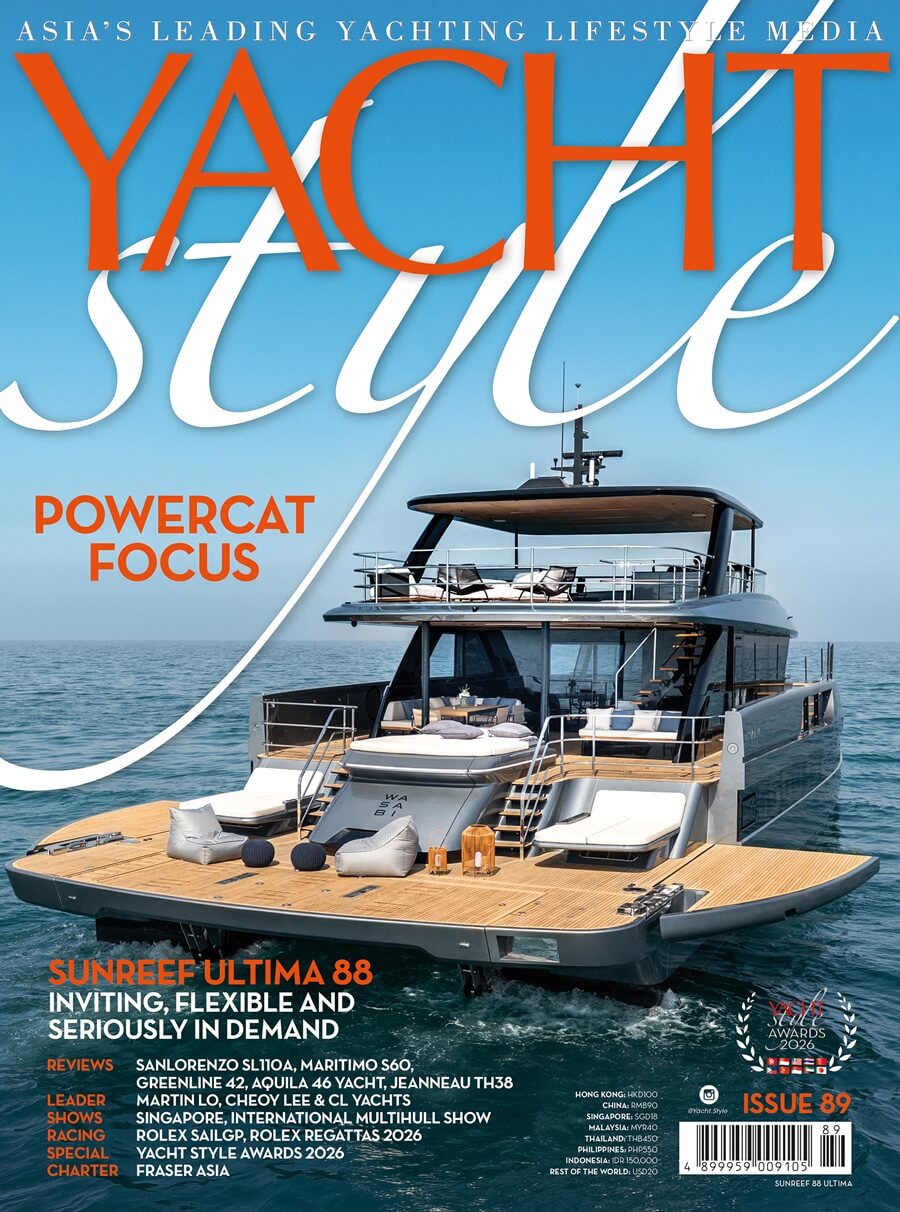
Read and download copy
Yacht Style, Issue 89, powercat, third issue, 2026, Sunreef, Aquila, Jeanneau, Sanlorenzo, Maritimo, Greenline, Yacht Style Awards 2026, Martin Lo of CL Yachts, charter, Fraser Asia, Rolex, regattas, Hong Kong Yachting Association, Chairman, Tommy Ho, Singapore Yachting Festival
Read and download copy

Asia's leading yachting lifestyle media

More results...

Generic selectors
Exact matches only
Search in title
Search in content
Post Type Selectors
Search in posts
Search in pages
Yacht Style, Issue 89, powercat, third issue, 2026, Sunreef, Aquila, Jeanneau, Sanlorenzo, Maritimo, Greenline, Yacht Style Awards 2026, Martin Lo of CL Yachts, charter, Fraser Asia, Rolex, regattas, Hong Kong Yachting Association, Chairman, Tommy Ho, Singapore Yachting Festival
Read your copy

More results...

Generic selectors
Exact matches only
Search in title
Search in content
Post Type Selectors
Search in posts
Search in pages

More results...

Generic selectors
Exact matches only
Search in title
Search in content
Post Type Selectors
Search in posts
Search in pages

Lifestyle

8 Opulent Real Estate Properties On The Market

8 Opulent Real Estate Properties On The Market

SHARE

From private beach estates in San Diego to luxe townhouses in London, LUXUO unveils the latest luxury investment properties for 2026.

By Joe Lim

  •  
  •  
  •  
  •  
  •  
  •  
  •  

From California’s private beach estates to London’s super-prime townhouses, LUXUO highlights the pinnacle of global residential opulence. These properties merge scale, design and location with technical precision and lifestyle sophistication, offering discerning buyers seamless indoor-outdoor living and unrivalled vistas. Get prepared to discover the kind of amenities that redefine what it means to reside in absolute luxury.


Miami Coastal Mansion


1510 W 23rd Street in Miami BeachPool and lounge areas are situated in front of the main living room. Image: Miami Real Estate Broker.
 

A recently constructed waterfront mansion at 1510 W 23rd Street in Miami Beach, offered for USD 38,995,000, embodies contemporary coastal elegance on guard-gated Sunset Island III. This high modern home — measuring 9,237 square feet and featuring five bedrooms and 4.5 bathrooms — sits on a 15,750 square foot property with 90 feet of canal frontage and direct ocean access. A unique beachfront dimension in Miami Beach.


1510 W 23rd Street in Miami Beach

Expansive living areas with beautiful vistas will greet your eyes. Image: Miami Real Estate Brokers.


The design emphasises seamless indoor-outdoor living through floor-to-ceiling glass, skylights alongside white oak, marble and travertine finishes. A bespoke Italian kitchen with high-end appliances, a heated in-ground pool with southern exposure, an integrated spa and a rooftop loft with terrace position this property for maximum performance in both entertaining and daily life. Central air and heating, wood flooring, a connected garage and covered parking, convenient access to Sunset Harbour’s food and lifestyle options and intelligent utility areas are among the technical features.


Premium Freehold London Home


St John's Wood, NW8, London

Regal feel of the stucco-fronted London Mansion. Image: Sotheby’s Realty.


On Avenue Road, St John’s Wood, NW8, an outstanding freehold house is available in the top tier of London’s premium market. This five-storey, 21,659 square foot stucco-fronted mansion is located on one of the capital’s most desirable streets, close to Regent’s Park and the High Street’s facilities.


David Linley’s interior design combines timeless materials with technological rigour: marble, onyx and limestone detailing throughout, mahogany and teak joinery and high ceilings define the primary areas. A marble-lined entrance hall leads to a full-width reception room that opens into landscaped gardens, while a bespoke family kitchen with high-end appliances stands next to a professional catering kitchen with a dumb waiter.


St John's Wood, NW8, London

Generous-sized living areas replete with chic furnishings. Image: Sotheby’s Realty.


The games room, media/cinema space, wine cellar, gym with ballet rail, steam room, sauna and plunge pool are comparable to boutique hotel amenities. The lower level has safe parking for five vehicles, a car lift, a strongroom and staff rooms. The building’s systems are fully integrated — Crestron control, underfloor heating, comfort cooling and comprehensive CCTV — demonstrating an exacting technological specification. This home strikes a balance between size, specification and location at the peak of London’s super-prime market.


Chic Chelsea Penthouse In New York


Penthouse PH2, 212 West 18th Street, Chelsea, New York

Indulge in a whole-floor penthouse spanning 6,738 square feet. Image: Sotheby’s Realty.


Penthouse PH2, 212 West 18th Street, is a whole-floor penthouse at Walker Tower in Chelsea, offering the pinnacle of Manhattan’s luxury condominium market. This 6,738 square foot full-floor penthouse has five bedrooms, five and a half baths and three wood-burning fireplaces. It is anchored by a north-facing balcony with uninterrupted 360-degree views of the skyline, harbour and rivers. Radiant-heated French herringbone oak flooring, vaulted ceilings and handmade millwork are featured throughout the property, which also has central air, Crestron home automation, built-in humidification and innovative ventilation systems. A new chef’s kitchen with quality appliances complements the formal and informal entertaining areas and the smart separation of bedrooms and living areas improves daily life.


The Walker Tower’s amenity suite depicts full-service living such as a 24-hour doorman, concierge, fitness centre with yoga room, children’s playground, landscaped roof terrace with eating and lounging areas, bike storage and resident lounge.


Hotel-Managed, Waterfront Residence in Phuket


The Residences at InterContinental Phuket Resort

Plush furnishings and discreet lighting. Image: Kamala Ascend Company Limited.


The Residences at InterContinental Phuket Resort have been officially revealed by Proud Real Estate Public Company Limited (PROUD), becoming Kamala Beach’s newest premium residential icon. Developed by Kamala Ascend Company Limited, the construction has 111 private units ranging from 59-square-metre one-bedroom homes to 425-square-metre five-bedroom penthouses, guaranteeing seclusion and spacious living spaces.

The “Paradise on Earth” storyline was established at the launch event, which allowed guests to explore exhibit units and experience interiors designed with high-end fixtures and furniture. The design draws on Phuket’s legacy, combining Sino-European and Peranakan inspirations while expanding the resort’s “Traiphum Phra Ruang” idea, resulting in timeless style and value.


The Residences at InterContinental Phuket Resort

The residences and hotel are close to beachfront activities. Image: Kamala Ascend Company Limited.


Residents have exclusive access to the InterContinental Phuket Resort’s facilities, which include more than 2,000 square metres of wellness and leisure space featuring Aqua Symphony, Hydro Massage, Technogym Fitness and Fitwel-aligned design. Membership in IHG One Rewards and Proud Privilege increases the lifestyle offering, combining world-class service and private ownership.


As Phuket consolidates its position as the world’s fifth city with the most branded apartments, valued at USD 2.3 billion, this development combines a globally recognised brand with a strategic location. The Residences at InterContinental Phuket Resort not only provides an exceptional residential experience but also establishes a new standard for luxury living in Thailand, heralding a transformation in the island’s real estate market.


Posh Spanish Bungalow Perched On A Hill


Casa Orquídea, La Quinta, Benahavis, Andalusia, Spain

A bungalow in Spain offering vistas of the Costa del Sol. Image: JamesEdition.


Situated in Benahavis, Andalusia, Spain, this freshly finished property — Casa Orquídea — perched atop Herrojo Alto in the private enclave of La Quinta, commands attention with unbroken panoramic views of the Costa del Sol. The 1,696-square-metre home features eight bedrooms, 10 bathrooms and is guarded 24 hours a day. It is ideal for both daily life and high-end partying.


The main level is defined by natural light, and open plan living extends from the lounge with a fireplace to the formal dining room and kitchen, which leads to a fully equipped outdoor kitchen. The upper-level features three ensuite bedrooms, including a master suite with a private terrace and jacuzzi. The recreational area below spans over 800 square metres and comprises various cafes, a theatre, a gym and an indoor spa with pool and jacuzzi. Ancillary areas include a home office, a staff suite with a kitchenette and an eight-car garage.


Exclusive Beachside Home in Greece


Private Seaside Estate, Spetses, Attica, Greece

Opulent beachside home situated on craggy cliffs, offering striking gulf views. Image: Sotheby’s Realty.

Located seven kilometres from Spetses town, this exclusive beachside home lies on a vast 35,000-square-metre plot with unbroken views across the Saronic Gulf and direct access to two isolated bays accessible only from the grounds — a rare footprint on Greece’s most discreet island.


The main residence spans 440 sqm and features 80 cm stone walls on three stories. The interiors are designed for both formal and informal living, with fireplaces, a TV lounge, a formal dining room, a professional-grade kitchen and expansive verandas overlooking the sea. There are three ensuite bedroom suites with a study and a fully autonomous two-bedroom guest apartment.


Three other bedrooms on the estate are for guests or domestic helpers. There is around 400 sqm of unfinished area near the pool that can be used for a wellness retreat or recreational centre. The offering includes landscaped gardens, mature olive trees, a future helipad and a private docking space, demonstrating its ability to provide a year-round seaside lifestyle at scale.


“Sand Castle” Mansion In California


Sand Castle Mansion, San Diego, California, US

A rare San Diego home with its privately-owned beach. Image: Sotheby’s Realty.


Perched on La Jolla’s desirable coastline, the USD 108 million “Sand Castle” mansion epitomises California waterfront luxury, complete with one of the state’s few privately owned beaches. Timothy Corrigan designed the 12,981-square-foot main residence situated in San Diego, which spans multiple levels and features seven bedrooms and eight bathrooms, linked by an elevator. The interiors highlight bespoke finishes, from solid gold-leaf detailing in the oval dining room to hand-laid New Ravenna mosaics and a walnut-on-onyx bar inspired by legendary yachts.


The 3,416-square-foot guesthouse features three-bedroom suites, a gourmet kitchen and outdoor cooking amenities. It works autonomously. The 35,750-square-foot outside area features a saltwater pool with bespoke Thassos glass mosaic tiles and two private cabanas. The estate’s private beach, manicured with sand from Augusta National Golf Club and the reinvented Boat Bar with a hydraulic-lift window emphasise its exclusivity. La Jolla’s proximity to San Diego provides unique access to urban infrastructure while maintaining coastal tranquillity.


Beachfront Modern Cabin With Rustic Charm In New Zealand


Coromandel house, Auckland, New Zealand

A modern beach house perched on a hill with regenerative bush all around. Image: Sotheby’s Realty.


Waimataruru — nestled on the Coromandel Peninsula — is a unique mix of architecture and environment. The 300-square-metre mansion on a 10-hectare beachfront estate blends in with the surrounding native flora and offers unimpeded views of Otama Beach. The residence — which has received international acclaim — is divided into floors and features three ensuite bedrooms, sophisticated living areas and expansive terraces that extend the interior spaces outside.


A north-facing orientation with a single-plane roof that follows the land’s natural contours enhances sunlight and panoramic views. Interiors feature high ceilings, stone worktops, walk-in closets and open-plan kitchens, all designed for comfort and visual harmony. Sustainable technology supplements the property’s environmental management, while landscaped grounds improve privacy and promote natural regeneration. Waimataruru — located five minutes from Kuaotunu village — is a coastal refuge with lasting architectural significance.


For more on the latest in luxury properties, click here.


SHARE

8 Opulent Real Estate Properties On The Market Read More »

The Anandita: Lombok’s Most Desirable Beachfront Villa for Rent

The Anandita: Lombok’s Most Desirable Beachfront Villa for Rent

SHARE

On the white sands of Sira Beach, the Anandita villa raises the bar for private island living with secluded grounds and endless comfort.

By Florence Sutton


Imagine waking up to the gentle sound of waves in your very own luxurious and private beachfront enclave, the kind of place where stars and CEOs recharge at. This oceanfront property isn’t just another island getaway, it’s a sanctuary of pampering and quiet yet refined luxury.


The five-star Anandita villa is set on the picturesque white sand Sira Beach, situated on the north coast of the Island of Lombok across from the Gili islands. What makes the Anandita villa truly extraordinary is its combination of private beachfront access, its attentive in-house staff including your very own private chef, and its luxurious amenities.


Enjoy unprecedented beach access and privacy at the Anandita Villa

Luxurious Accommodation & Facilities

This vast luxurious property includes a fifteen-thousand-square-meter coconut grove garden with verdant lawns, and sits next door to Lombok’s Sire Beach Golf Club. At the Anandita, guests can unwind and enjoy the stunning twenty-five-meter free-form swimming pool and beautiful landscaped gardens that blend seamlessly into the powder-white beach.


The Anandita boasts comfortable and generous living spaces, including a majestic living area pavilion with high vaulted ceilings as well as a stately dining pavilion with comfortable table seating for twelve guests.


Reconnect with nature on the expansive and manicured Villa grounds

With four large standalone bedrooms, all featuring their very own en-suite bathrooms, the villa is extremely spacious and ideally suited to accommodate large groups including families, while also providing all modern comforts and privacy.


Several features set the Anandita apart from and above most luxury villas on the market. In particular, the property includes its very own in-house spa pavilion where guests can unwind during their daily massages or yoga classes upon demand.


Guests also often have the beach almost entirely to themselves, creating a sense of exclusivity and tranquility.


The Anandita is a haven for entertaining and big groups and families

Exceptional Service and Dining

Exceptional service and world-class dining are synonymous with this one-of-a-kind villa. These attributes make the Anandita one of the best luxury beachfront villas in Lombok for rent.


The villa is fully staffed with an in-house chef, waiting staff, housekeepers, service staff, gardeners and security guards.


Dining is a highlight, as Anandita’s Chef and dining staff master both Western and Asian cuisines, often featuring fresh local produce and seafood, while also catering to the specific needs and requirements of each guest.


Experience world class dining experiences at the Anandita Villa

Alfresco dining by the beach or within the garden grounds of the property also makes for an unforgettable experience. The staff is frequently described as warm, attentive, and always ready to go above and beyond, whether organizing birthday celebrations, fireworks, or special dinners including with freshly caught lobster.


This dedication to details and personal touch of the staff ensures a comfortable and enjoyable stay for all ages.


The villa’s secluded yet accessible location, with direct flights from Bali, Singapore and Melbourne, makes the Anandita the perfect retreat for those looking for the ideal beachfront villa for rent in Indonesia. Upon request, helicopter transfers are also available for guests traveling to the villa from Bali.


Unlike most private villas, the Anandita has its very own private in-house spa

Activities and Experiences

Beyond the villa’s tranquil setting, guests can enjoy a world of adventure, including a wide array of water sports and cultural excursions.

The Anandita villa manager can arrange private speed boat charters for sunset cruises, or for guests to go diving with the giant sea turtles that inhabit Lombok’s most breathtaking dive spots around the Gili Islands and Sira Peninsula.


Guests can also use one of the villa’s many sea kayaks to explore the neighboring coastline or paddle out to the nearby reef with its own impressive coral and flora.


The villa also includes a volleyball court on the grass lawn and a pool table, while guests can also partake in a round of golf on the neighboring 18-hole course that sits just a few steps away from the villa grounds.


The more adventurous holidaymakers can also discover some of Lombok’s hidden gems including jungle treks to tucked-away waterfalls and even excursions to the famed Mount Rinjani volcano.


The Anandita villa is the ideal luxury holiday getaway in Lombok for families or groups of friends, with an abundance of space and activities to keep everyone entertained and pampered. To book your stay at the Anandita villa, head over to the villa’s official website or Instagram page.


For more on the latest luxury property reads, click here.  

SHARE

The Anandita: Lombok’s Most Desirable Beachfront Villa for Rent Read More »

Four Seasons Hotel Bosphorus, Istanbul’s Best Address

Four Seasons Hotel Bosphorus, Istanbul’s Best Address

SHARE

On the Bosphorus in Beşiktaş, Four Seasons Hotel, offers unmatched waterfront luxury steps from Istanbul’s major attractions.

By Lucas Raven

  •  
  •  
  •  
  •  
  •  
  •  
  •  

On the Edge of the Bosphorus, at the Heart of Istanbul


The Four Seasons Hotel Bosphorus occupies one of the most enviable positions in Istanbul—right along the European shore of the strait, where the city’s energy blends seamlessly with the calm of the water. Set in Beşiktaş, a historic neighborhood known for its culture, dining, and proximity to major landmarks, the hotel offers immediate access to the best of the city.


From here, it’s an easy walk to Dolmabahçe Palace, the refined shopping avenues of Nişantaşı, and the greenery of Yıldız Park. Ferries, taxis, and trams make navigating the city effortless, but the waterfront terrace has a way of convincing guests to linger longer than planned.


A Palace Restored to Modern Luxury


Housed in a meticulously restored 19th-century Ottoman palace, the hotel pairs imperial architecture with contemporary design. The interiors lean warm and elegant: soft off-whites, terracotta tones, patterned rugs, mahogany furniture, and subtle Ottoman references that never overpower.


Rooms and suites feel generous and serene, many with sweeping Bosphorus views that set the tone from the moment you wake. Bathrooms are spacious, marble-clad, and stocked with Diptyque amenities.


Outside, manicured gardens, a striking waterfront pool, and curated art and fashion displays create an atmosphere that is both refined and distinctly Istanbul.


Calm, Considered, and Complete


For travelers who spend much of their lives in transit, the hotel’s spa offers a welcome reset. The traditional hammam is beautifully executed, while massages—Swedish, Ayurvedic, or deep tissue—are delivered with consistency and precision. The MLX i3Dome infrared treatment adds a modern, performance-driven element for guests seeking recovery and wellbeing.


A sky-lit indoor pool, a well-equipped gym, and personal training sessions support both relaxation and routine. Whether you’re unwinding after a day in the city or recalibrating after long-haul travel, the wellness offering is impressively complete.


Refined, Fresh, and Thoughtfully Local


Breakfast sets a high standard, with traditional Turkish options—most notably the excellent çilbir—alongside continental and American classics.


Throughout the day, Yali Lounge serves Mediterranean dishes ranging from light, bright salads to comforting pastas and Turkish favorites.Aqua focuses on seafood and executes it with finesse: Mersin prawn tartare, delicate sea bass with razor clams, and a standout pistachio dessert that leans into local flavors.


For a more traditional experience, Ocakbaşi offers expertly grilled kebabs and meze. The bar’s cocktails, particularly the signature “Girl with the Pear Earring,” are well balanced and memorable.


Landmark Hotel With Lasting Appeal


As someone who travels frequently and stays in top-tier hotels around the world, what stands out here is the combination of setting, service, and sense of place. The property captures the essence of Istanbul—its history, its elegance, and its constant movement—while providing a calm, beautifully managed base. It’s a hotel that suits travelers seeking culture, comfort, or simply the rare pleasure of watching the Bosphorus drift by. A reliable, refined choice—and one that’s easy to return to again and again.


For more on the latest in lifestyle, culture and travel reads, click here.


SHARE

Four Seasons Hotel Bosphorus, Istanbul’s Best Address Read More »

Wellness Experiences Are the New Luxury Gifts

Wellness Experiences Are the New Luxury Gifts

SHARE

The rise of wellness tourism signals a shift in both travel and gifting, as consumers increasingly seek restorative luxury experiences.

By Sanjeeva Suresh

  •  
  •  
  •  
  •  
  •  
  •  
  •  

As global wellness tourism surpasses SGD 1 trillion, mindful experiences have begun to reshape travel behaviour as both domestic and international travellers increasingly seek restorative experiences. Hotels, resorts and tourist destinations are responding with their own immersive offerings that see a combination of personalised services within unique environments alongside holistic spa rituals and nature-led adventures. From destination-based retreats to nature-led adventures and holistic spa rituals, these experiences transform gifts into lasting memories, offering a rare combination of indulgence and purpose. LUXUO explores how curated wellness experiences are displacing objects as the preferred form of gifting, redefining value as exclusivity over possession with four Singapore and four international wellness escapes.


Singapore-Based Wellness Experiences


New St. Gregory Wellness Centre


The newly refurbished St. Gregory offers a fully connected wellness floor combining spa therapies, fitness, hydrotherapy and mindfulness under one roof. Guests can explore everything from sound baths and Reiki to neuroscience-based sleep technology, all designed to enhance recovery and focus. Traditional Chinese and Indonesian therapies are also central to the programme, delivered by certified practitioners to ensure authenticity and efficacy.


The centre’s design furthers the sense of retreat, with earthy tones, natural textures, greenery and celestial-inspired lighting that create calm in the middle of the city. Facilities are flexible and versatile, from a gym with dedicated zones for strength, cardio and reformative training to an outdoor pool that doubles as a venue for yoga or intimate events. St. Gregory reflects a broader shift in luxury gifting. By offering curated experiences that combine science, tradition and sensory indulgence, it positions wellness as a meaningful and memorable gift, perfectly suited to today’s time-poor but experience-hungry luxury consumer.


The relaunch at PARKROYAL on Beach Road is part of PPHG’s broader Asset Enhancement Initiative (AEI). A key focus of the initiative is to rejuvenate its wellness offerings across all St. Gregory facilities. This includes curated partnerships with premium wellness brands like ELEMIS and Thalion, as well as a renewed commitment to staff training to ensure best-in-class service across the group. St. Gregory is the only one in Singapore that uses the Thalion brand, which is known for harnessing the therapeutic properties of the sea while making its products highly compatible with human skin, offering exceptional tolerability and bio-affinity.


Mandai Rainforest Resort by Banyan Tree


Marking the grand opening of Banyan Group’s 100th hotel worldwide — and its very first in Singapore — this milestone symbolises a triumphant homecoming to the Lion City. From 27 November to 3 December 2025, visitors can immerse themselves in restorative yoga sessions, sound healing, guided nature walks and family-friendly activities that connect body, mind and environment. The festival also features culinary masterclasses, including a limited-time Thai and Peranakan four-hands dining experience, turning gastronomy itself into a sensorial gift.


Beyond indulgence, the event embodies purpose-driven luxury: all proceeds from festival tickets will be matched by Banyan Tree and donated to the President’s Challenge, adding a philanthropic dimension to the experience. With guided wellness sessions and opportunities to engage with founders in dialogue sessions, the festival transforms traditional gifting into an offering of time, wellbeing and discovery, perfectly suited for the discerning luxury consumer.


RXV Wellness Village’s Eight New Integrative Programmes


RXV Wellness Village in Thailand is introducing eight new integrative wellness programmes from 1 November 2025 to 31 October 2026, designed to make holistic wellbeing accessible for all ages. Set across the 50-acre Suan Sampran Heritage estate along the Tha Chin River, the village combines modern diagnostics with traditional therapies to restore balance to body, mind and lifestyle. Guests can choose programmes tailored to their needs, from enhancing skin radiance and posture through treatments like INDIBA Face Lifting, Cryosauna, Hair and Scalp Massage and advanced facial therapies, to stress relief with private crystal sound healing, botanical aromatherapy, mindfulness Tai Chi, hyperbaric oxygen therapy and Thai eye remedies.


Detox-focused journeys incorporate belly and gut therapies, Thai botanical breathing remedies, mineral salt compresses, myofascial release and colon hydrotherapy, while mindfulness sessions offer guided mandala work, Ayurvedic massage, breathwork and sound healing to support emotional clarity. Physical Rebalance programmes combine Thai Warrior and Ayurvedic massages, postural analysis, metabolic booster IV therapy, regenerative exercise and active recovery techniques and fully personalised journeys are available with comprehensive health assessments and treatment credits to curate a bespoke experience.


Families can engage children aged six and above with playful wellness activities including crafting mandalas, kite painting, gentle yoga and brain activation exercises, while extended-stay Wellness Escape programmes allow travellers and digital nomads to immerse themselves over eight nights or more in the village’s therapies and riverside surroundings. All programmes include accommodation, full-board wellness meals, diagnostic consultations, personalised treatments, daily activities and hydrotherapy access, with pre-arrival plans tailored to each guest’s personal health goals.


Sentosa’s New Wellbeing Brand Campaign


Sentosa has launched a new brand direction — “Discover your element in ours” — to position the island as a sanctuary for wellbeing and reconnection through nature. Spanning 500 hectares and located just 15 minutes from Singapore’s city centre, the island invites guests to engage with its natural elements of sun, sand, sea, nature and biodiversity, offering opportunities for micro-restoration that support both physical and mental balance.


The campaign draws on neuroscience-backed research into the restorative effects of nature, encouraging visitors to ground themselves in sand, flow with water, energise under the sun and centre within the island’s greenery. Sentosa’s approach goes beyond conventional wellness tourism, focusing on everyday reconnection and emotional recalibration, while its updated brand film and sensory-led creative materials highlight moments of personal discovery and immersive experiences across the island. This positioning aligns with growing public interest in wellbeing and work-life balance, emphasising the importance of time spent outdoors and away from screens.


International Wellness Experiences:


Knai Bang Chatt by Kep West Launches Festive “Year End Escape”


Knai Bang Chatt by Kep West offers travellers a structured approach to wellness and coastal exploration over the transition from one year to the next. The Year End Escape begins with a nostalgic train journey from Phnom Penh to Kep, followed by three nights at the resort where guests can combine wellness, culinary experiences and coastal activities. The programme includes wellness sessions designed to support relaxation and recovery, rooftop cocktails, seafood dinners, private island excursions in partnership with Marine Conservation Cambodia and sunset cruises along the Kep shoreline.


Following this, the New Beginnings Art & Yoga Retreat offers a four-day programme focused on mindful renewal, blending daily yoga and somatic movement with meditation and art workshops. Guests also participate in a guided excursion to Koh Po, connecting creative practice with the natural environment. Together, the two experiences provide a comprehensive mix of physical activity, relaxation, cultural immersion and environmental engagement, allowing guests to enter the new year with both rest and focus. Knai Bang Chatt’s design and programming emphasise accessibility to the coast, thoughtful integration of wellness practices and connection to local culture, offering a purposeful approach to regenerative travel.


Park Hyatt Kuala Lumpur Elevates Wellness Above the Clouds


Perched on Level 99 above Kuala Lumpur, Park Hyatt’s integrated wellness sanctuary combines The Spa, Fitness Centre and Sky Infinity Pool to offer a complete approach to wellbeing. The spa features treatments designed around the body’s natural circadian rhythms, alongside signature experiences from Omorovicza and GROUND Wellbeing that integrate science-led skincare with purpose-driven rituals.


Central to the offering is Circadian Therapy — The Spa’s treatment sequence that uses natural light, temperature modulation and acupressure to support rest, energy and recovery. Complementing these therapies are the Sleep Ritual and Deep Rest Journey, aimed at long-haul travellers and city dwellers seeking measurable outcomes.


As part of Hyatt’s wider Asia Pacific Wellbeing Strategy, Park Hyatt Kuala Lumpur reflects the region’s commitment to elevating spa and fitness experiences through evidence-based programming, design innovation and measurable outcomes. The property introduces Park Hyatt’s next generation “Living Spa” philosophy, where treatments evolve with natural rhythms and wellbeing is seamlessly integrated across the hotel guest journey.


Spa Valmont Pour Le Meurice’s New Spa Experience


Spa Valmont Pour Le Meurice in Paris has launched a new wellness offering that pairs spa treatments with a Parisian afternoon tea experience. Guests begin in the spa’s wellness area with access to the sauna, hammam, and relaxation lounge, followed by a 60-minute massage tailored to their preference, whether relaxing, Swedish, deep tissue, or fully personalised. The experience then continues at Restaurant Le Dalí, where pastry chef Cedric Grolet presents a curated menu of finger sandwiches, delicate pastries and hot beverages.


Designed for two, the Cocooning Afternoon Tea combines restorative therapies with culinary refinement, offering a balanced interlude of relaxation and indulgence. The experience is available by reservation from 5 January 2026 and can be purchased as a gift card, which includes a complimentary candle with each purchase. By integrating signature spa rituals with an elegant afternoon tea, Spa Valmont Pour Le Meurice creates a layered experience that blends wellbeing, sensory pleasure and Parisian refinement, making it a thoughtful option for gifting or shared moments of restoration.


New Zealand’s Great Outdoors


New Zealand invites travellers to reconnect with nature and adventure through its expansive network of trails, cycling routes and running events. From gentle coastal walks and beginner-friendly cycling loops to multi-day hikes and technical trail races, the country offers experiences suited to all levels, whether families seeking leisurely activity, solo travellers, or seasoned athletes pursuing personal challenges. Across Aotearoa, more than 1,555 walking and hiking tracks, 11 Great Walks, and 23 Great Rides traverse coastlines, forests, alpine peaks, and volcanic valleys, offering a combination of natural beauty and cultural insight.


Active escapes in New Zealand include both organised events and self-paced adventures. The Hawke’s Bay Marathon in May 2026 guides runners through vineyards, orchards, and coastal paths, finishing at Elephant Hill Estate & Winery with a festival atmosphere. Race Tekapo in September offers alpine courses set against Lake Tekapo’s dramatic scenery and access to the International Dark Sky Reserve. In January 2027, the First Light Marathon in Tairāwhiti Gisborne allows participants to greet the sunrise along coastal routes rich with Māori heritage. Complementing these events, Great Walks, Great Rides, and hundreds of day hikes provide opportunities for independent exploration or guided experiences with cultural storytelling.


Beyond the trails, New Zealand offers restorative options to balance activity with relaxation. Visitors can soak in geothermal hot pools, stargaze under the Dark Sky Reserve, sample local cuisine, explore wineries, or engage with Māori cultural experiences. These elements allow travellers to recharge physically and mentally, making each journey an invigorating one.


For more on the latest in wellness and beauty reads, click here.


SHARE

Wellness Experiences Are the New Luxury Gifts Read More »

What A Day is Like in One of Thailand’s Grandest Luxury Villas 

What A Day is Like in One of Thailand’s Grandest Luxury Villas

SHARE

Set on Phuket’s tranquil east coast, Villa Amaravida transforms each day into a curated journey of indulgence — from sunrise swims to rooftop sunsets.

By Florence Sutton

  •  
  •  
  •  
  •  
  •  
  •  
  •  


Situated on the serene and exclusive Cape Yamu estate in Phuket, Villa Amaravida is a masterpiece of modern tropical living, the kind of place that looks plucked from a dream. Overlooking Phuket’s stunning east coast with sweeping views across Phang Nga Bay, this eight-bedroom beachfront retreat combines eclectic design, expansive spaces, and some of the most comprehensive set of facilities found in any luxury rental villa on the island.


Villa Amaravida recently gained international attention when it appeared in HBO’s The White Lotus, yet its real-life allure far surpasses fiction. Here, a single day unfolds like a curated journey of indulgence that redefines what it means to live the luxury villa lifestyle.


The day kicks off with an al fresco breakfast at the poolside sala, where the panoramic view provides a serene backdrop. It’s the perfect spot to ease into the morning and set the tone for the day to come.


After breakfast, the morning unfolds at a leisurely pace with a fresh tropical drink by the pool, taking in the surrounding scenery.


The day moves into motion at the villa’s private gym, a space fully equipped for an energizing workout that brings a surge of vitality and happy endorphins.


For something livelier, the outdoor court comes alive with friendly matches of basketball and tennis. Playful competition set a vibrant rhythm to the morning.


Following the adrenaline rush, the infinity pool beckons. By late morning, a refreshing dip offers pure renewal, where the 38-m pool stretches out under the warm tropical sun.


At lunchtime, a luscious meal from the villa’s private chef awaits guests in the indoor dining room. With the breathtaking view of the sea as a backdrop, special moments are shared with loved ones at the table.


Later in the day, the entertainment area becomes the gathering place. The billiards and foosball table spark fun, laughter and friendly competition, creating more lively memories.


For the advanced golfers in the group, the indoor golf simulator offers a round of play on some of the world’s greatest courses without ever stepping outside.


When the time finally comes to embrace the outdoors in the early afternoon, kayaks await on the shore, ready for a leisurely exploration of the calm waters nearby.


Meanwhile, for those seeking serenity and relaxation, nothing beats a tranquil massage in the spa room with a professional therapist. The soothing spa treatments release tension in the muscles, preparing guests for more rest ahead.


To complete the relaxing rituals, a soak in the spa’s ensuite bathtub is in order, complete with herbs and flowers for much-needed aromatherapy. The uplifting scent combined with the warmth of the water creates the right atmosphere for quiet moments of solitude.


Sundown calls for a little get-together at the rooftop bar to enjoy the panoramic view of the bay. Lounge on the seats and watch the sun set over the horizon or take another relaxing dip in the whirlpool.


After a mouth-watering dinner courtesy of the private chef, it’s time for a nightcap to try out the selections from the well-stocked wine cellar.


And for those who are not ready to call it a night, there’s also a cinema room where they can binge-watch all their favorite movies and shows even past their bedtime.


There’s always time to go back to bed and catch up on sleep, no matter how late everyone stays up. Luckily, the villa’s bedrooms are inviting, spacious, and warm, with soft linens and fluffy pillows that are conducive for rest.


What makes each day-to-day experience special at a luxury villa like Villa Amaravida are the small details, each attended to by the villa’s own staff. Housekeepers are present to keep every room tidy, the private chef is always present to create nutritious meals, and the villa manager ensures that things are running smoothly day by day.


And perfect days in Phuket don’t always start and end at the villa alone. There’s a whole new world of natural and cultural wonders that’s waiting to be explored past the villa and estate gates, from majestic temples to island-hopping trips on chartered yachts.


Sounds like a dream? Yes, but it doesn’t mean it can’t come true. Villa Amaravida is part of the hand-picked roster of Phuket villas from The Luxury Signature, which specializes in full-service villa rentals. These villas are selected for their impeccable design and elevated standards of service with the aim to delight guests and create lasting memories.


With attentive service from a professional team and a seamless booking process, guests of The Luxury Signature’s villas in Phuket can rest assured that they can not only book the villa of their dreams but also have all their specific requests catered to before they leave for Thailand, from private transportation to a fully stocked wine cellar.


The Luxury Signature’s Guest Experience Services team can even help guests plan their best days during their stay in Phuket. These professionals can assist in planning complete itineraries for guests before they arrive in Thailand, whether it’s for day trips, special in-villa events, or that little something extra to make their villa stay complete.


Plan on having perfect days on your upcoming Phuket trip by booking Villa Amaravida with The Luxury Signature. Not only will you experience the allure of villa life every single day, but you will also create memories that will linger long after the end of your trip.

Find out more at www.theluxurysignature.com.


For more luxury property reads, click here.


SHARE

What A Day is Like in One of Thailand’s Grandest Luxury Villas  Read More »

Beyond the Bottle: The New Rituals of Premium Spirits

Beyond the Bottle: The New Rituals of Premium Spirits

SHARE

Today’s ritual of drinking has become a sensory awakening that elevates how consumers perceive (and consume) luxury spirits.

  •  
  •  
  •  
  •  
  •  
  •  
  •  

The act of appreciating luxury spirits has evolved beyond mere consumption into an intentional act of appreciation. Each gesture — from swirling the glass to inhaling the aroma and pausing before the first sip — forms a choreography that slows the pace and elevates the experience. Premium spirit brands are increasingly designing tastings as multisensory rituals, where provenance, pairing and technology converge to engage each of the senses. The ritual of drinking today is as much about storytelling and connection as it is about the liquid in the bottle itself. LUXUO explores how forward-thinking spirit brands are transforming the act of tasting into a multisensory ritual to expand the palate and deepen consumers’ understanding of flavour.


The Elemental Ritual


Every ritual begins with stillness. In the world of fine spirits, that moment is the first pour — the sound of the cork easing open, the first inhale, the weight of the glass in hand. These small gestures mark the transition from casual drinking to a deliberate act of appreciation. At The Macallan Estate in Speyside for instance, this initiation takes on a deeper dimension. Set across 485 acres of carefully preserved land, the distillery places terroir at the heart of its storytelling. Guests are invited to trace the origins of each whisky — from the River Spey’s mineral-rich water to the barley fields and oak casks that define its flavour. It is an experience that reintroduces time and place into the modern drinking ritual. By foregrounding scent, sound and texture before the first sip, The Macallan transforms anticipation into an integral part of the tasting experience.


What distinguishes The Macallan’s approach is how it reconnects whisky with its natural environment. The Macallan estate serves as part of the ritual itself. At The Macallan Estate, the tasting experience is designed to heighten awareness of the surroundings that shape each bottle. Guests are encouraged to move through the landscape before they taste — observing how light falls across Easter Elchies House, hearing the rush of the River Spey or catching the scent of pine and damp earth in the air. Inside the bar, the serve ritual incorporates ingredients drawn from the local environment, reinforcing the link between nature and craftsmanship. Each sense plays a role in preparing the palate, turning what might be a simple act of tasting into a sensory prelude and exploration of atmosphere.


Sipping Meets Sound


Multisensory tastings incorporate sound and light to heighten sensory experience. Modern tastings increasingly activate sound and space as much as they activate the palate. For example, Hennessy’s “Immersive Initiation” tour invites guests into its historic Cognac cellars for a full two‑hour experience that pairs a tasting of Hennessy V.S and V.S.O.P (neat, on the rocks and in a cocktail) with a virtual‑reality odyssey named MOBILIS.


Starting with a solar‑powered boat ride across the Charente River, the tour guides guests into the Pavillons Cellar, where hundreds of oak barrels line the walls and the lighting subtly shifts from natural daylight to internal low light — accentuating the texture of the casks and the chalk‑marked years of harvest. Within the VR portion — developed by artists Olivier Kuntzel & Florence Deygas — visual and auditory cues such as vibrating floors, simulated wind, shifting light and immersive soundscapes correspond precisely to the seven tasting notes of Hennessy X.O. By reframing the tasting as a choreography of environment, story and sense, Hennessy extends the ritual beyond glass and cognac — so the moment of first sip is only one part of a broader sensory architecture.


The Ritual of Pairing & Design-Driven Drinking


Pairing spirits with cigars, chocolate or curated accompaniments elevates the tasting by engaging more than just the palate. At LOUIS XIII, Cellar Master Baptiste Loiseau has developed food pairings that showcase how textures and flavours interact with the cognac. For example, beluga caviar on a mother-of-pearl spoon enhances the cognac’s complexity, allowing its delicate floral and fruity notes to come forward, while wafer-thin shavings of Bellota ham echo the smooth, rich texture of the spirit, creating a lasting sensory impression. LOUIS XIII also extends the ritual beyond taste, introducing porcelain tableware collections such as “Soil is Our Soul” and “Light of Time”, so that the act of serving and consuming becomes part of the sensory experience, merging visual, tactile and gustatory appreciation. The act of serving and handling the tableware engages the senses of sight and touch alongside taste, creating a full-bodied appreciation of the spirit.

Cigar pairings offer a similar depth, particularly with whisky. A lightly peated single malt can be paired with a mild Connecticut-wrapped cigar to complement the smoky undertones of the spirit while avoiding dominance over more delicate notes. The slow, deliberate process of lighting, drawing and tasting encourages the drinker to focus on subtle shifts in aroma, spice and oak influence. In both cases — food or cigars — pairing encourages guests to slow down and engage with the spirit in a structured, intentional manner.


The New Social Ritual


Appreciating premium spirits has evolved into a social ritual that blends discovery and human connection. Many brands now position their products as tools for creating memorable experiences. By crafting immersive tastings, pop-ups or curated pairings, brands invite consumers to actively participate in a ritual, making the act of drinking itself a story to remember. Modern alcohol experiences emphasise interaction, storytelling and Roku Gin’s “Live Your Peak” pop-up at AIR CCCC in Singapore offers a prime example of this. Over three days, the brand invited guests to explore its full range of gins alongside AIR CCCC’s ingredient-led culinary creations. The experience was designed around multiple sensory zones, from intimate dining and curated pairings to elevated casual serves — each carefully staged to enhance flavour perception and social engagement.


Visitors were guided through tasting sessions by Suntory’s Brand Ambassadors — rotating between light gin tastings, seasonal cocktails and pairing exercises — while also enjoying immersive elements such as light projections, curated music and a rooftop Fizz Bar. Guests could sip alongside friends, discuss flavour combinations and participate in a culturally rooted experience inspired by the Japanese principle of “Shun”, which celebrates ingredients at their seasonal peak. Beyond the cocktails themselves, the activation encouraged storytelling and memory-making. Attendees left with both tangible keepsakes — like complimentary mini bottles — and lasting impressions of shared discovery, reflecting how premium alcohol brands now frame “building memories” as a central element of marketing. Experiences like these extend the ritual of tasting beyond the palate, emphasising connection, participation and the narrative behind each spirit.


Time and Terroir


Exploring provenance — from water source to cask wood — deepens one’s connection to the spirit, turning the journey itself into part of the tasting ritual. At Glenfiddich in Speyside, visitors walk the same paths as the malt masters, from the Robbie Dhu Spring — the source of the water used in every drop — to stone warehouses cradling maturing casks. Guided tours highlight the craftsmanship behind hand-built copper stills, the scent of ageing oak and the influence of climate-controlled warehouses on flavour development, allowing guests to taste whisky in its natural ageing environment. Experiences range from introductory tastings to hands-on blending sessions and deep dives into rare expressions, giving consumers an intimate understanding of how time, place and technique shape every dram.


Similarly, Nikka Whisky’s distilleries in Japan offer tours that emphasise the surrounding environment as an active ingredient. At Miyagikyo, for instance, the cool mountain air, local water and humidity-controlled warehouses all interact with the casks to create Nikka’s signature flavour profiles. Guests are invited to explore the maturation process and taste spirits directly from the warehouses, highlighting the impact of terroir on the final product.


The principle extends to rum as well. Zacapa’s “House Above the Clouds” in Guatemala matures barrels 2,300 meters above sea level, where the cool, moist climate and the Solera system allow casks to exchange aromas and flavours. The journey from lowland distillation to high-altitude ageing demonstrates how environmental factors — temperature, humidity and altitude — are deliberately harnessed to develop Zacapa’s signature body, aroma and depth. In each case, the ritual of tasting becomes inseparable from understanding the spirit’s origin. Observing the interaction between water, wood, climate and craftsmanship transforms consumption into a sensory education, connecting flavour directly to place and time.


The Digital Ritual


Technology is rewriting the art of tasting, transforming it from a purely sensory ritual into an interactive, personalised experience. Augmented reality labels, AI-driven flavour recommendations and virtual tastings now allow drinkers to explore aroma profiles, experiment with blends and engage with a spirit’s story in ways previously reserved for distillers. In 2025, Diageo’s “What’s Your Whisky?” platform leverages AI to analyse individual taste preferences, matching users with single malts that reflect their unique palate. Suntory has taken a similar approach with AI-guided recommendations, enabling consumers to design custom blends that mirror their mood or personality, turning personal data into a sensory journey.


Beyond digital tools, brands are experimenting with immersive environments: Glenlivet offers virtual distillery tours where users navigate production spaces and ageing warehouses from home, while Jack Daniel’s connected bottles overlay AR content that reveals the spirit’s heritage and craftsmanship. These innovations illustrate a broader shift in that tasting is about communicating the story, environment and interactivity surrounding it — a modern ritual shaped by technology as much as tradition.


For more on the latest in alcohol and luxury spirits stories, click here.


SHARE

Beyond the Bottle: The New Rituals of Premium Spirits Read More »

A. Lange & Söhne’s Tino Bobe on Keeping Time with Tradition

A. Lange & Söhne’s Tino Bobe on Keeping Time with Tradition

SHARE

A. Lange & Söhne Production Director Tino Bobe delves into the novelties of the year and the particularities of watchmaking at the German brand.

 By Ashok Soman

A. Lange & Söhne Production Director Tino Bobe

Before we get down to business at A. Lange & Söhne at Watches and Wonders Geneva, we always confront the serious question of beer… You see, the Glashütte watchmaker is rather famous for its amber goodness, which is only available at the booth and nowhere else within the Palexpo. Simultaneously, our particular story with regards to the brand has had something to do with a pint (or so) for years now, mostly because I keep doing the interviews and presentations and I have never managed to grab that drink with Production Director Tino Bobe.

This year, I finally had the occasion to hang about the A. Lange & Söhne booth at length since I was also heading to the ‘friends of the brand’ dinner. No celebrities at this one (sort of), just collectors, pundits and writers – all I can say about this wonderful gathering this year is that my contribution had something to with a discussion on Juliette Lewis (with regards to Kalifornia and the Amazon Prime TV series Yellowjackets) and Charles Bronson. Yes, watch nerds are capable of talking about normal (sort of) subjects.

Make no mistake though, Tino Bobe is the ultimate in watch nerdery, which I cannot believe is a real word but there it is. Of course, being a watch nerd is a compliment in our books, and this book in particular. In case you missed his backstory, Bobe has clocked more than 20 years at A. Lange & Söhne (it will be 30 years in 2029) and once described how the various departments at the firm work with each in ping pong terms – people at the manufacture have to bounce things off each other.

“I joke that I have an A. Lange & Söhne barcode on my body <gesturing to his heart>,” Bobe told us in 2021. “I’m really proud to be part of this team, and to be part of the success we have here, in making really beautiful watches.”

It is also worth remembering that Bobe is that rarest of breeds, a Glashütte native who happens to be a watchmaker at a company that established the fortunes of the hamlet. Besides his undeniable authenticity and technical chops, he also has a sense of humour, which he sometimes demonstrates in unusual ways. For example, in discussing the new Minute Repeater Perpetual, he cites a couple of repeaters that A. Lange & Söhne has made but left out the Grand Complication. Well, we caught it anyway, Tino, if you are reading this.

I will admit that A. Lange & Söhne and Bobe have still caught us coming up short because I failed to write down the name of the beer served at the booth. With that technical writing flourish out of the way, read on to discover some surprising facts about the novelties from A. Lange & Söhne this year.


The Minute Repeater Perpetual

We have to begin with the Minute Repeater Perpetual and the calibre name, L122.2, which puts many, including us, in mind of the L122.1 in the Richard Lange Minute Repeater. Is this a continuing story from that?

In terms of knowledge, it’s a continuing story because you get your knowledge by doing things… we had a Zeitwerk Minute Repeater that we learned from; we also had a Richard Lange Minute Repeater; and now the next one (is the Minute Repeater Perpetual). This watch is now a combination with the perpetual calendar (function) and yet we wanted to have this really elegant size with only 12.1mm thickness and 45mm diameter. So, we really had to pack all the components – it is not just a modification of an existing movement or just to add (a perpetual calendar module to an existing movement).

We had to build it up because it’s 640 movement components – so (to give you some idea by way of comparison) the Odysseus Datomatic is 11.1mm thick with a 40.5mm diameter with only 312 movement components. So, this means that in one millimetre more (for the case of the Minute Repeater Perpetual), you have more than double the number of components. So yes, we base all the knowledge we have for this new watch from both the watches on the perpetual calendar side and the minute repeater side; in this sense, it’s a continuing (story), but movement-wise, it’s completely new. (To your point), the perpetual calendar is integrated because we had to do it this way since it would be too thick as a module. So, it is now the perfect size.


We always try to add little things, and those who know us know that the perpetual calendar indication is clear – in this case, it’s the outsized date. Then you have the push piece, the recessed push piece, to advance all the indications by one day forward, if the client has left it in the safe and the watch has stopped. It’s very convenient and useful for the client. The same for the minute repeater, which is not only a classical minute repeater, which it is in the sense that it chimes the hours, quarters and minutes. But, if there are no quarters, there is this pulse elimination system, which is very useful. The client doesn’t have to wait and wonder if the watch is broken! There is no waiting time (repeating mechanisms often have a gap if the first quarter has not yet passed, meaning the movement skips the chime; the Minute Repeater Perpetual does away with this).

Security-wise, we thought that it would be good to protect the repeater! That is why the watch has two bars of water-resistance and the security mechanism – you can’t pull out the crown and set the watch if the repeater is activated and, vice versa, if the crown is out, you can’t activate it. Basically, the watch is not just a normal combination of a minute repeater and perpetual calendar (as if such a thing would be normal in any case).


On that note, we do know of collectors who bring their perpetual calendars back to the boutique to have it set there, mainly because of the safety issue. People might be afraid that something will go wrong, basically if you adjust the date indication too far or something. In extreme situations, you might need a watchmaker to intervene-

That’s terrible! And that’s why you have the possibility to adjust each indication (on the perpetual calendar) separately or everything together. Both possibilities are open (To be clear, the Minute Repeater Perpetual still only adjusts forward so the usual cautionary practices should be followed here).

Do you think that’s a practical perspective for people who use it? How do you tell people that it’s really safe for them to adjust, or use, in the case of the minute repeater function?

If the client gets the watch, he also receives a really qualified explanation of the watch. Right down to how to set it, and so on. I think it’s the best way, even though we provide short videos from our academy where you can find all the information (about any relevant watch or function). But I think the best way is to get this information in person, with the watch. This way, if the client has a question, you can give the answer. It’s the best way to interact, in the very moment where you, as a client, get your watch.

“It’s never mass production at A. Lange & Söhne. The watches have become more complicated so our quantity goes down a bit because we need more production hours”

Tell us about the sound of the Minute Repeater Perpetual – how do you get the right balance for it?

So, it was never the case (in development where we said) let’s do it as loud as we can. It’s always the quality of the sound. It’s exactly how colourful the sound is and how clear it is. And this is why we even developed this hammer blocking system (unique to the Minute Repeater Perpetual). I think it’s a very intelligent way to bring the hammer back and to hold it there (at the end of each hammer’s strike sequence). As a result, you don’t have a second or third touch (or ricochet between hammers and gongs). The sound is much clearer and even a little bit louder because you don’t lose energy from the gongs. You get both advantages, which we can attest to, based on hearing the repeater in action a couple of times.

(Returning to the development process), when we started with the acoustical time indication, we even developed acoustical test equipment. An external institute and two universities helped to measure frequencies (of sound waves). In this way, you can find a range of frequencies and measure multiple frequencies, which gives colour to the sound. If you have just one frequency, it is not a colourful sound. In the end, it is still the ear of the watchmaker making decisions but he gets helped by this measuring (apparatus).


And it gets complicated because we can’t dictate how different materials are influencing the sound – the honey gold of the Zeitwerk Minute Repeater produces warmer tones than the platinum of this new watch. Each calibre also has its own specificities because of how the gongs are attached to the movement or the case, and the volume of air in the case…then there is the order and the speed of the strikes besides. There are many factors to have under control to deliver acoustic beauty; the watchmaker tries to bring it together and finishes his work when he is convinced that the sound is now colourful and clear (or as far as he can make it considering the materials he is working with).


Odysseus in honey gold with bracelet

Of course, it is not only about this one watch so we should talk a little about the Odysseus in honey gold. Solid as it is, it makes me wonder if you considered how people would feel about this watch, and how they would feel it?

I think, as human beings, we are all different; I can imagine even in the development team there are different feelings (about this and other watches that we worked on). But it’s clear here (with the Odysseus) that feeling includes the haptic, especially when you consider the bracelet too. If you take it in your hands (or hand when you wear it), we wanted to give this feeling that ‘oh yes, this is valuable.’ So, there is no merit in having the lightest case…if maybe (the client) does not get the impression that it is valuable, or has value. It has impact if someone picks it up and says ‘wow!’ In fact, that is what happened in one of the presentations (at WWG), where I unveiled the new watches and this lady said (of the Odysseus) that this is exactly what you want to have (A. Lange & Söhne makes it a habit to have the new watches arrive covered with a cloth; the senior management then pulls away the cloth with a bit of practiced flourish and watches your reactions. So, you are inspecting the watches and the watchmakers are inspecting you).

It was, for us, a little bit logical (to use honey gold for a sports watch, and introduce the honey gold bracelet for it) because it is twice as hard as normal gold. If I want to have a gold version of a sporty watch, it’s better to have the harder one to be more scratch-resistant, and (all the other virtues that hardness affords). The second point was that the honey gold fits perfectly with different skin colours (and seasons too). If I’m wearing it in the summer, and I’m wearing it outside in sunlight, it looks (more) brown. In the winter, it looks more white. So, it’s always perfect, I think, and that is not the case with every kind of gold.


Well, there is a hunger amongst collectors to see more honey gold pieces…

It’s so difficult, even with the processing of the alloy (before any machining happens, and the machining is pretty tough) and the heat treatment – we even had to reject some batches of the material. That’s why we stay with limited editions for (watches in honey gold). At the moment, there’s no way to do it for a watch in the normal collection.

Of course, this reminds me of the situation with the Odysseus Chronograph…

It’s never mass production at A. Lange & Söhne. You know, the (entire assortment) becomes more and more complicated. At the moment, even the quantity goes down a little bit as a result; this year, no more than 5,000, and maybe (only around) 4,800. This is because you need the production hours for more complicated watches.

For example, now we are training the second watchmaker who will work on the Minute Repeater Perpetual. There is a third one but he is working on the Richard Lange Minute Repeater, still, while also doing servicing for the Zeitwerk Minute Repeater. So, we are training people but it takes time. Hopefully, the 50 Minute Repeater Perpetual watches will be produced in three or four years…if everything goes well. It’s not fair to have the client wait five to eight years for that watch.

This story was first seen as part of the WOW Legacy 2025 Issue

For more on the latest in luxury watch reads, click here.


SHARE

A. Lange & Söhne’s Tino Bobe on Keeping Time with Tradition Read More »

Carbonikon and The Art of Luxury Innovation in Carbon

Carbonikon and The Art of Luxury Innovation in Carbon

SHARE

Born from aeronautical expertise, Carbonikon brings carbon fibre engineering into the luxury accessories market with products defined by lightness and long-term value.

By Florence Sutton

  •  
  •  
  •  
  •  
  •  
  •  
  •  


Founded in Rome, Carbonikon operates at the intersection of design and material science, applying aerospace-grade carbon fibre engineering to the luxury accessories market. The company’s roots in aeronautical manufacturing inform its commitment to structural performance, product longevity and lightweight design. Rather than rely on aesthetics alone, Carbonikon’s handbags and briefcases are positioned as long-term assets that combine industrial-grade precision with practical utility. By focusing on resilience and efficiency over seasonal trends, the brand challenges traditional notions of luxury and offers a performance-driven alternative for discerning consumers. With growing interest in high-performance materials within the luxury segment, Carbonikon’s approach aligns innovation with sustainability and measurable value.


Many of Carbonikon’s products have registered copyrighted designs. The company’s mission is to offer objects that reflect the feeling and passion for their work. “Our creations are part of us and our family who actively participate in their conception and creation,” says Fabio Manieri, Company Owner of Aviacompositi – Carbonikon. LUXUO speaks to Manieri on how the brand is translating aeronautical innovation into the language of luxury.


Your bags made of carbon are truly unique! Tell us about your passion for carbon, which is usually a material associated with the aerospace and automotive sectors?


My passion for carbon fibre stems from my passion for aeroplanes and their technologies. Having grown up in Ciampino, where Rome’s second airport is located, it’s easy to imagine why. My passion for aeroplanes and all the technologies applied to them dates back to when I was very young. I started building model aeroplanes at the age of five, and as I grew up I built all kinds of them. My passion for aeroplanes led me to attend the G. Galilei aeronautical construction school in Rome. In 1985, studying in even greater depth, I decided to build my own two-seater ultralight aircraft. I designed the aerodynamics and the structure and built it over three years of intense work. After many tests, I took it for a flight in 1988. I had realised my dream! I later took my wife, my father and many friends up for flights. It’s incredible to think that I built it in the family Woodshop, which was located on ‘Wright brothers’ street! It seemed like a sign of destiny…


Many years later, from 2001 to 2018, I resumed my old passion for model aeroplanes, winning 18 consecutive Italian championships in the “FAI” (Fédération Aéronautique Internationale) F1D and F1M categories, Ministick and TH are endurance model aeroplanes weighing between 0.49 grams and 3 grams (this is not a mistake; they really weigh between 0.49 and 3 grams depending on the category). They fly on their own without radio control and with a rubber band motor. They are extreme in their construction and aerodynamics, and even have an automatic variable pitch propeller, built as if it were part of a watch! If well built and set up, F1Ds, which represent the top of the category, can fly for almost half an hour in a single flight. They are extremely efficient and represent the essence of flight physics. This is an ancient category of model aeroplanes that embodies all the modern concepts of lightness and energy saving, which are the same reasons why carbon fibre is used today.


Returning to carbon fibre, from 1988 to 1992 my passion led me to work at Agusta helicopter company in the composite materials plant, where I was employed in the experimental composite materials department and in the industrial engineering office, thus increasing my specialisation in these materials that I already knew. During those years, carbon fibre began to be used in other sectors as well, and I constantly followed its development. In fact, around 1992, after leaving Agusta, I began to manufacture model aircraft parts and motorcycle parts in carbon fibre. In 1998, I founded Aviacompositi, which for 27 years has been producing many carbon fibre parts for the automotive sector as well as for many research and development sectors.


One of the most important and unusual projects I have personally undertaken was the design and construction of the carbon fibre support for the statue of Apollo Belvedere for the Vatican Museums. It was a very challenging project that took me over eight months to design and build. The Apollo, a statue created around 150 AD by the Romans, is a landmark and icon of classical sculpture. It was once again shown to the world last October after five years of restoration. The video of the restoration, which also shows me installing the carbon support, can be viewed on YouTube.


Tell us about the unique properties of carbon?


The main properties of carbon fibre are its high mechanical strength and stiffness, compared to its low weight, which, when properly exploited, offer great advantages. Its low weight allows for significant energy savings. For example, in transport, many commercial aircraft make extensive use of carbon fibre. Being lighter, they consume less fuel, resulting in lower costs and less impact on pollution. As a general concept of high performance and maximum efficiency, just think of Formula 1 cars or America’s Cup boats.


You stated that the Carbonikon bags you have created are not just accessories, but style statements that reflect the harmony between form and function. Can you elaborate there?


Carbonikon bags and accessories are not just beautiful objects in themselves. When I design them, I don’t just think about their form, but also their practical everyday use. I believe they should bring satisfaction and lighten our days, not only by being beautiful objects to look at, giving us that feeling of enchantment we get when we look at a work of art, but also by having a practical use. For me, this is the concept of perfect balance between aesthetic form and functionality.


Why is the lightness of carbon a key element of differentiation for your bags?


It is the same concept of energy efficiency expressed above: lightness reduces energy consumption for us too, as we tire less easily. It is better to have a lightweight container which, when added to the load to be carried, has the lowest possible weight. For example, our empty briefcase weighs about 1 kg (2.20 lbs) less than a standard one, which means that when full, it will weigh on average the same as or less than a normal empty briefcase. The same concept is applied to the women’s handbag that weights only 380 grams (0.84 lb).


Do you see yourself as an engineer or a fashion designer, or both?


Considering my passion for technology, my many interests, passions and studies – from aeronautics to mechanics, design, electronics, computer science, photography and so on – I believe I am a multifaceted engineer with an innate sensitivity to design and the beauty of things. This is not meant to be self-celebration, but rather a thoughtful reflection on a life devoted to pursuing my passions.


At Carbonikon, traditional craftsmanship meets technological precision. Tell us about the production process.

The production process for a carbon fibre component is very long and complex. There are stages where modern technology can be used, but there are also many stages where high-level craftsmanship and skills are required. For example, in the design phase, we move from pencil drawings to 3D CAD, and to create the mould, the model is normally milled using CNC, but in some cases it may be more convenient to do it by hand using the traditional method. To make the product, the carbon must be layered in the mould entirely by hand, and this is where human skill makes all the difference. To achieve a high-quality aesthetic effect, the fibres must be layered very carefully without distortion or asymmetrical orientation.


Then, in the finishing stage, there is a whole phase of manual sanding, followed by painting, which gives the carbon beauty and durability, and mirror polishing in the case of a glossy finish. The process is as long and complex as that of painting a supercar. in addition to this, taking our women’s bag or briefcase as an example, there is also the preparation and manual sewing of the inner lining, its gluing to the carbon shells, the gluing of the closing frames, the assembly of the handles and bottom studs, all very long and delicate manual operations that, when done skilfully, really make the difference.


What is the profile of your clientele and what do they look for when purchasing a Carbonikon bag?


Our customers seek the uniqueness of an object, its soul that carries with it a part of us, our passion for what we do and my personal history in the world of technology and design. Ours is a modern customer who appreciates the combination of technology and refinement, loves exclusivity and personalisation, and knows that the product they are buying is not a sterile industrial production but a product with a history, the result of the passion of people who have dedicated their lives to seeking excellence in their work.


You argue that a product that lasts over time is more sustainable. Can you tell us what you think about this?


Fast fashion certainly produces more pollution due to the large quantities produced, which generates a large amount of waste to be treated. My vision is of a product that lasts over time without ending up in a landfill after a few months. At Carbonikon, we apply this concept to everything we do, and it also represents our concept of quality, which translates into a benefit for both the planet and the customer.


Do you use recycled materials?


Where possible, we always try to use materials with a very low environmental impact, such as water-based mould release agents and so on. At the same time, we try to optimise production processes to minimise energy consumption.


Do you create limited series?


Yes, we plan to create limited series and unique pieces of our products.


Where do you see your brand in five years? Will you operate a network of Carbonikon boutiques?

I see steady growth towards the main global markets. At the moment, we operate directly through our online shop, but growth will most likely lead us to create a network of Carbonikon boutiques.


What is your definition of success?


For me, success means having people appreciate what we do. Of course, it also means seeing Carbonikon grow in terms of reputation and popularity around the world and knowing that many people identify with our style. Success in economic terms is obviously important, but for me it comes after these things.


If you were to name one person or mentor who has inspired you along your life and career, who would that be?


Both for inspiration and gratitude, to my father who was so creative in his work, called “Archimedes” by his friends, who passed on to me his passion for invention and ingenuity, to my mother too with her conviction that my creative activities and passions would help me in life. I think they were both absolutely right, to my wife Antonella, who has always stood by me and supported me in my work for many years, physically making our products with me and contributing her ideas and creativity which met mine as well; to my daughters, with whom I often discuss things, listening to their points of view and advice. They are all true sources of inspiration and guiding lights in my life.


For more information on Carbonikon, click here.

For more on the latest in leaders, style and fashion reads, click here.


SHARE

Carbonikon and The Art of Luxury Innovation in Carbon Read More »

In Conversation with Laurent Delaunay on Edouard Delaunay’s Landmark Partnership with Bonhams

In Conversation with Laurent Delaunay on Edouard Delaunay’s Landmark Partnership with Bonhams

SHARE

In a first-of-its-kind collaboration, Burgundy’s Edouard Delaunay joins forces with Bonhams for an exclusive ex-cellar auction — offering collectors, never-released wines that redefine provenance and long-term value in the fine wine market.

 By Florence Sutton

  •  
  •  
  •  
  •  
  •  
  •  
  •  


When Bonhams announced its partnership with Burgundy’s Edouard Delaunay for “Jubilant Revival in Burgundy: Maison Edouard Delaunay Ex-Domaine – Finest & Rarest Wines”, it marked so much more than a milestone auction. It also represented a shift in how fine wines are released, authenticated and collected. Running online from 5 to 27 November 2025, the sale features 68 exceptional lots sourced directly from the Delaunay family’s private cellar — bottles that have never left their home at Château de Charmont until now.


Founded in 1893 and revived in 2017 under fifth-generation winemaker Laurent Delaunay, the Maison has become a model of Burgundy’s modern renaissance, uniting heritage with technical mastery. LUXUO speaks to Laurent Delaunay, president of Edouard Delaunay, about the significance of this unprecedented collaboration with Bonhams, the evolution of Burgundy’s auction market and why provenance remains the ultimate benchmark of value in fine wine.


How unique – and extraordinary – is this association between Bonhams and Edouard Delaunay?


For us, it is both new and truly unique. This is the very first time that we have worked on such a project with a prestigious auction house of this calibre. Traditionally, wine auctions have focused on the secondary market — collectors or cellar owners reselling bottles they had previously purchased from producers or négociants. These sales confirmed that fine wine could be both a pleasure to share and a valuable investment.


In recent years, however, a new approach has emerged: auctions featuring wines released directly by the producers themselves, often bottles that have been carefully kept until they reach their ideal maturity and market interest. This is precisely what we are offering through this collaboration with Bonhams.


For wine lovers, the benefits are clear. Authenticity and provenance are fully guaranteed since these wines come directly from our own family cellar. They have never travelled, have always been stored in perfect conditions at our Château de Charmont in Burgundy, and are now released at their optimal drinking window. Although this approach is gaining traction, it remains rare. For us, this is a true première.


How important and knowledgeable are Burgundy wine lovers in the Far East?


Extremely. Alongside the USA and the UK, wine enthusiasts in the Far East are among the most passionate and knowledgeable in the world. Since relaunching our Burgundy winery in 2017, we have made this part of the world a priority — selecting the finest importers and distributors, spending time in the region to present our wines, and welcoming many Asian visitors to Château de Charmont, just outside Nuits-Saint-Georges.


Over the years, many of these encounters have evolved into genuine friendships. I am constantly impressed by the curiosity and deep understanding of Burgundy that our Asian friends display. On several occasions, they have even introduced me to fellow Burgundy producers I had not met before — which says a lot about their passion and network.


What will be the profile of the bidders at this special auction to be staged in Hong Kong?


Open-minded wine lovers and collectors — people who are eager to discover a different facet of Burgundy, one that reflects the spirit of an authentic family Maison they might not yet know. Burgundy is a fascinating and singular wine region where, even for seasoned connoisseurs, there is always more to explore: new names, forgotten appellations, hidden gems.


As the renowned wine critic Michel Bettane recently wrote, “This is no longer a renaissance, it is a masterful return to the forefront.”


And although the auction will be launched from Hong Kong, it will be accessible online to wine enthusiasts across the globe.


Do you expect some record-breaking numbers?


Not necessarily. We are fully aware of our current market positioning and we continue to build our reputation step by step. However, given the exceptional quality of our wines — which have been unanimously praised by critics and sommeliers alike — we are confident that their value and recognition will continue to grow over time.


This auction, therefore, represents an ideal opportunity for discerning collectors to invest in our best wines while they remain attractively priced. Above all, it allows us to introduce Edouard Delaunay to a new audience of collectors, to strengthen our image, and to establish an initial benchmark within the auction world.


How will you assess whether the auction is a complete or partial success?


Together with Bonhams, we have set moderate guide price targets and will be pleased if they are reached or exceeded. But beyond the financial aspect, what truly matters to us is the level of interest and enthusiasm this event generates around Edouard Delaunay.


Are there other similar initiatives by Edouard Delaunay planned elsewhere in the world?


No. This will remain a unique initiative, with no plans to replicate it in the near future.


Head to bonhams.com for more information.

For more on the latest in alcohol, lifestyle and culture reads, click here.


SHARE

In Conversation with Laurent Delaunay on Edouard Delaunay’s Landmark Partnership with Bonhams Read More »

Jean-Loup Afresne on Devialet’s Art of Engineering Endurance

Jean-Loup Afresne on Devialet’s Art of Engineering Endurance

SHARE

With the launch of the Devialet Phantom Ultimate, chief product and technical officer Jean-Loup Afresne discusses how engineering rigour and product longevity define the brand’s lasting success in the luxury audio landscape.

By Sanjeeva Suresh

  •  
  •  
  •  
  •  
  •  
  •  
  •  


Entering the foyer of Devialet’s largest flagship store in the Asia Pacific region — located at the Grand Hyatt Singapore — I am greeted by Jean-Loup Afresne, Devialet’s chief product and technical officer. We make our way towards the store’s immersive Listening Room, where the interview takes place opposite the Devialet Phantom Ultimate — the successor to the original Phantom first introduced a decade ago. This latest iteration is described as French acoustic engineering at its finest, delivering pure, high-resolution sound through a radically striking singular silhouette.


Before beginning the conversation, I take note of Afresne — dressed in a casual navy shirt beneath a blue blazer and washed denim jeans. Calm and unassuming, he is every bit the image of an engineer whose work quietly speaks volumes. Seated to his right is Martin Ku — Devialet’s regional director — who joins the conversation to give his input on Devialet’s marketing and business-related strategies. Dressed in sharply tailored suit and pocket square he embodies the corporate polish that complements Afresne’s understated technical poise. Together, they reflect the dual essence of Devialet itself — an understanding of design and presentation.


While Devialet’s legacy rests on pioneering design and boundary-pushing acoustics, its reinvention of the Phantom Ultimate proves that masterpieces endure only when innovation is treated as a constant, not a destination. With over 250 patents, Devialet’s vision of sound as a cultural and lifestyle investment has redefined how technology integrates seamlessly into luxury interiors. From its decade-long evolution to its integration with modern smart home technology, Phantom Ultimate is as much about emotional connection to music as it is about technical perfection. In this exclusive interview, LUXUO explores how Jean-Loup Afresne’s quiet mastery of sound engineering anchors Devialet’s continual evolution in the world of luxury audio.


Design trends shift quickly — how do you approach creating products for Devialet that feel timeless rather than temporary?


Jean-Loup Afresne (JLA): Yes, so this is actually one of our targets — to make a product that lasts. From the beginning, in our development process for new products, we focus on finding solutions that will last for a long time. This is not just a wish; it is a strategic mindset. We do not think about products as something to replace every two years — we aim to make fewer products and improve them over time. That is why we started with an amplifier, then Phantom speakers, then Devialet Mania. Endurance and product longevity are really a strategic decision for us.


You mentioned strategy and strategic decisions, can you expand on what kind of strategies you go through?


JLA: The foundation of our product design strategy is to make products fully optimised for what they do. For a single target, there is only one optimised solution. If we take time to find it, then the endurance target is met. For example, with the Phantom speaker, the main target was compactness — something very compact without compromising performance or design. By focusing on this target, we arrive at one solution, ensuring the product lasts, which is exactly what we did with Phantom.


You were the engineer behind the original Phantom. Now with the Phantom Ultimate, can you explain what evolutions customers can expect and how it has changed over the last decade?


JLA: From the outside, the design looks similar, but it has been refined with improved details. Inside, everything has changed — electronic, mechanical and acoustic components. With Phantom Ultimate, we kept the architecture and system design unique to Phantom but upgraded all components to improve performance.


You have been with Devialet since the early days, moving from engineer to chief product and technical officer. How has your personal and professional journey shaped how you lead Devialet today?


JLA: Devialet today is the same as in the beginning: bringing exceptional sound experiences to a wider audience. Exceptional sound can bring emotion and enhance people’s lives. That has always been our target.


When you mention emotion, what kind of emotion do you want the consumer to have?


JLA: We don’t dictate specific emotions. We want users to connect with the music and they will react in their own way. Our products are enablers between the artist and the listener.


Engineering and design often have conflicting demands. As chief product and technical officer, how do you navigate that tension?


JLA: Our target is not to make compromises. Usually, technical constraints and creative design targets conflict and the easy path is compromise. However, we challenge everything: why a design choice exists, is it really necessary or just a habit or industry standard? By doing so, design and technology amplify each other rather than compete, which is why Phantom lasts so long.


Looking back at the original Phantom of 2015, what were the key lessons that inform your engineering process today?


JLA: The key learning was to never forgive shortcuts and to stay aligned with the target. For instance, compactness was critical. Even though an easier solution would have slightly increased the size, we pushed the design to meet our original target, which required managing more complexity but maintained our radical approach.


As Devialet launches globally — including Singapore — how do you adapt the brand’s positioning for local and regional markets?


Martin Ku (MK):Being a French brand is beneficial in Asia. We position ourselves as a luxury, audio and lifestyle brand, which is unique. French heritage brings rigour in design and development. Combining brand image, product experience and retail location creates a strong, unique positioning. Singapore — in particular — is our priority in APAC with two flagship stores. The market’s receptivity and fast decision-making help us expand rapidly.


Singapore is a hub for premium audio and luxury lifestyle brands. What role does this market play in Devialet’s global growth strategy?


MK:Singapore is the standard for Asia. Partners train and see stores here before expanding in their markets. It’s a benchmark location for launching new concepts and limited editions.


Audio products are evolving with connectivity and a seamless user experience. How does the Phantom Ultimate respond to these expectations?


JLA: The electronics have been improved, with a processor more than four times faster than the previous generation. Phantom Ultimate supports Ethernet, Wi-Fi and smart home integration. Future updates will ensure compatibility with evolving smart home protocols.


Technology and luxury increasingly overlap. Do you see Devialet as a tech brand, luxury brand or hybrid?


JLA: Technology is a means, not the target. Our products are positioned at the intersection of luxury, lifestyle and audiophile performance. Technology enables usability, aesthetics and extreme audio experience, without being showcased directly.


How does Devialet reach younger consumers while also appealing to traditional audiophiles?


JLA: We design timeless products rather than targeting a specific demographic. Music is universal, so our audience is wide. Partnerships — like with Fendi or Opera de Paris — allow reaching niche audiences while the base product appeals broadly. Custom finishes help adapt to different tastes without changing the product itself.


Devialet has collaborated with brands like Opera de Paris, Alpine and BYD. How do you approach these partnerships and are there industries you want to explore next?


JLA: Most partnerships come to us because sound has become more important than ever. We can select which partners to work with, often bigger companies than ours. We are now in planes, automotive, TVs, etc. Future opportunities could be in architecture and interior design, integrating audio experiences from the start of a project.


With competitors like Bang & Olufsen and Sonos, what sets Devialet apart?

JLA: Devialet combines Hi-Fi-level audio quality with accessible, stylish, reasonably priced products. Competitors often focus on design or connectivity but don’t match extreme audio quality. Our product works both in lifestyle and high-performance audio spaces.


Sustainability is key in luxury. How does it factor into Phantom Ultimate’s design?

JLA: Material choice matters, but longevity is the main point. A green product is one that lasts. Many customers still use their first Phantom after 10 years, proving our approach.


What does success look like to you personally — recognition, adoption or product impact?

JLA: Success is about the emotion we bring to people’s homes. For example, a customer wrote about how Phantom allowed him to enjoy music again with his family, which was the ultimate success.


There is a revival of 2000s analog-style music. How does Devialet contend with this trend?

JLA: It doesn’t compete; it complements. We recently held an event for vinyl listening. Phantom can faithfully reproduce analog sources — it’s an enabler, making listening pure and genuine.


As someone who created it, how do you personally enjoy the Phantom Ultimate?

JLA: I play music at home all the time — when waking up, cooking or doing other tasks. Phantom’s goal is to provide excellent sound even during daily activities, not just when sitting down to listen carefully.

For more on the latest in tech interviews alongside lifestyle and gadgets, click here.


SHARE

Jean-Loup Afresne on Devialet’s Art of Engineering Endurance Read More »

Ulysse Nardin Diver Air: World’s Lightest Mechanical Dive Watch

Ulysse Nardin Diver Air: World’s Lightest Mechanical Dive Watch

SHARE

Ulysse Nardin’s Diver Air introducing a 52 g skeletonised titanium dive watch, the world’s lightest mechanical model.

 By Ashok Soman & Daniel Goh

  •  
  •  
  •  
  •  
  •  
  •  
  •  
Ulysse Nardin Watches


In the previous two editions of Watches and Wonders Geneva (WWG), Ulysse Nardin brought just one watch to the party. That watch was the Freak, in various forms, and the idea was to focus the world’s attention on just the one watch. In the case of the Freak, this made a lot of sense, and we told the top brass at Ulysse Nardin so; the Freak needs time to grow on a collector and the model should be far more successful than it is. This year, Ulysse Nardin switches gears with the watch models but it maintains the ‘one watch at a time,’ strategy. The Ulysse Nardin Diver Air, or as the brand has it Diver (Air) is basically the brand’s take on a skeletonised diver’s watch, paired with ultra-light materials, resulting in a record-breaking, world’s lightest mechanical dive watch.


This perhaps is a thrilling space for Ulysse Nardin to play in because usually records broken when it comes to diving watches always relate to depth; nobody is even looking at weight. Additionally, the contrast between the chunkiness of a dive watch versus the Diver Air’s supreme lightness is sure to surprise anyone who picks it up. And perhaps the third reason this is good for Ulysse Nardin is that alongside its Freak series, the diver collection tends to fall to the wayside and this new watch is the talking point the collection needs.


Ulysse Nardin Orange Watch


At just 52g in weight, this thing is just ultralight. The brand spared no expense to cut weight for the watch, incorporating titanium not just in the case but in the components of the movement as well. We were even told that the fabric strap paired with the watch was a result of a collaboration between Ulysse Nardin and suppliers who make lightweight wear for top-level athletes.


The most obvious way they have cut all that mass is by skeletonizing the movement to an insane degree. Bridges are cut to the bare minimum and even then hollowed out to reduce weight. The result is the space inside the watch consisting of 80% air and only 20% material. Now the last question to ask is that at 52g, will its weight completely disappear underwater considering the amount of air and its buoyant nature?


This story was first seen as part of the WOW #79 Summer 2025 Issue

For more on the latest in luxury watch reads, click here.


SHARE

Ulysse Nardin Diver Air: World’s Lightest Mechanical Dive Watch Read More »

The 10 Greatest Innovations F1 has Given the World

The 10 Greatest Innovations F1 has Given the World

SHARE

Even if you take the phenomenal sporting achievements out of the equation – the championships, the records, the victories – Formula 1 has undoubtedly made its impact on the world over the last 75 years.


  •  
  •  
  •  
  •  
  •  
  •  
  •  


Its status as the pinnacle of motorsport has opened the door for a myriad of innovative technology that has trickled down into wider society, improving sectors that you’d never think owed a small part of their progress to F1.

From paediatric surgery to London buses and toothpaste, we’ve delved into the best inventions the sport has given the world.


Project Pitlane

When the coronavirus pandemic put the calendar on pause back in 2020, F1 teams were uniquely placed to respond to the crisis. Pushing their intense rivalries aside, they came together and harnessed their incredible technological capabilities and resources in the creation of a life-saving breathing device.


Aptly named Project Pitlane, it involved the teams working alongside the UK government to reverse engineer existing medical devices, increase the production of ventilators efficiently, and design a new device.


The process of getting approval for a medical machine would usually take two years, but thanks to the relentless effort of engineers across the grid, this was completed within just four weeks, allowing an updated ventilator to be rolled out rapidly.


The 2020 season was drastically shortened due to the pandemic


Supermarket Fridges

UK supermarket Sainsbury’s has Williams to thank in their mission to become net zero by 2040 as the team repurposed their aerodynamics expertise to reduce the store’s energy consumption.

Working alongside Aerofoil Energy, Williams created an aluminium device that echoes the design of an F1 car’s rear wing – on track, this diverts air over and around the car to maximise performance, but the rehashed tech has a different impact in the supermarket aisles.


When attached to the shelves of a fridge, it stops the cold air from seeping out and instead keeps it within the cabinet, saving energy and keeping the surrounding areas warm for customers.

Fellow UK supermarkets M&S, Tesco and Asda have all adopted the technology throughout their stores, with Sainsbury’s revealing that it delivers carbon savings of 8,763 tonnes every year.


London Buses

Williams have grown into specialists when it comes to implementing sustainable technology both on the track and in our daily lives, especially if you’re a London commuter.


Back in 2009, the FIA introduced optional kinetic energy recovery systems (KERS) to the regulations and Ferrari, Renault, BMW and McLaren decided to try them out. The system harvests energy that is usually lost as heat when braking, turning it into additional power that is fed back into the car.

Williams developed their own flywheel-based KERS but elected not to use it due to packaging issues, preferring an electrical version. But the design was too good to waste, leading to the team selling the technology to the companies that run the iconic red London buses.


Regenerative braking has since been implemented in public transport across the rest of the UK, helping to reduce carbon emissions, improve fuel efficiency and lower air pollution.


Williams have been responsible for many innovations over the decades


Paediatric Surgery

Watching F1, it’s easy to lose sight of how impressive the work of a pit stop crew actually is – tell someone who’s not a fan that four seconds is considered a slow stop and they probably wouldn’t believe you.


In 2001, two colleagues from Great Ormond Street Hospital noted the similarities between the efficiency of a pit stop and the crucial process of moving an infant after they’ve undergone heart surgery. Looking down on a stop from above, the car is in the middle and worked on by the team surrounding it, much like a baby on a trolley in hospital.


This realisation sparked an unexpected collaboration; McLaren and Ferrari are historically two of the most intense rivals in sports, but on this occasion they joined forces to impart their knowledge and boost cardiac care for babies.


The Maranello team noticed that unlike their crews, doctors and nurses didn’t have specified roles when it came to transporting a child from the operating theatre to intensive care – if something went wrong, everyone would rush to fix it, rather than leaving one person to it.

Once this lesson was applied in the hospital, the number of technical errors fell by 42%, encouraging staff to recommend the procedure to hospitals across the UK.


Most modern pit stops take place in 2.5s or less


Toothpaste

What could an F1 team possibly know about making toothpaste? The answer is not much – but they do know an awful lot about planning for every possible scenario. Ahead of a race, they will have a plan for a Safety Car period, another for what to do if the tyres degrade faster than expected, and another for when their rivals are faster than anticipated.


This meticulous preparation was put into place after McLaren signed a partnership deal in 2011 with pharmaceutical company GlaxoSmithKline (GSK), which manufactures toothpaste for various brands.

Geoff McGrath from McLaren Applied Technologies analysed the process of a factory changeover, which is when the employees had to switch from one brand of toothpaste to another by rearranging tools and cleaning tubes. At the time, this took two hours and essentially halted production.


Using a computer simulation, he demonstrated how inefficient their methods were, prompting the factory team to come up with a refreshed seven-step plan that ultimately decreased changeover time by 60%, equating to an extra 20 million tubes of toothpaste produced by the end of the year.


Smooth Sailing

It takes place on a very different surface, but sailing is surprisingly similar to F1 in many ways, giving boat designers a great opportunity to learn from the series. It definitely helps when one of these designers used to work for McLaren as a Race Engineer.


Dan Bernasconi was responsible for the race-winning Team New Zealand yachts in the 2017 and 2021 America’s Cup, an international sailing competition. Incorporating his F1 knowledge of aerodynamics, he designed the carbon fibre yacht using simulation technology to take his team of 100 people to victory.


There is the added challenge of hydrodynamics, but at its core, America’s Cup is the F1 of sailing – a team of engineers must create the best car/boat they can based on smaller models, which is then piloted by a talented driver/helmsman to the finish line.


Aerodynamics and carbon composite technology aren’t the only shared elements. The yachts are covered in sensors that send real-time data back to the team for analysis, much like the ones that F1 teams monitor throughout each on-track session.


F1 expertise helped shape Team New Zealand’s America’s Cup boat


Making 5G Accessible

The importance of reliable connectivity for F1 teams can’t be overstated (imagine the chaos that would unfold if there wasn’t enough signal on a race weekend!). Gathering accurate data and sharing it with various departments is critical to their overall success.


So in another win for McLaren Applied Technologies, they harnessed the trackside technology that keeps their employees connected and built Fleet Connect, which is now being deployed across public transport networks.


From the UK to Singapore, it helps with the transmission of data and gives passengers a high-speed Wi-Fi connection, while also allowing rail teams to share live camera feeds and sensor readings to make quick decisions around engineering and maintenance.


Air Traffic Control

McLaren’s skill when it comes to data is second to none, something that airports around the world have made the most of in recent years.


Over a race weekend, their technology accurately monitors where every car is on the circuit and how fast they are going, which is equally useful knowledge for air traffic controllers keeping note of the location of planes.


Places like Heathrow Airport use tech created by McLaren to receive live information about departures and arrivals, enabling them to anticipate delays and ease congestion in advance.


Heathrow Airport benefits from McLaren’s technology


Carbon Copies

Carbon fibre, an exceptionally strong material, had been trialled in the aerospace industry with mixed results in the 1960s, but its true potential was unlocked by McLaren engineer John Barnard.

He designed the first carbon fibre composite monocoque in 1981, which is now used by every team on the grid and demonstrated how important the material could be both in racing and everyday life.

Many devices are now made of carbon fibre, from a super lightweight wheelchair that is custom fit to the user to the BabyPod designed by Williams, a monocoque-like transport vehicle that is designed to transfer unwell newborn infants in hospitals.


The McLaren MP4/1 was the first F1 car fitted with a carbon fibre monocoque


Hitting The Road

Out of everything on this list, it perhaps makes the most sense that many F1 innovations have found their way into the production of standard road cars.


Let’s start with paddle shifters, which were adopted by Ferrari in 1989 as they were both faster and more gentle on the car’s components than manual gear changes. They keep drivers in control by letting them choose when to switch gear while making the actual change automatic. It took just eight years for Ferrari to add them to their F355 road car, and now even family cars use them.


Another innovation is the highly complex F1 steering wheel, which has a button for everything the driver could need in a race. Brake bias, the differential (the amount of torque transferred between the rear wheels), and power unit settings are all controlled with dozens of buttons.


Over the years, more and more road cars have adopted similar technology, albeit with not quite as many options – you’re more likely to see a switch for radio stations than DRS in a family car!

From hybrid technology to the extensive learnings around aerodynamics that progress every year, plenty of tech developed in the competitive environment of F1 is implemented in supercars and gradually appears in more common road cars too.


With 75 years of innovation by the greatest engineering minds behind us, who knows what groundbreaking designs could arise next?


This article was first seen on FORMULA 1

For more on the latest in luxury motoring reads, click here.


SHARE

The 10 Greatest Innovations F1 has Given the World Read More »

Meet RIMOWA Groove, the First Leather Collection

Meet RIMOWA Groove, the First Leather Collection

SHARE

RIMOWA expands into its first leather bags series with the RIMOWA Groove collection that’s designed to complement its suitcases.

BY Asri Jasman

  •  
  •  
  •  
  •  
  •  
  •  
  •  

Ever since it released the Personal crossbody—first seen in a collaboration with Dior Men for the Summer 2020 season—RIMOWA has been steadily expanding into the lifestyle bags and accessories sphere. The brand launched the canvas-focused Never Still series shortly after, the nylon Signature collection in 2023, reimagined its aluminium suitcase as its first aluminium handbag last year, and most recently released an aluminium backpack. Just in case it isn’t already apparent, RIMOWA isn’t only about luxury travel.


Now, the brand is doubling down on the category with its first-ever series of leather bags. The RIMOWA Groove collection is named after the iconic design that decorates almost the entirety of its offerings, but unlike the standard unidirectional motif, the grooves on the Groove collection are a combination of both the horizontal and vertical. They’re also bolder and proportionally more oversized for a playful update the likes of which we haven’t seen from the brand before.


The bags in the Groove collection are made in Italy using supple and resilient premium leather to craft three distinct, structured silhouettes. The largest is in the collection is the Groove Shopping Bag that has a handle drop perfectly designed to be carried as a top-handle or on the shoulder, while the Groove Sliding Hobo Bag is more relaxed in structure and fitted with an adjustable strap. Both bags come with a removable pouch and have been cleverly designed to integrate with any RIMOWA suitcase—the notches on the Groove Shopping Bag and the back slot on the Groove Sliding Hobo Bag allow the telescopic handle to slide in easily. The final silhouette in the collection, the Groove Cross-Body Bag is shaped almost like a shrunken suitcase with a top handle that’s reminiscent of the RIMOWA Classic line’s. The style is available in small and large formats, with both featuring a wide zipped opening that extends all the way to the sides of the bag.


For a start, all bags in the Groove collection are permanently available in black. The Groove Cross-Body Bags, however, are available in a range of colours. The large and small formats are also available in a seasonal silver colour, while only the latter can be found in additional seasonal colours of pink, burgundy, and green.

But how much are they priced at, you ask? The Groove Shopping Bag comes in at SGD2,870, the Groove Sliding Hobo Bag is priced at SGD2,700, the large Groove Cross-Body Bag goes for SGD2,360, and the small Groove Cross-Body Bag will set you back SGD1,600. The best thing is, like every RIMOWA piece that’s not a wheeled suitcase, every design in the Groove collection also comes with a two-year guarantee.


The RIMOWA Groove collection is now available in RIMOWA boutiques and online.


SHARE

Meet RIMOWA Groove, the First Leather Collection Read More »

The Future of Luxury Travel: Trends, Transformations and What’s Next

The Future of Luxury Travel: Trends, Transformations and What’s Next

SHARE

Luxury travel in 2025 redefines itself with personalized, ethical, and transformative experiences beyond five-star standards.

By Lucas Raven
Travel


As we look to the horizon of luxury travel in 2025, it’s clear that the world of high-end tourism is undergoing a profound shift. It’s no longer just about private jets, luxury villas, or five-star service. Today’s elite travelers are increasingly looking for experiences that are deeply personal, ethically sound, and transformative—both for themselves and the world around them. Here’s a closer look at the most significant trends that are shaping the future of luxury travel.


Travel


1. Political and Ethical Travel: Values Over Destinations


In the past, travel decisions for the ultra-wealthy were driven largely by destination appeal, luxury amenities, and exclusivity. But in 2025, more and more travelers are factoring geopolitics into their choices. They are consciously avoiding countries that are aligned with regimes known for human rights violations or unethical practices. Political travel is emerging as a crucial consideration in the luxury travel market.


Travel


This trend speaks to a broader shift toward conscious travel. Today’s discerning travelers are seeking destinations that are not only sustainable but also spiritually enriching and deeply authentic. Whether it’s trekking through the Himalayas, experiencing the untouched wilderness of Mongolia, or staying in exclusive sanctuaries like Mustique, luxury travel in 2025 is about much more than indulgence. It’s about aligning one’s travel choices with personal values, a desire for adventure, and a need for introspection.


2. Hyper-Personalization: The New Definition of Luxury


Luxury travel is fragmenting in exciting new ways. No longer is it defined by a universal standard of opulence. Instead, luxury is being shaped by the unique values of travelers across different regions of the world.


In the Gulf States, privacy and exclusivity reign supreme. Travelers from the region demand not just personalized service but complete discretion and tailored experiences that feel uniquely their own. In contrast, travelers from Asia prioritize cultural immersion, where traditional rituals and modern wellness blend seamlessly. American travelers, on the other hand, are embracing high-adrenaline, bucket-list experiences like private safaris, extreme adventure activities, and sustainable travel.


Skydiving


This shift toward hyper-personalization means that luxury is no longer about just meeting expectations—it’s about exceeding them in a way that resonates emotionally and culturally. True luxury is defined not by income level but by the emotional resonance of an experience, a key factor that is pushing the industry toward more bespoke, thoughtfully crafted journeys.


3. The Power of Imagination: Luxury as a Personal Vision


Luxury in 2025 is about moving beyond the ordinary and exploring the extraordinary. In this new era, high-net-worth individuals expect to create itineraries that align with their most adventurous dreams. Imagine diving between tectonic plates in Iceland, heli-skiing on an active volcano in New Zealand, or watching the northern lights from a private hot air balloon over Lapland. The ability to make such audacious experiences a reality—seamlessly—is what defines the new standard of luxury.


The true power of luxury travel today lies in the ability to bring a traveler’s boldest imaginings to life. Whether it’s a custom-built wellness retreat in the Galápagos or a journey deep into the untouched wilds of Antarctica, the experiences are crafted to stir the soul and transcend the ordinary.


Travel


4. Sustainability: The Non-Negotiable Luxury Expectation


Sustainability is no longer a “nice-to-have” feature—it’s a foundational element of the luxury travel experience. Travelers today are deeply attuned to the environmental impact of their choices, and many are leading the charge for more eco-conscious travel. From eliminating single-use plastics to opting for carbon-neutral experiences, luxury travelers want to leave a lighter footprint.


This sustainability shift goes hand in hand with a rising demand for farm-to-table dining, local and culturally respectful experiences, and accommodations that honor the environment. Brands that fail to meet these expectations are quickly being left behind. In fact, for the ultra-wealthy traveler, sustainability is now one of the most non-negotiable elements of any luxury experience.


5. The Rise of ‘Coolcations’: The New Seasonal Travel


Climate change has altered traditional travel patterns, making what was once considered the off-season the new prime travel time. Cooler destinations, once overlooked by mainstream tourists, are now seeing a surge in interest. Think northern latitudes, alpine regions, and places that offer a reprieve from the scorching heat. This shift in seasonal travel has created new opportunities for destinations that were once considered “low season.”


For the affluent traveler, the appeal of “coolcations” lies not just in the weather but in the ability to escape the heat and crowds that plague traditional summer vacation spots. From luxury lodges in Iceland to exclusive Arctic cruises, the demand for cooler, quieter destinations is skyrocketing.


Travel


6. Solo Travel: A Journey of Self-Discovery


While family-oriented travel remains a cornerstone of the luxury market, solo travel is seeing an unprecedented boom. For many, the allure of solo luxury travel lies in the opportunity to reconnect with themselves—whether it’s for introspection, personal healing, or adventure. Solo travel offers the space to explore new destinations at one’s own pace, without the distractions of daily life.


On the flip side, family travel is evolving too. Multi-generational trips, private yacht charters, and family safaris are more popular than ever. Families want to create shared memories that will last a lifetime, with bespoke, tailored experiences that cater to each family member’s interests. Whether reconnecting with nature in Africa or embarking on a luxury cultural journey through Europe, family travel is becoming more about creating lasting emotional bonds than checking off a list of experiences.


Food


7. The Art of Curated Experience: What Top-Tier Properties Get Right


Luxury travel brands like andBeyond, Aman, Belmond, Silversea, and Oberoi understand that true luxury is not about providing a service—it’s about creating an experience that resonates deeply with each guest. They don’t just offer five-star amenities; they offer an intuitive level of service that knows your rhythm, your preferences, and your emotional needs.


What sets these brands apart is their ability to personalize not just the guest’s experience but their entire stay, down to the smallest detail. Whether it’s anticipating your favorite tea, crafting an itinerary that aligns with your inner journey, or understanding the cultural nuances of your background, these properties know that luxury is about more than opulence—it’s about creating a connection that lasts long after you leave.


Travel


8. Looking Ahead: Luxury Travel in 2025


As we move into 2025, the luxury travel landscape will continue to evolve with a focus on sustainability, authenticity, and deeply personal experiences. Travelers are seeking not just a change of scenery but a chance to connect with themselves, others, and the world around them. From ethical choices in destinations to hyper-personalized itineraries, luxury travel is transforming into a journey of self-expression, cultural empathy, and environmental stewardship.


For the luxury traveler of the future, it’s not just about where you go, but how you go and why. It’s about making a meaningful impact—not just on the places you visit, but on your own life, and the world at large.


So, as you plan your next getaway, ask yourself: How can your journey reflect your deepest values? How can it shape the world around you? The answers to these questions will guide you into a new era of travel—one that is as luxurious as it is meaningful.


For more on the latest in lifestyle, culture and travel reads, click here.


SHARE

The Future of Luxury Travel: Trends, Transformations and What’s Next Read More »

ZENITH’s New Chronograph is Inspired by ’60s Mid-Century Interior Design

ZENITH’s New Chronograph is Inspired by ’60s Mid-Century Interior Design

SHARE

ZENITH collaborates with USM Modular to create the DEFY Chronograph USM

By Elliot Tan

  •  
  •  
  •  
  •  
  •  
  •  
  •  
(USM)

If you’ve never heard of USM Modular Furniture, here’s a quick crash course. Founded in 1885, the Swiss designer and manufacturer became a household name only in 1963, when it introduced the USM Haller System. Built on a steel ball-and-tube skeleton, the modular design allowed for infinite reconfigurations, with vibrant glass panels that captured the spirit of the ‘60s—think the explosion of colours in pop art and psychedelia.

Nearly 60 years later, Zenith has teamed up with USM to release a limited-edition watch inspired by the ‘60s. Its design philosophy was sparked by a single question:


“What might these two icons of Swiss craftsmanship have created together back then?” 

The answer is a vibrant, integrated sports bracelet watch that plays with geometry and angles.


Gentian Blue and Pure Orange (ZENITH)Gentian Blue and Pure Orange (ZENITH)

The foundation is the skeleton of the 1969 Zenith DEFY, a fitting starting point for this creative fusion. Chrome-plated steel tubes and ball joints of the Haller System are mirrored through a compact 37.3 mm stainless steel case, while its octagonal form and fourteen-sided bezel scream classic ‘60s. Vintage pump-style chronograph pushers flank the right side of the case, reinforcing that rugged, asymmetrical silhouette that has endured across generations/


Green ZENITHGreen ZENITH

This interplay between contour and angular shapes is contrasted by square hour markers with horizontal grooves, lending the piece even greater architectural edge. But Zenith fans will know that these design elements aren’t novel.


Golden Yellow (ZENITH)Golden Yellow (ZENITH)

So What Is?

Where the new DEFY Chronograph USM separates itself is through its movement. This is the first time a chronograph has entered the fray of the original DEFY line. Three silver subdials finished with fine concentric circles overlap each other boldly. This not only adds textural depth within a vibrant, solid-filled dial, but doubles as a subtle nod to USM’s iconic handles. Now pay attention to the second hand, it’s also tipped with a miniature USM Haller ball joint.

(ZENITH)(ZENITH)

Inside beats the automatic El Primero 400 calibre—a choice that feels poetic given its lineage traces back to the El Primero 3019 PHC of 1969, the world’s first automatic high-frequency chronograph. Running at a frequency of 5hz, the movement also allows a water resistance of 100m and 55 hours of power reserve.

The DEFY Chronograph USM will be available in four punchy dial colours: Gentian Blue, Golden Yellow, Green, and Pure Orange. Each is limited to just 60 pieces, making this collaboration as exclusive as it is vibrant.


This article was first seen on ESQUIRE SG.


For more on the latest in luxury watch reads, click here.


SHARE

ZENITH’s New Chronograph is Inspired by ’60s Mid-Century Interior Design Read More »

Celebrating 270 Years of Tradition With Vacheron Constantin

Celebrating 270 Years of Tradition With Vacheron Constantin

SHARE

As Vacheron Constantin turns 270, it is worth recalling that its stock in trade are watches in the Traditionelle and Patrimony collections

By Charmian Leong

  •  
  •  
  •  
  •  
  •  
  •  
  •  
Vacheron Constantin


Big anniversaries demand big releases. After all, what is the point of peerless longevity if not to flaunt all that accumulated mastery? Vacheron Constantin has just turned a spry 270 years–the oldest manufacture to operate continuously since its founding–and it certainly has the horological chops to prove it. Case in point: the bombastically named Les Cabinotiers Solaria Ultra Grand Complication, boasting a jaw-dropping 41 complications (see the general Watches and Wonders Geneva stories this issue for more).


But showmanship alone is not what keeps the house Jean-Marc and Francois built like this ticking through centuries. Subtlety and refinement are equally important hallmarks of excellence, which is why part of the anniversary celebration includes a series of simple but elegant limited editions from the Traditionnelle and Patrimony collections.


Sketch


All eight commemorative references (four from each line) are distinguished by dials engraved with a contemporary geometric motif inspired by the Maltese cross. The emblem has been associated with Vacheron Constantin since 1880, referencing a historic movement component designed to regulate the power delivered by the barrel. Over the years, the motif has made appearances in pin buckles, bracelet links, winding rotors, tourbillon cages, and even diamond prongs. Now it finds new life as a dial decoration that plays with light and depth.


Vacheron Constantin


The beating hearts of the watches have also taken on festive festooning. The movements all have a “cote unique” finish on their bridges — a deceptively simple pattern that requires precise machine-guided preparation and hand-executed finishing. First seen more than a century ago and revived in 2021 for the Historiques American 1921, this long-lost decoration took today’s artisans some 500 hours to (re)learn. The result is a seamless pattern of flowing lines across the bridges, complemented by a Maltese cross engraving to mark the milestone.


The decision to highlight the Traditionelle is informed by the collection’s high technical standards and distinctive aesthetics. The Traditionelle watch’s stepped lugs, fluted case back, slim bezel, railway minute track and faceted dauphine hands all speak to classicism with backbone. This anniversary edition includes two Traditionnelle Manual-Winding models in 38mm platinum or 5N pink gold (limited to 370 pieces each), both paired with grey alligator straps. There is also a 36mm Moon Phase in a gem-set pink gold case, and a demure 33mm Manual-Winding version, also gem-set and in pink gold. Both of the latter are limited to 270 pieces and feature pink alligator straps.


Watch


If the Traditionnelle honours Vacheron Constantin’s past, the Patrimony collection looks a little ways forward, with minimalist, ultra-thin models inspired by its round dress watches from the 1970s. The clean bezel, gently domed dial, baton hands and pearl minute track exude contemporary restraint. For the anniversary, the brand has selected the Patrimony Moon Phase Retrograde Date and the Patrimony Self-Winding — both available in white or pink gold. The Moon Phase (limited to 270 pieces) features a retrograde date display, a Vacheron Constantin specialty since the 18th century. The Self-Winding is a 370-piece edition featuring time, date, and hacking seconds. Each is paired with a dark green alligator strap.


Turns out, you do not need to shout to stay in business for 270 years. You just need to be good at making the quiet look effortless.


This story was first seen as part of the WOW #79 Summer 2025 Issue

For more on the latest in luxury watch reads, click here


SHARE

Celebrating 270 Years of Tradition With Vacheron Constantin Read More »

Parmigiani Fleurier Unveils Chronograph Ultra-Cermet with a New Material

Parmigiani Fleurier Unveils Chronograph Ultra-Cermet with a New Material

SHARE

Discover the Parmigiani Fleurier Tonda PF Sport Chronograph Ultra-Cermet with its innovative ceramic-titanium case and refined craftsmanship.

  •  
  •  
  •  
  •  
  •  
  •  
  •  

Leave it to Parmigiani Fleurier to make material innovation an exercise in restraint. While the practice of borrowing high-tech materials from aerospace or automotive industries is not new to watchmaking, it is often accompanied by aggressive posturing – all wild colours and boasts of virtual indestructibility. Not so at Parmigiani Fleurier. When the brand announced it had become the first to use cermet (a composite of ceramic and metal, covered below and in our materials special elsewhere) extensively in a watch case, it did so with quiet refinement. Meet the Tonda PF Sport Chronograph Ultra-Cermet.


Parmigiani


Cermet is a composite popular in aerospace, automotive, biomedical, and other high-performance fields, prized for combining the best qualities of ceramics and metals. It offers the scratch-resistance of ceramic while maintaining the toughness and ductility of metal, making it less brittle, more durable, and pleasingly lightweight and cool to the touch. There are all manner of such ceramic and metal blends, some of which are composites and others not quite. In the case of the Fleurier brand, it is a blend of ceramic and titanium, resulting in a cool anthracite shade with a subtle metallic sheen, enhanced through alternating brushed and polished finishes.


The Tonda PF Sport Chronograph Ultra-Cermet’s 42.5mm by 13.3mm case, fluted bezel, crown, pushers, and pin buckle are all made from this composite. It took the brand three years to develop the material, and the case alone requires a full day to assemble it 72 distinct components.


Parmigiani


The dial continues the theme of understated sophistication. A satin-finished black or (a 9k gold-nickel alloy) gives the surface a grey-black hue that harmonises with the case. Delta-shaped, open-worked hands track the hours and minutes, while a central second hand marks the chronograph function. The gold indices are hand-applied, plated with black or, and filled with lume for nighttime legibility. Two dial variations are available – one with subdials in “London Grey”, the other in “Milano Blue”– each paired with a matching rubber strap.


Turn the watch over and you will find the in-house PF070 calibre, first introduced in 2021 for the brand’s 25th anniversary and the launch of the Tonda PF Chronograph collection. A high-frequency movement beating at 5 Hz (36,000 vph), it measures elapsed time to 1/10th of a second and is COSC-certified. It features a column wheel and vertical clutch, while its bridges are open-worked, satin-finished, and hand-bevelled. The 22-carat rose gold oscillating weight is skeletonised, sandblasted, and polished. Fully wound, the calibre offers 65 hours of power reserve.


In an industry where cutting-edge is rarely quiet, the Tonda PF Sport Chronograph Ultra-Cermet is refreshingly modest, without losing presence. As CEO Guido Terreni puts it: “Our timepieces are created for those who value silence over noise, craftsmanship over spectacle, and meaning over affectation.”


This story was first seen as part of the WOW #79 Summer 2025 Issue

For more on the latest in luxury watch reads, click here.


SHARE

Parmigiani Fleurier Unveils Chronograph Ultra-Cermet with a New Material Read More »

Aston Martin Celebrates Its 75th Anniversary With Limited-Edition Models

Aston Martin Celebrates Its 75th Anniversary With Limited-Edition Models

SHARE

Aston Martin’s Thrillseeker Collection made its debut in the Americas where adoring fans of ultra-luxury motoring lapped up the visual feast.

  •  
  •  
  •  
  •  
  •  
  •  
  •  

Aston Martin commemorated its 75th anniversary in the Americas earlier this week at Monterey Car Week 2025, a diamond jubilee that signifies the British brand’s ongoing passion for the New World. The luxury motoring company observed a masterclass in how to pay homage to its legacy while moving forward towards its next chapter, from the premiere of the exclusive Thrillseeker Collection to the reveal of the production-ready Valhalla.


Aston Martin Thrillseeker Collection.

Aston Martin’s custom Q division debuted the breathtaking Thrillseeker Collection — a trio of renowned models. Image: Aston Martin.


As an appropriate tribute to a brand that has spent three-quarters of a century drawing attention throughout the continent, Aston Martin celebrated its 75th anniversary in the Americas during Monterey Car Week 2025. The British company demonstrated why it remains one of the most sought-after names in motoring, from the launch of the special Thrillseeker Collection to the eagerly anticipated introduction of the production Valhalla.


At The Quail — where Aston Martin’s custom Q division debuted the breathtaking Thrillseeker Collection — the festivities got underway in earnest. This convertible trio — each inspired by the changing light over Carmel Bay — will be produced in a limited edition of nine pieces. The DB12 Volante’s Seychelles Blue recalls midday splendour, while the Vantage Roadster’s Mako Blue captures the first light of morning. The Vanquish Volante’s Ultramarine Black completes the set by reflecting the increasing colours of twilight. The kit is finished with custom luggage and bronze details that allude to the Pacific sunset on the wheels, strakes and even the rotary dials.


Aston Martin DB12 Volante's Seychelles Blue

The DB12 Volante’s Seychelles Blue. Image: Aston Martin.

The production-spec Valhalla, however, was the real showstopper. Now more than just a concept, Aston’s first mid-engine supercar to go into production marks a turning point. Without losing a single bit of its spirit, the F1-bred plug-in hybrid brings the brand into the electrified era by fusing an electric punch with a screaming V8. After years of development, it made its debut at Pebble Beach’s Concept Car Lawn, signalling the beginning of a new era.

  •  
  •  
  •  
  •  
  •  
  •  
  •  

While setting up their own Valhallas, guests at Aston’s four-storey Spyglass Hill house sipped whisky with new partner Glenfiddich. Near the Thrillseeker vehicles were the most recent DBX S and Vantage S models, which brought back the cherished ‘S’ badging. The entire current lineup — from the formidable DBX707 to the magnificent V12 Vanquish — was available on Northern California’s best roads for those who were itching for some wheel time.


Aston Martin Valhalla

The production-spec Valhalla unveiled by Aston Martin. Image: Aston Martin.


According to Jolyon Nash, Chief Commercial Officer, “Monterey embodies everything Aston Martin stands for — craftsmanship, performance and prestige.” The evidence was visible everywhere 75 years after the Atlantic was crossed. This celebration was deserving of the winged insignia, from the space-age Valhalla to the hand-finished features of the Thrillseeker automobiles.


The week ended at the Pebble Beach Concours d’Elegance, the scene of all classic Monterey tales. Aston’s VIPs were treated to front-row seats to motoring history as dawn broke over the 18th fairway. One thing became evident after 75 years in America: the best was still to come.


For more on the latest in luxury motoring reads, click here.


SHARE

Aston Martin Celebrates Its 75th Anniversary With Limited-Edition Models Read More »

Venetian Palace in Cannes with Panoramic Sea Views Listed for USD 140 Million

Venetian Palace in Cannes with Panoramic Sea Views Listed for USD 140 Million

SHARE

Set in Cannes-la-Bocca, with sweeping sea views, this 3,000 m² estate is one of the French Riviera’s most valuable listings.

  •  
  •  
  •  
  •  
  •  
  •  
  •  


Perched on the scenic heights of Croix des Gardes in Cannes-la-Bocca, France, this Venetian Palace is an expansive estate spanning 3,000 m² of living space on 25,000 m² of land. With uninterrupted panoramic views over the Mediterranean Sea, the property combines Byzantine and Venetian architectural elements with the natural beauty of the French Riviera.


  •  
  •  
  •  
  •  
  •  
  •  
  •  


Monumental columns and intricate mouldings define the residence’s imposing façade, while the interior layout has been designed for both comfort and grandeur. This estate on the French Riviera includes nine bedrooms and twelve bathrooms, along with multiple reception rooms that accommodate both intimate gatherings and large-scale entertaining.


The grounds offer a full range of outdoor features, including a peaceful lake, a tennis court discreetly situated in the woods, terraced gardens, and a large outdoor swimming pool. Several additional pools have been integrated into the landscape to enhance the leisure offering. Inside, the home is fully equipped with state-of-the-art automation technology, providing seamless control over lighting, temperature, music, and security systems. A private cinema, a disco, and a climate-controlled wine cellar add to the residence’s lifestyle amenities, while a fully equipped gym, sauna, and steam room provide space for wellness and relaxation.


An elevator offers easy access across multiple levels of the residence, and air conditioning is available throughout. One secure garage parking space is included. The property is classified with an energy performance rating of D (215) and greenhouse gas emissions rating of C (21).


Represented by MONTY+CO Real Estate and listed under reference MCO-V-28, the Venetian Palace is priced at EUR 40,000 per square metre (approximately USD 46,755/m²), not including notarial, registration, or land transfer fees. The agency is based in Roquebrune-Cap-Martin, at 213 avenue Aristide Briand.


Click here for more information on this listing.


For more luxury property reads, click here.


SHARE

Venetian Palace in Cannes with Panoramic Sea Views Listed for USD 140 Million Read More »

Most prestigious cars on the market 

Most prestigious cars on the market

SHARE

From luxury electric cars to coachbuilt marvels, these standout machines define automotive prestige in 2025 through avant-garde design and heritage craftsmanship.

Words: Sanjeeva Suresh

  •  
  •  
  •  
  •  
  •  
  •  
  •  

In 2025, prestige in the luxury automotive industry is not just about speed or badge power – it is about provenance and painstaking detail. As electric mobility continues to reshape the industry, a new generation of high-luxury vehicles is emerging with models that marry cutting-edge technology with the kind of craftsmanship once reserved for coachbuilt classics. These are not cars made for the masses. They are engineered to evoke desire and uphold legacies decades in the making. From the debut of four-door Ferraris to the quiet confidence of an all-electric Maybach, the most aspirational cars on the market today remain resolutely aspirational.


RollsRoyce La Rose Noire Droptail


Rolls-Royce La Rose Noire Droptail is a singular expression of coachbuilt artistry, inspired by the velvety Black Baccara rose and developed over a four-year period. At its core is a motif of abstract petals rendered in the most complex parquetry Rolls-Royce has ever produced, comprising 1,603 pieces of Black Sycamore veneer. Crafted in complete silence over nine months by a single artisan working in limited-hour shifts, the symmetrical triangles and asymmetrical red inserts resemble falling rose petals that cocoon the driver and passenger. This motif continues seamlessly across the aft deck, framed by two dramatic sail cowls that recall a yacht’s profile.


Measuring 5.3m long and 2m wide, Droptail’s roadster form is a sculptural ode to early Rolls-Royce proportions, featuring a ‘dropping’ rear and a striking negative body line. Its exterior finish, dubbed True Love, echoes the changing tones of the Black Baccara rose, from pomegranate in shadow to luminous red in light, achieved through a new paint process involving over 150 iterations and five layers of tinted lacquer. The darkened brightwork – finished in bespoke Hydroshade – mirrors natural light and adds to the car’s noir elegance. In a refined flourish, the reverse side of the grille vanes is painted in True Love red – visible only by indirect reflection.


Inside, the two-seat cabin marks a first for modern Rolls-Royce design. The fascia reveals the intricate parquetry, while the seats are trimmed in dark red Mystery leather and shimmering light red True Love leather. A low, enveloping layout reinforces the romantic character. The car offers two experiences: an open-air drive with the roof removed and a sleek coupé profile with the hardtop in place. With only four ever to be made, the La Rose Noire Droptail stands as a dramatically romantic celebration of automotive excellence.


Mercedes Maybach EQS SUV


With its sweeping silhouette, hand-applied two-tone paintwork and unmistakable Maybach grille, the Mercedes-Maybach EQS SUV signals a new era of electric prestige. This is not just the brand’s first all-electric SUV – it is the amalgamation of cutting-edge innovation with the meticulous craftsmanship that the Maybach is revered for. Offering up to 635 km of all-electric range (WLTP), 658hp of seamless power and fast-charging capabilities that take it to 80 per cent in just 31 minutes.

  •  
  •  
  •  
  •  
  •  
  •  
  •  

Inside, the cabin becomes a sanctuary of sensory indulgence: sustainably produced, vegetable-tanned leather makes its debut, paired with ambient lighting, high-end entertainment systems and Maybach-exclusive trim elements. The pièce de résistance is arguably the refrigerated rear compartment with matching champagne goblets and bespoke holders, ideal for moments that call for celebration on the move. From its stainless-steel pedal system to its intelligent energy-recovery technology, every detail is designed to elevate the driving experience.


Aston Martin Valhalla / Vanquish


The Aston Martin Valhalla represents a groundbreaking chapter in the marque’s 112-year legacy – a mid-engined plug-in hybrid supercar that sees road and track performance in unprecedented ways. Developed in close collaboration with Aston Martin Performance Technologies (AMPT), the Valhalla features cutting-edge innovations in dynamics, aerodynamics and materials, many drawn from Formula 1® technology. At its core is a bespoke 4.0-litre twin-turbo flat-plane crank V8 engine producing 828PS, paired with three electric motors delivering an additional 251PS – for a combined output of 1079PS and 1100Nm. It can accelerate from 0–100kmh in just 2.5 seconds and reaches an electronically limited top speed of 350kmh (217mph).

This is Aston Martin’s first series production mid-engined supercar and the first to feature a fully integrated plug-in hybrid system with dedicated EV range. A newly developed 8-speed Dual Clutch Transmission and an advanced all-wheel drive system with torque vectoring further to elevate its dynamic performance. The Valhalla’s design is equally striking, combining Aston Martin’s signature luxury with aerodynamic efficiency and dramatic styling cues. Limited to just 999 units, deliveries are set to begin in the second half of 2025, marking the arrival of a true road and track masterpiece.


Lamborghini Revuelto

Unveiled on the cusp of Lamborghini’s 60th anniversary, the Revuelto marks a bold new chapter as the brand’s first HPEV (High Performance Electrified Vehicle) hybrid super sports car. Fusing the raw power of a brand-new naturally aspirated V12 with three electric motors and a groundbreaking transversal dual-clutch e-gearbox, the Revuelto delivers an astonishing 1,015 CV (747 kW). It accelerates from 0 to 100 km/h in just 2.5 seconds and exceeds top speeds of 350 km/h.

Performance is matched with advanced aerodynamics, LDVI 2.0 driving intelligence and a carbon fibre monofuselage inspired by aeronautics — a feat that improves stiffness and reduces weight by nine kg compared to the Aventador’s front frame. Visually, the Revuelto sees tradition and futurism with sharply sculpted lines, a central silhouette and an exposed V12 engine. Inside, a driver-centric cockpit embraces Lamborghini’s “Feel Like a Pilot” philosophy, combining symmetry, hexagonal elements and futuristic tech for a fully immersive driving experience.


Bugatti La Voiture Noire


A singular homage to the long-lost Type 57 SC Atlantic, the Bugatti La Voiture Noire embodies the marque’s legacy of pioneering design and unparalleled craftsmanship. Inspired by Jean Bugatti’s missing black Atlantic, this one-off creation is an exercise in automotive haute couture. Its elongated silhouette, flowing windscreen and helmet-like windows reflect Bugatti’s artistic precision. Six tailpipes subtly signal the immense power beneath its sculptural frame: the iconic 16-cylinder engine.

With a dorsal seam that recalls the Atlantic’s legendary fin, the car is a commanding presence. As with the original Atlantics — only four of which were ever made and just three known to survive. More than a revival, it is a reimagining of a mystery, a masterpiece resurrected for a new era of connoisseurs. Bugatti’s latest Mistral closed‑top record‑setter, and the one‑of‑a‑kind La Voiture Noire hyper‑luxury model, both showcase flagship speed and exclusivity.


Bentley Flying Spur Speed


Bentley’s fourth-generation Flying Spur debuts in 2025 as the marque’s most powerful four-door to date. This super sedan is powered by the new Ultra Performance Hybrid powertrain, which pairs a 600 PS 4.0-litre twin-turbo V8 with a 190 PS electric motor, delivering a combined 782 PS and 1,000 Nm of torque. Acceleration is staggering: 0–60 mph in just 3.3 seconds, all while achieving CO₂ emissions of only 33 g/km and an electric-only range of up to 47 miles.

Beneath its familiar but refined exterior lies Bentley’s most advanced chassis yet, equipped with Dynamic Ride, All-Wheel Steering and twin-valve dampers that allow for nuanced control between drive modes. Inside, the cabin has been elevated with new 3D diamond hide, wellness seating for all passengers and Bentley’s My App Studio, which integrates infotainment and smart services directly into the vehicle. With nearly limitless customisation options through Mulliner, a palette of 101 standard paints (plus bespoke matching) and three elite audio systems — including a Naim 2,200W 19-speaker setup — the Flying Spur is as much a feat of personal expression as it is of engineering.


Ferrari Purosangue


Marking a historic first for the marque, the Ferrari Purosangue is the brand’s inaugural four-door, four-seater vehicle — a bold move that remains rooted in the spirit of the Prancing Horse. Developed over 75 years of engineering ambition, the Purosangue delivers a seamless fusion of power, dynamic handling and refined cabin comfort. Aptly named “Purosangue” — meaning “thoroughbred” in Italian — it channels Ferrari’s racing heritage into an entirely new format, without compromising on presence or performance. Fuel consumption averages 17.3 l/100 km under the WLTP cycle, with combined CO₂ emissions at 393 g/km — a testament to Ferrari’s unapologetically potent character.


For more on the latest in luxury automobile reads, click here.


SHARE

Most prestigious cars on the market  Read More »

Vanta: The SGD30 million Private Club Coming To Singapore

Vanta: The SGD30 million Private Club Coming To Singapore

SHARE

A preview of Singapore’s most ambitious invitation-only membership to date

BY Esquire Singapore

(VANTA)

Don’t you love it when we play into the Crazy Rich Asians image that the world has of Singapore? We’ve got a couple of private clubs going, but a SGD30 million one? Yeah, it’s about time we raised the stakes.


Spanning a hefty 16,000 square feet at the newly transformed MacDonald House, you should know Vanta took two years of dedicated development. The extensive design seeps into every detail, from architectural layout to cultural curation.


Inside the two-level dining and lounge, Italian marble and quartz finishes are amongst the bespoke materials you’ll spot. And yes, the mezzanine towering over the main salon offers both panoramic views and discreet enclaves. Besides private dining rooms for immersive tastings and hosted masterclasses, the space also sports an impressive AI golf simulator to match.


Since gastronomy is the unofficial national obsession though, great sophistication goes into Vanta’s culinary approach. Michelin-starred Consulting Chef Alvin Leung helms the bold programme, so there’s much to anticipate from this innovative approach.


(VANTA)

Members also gain access to-the best part, in our humble opinion-an ever-evolving collection of investment-grade whiskies. Specially sourced, collectible bottlings; all in one storied cellar. Limited-releases also include vintages from some of the world’s most prestigious vineyards, coveted junmai daiginjo from legendary Japanese producers, and more.


“At Vanta, exclusivity isn’t about status-it’s about significance,” says Wayne Lin, Vanta CEO. “We’ve designed this club for individuals who are actively shaping conversations and leading change across industries. It will be a place where connoisseurs, especially those with a passion for whisky, wine and sake, can connect, collaborate, and define what’s next for business and culture.”


Vanta is set to open December 2025


SHARE

Vanta: The SGD30 million Private Club Coming To Singapore Read More »

Amanda Teale, Minerva Private Travel, Thailand, The Shinmonzen, Nihi on Sumba Island, Yangshuo Sugar House, Four Seasons Hotel Hangzhou at West Lake

Amanda Teale: Making impossible possible

Amanda Teale: Making impossible possible

SHARE

Founder of Minerva Private Travel and working only on referral, Teale prides herself on understanding, planning and realising her clients’ dream escapes.
  •  
  •  
  •  


Amanda Teale, Minerva Private Travel, Thailand, The Shinmonzen, Nihi on Sumba Island, Yangshuo Sugar House, Four Seasons Hotel Hangzhou at West Lake

Four Seasons Hotel Hangzhou at West Lake; Photo: Four Seasons


After more than three decades in the industry, I’ve learned that the most valued luxury isn’t opulence – it’s seamlessness. The world’s most discerning travellers want to move through the world effortlessly, without disruption.


They want access to the extraordinary, but without spectacle. They expect their preferences to be anticipated, and every detail managed flawlessly, before they even realise it needs to be done.


It’s the seamless choreography behind every journey and every experience that truly makes the magic, from collecting luggage a day before departure, direct access to the aircraft steps via our private fleet, the child’s correct car seat already installed, the hotel room already adjusted to personal temperature preferences – this is just as precious to our clients (and us) as the trip itself.


Minerva Private Travel was founded in 1999 as an invitation-only service for a select global clientele. Our clients include leading figures in film and entertainment, prominent entrepreneurs, legal professionals and industry chiefs, many of whom I now consider extended family.


Every experience we craft is entirely unique. There are no one-size-fits-all templates, and we never send our clients anywhere unless it has been meticulously experienced and vetted by me or my expert team.


Amanda Teale, Minerva Private Travel, Thailand, The Shinmonzen, Nihi on Sumba Island, Yangshuo Sugar House, Four Seasons Hotel Hangzhou at West Lake

Four Seasons Hotel Hangzhou at West Lake; Photo: Four Seasons


No matter the trip, at Minerva, every journey begins with a one-on-one conversation that goes far beyond logistics. It’s about uncovering passions, preferences, habits and even dreams.


From dietary requirements to personal tastes, hobbies and even fears, we take it all ‘on board’. Whether it’s a milestone celebration, a restorative break or a spontaneous escape, the experience is tailored from the ground up.


We’ve intentionally remained focused, growing organically through high-value referrals and repeat clients. This deliberate approach allows us to deepen relationships and refine every element of what we offer.


Over the years, we’ve amassed a trusted network of highly valued partners who meet our exacting standards, ensuring we consistently deliver the utmost service and truly exceptional experiences for our elite clientele.


YACHTING ESCAPES

Yacht charter and sailing holidays remain a top priority for our clients, and we don’t see that changing. There’s something about time spent at sea that perfectly blends adventure with unparalleled luxury.


From a romantic honeymoon on a luxury charter in the Aegean to a week-long, multi-generational family getaway exploring the British Virgin Islands, yachts provide sanctuary, freedom and the feeling of ‘home’ in equal measure.


The 55m Purpose is among yachting options


For a completely customised experience, you could explore Thailand’s myriad of islands onboard the stunning 55m Trinity superyacht Purpose. From Koh Tao’s crystal-clear waters teeming with vibrant marine life and abundant coral reefs to savouring the local culture and cuisine, a luxury yacht holiday creates unforgettable memories.


When it comes to Caribbean escapes, the itineraries crafted by Ritz-Carlton’s all-suite yacht Evrima are beloved for blending luxury with discovery. And for the ultimate adventure in the Galápagos, Grace by Quasar Expeditions is a top choice. This glamorous, 16-guest yacht (once a gift to Grace Kelly) offers a refined, sustainable journey to remote islands and incredible wildlife.


We also love Asia’s largest wooden sailing yacht, Lamima, the epitome of traditional Indonesian craftsmanship, adorned with modern luxury, complete with expert local crews and bespoke itineraries from Bali to Raja Ampat.


ASIAN DESTINATIONS

As for destinations, Asian gems continue to dazzle, with clients drawn to its rich diversity and exceptional experiences, from turquoise waters to lush jungles.


For instance, the exclusive Amanwana camp on Indonesia’s Moyo Island offers a secluded, tented sanctuary in the middle of the jungle. Our families delight in the seaplane journey from Bali, and then the ride in a vintage jeep to camp. It’s a wonderful blend of understated luxury and nature with plenty of child-friendly activities and lifelong memories to be made.


Similarly, Nihi on Sumba Island epitomises laid-back luxury in a surfer’s paradise, with pristine beaches, world-class waves and family-sized villa estates. It provides a soulful, barefoot-chic retreat that perfectly balances relaxation and adventure.


The Nihi resort on Sumba Island; Photo: Nihi


For a touch of unparalleled Japanese hospitality, we love The Shinmonzen. Nestled on the Shirakawa River in Kyoto’s historic Gion district, this discreet, ultra-luxury haven offers authentic, exclusive experiences with geishas, private tea ceremonies and zen meditation in hidden temples.


For serene escapes in China, Yangshuo Sugar House in Guilin is a unique, contemporary resort born from a historic sugar mill, beautifully blending industrial heritage with the region’s glorious mountains.


Further east, the Four Seasons Hotel Hangzhou at West Lake blends classical Chinese elegance with modern luxury, offering private lake cruises and chef-curated banquets on a private pavilion, perfectly tailored for our clients.


THE WELLNESS WAY

While destination choice is crucial, it’s the deeper intention behind each journey that truly guides us. Increasingly, wellness is becoming a central theme in how our clients choose to travel. Wellness tourism is expected to hit a value of US$1.3 trillion by 2025, and Minerva clients are emblematic of this trend.


Where holidays were once seen as indulgent escapes, they are now viewed as essential to both health and longevity. We’ve seen a year-on-year uptick in travellers seeking wellness-focused itineraries, be it healing retreats, medi-spas, personalised longevity programmes or wellness sabbaticals.


We now regularly plan immersive stays at wellness resorts that integrate ancient healing traditions with cutting-edge science, often within spectacular natural settings.


The Nihi resort on Sumba Island; Photo: Nihi


Even infrastructure is catching up. Airports are already incorporating wellness features into their main passenger areas. Some premium lounges go a little further, whether it’s an oxygen lounge at Tokyo’s

Narita Airport, a yoga room in San Francisco, or a sauna in the Finnair lounge in Helsinki.


Airlines are reviewing their wellness offerings, investing in state-of-the-art technologies including on-board wellness zones. On Qantas’ Project Sunrise planes, six first-class suites now offer customised lighting, allowing you to choose which time zone you wish to fly in.


GOOD CONNECTIONS

Sustainability is another defining expectation. Today’s ultra-high-net-worth traveller wants to leave a lighter footprint, give back in meaningful ways, and know that they are enriching the local ecosystem. We work with eco-lodges in Africa, conservation-led resorts in Southeast Asia, and heritage hotels in Bhutan.


For some clients, that might mean donating to reforestation projects; for others, visiting a local artisan or school supported by their hotel stay. We see this not as a trend but as the new standard, so that luxury and responsibility must coexist for the people that call each destination home.


While destinations and travel motives evolve, the expectations remain constant: perfection, discretion and precision. Of course, some requests are a higher mountain to climb, and access to exclusive experiences is in demand, although I prefer to move away from the phrase ‘hard to secure’.


While these experiences may be challenging for most to access, they’re rarely out of reach for us. If a client has a specific request, whether it’s centre court at Wimbledon, a private suite at the Monaco Grand Prix, front-row concert seats, or entry to a members-only event, then nine times out of ten, I will secure it.


What we offer is more than service. It’s a partnership. Sometimes that means seeing a client off at the airport or escorting the entire trip. Sometimes it means fielding a call at 3am. That’s the invisible part. And that’s what makes it seamless.

theminervatravelgroup.com


AMANDA TEALE

Teale is founder and Managing Director of Minerva Private Travel, a luxury travel and lifestyle management company with offices in the UK, Italy and USA, and a fleet of executive vehicles. Working on a referral-only basis and focused on complete discretion and exclusivity, Teale offers meticulously tailored travel arrangements and bespoke services to UHNWIs and public figures. The Minerva team provides 24/7 concierge support as clients benefit from VIP airport services around the world including direct tarmac access, luxury limousines and private lounges. Teale has recently been recognised in Conde Nast Traveller, Fortune and Inside Hook.


SHARE

Amanda Teale: Making impossible possible Read More »

Derek Gomez on What Makes The St. Regis Langkawi the Island’s Most Storied Beachfront Sanctuary

Derek Gomez on What Makes The St. Regis Langkawi the Island’s Most Storied Beachfront Sanctuary

SHARE

General manager Derek Gomez speaks to LUXUO about the impeccable, bespoke services available at The St. Regis Langkawi — from personalised butler services to elevated wellness experiences.

By Florence Sutton

  •  
  •  
  •  
  •  
  •  
  •  
  •  


In the heart of Malaysia’s coveted “Island Jewel of Southeast Asia” sits St. Regis the Langkawi. Positioned on the island’s tranquil southeast tip and surrounded by centuries-old rainforest, this 5-star luxury property is located in UNESCO’s first Southeast Asia Geopark, renowned for its 99-island archipelago. The luxury resort sits on Langkawi’s largest natural lagoon, framed by a 600-metre stretch of white sand beach and the emerald green waters of the Andaman Sea. With dramatic seascapes, tropical greenery, distinct over-water villas and world-class amenities, The St. Regis Langkawi offers a one-of-a-kind holiday escape. At the helm is general manager Derek Gomez, who clues LUXUO in on how the St. Regis Langkawi provides its own brand of luxury hospitality through personalised butler service, sustainable dining, and curated guest experiences.


Among the many world-class amenities are exquisite dining across six signature restaurants and bars, unwind at the St. Regis Spa, or relax beside the infinity pool — all framed by the natural drama of Langkawi’s rainforest coastline. Its renowned over-water villas feature direct beach access and panoramic sunset views, while its interiors pair classical detailing with bold accent hues and imaginative paintings by esteemed local artists. The resort’s exquisite rooms offer expansive, unobstructed views of the sea or the neighbouring rainforest from spacious terraces.


Tell us about the history and specific DNA of the St. Regis Hotel & Resort brand.


The St. Regis legacy began in 1904 when John Jacob Astor IV opened the first St. Regis in New York City — a hotel designed to reflect the grace and grandeur of a Gilded Age mansion. Since then, the brand has become synonymous with timeless elegance, anticipatory service, and refined sophistication. Every St. Regis property is rooted in this storied heritage, yet artfully reimagined to reflect its local culture. From our signature rituals like Champagne sabrage to the bespoke St. Regis Butler Service, the brand DNA is anchored in a world of uncompromising luxury and impeccable attention to detail.


The St. Regis Langkawi is located in UNESCO’s first Southeast Asia Geopark, renowned for its 99-island archipelago. Tell us more about this unique location.


Langkawi is truly nature’s masterpiece. Cradled by the emerald waters of the Andaman Sea, this enchanting island offers a rare harmony of ancient rainforests, soaring limestone cliffs, and pristine turquoise bays. As part of Southeast Asia’s first UNESCO Global Geopark, the island is home to 550-million-year-old geological wonders, vibrant ecosystems, and a deep-rooted cultural legacy. The St. Regis Langkawi is gracefully positioned on the tranquil southern tip of the main island — just a scenic 30-minute drive from Langkawi International Airport — offering a secluded beachfront sanctuary where panoramic sunset views and immersive natural beauty create an atmosphere both intimate and transcendent.


  •  
  •  
  •  
  •  
  •  
  •  
  •  

Tell us about the different rooms, suites, and over-water villas which can be booked at the St. Regis Langkawi.


Designed by G.A Design with architecture by the renowned firm Gensler, The St. Regis Langkawi blends classical elegance with contemporary sophistication. The resort offers 85 exquisitely appointed rooms and suites, along with four private over-water villas, each thoughtfully designed to reflect refined island living. Bold accent hues and imaginative works by local artists bring a distinct sense of place to every room, while bespoke furnishings, plush bedding, and sweeping views — of either the rainforest or the Andaman Sea — create an atmosphere of understated luxury. From romantic escapes to family retreats, each accommodation seamlessly merges modern comfort with the island’s natural beauty. The Sunset Royal Villa, perched over water with a private infinity pool and dedicated butler, offers the pinnacle of privacy and indulgence.


As a General Manager, what is the first thing you notice when you enter a hotel, and which details do you pay particular attention to?

The atmosphere speaks first. I immediately sense the energy of the space — how welcoming it feels, how seamless the flow is, and whether the team is genuinely connecting with our guests. I pay close attention to lighting, scent, and sound, but above all, it’s the quality of the service interactions that sets the tone. A warm, confident greeting at the door, a discreet adjustment made without being asked — those are the true markers of luxury hospitality.


How do you maintain consistent service standards at the property?

Consistency comes from a deep-rooted culture of excellence. We invest heavily in training and mentorship, ensuring that each associate understands not only what to do, but why it matters. We operate on the principle of anticipatory service — delivering not just what is expected, but what is unspoken. Daily briefings, regular audits, and real-time feedback loops allow us to maintain our high standards while continually refining the guest experience.


Tell us more about the St. Regis Butler Service, a cornerstone of the St. Regis brand.


The St. Regis Butler Service is truly unparalleled — it’s the hallmark of personalized luxury. Every guest, regardless of room category, is assigned a dedicated butler, available 24/7. From unpacking luggage and pressing garments to orchestrating bespoke experiences, our butlers are both intuitive and discreet. They are not only service providers, but thoughtful curators of each guest’s stay, ensuring every detail is flawlessly executed.


What can visitors to the St. Regis Langkawi expect in terms of dining experiences?

The St. Regis Langkawi offers six distinct dining and bar venues, each designed to delight the senses. The signature over-water restaurant, Kayuputi, designed by Bill Bensley, serves Asian-inspired haute cuisine in a striking space adorned with antiques and architectural treasures. L’Orangerie presents modern French cuisine with Asian influences, framed by views of the Andaman Sea.


For lighter fare, The Gourmand Deli offers artisanal pastries and refreshing herbal iced teas. In the evening, guests can enjoy signature cocktails at The St. Regis Bar, including the locally inspired Lang Mary, or savor rare vintages at The Decanter. The Drawing Room provides a plush, elegant setting for intimate gatherings. Each venue reflects the resort’s dedication to culinary excellence and sense of place.


How important is sustainability in your culinary approach and how will you reflect this across the hotel’s dining venues?

Sustainability is both a responsibility and an inspiration. We work closely with local farmers and fishermen to source fresh, seasonal ingredients, reducing our carbon footprint while supporting the community. We minimise food waste through smart planning and composting initiatives, and we’re actively exploring more plant-forward menu options across our dining venues. Sustainability isn’t just about what’s on the plate — it’s about creating a conscious, transparent culinary journey.


Tell us about your favourite cocktails at the St. Regis Langkawi Bar.


First, of course, the Lang Mary — our signature take on the Bloody Mary. Bold, spicy, and infused with local flavours like pandan and tamarind, it captures the spirit of Langkawi in a single sip. Second, the Pengat Pisang Cenang — our most recent sustainable creation. This inventive cocktail features Chivas 18 infused with banana peels and pandan, a house-made brown syrup, and a float of coconut cream — all thoughtfully repurposed from our kitchen to reduce waste while enhancing flavour.


Tell us more about the spa & wellness facilities at the St. Regis Langkawi.


At The St. Regis Langkawi, wellness is an integral part of the guest experience. Our spa blends ancient techniques with modern therapies, using tropical botanicals and tailored treatments to restore balance. Two standout rituals include Where Oceans Meet, inspired by Indonesian beauty traditions, and Urutan Malaysia, a traditional full-body massage rooted in local heritage. Guests can also enjoy facials, manicures, and pedicures — all delivered with the care and attention to detail that define St. Regis.


What makes a hotel stay an unforgettable experience?

It’s the emotional resonance. Guests may forget the thread count of their sheets, but they will always remember how they felt — the warm welcome, the surprise gesture, the quiet moment of awe. An unforgettable stay is one where every detail, seen and unseen, converges to make the guest feel truly known, valued, and inspired.


St. Regis Langkawi is part of the Marriott Bonvoy network. What kind of value does this bring to the property?

Being part of the Marriott Bonvoy portfolio connects us to a global community of discerning travelers. It brings both reach and recognition, while allowing us to uphold the unique character of our resort. The loyalty program also enables us to reward our repeat guests meaningfully — offering elevated experiences, exclusive access, and personalised service that grows deeper with every visit.


How do you see the hospitality industry evolving in the next few years?

Luxury is evolving from being product-driven to experience-led. Tomorrow’s traveler seeks authenticity, personalisation, and meaningful connections. Sustainability, wellness and technology will continue to shape the guest journey — but never at the expense of the human touch. At The St. Regis Langkawi, we’re embracing this future by combining timeless traditions with thoughtful innovation — ensuring our guests always feel at home in a world that is constantly changing.


For more information on St. Regis Langkawi, head to the website here.

For the latest in leader and luxury property reads, click here.


SHARE

Derek Gomez on What Makes The St. Regis Langkawi the Island’s Most Storied Beachfront Sanctuary Read More »

6526 Surfside Boulevard, Florida

6526 Surfside Boulevard, Florida

6526 Surfside Boulevard elevates Florida’s prime waterfront market

SHARE

Purpose-built for multi-generational living and entertaining at scale, this landmark 6526 Surfside Boulevard property is storm-ready and poised to set a new benchmark in coastal living.
Words: Florence Sutton

  •  
  •  
  •  
  •  
  •  
  •  
  •  


6526 Surfside Boulevard, Florida


Set against the backdrop of Tampa Bay’s sweeping skyline, 6526 Surfside Boulevard stands as one of Apollo Beach’s most distinctive waterfront estates. Purposefully designed for multi-generational living and high-end entertaining, this expansive custom residence offers over 12,700sqft of living space and an additional 3,000sqft of climate-controlled storage. From the moment you arrive, the gated entry, oversized paver driveway, and lush tropical landscaping set the tone.

6526 Surfside Boulevard, Florida
  •  
  •  
  •  
  •  
  •  
  •  
  •  

Engineered for longevity, the hurricane-rated property is constructed at more than 12ft of elevation level with a stem wall and solid block construction, offering both resilience and peace of mind. Smart features such as energy-efficient insulation, noise-reducing hurricane-rated windows and doors, fire-rated doors and a solar design ensure the home is future-proofed without compromising on comfort. With a full house solar system, a backup generator, Tesla solar shingles and a self-contained server, your home stays powered and connected during any weather event.


6526 Surfside Boulevard, Florida


A private dock with direct access to Tampa Bay offers effortless opportunities for boating, paddleboarding or fishing — often with dolphins and manatees making a peaceful appearance right in your backyard. Inside, the home opens to unobstructed water views, with full retractable corner sliders on both levels framing sunrises over Tampa and sunsets toward St Petersburg.

6526 Surfside Boulevard, Florida
  •  
  •  
  •  
  •  
  •  
  •  
  •  

The interiors are designed to evolve with lifestyle needs. Seven full-sized bedrooms and eight bathrooms are complemented by flexible-use spaces that can function as media rooms, in-law suites, home offices or guest lounges.


6526 Surfside Boulevard, Florida
  •  
  •  
  •  
  •  
  •  
  •  
  •  

A gourmet kitchen anchors the main floor, complete with gas cooktops, double ovens, butler’s pantry, wine fridge, subzero fridge and freezer and expansive island. A formal dining area with a built-in wine wall offers an elegant focal point for entertaining guests.

6526 Surfside Boulevard, Florida
  •  
  •  
  •  
  •  
  •  
  •  
  •  

The primary suite, located on the main level, offers direct bay views, access to the pool and spa area alongside a serene private retreat complete with a sitting area and spa-style bath. Features include a jetted tub, multi-stream rain shower, dual vanities with integrated smart screens, and a walk-in wardrobe with centre island and a dedicated dressing area.


6526 Surfside Boulevard, Florida


Two further bedrooms on the same level also feature ensuite bathrooms, while upstairs, additional bedrooms enjoy modern styling and access to wraparound balconies fitted with glass railings and dramatic transparent floor panels that overlook the outdoor living space below.

6526 Surfside Boulevard, Florida
  •  
  •  
  •  
  •  
  •  
  •  
  •  


Adding to the home’s rare offering is a fully furnished interior curated with high-end Bentley Home pieces. The residence also includes Tesla charging stations, garage space for up to 10 vehicles with a built-in workshop and storage area, and a private home theatre outfitted with recliner seating for 10, full surround sound, and a projection system. A wet bar and upper-level lounge provide additional space for entertaining, while laundry facilities are conveniently located on both floors.


6526 Surfside Boulevard, Florida


The outdoor kitchen is designed for entertaining, complete with a retractable TV, gas grill, and custom lighting, seamlessly integrating indoor luxury with the refinement of an open-air sanctuary. Multiple balconies offer unobstructed views across Tampa Bay, adding to the property’s immersive connection with its surroundings.

6526 Surfside Boulevard, Florida
  •  
  •  
  •  
  •  
  •  
  •  
  •  

Located within a close-knit waterfront enclave just minutes from beaches, schools, dining and commuter routes, 6526 Surfside Boulevard is more than a luxury residence. 6526 Surfside Boulevard offers a rare opportunity to own a Florida lifestyle property that is built to meet the evolving demands of luxury property owners. For those seeking a singular home in the Tampa area, this landmark estate offers an unmatched blend of size, sophistication and coastal serenity.

  •  
  •  
  •  
  •  
  •  
  •  
  •  


6526 Surfside Boulevard, Florida


Located at 6526 Surfside Boulevard, this expansive estate features seven bedrooms, eight bathrooms, over 12,700sqft of living space, more than 3,000sqft of storage, a private dock and direct access to Tampa Bay. This custom home, completed in 2025 by Bistro Builders, is proudly presented by Shawna Calvert, Realtor® with Align Right Realty South Shore.


Watch the YouTube Short for a quick glimpse or view the Full YouTube Tour for a complete virtual walkthrough.


Take the 3D Tour on Zillow to explore the layout at your own pace.


For more real estate, home and interior reads, click here.


SHARE

6526 Surfside Boulevard, Florida Read More »

Swisskern, Faisal Baig, cellular

Swisskern’s Faisal Baig believes wellness begins at the cellular level

Swisskern’s Faisal Baig believes wellness begins at the cellular level

SHARE

As Swisskern’s co-founder and CEO, Baig shares his insight on the world of high-bioavailability nutraceuticals and the brand’s mission to elevate wellness with cellular absorption.
Words: Esquire Singapore; Photos: Swisskern

  •  
  •  
  •  
  •  
  •  
  •  
  •  


Swisskern, Faisal Baig, cellular


In a wellness world oversaturated with buzzwords and overpromises, one name cuts through the noise with clinical clarity and unapologetic luxury: Swisskern. Founded in Switzerland and crafted with biomedical precision, Swisskern is quietly redefining what it means to invest in your health – with what many are calling the most technically advanced, high-bioavailability longevity supplement on the market.


Unlike conventional capsules and powders that offer vague benefits and poor absorption, Swisskern delivers a potent, micro-encapsulated liquid-based formulation designed for maximum bioavailability and rapid cellular uptake. This isn’t wellness for the masses – it’s performance biology for the elite.


At its core, Swisskern isn’t about chasing youth. It’s about optimising life – targeting the root causes of aging through scientifically structured protocols that work on inflammation, mitochondrial decline, epigenetic drift, oxidative stress and telomere shortening. The result? A refined formulation that doesn’t just support your body – it upgrades it.


Each sachet is designed and engineered in Switzerland, using pharmaceutical-grade ingredients that are clinically studied, ethically sourced and meticulously calibrated. This isn’t a supplement born from trends. This is longevity, elevated – crafted for those who demand more from every molecule.


Swisskern’s following is growing fast among CEOs, elite athletes and high-functioning creatives who understand that modern performance requires more than a good night’s sleep and a multivitamin. These are individuals who track their biomarkers, who train for cognitive edge, and who understand that prevention is the new status symbol.


At a time when health has become both currency and conversation, Swisskern is not simply a brand – it’s a movement. With breakthrough formulations already targeting the gut-brain axis and epigenetic health, Swisskern is now expanding its vision through strategic collaborations with world-leading hotels to integrate Swiss-designed colon and longevity therapies into their spa programmes. This isn’t a response to trends – it’s the quiet architecture of the future of health.


In a marketplace where style too often outpaces substance, Swisskern dares to deliver both. Minimalist in design, maximalist in science. It’s a brand for those who seek clarity, performance, and above all – longevity with purpose.


Because living well isn’t about adding years to your life. It’s about adding life to your years. And Swisskern knows exactly where to start: at the cellular core. We speak with Faisal Baig, Swisskern’s CEO and co-founder, to find out more.


Swisskern, Faisal Baig, cellular

Faisal Baig


Swisskern has been described as a revolution in preventative health and cellular longevity. What was the vision when you launched the brand?

The vision was simple but radical: to create one of the most technically advanced, bioavailable longevity supplements in the world – something that doesn’t just tick boxes but changes lives.


Swisskern was born out of deep frustration with the superficiality of the wellness industry – too much fluff, not enough substance. We wanted to disrupt that. Every formulation we create is anchored in biomedical science, Swiss precision and an uncompromising commitment to cellular efficacy.


The term ‘bioavailability’ gets thrown around often. What does it mean to Swisskern – and why should consumers care?

Bioavailability is everything. It’s the difference between a supplement that sits in your system and one that transforms it. We deliver our formulations in a cutting-edge, micro-encapsulated liquid delivery format, ensuring maximum absorption at the cellular level. Most capsules and powders lose up to 70 per cent of their potency through digestion. Ours don’t. If you’re investing in your health, you deserve performance, not placebo.


You speak a lot about targeting aging at the ‘root cause’. What does that look like scientifically?

Ageing isn’t just about wrinkles or grey hair – it’s cellular degeneration. At Swisskern, we target biological age: inflammation, mitochondrial decline, oxidative stress, telomere shortening and epigenetic drift. Our formulations are structured into protocols that act on these precise mechanisms, not just symptoms. It’s prevention redefined.


Swisskern, Faisal Baig, cellular


Your supplement is priced at the luxury end of the spectrum. What makes it worth the investment?

Because quality health is a luxury and cutting corners in longevity science is not an option. We use pharmaceutical-grade, clinically validated ingredients at dosages proven to work. Every batch is produced under stringent medical standards. It’s not a vitamin; it’s a molecular intervention for the future of your body. If you invest in a watch, a car or a bespoke suit, why wouldn’t you invest in the one thing that powers it all: your health?


How do you see Swisskern fitting into the lifestyle of today’s modern, ambitious man?

The modern man is under siege – mentally, physically, digitally. He’s trying to stay sharp, strong, resilient and young, all at once. Swisskern is his ally. It’s not about trends but timeless performance. You can train hard, eat well and sleep right, but we offer that extra edge: intelligent, cellular-level support for people who don’t just want to live longer but live better.


Where do you see Swisskern in five years?

At the intersection of science, luxury and legacy. We’re already exploring proprietary biomimetic technologies inspired by cancer-resistant technology, exosome innovation, and further enhancing gut-brain epigenetic formulations. Swisskern will expand into flagship wellness sanctuaries, personalised treatments within the world’s top leading hotels, with diagnostics-based longevity protocols. The brand is not just a supplement – it’s a movement.


What’s your main message to readers?

Don’t wait until something breaks to care about your health. Precision prevention is the new luxury. Invest in your biology the same way you invest in your ambition, and watch what happens.

swisskern.com


For original article, click here


SHARE

Swisskern’s Faisal Baig believes wellness begins at the cellular level Read More »

Maison 21G, Johana Monange, The Halong Catamaran

Sailing through scent

Sailing through scent with Maison 21G

SHARE

How Maison 21G is redefining yacht luxury with Johanna Monange’s bespoke creations.

  •  
  •  
  •  
  •  
  •  
  •  
  •  


The Halong Catamaran


In the world of superyachts, luxury is measured not only in visual splendour or sleek engineering – it is now also felt in the air. As silent as a breeze and as personal as a signature, scent is becoming the invisible hallmark of elevated onboard living.


Leading this olfactive revolution is Maison 21G, the French house of bespoke perfumery, whose latest project aboard The Halong Catamaran is a testament to how bespoke scented objects can transform a vessel into a sensorial sanctuary.


Scenting the sea: A new dimension of yacht design

As the global luxury landscape evolves, scent has emerged as one of the most powerful tools in emotional branding – discreet yet unforgettable, invisible yet instantly evocative. Maison 21G, founded by master perfumer Johanna Monange, has positioned itself at the forefront of this revolution.


From prestigious hotels and luxury brands to high-end retail spaces and private residences, the Maison has become a trusted partner in scent marketing, crafting tailor-made olfactive signatures and scented objects that deepen brand identity and transform atmospheres.


Now, this expertise is being brought to the high seas.


As luxury yachts increasingly become private sanctuaries for the senses of their owners, the role of scent has evolved beyond the personal perfume bottle. Today, fragrance is an integral part of spatial identity just as vital as interior materials or ambient lighting. Maison 21G is leading this shift, curating immersive olfactive environments and unique scented objects with your boat identity and name that elevate life on board.


Their latest commission? Creating a custom scent experience aboard The Halong Catamaran, a modern, elegant yacht sailing through the legendary emerald waters of Vietnam’s Halong Bay, a UNESCO World Heritage Site known for its mythical beauty and tranquil majesty.


The brief was clear yet refined: develop a fragrance that harmonises with the yacht’s natural surroundings, while enhancing the on-board experience with tailor-made decorative scented objects like reed diffusers, candles and scented ancillaries for the cabins.


Monange, drawing on her deep knowledge of olfactive storytelling, composed a scent that captures the spirit of the boat with quiet elegance. A breath of ocean mist drifts through sage-laced air, anchored by the soft embrace of sun-warmed cashmere wood. It whispers of freedom, stillness, and salt-kissed sophistication – a fragrance that sails like a soul in sync with the sea.


The result is a creation both refined and emotionally resonant; not just a scent, but a sensory horizon – a signature that journeys with you.


Haute couture diffusion with design in mind: When your scent becomes luxurious scented objects

Scenting a yacht is as much a technical challenge as it is an artistic one. Maison 21G approached this project with a dual strategy of blending cutting-edge cold diffusion technology with timeless craftsmanship to create an olfactive presence that is both refined and adaptable to the vessel’s dynamic environment.


Maison 21G, Johana Monange, The Halong Catamaran


At the heart of the scenting system were cold-air micro-diffusion machines, seamlessly integrated into discreet corners of the main lounge and guest areas. These high-performance systems vaporise your bespoke fragrance without heat, preserving the integrity of the natural ingredients while allowing precise control over intensity and dispersion which is essential for maintaining harmony in enclosed spaces or open decks exposed to sea breeze.


To complement this invisible elegance, Maison 21G also deployed artisanal Reed Diffusers, candles, ancillaries with the boat branding in intimate spaces such as private cabins, bathrooms and dressing quarters. These were not simply decorative additions but thoughtfully placed to create pockets of warmth and olfactive intimacy, enhancing moments of stillness and privacy onboard.


Each bespoke Reed Diffuser was custom-coloured and styled to echo the yacht’s design language, using high-quality materials resistant to marine conditions. The reeds, the vessel and even the oil’s viscosity were carefully calibrated to suit the microclimate at sea, ensuring the scent would evolve naturally and harmoniously over time.


The interplay between precision diffusion and scented objects created an ambient experience that was immersive yet unobtrusive – like a breath of the ocean layered with herbal clarity and a whisper of wood. It’s a scent that travels with elegance, not only in the air but in visual memory.

The future of luxury gifting and scent branding

In today’s hyper-personalised economy, where customer loyalty is earned through emotional resonance and sensory engagement, corporate gifting is undergoing a transformation. No longer just a polite token, the most visionary brands are elevating it into a strategic tool – one that tells a story, builds brand equity, and cultivates enduring relationships.


Maison 21G is redefining how luxury brands express gratitude, deepen partnerships and immortalise their identities through olfactive craftsmanship.


At The Reserve, Maison 21G crafted the exclusive ‘Scent of Gold’, a fragrance that captures the hotel’s opulent serenity. This scent was not only diffused throughout the property but transformed into a personalised gift for VIP guests, turning each stay into a lingering, sensorial memory that reinforced loyalty and brand prestige.


Maison 21G, Johana Monange, The Halong Catamaran


Maison 21G brought a similarly strategic vision to its partnership with Williams Racing. In the high-octane world of Formula 1, the brand created a fragrance that encapsulated speed, innovation and elite performance – used both in hospitality lounges and as a limited-edition gift for sponsors and partners.


These olfactive touchpoints elevated the corporate gifting experience from transactional to deeply emotional. Whether for luxury hotels, elite sports, or yachting, Maison 21G enables brands to create truly memorable moments through scent – delivering gifts that are not only luxurious but deeply personal, timeless and brand-defining.


Maison 21G, Johana Monange, The Halong Catamaran


The invisible signature: The future of scented yachting and bespoke olfactive decoration

Beyond the polished teak and sculpted marble of today’s superyachts lies a new dimension of luxury – scent. No longer a mere accent, fragrance has become a vessel for emotion, memory, and owner identity.


Maison 21G brings this invisible signature to life, crafting bespoke scents that echo the spirit of the yacht and the soul of its owner. Each fragrance is a silent narrator, designed to linger not only in the air but in the memory, turning each voyage into a personal, olfactive journey.


Maison 21G goes beyond air scenting, offering a complete sensory ecosystem at sea. We craft bespoke scented objects – designed not only to perfume the air but to be seen, touched and experienced with your unique boat identity.


From branded soaps and reef-safe sunscreens to facial mists, lip balms, and hand wash and lotion, every item is infused with your yacht’s unique scent and visual identity. These pieces are not off-the-shelf amenities; they are custom creations that merge function, beauty and atmosphere into one coherent sensory language.


Because in the end, luxury is not just what surrounds you – it’s what lingers in your memory, long after the sea has slipped from your view.

maison21g.com


SHARE

Sailing through scent Read More »

Galleria Vik Milano turns hospitality into an immersive art form

Galleria Vik Milano turns hospitality into an immersive art form

SHARE

Galleria Vik Milano redefines luxury stays by transforming a historic landmark into a living art gallery, offering an immersive experience where culture, creativity, and hospitality intertwine.

By Florence Sutton

  •  
  •  
  •  
  •  
  •  
  •  
  •  

Nestled within the heart of Milan’s historic Galleria Vittorio Emanuele II, Galleria Vik Milano is not just a hotel — it is a masterpiece. With over 400 artworks, bespoke interiors and a bold vision that fuses hospitality with artistic expression, this extraordinary property sets a new standard for immersive stays in the Italian city. A striking blend of past and present, it invites guests to experience the city’s rich cultural heritage through a uniquely curated lens. LUXUO speaks to operations manager Jesica Garcia Falcone on how Galleria Vik Milano exemplifies luxury hospitality by seamlessly blending art and history to create an exquisite stay in Milan that is unlike any other.


Tell us about the history and DNA of Galleria Vik Milano.

Galleria Vik Milano is a luxury hotel with a unique and incomparable experience located in the very heart of Milano inside one of the most iconic historic buildings in the world the Galleria Vittorio Emanuele II. We had the courage to break with convention and focus on a completely innovative idea, one that could offer something unique, transform a luxury hotel in a contemporary art gallery. This approach allowed us to combine hospitality with art, creating an unprecedented experience for our guests.


The hotel features uniquely designed rooms and suites reflecting Milan’s rich artistic heritage. It is a true celebration of history, culture, art, architecture and spirit through its distinct design, highlighting artistry from the past and present to create a singular escape.


As the Operations Manager, what is the first thing you notice when you enter a hotel and which details do you pay particular attention to?


The first thing every person notices upon entering is the overall ambiance and the first impression it creates, Galleria Vik Milano entrance is already a reflection of what guests will find all over their stay. Guest’s are welcomed by a replica of The Thinker by Rodin and will be immersed into a large-scale artistic installation, painting 220 square meters with striking depictions of titans, atlases and mythical figures, adorned with unique punched gold leaves.


The guest experience begins the moment they step inside, so I also focus on the warmth and professionalism of the staff. The way they greet guests and their level of attentiveness are key indicators of the quality of service we provide.


How do you maintain consistent service standards at the property?


To maintain consistent service standards at the property, we rely on a combination of strategies. First, we hold regular staff meetings to ensure that everyone is aligned on expectations, updates and any changes in our service protocols. This helps us maintain a high level of communication and ensures that the team is always aware of our standards.


Additionally, we actively seek feedback from our guests, whether through direct interactions or review platforms. This feedback is invaluable in identifying areas where we can improve and ensuring we’re meeting the needs of our guests consistently.


We also sponsor mystery guest inspections, which allow us to assess our services from a guest’s perspective. These inspections provide an objective evaluation and help us identify any areas for improvement that may not be immediately visible to the team. By combining these approaches, we ensure that our service remains consistently high across all touchpoints.


Galleria Vik Milano is only a short stroll from the Duomo, which is must-see in Milan. Do you have other favourite cultural destinations close by?


Milan has an incredible concentration of cultural destinations, especially around the Duomo area. Here are a few more spots to add to your list:


Teatro alla Scala (5-minute walk) – One of the world’s most famous opera houses, offering an unparalleled cultural experience.

Museo del Novecento (3-minute walk) – A hidden gem of 20th-century Italian art, located right next to the Duomo. The museum hosts a wide range of modern masterpieces, perfect for art enthusiasts.

Palazzo Reale (3-minute walk) – Once the royal palace of Milan, this impressive building now houses a rotating selection of art exhibitions, including major retrospectives and temporary shows.


Pinacoteca di Brera (15-minute walk) – Milan’s premier art gallery, home to masterpieces by Caravaggio, Raphael, and other Italian greats. It’s a must-see for those wanting to dive deeper into Milan’s art heritage.


Additionally, if you’re in the mood to explore:

Sforza Castle (15-minute walk) – This grand historic fortress is home to several museums and art collections.


Basilica di Sant’Ambrogio (20-minute walk) – A beautiful, historic church, one of Milan’s oldest and most significant religious sites, offering a quiet escape from the hustle and bustle.

These cultural spots, all within walking distance, offer a deep dive into Milan’s rich artistic and historical heritage.


How do you create a genuine Italian look and feel at Galleria Vik Milano?

At Galleria Vik Milano, we create a genuine Italian look and feel primarily through our culinary offerings. The Italian touch is reflected in our gastronomic experiences, where guests can indulge in authentic flavors that represent the essence of Italian cuisine.


Our restaurant, Vik Pellico Otto, serves Mediterranean cuisine with a Milanese twist, showcasing fresh, local ingredients and traditional Italian recipes reimagined with modern flair. Meanwhile, our pizzeria, I Dodici Gatti, brings the taste of Naples to Milan, offering traditional Neapolitan pizza with a focus on high-quality ingredients and classic preparation methods.


These gastronomic experiences help immerse our guests in the true spirit of Italy, making them feel connected to both Milan’s rich heritage and the broader Italian culinary tradition.


Tell us more about the artistic collaboration between modern artists and Galleria Vik Milano?


Our artistic collaboration at the hotel is truly a reflection of our commitment to blending hospitality with art. Our art collection boasts over 400 works by more than 100 national and international artists, ensuring a diverse and dynamic atmosphere throughout the property. Each room is a unique experience, with its own artistic style and distinctive design, telling a different story, much like a work of art that reveals something new every day.


What sets our collaboration apart is that many of the artists actually stay at the hotel while they’re working on their pieces, allowing them to immerse themselves fully in the environment. This creates a unique bond between the artists and the hotel.


In addition, we host temporary art exhibitions that change every month, offering our guests fresh opportunities to experience new works of art. We also provide special experiences related to these artists, allowing guests to engage directly with the creative process, attend artist talks, or even participate in exclusive art-related events. This constant evolution of our art offerings ensures that every visit to the hotel feels like a new, inspiring journey.


What makes a hotel stay an unforgettable experience?


I believe that the answer to this question is directly related to the previous response. An unforgettable hotel stay is all about creating a unique, immersive experience that goes beyond just comfort. At our hotel, we elevate this by offering guests an opportunity to engage with art in a way that few other hotels do.


What is your outlook on growth for the property?

Our outlook on growth for the property is very optimistic. As the first city hotel of our group and the first in Europe, it marks an exciting milestone for us. We see this property as a key stepping stone in expanding our presence in the luxury hospitality sector, both within Europe and globally.


With its unique blend of art, culture, and luxury service, we believe the hotel will continue to attract both international travelers and local guests looking for an elevated experience. We’re focused on building brand recognition in Milan and beyond, and we’re confident that as we expand our reach, we will solidify the property’s position as a destination in itself.


Looking ahead, our goal is to leverage this success and expand to more locations, while continually elevating our offerings to ensure that each stay is unforgettable. The growth potential is immense, and we’re excited about the opportunities that lie ahead.


What is the key focus for the property in 2025?


In 2025, our key focus for the property is to strategically increase RevPAR (Revenue Per Available Room) and strengthen our rate positioning. We aim to continue enhancing the value we provide to guests while ensuring that we remain competitive in the luxury market. This will be achieved through refined pricing strategies and personalised guest experiences.


Additionally, we are putting significant emphasis on expanding our marketing and social media exposure. We want to ensure that our brand reaches a wider audience and remains top-of-mind for travelers globally. By investing in targeted campaigns and digital marketing, we aim to engage with potential guests more effectively.


Another major focus is expanding our reach into the Middle East, Asian and Indian markets. These regions are experiencing increasing demand for luxury travel, and we plan to cater to these emerging markets by offering tailored experiences that resonate with the cultural preferences of these travelers. This expansion aligns with our overall goal to grow our presence internationally and attract a more diverse clientele in 2025.


For more on the latest information on Galleria Vik Milano, click here


For more on the latest in property and hotel reads, click here.


SHARE

Galleria Vik Milano turns hospitality into an immersive art form Read More »

The enduring Parisian charm of Le Meurice hotel

The enduring Parisian charm of
Le Meurice hotel

The enduring Parisian charm of Le Meurice hotel

SHARE

Blending 19th-century grandeur with modern artistry, Le Meurice Hotel is a sanctuary of elegance where Salvador Dalí once roamed and Michelin-starred cuisine continues to evolve.

By Florence Sutton

  •  
  •  
  •  
  •  
  •  
  •  
  •  


For nearly two centuries, Le Meurice has epitomised Parisian luxury, drawing royalty, artists and discerning travellers into its world of refined splendour. Nestled between the Louvre and Place de la Concorde, this legendary palace hotel blends 19th-century grandeur with contemporary artistry, all while upholding the highest standards of service. Deputy general manager Christophe Chopineau offers a glimpse into the hotel’s unique character, from its ties to Salvador Dalí to its Michelin-starred dining experiences and commitment to sustainability.


Tell us briefly about the history and specific DNA of Le Meurice?

Le Meurice is strategically located opposite the Tuileries Gardens and has held its sway as one of the first Parisian luxury hotels dating back to 1835. Reflecting its uninterrupted attachment to the French art of living, Le Meurice is a magical, serene and elegant place, where the refined splendours of 19th-century architecture meet the design of Philippe Starck and Charles Jouffre, the French artisan-designer who created the sumptuous drapes and hangings of the Grand Foyer at the Opéra Garnier. It is also where Alain Ducasse, the most Michelin starred Chef in the world, celebrates the seasons with his culinary creations. His heavenly cuisine elevates Parisian gastronomy to the rank of art. He brings past and present together with flavour and flair. As for Cédric Grolet, elected the world’s best Pastry Chef in 2018, the lines in front of his shop within the hotel speak for themselves!


In the heart of Paris, a minute’s walk away from Place Vendôme and Rue Saint-Honoré, where luxury stores and boutiques showcasing young designers flourish, Le Meurice gradually unveils its secrets, as a haven of peace where you can truly be yourself.


As the deputy general manager, what is the first thing you notice when you enter a hotel and which details do you pay particular attention to?


This is difficult to explain as it is all about feelings and perception. When entering Le Meurice for example, you immediately feel a sense of belonging. You get like magically attracted by every place and the warm welcome of the people. That’s what it is all about! Each palace has its own story and Le Meurice, which is part of the iconic hotels of Dorchester Collection, has always stood out as the jewel among French palace hotels since 1835. It reflects elegance and stays true to its philosophy of the art of living à la française. It is also the place where you can be yourself, where there are no dictates. Maybe it is because since its creation, it has nurtured intimate links with artists leaving behind wonderful stories, all witness to its legendary extravagance.


How do you maintain consistent service standards at the property?


I would say that our profession is made of passion and transmission, both of which have always been of paramount importance to us. They have undergone a vertiginous evolution in recent years, not only in terms of service excellence, but also in terms of guest experience and staff development thanks to cutting-edge training initiated by Dorchester Collection. Training is consistent throughout your journey with the Collection, internal promotions are frequent and encouraged, and there are several programs tailored for junior staff to help them evolve within the Collection as well as for more senior staff members to allow them to become inspirational leaders and/or ambassadors to the Collection.


Le Meurice is only a short stroll from Le Louvre, which to most visitors is the must-see Paris art institution. Do you have other favourite cultural destinations close by?


The Museum of Decorative Arts (MAD) is right across the street in the northwestern wing of the Louvre. It is the largest museum of decorative arts in continental Europe and its collection is primarily composed of French furniture, tableware, carpets such as those from Aubusson, porcelain such as that by the Manufacture nationale de Sèvres, and many glass pieces by René Lalique, Émile Gallé and many others. It includes numerous works in the Art Nouveau and Art Déco styles and modern examples by designers like Eileen Gray and Charlotte Perriand.


A short 2 minutes’ walk away from the hotel, on place de la Concorde, is the Hôtel de la Marine, the former ministry of the French Navy. The building was entirely renovated between 2015 and 2021 and displays the Al Thani Collection presenting international and inter-cultural works of art from the extraordinary collection of Sheik Hamad bin Abdullah Al Thani, representing civilizations around the world. The building is absolutely stunning and the exhibition art at its finest.


Tell us more about the unique art collection at Le Meurice?


As soon as you enter the lobby, you are in front of “The Kiss”, a monumental artwork by Zoulikha Bouabdellah who was awarded the very first Meurice Award for Contemporary Art in 2008 and which is now part of the hotel’s artistic DNA.


Salvador Dalí is very present of course, the Suite he occupied for at least a month every year still displays some of his original furniture he brought by himself.


In almost every corner of the hotel, you will be discovering smaller or larger artworks and it is a real pleasure sitting in one of our restaurants or in the bar and let your eyes stroll through the room, coming across so many features and spotting some hidden secrets!


What can visitors to Le Meurice expect in terms of dining experiences?


As you know, we are working with Alain Ducasse and I would consider him as a pioneer and visionary. His culture and curiosity allow him to be always ahead of the curve. As a skilled and decisive captain, he federates our teams led by Executive Chef Amaury Bouhours who takes them constantly up to the next level proposing new challenges. His focus is on the product and those who provide it; he always would prefer seasonal culinary experiences to exotic creations and is adept of authentic taste while offering a global experience where every detail counts. Alain Ducasse and Amaury Bouhours aim to defend the culinary French heritage that is similar to the identity of Le Meurice where we strive to combine tradition and modernity.


The dining experience is of course about what is on the plate – and Chef Clémentine Bouchon from Le Dalí masters this art at its finest by sublimating and transforming the best ingredients into tasteful dishes – but also about the ambience. Whereas Le Dalí is the vibrant heart of the hotel and offers the guest a magnificent spectacle of palace life, the gastronomic restaurant elevates the dining experience to another dimension.


Of course, competition in this field is growing constantly in Paris, but I believe we have solid assets to be competitive. Our offers between the fine dining restaurant, the Dalí restaurant, the Bar 228 and the banqueting reflect a great variety allowing to meet every guest’s expectations. Cédric Grolet’s pastry masterpieces are another asset to the hotel and the Michelin Guide obviously plays an important role at Le Meurice, as we have always stood out among the best.


How important is sustainability in your culinary approach and how will you reflect this across the hotel’s dining venues?


At Le Meurice, every outlet – from the Michelin-starred Le Meurice Alain Ducasse to the staff restaurant – focuses on local and seasonal products. This is one of our top ESG priorities: we aim to be proactive in reducing our environmental impact as much as we can. We want to play our part in contributing to decrease noxious emissions.


Whenever we can, we process locally grown products. All of our suppliers are asked to sign our ESG charter to ensure our and their commitment to sustainability and responsible procurement and cultivation. We are also the first Palace hotel to be awarded three stars from the Ecotable label for our gastronomic restaurant, a French distinction for sustainable F&B management of which we are very proud.


How much of a focus has your spa product been?


We are having a strong partnership with Valmont since 2008, culminating in the opening of La Maison Valmont in 2020, the brand’s Parisian flagship retail store. Valmont are pioneers when it comes to continuous cutting edge training for their therapists, be it for innovative treatments such as Hydrafacial technology or the modern lympathic drainage by Renata França.


Our Spa has 4 treatment rooms, 2 of which are double rooms, and all benefiting from natural light.


The hotel has hosted many renowned artists in the past, most famously Salvador Dalí. Were any of the current staff around when he was still a regular?


Unfortunately not. The employees with the highest seniority – nearly 40 years – arrived just after Dalí’s last stay with us. However, when I arrived, there were still some people who had known him. For more than 30 years, he spent a least one month per year at Le Meurice, bringing his own furniture, sometimes his pet, an ocelot called Babou, or even a Harley Davidson motorbike into the living room! He always rented the same Suite, as he heard that King Alfonso XIII of Spain had been there once. In addition, Dalí was a monarchist. His excentricity was somewhat exhausting, but he turned out to be nice and friendly with the staff, even offering them lithographs he produced here. Today the Suite bears his name.


What makes a hotel stay an unforgettable experience?


Le Meurice has an amazing historical background anchored in art and culture. It is true to the 19th century French spirit with no display of style, but with true elegance and chic. It is all about sophisticated details that are skilfully arranged in each of the rooms and suites providing a very authentic environment. When you wake up at Le Meurice, you definitely know you are in Paris!


Ideally located opposite the Tuileries Gardens, between Place de la Concorde and the Louvre, Le Meurice provides a haven of tranquillity to countless important personalities since it opened in 1835. As for the distinguishing characteristics, it is not that much about the hotel’s material features, it is more about the staff!


Le Meurice is part of Dorchester Collection. What kind of value does this bring to the property?


Guests have references and they know in advance that the employees will take care of them, be always available for special requests and make them feel secure. Dorchester Collection focuses on the human dimension with our “We Care” approach, and our leitmotiv is treasured by guests, cherished by employees, celebrated worldwide. That says it all! The special way to create a home away from home for your guests can only consolidate your relationship and enhance loyalty. We have guests who have been coming to Le Meurice for more than 30 years, passing on their passion to their children and grandchildren.


What is your outlook on growth for the property and what is the key focus for the property in 2025?


2024 has been an exceptional year for Paris, the impact of the Olympics was very positive in terms of image (remember the great views of Paris’ iconic landmarks during the sport events!), organisation and security. Many of those who did not travel during the last summer and who saw the beautiful pictures of Paris and its surroundings on TV would now like to catch up their stays. The reopening of Notre Dame in December was another highlight: visits of the rebuilt cathedral are skyrocketing (I was lucky to be able to go and must admit that it is absolutely stunning!). Hence reservations increase steadily and I am confident that this trend will continue throughout the year. At Le Meurice, everyone is prepared and we are looking very much forward to welcoming regular and new guests from all over the world as we have been doing for 190 years!


For more information on Le Meurice Hotel, click here.

For more on the latest in property and hotel reads, click here.


SHARE

The enduring Parisian charm of Le Meurice hotel Read More »

Nocturne Noir’s Jason Ong on disrupting the coffee-spirit scene

Nocturne Noir’s Jason Ong on disrupting the coffee-spirit scene

SHARE

Nocturne Noir founder Jason Ong delves into his award-winning coffee spirit and how it blends the purity of eau de vie with the complexity of Colombian Arabica.

By Florence Sutton

  •  
  •  
  •  
  •  
  •  
  •  
  •  

Coffee and alcohol have long been familiar companions, found side by side in everything from the classic espresso martini to after-dinner liqueurs that warm the palate. Nocturne Noir takes this relationship to a new level, distilling the essence of each with remarkable craft. Nocturne Noir is not your average coffee liqueur. This refined coffee spirit is made without sugar, additives or shortcuts — just pure Eau de Vie aged with single-origin Colombian Arabica beans. The Eau de Vie is composed of barley, wheat and rye, which have been distilled five times in a copper still and triple filtered with basalt lava rocks and quartz sand to remove any impurities. In this exclusive interview, LUXUO speaks to Jason Ong about redefining what a coffee spirit can be, building a refined ritual around flavour and where he hopes to take this award-winning label next.


Tell us about the origins of Nocturne Noir.

Nocturne Noir was born from the founders’ love of both coffee and whisky, with the first formulation dating back to 2012. Most coffee-based alcohols on the market are liqueurs — typically sweetened and filled with colourings, flavourings, and additives. While some are enjoyable, few are crafted to be savoured neat as a primary drink for the evening. Nocturne Noir was created to change that — a pure, refined coffee spirit with no added sugar or artificial ingredients. After six years of development and refinement, it launched in 2019 and has since gone on to win multiple international awards.


What is the Eau de Vie composed of and what are its dominant tasting notes?

Our Eau de Vie is distilled five times and triple-filtered, made from a blend of barley, wheat and rye. This process gives it exceptional smoothness and a rich, satisfying mouthfeel. On the palate, you’ll find notes of toffee, amaretto, hazelnut and almond, with a subtle creaminess — even though it is entirely pure and dairy-free.


Why the emphasis on using only Colombian coffee beans?

We use only the finest Arabica coffee beans from Colombia because its ideal climate and geography produce some of the world’s best coffee. Arabica beans offer a more delicate and complex flavour profile, lower caffeine content and a natural harmony with our Eau de Vie — making it the perfect match for Nocturne Noir.


How do you recommend people enjoy Nocturne Noir?

We suggest serving Nocturne Noir chilled neat at around 5°C or over ice. It is incredibly versatile and pairs beautifully with cuisines such as Japanese, Italian, French and Cantonese.


Coffee spirits are relatively new in Southeast Asia. Are Singaporeans open to trying new cocktails?

Absolutely. Cocktail culture is gaining strong momentum in Southeast Asia, especially in Singapore. To showcase Nocturne Noir’s versatility, renowned mixologist Din Hassan created five signature cocktails — all of which are easy to replicate at home. The recipes are available on our website.


Can you name some cocktail bars in Singapore that serve Nocturne Noir?

Yes, several esteemed venues in Singapore offer Nocturne Noir, including Capasso, Ole Bar, Smoke & Mirrors, LVLR Rooftop Bar, The Hidden Story and Hermitage.


How do you ensure consistent quality at Nocturne Noir?

Quality is non-negotiable. Every ingredient is carefully selected and must meet our exacting standards before it is approved. The production process is tightly controlled, and we conduct rigorous taste tests on every batch to ensure it meets our flavour profile before bottling. This commitment to quality is reflected in our consistent success at international spirits competitions.


Tell us about your sustainability efforts.

Sustainability is important to us. All of our packaging is recyclable. Our uniquely designed bottles are often repurposed by customers as décor items or flower vases, helping to reduce waste and extend their use.


Where do you see Nocturne Noir in five years? What are the key milestones ahead?

In five years, I envision Nocturne Noir available on every continent — becoming the go-to name when people think of coffee spirits. We’re working toward expanding distribution globally while maintaining the quality and ethos of our brand.


If there’s one ultimate thing you’d like people to know about Nocturne Noir, what would it be?

Nocturne Noir is a coffee spirit unlike any other — pure, elegant and free from added sugar, colouring, or flavourings. It’s made to be appreciated in its natural form.

Can you share your favourite variety of coffee?

My all-time favourite is Esmeralda Geisha for its vibrant and complex flavour profile, though it’s not commonly found in Singapore. San Alberto from Colombia is my usual go-to and more widely available.


If you could name a mentor or source of inspiration in your career, who would it be?

While I’ve never had a personal mentor, I’ve found great inspiration in the work and philosophy of two individuals: Napoleon Hill and Li Ka-shing. Their insights on mindset, strategy, and resilience have deeply influenced my approach to both life and business.


For more on the latest in luxury lifestyle, business and gastronomy reads, click here.


SHARE

Nocturne Noir’s Jason Ong on disrupting the coffee-spirit scene Read More »

Maison Brimoncourt returns to Champagne’s roots

Maison Brimoncourt returns to Champagne’s roots

SHARE

LUXUO delves into Maison Brimoncourt’s distinct flavour profiles, food pairings and how the brand aims to reach Champagne lovers in Singapore and beyond.

By Florence Sutton

  •  
  •  
  •  
  •  
  •  
  •  
  •  


Maison Brimoncourt is not your average Champagne house but rather a celebration of the art of living. Brimoncourt was founded with a vision to rediscover the original spirit of champagne — a light, joyful wine meant for celebration, meant to be shared freely without the formality that often surrounds it. Brimoncourt is described as “a way of being, inspired by free spirits — it is a chivalrous desire, a sophisticated response to convenience and boredom”. Founded by the charming Alexandre Cornot — a former lawyer, Navy officer and art collector — the Maison aims to return Champagne to its original role as a joyful, shared experience. As an admirer of the terroir and Champagne lover, Alexandre Cornot breathes character and exigency into each and every one of the House’s creations.


Brimoncourt founder Alexandre Cornot
 

Brimoncourt’s Chardonnays, known for their fine bubbles and delicate floral notes, are crafted from the finest vintages of the Sézanais and Côte des Blancs. Their Pinot Noir and Pinot Meunier, meanwhile, are sourced from the Montagne de Reims and the Marne Valley. At the helm of this meticulous process is François Huré, the Chief Oenologist, whose mastery in blending reflects a deep respect for the unique terroir of Champagne. With its roots in the historic terroirs of Sézanais, Côte des Blancs, Montagne de Reims and the Marne Valley, Brimoncourt crafts wines that combine finesse with a touch of rebellion. In this exclusive interview, LUXUO speaks to Patrick Sng, founder and CEO of OneCellar, about why Brimoncourt is capturing the hearts of Champagne lovers in Singapore and beyond.


Tell us about the origins of Champagne Brimoncourt.

The name Brimoncourt was a historic Champagne but had been abandoned until the label was resurrected by the current owner, Alexander Cornot, in 2008. Cornot had been an art buyer in New York and saw how people took wine more casually, and wanted to revive the celebratory roots of Champagne instead of reinforcing the formal, exclusive stereotypes. The first vintage was released in 2013, and since then, the signature style of the label has been “joyful elegance”.


Why did One Cellar decide to bring Brimoncourt to Singapore’s Champagne lovers?

It is a beautifully fresh Champagne — generous, silky bubbles, elegant structure with a freshness that doesn’t need excessive sweetness or heaviness. We think it fits not just the Singaporean palate, but also the spirit and cuisine of Singapore.


Can you share some thoughts on the terroir of Brimoncourt: Cote des blancs, Montagne de Reims, Ay?

The chardonnays, characterised by their fine bubbles and their floral notes, are made from the finest vintages of the Sézanias and the Côtes des Blancs, regions, where the grape thrives. The Pinot Noir and Pinot Munier stem from the Montagne de Reims and the Marne Valley. The Marne Valley is where darker grape varieties shine, particularly the Pinot Noir in Ay. François Huré, Chief Oenologist, strives to respect the Champagne Terroir and is a master in the art of blending.


What distinguishes Brimoncourt Brut Regence from the rest of the Brimoncourt range?

The Brut Regence is Brimoncourt’s signature wine. It’s a blend of 80 percent Chardonnay and 20 percent Pinot Noir, and is aged on lees in the bottles for 48 months. This allows it to develop rich flavours of brioche and toasted nuts, while maintaining a beautiful freshness and a delicate floral fragrance. It’s quite a seductive wine, and goes amazingly with smoked salmon or pan-fried scallops. But of course because of it’s subtle elegance, it’s extremely versatile and divine on it’s own.


Brimoncourt Cuvees are well-known for their elegance and lightness. Do you think that makes them perfect wines to pair with food, as opposed to heavier champagne that would overtake the flavours of a dish?

Their lightness and elegance make them the perfect, versatile champagne to always have on hand. Their light flavours certainly make them particularly pairable with Asian cuisines. Lightly fried dishes like fried rice variations and many dim sum options are on point with these wines. Plus, they are surprisingly versatile with deep-fried dishes, think tempura and batter-fried chicken and fish. This also makes them compatible with western fusion dishes, or on their own. They’re suitable for a number of occasions.


Do you have a personal favourite from the Brimoncourt range, and what would you pair it with?

Personally, I love the Extra Brut. The grapes are rigorously selected from 6 Grand Cru villages in outstanding years. It spends 4 years maturing in the cellar, giving it refined complexity; the winemaking skills really shine through. With a very low dosage of only 2 grams of sugar, it stays dry and fresh on the palate which spotlights the quality of the vines. Bubbles are fine, the citrus and minerality are a delight if you prefer a drier wine.


When do you recommend drinking the subtle, Brimoncourt brut rosé?

We think of this bottle as “bookends”, or a “before and after” kind of bubbly. On a weekend afternoon, it’s a luxury to open a bottle of Champagne, particularly after a hike at MacRitchie Reservoir or a day of running errands. If you can pair this at home with an afternoon thunderstorm and a bit of brie cheese and prosciutto, you’ve hit the pairing jackpot. Before dinner, it’s fresh and whets the palate.


On the other hand, it is perfect to finish a meal with. When you have guests who need one more glass, or if you’re serving a delicious custard with berry compote, this is THE Champagne to have ready. To pair this directly with a meal, I’d recommend roasted veggies or a goat cheese salad.


Do you think Champagne pairs well with Chinese cuisine?

Absolutely! Dim sum and fried rice variations have already been mentioned. Besides that, the acidity in Champagne makes it an excellent match for almost anything featuring scallops, salmon or prawns. Fresh seasonings and subtle herbs served with vegetables are also a good match for Champagne, plus the bubbles go great with steamed or fried dumplings and spring rolls.


Is Maison Brimoncourt in Ay open to visitors? What can guests expect to experience?

Absolutely! Apart from tasting the various cuvees, one can be amazed with the archive of over 8,000 pieces of lithographic stones for various Champagne houses whose labels were once printed on-site 2 centuries ago. Brimoncourt occupies remarkable historic buildings listed in the inventory of the industrial heritage of Champagne. These buildings, designed by Gustave Eiffel, are surrounded by two-hundred-year-old gardens. Visitors are welcome to visit on an appointment basis; either via the Maison’s website https://www.brimoncourt.com/en/ or contact One Cellar at +6593661616 to assist with visitation arrangements.


Tell us about the sustainability policies in place at Champagne Brimoncourt?

Brimoncourt has invested time in slowly building relationships with independent growers who respect and encourage integrated viticulture throughout the vine growing cycle. Through it’s carefully selected partnerships, they support soil and vine nutrition, biodiversity preservation, balance of the vine and strengthening of its natural defences.


Brimoncourt and the Asian consumers, a fast-growing love story?

Brimoncourt meets everything the Asian consumer requires; suitable, delicious and accessible. It’s suitability with Asian food pairings, the exquisite and versatile taste and the accessible price point make it a stunning wine. Not only is it getting high ratings from global wine critics like Jancis Robinson and Wine Enthusiast, but our local audience loves it as well.


For more information, head to the website here or visit the official social media platforms here.

For sales enquiries, contact www.onecellar.com

For more on the latest in lifestyle and alcohol reads, click here. 


SHARE

Maison Brimoncourt returns to Champagne’s roots Read More »

Johanna Monange and Maison 21G — scenting the world’s most luxurious hotels

Johanna Monange and Maison 21G — scenting the world’s most luxurious hotels

SHARE

From Raffles Sentosa to The Ritz-Carlton, Johanna Monange transforms five-star stays into scent-driven journeys by crafting invisible architecture for some of hospitality’s most luxurious addresses.


In luxury hospitality, every detail counts — the welcome, the service the surroundings but what truly lingers long after check-out is often scent. Luxury hospitality has long been defined by grand architecture, impeccable service and world-class cuisine — but increasingly, it is what guests feel that defines a stay. At the intersection of design and emotion, fragrance is emerging as the soul of hotel storytelling. Johanna Monange — the founder of Maison 21G — is the invisible hand behind the olfactive identities of destinations like Raffles Sentosa, Marina Bay Sands, Ritz-Carlton, Chedi Hegra and Mandarin Oriental Singapore. In this exclusive interview, she reveals how scent becomes memory, how memory becomes magic and why the future of hospitality is no longer seen — it is felt.


You are often described as the creative force behind the scent identities of some of the world’s most iconic hotels. How do you personally define the art of luxury hotel scenting?


Johanna Monange (JM): To me, true luxury isn’t just what you see or hear — it’s what you feel. And scent is the only sense that speaks directly to emotion, bypassing reason to awaken memory and stir the soul. In that way, fragrance is not an accessory — it’s the silent architect of emotional experience. It lingers long after a guest has left, becoming the invisible thread that ties them to a place, a moment, a feeling.


Scent is the most intimate form of design. It enters the guest experience discreetly, yet leaves the most lasting impression. It bridges brand identity with human emotion, transforming spaces into soulful environments that resonate on a personal level. In luxury hospitality, a scent must be more than beautiful — it must be meaningful. It should reflect the brand’s DNA, its culture, its clientele, its geography, and its values. When done right, fragrance becomes the first impression and the final memory—a silent welcome, a gentle goodbye.


When I was invited to design the signature scent for Raffles Sentosa Singapore, I walked through the soon-to-open property with their visionary team. We explored the majestic lobby, the serene villas, and spoke at length about the spirit of the space: legacy, intimacy, timeless elegance, and a deep connection to nature. One phrase stood out and became my North Star: “A place of endless possibilities, where you arrive as a guest, leave as a friend, and return as family.”


To embody that, I composed a fragrance featuring sparkling Bergamot, Ocean breeze accords, rare Tuscan Orris, and warm, grounding Cedarwood and creamy Sandalwood. It was fresh and uplifting, yet noble and serene — an olfactive portrait of the island itself. But the scent didn’t stop in the air.


We extended the fragrance throughout every touchpoint: luxurious reed diffusers in each villa, pillow mists to cradle dreams, scented bathroom amenities, and even sunscreen by the poolside — each product carefully infused with the signature scent, subtly enriching the guest’s emotional journey at every moment.


The collaboration evolved into a bespoke amenities trousseau, with hand cream, lip balm, aftershave, after-sun lotion, and a curated scent gift kit for VIPs. We also designed a line of artistic candles and reed diffusers, adorned with the traveller’s palm and peacock motifs — symbols of Raffles’ tropical heritage. These weren’t just beautiful objects; they became emotional souvenirs sold in their boutique, pieces of the experience guests could take home. At the request of the General Manager, we designed a monumental ceramic reed diffuser and candle — a bespoke centerpiece for the salon that would embody the unique scent identity of Raffles in both form and fragrance. Over the course of three months, we collaborated with master ceramicists to bring this sculptural vision to life, seamlessly merging olfactive storytelling with artisanal craftsmanship to create a true icon of place and scent.


At the heart of the hotel, we installed a Maison 21G Atelier de Création — a creative perfume space where elite guests are invited to co-create their own signature fragrance using natural essences inspired by the Raffles spirit. It’s more than a boutique — it is a chance to write their own scent story. And finally, we extended the scent experience to the spa. Guests can choose from wellness oils — relaxing, energising, or detoxifying — each blend designed to offer both therapeutic and emotional benefits. It transforms a traditional massage into a personalised voyage of the senses.

At Raffles Sentosa, scent is not a finishing touch — it is the soul of the experience. From the moment of arrival to the final farewell, it creates a narrative that unfolds through emotion, memory, and feeling.


At Maison 21G, we don’t just perfume spaces — we craft the emotional blueprint of every space. I love to design how a place should feel before it is ever seen. That is the power of scent — it turns luxury into memory, and memory into magic.


What is your creative process when translating a hotel’s brand into a bespoke fragrance?


JM: The most iconic hotels are not simply destinations — they are emotions, etched into memory. And scent is the invisible signature that lingers long after check-out, binding moments to place.

At Maison 21G, every creation begins with deep immersion. I don’t start with ingredients — I start with immersion. I live the brand, breathe its atmosphere, and only then begin to translate its soul into scent. I craft how a place should feel, long before it is seen.


For Marina Bay Sands, I created “Limitless” — an iconic scent that captures ambition in motion. I walked its vast corridors as a silent observer, absorbing the pulse of possibility: the interplay of light on marble, the quiet confidence in every guest’s stride, the seamless dance between indulgence and aspiration. This wasn’t just luxury — it was elevation.


The fragrance the hotel needed had to whisper elegance while roaring potential. I composed a bold yet refined blend: Sage for clarity and momentum, Cedarwood for a sharp, modern edge, Vetiver for depth and grounded luxury, and Oceanic notes for freedom. The result was “Limitless” — an olfactive crescendo that mirrors the soaring skyline views and the energy of high-stakes moments.

We diffused it as a signature reed scent in every room, and expanded it into pillow mists, face sprays, and bath oils, delicately packaged for premium guests. These sensorial gestures ensure the Marina Bay Sands’ spirit travels with the guest — from arrival to departure, and in memory long after.


At the iconic Chedi Hegra in AlUla, the scent journey takes on a near-spiritual dimension. Drawing from the awe-inspiring desert landscape, I crafted a blend of sacred Oud, rare Rose Taif, and radiant solar Saffron — an olfactory tribute to the golden light and profound stillness of this historic site. From the moment guests arrive to their time in the wellness sanctuary, every step is a seamless passage through time and fragrance. Even the massage oils and robes carry subtle scents that echo the space’s meditative essence.


Today, personalisation isn’t just a trend — it’s an expectation. In the realm of five-star hospitality, true distinction lies in being remembered, and nothing imprints itself on memory quite like a signature scent.


How are hotels using scent to elevate their ancillary offerings and guest rituals?


JM In real luxury hospitality, scent isn’t just a nice touch — it’s part of the story you’re telling. Whether it’s a lightly misted towel, a subtle fragrance on the pillow, or the fresh aroma in the shower, every detail should evoke a feeling. Scent is the soul of service, made tangible.

With Kimpton Hotel in Hainan, we wanted the fragrance to guide guests through a full sensory journey. We created custom reed diffusers and artisanal candles as welcome gifts, and infused the bath products — shampoo, shower gel, body lotion — with a crisp blend of Vetiver and Ocean. The scent captured that fresh sea breeze and the grounding calm of lush greenery. So even a morning shower or evening wind-down felt like a small, personal escape.


For Luura Hotelin Greece, the vision was something truly special — sunlit, soulful, and deeply rooted in the local spirit. Tucked between olive groves and looking out over crystal- clear waters, they wanted a scent that celebrated the beauty of the place without overwhelming the light, breezy summer air. So we created a delicate blend of Fig leaves and wild Olive Tree essence — drawn straight from the land itself. The result? A fresh, green, and comforting fragrance that feels like a soft breeze rustling through sun-warmed leaves.


This gentle scent now runs through their bathroom amenities — from silky lotions to refreshing hand washes — bringing a sense of calm and connection to nature with every use. But at Maison 21G, it’s not just about how something smells. We care just as much about how it’s made. That’s why we share a strong commitment to sustainability with our hotel partners. Our formulas are clean — no parabens, phthalates, sulfates, or harsh chemicals. They’re 100 percent vegan and packed with high-quality natural ingredients that are kind to both skin and planet.


While most ancillary products use only 0.3 percent to 0.5 percent fragrance — often synthetic — we go much further, using 1 percent to 1.5 percent with noble natural essences. It’s one of the most luxurious formulas in the industry — crafted with care and no shortcuts. We also put real thought into the containers. Our ancillaries are refillable and made from elegant, sustainable materials like ceramic, glass, or aluminum — transforming simple moments into beautiful, mindful rituals.

Because honestly, that’s where hotels are headed: ethical, elevated, and emotionally memorable.


What emerging trends are you observing in the way hotels are incorporating fragrance into their guest experience?


JM Hotels don’t just want a nice scent floating through the lobby anymore; they want to create an emotional journey for their guests, and scent plays a huge part in that. It’s the invisible thread that connects every moment of the stay.


That’s why we’re bringing fragrance into every key touchpoint — from the first hello to the final goodbye. Picture this: you step into a beautifully scented limousine, where a discreet diffuser fills the space with a luxurious aroma that sets the tone for what’s to come. You’re greeted at the hotel with a freshly steamed towel, lightly perfumed with the brand’s signature notes. In your room, a ceramic or glass reed diffuser gently scents the air, while in the bathroom, every product — shower gel, shampoo, body lotion — carries a fragrance crafted to reflect the hotel’s identity.


These aren’t off-the-shelf products with no connection to the brand. They’re luxurious, high- concentration formulas made with natural ingredients, turning simple routines into moments of self-care. At turndown, there’s a personalised pillow mist waiting to help you drift into restful sleep. And in the spa, guests can even choose their own massage oil scent — blends designed to relax, detox, or energise, each one packed with real wellness benefits.


It’s about making every detail feel thoughtful, intentional, and deeply personal.


And of course, we don’t stop at the hotel stay itself. We create beautiful, memorable scented gifts that guests can take home — think elegant candles, refined reed diffusers, and bespoke eaux de parfum, all infused with the hotel’s signature scent. These aren’t just souvenirs — they’re emotional keepsakes that let guests relive the experience long after they’ve checked out.

That’s exactly what we did for the new Laurus Hotel at Resorts World Sentosa. We spent six months developing a full collection of unique, scented, and branded objects — each one carefully designed to reflect the hotel’s identity and values. Every detail was considered, just like how luxury houses like L’Oréal or LVMH craft their products.


This kind of approach turns hotel guests into active participants in the brand story. They don’t just visit — they connect, remember, and return. In today’s world of luxury hospitality, it’s not just about how a space smells. It’s about how it makes you feel. And when done right, scent becomes one of the most powerful ways to create a lasting emotional bond.


In your opinion, what’s the biggest miss in how hotels approach scent branding?


JM One of the biggest — and most expensive — mistakes hotels make is going with off-the-shelf scents from machine suppliers. Sure, they’re convenient, but they strip away what makes a hotel truly unique. Real luxury isn’t about convenience — it’s about creating a strong, memorable identity.

When I work on a bespoke scent for places like Aquarius Hotel, Crockfords, or Michael Hotel, it’s never a one-way street. It’s a creative journey we take together. I dive deep into the hotel’s story, values, location, and the kind of guests they welcome. Then, through several rounds of olfactive trials and feedback sessions, we co-create a signature scent that’s aligned with the brand on every level. It’s not just about making something that smells nice — it’s about crafting something meaningful and lasting. And that’s not something you’ll ever get from a pre-made scent in a catalog.


Another common mistake? Getting the intensity all wrong. Too strong, and the scent overwhelms. Too weak, and it vanishes. Even the most beautiful fragrance can fall flat if it’s not diffused properly.

At Maison 21G, we treat diffusion with the same precision as the scent itself. Once the perfume is ready, we work closely with the hotel team to fine-tune the diffusion — adjusting for the space’s layout, airflow, ceiling height, how guests move through the area, even the time of day. Every detail matters.


That’s what sets Maison 21G apart. We don’t just create a beautiful scent — we make sure it lives perfectly in the space. Scent shouldn’t shout. It should whisper. It should wrap around the guest gently, leaving a quiet, powerful impression that stays with them long after they’ve left.

To find out more about Maison 21G, visit https://www.maison21g.com/home or contact them at create@maison21g.com

For more reads on beauty and leaders, click here.


SHARE

Johanna Monange and Maison 21G — scenting the world’s most luxurious hotels Read More »

Elle launches debut residential tower in Miami

Elle launches debut residential tower in Miami

SHARE

The global media brand’s first foray into real estate is going to feature 180 turnkey residences, resort-style amenities and undeniably Parisian vibes.

By Florence Sutton

  •  
  •  
  •  
  •  
  •  
  •  
  •  


South Florida is practically bursting with luxury real estate developments, and ELLE publication, a licensee of Lagardère Group, is joining the party. The fashion and lifestyle media entity announced plans to put its mark on the world beyond the glossy page in the form of a 25-story, 180-unit residential tower in Miami’s Edgewater neighbourhood. Helming the project are Vertical Developments and Urban Network Capital Group through an agreement signed with the French media company.


While the development’s projected completion date is still under wraps, this much is for certain ELLE  has tapped top talent to ensure that its first foray into the world of real estate is infused with class, liveability, and a certain Parisian je ne sais quoi. The One Atelier, a branded real estate powerhouse that has collaborated with brands from Fendi to Karl Lagerfeld, will be in charge of interiors at ELLE Residences Miami. Gregory Martínez de Riquelme and Roberto Saija , from the architecture and design studio Arquinaut, have also chipped in to ensure the smooth confluence of Miami’s environment and ELLE’s stylish sensibilities. The building’s design itself—all reflective surfaces and glossy wraparound terraces—was spearheaded by Behar & Partners.


It doesn’t hurt that the high-rise’s location — at 3618 NE 5th Avenue — is within a few minutes’ walk of the famed Miami Design District. The latter’s assortment of high-end boutiques, showrooms, and restaurants is only bound to intensify the ELLE project’s aura of luxury.

“This project will represent a groundbreaking concept, offering captivating gateways for owners and residents to experience condo living through a fresh lens and the visionary perspective of ELLE,” says Constance Benqué, CEO of ELLE International and Lagardère News.


Future ELLE Residences Miami owners are in for a treat and a half with the anticipated amenities package — including a high-tech gym, fitness lawn, pool, outdoor movie theater, and gourmet summer kitchen—spanning two whole floors. There will even be a steam room, sauna, and cold plunge, perfect for a quick workout recovery or after catching some rays on the building’s French Riviera – inspired sundeck.


Units will be priced from USD 525,000 (about SGD 709,614), ranging from studios to penthouses of 350 to 845 square feet. There is also an option for residential owners to use their residences for short-term use with flexible rental capabilities.


For further information, email elle@heart-media.com

For more information on the latest in property and interior reads, click here.


SHARE

Elle launches debut residential tower in Miami Read More »

Salone del Mobile’s striking highlights

Salone del Mobile’s striking highlights

SHARE

Luxuo delves into the new creations recently shown by the furniture industry’s big brands at Salone del Mobile 2025.

By Joe Lim

  •  
  •  
  •  
  •  
  •  
  •  
  •  

The industry’s most prestigious furniture brands flaunted their wares to an adoring crowd of design enthusiasts, architects and interior designers who thronged the cavernous halls of Salone del Mobile 2025. Here is a curated list of the most visionary exhibits and installations redefining luxury interiors this year.


CassinaCassina 2025

The Cassina 60th Anniversary models. Image: Cassina.


Cassina commemorated the 60th anniversary of its partnership with Le Corbusier, Pierre Jeanneret and Charlotte Perriand with its “Staging Modernity” display during Milan Design Week 2025. The first four furniture models Cassina created from the trio’s 1929 ideas, which were first displayed at the Salon d’Automne in Paris, are being reintroduced at the restored Teatro Lirico Giorgio Gaber. Cassina and Kiton created a unique fabric to deliver limited-edition pieces that are available in 120 pieces globally. Kiton’s combination of blue and burgundy produces two bi-colour versions of the armchair. Le Corbusier, Perriand and Jeanneret’s design philosophy, which believed that colour was crucial to defining spatial harmony, is reflected in this colour selection.


Cassina exhibition curated by Formafantasma at Teatro Lirico Giorgio Gaber. Image: Cassina.
 

The best Mongolian farms provide the fibre for Kiton’s wool factory. A significant advancement in design manufacturing was made when Cassina’s R&D team, working with historians, painstakingly examined the original blueprints to bring these handcrafted items into industrial production. Architect Andrés Jaque, artist Feifei Zhou and philosopher Emanuele Coccia all contributed to the much-discussed exhibition organized by Formafantasma and directed by Fabio Cherstich. This interdisciplinary approach strengthens Cassina’s position in developing contemporary design narratives by highlighting the company’s dedication to fusing historical authenticity with modern innovation.


B&B ItaliaTufty Time B&B Italia

The Tufty Time sofa celebrated its 20th anniversary in production. Image: B&B Italia.


A sophisticated development of Patricia Urquiola’s original 2005 design, the Tufty-Time 20 was unveiled by B&B Italia to mark the 20th anniversary of the renowned Tufty-Time couch. With more padding and a thicker Dacron layer between the fabric and polyurethane core, this revised modular system improves comfort without sacrificing its distinctive deep-sitting and low-slung profile. The seat height is slightly raised to create better ergonomics.


Tufty Time B&B ItaliaThe 20th anniversary Tufty Time now sports recycled parts. Image: B&B Italia. 
 

The curved module is a noteworthy feature that broadens the range of configuration options to include rounder designs appropriate for commercial and residential settings. A new chenille fabric with a bouclé appearance is now available for the sofa, adding an element of elegance to the overall look and feel. The Tufty-Time 20 emphasises sustainability by being wholly disassembled, which enables the recycling or reuse of its parts at the end of its useful life. In addition to the sofa, B&B Italia has introduced a line of coffee tables that work in unison with the modular system.


MinottiMinotti 2025

A 1970s-inspired theme peppered the Minotti space at Salone del Mobile 2025. Image: Ciatdesign.com


Minotti debuted a vibrant collection at Salone del Mobile 2025 that skillfully combines modern design sensibilities with characteristics reminiscent of the 1970s. Five renowned design studios—Study MK27, Giampiero Tagliaferri, Hannes Peer, Nendo and GamFratesi — contributed to the presentation. Each contributed a different viewpoint, creating five unique settings that showcase Minotti’s dedication to creativity and craftsmanship.


Minotti 2025Outdoor furniture products also decorated the Minotti booth. Image: Ciatdesign.com
 

With an emphasis on cosy, welcoming spaces marked by embracing curves and careful material selection, the exhibition sought to appeal to seasoned fans and a younger audience. This strategy demonstrates Minotti’s commitment to changing its design language without sacrificing the elegance and quality that have come to define the brand. For the 2025 collection, Minotti demonstrated its capacity for innovation and adaptation, guaranteeing its continued relevance in modern furniture design.


Moroso

Moroso Gruuvelot sofaThe “morphing” inspired sofa design Gruuvelot, designed by Patricia Urquiola. Image: Moroso. 
 

Moroso debuted its “Normal / Non-Normal” collection at Salone del Mobile 2025, a daring investigation of design that questions established conventions. According to this subject, “normal” is what we consider suitable, secure and practical in life; it is an invitation to defy expectations. But Moroso also presented a counter-movement in which a new design language melded with the “normal” things through the “non-normal” aspects of polymorphic, fluctuating forces. Innovative pieces from this collection include the “Gruuvelot” sofa, which has an organic shape and was inspired by the “morphing” that occurs in many living, natural things. The free-spirited atmosphere of the 1970s, with its flowing shape and dynamic modularity, served as another inspiration. In contrast to conventional methods, Patricia Urquiola’s design for the sofa’s fabric uses a water-based printing technique that reduces water use by 90 percent and greenhouse gas emissions by up to 80 percent.

Moroso Clay armchair

Moroso’s Clay armchairs sport shimmering ceramic metal backrests, designed by Zanellato/Bortotto. Image: Moroso


The “Clay” armchair by Zanellato/Bortotto, which is the other noteworthy item from Moroso 2025’s collection, has a distinctive backrest composed of slabs and thin sheets of ceramic material manufactured by artists who are only found in the town in the Veneto area of Italy. The cushioned, luxurious armchair boasts a striking backrest that gleams because of its priceless glazing method.


Molteni & C

Molteni & C Monk chair The “Monk” chair, designed by Tobia Scarpa has been reissued by Molteni & C. Image: Molteni & C.
 

Through several carefully chosen installations, Molteni&C demonstrated its dedication to design innovation and legacy at Salone del Mobile 2025. New pieces like Vincent Van Duysen’s Aria desk and Linea armchair, GamFratesi’s Lia armchair, Christophe Delcourt’s Emile sofa and Tobia Scarpa’s republished Monk chair were featured in the “Letters to Milan” installation. In addition, various items and accessories honouring Ponti’s legacy were on display at the “Gio Ponti Objects” exhibition, which was organised in association with the Ponti heirs and the Gio Ponti Archive.


The “Lia” armchair designed by GamFratesi. Image: Molteni & C.


With interiors created by Van Duysen to mimic the home of an art and design collector, the brand’s flagship store, Palazzo Molteni, provided guests with an immersive experience by skillfully fusing modern and traditional styles in various living areas. Additionally, reiterating the brand’s commitment to classic design, Molteni&C unveiled a new armchair version and upgraded materials for the renowned “Monk” chair, which was first created by Afra and Tobia Scarpa in 1973.

salonemilano.it

For more decor reads, click here. 

SHARE

Salone del Mobile’s striking highlights Read More »

Lodovico Antinori’s legacy of innovation in Italian fine wine

Lodovico Antinori’s legacy of innovation in Italian fine wine

SHARE

From shaping the reputation of Tuscan wine to his latest venture — Lodovico Wine — Italian winemaking pioneer Marchese Lodovico Antinori has never been bound by tradition alone.

By Sanjeeva Suresh

  •  
  •  
  •  
  •  
  •  
  •  
  •  


For over six centuries, the Antinori family has shaped the course of Italian winemaking, establishing a legacy built on tradition, pioneering vision and an unwavering pursuit of excellence. But Marchese Lodovico Antinori has never been one to rest on heritage alone. From founding Ornellaia and Masseto — two of Italy’s most celebrated wines — to his latest venture, Lodovico Wine, he has consistently pushed boundaries, redefining what Tuscan winemaking can be.


In this exclusive interview, Mr Lodovico Antinori reflects on his journey — from transforming the global perception of Italian wine to embracing sustainability and the evolving tastes of a new generation. With an unshakable commitment to quality and rarity, he continues to shape the future of fine wine, proving that the luxury wine industry is not just about name or history alone — it is about vision.


The Antinori family name is synonymous with centuries of winemaking excellence. How does Lodovico Wine both honour this heritage and carve its own identity?

I started working with the family business in America when Italian wine had a very remote presence there. This was in the late ’60s, a time when the perception of Italian wine was quite low. Many wines still came in straw-wrapped bottles, and the industry was dominated by French wines for reds and German Rieslings for whites. Italian wines were seen as second-tier.


That experience shaped my vision. I realised that Italian winemaking had the potential to evolve beyond tradition and stand on equal footing with the world’s best wines. Fifteen years later, I stepped away from my family business to create something small but of exceptional quality — something that truly reflected my philosophy.


I launched my first independent project in the 1980s, aiming to elevate the standards of Italian wine. At the time, many Italian producers were complacent, sticking to the status quo. My goal was to wake them up, to show that we had the land, the climate, and the potential to do better. I wasn’t just another Antinori — people knew my family name, but they also saw that I had built something on my own. That inspired many small producers to raise their standards. Today, the quality of Italian wine has improved significantly, and I take pride in having contributed to that shift.


Lodovico Antinori and his daughter Sophia – 2022

What was the inspiration behind founding Lodovico Wine, and how does it differ from your previous ventures in the wine industry?

The idea for the wine came from a vineyard that was uniquely exposed to the north. Traditionally, vineyards are planted facing southwest to maximise sun exposure. But with the rising temperatures and climate change, I thought — why not do the opposite? So I planted the vineyard facing north, where it would receive less direct sunlight.


At first, I wanted to name it “Vigna Nord,” which means ‘North Vineyard.’ But my German agent—one of my strongest supporters — insisted against it. “That would be a disaster,” he told me outright. He left my office abruptly, and later, I called him to ask why. His response: “You’re getting old—you left the answer right in front of you”. I was taken by surprise because I had never planned to put my own name on the wine. I was hesitant and shy about it at first. But then he gave me an ultimatum — he even wrote me a blank cheque and said, “If you name it Lodovico, you can fill in the amount and cash it. But if you insist on calling it Vigna Nord, I won’t give you a single cent”.


When you’re starting a project, funding is critical, so in the end, I gave in. That’s how the wine came to bear my name. Of course, with a personal name comes a great sense of responsibility — especially in the American market, where putting your name on something means a commitment to quality. It implies a deep level of care and involvement. People assume I inspect every barrel myself, which, to be honest, I don’t. But I do take the responsibility seriously.


What sets Lodovico apart from your previous projects?


The biggest difference is that Lodovico is centred around Cabernet Franc. Before this, with Biserno —which you may be familiar with — we worked with a Bordeaux blend, incorporating all the classic varieties, including Petit Verdot. But this project focuses primarily on Cabernet Franc.


That said, the wine we’re drinking today also contains a bit of Merlot. That’s because our winemaker, Michel Rolland, has a strong preference for Merlot — he just can’t resist adding some to the blend. He’s not as keen on Cabernet Franc as I am, so we’ve had a few debates about the percentages. Over time, though, he’s started listening to me more, and from the 2020 vintage onward, we’re reducing the amount of Merlot.

Before that, from our first vintage in 2007 through to 2019, we used a higher percentage of Merlot — sometimes 10 to 12 percent, sometimes five percent, depending on the year. But moving forward, we’re focusing even more on Cabernet Franc to give the wine a distinctive personality.


Sustainability is a key topic in luxury winemaking today. How does Lodovico Wine integrate sustainable practices without compromising on quality?

We’re not fully biodynamic or organic, but we are following a set of protocols that will allow some of our vineyards to transition to organic practices in the next five years. That said, it’s not my primary focus at the moment. Sustainability is important, but my main priority is always quality. It sets an example in the region. But of course, sustainability comes at a higher cost. A sustainability-focused approach is more expensive than traditional methods. For example, in conventional winemaking, you can simply spray chemicals to remove weeds, but that’s not good for the soil or the roots.


We’ve taken a more ecological approach. Instead of actively removing weeds, we let them die off naturally. This means we don’t need to plough as often or disturb the land unnecessarily. We aim for sustainability, or as we say in Italian, ecosostenibilità, but without necessarily adhering to strict organic certification, which requires specific treatments that are costly and don’t necessarily improve the wine.


For pest control, we no longer use pesticides. Instead, we use a German-developed solution that prevents insects from reproducing. It doesn’t kill them — it simply disrupts their reproductive cycle. This way, the population gradually declines without introducing toxic chemicals into the vineyard.


Of course, all of these add to the cost of production. Sustainable practices are more expensive than the standard viticulture methods used across Italy, which rely on cheaper, conventional treatments. Labour is also a significant factor. While many wineries use machines or quick-fix chemical treatments, we require skilled workers to tend to the vines manually, ensuring every step is done with precision. This level of detail and care is what makes our wines expensive — but also what makes them exceptional.


Marchese Lodovico Antinori with Michel Rolland, a Bordeaux oenologist

The luxury wine market is becoming increasingly competitive. What do you believe sets Lodovico apart as a collector’s wine?

Quantity plays a crucial role. For example, Lodovico is limited to only 10,000 bottles per year. And that number will never increase — it’s written into a contract, even after I’m gone.


There’s always the temptation, when a wine is successful, to produce more. But I believe that would be a mistake. Collectors and connoisseurs aren’t foolish—they have refined palates, and they can immediately detect even the slightest change in quality. That’s why we remain committed to this strict production limit. Rarity is a key factor in luxury, and maintaining exclusivity ensures that our wine remains truly special.

Another defining element is the role of Cabernet Franc in our wine. The potential for aging is extraordinary. In the world of luxury, longevity is an important statement. A great wine should not only be drinkable when young but should also improve significantly over time.


For example, we recently opened a bottle of Lodovico from 2007 — one of the earliest vintages, when the vineyards were still young. Only 3,000 bottles were produced that year, yet it has aged beautifully. The wine has evolved, gaining depth and complexity without any signs of decline. That’s what defines a truly great wine: the ability to mature gracefully over decades while remaining a pleasure to drink at any stage.


How is Lodovico engaging with the new, younger generation of wine drinkers, and what strategies are you implementing to appeal to their evolving tastes and preferences?

They want something different. Many of them come from wealthy families, so they’ve grown up surrounded by fine wines. But they want to distinguish themselves, to drink wines that aren’t the same as what their parents prefer.


At the moment, my wines appeal more to an older audience. But I do have a project in the works for younger drinkers — a wine called Le 2 Ville del Nicchio, which will be starting from the 2023 vintage.


This is a project I’m working on with my daughter, who is 25. She will be more in tune with the preferences of the younger generation. I believe they (younger consumers) prefer wines with lower alcohol content, wines that are a little lighter, less opulent, and more restrained. The trend is shifting away from the bold, highly concentrated wines that were once designed to impress the American market.


In the past, American consumers were used to drinking whiskey, milk, or almost nothing else. When they were first introduced to wine, they found the taste too tannic, too harsh. That’s when Robert Parker — a very famous American wine journalist — had a major influence. He convinced European winemakers, including the French, to soften their wines. We adapted, making wines with rounder, smoother tannins, and harvesting later to achieve riper fruit flavours. That style dominated for a long time.


That leads me to my next question. There is a growing trend of alcohol-free wines, particularly in the U.S., driven by a new, health-conscious movement on social media. What are your thoughts on alcohol-free wine, and do you think it impacts fine wine?

No, fine wine will not be affected by that at all.

In America, they call this kind of thing a “fad”. Just like orange wine became a trend, alcohol-free wine is something that’s gaining popularity with certain groups, particularly younger, health-conscious consumers. But it won’t have any real impact on the fine wine world.


With a growing interest in wine as a form of investment, do you consider Lodovico a wine meant for collectors, investors, or purely for the pleasure of drinking?

We produce wine for pleasure — we want people to drink and enjoy it. That’s the core purpose.

But in reality, there are collectors who buy wine as an investment. Some drink it, but others store it and sell it later when the price rises. The English are especially known for this — they often buy five cases of wine early, sell two cases after a few years when the value increases, and essentially enjoy the remaining wine for free. This was very common in the Bordeaux market when prices were booming. Investors would buy wine early, hold onto it for five years, and then sell at a profit. However, the Bordeaux market has declined recently, so this kind of speculation isn’t as lucrative right now.


Do you think your wines are suited for investment in the same way?

Not to the same extent. Our wines are not yet established enough in the market for that kind of speculation.

The first vintage I ever made was sold at auction once — just one time. That was back in 2001. Then I stopped offering it at auctions for a while. But from the 2021 vintage, I might start again.


Recently, some vineyards in France struggled to make enough profit from wine sales alone, so they introduced tourism experiences — vineyard stays, guided tours, and even Airbnb-like accommodations on their estates. Do you see this becoming a trend in Italy as well?

Yes, this concept already exists in Italy. There’s even a legal framework for it. If a vineyard becomes part of this program, they receive tax benefits and other advantages, but they must comply with strict regulations. For example, they can’t buy food from standard vendors; they must source from approved local suppliers. Ideally, they should grow their own vegetables, fruits, and eggs on-site. It’s a beautiful idea, but sometimes it’s difficult in practice. If guests arrive when certain ingredients aren’t in season, the vineyard must still find a way to provide them while staying within the regulations.


However, this model is extremely popular, especially in Tuscany, which has become an iconic luxury destination. Tuscany attracts visitors with strong financial potential, so even small vineyards can benefit. If a couple with a child wants a luxurious yet authentic experience, they can now find exactly that.


How do you see the role of living spaces, such as the one you’ve created, where the owner interacts with the guests?

They occupy one floor, pay a reasonable amount and live together with the owner, creating a kind of interactive, communal lifestyle. This has been especially successful with younger people. I think what they’re doing with that is very good. We did something similar at the beginning, but the standard was so high, it ended up costing a lot of money. Now, I hope my nephew is taking care of it. He’s very tight with finances and wants the balance sheet to be favourable. He doesn’t understand how important it is to entertain people. Even if it’s expensive, it’s the only form of advertising we do. Of course, it’s not profitable for us because we do it at a high standard, which means we need more personnel, and that’s expensive. So, it cost too much. My nephew is now focusing on making it a beautiful spot because people come and visit.


How do you see the role of limited editions and exclusivity evolving in the fine wine industry?

We always produce small batches — about 10,000 bottles, which is very small in comparison to other American wineries, which produce several thousand cases of 12 bottles each. In American terms, that’s about a thousand cases, each case containing 12 bottles. So it’s really a small operation, not like Romanée-Conti, but still very small in size. We haven’t promoted it much — word of mouth is how it spreads. Some people like it, and they talk to their friends. But we haven’t done a big promotion about the rarity. We always sell out of the cases, though. We haven’t needed to overpromote because the rarity itself attracts buyers. Our cases are expensive, but because of the limited quantity, we always find interested customers.


How do you see the role of technology — be it in viticulture, production, or distribution — shaping the future of Lodovico Wine and the wine industry?

The technological aspect we use is very modern, but we also have a philosophy of minimal intervention. The goal is to touch the grapes as little as possible to avoid shocking them. We’ve found that noise can disturb the grapes, so we try to minimize it. The French have a similar philosophy with their winemaking, where they emphasise not disturbing the wine too much. It’s a bit romantic, but it’s also about respecting the nature of the product. We believe that the less you disturb the grapes, the better the final wine will be.


What does the next decade have in store for Lodovico and the world of winemaking?

In the next 10 years, the vineyards will continue to age, and that will greatly improve the quality of the wine. Older vineyards produce better wine, and ours are only about 14 or 15 years old, so they still have time to mature. We also plan to expand into the American market, which we haven’t been able to do because we’ve never had enough wine to supply it. In terms of strategic growth, we’ll focus on making our wine available to collectors in America, which has been a long-term goal.


With regard to international expansion, right now, we are strong in Europe, especially Eastern Europe. We’ve made great strides there. Singapore is also becoming an important market, however at present, our sales are lower, but we are confident that we can boost that number to around 300 bottles. Our goal is to sell approximately 600 bottles there. We also have connections in Hong Kong and Shanghai, where we’ve had some success. However, the wealthy Chinese market is currently more interested in Burgundy wines, particularly Pinot Noir. As a result, we’re seeing a shift in the market preferences, and we’re adapting to that trend.


Lastly, in your own words, describe what makes a “good” wine.

A good bottle of wine is one that has a balance of all its elements, in equilibrium. It should have depth and personality, bringing out the character of the grapes from which it’s made. It shouldn’t be extreme — just enough to recognise the varietal. For me, elegance is one of the most important aspects of wine. By elegance, I mean that the wine must be refined. It should never be too overpowering or too weak. The key is balance. 


For more on Lodovico wine, head to their website here.

For more on the latest in leader interviews and profiles, click here. 


SHARE

Lodovico Antinori’s legacy of innovation in Italian fine wine Read More »

Highlights from Watches and Wonders Geneva 2025

Highlights from Watches and Wonders Geneva 2025

SHARE

From stealth drops to technical flexes, Watches and Wonders Geneva 2025 delivered drama and a few quiet revolutions — with Rolex, Patek Philippe and Vacheron Constantin making the loudest noise in the most unexpected ways.

By Ashok Soman

  •  
  •  
  •  
  •  
  •  
  •  
  •  

Watch fairs like Watches and Wonders Geneva (WWG) are built around a measure of secrecy that can be difficult to understand but this year was a little different. Since there was an unprecedented leak from Rolex on most of its novelties, including the deeply consequential Oyster Perpetual Land-Dweller (see our brief post on that watch), plans for grand reveals went up like smoke – minus the fireworks. Brands flooded everyone’s inboxes with their news by midnight on day one of WWG 2025, with only a few staying their hands, notably Patek Philippe and Bulgari. We are not sure about the value of preserving mystique and the like, but one of the joys of a show like WWG is discovering watches for the first time on day one. It can even influence decisions on which brands to see first next time. On that note, the top dog of this fair was Rolex, leaks notwithstanding.

It is certainly a rare vintage year for the jolly green giant of Geneva watchmaking, with not only new models and new dials but also two new bracelets – just one of those would have been remarkable enough. Needless to say, when you throw the new calibre 7135 into the mix, this spells domination (in our opinion). With the Land-Dweller, Rolex has the most important watch of 2025. Yes, that means the entire year and includes all brands, not just Swiss ones and not just the 60 or so brands exhibiting within the Palexpo. The only brand that could challenge Rolex is Rolex, and that would indeed be something. With the world as it is, we are lucky in watchmaking that the most powerful force is indeed a force for good. We have it on good authority that the Land-Dweller is coming to stores soon, and it will not be limited to Bucherer, to cite just one example.

Overall, the fair was abuzz with good cheer from A. Lange & Sohne, Bulgari, Vacheron Constantin, Zenith and Patek Philippe. Since we gave over our entire first day coverage to Rolex, with the aforementioned watch, we shall lead here with Patek Philippe. Of course, we noted the new sizes for the Cubitus on social media but this is hardly the story at the great Geneva brand. Instead, what seems to have grabbed the most attention is Ref. 6196P, which is a successor of sorts to the discontinued Ref. 5196. For anyone who appreciates the Calatrava, this new model will be essential. The brand’s continuing commitment to good timekeeping principles is evident in the calibre 30-255 PS (new for this reference but introduced in 2021).

For something more complicated, there is a new split-seconds chronograph built into an existing calibre in ref. 5308G that features two special features. The first is an anti-backlash wheel to tackle friction when the chronograph wheel engages with the seconds wheel; the second is an isolation system that prevents energy consumption when the split seconds mechanism is stopped. If that sounds prosaic, that is because these are functional improvements that will not be immediately evident. This is because this reference is a quadruple complication, with minute repeater, split-seconds chronograph and instantaneous perpetual calendar. One reason that the new technical features will make themselves felt here is that the split-seconds chronograph is new – it was previously a mere chronograph.

For cynics and realists alike, there is every chance that Patek Philippe is saving something for later in the year. This does not matter that much for this story because there are plenty of great watches fighting for your very valuable attention at WWG. Key amongst those will be the Vacheron Constantin Les Cabinotiers Solaria Ultra Grand Complication, which now has the honour of being the world’s most complicated watch (by number of functions at 41, if not the 1,521 component count) as well as the first grand complication to crown itself with the ‘ultra’ designation. We especially like that the watch manages to cram all of this horological excellence into a case clocking in at just 14.99mm thick (it is 45mm in diameter and has two faces, but this is irrelevant).

Interestingly, the Solaria Ultra was made by just one master watchmaker, whose identity has not been disclosed, much as the old standards were. Unusually, this watchmaker worked with the designer on the case; normally, aesthetics are a domain that does not concern the movement developer and thus we wonder if there is a secret signature somewhere here that points to the identity of the maker, just as was the case for Jean-Marc Vacheron back in the day. Yes, the Solaria Ultra might be the most sought-after yet completely inaccessible watch of its kind. It certainly helps that Vacheron Constantin is making just one of this model, although we fully expect that it will be hugely consequential for releases in the coming years. For evidence, just look to the 250th anniversary watch and what happened there.

From the supremely complicated, we move to a simple expression of precision with the Zenith GFJ. Clearly, another anniversary we are paying attention to is over at Zenith, which celebrates its 160th birthday this year with the aforementioned new GFJ model. Just as the Skyline was at its debut, this is now the only full collection that exists with pure time-only properties. Collectors will no doubt hanker for a chronograph and it may already be on the way but for now, we get to enjoy this new collection as pure tribute to precision timekeeping. Calling attention to itself with a massive balance wheel, the reissue of the manual-winding Calibre 135 looks like a straight recreation but it is anything but. The unique brick-style decoration on the movement plates indicates that much, and it will only be in play for this anniversary edition. A key technical feature of the GFJ is its 72-hour power reserve, which is highly contemporary (and an improvement over the original’s 40-hour or so rating). What is the accuracy of this tribute to on-point timekeeping then? The brand says it is chronometer-level, meaning +/-2 seconds per day.

Looking at broader trends and the like, it is probably best to wait a few weeks to digest all the information. For those who insist on gleaning whatever they can, we will simply say that case sizes continue to become more demure even as dials embrace all manner of novel decorations, materials and colours. If you thought we hit peak colour with the bold Rolex Oyster Perpetuals of a few years ago, well think again. Even Chanel is joining in, with its advertising reading “It’s not black; it’s not white. It’s Bleu.” We will be brining you more on this front and the remarkable J12 Bleu soon but we must return to those broad strokes we mentioned. To avoid ending on a sour note, we will sneak in a reference to the ongoing tariff wars, which of course impact watchmaking too.


To be blunt, there are much more important consequences to the tariffs than will be felt in Swiss watchmaking at all levels. The US is an important market for Swiss watches – the number one market in fact – so there are likely to be shocks but it is the wild west out there and no one knows how this will pan out. Uncertainty is the new normal as the stock market presents the cash-rich youth with opportunities to build wealth like their parents did. In fact, this should read ‘stock markets’ because there is hardly one that has not taken a dive.

We will end, for now, with a note about the watch industry’s commitment to making every shape possible, so long as those shapes are round. WWG 25 did not reveal any changes here, nor did it indicate that brands were in the mood to experiment with forms. The most exciting form watches this year are still from brands with established legitimacy here, including Cartier, Jaeger-LeCoultre and Bulgari, which is a fresh entrant in the Palexpo. Of the bold bunch, led as always by Hublot, things were quiet as far as new developments go but there is optimism aplenty in the messaging. For the 20th anniversary of the Big Bang, there are a lot of special editions to choose from, and every indication that the brand is holding back on a surprise or two. And that, we predict, is all we can expect from the world of watches in the second half of 2025: surprises.

For more on the latest in luxury watch reads, click here.

SHARE

Highlights from Watches and Wonders Geneva 2025 Read More »

Modern luxury watches interpret tradition

Modern luxury watches interpret tradition

SHARE

While established Maisons uphold centuries-old craftsmanship, a new wave of watchmakers is reshaping what tradition means, reviving old techniques and forging bold new identities.

By Florence Sutton

  •  
  •  
  •  
  •  
  •  
  •  
  •  

In luxury watchmaking, tradition has long been synonymous with prestige, craftsmanship and enduring value. Yet, in an industry that thrives on legacy, innovation is reshaping age-old traditions. While established Maisons continue to safeguard centuries-old techniques, a new wave of watchmakers is redefining heritage — some by reviving lost crafts, others by forging entirely new identities. Today, tradition in watchmaking is no longer just inherited; it is actively reimagined, proving that legacy and modernity can coexist in unexpected ways.


While heritage watch brands preserve centuries-old craftsmanship to maintain their prestige, a new wave of watchmakers is redefining tradition by either reviving historical techniques or forging entirely new identities — proving that in modern luxury watchmaking, tradition is not just inherited but continuously reinvented. Luxury watchmaking today reflects three distinct approaches to tradition: heritage brands that have upheld their craftsmanship for generations, new watchmakers reviving historical techniques and modern disruptors creating their own traditions while redefining value.


Category: Non-broken heritage brands, Time-Honoured Traditions


The first category focuses on the non-broken heritage brands that have maintained their legacy over centuries, such as Patek Philippe, Vacheron Constantin and Rolex. These brands are revered not only for their exceptional craftsmanship but for their ability to evolve with the times, incorporating modern features like smart technology while keeping their traditional roots intact.


Rolex


While Rolex may be renowned for its robust tool watches, its commitment to precision and innovation is deeply embedded in its watchmaking heritage. The introduction of the first waterproof Oyster case, the development of the perpetual movement and the innovation of the Parachrom hairspring are just a few examples of how Rolex continues to evolve while remaining true to its legacy. For Rolex, a watch is not just a timekeeping instrument; it is an institution, one that stands as a symbol of excellence and precision. Modern Rolex watches bear the title of “Superlative Chronometer,” a designation that assures owners of superior performance across several key areas, including precision, robustness and durability. This certification — unique to Rolex — guarantees an exceptional precision of –2/+2 seconds per day, surpassing the standards of the Swiss Official Chronometer Testing Institute (COSC).


Rolex’s commitment to creating the finest watches is evident in every aspect of its designs, from the materials used to the exacting standards upheld in production. The brand’s proprietary Oystersteel, for example, is a highly corrosion-resistant alloy, while the scratchproof Cerachrom bezels ensure that each timepiece remains pristine over the years. Rolex watches undergo rigorous testing to ensure they endure extreme conditions, whether worn by an explorer, a diver or a mountaineer. In fact, each watch is subjected to tests that simulate real-world wear and tear, from salt exposure to temperature extremes, ensuring that the finished product is both durable and reliable. Despite its technological advancements, Rolex remains true to the belief that simplicity is a measure of performance. The Cosmograph Daytona, for instance, is an exemplary model of Rolex’s philosophy, containing only 314 components while offering exceptional timing precision. This dedication to simplification and reliability extends to the development of new models, such as the Sky-Dweller — which despite its complex functionality — operates with remarkable ease.


Patek Philippe


Patek Philippe’s reputation as a leader in the world of horology is built on its unwavering commitment to craftsmanship and innovation. Few names command as much respect in watchmaking and the brand’s legacy is defined by its ability to balance tradition with progressive design. Known for its meticulous hand-finishing and technical mastery, Patek Philippe has remained fiercely independent, ensuring that each timepiece meets the brand’s exacting standards. The Grand Complications collection — with its perpetual calendars, minute repeaters and celestial movements — epitomises the brand’s dedication to pushing the boundaries of watchmaking while maintaining an unrelenting focus on precision.


The Cubitus collection marks a bold departure from the brand’s traditional design language, introducing the first square wristwatch in Patek Philippe’s history. This is a significant move, demonstrating the brand’s ability to innovate while preserving its heritage of technical excellence. By embracing modern aesthetics and incorporating familiar Patek elements — such as integrated bracelets and high-quality hand-finishing — the Cubitus offers a fresh perspective on the brand’s approach to luxury sports watches. While it pushes new boundaries in design, the Cubitus remains anchored in Patek Philippe’s core values, making it both a bold evolution and a fitting continuation of the brand’s storied legacy.


Vacheron Constantin


The story of Vacheron Constantin is one of passion, perseverance and unrelenting pursuit of excellence. The Maison’s legacy is not merely built on technical innovation but on a deep respect for artistry and tradition. Each timepiece is a reflection of this balance — an enduring tribute to the watchmaking craftsmanship that has been passed down through generations.


As the longest continuously operating watchmaker, Vacheron Constantin has crafted timepieces that transcend mere function, embodying artistry and precision in equal measure. Since 1755, the Maison has been at the forefront of Swiss watchmaking, creating pieces for royalty, collectors and connoisseurs alike. From the ultra-complicated Les Cabinotiers collection to the refined elegance of the Patrimony range, Vacheron Constantin continues to define the art of horology.


As part of the celebrations for its 270th anniversary in 2025, Vacheron Constantin introduces the reissue of the iconic Historiques 222 in stainless steel. This release marks the first of many milestones throughout the year, honouring both the brand’s storied past and its forward-thinking vision. The anniversary festivities also include the immersive exhibition The Quest: 270 Years of Seeking Excellence — having debut in Abu Dhabi in February 2025 — offering a glimpse into the Maison’s rich heritage and its commitment to future innovation. This global exhibition will journey through the world’s luxury hubs, continuing to showcase the values that have defined Vacheron Constantin since its founding.


Category: New Brands, Revived Traditional


The second category explores how new brands are breathing new life into traditional watchmaking methods, merging them with modern aesthetics to capture the attention of a new generation of collectors. Drawing from the rich heritage of Swiss watchmaking, these brands are putting a fresh spin on time-honoured techniques, creating timepieces that appeal to today’s luxury consumers who seek both innovation and craftsmanship.


Romain Gauthier


Romain Gauthier — an independent watchmaker of exceptional renown — has earned a place alongside the likes of F.P. Journe for his unmatched blend of traditional hand-finishing and cutting-edge engineering. His approach is all about pushing the technical boundaries of watchmaking while still honouring the finest craftsmanship. Take, for example, his Logical One, a timepiece that exemplifies this fusion of innovation and meticulous finishing.


One of the most remarkable pieces in his portfolio is the Freedom Continuum, a watch that embodies Gauthier’s signature style of precision and artistry. This limited edition of just 28 pieces is a testament to the brand’s commitment to exclusivity and craftsmanship. While Romain Gauthier may not be as widely recognised as some of the larger names in haute horlogerie, his influence and expertise are undeniable. In fact, Gauthier played an integral role in the creation of the movement for a high-profile Chanel watch, further cementing his reputation among collectors and connoisseurs. This timepiece is a perfect reflection of Gauthier’s ability to merge traditional watchmaking techniques with forward-thinking designs, creating a luxury sports watch that appeals to a global market of discerning collectors. With its high level of hand-finishing and innovative use of materials, the Freedom Continuum has quickly become one of the most coveted pieces for collectors seeking something distinct in the world of high-end sports watches.


Kudoke


Kudoke — founded in 2005 by German independent watchmaker Stefan Kudoke — has quickly established itself as a standout in the world of haute horlogerie. As one of the youngest recognised Master Craftsmen (Deutsche Meisterbrief) in Glashütte at just 22, Kudoke’s journey into the horological elite has been marked by a blend of technical mastery and artistic refinement. An AHCI member and GPHG Laureate, he made history as the first independent German watchmaker to win the prestigious Grand Prix d’Horlogerie de Genève (GPHG) Petite Aiguille award.


Kudoke’s timepieces are revered by collectors for their refined, hand-finished craftsmanship, staying true to the traditional German schools of watchmaking. A standout in their collection is the in-house KALIBER 1 movement, which powers the HANDwerk series. Developed by Kudoke, this movement epitomises his commitment to excellence, with meticulous hand-engraving and finishing that honours the art of traditional watchmaking. The HANDwerk series exemplifies Kudoke’s philosophy of merging precision with artistry, offering collectors a glimpse into the heritage of German watchmaking. Today, Kudoke watches are available at Sincere Fine Watches and SHH boutiques in Singapore and Malaysia, offering discerning collectors a chance to experience the elegance and craftsmanship of this celebrated independent brand.


New Traditions: Watchmakers Creating a Legacy of Their Own


Not all modern luxury watches are tied to centuries-old traditions. Some brands are carving out entirely new identities, combining futuristic materials, radical designs and high-performance movements to redefine what a luxury watch can be. These companies are building their own legacies, often combining high-tech features, unique materials and distinctive designs to create timepieces that resonate with modern buyers who want more than just a functional watch. These watches represent not just a new style but a new chapter in the story of watchmaking.


Hublot


Hublot is known for pushing the boundaries of traditional design by incorporating high-tech materials and innovative features that appeal to modern buyers who value both aesthetics and functionality. For example, their use of materials like ceramic, titanium and their proprietary King Gold combined with modern design techniques, creates timepieces that feel contemporary while maintaining the craftsmanship associated with luxury watches. Case in point, Hublot’s Big Bang Integrated Time Only 38mm is a bold reinterpretation of its signature design. While the larger Big Bang models have been central to Hublot’s identity, this 38mm version represents a move towards something more compact, yet still filled with the same distinctive features that have become synonymous with the brand. The watch retains the signature “ears,” the six H-shaped screws around the bezel, and the rubber composite inserts between the case and bezel, all of which contribute to its unique, recognisable design. These elements are not just for show but are part of what makes the Big Bang collection so iconic.


One of the key features of the Big Bang Integrated Time Only 38mm is its unisex appeal. With its integrated bracelet and range of material options, including brushed titanium and Hublot’s King Gold, the watch embraces a more versatile design. Additionally, the dial’s ferromagnetic steel construction ensures protection against magnetic fields, an uncommon feature in most watches. The HUB1115 movement — with a 48-hour power reserve — drives the watch, adding a level of technical innovation to its design. This movement, while not a Unico calibre, represents a first for the Big Bang collection and speaks to Hublot’s ongoing pursuit of blending tradition with modernity.


Roger Dubuis


Roger Dubuis stands out as a brand that embraces traditional watchmaking while boldly reinterpreting it through a contemporary lens. Certified with the prestigious Poinçon de Genève, the brand maintains the highest standards of craftsmanship yet presents its creations with an audacious, modern aesthetic. The Excalibur Spider Flyback Chronograph exemplifies this balance, showcasing intricate mechanical complications such as the column wheel and vertical clutch while re-engineering their placement for a striking visual impact. By positioning the column wheel at the front of the calibre — rather than the conventional bridge-side — the brand challenges traditional norms while staying true to its horological roots.


This fusion of heritage and innovation extends beyond the technical aspects of its timepieces. Roger Dubuis strategically aligns its watches with motorsport culture, a modern narrative that reinforces its bold identity. The Flyback Chronograph, for instance, was launched at the Goodwood Festival of Speed, highlighting the synergy between high-performance engineering and fine watchmaking. Similarly, the brand’s presence at Watches & Wonders transforms the traditional watch fair experience into a spectacle, drawing in audiences who may be entirely new to the world of haute horology. This reflects a broader shift in luxury watchmaking, where heritage brands are no longer just about preserving the past but actively engaging with contemporary culture.


Beyond technical mastery, Roger Dubuis also redefines how luxury watches are marketed and experienced. Rather than focusing solely on transactions, the brand prioritises storytelling, creating conversations that foster deeper connections with collectors and newcomers alike. This approach mirrors the evolving landscape of modern luxury watchmaking, where tradition remains at the heart of the craft but is continuously reimagined to captivate a new generation.


Franck Muller


Franck Muller’s name is synonymous with audacious innovation, a brand that bridges the gap between the time-honoured techniques of Swiss watchmaking and bold, contemporary design. His creations — particularly the Cintrée Curvex — challenge conventional aesthetics with their sweeping curves and complex, sculptural forms. However, Muller’s true brilliance lies in his ability to marry artistry with mechanical mastery, employing intricate complications like the Tourbillon and Minute Repeater in timepieces that are both technically advanced and visually striking. By embracing modern technology while honouring Swiss horological traditions, Franck Muller ensures that each of his pieces remains an intricate fusion of heritage and cutting-edge design, securing his place as a visionary within the world of luxury watchmaking.


Franck Muller continues to assert his mastery of horological innovation with the Long Island Evolution Master Jumper, a groundbreaking timepiece that pushes the boundaries of traditional watchmaking. Featuring an instantaneous triple-jumping mechanism, the watch synchronises hours, minutes and dates through mechanical digital indicators — an unprecedented achievement in the world of luxury watches. This creation is powered by the manual-winding FM 3100-L movement, a marvel of precision, with five rotating discs to facilitate the jumping action. The watch’s design — housed in a brushed titanium case with a green anodised aluminium bezel — speaks to Franck Muller’s meticulous craftsmanship, as only 100 pieces will be made, exclusively for the Asia-Pacific market. The Master Jumper’s exceptional mechanism and innovative presentation are a testament to Franck Muller’s reputation as the “Master of Complications,” capturing the essence of modern horological tradition while securing his place as a pioneer in the future of watchmaking.


For more on the latest in luxury watch reads, click here.


SHARE

Modern luxury watches interpret tradition Read More »

Lush hospitality blooms at Artyzen Singapore

Lush hospitality blooms at Artyzen Singapore

SHARE

Artyzen Singapore is the urbane and acclimatised escape for city-dwellers who don’t mind a quite bit of green and quiet.

  •  
  •  
  •  
  •  
  •  
  •  
  •  
Artyzen Singapore


Between last June and this February, the Orchard precinct welcomed a grand total of four new hotels. A rare occurrence anywhere else in the world, but when you live in the compact metropolis of Singapore, the sight of so many hospitality establishments vying for our scarce land is a happy sign of both economical health and a flourishing luxury landscape. Artyzen Singapore may have been second-in-line to open its doors, but its relatively quiet launch eventually served to highlight its otherwise unassuming presence amidst the many palatial towers that make up our hospitality scene — speaking volumes about its care for the still and calm.


The fourth hotel to open as part of the Artyzen Hospitality Group (two in Shanghai and one in Macau) prides itself in being both design-led and abundantly cognisant of both the cultural and natural environment it is local to. While this plot of land formerly housed an estate known as Villa Marie — a 1940s-era mansion built by avid botanist and great-grandson of philanthropist Tan Tock Seng, Tan Hoon Siang — it now hosts Artyzen’s striking 142-room residence that leans into the space’s botanical heritage, pockets of lush greenery decorating its trellised columns while throughout, there is noticeable effort to allow for the passing breeze to aerate and refresh the space.


Instead of facing the main road, the entrance to the lobby is tucked behind a green curtain of creepers. Raw concrete forms the foundation of the building, a neutral canvas accentuated by grand, elongated ceilings and archways to facilitate airflow. But apart from being framed by pockets of vegetation, motifs of flora also decorate the interior, a reflection of the unique tapestry that makes up Singapore’s cultural landscape — conceived by renowned architecture firm ONG&ONG and award-winning interior design studio Nic Graham & Associates. Topping it off is an infinity pool and herb garden on the roof, the best of natural cooling mechanisms in place to sustain this meeting place of man and nature.


One of the most impressionable things that one will inevitably come away with from a visit is the pervasive use of ceiling fans, which is not only an ode to a common feature of Singaporean homes, but also a major contributor to the unique stay experience at Artyzen. All rooms are already equipped with a balcony; suites offer private ones (that span two levels) big enough to hold small parties or events like solemnisations. Add the ability to enjoy the natural humidity of our tropical climate without the heat thanks to the nostalgic, rhythmic swirl of the ceiling fan and its the epitome of comfort in nature — the gentle circulation of air in the room is a perfect complement to the visual warmth of the room’s East-Meets-West notes of concrete, herringbone timber, stone and brass. In other words, its a clear differentiation in cosiness when compared to the typical air-conditioned-induced comfort of most hotels — also an option here though, not to be concerned.


Couple that with the leading room already sporting a four-metre-high ceiling and you can better picture how “homely” and Singaporean the room’s design truly feels. For those looking for the highest tier, a 448 sqm penthouse is available for booking — truly a next-level kind of luxury that deserves to be savoured for the most special occasions. Or a much-needed getaway or respite from the monotony of daily routine.


If we are talking about finishing touches, the Dyson hairdryer is a must and happy mention. And so is the separation of the toilet from the shower room and bath tub — an ick for some travellers when not. But so are all the other experiences, particularly the restaurants available, and the health and wellness considerations built into the hotel.


Quenino by Victor Liong, the resident fine-dining hideout on level 4 show off the best of contemporary Asian cuisine by experimenting with familiar flavours and re-combining them to pleasant surprises. Helmed by the titular chef who was born in Brunei to Malaysian parents of Chinese heritage but grew up in Australia, the fare is diverse in nuance and style, just like his third culture upbringing and thus, appreciation of the region’s mosaic of gastronomic influences.


Finally, the experience consummates in Artyzen’s Wellness & Workout floor — a dedicated level that sees a state-of-the-art Technogym-equipped fitness centre sitting alongside two serene yoga pavilions and a few spa treatment rooms. Apart from HIIT sessions and classes, there are also drop-in guided meditation and yoga sessions available for you to truly get in touch with your chakras, before you seek out some scrubs or massages for the ultimate wind down.


“Artyzen Singapore is not just a hotel, we are a cultural venue,” says Jeff Crowe, General Manager of Artyzen. “Embracing culture, and emotional wisdom is at the heart of our ethos. By celebrating the beauty, traditions, heritage, and distinctiveness of each destination, our vision is to foster opportunities and spur growth within communities.” And a legacy they will imprint on Singapore’s hospitality scene, lush and flowering with warmth and generosity.


Book a room or learn more about Artyzen Singapore here. 


This article was first seen on MensFolio.Com

For more on the latest in luxury hotel reads and reviews, click here.


SHARE

Lush hospitality blooms at Artyzen Singapore Read More »

QT Singapore: where heritage meets a playful edge

QT Singapore: where heritage meets a playful edge

SHARE

Nestled in the heart of the CBD on Robinson Road, QT Singapore transforms the historic Telegraph building into a modern playground for adults seeking understated glamour.

By Jasmine Alimin

  •  
  •  
  •  
  •  
  •  
  •  
  •  
Photo: QT Singapore

As the first Southeast Asian venture for QT Hotels & Resorts, QT Singapore dazzles with a design that strikes the perfect balance between neo-classical elegance and contemporary boldness. It’s a love letter to Singapore’s past and future, rendered in rich hues, eclectic textures, and thoughtful, unconventional details. Every corner, from its vibrant art installations to the custom furnishings, seems curated for the discerning aesthete—an Instagram-ready dream where every detail invites closer inspection.

Suite Serenity

Photo: QT Singapore

For a weekend stay, luxuriate in any one of the stately rooms or suites which feel being in a private gallery, with the room itself an exhibit of understated opulence. The spacious interiors in my King Room Suite felt designed for indulgence, while the fluffy QT Dream Bed was an oasis of comfort. High ceilings breathe space and light into room, anchored by large windows that offer a visual reminder of the hotel’s unique location (it sits conveniently next to Lau Pa Sat and is a 15-minute walk to Marina Bay Sands).

Photo: QT Singapore

The bathroom was my favourite hideaway, simply for the gigantic bathtub that can literally fit four people. After a long soak, I rinsed off in the walk-in rain shower using bath essentials by Aussie beauty brand, Kevin.Murphy, and styled my hair with a Dyson hairdryer. And then it’s off to the plush couches, to enjoy a hot cuppa of Nespresso, and channel surf, order room service, and control the lighting, all using one handy tablet.

Rooftop Revelry

Photo: QT Singapore

As twilight descended, I headed to Rooftop at QT. The labyrinth pool was a visual spectacle, its mirrored surface merging seamlessly with the skyline. The space had an energy that was both intimate and electric—a modern playground for adults seeking understated glamour.

Here, I recommend indulging in some chilled Frescas and Mezcal Margaritas and Taqueria-style bites as you watch the sun set amidst majestic skyscrapers. It’s after dark where the rooftop comes alive with conversation, a meeting place for creatives and connoisseurs alike.

A Culinary Affair

Photo: QT Singapore

Dinner at Cygnet was the pièce de résistance of my stay. The Manhattan-inspired steakhouse, helmed by chef Sean Connolly, exuded the kind of chic that felt effortless yet deliberate.

Photo: QT Singapore

My ribeye arrived with a theatrical flourish, cooked to absolute perfection and topped with a delicate béarnaise sauce. I highly recommend pairing your steak with a New York-inspired cocktail like a Manhattan—mostly for the vibes!

Photo: QT Singapore

The bespoke uniforms, inspired by Singapore’s national flower, added a unique touch of character to the dining experience. With every bite, I could taste the meticulous attention to detail that defines QT’s culinary philosophy — luxury without pretension.

QT Singapore is more than a hotel; it’s an experience tailored for those who appreciate the finer details of life. Its mix of playful irreverence and design sophistication feels refreshingly different from the cookie-cutter luxury that dominates the scene. From the heritage-inspired interiors to the personalised touches by the charming “directors of chaos” (as the staff call themselves), QT Singapore delivers on its promise to surprise and delight.

QT Singapore is located at 35 Robinson Road. To book a table at Cygnet, call 6701 6800.

This article was first seen on Elle Singapore.

For more on the latest in hotel and gastronomy reads, click here.

SHARE

QT Singapore: where heritage meets a playful edge Read More »

Nicholas Rudaz on steering Franck Muller’s legacy with style and strategy

Nicholas Rudaz on steering Franck Muller’s legacy with style and strategy

SHARE

Franck Muller CEO Nicholas Rudaz talks up the partnership between his brand and Sincere Fine Watches.

By Ashok Soman

  •  
  •  
  •  
  •  
  •  
  •  
  •  
Franck Muller CEO Nicholas Rudaz

Brand CEOs often have to embody the spirit of the companies they lead. This can be challenging because most of these C-suite people are not watchmakers or engineers who can dazzle with their technical knowledge, experience with industrial or artisanal production and sense of love for the craft. Yet, watchmaking skills do not serve well in the CEO role, which tends to require business acumen and charisma. This is most evident at a brand such as Franck Muller, where the master watchmaker himself is not in the captain’s chair, so to speak. Happily, Nicholas Rudaz has just the right vibe for the top job here.


Rudaz is one of the watch brand leaders we typically meet more than once a year, and who is also happy to spare a little time for the press. Regular readers will be quite familiar with him and his style of communicating; key Franck Muller collectors will be even more familiar with the man. Nevertheless, as we discussed on his visit to Singapore late last year, we can always be surprised, as we were to discover that he once tended bar at the Sydney Opera House…

Rudaz has charted a remarkable journey from his early days in hospitality to leading one of the world’s most prestigious contemporary watchmaking brands. Franck Muller is also a favourite of this magazine, by tradition because it has been on numerous covers and, generally, it has been one of our strongest supporters over the years. Rudaz is relatively new to us in the CEO role, having taken the top job in 2021, the 20th anniversary of WOW.


Rudaz was born in Switzerland but raised in England, and we imagine that his diverse background must have significantly influenced his professional trajectory. In the early 1990s, at the age of 20, Rudaz found himself in Australia, working behind the bar at the aforementioned Sydney icon. This experience was more than just a job; it was a formative period that honed his interpersonal skills and deepened his understanding of luxury service. Reflecting on this time, Rudaz told Harper’s Bazaar Australia/New Zealand, “Working in luxury hospitality is about selling a dream, which is exactly what we do in watchmaking.”


Vanguard Damascus Steel Sincere Platinum Jubilee Edition
 

That statement is a fine summation of a point Rudaz likes to make, which was particularly relevant on the occasion of his visit this time, which was to launch a special watch for the 70th anniversary of Sincere Fine Watches: the Vanguard Damascus Steel Sincere Platinum Jubilee Edition. Rudaz’s sentiment goes a little like this, and we are paraphrasing here: making watches is an art but selling them is another kind of art. That is a fine tribute to pay to Sincere Fine Watches, which opened the first mono-brand Franck Muller store in the Asia Pacific region, right here in Singapore back in 1992. Franck Muller had just established his brand the year before and Sincere had just become the exclusive distributor in Southeast Asia.


Our story picks up in 2007, with Rudaz’s entry into the world of haute horlogerie when he joined Franck Muller as a director. Over the years, he ascended the corporate ladder, culminating in his appointment as CEO. Under his leadership, Franck Muller has continued to push the boundaries of watchmaking with releases such as the Aeternitas Mega 4 and the recent Long Island Evolution Master Jumper continuing to build on the brand’s reputation as the Master of Complications. Joining these watches to celebrate Sincere Fine Watches’ birthday is the world’s first watch to include movement elements crafted in Damascus steel.


As a quick note on the watch in question and the vaunted Damascus steel here, Rudaz notes that Franck Muller has used this material before, but just for cases. We recall these as the Vanguard Damas watches and Rudaz frequently referred to the new watch in the same way, even though this is not the current naming convention of the 28-piece Platinum Jubilee Edition. We have altered this in the interview that follows.


Note the Sincere logo, laser-engraved on the sapphire crystal
 

On a further note about Damas and Damascus steel, what Franck Muller has done here is to use two steel alloys in one, shall we say, ingot; this accounts for the two distinct grains seen in the metal of the case and the movement. Rudaz explained that the pattern emerges after a chemical treatment (an acid bath) causes a surface reaction in the two different types of steel (316L and 304L), and this is consistent with other reports on the subject. As you may already know, true historical Damascus steel is not extant because no one knows how exactly to recreate it. Everything that looks and even functions like preserved examples is an approximation.


With that said, we invite you to read on for Rudaz’s point of view on the watch and Franck Muller’s many years working alongside Sincere Fine Watches n this region.


Welcome back to Singapore! Tell us about the milestone you are here to celebrate and the Vanguard Damascus Steel Sincere Platinum Jubilee Edition?


Well, I think it’s a wonderful milestone and effectively it’s an incredible 70th anniversary for Sincere; we’ve been sharing 32 of those years with them so we’ve grown together mutually, hand-in-hand, and we have had many milestones together. I’m very happy to be celebrating this specific one with this wonderful Vanguard Damascus Steel Sincere Platinum Jubilee Edition. It has a seven-day power reserve and, at 43mm, is a great size for the local market. It’s exclusive to the Asia Pacific region of course. While we have used Damascus steel in our cases before, this will be the first time it has been used in the movement. Damascus steel is very hard and strong, and using such a material for the watch movement is very difficult. Since every Damascus steel pieces has a different pattern, there are 28 unique watches in this edition. It took us about one year to master using Damascus steel in this way, and the watchmakers, for sure, needed special tools to work the material and to decorate it (the bridges and plates are skeletonised and have clearly been beveled and chamfered).


With this watch, Sincere and Frank Muller have become one family, as represented by the mixture of different materials here (the different steel alloys and the rose gold of the case middle and crown). It is really about two entities, Sincere and Franck Muller, becoming the Yin and the Yang, as embodied in the intricate mix of materials seen in each Vanguard Damascus Steel Sincere Platinum Jubilee Edition.


Tell us more about the partnership then! It is a fascinating story that spans more than 30 years, as you noted.


Well, effectively there’s a million and one aspects to look at when you sell a watch, that’s for sure. We are Franck Muller, and we concentrate on designing and producing beautiful watches. We are then only as good as the agent, our partner in any given country. And with Sincere, we’ve been growing together for all these years and we’ve gone through ups and downs together. Sincere is very creative, just like we are creative. As I said, selling a watch is another craft, which is beautifully mastered by Sincere. I like to say it’s like bread and butter; one without the other is not so good.


So, the fact is, over the years, we have a proven track record together and this is because there a lot of similarities between us. We are both family companies and Sincere is very good at promoting our own values (because they are close to if not actually Sincere’s own values) in the market with clients. I think they have done a particularly good job in specializing in watch collectors and connoisseurs; they really take the time to educate their clients, as we were saying before and I think clients appreciate that. It’s one thing to learn about watches (and get) information on the Internet or social media, if it’s the right information, and another thing having a great personal experience inside the shop…and a beautiful shop as well!


Rudaz with Sincere Fine Watches CEO Ong Ban
 

That’s a wonderful segue, because now I can ask why Damascus steel here?


Well, first of all, why not? Secondly, because in the past, since we have had many milestones together, we’ve done tourbillons, the Cintree Curvex, and gem-set pieces. It was only appropriate for us to expand on this new material which we had presented in 2023 for the first time. This was a novelty for us, and we were all very excited about this great new material. And together we pushed it even further by using it inside the movement! I think it’s also appropriate for the market today because we don’t want to be doing so many tourbillons right now.


And it’s also a very creative experience for young watchmakers to enjoy a new material. We’ve seen a big trend in in the market enjoying new materials so yeah, it was just a natural step forward.


So, it was not a special request from the market then?


Well, Sincere is very good at bringing the information from the market up to us in Geneva so we appreciate the feedback and the knowledge of the local market. Of course, they listen to watch collectors everyday. From time to time, they send us this important information, but to be honest in this case (of the Vanguard Damascus Steel Sincere Platinum Jubilee Edition), we did not respond to the market; the watch was a result of us being creative and wanting to do something different in our watchmaking. Creativity, complications and designs are our number one priority. Because we have no shareholders, we also don’t need to worry about chasing margins every quarter. It is really about (the watchmaker) Franck Muller’s DNA, which is strongly embedded in the Watchland manufacture and the spirit of the brand itself. Many of our staff have worked with him (he retired in 2002), and we all treasure that.


This article first appeared on WOW’s Festive Issue #76

For more on the latest in luxury watch reads from WOW, click here.


SHARE

Nicholas Rudaz on steering Franck Muller’s legacy with style and strategy Read More »

Black Bay Chrono Flamingo Blue is TUDOR’s New Miami Vice

Black Bay Chrono Flamingo Blue: Tudor’s new high-spec head-turner

SHARE

The iconic Black Bay Chrono lineup gets a turquoise addition.

By Elliot Tan

Following the success of its pink-dialled sibling from 2024, TUDOR is injecting another burst of colour into its iconic Black Bay Chrono lineup. The new “Flamingo Blue” channels the spirit of South Beach into a sophisticated sports watch, manifested in the form of a turquoise dial.

Details That Matter

While flamingos themselves aren’t blue, the dial’s distinctive turquoise hue evokes the tropical waters where these birds inhibit — bright skies, shimmering lagoons, and the kind of carefree energy that comes with the imagery. The 41mm chronograph maintains the Black Bay’s signature design elements, including the iconic “Snowflake” hands — a Tudor diving watch hallmark since 1969 — and a domed dial with two contrasting black sub-counters. Paying homage to TUDOR’s first chronographs from 1970, the layout includes a 45-minute counter and a date window neatly positioned at 6 o’clock.

But don’t be fooled by its playful look — the Black Bay Chrono “Flamingo Blue” is as serious as they come. At its core lies the Manufacture Calibre MT5813, a high-performance automatic movement featuring a column wheel and vertical clutch. The chronograph movement, derived from Breitling’s B01 calibre but enhanced with TUDOR’s own regulating organ and exclusive finishes, offers a robust 70-hour power reserve and COSC certification that qualifies for everything from adventurous pursuits to day-to-day wear. The watch can also reach depths of up to 200 meters, living up to its sun-soaked aesthetic.

A fixed bezel with a tachymetric scale adds a dash of motorsport flair, harking back to the 1970s Oysterdate chronographs that cemented TUDOR’s connection to the racing world. Yet, the Black Bay Chrono “Flamingo Blue” doesn’t overplay its sporty side. Instead, it strikes a careful balance between the racetrack and boardwalk — perfect for the massive market of collectors who love drag racing and long walks on the beach.

Then there’s the bracelet. TUDOR’s five-link stainless steel bracelet with the T-fit clasp might not steal headlines, but it deserves praise. Offering five adjustment positions within an 8mm range, the rapid adjustment clasp requires no tool, allowing wearers to tweak the fit on the fly. The ceramic ball bearings ensure a smooth, secure closure while adding a subtle tactile pleasure to each adjustment.

The Black Bay Chrono “Flamingo Blue” isn’t a watch for those looking to fade into the background. It’s a statement piece that merges heritage with personality, embracing the boldness and individuality of Miami. Practicality? That depends on who you ask. But for those who believe that individuality can coexist with style, this is a watch that fits in anywhere — and yet stands out everywhere.

This article was first seen on Esquire Singapore.

For more on the latest in luxury watch reads, click here.


SHARE

Black Bay Chrono Flamingo Blue is TUDOR’s New Miami Vice Read More »

The top 20 hotel openings for 2025

The top 20 hotel openings for 2025

SHARE

From London to Lisbon, and from Kyoto to Kenya.

  •  
  •  
  •  
  •  
  •  
  •  
  •  

Photo: Courtesy of andBeyond Suiyan Lodge

Here is our pick of the most exciting new hotels that hotel fanatics and frequent fliers worth their salt should not miss in the new year.


AFRICA

Zambia: Anantara Kafue River Tented Camp

Photo: Courtesy of Anantara Kafue River Tented Camp 

With just 12 luxury tents including a 6,000 sq ft Presidential Villa, the Anantara Kafue River Tented Camp located on the banks of the Kafue River in Western Zambia is an exclusive retreat. Fully suspended 3.5m above the ground, the camp is bookended by two islands. When the camp opens early this year, it will immerse guests in the heart of the Kafue National Park which at 24,400 sq km is teeming with wildlife. Each tent also comes with its own plunge pool and the use of a boat and skipper.


Kenya: andBeyond Suiyan Lodge

Photo: Courtesy of andBeyond Suiyan Lodge 

When andBeyond Suiyan Lodge opens in the third quarter in the 16,200 ha Suiyan Conservancy in Laikipia, Kenya, it will be the only luxury lodge and tented camp operator in the national park. As a nod to the kopjes, the small rocky hills that dot the landscape, the 14 sculptural suites are built in thatch and stone. Samburu art pieces adorn the interiors. From the private plunge pool and viewing deck of each suite, guests can enjoy views of Mount Kenya; and if they are lucky, spot reticulated giraffes, lions, cheetahs, and some of Kenya’s black rhino population, half of which live in Laikipia.


NORTH AMERICA

United States of America: Waldorf Astoria New York

Photo: Courtesy of Waldorf Astoria New York 

For over a century, the grand dame dominated New York high society until it closed for a major facelift in 2017. Come spring, Waldorf Astoria New York will reclaim its status. This is a shoo-in, especially when its refreshed spaces include a new opera-inspired Grand Ballroom, a 30,000 sq ft spa and a signature restaurant led by internationally acclaimed Chef Michael Anthony, a well-known chef in the the New York City dining scene. Waldorf Astoria loyalists need not fret. Despite these changes and rooms that seamlessly blend modern comforts with subtle Art Deco accents, iconic elements of the hotel like the famous Waldorf Astoria clock remain.


ASIA

China: Salt of Anji

Photo: Courtesy of Salt of Anji 

In the second quarter, The Lux Collective will debut in China with Salt of Anji, a 108-key hotel. Anji, a county in Huzhou in northwestern Zhejiang province is known for its white tea and bamboo forests. A 2.5-hour drive away from Shanghai, the hotel designed by South African architect Peter Rich by Catalan is set in a collection of Gaudí-inspired showstopping structures. Launched in 2018, Lux’s sister brand, Salt, seeks to enrich modern explorers’ travel through meaningful travel experiences, sustainability and connections to local communities.


China: Avani+ Xinyi Guangdong

Photo: Courtesy of Avani+ Xinyi 

Blessed with a wealth of natural attractions including a sprawling alpine meadow, the largest bamboo forest in western Guangdong, a spectacular mountain lake and hot springs, Xinyi is an up-and-coming ecotourism destination. Slated to open in the first half of this year, the 96-key Avani+ Xinyi Guangdong Resort sits in the midst of this verdant beauty, surrounded by a bamboo forest in the mountains above Ma An Village. In the hotel, guests will get to enjoy authentic Gaoliang cuisine, Xinyi’s first infinity sky pool and cutting-edge amenities.


China: Waldorf Astoria Shanghai Qiantan

Photo: Courtesy of Waldorf Astoria Shanghai Qiantan


The Waldorf Astoria enjoys such popularity in the chic city of Shanghai that it is opening a second one. Located in the New Bund area, Shanghai’s brand-new CBD, Waldorf Astoria Shanghai Qiantan will afford guests peerless panoramas of the Huangpu River while showering them in the glamour of a bygone age. The Art Deco inflections in the dazzling  interiors pay tribute to Shanghai in the 1930s, the city’s golden age.


Japan: Capella Kyoto

Photo: Courtesy of Capella Kyoto 

Designed by Kengo Kuma, the 92-key Capella Kyoto is poised to become a landmark when it opens in the historic Higashiyama district. While it is within walking distance to the popular Kiyomizudera temple and the picturesque streets of Gion where geishas and maikos dwell, the hotel is designed to be a luxury retreat. The rooms and suites are furnished with soothing hues and sumptuous textures. A Japanese garden courtyard in the centre of the property provides the perfect space for guests seeking mindfulness and rest.


Japan: Kai Hakone (Reopening)

Photo: Courtesy of Hoshino Resorts 

Well-loved onsen ryokan, Kai Hakone located an hour away from Tokyo in Hakone Yumamoto, an onsen village with 1,200 years of history, will reopen on August. It had closed last September to upgrade some rooms and improve communal spaces.  The 12-year-old hotel managed by Hoshino Resorts, will introduce a new teahouse in its courtyard. Inspired by the teahouses of the Edo period and located among lush greenery, the new teahouse is a pretty spot for guests to relax after arrival or hangout with friends and family for postprandial chat.


Japan: Rosewood Miyakojima

Photo: Courtesy of Rosewood Miyakojima 

With five openings in 2025, Rosewood has chosen the tropical islands of Okinawa for its Japan debut.  The 55-suites only Rosewood Miyakojima on the largest island in the Miyakojima cluster is designed with local materials by Dutch architecture firm Studio Piet-Boon and Japanese studio Mitsubishi Jisho Sekki. Four different F&B concepts affording unrivalled views of soft sand and turquoise sea will leave guests spoiled for choice.


Japan: Risonare Shimonoseki

Photo: Courtesy of Hoshino Resorts 

Scheduled to open in the south of Japan in Shikoku, the smallest of Japan’s main islands this December, Risonare Shimonoseki will command unparalleled panoramas of both sunset and sunrise. Taking advantage of its location on the waterfront, all 187 rooms will afford ocean views of the Kanmon Strait and passing ships. To draw guests closer to the Kanmon Strait for a deeper sense of place, the hotel will have an infinity pool filled with seawater pumped from underground.


Taiwan: Capella Taipei

Photo: Courtesy of Capella Taipei. 

The opening of the 86-key Capella Taipei in the Songshan district of Taipei  this winter is highly anticipated as it is the first international luxury hotel to be launched in the Taiwanese capital since the pandemic. Designed by Andre Fu to be a “modern mansion”, the hotel offers bon vivants well-curated experiences by their signature Capella Culturists, and also four F & B concepts from French-inspired to Japanese.


SOUTHEAST ASIA

Thailand: Aman Nai Lert Bangkok

Photo: Courtesy of Aman Nai Lert Bangkok 

After its successful opening in New York in 2022, Aman’s latest hotel opening in Bangkok is a much anticipated  one. Featuring 52 suites, the Aman Nai Lert Bangkok will boast state-of-the-art Aman wellness facilities and well curated dining and recreational options including a jazz bar. Designed by Jean-Michel Gathy of Denniston, the hotel’s interiors will evoke elements of Thai culture while staying true to the Aman’s signature design aesthetics of clean lines and neutrals.


Indonesia: Regent Bali Canggu

Photo: Courtesy of WATG 

Located near Echo Beach in Canggu, Bali, the Regent Bali Canggu designed by WATG occupies prime position on a coveted stretch of Canggu coastline that is popular with surfers. Eschewing the traditional Balinese design theme that is common among many Bali villas, this 150-key resort takes cues from contemporary Indonesian fashion and culture for its interiors. Guests can take their pick among five restaurants and bars for F&B, but an upgrade to a Regent Club accommodation means access to a well-appointed private lounge as well.


EUROPE


Italy: Casina Cinquepozzi

Photo: Courtesy of Casina Cinquepozzi 

Come spring, Casina Cinquepozzi, an 18th century manor reimagined into a hotel with 55 keys on a 16 ha estate in Puglia, Italy, is likely to beckon creatives and the well-travelled who want to stay under the tourist radar. Guests will love the personal touches in the interiors by the current owners, a jewellery designer and her partner who had dedicated two years to restoring the house. Guests will get to sip the owner’s own organic rosé stash from their pigsty-turned-wine cellar alongside delicious nosh created by guest chefs and other creatives who will be hosted in an on-site artist residence flat.


Portugal: ME Lisbon

Photo: Courtesy of ME Lisbon

When it opens this year, the ME Lisbon will boast prime location in a historic neighbourhood with iconic landmarks like the Marquês de Pombal a stone’s throw away.  With 213 rooms, the ME Lisbon will offer the perfect combination of design, service and comfort for modern travellers, perfectly complemented by a choice of innovative dining and wellness concepts. A destination spa will provide guests with everything they need to disconnect, such as an indoor pool, sauna, Turkish bath or massage cabins.


Greece: Four Seasons Resort Mykonos

Photo: Courtesy of Four Seasons Resort Mykonos

This summer, the famous Greek island of Mykonos well known for unrivalled views of the Aegean, white cubic architecture with whitewashed courtyards and garden paths will welcome the Four Seasons. The 94-key Four Seasons Resort Mykonos on the coastline of Kalo Livadi Bay, is being developed in the Cycladic style that is synonymous with Mykonos, with a focus on sustainability. An exciting variety of F & B options including a modern Mykonia Kafeneio (café) awaits guests.


United Kingdom: Six Senses London

Photo: Courtesy of Six Senses London 

Housed within the former art deco department store, The Whiteley in Bayswater, West London, the Six Senses London is both an epicentre, and an escape from the hustle and bustle of city life. When opened, Six Senses London will boast 109 rooms and suites, 14 branded residences, a variety of dining destinations, the renowned Six Senses Spa, and the brand’s debut membership concept – Six Senses Place. The new private member’s club will operate with the brand’s mantra that wellness is anything and everything that results in mental, physical, spiritual and emotional happiness.


United Kingdom: Britannic Explorer

Photo: Courtesy of Belmond

Not quite a hotel in the traditional sense, but this locomotive accommodation will appeal to travellers who are seduced by the romance of train travel. Debuting in the third quarter, the Britannic Explorer, a Belmond train, will take slow travel seekers through the vast, rolling landscapes of Great Britain in three routes: Cornwall, Wales and The Lake District. In the day, join guided tours of  renowned Hauser & Wirth Somerset gallery and trek through bucolic Wales. At sunset, imbibe cocktails and spirits inspired by Victorian apothecaries.


MIDDLE EAST

United Arab Emirates: Lux* Al Jabal

Photo: Courtesy of Lux* Al Jabal

Lux* Al Jabal, one of two inaugural Lux* hotel launches in Sharjah, UAE, in the fourth quarter, will boast views of the Gulf Oman and jagged mountains, access to a private beach, a destination spa and world-class dining options. As Sharjah is recognised by UNESCO as the Cultural Capital of the Arab World’ of its  array of museums, mosques and cultural sites including the Al Madam ghost town, hotel guests will be offered a huge selection of cultural activities by the hotel. The crown in the jewel of this 45-key hotel is the Royal Suite which comes with its own pool.


THE PACIFICS

Palau: Hotel Indigo Palau

Photo: Courtesy of Hotel Indigo Palau

By year end, a Hotel Indigo by IHG Hotels & Resorts will open in Malakal island, one of over 300 islands that make up Palau, a paradisiacal country in Micronesia. Harnessing the natural beauty of the island and the marine wonders that surround it, the 200-key Hotel Indigo Palau will offer access to vibrant coral reefs, diving spots and marine wonders. Avid divers and water babies will love it.


This article was first seen on Grazia Singapore.

For more on the latest in property and hotel reads, click here.


SHARE

The top 20 hotel openings for 2025 Read More »

Dubai’s yacht industry and ownership contribute, but what makes Dubai a global powerhouse?

Dubai’s yacht industry and ownership contribute, but what makes Dubai a global powerhouse?

SHARE

Whether or not on a visit for this year’s Dubai International Boat Show, the UAE city buzzes with credentials that make it a world-class destination to behold.

By Sanjeeva Suresh

  •  
  •  
  •  
  •  
  •  
  •  
  •  
Dubai evening skyline
 

Dubai’s innovative approach to business, luxury commerce, real estate, and art is redefining the city as a leading global hub, attracting diverse industries and talent, and establishing itself as a key player in today’s landscape of international business and trade. Once a modest trading port, Dubai has transformed itself into a dynamic metropolis that attracts industries and talent from around the world. From cutting-edge skyscrapers to world-class shopping experiences, the city is redefining the modern urban landscape and setting new standards for luxury and innovation. LUXUO takes a closer look at how Dubai is shaping its future and solidifying its place as the new powerhouse of the Middle East.


Business-Centric Ethos

Dubai International Financial Centre has been a catalyst for development in the Gulf region

Dubai’s geographic location places it at the crossroads of Europe, Asia, and Africa, making it a natural hub for global trade and tourism. This alongside the city’s pro-business policies — including tax incentives, free zones, and minimal regulation — have made it a magnet for entrepreneurs and global corporations. With 100 percent foreign ownership allowed in various sectors, Dubai attracts foreign direct investment (FDI) and is ranked high in the World Bank’s Ease of Doing Business Index. Initiatives like Dubai Future Accelerators and Expo 2020 have positioned Dubai as a leading city for innovation and tech startups.


Dubai International Finance Centre (DIFC) grows at Record-Breaking Pace 

The Dubai International Financial Centre (DIFC) is a leading financial hub in the Middle East, Africa, and South Asia (MEASA) region. It attracts top-tier financial institutions, hedge funds, and private equity firms. Dubai’s flexible regulatory framework and status as a tax haven make it an attractive destination for high-net-worth individuals and family offices. It also boasts a rapidly growing fintech sector, supported by government initiatives aimed at fostering digital finance.


Dubai’s cosmopolitan nature is reflected in its highly diverse population, with over 200 nationalities calling the city home. This diversity allows the city to draw on a global talent pool, creating a melting pot of ideas, skills, and innovation. With prestigious universities, specialised training centres, and government efforts to upskill local talent, Dubai is fast becoming a hub for knowledge and human capital development.


Immersive Luxury Retail Experiences

The Dubai Mall 

Dubai is synonymous with luxury shopping, boasting some of the world’s largest malls, such as The Dubai Mall and Mall of the Emirates. These are not just retail spaces — they are immersive experiences combining high-end fashion, fine dining, and entertainment. The city’s love for luxury extends to its thriving jewellery market, particularly in gold — making Dubai the “City of Gold.” Its malls and retail spaces also serve as international fashion hubs, hosting top global brands and luxury designers.


As an integral part of Downtown Dubai, The Dubai Mall is the largest shopping mall in the world and boasts an internal floor area of 5.9 million square feet, with 3.77 million square feet of gross leasable space. It houses over 1,200 retail stores, two anchor department stores, and more than 200 food and beverage outlets. The mall features stunning design elements, including an indoor ice rink, an aquarium, and a vast array of dining options and is a hub of activity, attracting millions of visitors each year and serves as a key destination for shopping, entertainment, and leisure in the city.


Burj Al Arab

The Dubai Mall is only one part of Dubai’s luxury hospitality landscape which is unrivalled when combined with some of the world’s most luxurious hotels like the Burj Al Arab and Atlantis, The Palm. The city’s ability to offer a mix of desert safaris, beach resorts, skyscrapers, and cultural experiences has made it a top tourist destination, attracting millions of visitors annually. Dubai’s focus on experiential tourism — from culinary excellence to adventure tourism — delivers a diverse experience for travellers and reinforces its status as a global tourism hub.

Growing Real Estate Industry

Dubai Marina


Dubai is renowned for its ambitious real estate projects, such as the Palm Jumeirah, Burj Khalifa, and Dubai Marina. These architectural feats have become iconic landmarks, symbolising Dubai’s rapid ascent as a modern metropolis. The city’s real estate market offers everything from luxury beachfront properties to futuristic smart cities, which attract global investors. Sustainable development initiatives like Masdar City showcase Dubai’s efforts to embrace green technologies and environmentally friendly urban planning.


While Dubai is commonly known for its stunning architecture, luxurious shopping malls, and extravagant lifestyle, the city has evolved beyond being one of the most sought-after travel destinations in the world. With the influx of entrepreneurs and businesses, the real estate market has been on a steady rise, with luxurious properties becoming increasingly popular. According to data from Knight Frank, the average price per square meter for a luxury property in Dubai increased by 1.5 percent in the first quarter of 2022. This trend is set to continue as more investors flock to the city. Savills — a global real estate service provider — reported that the high-end residential market in Dubai has seen a 5.6 percent growth in the first quarter of 2022 compared to the previous year.


The Arabian Business reports that Dubai’s real estate sector achieved a record of AED 38.6 billion in sales in their third quarter. According to fäm Properties, quarter 3 saw 50,423 property sales in Dubai, marking a 37.9 percent year-on-year increase and a 16.6 percent rise from quarter 2.


Jumeirah Village Circle


The top-performing areas for real estate transactions included Jumeirah Village Circle, which saw AED 5.33 billion (approximately USD 1.4 billion) from 4,467 transactions, and Dubai South, with AED 8.25 billion (approximately USD 2.2 billion) from 2,910 deals. Third was Business Bay which recorded AED 7.22 billion (approximately USD 2 billion) from 2,651 sales followed by Wadi Al Safa 5 which generated AED 5.3 billion (approximately USD 1.4 billion) from 2,382 transactions, and Dubai Hills Estate followed closely with AED 7.38 billion (approximately USD 2 billion) from 2,358 deals.


In terms of property values, 31 percent of sales were for properties priced between AED 1 to 2 million (approximately USD 272,000 to 544,000), while 29 percent were for properties below AED 1 million (approximately USD 272,000). Sales between AED 2 to 3 million (approximately USD 544,000 to USD 817,000) accounted for 18 percent of the market, while 14 percent of transactions involved properties priced between AED 3-5 million (approximately USD 817,000 to 1.4 million). Properties over AED 5 million (approximately USD 1.4 million) represented 8 percent of the total sales.

Leveraging Rich Cultural Heritage

Dubai Opera


Dubai has invested heavily in becoming a cultural hub, with the development of the Dubai Opera, the Louvre Abu Dhabi, and Alserkal Avenue — which houses art galleries, exhibitions, and cultural events. By integrating art and culture into its urban development, Dubai appeals not only to business elites but also to creatives, artists, and innovators from around the world. The growing art scene reflects Dubai’s vision of becoming a cosmopolitan city that blends tradition with modernity.


Prominent events such as Art Dubai and the Sikka Art Fair showcase both international and local talent, strengthening Dubai’s reputation as a center for the creative economy. These events, alongside projects like the transformation of Dubai Metro stations into art galleries, reflect the city’s commitment to becoming a beacon of cultural innovation. Dubai Culture also supports emerging artists through partnerships with institutions such as Art Jameel and Alserkal Avenue, offering platforms for artists to display their work and connect with a global audience. With ambitious plans to further double its creative economy under the Dubai Economic Agenda (D33), the city is increasingly becoming a major player in the international art world. Speaking exclusivity to LUXUO, Malaysian art curator and journalist Zena Khan notes “… a strong mix of commercial and critical activity Dubai has used its geographical location be a leading gateway to the art of the MENASA region — and beyond”.

Sustainability and Long-Term Goals

Dubai’s leadership has set ambitious sustainability goals under its Dubai Clean Energy Strategy 2050 and Dubai Plan 2021. Initiatives like the construction of the world’s largest solar park and green building regulations are making Dubai a leader in environmental sustainability. Dubai’s visionary leadership has consistently pushed for modernisation and long-term growth, positioning it as a resilient city with global aspirations.

When it comes to technological innovation, initiatives such as the Dubai Internet City, Dubai Silicon Oasis, Dubai Blockchain Strategy and Dubai’s Smart City show its commitment to future-proofing the city’s infrastructure. It has also become a leader in drone technology and 3D printing, with bold plans to create the world’s first 3D-printed skyscraper.

Dubai’s rise as a new global powerhouse comes from a willingness to push boundaries in business, culture, and technology, Dubai has transformed itself into one of the world’s most dynamic and forward-thinking cities, setting the benchmark for future urban centres across the globe.

For more on the latest in business reads, click here.


SHARE

Dubai’s yacht industry and ownership contribute, but what makes Dubai a global powerhouse? Read More »

Gallery des Artistes Owner Edith Ho on Shaping the Pop Art Scene in Malaysia

Gallery des Artistes Owner Edith Ho on Shaping the Pop Art Scene in Malaysia

SHARE

Edith Ho — founder of Gallery des Artistes — shares her journey from art collector to gallerist, and her passion for bringing contemporary pop art to Asia.

  •  
  •  
  •  
  •  
  •  
  •  
  •  


Edith Ho’s life and career have been shaped by a rich tapestry of global influences. With Danish and Brazilian heritage, a childhood in France, and years spent living in Asia, she was naturally drawn to the arts — an industry that celebrates culture, people, and place. A dedicated art collector for over two decades, she took a bold step forward by founding Gallery des Artistes — a space dedicated to championing contemporary art.


Focusing on emerging artists at the cutting edge of the Pop and Street Art scenes, Gallery des Artistes has become a platform for bringing contemporary art to Asian audiences and beyond. Speaking to LUXUO, Edith shares insights into her journey, her vision for the future of art, and the stories behind the artists she’s passionate about.


When did you first get interested in art, and how did it lead you into the business of being a gallerist?

I have always been interested in art. My mother was an amateur painter and I grew up in France so automatically you soak it all in!


When was Gallery des Artistes founded in Kuala Lumpur?

Gallery des Artistes was founded in 2018 with the purpose and mission to show and bring POP ART — and more specifically Western pop art — to Malaysia.


What differentiates Gallery des Artistes from other galleries?

I would say two things — first, all our artists and their works are contemporary, literally meaning that they are exhibiting around the world now; and second, the price points. I was growing exceedingly critical of certain galleries in the region and their pricing strategies so I decided to be super transparent and just show the works at European studio prices.


Can you share the most significant pop-up event curated by Gallery des Artistes in hotels and unconventional locations?

My favourite event was at W Hotel here in KL where we organised an “ART TRAIL “ taking guests on a walk about from the lobby to the pool, to the Presidential Suite where a surprise cocktail was ready for them! Art was everywhere and as we went along, I explained each collection to them.


Tell us about the vibrant “Crazy Asian” series you have produced in collaboration with artist Gung Ho.

“Crazy Asians” is Gung Ho’s second collection, born in 2021 during the COVID lockdown. I called it “Crazy” because we were all going crazy and the works reflect that — although in a very happy positive way. The artworks are extremely colourful, eye-catching, very “pop” and slightly provocative. In fact, in 2019, I created a collective with a Malaysian artist and we called ourselves Gung Ho so now I am in an unusual position of being a gallerist and an artist at the same time.


What led you to develop a strong expertise in the contemporary pop art market?

Before officially launching the gallery, I decided to go back to school, studied at Sotheby’s and MOMA, and toured major art fairs around the world to get a sense of what was trending out there.


Being a gallerist means working actively on positioning your artists. How do you approach that part of your work?

My rule of thumb is to have a personal connection with the artists. Most of them have become friends. I generally look for emerging artists who are doing well and gaining track.


Today, a lot of your business as a gallerist is being conducted online. What skills are required there?

True, and you need an active presence online and on social media. But I think that a physical space is still relevant because art is emotional and people still like to see the works in real life.


Tell us about the latest exhibitions you have curated in Kuala Lumpur in collaboration with the Spanish embassy.

That was a last-minute rush as the artist could only be in KL for less than 24 hours. I approached the Embassy of Spain nevertheless because Artigas is a world-famous sculptor and it’s rare to have sculpture exhibitions here. The Embassy was very receptive and in a month we managed to pull it off!


What is planned for you this year and 2025?

Lots of surprises, mainly with Gung Ho and an exciting collaboration — still secret for now — with a big luxury conglomerate! Hope to share some news about it soon.


What is your favourite museum in Asia?

Definitely M+ in Hong Kong.


What is your best advice to a young gallerist wanting to set up their own art gallery?

Do it for passion, not for money.


If you were to name one mentor who has inspired you in your life, who would that be?

My mother’s best friend, in Denmark, who ran a famous gallery and hung paintings on trees!

 For more on the latest in culture and art reads, click here. 

SHARE

Gallery des Artistes Owner Edith Ho on Shaping the Pop Art Scene in Malaysia Read More »

Love, laughter, and skyline vistas at Attiko, Dubai

Love, laughter, and skyline vistas at Attiko, Dubai

SHARE

Celebrate the season of love at ATTIKO, Dubai’s premier rooftop destination, where romance meets revelry against the city’s dazzling skyline.

By Lucas Raven

Nestled atop one of Dubai’s most coveted rooftops, ATTIKO offers more than just breathtaking panoramic views of the iconic skyline. With its unmatched fusion of stunning vistas, mouthwatering cuisine, and an atmosphere designed for every mood, it’s no wonder that this hotspot has become a go-to destination for both the city’s most discerning diners and those in search of the perfect evening out.


As the season of love draws near, ATTIKO is setting the stage for two unforgettable events that promise to capture the essence of romance and friendship. Whether you’re celebrating the bonds between your closest girlfriends or sharing a romantic evening with that special someone, their vibrant settings and mouthwatering dishes will be the perfect backdrop for cherished moments.

Heartbreakers: The Ultimate Galentine’s Celebration

The first highlight of February brings the return of Heartbreakers, ATTIKO’s special edition Galentine’s Day celebration on Tuesday, 11th February, from 8 PM to 11 PM. For just AED 150 per person, this lively gathering promises an evening filled with fun, laughter, and the most magical views of the city.


As the night unfolds, the energy builds with a live DJ spinning the latest beats, while a talented violinist weaves a soulful soundtrack that sets the mood for what’s sure to be a night of pure glamour. Complimentary cocktails and house wines flow generously throughout the evening, keeping the atmosphere electric as you indulge in ATTIKO’s signature Pan-Asian dishes.


But the true star of the night? The playful Heartbreaker dessert, a heart-shaped treat that you literally crack open with a small hammer to reveal a surprise filling—because what’s a girls’ night out without a little bit of delicious drama?


It’s the perfect occasion to gather your best friends for a night of high energy and unforgettable memories, all while soaking in the incredible views of Dubai’s twinkling skyline.

The Red Strings: A Valentine’s Day Dinner Like No Other

For couples looking to add a touch of enchantment to their Valentine’s celebrations, ATTIKO’s Red Strings dinner on Friday, 14th February, is nothing short of magical. Inspired by the Japanese legend of the red thread, which symbolises soulmates bound by an invisible connection, this romantic evening invites lovers to come together and celebrate their unique bond.


Starting at AED 425 per person, the evening is crafted to impress, with an elegantly curated set menu served as sharing plates to enhance the intimacy of the experience. As guests are greeted by stunning heart-shaped floral arrangements, panoramic views of Dubai Harbour, Palm Jumeirah, and Bluewater Island provide the perfect backdrop for what is sure to be a mesmerising dining journey.


The meal kicks off with a luxurious selection of starters, including oysters and caviar served with wasabi kaki sauce, and a Wagyu and Truffle Tartare that perfectly complements the evening’s indulgence. A delicate nigiri assortment follows, offering the finest Boton Ebi and Chu-Toro for a touch of finesse.


For the main course, the tender Wagyu Beef Strip Loin is paired with crispy golden potatoes and a sweet and savory King Crab Leg, delicately drizzled with yuzu butter. Seasonal mushrooms sautéed in garlic soy butter, topped with a touch of chili crumble, add a savory finish to this extraordinary dish.

And, of course, no Valentine’s meal would be complete without a decadent dessert. ATTIKO’s Valentine Dessert Platter is a final sweet note to close the evening on, leaving guests with a lingering sense of indulgence.

For those dining on the terrace, the à la carte menu is also available, with a minimum spend of AED 425.

The ATTIKO Experience: Where Sunset Meets Sophistication

More than just a restaurant, this is an experience. Perched high above the city, its sleek, high-energy atmosphere makes it the ultimate destination for sunset drinks, sophisticated dining, and late-night revelry. Whether you’re unwinding over brunch with friends or letting loose to live DJ performances, offering something for every mood and moment.


The venue is best known for its stylish blend of Pan-Asian flavors and its seductive ambiance that seamlessly transitions from an elegant dinner spot to one of Dubai’s hottest party venues. With an expansive terrace offering unrivaled views of the city, there’s no better place to sip cocktails, savor exquisite dishes, and dance the night away.

A Celebration of Love, Food, and the Perfect View

This Valentine’s Day and Galentine’s Day, ATTIKO Dubai is the place to be, offering unparalleled views, exceptional service, and food that will leave you craving more. Whether you’re celebrating friendship, love, or both, the venue’s blend of romance, excitement, and sophistication makes it a must-visit for those looking to make the season truly unforgettable.

For more information and reservations, call +971 4 350 9983, email reservations@theattiko.com or visit ATTIKO’s Instagram channel: www.instagram.com/attikodubai

For more on the latest in travel and lifestyle stories, click here.


SHARE

Love, laughter, and skyline vistas at Attiko, Dubai Read More »

2025 Lunar New Year Snake Watches

2025 Lunar New Year snake watches

SHARE

From IWC to Hublot, luxury watchmakers honour the Year of the Snake with exquisite, limited-edition timepieces that embody tradition and artistry.

By Florence Sutton

  •  
  •  
  •  
  •  
  •  
  •  
  •  

As the Year of the Wooden Snake dawns on 29 January 2025, it heralds a time of transformation, introspection, and strength. This celestial year is one of profound evolution and self-improvement, making it the perfect backdrop for luxurious timepieces that reflect timeless artistry and bold design, setting new standards in zodiac-inspired horology. As one will come to see, many of these timepieces are limited to just 88 pieces, symbolising good luck while reinforcing an element of exclusivity. LUXUO discovers the finest zodiac-inspired timepieces for the Year of the Wood Snake.


IWC


IWC introduced its Chinese New Year watch at Watches and Wonders Shanghai 2024 in September. This Portofino model — limited to 500 pieces — features a burgundy dial and an automatic winding rotor shaped like a snake. The design remains largely unchanged from the standard model, with the primary difference being these two distinct elements. This follows a trend seen with previous editions, where burgundy dials were paired with thematically shaped rotors. The approach began with the Pilot’s Chronograph for the Year of the Tiger in 2022, continuing with the Rabbit watch in 2023. The possibility of completing a full 12-year zodiac cycle with specific design elements adds to the appeal for collectors, despite earlier disruptions due to pandemic-related challenges.


Longines


The Conquest Heritage Year of Snake model closely follows the standard Conquest Heritage time-only watch design, with a gradient red domed dial and an engraving of a snake holding a Lingzhi mushroom on the closed caseback. Over the years, Longines has released several zodiac symbol watches following a similar design approach, although the brand does not specify how far back this tradition extends. This limited edition — with 2,025 pieces — has the highest availability among the Longines Chinese New Year models.


Regarding the history of the wide circulation of Lunar New Year watches at Longines, it is possible that the brand only began this tradition last year with the Dragon model, which had a limited run of 888 pieces. The Year of Snake model — like its predecessor — features a collaboration with Chinese artist Wu Jian’an, who conceptualised and executed the motif on the caseback, inspired by The Legend of the White Snake. Similarly, The Dragon watch involved a collaboration with artist Zinan Lam, suggesting that this series may continue as a regular feature for Longines.


Bvlgari’s Serpenti Collection

To usher in the Year of the Snake, Bvlgari pays homage to the serpent’s rich symbolism and its deep ties to Chinese culture with the introduction of Serpenti Infinito — a new concept symbolising the transformative power of the snake as a representation of infinity. Continuing the legacy of its iconic emblem, Bvlgari unveils 13 new Serpenti creations, including jewellery, watches, and leather goods, that seamlessly blend the brand’s distinctive serpent design with elements of nature.


Capturing the pure essence of the serpent, the Serpenti Viper pieces are reimagined in rose, yellow, and white gold, adorned with dazzling diamonds. Two new jewellery sets — crafted in either rose or yellow gold — feature a sleek necklace with the signature serpent head gracefully curling around its tail. Accompanying the necklace are hoop earrings, a looped bracelet, and rings enriched with white gold and diamond pavé, showcasing stylised serpent scales. For a more artistic expression, four Serpenti rings draw inspiration from Bvlgari’s High Jewellery creations. Crafted in rose gold, these rings are adorned with multi-sized diamonds, and feature sapphire, ruby, or emerald beads on the serpent’s body, with matching gemstone eyes. A stunning white gold version, embellished with a baguette and brilliant-cut diamonds, adds a touch of luxury to this collection. In the realm of watches, the Serpenti Seduttori combines the elegance of stainless steel with a diamond-set bezel and a bracelet inspired by the scales of a serpent. Meanwhile, the Serpenti Tubogas seamlessly weaves rose gold and stainless steel with pavé diamonds, forming a flexible, solder-free bracelet that coils gracefully around the wrist.


Breguet


Breguet has crafted a limited edition of eight Classique 7145 watches, showcasing the brand’s creative artistry through métiers d’art techniques such as guilloché and engraving. The 40mm rose gold case houses an ultra-slim automatic movement. The dial is hand-engraved in bas-relief, depicting a snake figure with scales and foliage. Guilloché patterns are applied for texture and depth, accentuated with a black galvanic treatment and hand-painted translucent green leaves. The 40mm rose gold case has a slim profile of 6.5mm, with straight lugs and a delicately fluted caseband. The open-tipped hour and minute hands, combined with subtle rose gold indices, complement the handcrafted dial. The Breguet calibre 502.3 is an ultra-thin 2.4mm automatic movement, featuring a 22k gold rotor adorned with hand-guilloché decoration.


Jaeger-LeCoultre


The Reverso Tribute Enamel serves as a stunning homage to the 2025 Year of the Snake, crafted at Jaeger-LeCoultre’s Atelier des Métiers Rares. Featuring deep black Grand Feu enamel dials on both the front and reverse, the watch embodies meticulous artistry through its layered enamelling process and multiple kiln firings at 800°C. The reverse of the watch showcases a majestic snake, intricately engraved amidst fiery motifs, a detail that took over 80 hours to perfect.


Harry Winston


Harry Winston celebrates the Chinese Year of the Snake with an exclusive, limited-edition timepiece — the Chinese New Year Automatic 36mm. Crafted in 18K rose gold, this distinguished watch blends the artistry of fine watchmaking with the symbolism of ancient Chinese culture and mythology. Adorned with a meticulously lacquered snake on the dial, the piece reflects the serpent’s revered role as a guardian of hidden treasures, symbolising the timeless value of time itself. The dial, complemented by green beaded mother-of-pearl and adorned with Harry Winston diamonds, captures the essence of transformation and infinity. With only eight pieces in existence, this limited-edition timepiece embodies the fusion of heritage, luxury, and artistry, making it a rare gem for collectors and connoisseurs alike.


Arnold & Son


Arnold & Son celebrates the Lunar New Year with the release of the Perpetual Moon 41.5 “Year of the Snake”, a limited series of eight exquisite timepieces crafted in red gold. This masterful creation combines the brand’s hallmark features: a manufacture calibre, a large astronomical moon, and an aventurine glass dial base. Adding to its allure, the watch showcases intricate artisanal craftsmanship, making it a stunning tribute to the Year of the Snake.


The highlight of the timepiece is the hand-engraved snake, meticulously carved from 18-carat rose gold. Its lifelike details, including fine scales, a forked tongue, and a broad, flat head, are set against a shimmering blue aventurine glass dial. Enhancing this celestial scene is a large mother-of-pearl moon, complete with realistic shadowing and overlaid with Super-LumiNova for a soft luminescence. The dial also features the constellations Ursa Major and Cassiopeia — delicately painted with luminescent material — creating an ethereal night-sky effect. The case back houses a secondary moon phase display, allowing precise and swift adjustments. At the heart of this timepiece is a manually-wound calibre renowned for its extraordinary precision. The movement tracks the lunar cycle — lasting 29 days, 12 hours, 44 minutes, and 2.8 seconds — so accurately that it would take 122 years of continuous operation to accumulate a 24-hour deviation from astronomical reality.


Franck Muller


To celebrate the Year of the Snake, Franck Muller has unveiled the Silhouette CX Snake — a limited-edition timepiece that blends serpentine elegance with technical innovation. Marking the debut of the Silhouette CX case, this creation redefines the brand’s legacy, presenting an asymmetrical design inspired by the snake’s fluid motion and enigmatic charm. Crafted in 18k rose gold, the Silhouette CX Snake embodies the snake’s mystique through undulating curves that suggest its form without fully revealing it. Guided by co-founder Vartan Sirmakes, the new case is a bold evolution of Franck Muller’s iconic Curvex designs, offering a tactile and visual experience that is as dynamic as it is elegant. Limited to just 28 pieces, this Asia-Pacific exclusive timepiece builds on the brand’s tradition of crafting unique zodiac watches, following last year’s Vanguard Year of the Rabbit edition and the Cintrée Curvex Ryoko Kaneta Dragon.


The Silhouette CX Snake’s intricate dial mirrors the asymmetrical case, with carefully aligned numerals and a snake motif handset with emeralds in a snow-setting technique. The glittering emeralds form a dazzling, mysterious pattern across the dial, capturing the snake’s allure without overt depictions. Completing the design is a green calf leather strap embossed with a snakeskin texture and reinforced with a rubber underside for durability and comfort.


Hublot

Since 2016, Hublot has honoured each Lunar New Year with exquisite limited-edition creations from its Spirit of Big Bang collection. For 2025, the Swiss watchmaker presents the Spirit of Big Bang Year of the Snake — a masterful celebration of this symbolic creature — available in an exclusive series of 88 pieces. At the heart of this timepiece is a mesmerising gold-plated snake, brought to life with extraordinary three-dimensional detail. Using cutting-edge laser engraving technology, Hublot has etched the serpent with remarkable precision, capturing its lifelike scales and fluid movement.


The black, barrel-shaped ceramic case — a hallmark of the Spirit of Big Bang — is paired with Hublot’s innovative “One-Click” strap changing system for effortless versatility. The ceramic bezel is engraved with an intricate snake-scale pattern, a motif that extends seamlessly onto the black rubber strap. Finished with a unique velvet texture and subtle shimmer, the strap demonstrates Hublot’s ingenuity in creating luxurious details from a single piece of rubber through advanced embossing techniques.


Vacheron Constantin


In honour of its historical connection to China, Vacheron Constantin introduces a new chapter in its Métiers d’Art series, titled “The Legend of the Chinese Zodiac – Year of the Snake”. This annual tradition celebrates the zodiac sign with exceptional artistry, showcasing the Maison’s dedication to blending traditional craftsmanship with horological excellence. For 2025, Vacheron Constantin unveils two limited editions of 25 pieces each, crafted in pink gold and platinum. The dials feature the snake, a symbol of wisdom, renewal, and prosperity, meticulously rendered as a coiled cobra atop a textured rock. This motif pays homage to the centuries-old relationship between Chinese and Swiss cultures, dating back to Vacheron Constantin’s early explorations into Asia in the 19th century when the brand created intricately decorated jewellery watches for Chinese dignitaries.


The “Year of the Snake” timepieces exemplify Vacheron Constantin’s mastery of engraving and enamelling, combining these two métiers to produce breathtaking detail. The cobra and rock are sculpted by a master engraver, who painstakingly carves pink or white gold over three days to create intricate textures and lifelike relief. The cobra’s ochre tones on the pink gold model and anthracite grey hues on the platinum version are enhanced with patina and miniature painting. The dial’s background is crafted using Grand Feu enamel, showcasing a gradient effect that transitions seamlessly from the centre to the edges. The flora, painted using the Geneva technique of opaque flux-coated enamel, adds further depth.


Piaget


Piaget captures the season’s brilliance with exquisite timepieces that shine with vibrant colours and masterful craftsmanship, celebrating life’s golden moments. At the heart of this festive collection is the Limelight Gala Watch, a true testament to Piaget’s artistry and timeless glamour. An icon reimagined, the Limelight Gala Watch draws inspiration from the bold sophistication of 1970s design. Its 32 mm case — crafted in 18K rose gold — is adorned with 62 brilliant-cut diamonds, highlighting the watch’s asymmetrical lugs that gracefully embrace the wrist. The diamond-paved bezel enhances its refined silhouette, exemplifying the signature allure of the Limelight Gala collection. The watch’s Milanese bracelet is a work of art in itself. Meticulously engraved by Piaget artisans, the bracelet features a scale-like texture that shimmers with iridescent brilliance, turning every movement into a statement of luxury. The boutique-exclusive Limelight Gala Precious Watch elevates opulence with its round rose gold case set with 40 brilliant-cut diamonds totalling 4.736 carats, further highlighting the Maison’s commitment to craftsmanship and grandeur.


Parmigiani Fleurier


Parmigiani Fleurier’s TONDA PF Xiali Complete Calendar is a landmark creation in watchmaking, honouring the intricate beauty of the Chinese calendar. This world-first timepiece seamlessly blends technical mastery with cultural homage, showcasing the complex lunar-solar calendar system in an elegant and innovative design. The Chinese calendar combines lunar and solar cycles, synchronised through the addition of an intercalary (13th) month approximately every three years. It divides the solar year into 24 terms reflecting the agricultural seasons, while the lunar year follows a 60-year cycle governed by zodiac animals and elemental associations. This meticulous system ensures that Chinese New Year — marking the arrival of spring — aligns with specific astronomical conditions between 21 January and 19 February in the Gregorian calendar.


The TONDA PF Xiali Complete Calendar embodies this complexity through its intricate mechanics and refined aesthetics. The watch features a 42 mm stainless steel case — polished and satin-finished — with Parmigiani Fleurier’s signature platinum 950 fluted bezel. Its imperial red dial — adorned with hand-guilloché Grain d’Orge detailing — is a stunning centrepiece, complemented by rhodium-plated 18ct gold appliqué indices and skeletonised delta hands. The dial displays a remarkable array of information, including the year and zodiac sign, the day and month, and indicators for leap months and long or short months. The TONDA PF Xiali celebrates the precision of the Chinese calendar, honouring its blend of tradition, astronomy, and symbolism. With its perfect marriage of technical innovation and cultural heritage, the TONDA PF Xiali Complete Calendar offers a fitting tribute to the Year of the Snake.


Blancpain


Blancpain marks the arrival of the Year of the Wood Snake in 2025 with its latest Villeret Calendrier Chinois Traditionnel, a timepiece that beautifully bridges Eastern and Western traditions. For the 14th year, Blancpain commemorates the Chinese zodiac with a limited-edition creation, featuring a newly designed snake motif engraved on the watch’s 22K white gold rotor. This edition debuts an elegant platinum case paired with a green Grand Feu enamel dial, a first for the collection. The Villeret Calendrier Chinois Traditionnel is renowned for its groundbreaking integration of the Chinese calendar with the Gregorian calendar and moon phases. First introduced in 2012, it embodies Blancpain’s commitment to blending cultural heritage and technical mastery. With the transition into its second 12-year zodiac cycle in 2024, Blancpain refreshed the designs of the zodiac animals, now showcased through an aperture at 12 o’clock. For 2025, the intricately detailed wood snake appears for the first time on this remarkable timepiece.


The snake — symbolising intuition and wisdom — takes centre stage on the meticulously engraved rotor. Crafted in Blancpain’s Métiers d’Art workshop, the design includes Chinese characters for “serpent” and “wood,” as well as a natural ruby accent. The dial layout ensures that the extensive calendar indications remain legible and intuitive. At 3 o’clock, the watch displays the five elements and their Yin-Yang associations linked to the sexagesimal cycle, while 9 o’clock features Chinese days and months. Double Chinese hours and the zodiac sign of the year appear at 12 o’clock, alongside an aperture for the Chinese leap month. A serpentine hand indicates the Gregorian date, while Blancpain’s signature moon phase is positioned at 6 o’clock. Limited to just 50 pieces, the Villeret Calendrier Chinois Traditionnel 2025 is a fitting tribute to the Lunar New Year and the wisdom and renewal symbolised by the snake.


Dior


The new Dior Grand Soir celebrates the Year of the Snake. Within Chinese mythology, the snake is the symbol of wisdom and strength. The rose-gold-adorned snake is placed in a miniature Toile de Jouy landscape, navigating through a foliage of leaves and flowers delicately made of mother-of-pearl. This mysterious and magical environment is punctuated with rose gold butterflies, echoing the scales of the gliding snake.


CIGA Design Year of the Snake


CIGA DESIGN captures the Lunar New Year with a stunning timepiece that embodies wisdom, vitality, and prosperity. The watch features a golden snake crafted using sculptural techniques and symbolic abstraction. Set against an abstract snakeskin-inspired pattern, the satin-textured, gold-plated snake radiates elegance. The snake itself is more than decorative — it rotates to tell time. The snake’s head indicates hours while its tail tracks minutes. As a nod to Eastern traditions, the watch case is made from jadeite, a material with thousands of years of cultural history. Its jade-like warmth enhances the design, reflecting the fusion of modern aesthetics with timeless heritage. The use of jadeite not only symbolises prosperity and vitality but also highlights the watch’s distinctly Eastern character. CIGA DESIGN’s Year of the Snake watch represents a harmonious blend of culture and contemporary innovation, bringing a fresh perspective to zodiac-themed timepieces.


Perrelet


Perrelet unveils the Turbine Snake, a striking timepiece dedicated to the Year of the Wood Snake. Limited to just 88 pieces — a number symbolising prosperity and luck — the watch celebrates the zodiac sign known for its wisdom, creativity, and mysterious allure. Associated with the element of wood, the Wood Snake embodies resilience and renewal, heralding a harmonious and opportunity-filled year.


The Turbine Snake exemplifies this vision, combining Swiss precision with symbolic storytelling while adhering to cultural themes and rituals. The Turbine Snake is a visual masterpiece. Its red lacquered sub-dial — a nod to luck and protection — is adorned with gold-etched ideograms symbolising well-being and prosperity. At its heart lies a gilded, three-dimensional snake, its head poised above intricately textured coils. This dynamic reptilian motif is revealed in full when the 12 black anodised aluminium blades of the watch’s signature rotating turbine spin with the wearer’s movements. With only 88 pieces available globally, the Turbine Snake is not merely a timepiece but a collector’s item imbued with cultural symbolism and artisanal expertise. Perrelet’s latest creation offers aficionados a unique blend of mechanical precision and artistic expression, making it a fitting tribute to the Year of the Wood Snake.


Raymond Weil


In celebration of the Chinese New Year and the Year of the Snake, Raymond Weil introduces the Millesime Burgundy — a limited-edition masterpiece that seamlessly blends tradition with contemporary elegance. With only 88 pieces available, this exquisite timepiece captures the transformative symbolism of the snake, embodying wisdom, prosperity, and refined craftsmanship.


The Millesime Burgundy honours Raymond Weil’s legacy of fine watchmaking while embracing bold design and understated sophistication. Its deep burgundy dial, a rich symbol of good fortune and prosperity, serves as the centrepiece. Complemented by a matching leather strap and encased in polished stainless steel, the design achieves a harmonious balance between classic simplicity and modern allure. Powered by the RW4200 central seconds automatic movement, the Millesime Burgundy showcases the precision and artistry for which Raymond Weil is renowned. The engraved “ONE OF 88” on each piece underscores its exclusivity, transforming the watch into a coveted collector’s item that celebrates the intersection of time and culture.


Panerai


For the Year of the Snake, Panerai presents a collection of timepieces that seamlessly blend tradition and innovation. Inspired by the snake’s wisdom, grace, and transformative nature, these watches symbolise change and the continuous flow of time. Panerai’s Perpetual Calendar captures the passage of time in its most refined form. With intricate mechanics, it not only tracks every moment but also embodies the enduring essence associated with the snake, making it the perfect companion for this significant occasion.


Here are three stand-out red-dialed watches from the collection:


Luminor Perpetual Calendar PAM01688


The Luminor Perpetual Calendar PAM01688 — a limited-edition watch, with only 100 pieces available, features — a burgundy dial paired with Panerai Goldtech, this combination represents prosperity and longevity. The reference number 88, deeply rooted in Chinese tradition, pays homage to good fortune and the cycle of prosperous years ahead.


Luminor Due PAM01424


The Luminor Due PAM01424 showcases a 42mm steel case with a burgundy dial that transitions from a lighter center to a deeper gradient at the edges. Its sandwich dial design includes a date display at 3 o’clock and a small second hand at 9 o’clock, complemented by white Super-Luminova that glows in the dark.


Luminor Due Metal Bracelet PAM01539


The Luminor Due Metal Bracelet PAM01539 features a polished 42mm steel case and bezel. Its burgundy sun-brushed sandwich dial, with a soleil finish that lightens towards the center, is paired with white Super-Luminova for a bright, luminous effect.


For more on the latest in luxury watch and news reads, click here.


SHARE

2025 Lunar New Year Snake Watches Read More »

The Luxury Chalet Company redefines alpine escapes

The Luxury Chalet Company redefines alpine escapes

SHARE

Discover the pinnacle of alpine luxury with a stay in one of The Luxury Chalet Company’s premium holiday villas, offering breathtaking accommodation and unparalleled service across Europe’s finest ski resorts.

By Florence Sutton

  •  
  •  
  •  
  •  
  •  
  •  
  •  
Luxury Chalet in the Swiss Alps, in Zermatt, in February 2021. Image courtesy of David Birri

With a collection of premier ski chalets located in Europe’s finest alpine destinations, The Luxury Chalet Company stands as a testament to alpine mastery and bespoke hospitality, particularly when it comes to curating the ultimate winter escape. The Luxury Chalet Company offers an unparalleled combination of breathtaking properties, impeccable service, and tailor-made experiences. LUXUO explores how this company turns the notion of a ski holiday into an unforgettable blend of luxury, adventure, and serenity.


Diverse Luxury Offerings


The Luxury Chalet Company. Image courtesy of David Birri

From seeking a romantic timber-clad hideaway for two or a sprawling chalet perfect for large groups, The Luxury Chalet Company’s options are as varied as they are luxurious. The properties are situated in prime locations, offering ski-in/ski-out access, secluded retreats with panoramic mountain views, or central spots in exclusive ski villages near award-winning restaurants and bars. Each chalet is thoughtfully designed to exceed expectations. Be it sumptuous furnishings to state-of-the-art amenities, the attention to detail is extraordinary. Guests can spend their evenings by a statement fireplace, unwinding in an outdoor hot tub with sweeping vistas, or indulging in a private sauna session after a day on the slopes. Some chalets even boast indoor infinity pools, wrap-around balconies, and dedicated entertainment areas, making them the epitome of alpine elegance.


The Luxury Chalet Company. Image courtesy of David Birri

Bespoke Service

Beyond the stunning architecture and interiors, The Luxury Chalet Company’s hallmark is its seamless service. Each chalet is supported by a dedicated team that caters to every whim. From private chefs crafting bespoke gourmet meals to Michelin-trained bartenders shaking up your favourite cocktails, the service is truly exceptional. Most of The Luxury Chalet Company’s luxury ski chalets come with the ultimate private catering services, taking the stress out of dinner reservations and busy hotel breakfasts. The Luxury Chalet Company’s private chefs design bespoke menus for every booking, tailoring gourmet meals exactly to guest’s tastes and dietary requirements to provide a Michelin-star dining experience from their private dining table. Families can also benefit from professional nannies, ensuring that every member of your party experiences a relaxing and unforgettable stay.


The Luxury Chalet Company. Image courtesy of David Birri

Understanding that no two holidays are alike, The Luxury Chalet Company takes a bespoke approach to planning a getaway. The team works closely with clients to create customised itineraries, handpicking properties that align perfectly with guest’s preferences. Once guests have selected their ideal chalet, the company takes care of every detail, from arranging private ski instructors and equipment rentals to booking spa treatments and dinner reservations. This level of personalisation ensures a stress-free experience, allowing guests to focus entirely on the joys of their winter escape. It is this level of attentiveness that sets The Luxury Chalet Company apart, creating what is described by the company as “ski chalet matchmaking”.


Luxury Chalet Company’s Point of Differentiation


The Luxury Chalet Company. Image courtesy of David Birri

The Luxury Chalet Company isn’t just about renting chalets; it is about crafting unforgettable moments. The company’s unrivalled knowledge of the luxury ski chalet market and exclusive access to Europe’s top ski resorts make it an industry leader. They offer more than just accommodation — they deliver a complete winter holiday experience, meticulously tailored to meet even the most discerning tastes.


The Luxury Chalet Company. Image courtesy of David Birri

Whether you’re drawn to the allure of slopeside swimming pools, crave the privacy of in-chalet spa treatments, or dream of Michelin-star dining at your own table, The Luxury Chalet Company makes it a reality. Their chalets are architectural marvels that blend alpine charm with modern luxury, providing a setting where memories are made.


Luxury Winter Festivities


The Luxury Chalet Company. Image courtesy of David Birri

For Christmas, The Luxury Chalet Company provides the perfect setting for a snowy, white celebration, whether for intimate family gatherings or larger groups of friends. Half-term holidays present an ideal opportunity for families to enjoy precious time together in premium Alpine accommodations, designed for ultimate comfort and relaxation. For New Year’s Eve, these exceptional chalets offer the ultimate celebration, where sparklers illuminate breathtaking mountain vistas, creating an unforgettable start to the year. The Luxury Chalet Company ensures that every festive escape is defined by sophistication, warmth, and impeccable style.


The Luxury Chalet Company. Image courtesy of David Birri

As winter beckons, there’s no better time to indulge in the luxurious offerings of The Luxury Chalet Company that includes everything from slopeside swimming pools and breath-taking balconies to personal training in private gyms and in-chalet spas with personalised massage therapies. From unrivalled service to properties that redefine comfort and style, they provide an experience that’s second to none.


For more on: The Luxury Chalet Company.

For more on the latest in luxury property reads, click here.


SHARE

The Luxury Chalet Company redefines alpine escapes Read More »

Patek Philippe Cubitus Breaks Tradition with Revolutionary Square Design

Patek Philippe Cubitus breaks tradition with square design

SHARE

The Cubitus redefines Patek Philippe’s legacy, introducing the brand’s first square wristwatch with a daring design and a vision for modern form watches.

By Ken Ke

From left: Patek Philippe Ref. 5821/1A, Patek Philippe Ref. 5822P and Patek Philippe Ref. 5821/1AR

The horological year that began with Watches and Wonders Geneva in April last year was perhaps most notable for what was not revealed there: a brand-new collection from Patek Philippe. Select press attending the fair heard about this coming launch via requests to block calendars in October. This news was then reported on by virtually everyone, including Luxuo. Why the fuss? It really is not every day that Patek Philippe unveils a new collection; it is not even every decade because the last full collection was the Twenty~4 in 1997, which was and remains for ladies. For a collection with more breadth, and inherent appeal to men, we have to go back to the 1995 launch of the Aquanaut. Needless to say, that is a long time between collections and is somewhat reflective of how long collectors take to fully embrace something new from the grand old names.

We made this very point in our initial story on the Cubitus, published right after the collection made its public debut. This story also covered the basics of the three new watches so we will not rehash that, except where necessary to hammer home any points. On that note…


From left: Patek Philippe Ref. 5821/1A, Patek Philippe Ref. 5822P and Patek Philippe Ref. 5821/1AR

Make no mistake about it, the Cubitus is entirely new and, in case you are wondering, it is indeed a properly square watch. Do not let the rounded corners deceive you. Not only is the shape new for Patek Philippe, it is actually the first time the brand has made such a wristwatch. Any similar shape you might be conjuring up in your mind, such as the Gondolo with its famous Ref. 5100, is not square (although we will return to these watches later).


Patek Philippe Ref. 5100, limited edition white gold

“(Two reasons why the square shape is important), first because I never had it in (the brand’s permanent) collection, and I always enjoy seeing some of the square watches (from other brands),” said Patek Philippe President Thierry Stern. “And secondly, because I thought it would be good to surprise people with it. It’s a personal challenge for me also to say, well, nobody expected me to go there!”


Patek Philippe Nautilus Ref. 5712/1R-001 Rose Gold

With those words, Stern dispels any notion that market forces or collector demands fuelled the creation of the Cubitus. Ref 5821 is indeed the successor to the much-loved and now-discontinued Ref. 5711A and Stern tells us that he very much envisioned the Cubitus as part of the Nautilus family. Such is evident from the choice of hands, dials and even the integrated bracelet of the time-only models. While it is not so evident in the Ref. 5822, this is arguably because the end link for the Nautilus models with leather straps is not as famous as the integrated bracelets. A side-by-side comparison between Ref. 5822 and something like Ref. 5712 with leather straps shows that the links between the Nautilus and Cubitus are quite solid, if you will pardon the pun.


Patek Philippe Ref. 5822P-001 Platinum

Patek Philippe asserts that what we might see as Nautilus hallmarks though are brand signifiers. “I didn’t even think of the Nautilus when (the design process started). The target for me was really to find a kind of sporty and classic watch, that’s for sure. (Maybe) I was inspired by the Nautilus because it’s such a strong design yet, when I look at (that watch), I said ‘Oh, how can I do something as strong as the Nautilus or even the Aquanaut but in a square shape? The square was really the number one target for me.


Patek Philippe Nautilus Ref. 7010/1R-013

“I know people will say (the Cubitus) is a little bit the sister of the Nautilus, but I don’t mind,” Stern continued. “Why should I change just because (of design carry-overs)? So what, if the watch is nice? We don’t try to change things just because we have done something before…imagine if we had to say that of all the round watches we have done! ‘Don’t do another round watch.’ It would be impossible.”


Patek Philippe Gondolo Line Ref. 4962/200R-001

On that well-defended point, it should be noted that Patek Philippe mostly reserves its form offerings in the aforementioned Gondolo line. That Stern did not reference this collection, nor the Golden Ellipse, is an important indicator of what the Cubitus is, or what Patek Philippe hopes it will be. While the team struggled to find the significance behind the new collection in a pithy sentence or two, we have now settled on this: the Patek Philippe Cubitus is meant for wide commercial success. Aside from the Twenty~4, Patek Philippe does not have a properly commercial form watch collection.


Patek Philippe Twenty~4 Automatic Ladies Collection Ref. 7300/1200A

On that point, the Twenty~4 was the last big commercial collection for the Geneva brand, although it does not break down sales by collection. By way of contrast, the Nautilus and Aquanaut are both hugely popular but Patek Philippe considers both to be niche. We think the Cubitus represents a way for the brand to take advantage of the commercial potential of its sports lines while keeping the iconic models protected from market forces.

We will end on a positive remark about market forces, unlikely as that sounds. Movements matter, especially Patek Philippe ones, and if there is a hunger for the Cubitus, it might also make sense for those wonderful form movements from the Gondolo collection to make a comeback. Until that time, do look out for our full interview with Stern and several pieces on the Cubitus itself in the coming Festive issue of WOW.


For more on the latest in luxury watch and news reads, click here.


SHARE

Patek Philippe Cubitus Breaks Tradition with Revolutionary Square Design Read More »

Enchanting Asian resorts for a warm winter

SHARE

Enchanting Asian resorts for a warm winter

SHARE

Indulge in sea-view focused properties or resorts offering epic mountain vistas, one will be pampered with LUXUO’s selection of luxury getaways this festive season.

By Joe Lim

From the serene shores of Vietnam’s Son Tra Peninsula to the cultural depths of Kyoto and the verdant valleys of Bhutan, Asia’s latest luxury resorts offer more than just a stay — they provide transformative experiences. These meticulously designed properties marry architectural brilliance with natural beauty, creating sanctuaries that immerse guests in the best of their surroundings. Whether you’re seeking high-performance sustainability in Singapore or intimate escapes on Tioman Island, each resort delivers its own unique blend of comfort, culture, and sophistication. Be it local staycations or far-flung escapades, LUXUO’s list of luxury hotels will suggest the perfect getaway with your loved ones this festive season.


Intercontinental Danang, Vietnam


Intercontinental Danang

Views of the Son Tra Peninsula from the pool. Image: Intercontinental Danang


Located just outside Danang, Vietnam, the InterContinental Danang Sun Peninsula Resort is roughly a 40-minute from the city’s traffic-free airport. “Monkey Mountain” is the resort’s nickname, so monkey sighting is to be expected. The 197-key property occupies 39 hectares of the peninsula, including 700 metres of private beach. Be warned that the resort is remote, so don’t expect to hop into town quickly or to eat outside the property easily during your stay. There are no restaurants or shops near the resort. Once you check-in, you’re here to stay. For example, if you want to take a day trip to Hoi An, you’d face about a one-hour drive each way.


Intercontinental Danang

Whimsical designs pepper the interior; designed by Bill Bensley. Image: Intercontinental Danang.


Bill Bensley, a quirky architect and interior designer known for his lively personality, created the rooms and common areas to impress visitors. Expect a fantastic experience as you take in Benley’s quirky, artistic, expressive, and colourful style inspired by traditional Vietnamese design with opulent and modern components.


To stimulate the senses, the resort’s primarily black-and-white design incorporates splashes of colour. An example would be the main restaurant, Citron, which has a homogeneous décor with lime green and yellow touches. Visitors can have a magnificent dining experience at the Michelin-starred La Maison 1888, where they can savour its culinary pearls with a Gallic flair.


Intercontinental DanangThe property offers creature comforts, lifestyle conveniences and plenty of lush greenery. Image: Intercontinental Danang
 

The facility, which runs down a cliff and is separated into four levels —Sea, Earth, Sky, and Heaven — is administered by employees who transport visitors using a pulley system called Nam Tram. If visitors are not in a hurry, they may also use golf buggies to navigate the property and take in the well-kept gardens and verdant surroundings. The Intercontinental Danang is a fantastic retreat for those who value privacy and a warm welcome.

https://www.danang.intercontinental.com

The Standard Singapore


The Standard SingaporeThe Standard Singapore is nearby to Orchard Road – Singapore’s famous shopping district. Image: The Standard Singapore
 

Are you in the market for a staycation? With 143 rooms, the much-awaited The Standard, Singapore, is set to open its doors shortly. Designed by the Ministry of Design, the interior features various curvy elements, such as a wooden deck ceiling that sprawls over the bed and expansive floor-to-ceiling windows.


The Standard SingaporeThe modern interior features curvy details. Image: The Standard Singapore
 

The Standard aims to provide a unique visitor experience with its signature dining and entertainment options and a peaceful infinity pool surrounded by a lush botanical garden. Among the many facilities available to visitors are conference spaces, a fitness centre, and various cultural and artistic events. In keeping with Singapore’s environmentally conscious culture, the property is dedicated to a Green Plan. Furthermore, Singapore’s famous UNESCO Singapore Botanical Gardens are easily accessible by foot from the hotel.
https://www.standardhotels.com/singapore/properties/singapore


Boathouse Pulau Tioman, Malaysia


Boathouse Pulau TiomanEnjoy sea views and beach-focused activities. Image: The BoatHouse, Pulau Tioman
 

Nestled along the pristine west coast of Tioman Island in Malaysia, HPL Hotels & Resorts, a subsidiary of Singapore-listed Hotel Properties Limited and operator of hospitality establishments in the Asia-Pacific and Indian Ocean region, has announced the opening of a new resort called The Boathouse Pulau Tioman, which opened in the first quarter of 2024.


Boathouse Pulau Tioman

Modern trappings set in cosy, resort-chic comfort. Image: The Boathouse Pulau Tioman


This hotel will be HPL Hotels & Resorts’ newest addition to The Boutique Collection. The Lakehouse Cameron Highlands, Casa del Mar Langkawi, Casa del Rio Melaka, and The Boathouse Phuket are more hotels. The Boathouse Pulau Tioman is a picturesque haven on a remote beach where visitors may enjoy native simplicity at its best. It is reachable by boat from Mersing or Tanjung Gemok on the east coast of Peninsular Malaysia. All 31 bungalows are made of locally obtained renewable wood and are designed like typical Malay houses, drawing inspiration from nature. A common hall for informal gatherings and celebrations is available, along with an infinity pool, beachfront bar, and all-day dining.


Flying to Kuala Lumpur and then taking a bus or rail to Mersing or Tanjung Gemok, where you may board a ferry to the island, is how one gets to the resort. Another option is to travel four to six hours by bus or train to Mersing or Tanjung Gemok, where you can board a ferry to the island. The third option is to take a ferry from Singapore to Pulau Tioman; depending on the weather, the trip could take 2.5 to 4 hours. Boathouse Tioman is a cheap retreat that lets you relax with a jungle and beach experience.
https://boathouse-tioman.com/


Umana Bali, Indonesia


Umana BaliModern resort furnishings and stylish decor dominate the interiors. Image: Umana Bali
 

Enjoy the sea wind, ocean views, and beach life at Umana Bali, a brand-new resort that Hilton debuted in November, and that was created by the international design firm WATG and Wimberly Interiors. A hand-blown chandelier in the lobby that takes its shape from the native Legong Keraton dance is one example of how the design idea combines features like sculptures of Balinese dancers with lighting and furnishings that draw inspiration from local tales, customs, and themes.

There are 72 luxurious villas to choose from, each with an infinity-edge pool and an outdoor hot tub for relaxing soaks whenever you choose. These opulently large buildings, which range in size from 4,337 square feet (the one-bedroom villa) to 12,916 square feet (the three-bedroom villa), entice guests to stay inside and take in the small pleasures of a beachside getaway.


Umana BaliBe prepared to take in arresting sea views at this posh property. Image: Umana Bali.
 

When you’re ready to explore, take advantage of the direct access to the immaculate beach from your lodging and enroll in customised itineraries designed by the guest experience team to make the most of your trip. These may include cooking lessons, kite building, stargazing, and helicopter rides to see Mount Batur’s peak. Lastly, savour lunch at any of the hotel’s five restaurants and bars, paired with Bali-produced wines, and take advantage of several additional amenities, such as a spa, a fitness centre, and a kids’ club where you can schedule individual and group wellness sessions.
https://www.hilton.com/en/hotels/dpsolol-umana-bali-resort/


Banyan Tree Higashiyama Kyoto, Japan


Banyan Tree Higashiyama Kyoto

Pared-down aesthetics and a calming interior greet guests. Image: Banyan Tree Higashiyama Kyoto


Travelers have long been drawn to the old city of Kyoto because of its customs, rich cultural legacy, and famous historical sites. Located next to the bamboo forest that leads up to the well-known Kiyomizu-dera temple, this hilltop property honours the city’s rich artistic heritage with a Noh stage as its most distinctive feature. It is currently the first and only hotel in Kyoto to have such a cultural venue. The property is nestled in Kyoto’s Gion and Higashiyama “geisha” districts.


The 52-room Banyan Tree Higashiyama Kyoto, which will open later this year, offers vistas of the surrounding vegetation and old neighbourhoods. Kengo Kuma & Associates’ architectural design was constructed around the site’s mature trees, maintaining the compound’s existing stone retaining wall while compacting the construction.


Banyan Tree Higashiyama Kyoto

Enjoy modern spa services. Image: Banyan Tree Higashiyama Kyoto


Hashimoto Yukio Design Studio’s guest room interiors feature natural materials and contemporary Japanese design features. Design Worldwide Partnership’s public spaces have a similarly minimalist look meant to highlight the area’s peaceful ambience.
https://www.banyantree.com/japan/kyoto


Pan Pacific Orchard, Singapore


Pan Pacific Orchard

The Jenga-like architecture devised by WOHA Architects for Pan Pacific Orchard. Image: Pan Pacific Orchard


Pan Pacific Orchard was the only hotel in Singapore to receive the World Selection designation from UNESCO’s Prix Versailles, one of the top architectural and design awards in the world in 2024.

The Pan Pacific Orchard was named one of the world’s 16 most exquisite new hotel debuts by the World Selection Award. The lone hotel in Singapore to make the list is the 23-storey, 347-key establishment, which debuted in June 2023. Renowned architects WOHA redesigned it and renovated it for US$22 million.


The Hanok Heritage House in Yeongwol, South Korea, won the Prix Versailles top prize for hotels. The Dolli in Athens took home a special award for exterior design, while the Ned Doha took home a special honour for interior design. W Macau, Raffles Al Areen Palace Bahrain, and Pulso Hotel in Sao Paulo, while the others were awarded World Selection titles.


Pan Pacific Orchard

Modern amenities and thoughtful aesthetics abound in the room’s interior. Image: Pan Pacific Orchard


Visit St. Gregory, our opulent spa for hotel visitors, to experience profound rest and renewal. The hotel is situated on Orchard Road, a premier dining, shopping, and hospitality district providing many unforgettable experiences for locals and visitors.


With 7,300 square meters of vegetation spread across four cut-out terraces—Forest (floors 2-3), Beach (5–10), Garden (floors 11–16), and Cloud (18–23)—the towering structure is a breathtaking sight, resembling a tropical Jenga tower. Hotel services are provided on the fourth and seventeenth floors. Chef Pedro Samper of San Sebastian serves Peruvian-meets-Mediterranean fare at the all-day eatery Mosella, a naturally light-filled, spacious area.
https://www.panpacific.com/en/hotels-and-resorts/pp-orchard-sg.html


And Beyond Punakha River Lodge, Punakha, Bhutan


AndBeyond Punakha River Lodge

Bhutanese decor and tent-like details create a glamping experience. Image: AndBeyond Punakha River Lodge


The Himalayan nation of Bhutan is already a popular tourist destination on many people’s wish lists. Another compelling reason to visit is the AndBeyond Punakha River Lodge. The property’s valley setting in Punakha, northeast of Thimpu, offers peaceful views of the Mo Chu River and the surrounding mountains. Six safari-style tented rooms and two private pool villas are part of the property, which pays homage to traditional Bhutanese architecture and the picturesque setting.


AndBeyond Punakha River Lodge

Indulge in a bath and enjoy the sensory experience. Image: AndBeyond Punakha River Lodge


The hotel may set up outdoor activities that allow you to take in the beauty of nature in addition to visiting the adjacent famous Khamsum Yulley Namgyal Chorten monument. Enjoy paddy field meals and riverside picnics alongside mountain biking, kayaking, swimming, and trekking adventures. Moveable feasts will be served, allowing guests to eat outside in the most picturesque locations carefully chosen to let city dwellers forget about the hustle and bustle of the metropolis.
https://www.andbeyond.com/our-lodges/asia/bhutan/punakha/andbeyond-punakha-river-lodge/


Rissai Valley, A Ritz-Carlton Reserve, Jiuzhaigou, China


Rissai Valley, a Ritz-Carlton Reserve

Escape to Rissai Valley to witness the jaw-dropping mountain views: Rissai Valley, a Ritz-Carlton Reserve


Travel to Jiuzhaigou, China’s Rissai Valley, a Ritz-Carlton Reserve, a breathtaking resort that looms over picturesque views of alpine mountains, turquoise lakes, lush woods, and imposing waterfalls. The American architectural firm WATG created its 87 houses, which are set up in the shape of a typical local town in an “endless Tibetan knot.”


The late, famous Indonesian design icon Jaya Ibrahim created its interiors, decorated in vibrant colours inspired by Jiuzhaigou’s gem-hued lakes waterfalls and local craft customs. John Pettigrew’s designed garden, which includes native species to complement the breathtaking mountain views, completes the tranquil appearance.


Rissai Valley, a Ritz-Carlton Reserve

A warm and cosy interior courts chic Chinese decor. Image: Rissai Valley, a Ritz-Carlton Reserve


In addition to organising everything from meditation sessions, outdoor lunches, and daring treks to cultural events with Tibetan traditional dance and music, a dedicated host for each villa will handle the finer points of your visit. Families will love the kid-friendly indoor and outdoor amenities and activities that will keep the little ones occupied during their stay, and the infinity pool is the ideal location for a picturesque dip.

https://www.ritzcarlton.com/en/hotels/jzhrz-rissai-valley-a-ritz-carlton-reserve/overview

For more reads on luxury hotels, click here.


Enchanting Asian resorts for a warm winter Read More »

Jewellery icons: timeless fantasy and elegance

Jewellery icons: timeless fantasy and elegance

SHARE

The art of high jewellery continues to push the bounds of creativity, combining iconic motifs and craftsmanship to birth fantastical pieces.

By Yasmine Loh

  •  
  •  
  •  
  •  
  •  
  •  
  •  


The world of luxury would not be complete without an appreciation for jewellery. For so long, the industry has pushed the boundaries of artistry and craftsmanship, with pieces becoming cultural icons or signifiers of immense status. But beyond its adoration, high-end jewellery has become a powerful medium for storytelling — allowing artisans to explore the limits of creativity, bringing fantastical visions to life.


Central to this creative evolution is the development of signature icons and techniques by some of the world’s most prestigious jewellery houses. Whether it is Van Cleef & Arpels’ fairy-tale creatures or Buccellati’s “rigato” gold, these motifs have not only become recognisable symbols of their respective brands, but also integral parts of the narrative woven into each collection. The lasting allure of these jewellery pieces lies both in their status as coveted treasures and in their ability to evoke elegance and fantasy.


Van Cleef & Arpels Treasure Island

Inspired by Robert Louis Stevenson’s classic adventure novel, Treasure Island, Van Cleef & Arpels’ latest High Jewellery collection embarks on a thrilling journey, reimagining the iconic story through breathtaking designs and masterful craftsmanship. The collection — split into three “chapters” — draws from the novel’s journey across the sea, colourful characters, and search for hidden treasures.


The En haute mer Transformable Necklace and Ring draws inspiration from nautical navigation. The necklace features intricately braided yellow and white gold, mimicking the three-dimensional appearance of ropes used aboard a ship. Varying knots — sheet bends, carrick bends, reef knots, and clove hitches — are replicated through precious metals, making up the collar of the necklace. At the centre of the piece lies a 55.34-carat emerald-cut blue sapphire, nestled within the braided structure. This captivating gemstone can be detached, transforming the necklace into a solitaire ring.


In the second chapter, Van Cleef & Arpels explores the vivid landscapes of the so-called island. The Coquilles Mystérieuses Bracelet uses decorative elements from the Rococo era of architecture and design. Flowing lines and three-dimensional shapes are blended together to replicate the curves of seashells found along the island’s shore, finished with scalloped white gold edges. Using their patented Traditional Mystery Set technique, the Maison’s artisans were able to create the illusion of rows of gems held together by themselves, as though no metal structure exists beneath.

For the finale, the jewellery house focuses on the novel’s central treasure hunt plot point and its references to South America. In particular, the Roi d’Uxmal, Gardien de Palenque, and Danseur de Tikal pieces are a trio of clips that utilise Mayan iconography. Each figure features a rose-cut diamond face — a favourite technique of Van Cleef & Arpels since their signature fairies collection was created in the 1940s. Grand headdresses adorn the metal Mayan figures, decorated with a mix of baguette and pear-shaped blue and pink sapphires.


Dior Diorama & Diorgami

Romantic imagery has long been associated with the house of Dior, with its iconic Toile de Jouy pattern embellishing many of their collections. The latest iteration of this is its haute joaillerie collection, Diorama & Diorgami. In it, Dior introduces an idyllic, whimsical forest, filled with figures of woodland creatures carved from gemstones.


The standout piece in the first chapter of Diorama & Diorgami is the Forêt Enchantée — a tableau of squirrels, swans, deers, and rabbits carved from chrysoprase, intertwined into a necklace of tsavorite garnets, diamonds, and a 16.16-carat Colombian emerald.


Another distinct feature of this dual-themed collection is its ode to pleating techniques, reflected on the jewellery pieces in origami-shaped flowers. To evoke the bright foliage of forest landscapes, a mix of white, pink and yellow gold are used to set rubies, emeralds, pink sapphires, and red spinels. The resulting design is a blooming bouquet of multi-coloured flowers on a necklace, ring, earrings, and ear cuff.


Dior’s second chapter in its high jewellery collection extends the visual narrative of nature through more stunning pieces. A yellow gold swan takes centre stage on a necklace, ring, and earrings. The graceful features are studded with diamonds, floating atop a mother-of-pearl pond or resting against a brilliant blue sapphire.


Bulgari Aeterna

In celebration of its 140th anniversary, Bulgari has unveiled the Aeterna collection, an extraordinary testament to the brand’s legacy and visionary spirit. Drawing inspiration from Rome — the Eternal City — the collection blends the past, present, and future with a series of breathtaking high jewellery pieces that demonstrate the house’s mastery of jewellery design and watchmaking.


The centrepiece of the collection is the Serpenti Aeterna necklace, which calls to mind Bulgari’s signature Serpenti motif. This masterpiece features a remarkable 140 carats of D-flawless diamonds, with seven pear-shaped diamonds cut from a 200-carat rough diamond. From there, the diamonds are set in a flexible, sinuous platinum structure that mimics the motion of a snake, further enhanced by 698 baguette diamonds.


The Sapphire Brocade necklace, crafted with 63.48 carats of diamonds and sapphires, further exemplifies the brand’s commitment to impeccable craftsmanship. Taking two years to assemble the precious stones, this piece features 13 cushion-cut sapphires and buff-top emeralds — so extravagant in its design that it almost resembles a bejeweled lace collar more so than a necklace. Matching earrings complement the piece with sapphires, emeralds, and diamonds, showcasing Bulgari’s signature colour combinations.


Tiffany & Co. Blue Book 2024: Tiffany Céleste

Tiffany & Co.’s annual high jewellery collection returns with a new cosmic theme. The 2024 Tiffany Blue Book Collection is named  Tiffany Céleste, in tribute of the House’s legendary jewellery designer Jean Schlumberger, and his fascination with the world’s mysteries. For Tiffany Céleste, the collection looks to Schlumberger’s archival designs, reinterpreting them into four themes: Owl on a Rock, Phoenix, Unicorn, and Star Burst.


With mystical creatures abound, the Phoenix collection remains a fiery standout. The phoenix’s association with flames and rebirth are translated into two signature pieces: a brooch and a ring, each featuring a radiant fire opal. The brooch showcases a remarkable 29-carat fire opal, accented with Umba sapphires, tsavorites, and diamonds, while the ring highlights a 9-carat fire opal, framed by these same dazzling gemstones. This segment also features a stunning necklace, inspired by the vibrancy and shape of phoenix wings rising from the ashes. Crafted over 1,400 hours, the necklace is set with 17 cushion-cut reubellites, totalling more than 73 carats.


Schlumberger’s intrigue with mythical creatures is also explored through the Unicorn theme, where his iconic Crazy Twist designs are reimagined in a whimsical style. The unicorn’s spiralled horn is a particular focus in this chapter, prominently showcased on a necklace set with pink and purple sapphires, arranged in a harmonious swirl of colour. Another signature piece is the unicorn brooch, which makes use of a bicolour cushion-cut tourmaline that shifts hues ever-so-slightly as the light touches it.


Mikimoto x Chrome Hearts

Mikimoto — known for their exceptional pearl craftsmanship — has joined forces with Chrome Hearts, the avant-garde jeweller renowned for its bold, rock-inspired designs. The result is a fantastical collection that bridges the gap between timeless elegance and rebellious spirit, capturing the essence of both brands.


The collaboration showcases eleven fine jewellery pieces, including an edgy safety-pin brooch and heart-shaped pearl drop earrings, fusing Chrome Hearts’ gothic motifs with the delicacy of Mikimoto’s Akoya and White South sea pearls. However, the true showstoppers are the four limited-edition bespoke necklaces. Take, for instance, the hand-crafted choker that perfectly balances the punk aesthetic with refined pearl touches. A chain of Chrome Hearts’ signature cross creates the choker’s lattice, studded with diamonds and set with a cultured pearl in the middle.


Chopard Contes de Fées

Since 1998, Chopard has been the official partner of the Cannes Film Festival, creating a tradition of celebrating the art of cinema in various forms. This year, Chopard’s artistic director Caroline Scheufele has dreamt up the Contes de Fées Red Carpet Collection. The French phrase translates to “fairytale” — a fitting theme for one of the world’s most extravagant film festivals.

In this collection, traditional elements from classic fairytales come to life in the form of whimsical jewellery pieces. Central to this theme is an enchanted forest. A majestic oak tree is alluded to in a mesmerising necklace. The piece features an intricate arrangement of vibrant sapphires, emeralds, tsavorites, demantoid garnets, and diamonds to evoke the woodsy colours and textures found in a forest. Delicate acorns hang from the corded rose gold structure, like tree branches diverging outward.


The mushroom — often a common appearance in the woods of fairytale stories — are re-interpreted in Chopard’s diamond-encrusted ring. Shades of cognac diamonds make up the mushroom cap, while its stem twines into a circle that sits perfectly on the finger. Meanwhile, pink fairies hang from emerald-studded oak leaf-shaped earrings.


The classic “Princess and the Frog” also features in this collection. The Maison’s new frog-inspired ring features two intricately designed frogs that embrace a stunning 17.71-carat rubellite, set atop a gold-crown setting. But no fairytale is complete without a sense of nostalgia. Scheufele’s favourite childhood figure — the clown — is transformed into a delightful diamond pendant. With its cheerful expression and playful costume, this piece invokes a sense of innocence and joy that comes with the fantasy genre.


FRED Colours That Shimmer Under FRED’s Sun

Known as “The Sunshine Jeweler,” FRED’s latest collection is a dazzling homage to the colours of the sun and the sea. Each colour story is a visual representation of founder Fred Samuel’s life experiences — the brand’s most popular designs are now imbued with its creator’s most cherished memories.


One such example is the Pain de Sucre collection, which embodies the essence of the French Riviera — a place deeply cherished by Fred Samuel. The limited-edition set of jewellery features two interchangeable plates crafted with fine inlays, each depicting a serene summer scene. The first plate showcases a pontoon paved with diamonds, leading out to a lapis ocean against a turquoise horizon. The second plate depicts a sandy beach shore, where yellow gold grains meets a turquoise wave sparkling with diamond foam.


As part of the FRED’s Pretty Woman collection, a lineup of sweet heart-shaped jewellery pieces, the Maxi Hypnotic Ideal Light necklace is meant to create the impression of being drenched in sunlight. The necklace is composed of four movable hearts, paved pink opal, yellow agate, orange carnelian, and red coral. Engraved with the rays of a setting sun, these hearts are reversible, revealing a diamond-paved reverse side, offering a total of 16 different combinations. Meanwhile, the necklace’s pink gold chain is adorned with seven links, each set with a gradient of yellow sapphires, orange sapphires, and rubies.


Special Mention:


Dior Galons

In celebration of haute couture, Dior Joaillerie introduces the Galons Dior collection, so named for the fabric strips that often finish off each garment. In this collection, Dior’s artistic director Victoire de Castellane transforms decorative trimmings into wearable works of art. The Galons Dior collection pays homage to these elegant adornments through four distinct variations: Milieu du Siècle, Floral, Zigzag, and Pearly Galons. Each design is carefully rendered in rose and yellow gold, with subtle touches of diamonds.


At the heart of this collection is the Galons Dior necklace, which combines all four fabric techniques and textures to create a feat of high jewellery. With four precisely braided lines of gold, each one is painstakingly assembled using invisible links, allowing the repetitive patterns to hang organically, as if actually placed on the end of Dior’s haute couture silhouettes. These braids twirl, twist, and knot, creating a captivating play of asymmetry and repetition.


For more on the latest in luxury jewellery reads, click here.


SHARE

Jewellery icons: timeless fantasy and elegance Read More »

From prestige to discounted sales: Chinese-owned Châteaux in France

From prestige to discounted sales: Chinese-owned Châteaux in France

SHARE

French vineyards owned by Chinese nationals are being offered at deeply discounted prices and Beijing’s crackdown on extravagant public spending has led to problems for these wineries.

  •  
  •  
  •  
  •  
  •  
  •  
  •  
France takes back Chinese-owned vineyards.Chateau Latour-Laguens is just one Chinese-owned vineyard that is back on the market for a fraction of its value. Image: Getty Images/Patrick Aventurier.
 

Château Latour-Laguens was the multimillion-euro flagship in a bold new era of Chinese-owned winemaking only a few years ago. The winery — located 30 miles southwest of Bordeaux — is now dilapidated, abandoned, and being sold for a small portion of its original price.


As China loses its love for imported wine, hundreds of Chinese-owned vineyards are sold at knockdown prices. For many investors based in Beijing and Shanghai, the prospect of making a significant profit has turned sour. Several causes are driving the sell-off. Tighter capital controls make it harder for the Chinese to spend money overseas, and a domestic crackdown on corruption has reduced demand for pricey presents.


Nine châteaux near Bordeaux — valued at around EUR 35.5 million —  were seized by France in May from a Chinese entrepreneur who had been found guilty of misappropriating Chinese state funds and money laundering. Most importantly, it has been late discovered that a large number of patrons merely dislike the wine. It turns out that the Chinese dinner table just does not suit heavy, tannin-rich red wines.


China was one of the world’s most intriguing and rapidly expanding wine markets at the time. Prestigious bottles of French Bordeaux have become the newest status symbol for China’s wealthy elite, who offer them as luxury gifts and display them in their homes like trophies, in tandem with the skyrocketing demand for French luxury goods like Dior, Hermès, and Louis Vuitton.


Although foreign ownership has long been common in Bordeaux’s wine-growing region, the influx of Chinese investors was astounding; in a matter of years, they acquired over 200 vineyards to satisfy what was expected to be an insatiable demand for French wine back home.


Ten years later, many properties are for sale for a small portion of what they initially cost.


When the Chinese real estate company Longhai Investment Group purchased Château Latour-Laguens in 2008, it made headlines as one of the first vineyards to be bought in the Entre-Deux-Mers wine area. Le Figaro stated that the Chinese buyers paid EUR 2 million for the entire lot at the time, even though the original transaction price was not formally revealed. Now that the vines are gone, it is being offered for EUR 150,000.


This was different from how it was meant to go.


French vineyards

Chateau Latour-Laguens was one of the first wine estates in the Bordeaux region to be bought by a Chinese company. Image: AFP/Philippe Lopez.


China’s wine consumption skyrocketed by 142% between 2007 and 2011. China and Hong Kong became the world’s biggest consumers of red wine, with a preference for French Bordeaux. By the end of 2013, they had surpassed France and Italy. Chinese investors eager to take advantage of a fresh business opportunity purchased vineyards and renamed them Gold Rabbit or Imperial Rabbit.


To the surprise of the locals, bottles of red wine that would typically retail for EUR 3 or EUR 4 in France were being marked up to EUR 20 to EUR 30. The wines were intended for consumers back in China, with ridiculous profit margins.


However, the enthusiasm was too soon. In 2012, wine consumption in China reached a peak. China’s president, Xi Jinping, began an austerity campaign in 2013 that slashed back on extravagant, conspicuous state spending almost immediately after many Chinese millionaires signed ownership documents. The action came after a series of corruption incidents, which frequently involved costly presents or bribery, such as a high-end purse or a pricey bottle of red wine.


Chinese investors suffered another setback in 2017 when Beijing imposed new capital controls that restricted the flow of funds outside of China. Ms Li Lijuan, a Chinese estate agent for Vineyards-Bordeaux, stated, “It was catastrophic for business.” She received four to five daily inquiries from affluent Chinese investors who wanted to participate in the Bordeaux wine boom.


French vineyards

Ten years on from the Chinese rush to buy vineyards the market has turned sour. Image: Alamy


“I keep a dossier, and since I started working in 2013, I have counted about 300 potential Chinese buyers who wanted to buy a domain,” said Ms Li.


According to the International Organization of Vine and Wine, China’s wine consumption has continuously declined since 2012, with an average annual loss of 2 million hectoliters since 2018. In 2023, the nation’s wine consumption fell 25% from the previous year due to an ever-dwindling economy.


Jérôme Baudouin, the principal editor of the wine publication La Revue du Vin, had long anticipated this tendency. For starters, he notes that wine cannot compete with the typical Chinese meal, which frequently consists of both savoury and sweet foods, such as fish, meat, and vegetables, all served simultaneously at the centre of the table.


According to him, bottles are gathered for display purposes but are not drunk, which may account for a significant disparity between wine sales and consumption in China. “For me, it was a mirage. People were wrong on both sides,” he said. “Producers in Bordeaux thought a new market was opening up for them, like the US and UK, and this would last. It was the same for the Chinese who came over to Bordeaux. They thought making wine and making them a lot of money would be easy.”


Workers on the estates and in the vineyards were caught in the middle, and many of them complained about unpaid wages, conflicting work cultures, and absentee owners. At Château de Pic in 2020, Hélène Pauly and her five coworkers were not paid by their Chinese employers for about five months. The administrative manager of the estate, Ms Pauly, had to withdraw money from her savings and apply for overdraft protection. Her other coworkers were compelled to use food banks and obtain bank loans. Ultimately, the Bordeaux tribunal sided with the workers and ordered back pay after she led a fight against her boss, Xu Min.


“There was never any sincerity or honesty in their explanations, and it was like this all the time,” Ms Pauly told The Telegraph. She talked of working in a problematic atmosphere where she was micromanaged from China and had ridiculous requests made by bosses who needed to learn more about how a vineyard operates, such as harvesting in June rather than September.


When she was at her lowest, Ms. Pauly started to fear for her safety. “I didn’t know how far they could go…they knew my address, my habits, they could easily have done something to send me a message.” She retired early as a result of the draining experience. “Some Chinese proprietors simply vanish.” According to Corinne Lantheaume, a union representative for the local CFDT Gironde who assisted Ms. Pauly’s case, the largest challenge is dealing with absentee proprietors in China.

“There are Chinese owners who just completely disappear,” she said. “Our problem is that when there is an issue at some point in France, we don’t know who to contact because everything is in China. If we succeed, the new owner who buys the property pays the back salary on their behalf.”


According to Ms. Lantheaume, Chinese companies also tend to mistrust French employees. Rather, they recruit Chinese workers with little to no background in the wine industry or vineyards.


“There’s a great mistrust of French employees. And it becomes complicated when you don’t trust people who know the work.”

However, Ms. Lantheaume quickly notes that Peter Kwok, a Hong Kong businessman who owns Maison Vignobles K and is highly regarded by his employees and fellow winemakers, is one of the most admirable employers in the area. Additionally, labour issues at châteaux owned by French people are familiar.


Bourdeux tourisme

Château Loudenne is one of several Bordeaux properties that have been reclaimed by French investors. Image: Bordeaux Tourisme.


Meanwhile, Ms Li asserts that mistrust can reciprocate, whether earned or not. She describes how she once saw a Chinese employer circumvent the issue of frozen funds by paying his employees in cash. To her dismay, however, the absence of a paper trail enabled the pair to falsely accuse their employer of not paying them in court.


According to Ms Li, wealthy Chinese individuals who reside outside China in Malaysia, Singapore, and Thailand have expressed interest in the news of Chinese investors attempting to sell their chateaux in recent weeks. “At this moment, I’m getting about four to five people contacting me weekly.”


For more reads on French wines, click here.


SHARE

From prestige to discounted sales: Chinese-owned Châteaux in France Read More »