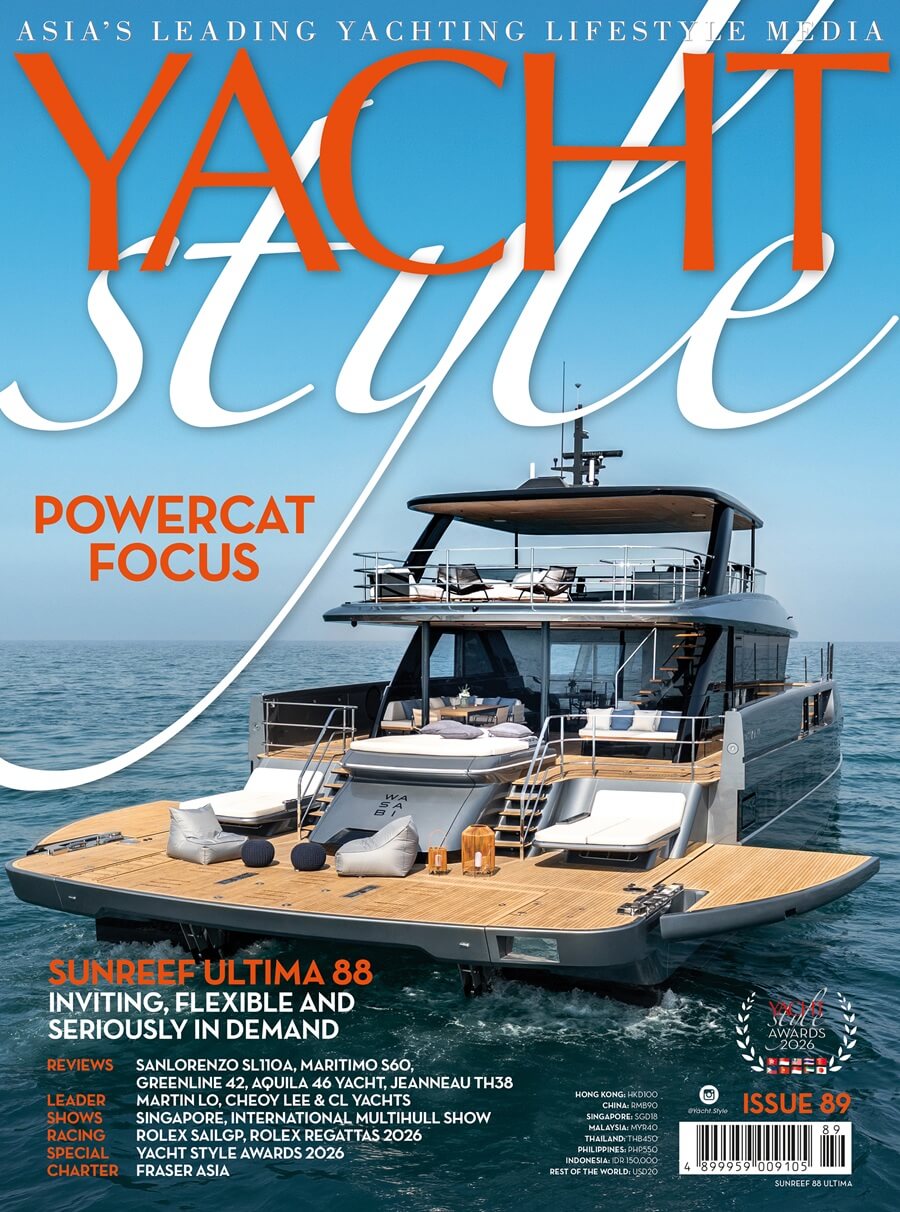
Read and download copy
Yacht Style, Issue 89, powercat, third issue, 2026, Sunreef, Aquila, Jeanneau, Sanlorenzo, Maritimo, Greenline, Yacht Style Awards 2026, Martin Lo of CL Yachts, charter, Fraser Asia, Rolex, regattas, Hong Kong Yachting Association, Chairman, Tommy Ho, Singapore Yachting Festival
Read and download copy
Yacht Style, Issue 88
Read and download copy

Asia's leading yachting lifestyle media

More results...

Generic selectors
Exact matches only
Search in title
Search in content
Post Type Selectors
Yacht Style, Issue 89, powercat, third issue, 2026, Sunreef, Aquila, Jeanneau, Sanlorenzo, Maritimo, Greenline, Yacht Style Awards 2026, Martin Lo of CL Yachts, charter, Fraser Asia, Rolex, regattas, Hong Kong Yachting Association, Chairman, Tommy Ho, Singapore Yachting Festival
Read your copy

More results...

Generic selectors
Exact matches only
Search in title
Search in content
Post Type Selectors

More results...

Generic selectors
Exact matches only
Search in title
Search in content
Post Type Selectors

Lifestyle

For Sale La Villa Baan Ing Phu in Hua Hin, a slice of the Thai Riviera

For Sale La Villa Baan Ing Phu in Hua Hin, a slice of the Thai Riviera

SHARE

With a growing reputation for being the “Thai Riviera”, La Villa Baan Ing Phu in Hua Hin is the latest luxury private estate with villa style units available for sale

Aug 11, 2020 | By LUXUO

  •  
  •  
  •  
  •  
  •  
  •  
  •  

Fast developing a reputation of being the “Thai Riviera”,  Hua Hin takes its name from a providential bit of royal history when a 100 years ago, Prince Krom Phra Naresworarit became the first member of the royal family to build his palaces beside the beach, lending credence to its nascent reputation as a growingly luxurious waterfront escape.

Since then, Hua Hin’s natural beauty has attracted monarchs like King Prajadhipok (Rama VII) and other members of Thai aristocracy to embrace Hua Hin as their summer escape. In fact, right up to 2006, it was the full time residence of the much beloved King Bhumibol Adulyadej (Rama IX).

For Sale: La Villa Baan Ing Phu in Hua Hin, a slice of the Thai Riviera

After the building of southern railway connected Hua Hin with Bangkok along with various destinations en route, many Bangkok natives are rediscovering Hua Hin as an elegant getaway from hectic Bangkok, in turn making it the most popular beach resort in the country. This rapid gentrification has led to investment and stay opportunities like La Villa Baan Ing Phu

While the many attractive heritage summer palaces have become a tourist draw in recent history, La Villa Baan Ing Phu is situated in a secluded drive that is off the main road, cleverly avoiding the pitfalls of rapid gentrification while reaping the benefits of growing communal infrastructure like transport and retail experiences.

Nestled next to scenic landscapes like the lush green fairways of Black Mountain Golf Course and neighbouring a peaceful meditative retreat for monks; La Villa Baan Ing Phu sits in a prime location of stunning natural beauty which includes a giant park once reserved for the royal family. Located just 10-km from the centre of Hua Hin, it takes less than 15 minutes to access Hua Hin’s amenities like shops, banks and supermarkets.

Hua Hin’s Growing international connectivity increases La Villa Baan Ing Phu’s attractiveness

La Villa Baan Ing Phu is a perfect getaway destination in one of the most beautiful valleys of Hua Hin. Only 3 hours from Bangkok, its location is ideal for both local and international travellers. In August 2018, the Department of Airports announced that it will spend 3.5 billion baht to upgrade Hua Hin Airport over the next five years with a projected tenfold increase of travellers using the airport to three million a year. The upgrade is part of the “Riviera Thailand” and Southern Economic Corridor projects, opening up Hua Hin to international destinations including: Hong Kong, Shanghai, Guangzhou, Wuhan, Singapore, New Delhi and other ASEAN countries.

Baan Ing Phu is much more than a luxury private estate – it’s an extraordinary lifestyle that epitomises relaxation and refined living for the few. The resort also offers a diverse range of sports and leisure facilities that reflect its five-star environment such as fitness, tennis, paddle tennis, spa, restaurant and security.

Ultimately, La Villa Baan Ing Phu is a relaxed stress-free environment for people who expect exceptional living standards, in a locale which members of Thai Royalty once called home.

Units available at La Villa Baan Ing Phu

  • MAIN VILLA – Master bedroom & bathroom, 2 Bedrooms with private bathrooms, Guest toilet, Open kitchen facing the living room (fully equipped), Separate kitchen with all kitchen utensils, Terrace overlooking pool
  • GUEST VILLA 1 – Office, 2 Bedrooms with private bathroom & toilet, 1 bedroom with King size bed, 1 bedroom with sofa bed, Storage room
  • GUEST VILLA 2 – Private suite: King size bed, Separate bathroom & toilet
  • GUEST VILLA 3 – Family guest house with 2 bedrooms: 1 bedroom with King size bed, 1 bedroom with 2 twin beds, Shared bathroom, Shared toilet (separate from bathroom)

Prices from THB 60,000,000 (sixty million); USD 1,900,000 (one million, nine hundred thousand)

For more information, contact: st@nisekoluxurychalet.com


Yacht Style Issue 54 Out Now: The Charter Issue 2020 - LUXUO

Yacht Style has released Issue 54 (July-August), its Charter Issue for 2020. Flying Fox, the world's largest charter yacht, stars on the front cover of the 208-page magazine, as the 136m megayacht prepares to return to Asia later this year.

SHARE

For Sale La Villa Baan Ing Phu in Hua Hin, a slice of the Thai Riviera Read More »

New TAG Heuer Aquaracer Special Editions adds Stylish Aesthetics to Series

New TAG Heuer Aquaracer Special Editions adds Stylish Aesthetics to Series

SHARE

Latest 43mm Aquaracer Special Editions introduce new Tortoise Shell effect and olive-green khaki matte aluminium bezels to the series

Jul 17, 2020 | By Julia Roxan

  •  
  •  
  •  
  •  
  •  
  •  
  •  

Three new special edition TAG Heuer Aquaracer models sporting colourful new aesthetics heralds a fashionable beginning to summer. Available in sportive yet stylish olive-green khaki from bezel to strap and tortoiseshell patterns in blue and brown, the ocean-inspired heritage of TAG Heuer’s latest Aquaracer is eminently suitable for a life casual desk diving or literal diving.

New TAG Heuer Aquaracer Special Editions adds Stylish Aesthetics to Series

Ready to accompany wearers during their favourite summertime activities, TAG Heuer’s latest Aquaracer collection introduces two firsts to the sporty series: a new Aquaracer 43mm Khaki Special Edition featuring a slick combination of sturdy fabric strap and sleek anthracite sunray brushed dial joins cool sophistication with a robust “militaristic” aesthetic of olive green aluminium bezel.

Showing casing a polished and fine-brushed steel case, the new 43mm Aquaracer Special Editions match performance with prestige via the La Chaux-de-Fond manufacture’s first use of distinguished tortoiseshell pattern. Inspired by the sunlight reflecting off the ocean waves, TAG Heuer created a magnificent tortoiseshell effect of the bezel using a high tech resin technique.

New resin technique adds Tortoiseshell effect to latest Aquaracer mode

The dark and light blue hues reminiscent of the ocean’s tempestuous waves, plays up the ocean-adventure credentials of the latest Aquaracer 43mm Tortoise Shell Special Edition. Tortoise Shell Editions of the new TAG heuer Aquaracer are also available with a contemporary brown tortoiseshell bezel paired with black sunray brushed dial with horizontal stripes.

Form meets function, the new TAG Heuer Aquaracer Special Editions augment the functionality with 60 minute scale on the unidirectional bezel and an angled magnifying lens over the date window at 3 o’clock. The rhodium plated applied indexes and indicator hands are coated with white Super-LumiNova for enhanced legibility in underwater conditions as well. A new rubber strap like those found on high end sports luxury watches also accompanies the new TAG Heuer Aquaracer Special Editions, featuring an alligator leather pattern and a steel folding clasp with double safety push buttons.

Latest Aquaracer 43mm Khaki Special Edition Price & Specs

Movement Quartz
Case 43mm stainless steel with 300 metres water resistance
Strap Khaki Textile
Price US$1600, S$2250

New Aquaracer 43mm Tortoise Shell Effect Calibre 5 Automatic Price & Specs

Movement Automatic Calibre 5 with 48 hours power reserve
Case 43mm stainless steel with 300 metres water resistance
Strap  Alligator pattern blue rubber strap
Price US$2600, S$3700

SHARE

New TAG Heuer Aquaracer Special Editions adds Stylish Aesthetics to Series Read More »

Creative Director Kris Van Assche Crafts The First Berluti Patterned Canvas

Creative Director Kris Van Assche Crafts The First Berluti Patterned Canvas

SHARE

“The more I think of the future, the more I want to anchor it in a historical context. This Signature Canvas creates a bridge between the past and the present.” – Creative Director Kris Van Assche.

 By Julia Roxan

  •  
  •  
  •  
  •  
  •  
  •  
  •  

Engraved on a black textured fabric that resists everyday use, the Berluti SIGNATURE pattern marks the Maison’s first patterned canvas created by Belgian fashion designer and Creative Director, Kris Van Assche. Inspired by the archives, the all-new signature canvas remains anchored in a historical context, seamlessly bridging the past with the present, whilst reinventing the boundaries between craftsmanship and style in true Berluti form.

Creative Director Kris Van Assche Crafts The First Berluti Patterned Canvas


Offering a variety of briefcases, cross-body bags, clutches, totes, backpacks, travel bags, and a sailor bag, this collection comes complete with the Maison’s trademark finishing alongside its latest emblematic.

Created in collaboration with British luxury travel lifestyle brand, Globe-Trotter, each case represents the product of combined expertise, assembled with the same set of tools Globe-Trotter has used since its foundation, whilst featuring the exclusive Berluti SIGNATURE Canvas.

Berluti - The Signature Canvas Campaign

The new SIGNATURE Canvas features a pattern blending Berluti's new logo and ‪‪the strokes‬ of the iconic Scritto motif. "My idea was to design a printed canv...

Presenting the brand’s first-ever, exclusive handcrafted luggage collection, brand-and-travel-enthusiasts can expect a solid-yet-lightweight base in which 14 layers of Japanese paper are compressed to form an organically textured shell, completed in the brand’s SIGNATURE canvas. With leather handles, corners, and straps, the Globe-Trotter Travel Capsule includes eight hard cases in different formats: 2 rolling suitcases, a shoe trunk holding up to six pairs of shoes, a shoe care kit case, and a watch box, as well as day-to-day accessories such as a messenger bag, a backpack, and a briefcase – all of which, engraved with the Berluti logo.

Yacht Style Issue 54 Out Now: The Charter Issue 2020 - LUXUO

Yacht Style has released Issue 54 (July-August), its Charter Issue for 2020. Flying Fox, the world's largest charter yacht, stars on the front cover of the 208-page magazine, as the 136m megayacht prepares to return to Asia later this year.

SHARE

Creative Director Kris Van Assche Crafts The First Berluti Patterned Canvas Read More »

New Pasha de Cartier introduces subtle yet significant improvements on the 1985 original

New Pasha de Cartier introduces subtle yet significant improvements on the 1985 original

SHARE

The new Pasha de Cartier revives a beloved early diving watch with a questionable but endearing back story emblematic of the maison, a key appeal to the mystique and wonderment that is uniquely Cartier

 By Jonathan Ho

  •  
  •  
  •  
  •  
  •  
  •  
  •  


Inspired by the original 1932 model made by Louis Cartier for Thami El Glaoui the Pasha de Marrakech, the Pasha de Cartier was eventually revived as a serial collection in 1985. Commissioned by Cartier, Gerald Genta adopted design details which made the Pasha’s watch such an icon, into the serially produced edition for the mass market. Though there’s controversy as to whether this backstory is a work of marketing fiction, there is a convergence of evidence which lends credence to the brand’s story.

New Pasha de Cartier introduces subtle yet significant improvements on the 1985 original

First, back in the 1930s, water resistant watches like the one the Pasha de Marrakech wanted Louis Cartier to design, used external cases that would hermetically seal the movement – this was because crown sealing systems had yet to be invented yet and so Cartier answered the Pasha’s needs with a unique creation, secured and made waterproof with a little screw-on cap that served to seal the crown, hanging on a tiny chain fixed to the case.


Second, there would be little necessity, contrary to what some watch journalists assert, to jump on the luxury sports watch bandwagon when Cartier was already in possession of the world’s first pre-eminent sports watch – the Santos de Cartier, complete with bezel secured by visible external screws. And finally, designed as a piece unique originally for aviator Santos Dumont, the Maison already showed historical precedent in acceding to special requests of high profile individuals and luminaries to create timepieces and accessories, elegant yet functional for their lifestyle needs. Nevertheless, regardless of what the truth is, the fact of the matter is – the Pasha de Cartier can be considered not just the Maison’s first attempt at a “diver’s watch” but also its first round watch before the exquisite Ballon Bleu.

Introducing the 2020 Pasha de Cartier

For 2020, the Pasha de Cartier returns with major updates from its 80s predecessor: Two new sizes and a myriad of variations elevate the new Pasha into a full fledged collection thanks to the variety of aesthetic and practical improvements. According to a Cartier representative, the 41 mm and the 35 mm model are not officially designated men’s or women’s editions. Proportionally speaking, both are essentially identical and keep most, if not all, the original elements.

A notable exclusion: the bidirectional-rotating bezel has not made its way into the new collection; instead a host of user-friendly updates including improved functional elements like Cartier’s QuickSwitch quick strap release system and its SmartLink quick bracelet sizing systems can now be found on the 2020 Pasha de Cartier. These innovations made their debut on 2018 Santos de Cartier models and while not new, is the clearest indication that these little ‘quality of life’ updates will soon be seen across most of the Cartier watch collections and not just limited to Santos and Pasha collections.

Returning is the trademark chained crown cover which the new Pasha de Cartier has cleverly hidden a new hidden name plate for personalised initials. Also returning, is the crown cover adorned with sapphire cabochon but now, unscrew the chain-linked “canteen cover” and the crown below surprises the owner with a smaller crown sporting a blue spinel. It’s totally unnecessary but expresses the Cartier penchant for attention to detail.

Sporting Art Deco-style Arabic numerals instead of signature Cartier Roman numerals at cardinal positions 12, 3, 6 and 9 o’clock, the original Pasha de Cartier bore a protective grill over the face which could be flipped open as well as features like a date window at 4 o’clock and the distinctive “Louis Cartier Vendome” lugs. All of those features sans protective grill returns on the new 2020 Pasha de Cartier.

Variants of the new Cartier Pasha de Cartier Prices & Specs

While the original edition had a 35 year run encompassing chronographs and perpetual calendars (including a four button Ref. 30010 made for golf enthusiasts), the new Pasha collection begins in a less gregarious manner with eight appealing novelties: two bejewelled pieces with diamonds across the case, bezel, and even the dial for the 35mm variant and two Pasha de Cartier Tourbillon editions for the 41mm variants. No word on whether the Parisian Maison will be unveiling more complications like moon phases in the future. That said, the tourbillon variant is no longer a Poincon de Geneve stamped edition like its 2011 predecessor, other than that, it remains little changed right down to the iconic “C” tourbillon carriage – naturally, the price matches the new lineage.

Pasha de Cartier

Movement Automatic 1847 MC with 40 hours power reserve
Case 35mm or 41mm stainless steel or gold with 100 metres water resistance
Strap Leather or steel bracelet
Price From S$8,600

Pasha de Cartier Skeleton

Movement Manual winding 9624 MC with 50 hours power reserve
Case 41mm stainless steel with 100 metres water resistance
Strap Leather or steel bracelet
Price S$34,900

Pasha de Cartier Skeleton Tourbillon

Movement Manual winding 9466 MCC with 50 hours power reserve
Case 41mm pink gold or white gold with diamonds with 100 metres water resistance
Strap Alligator
Price From S$138,000

SHARE

New Pasha de Cartier introduces subtle yet significant improvements on the 1985 original Read More »

How Fred Pinel of Pinel et Pinel, Transformed The ‘Trunk’ Into an Item of Contemporary Furnishing

How Fred Pinel of Pinel et Pinel, Transformed The ‘Trunk’ Into an Item of Contemporary Furnishing

SHARE

“Fred’s vision of the trunk remains in line with that of contemporary furniture – a flawless fusion of aesthetics into everyday living.”

Aug 06, 2020 | By Ryan Mario

  •  
  •  
  •  
  •  
  •  
  •  
  •  

Founder of Pinel et Pinel, Fred Pinel

When Fred Pinel informed us of his inclination towards luxury cars and watches, we instinctively knew why he was so passionate about making bespoke artisanal trunks. From the dynamism of engine roars on the circuits to the hypnotic gear clicks in a timepiece, there really is much between them for the modern-day malletier to appreciate all that are exquisite as they are practical. Established in 2004, Pinel et Pinel has since been the only brand in the past 150 years that stepped up to the plate and proved the relevance of trunk manufacturing in present times.

How Fred Pinel of Pinel et Pinel, Transformed The ‘Trunk’ Into an Item of Contemporary Furnishing

Malle Arcade 80 GT in Navy White

A quick scan on the history of trunks reveals their heyday to be during the Victorian era from 1870 to 1920. Originally used as luggage, these travelling chests were brought along for extended trips by stagecoach, train, or steamship. Aesthetics of the Victorian era were noted for orderliness and ornamentation, and the angular build of these steamer trunks befits these elements through the sophistication in their displays and ease of storage, while the dome-topped humpback counterparts were religiously used to prevent a build-up of water on their lids. Today, however, given the weight limitations on airplanes and the new, lightweight wheeled luggage available, the number of malletiers has dwindled to the known few who still practice the craft that is worth its weight in gold.

Malle coffre-fort, Vacheron Constantin, 2008.

Formerly from advertising, Fred Pinel’s career switch stemmed from a chanced discovery of an old European leather suitcase in his grandparents’ basement. Intrigued, he took it apart and reassembled the suitcase whilst noting the intricacies of its structure, thereby prompting him to start a leather-making workshop of his own. Gradually, with no former training and only his experimental disposition to fall back on, Fred managed to forge a brand that centres itself around catering to the ever-increasing specifics of client demands. “I was never intent on building an empire,” professed the founder. He also guaranteed that Pinel et Pinel remains a small Parisian company with about 40 qualified personnel in 16 specialised positions to retain the flexibility in addressing the needs of its patrons. “They can ask us for whatever they want, and we will make it!”

“Mais qui êtes vous Monsieur Pinel?” Crédit Ludovic Parisot

Ultimately, Fred’s vision of the trunk remains in line with that of contemporary furniture – a flawless fusion of aesthetics into everyday living. Yet, in contrast to its predecessors, the company’s creations are far more extensive in terms of usability and construction. Be it a humble cigar case or a futuristic DJ trunk that houses the whole shebang complete with turntables and a laptop stand, Fred constantly pushes the envelope in assembling trunks that suit every occasion, no matter how whimsical it may seem. (Yes, Arcade Trunk that houses arcade games from the 80s, we are looking at you.) Fred is most certain of the value in his craft, and he has his list of collaborators to be ensured of it. From Piaget to Vacheron Constantin, and now Berluti, Fred has a hand in all that is required of his fabrications to house the most exquisite products the watch world can bring to the table. For a watch lover like himself, that must have been quite the exhilaration on Fred’s end indeed!

Pinel et Pinel Facade Boutique, Hong Kong – Shop: 4-6 On Lan Street Central Hong Kong

12 years ago, a sale of a picnic trunk to a Chinese client provided Fred with the realisation that Asians have a palate for the elegance of a vintage product made new. He also recounted having a number of Chinese patrons approaching him at his Paris store for rather unique requests. As the East grew bolder in their acquisition of eccentricities, it became apparent to Fred that the market was ready to receive his customisable trunks. In 2019, Hong Kong became home to the region’s inaugural flagship store and his latest pin-drop on map after France, America, and Japan, allowing Fred to further set his sights on artist collaborations and temporary exhibitions within the store itself.

Pinel et Pinel Boutique, Paris – Shop: 4 rue boissy d’Anglas/ 5 bd Malesherbes75008 PARIS

The state of the products bearing the Pinel et Pinel logo is in constant flux; this is to say that, in accordance to the market and locations the flagship boutiques in Paris and Hong Kong serve, new ideas are constantly materialising into newer gadgets that quickly gain appeal amongst the masses. Fred has now ventured into smaller goods like handbags, clutches, and other leather-clad paraphernalia, and we are confident that many more variations of these will be surfaced by the genius of a man with an insatiable thirst for quirkiness.

Immerse yourselves in Fred Pinel’s emporium of boxed curiosities here at https://shop.pineletpinel.com/.

This article was written by Ryan Mario.

All images are courtesy of Pinel & Pinel .

SHARE

How Fred Pinel of Pinel et Pinel, Transformed The ‘Trunk’ Into an Item of Contemporary Furnishing Read More »

This 1961 Ferrari 250 GT SWB Berlinetta by Scaglietti, is One of Ferrari and Pininfarina’s Greatest Achievements.

This 1961 Ferrari 250 GT SWB Berlinetta by Scaglietti, is One of Ferrari and Pininfarina’s Greatest Achievements.

SHARE

Currently for sale, the 2563GT belongs to an important Ferrari collection, built in a modest quantity of 165 examples.

By Julia Roxan

  •  
  •  
  •  
  •  
  •  
  •  
  •  

Dressed in a bodywork that is widely considered Pinin Farina’s greatest masterpiece, the 1961 Ferrari 250 GT SWB Berlinetta by Scaglietti, breezes through three twin-choke Weber carburettors in a two-cam, all-aluminium power unit, producing up to 280bhp at 7,000rpm, with a top speed of 150mph.

This 1961 Ferrari 250 GT SWB Berlinetta by Scaglietti, is one of Ferrari and Pininfarina’s Greatest Achievements.

Available for sale, this Ferrari 250 GT SWB Berlinetta, was built in a modest quantity of 165 examples, 91 of which were finished in the steel-bodied Lusso street-car configuration, whilst the remaining 74 examples wore alloy coachwork and were specified for racing use.

With a chassis no. 2563GT, this motorcar represents the 78th of just 165 units built, leaving factory production in April 1961, to be sold new to its first of many owners, on 15th May of the same year. Originally ordered with competition 40-DLC-6 carburetors (instead of the regular 36-DLC-3 type), the car eventually passed through the hands of four different Swiss owners, including famous Swiss collector Jean Pierre Slavic of Mies.

Registered under VD 40201, the car for remained in Slavic’s possession for at least 17 years, from 1984 up till 2001, when he traded his 2563GT for a 275 GTB/C 9027 from Anthony Bamford. Within a year from the trade, the Ferrari 250 GT SWB Berlinetta, was sent to GTO Engineering for a complete engine check-up, before entering multiple historic events from 2002 until 2006, including the Tour Auto and Le Mans Classic.


A & S Talking Cars: Ferrari 250 GT SWB Berlinetta

This is "A & S Talking Cars: Ferrari 250 GT SWB Berlinetta" by Auxietre & Schmidt on Vimeo, the home for high quality videos and the people who...

With a long, extensive history on file, this Ferrari 250 GT SWB Berlinetta, is a seasoned race car, currently being offered alongside its Ferrari Classiche Certification, in impeccable condition.

Yacht Style Issue 54 Out Now: The Charter Issue 2020 - LUXUO

Yacht Style has released Issue 54 (July-August), its Charter Issue for 2020. Flying Fox, the world's largest charter yacht, stars on the front cover of the 208-page magazine, as the 136m megayacht prepares to return to Asia later this year.

SHARE

This 1961 Ferrari 250 GT SWB Berlinetta by Scaglietti, is One of Ferrari and Pininfarina’s Greatest Achievements. Read More »

Kos Cos Depicts The Canvas of Our Every Emotion Through Dynamic Portraits

Kos Cos Depicts The Canvas of Our Every Emotion Through Dynamic Portraits

SHARE

Kos’ work explores beyond the conventional and traditional, adding movement and energy through vivid colour and bold brushstrokes.

Jul 17, 2020 | By Julia Roxan

  •  
  •  
  •  
  •  
  •  
  •  
  •  

In the golden age of hand-drawn signage, Hong Kong-based artist, Kos Cos turned his father’s agency workshop into a personal playground, where he studied and practised brush skills after school. Renowned for portraits that are distinctive through their use of vivid colour and bold brushstrokes, Kos’ work explores beyond the conventional and traditional, adding movement and energy to create a more dynamic piece of work.

Kos Cos Depicts The Canvas of Our Every Emotion Through Dynamic Portraits

Nam in Pink – Oil on Canvas

You were born in 1974 in Sri Lanka in an artistic family. What memories do you have of that specific time of your life, what influence has it had on your art?

I consider myself lucky to have been born to my parents. I had a normal childhood just like other kids growing up in the suburbs of Colombo, Sri Lanka during the late 70s to mid 80s. Life was slow-paced and simple – with lots of greenery and nature. In my mid-teens we moved to Mount Lavinia which is a coastal town: that’s where I developed my relationship with the sea. I still love the sea and I’m currently living close by to the sea! I had a bunch of great friends while growing up: playing cricket was our favourite pastime. I remember being more focused on my studies until high-school. I gradually lost interest in academia and got more focused on the usual ‘teenage activities’ at that time.

My parents wanted me to be an engineer so they pushed me into related studies – and not art and stuff like that. So I never studied art formally, although later on my father sent me to one of his friends – an artist – to learn political cartooning. My homefront was always a creative space and influenced me greatly. My mother used to make patchwork using textiles in her free time. All this was done at this table with lots of colourful textiles next to her sewing machine. I watched her combining colourful pieces of textiles to create fantastic wall hangings etc – I feel this influenced me on colours. My father had his own outdoor advertising agency. I have vivid memories of this when I was 7-8 years old. I remember going to my father’s workshop after school to see artists working on outdoor advertising billboards. Here, I had the first-hand opportunity to see painters creating advertisements from babies to movie stars, milk powder to cigarettes on giant billboards. In addition, there were also many art materials available to me, which I used to paint drawings and make crafts.

Sadly though, that was the last 2-3 decades of hand-painted outdoor billboards: everything went digital after that. I believe I am very fortunate to have that exposure to watch and learn from. Looking back, those outdoor billboards were a heavy influence on my early portrait works.

  •  
  •  
  •  
  •  
  •  

Lucid Dreams 03 – Oil stick, Oil paint and Acrylic on Canvas

You moved to Hong Kong in 1999, working in the advertising & creative field. A rather radical change of life. What did Hong Kong inspire you of? When did you decide to focus fully on your art and creation? 

I wasn’t planning on moving to HK; it was an opportunity that came out of the blue. One day I received a call from one of my best friends, who used to work at the same advertising agency as me in Sri Lanka. He asked me if I’d like to come and work in Hong Kong, I said yes and told my parents that I was going away for two years. So here I am, in Hong Kong – after 21 years!

Hong Kong was at the peak of advertising at that time, with agencies producing award-winning creative Ads. It was also much ahead in Multimedia and Web; which was a new learning area for me with new software and a new way of thinking to work with this new media. Working with top creative directors inspired me to come up with out of the box ideas. Having to learn new tools and also think differently to fit new media was a challenge for me initially.

Even at that time, Hong Kong was Asia’s top Art Hub with many international and local galleries, artists and exhibitions. This was a lot of exposure for a young artist and I feel it greatly influenced my art-works. Personally, it was a big change in scenery compared to Colombo/Sri Lanka. It was a great opportunity to learn, experiment and grow as a person.

Coming to Hong Kong  straight from Sri Lanka was like entering a futuristic city with super tall glass and concrete buildings, massive colourful neon signs and infinite energy was an amazing experience. It was definitely sensory overload! Even food was an alien experience because of the bland taste (Sri Lankans love spices!) served with two sticks (chopsticks)!

With the spread of digital and social media, I felt that ‘creativity’ was starting to fade away from the advertising industry. In fact, I sensed this change many years ago. It was at that time when I decided to return to my canvases to express myself without any boundaries. Around 8 years ago, I was fortunate to have my work recognised by a gallery  in Hong Kong. After that I started to show my work regularly in galleries across Hong Kong and the United Kingdom.

In 2019, I finally decided to fully focus on Art as my career and went to open another studio in Belgium with my creative partner.

  •  
  •  
  •  
  •  
  •  

Lucid Dreams 03 – Oil stick, Oil paint and Acrylic on Canvas

Portraits are at the very core of your art. Tell us more about your fascination for human faces in all their diversity?

Yes, I’ve always been drawn more towards portraits than any other type of painting. Our face is our identity. The human face is complex and constantly changes with emotions and moods. Of all the things in the world, humans are most susceptible – physiologically and biologically – to take an interest in another human face. This is because it displays a great deal of information about that person. When we meet someone, we look at their face to read their emotions and understand their personality.

I think portraiture has become a dying art with the development of photography. I knew of many artists who were put-off by portraiture as it gradually became out of fashion. So as an artist, I like to challenge myself – this is why I started with portraits. Further, I like to leave portraits artfully unfinished compared to traditional portraits. Not only does this bring a modern-touch but also, the viewer can engage more with the piece.

  •  
  •  
  •  
  •  
  •  

Majesty VI_Charcoal and Acrylic on Canvas (Serene Majesty)

Tell us about your painting techniques. You are known for always looking at experimenting new materials and various forms of mixed media?

Oil is my main medium but over the years it has changed with the flow, influence or the subject matter. In my early works, I always started with a charcoal sketch and subsequently covered all the charcoal markings with oil paint.

Later on, I did a series called ‘Serene Majesty’, which was about my most beloved animal of all time – elephants. This series also started with charcoal sketching and then I found it’s better to leave the charcoal marks because with these, I could bring to life the true character of the elephant. Later on, I experimented with pastels after seeing ‘Two Dancers Resting’ by Edgar Degas at Orsay Museum in Paris. Basquiat and George Condo further inspired me to work with oil sticks. Oil sticks are a great expressive medium which I love very much and I still do most of my studies using pastels.

While I have used different mediums, I also try to combine different mediums to create experimental works. So my technique always changes based on the medium that I use.

 Are these thick vivid paint colours you are using your signature as an artist? 

With my early works, yes; I loved to apply thick layers of paint on canvas, as in the “Life goes on within you without you” series. Carefully selected vibrant colours are poured onto the canvas and left until a dried outer-layer forms. The entire portrait is painted over this crusty layer. I then make incisions using a palette knife. This releases the dynamic inner layers of still liquified paint which make their own unique impression along the portrait.

All these were my experiments in the recent past, so I wouldn’t call it my signature as an artist. However, I feel my latest collection resonates more as a unique signature – I have a very positive feeling towards this. In fact, I’m also planning to make sculptures based on this series.

Your art has evolved over the past 15 years. Your latest collection, what story does it tell?

Many artists like to express their thoughts via paintings. However, I thought in the opposite direction for my “Shape of a thought” collection.

For me, the shape of a thought is a very abstract idea to play with. Subjectively our thoughts come from nowhere: they just pop into our heads; no one really knows what it looks like, it’s colour, size, weight, shape or where they originate from. Objectively, we can say that thoughts emerge from neural processes. Thoughts are the result of interrelationships between forms and colours – they create an aesthetic experience which engages sights and emotions.

The thoughts we allow into our brain everyday shape our lives and impact our future. They contribute to our behaviours, decisions and therefore our actions, personality and character are based on our thoughts. We become what we think, our thoughts are as unique as our individual profiles. Therefore I created thoughts as the shape of a human profile in a cylindrical or spherical way, almost looking like a spinning top or a UFO.

Colours also play a major role in this collection as I believe thoughts come in a shape as well as colours. These colours change according to each particular thought. To create this phenomenon, I chose different colour combinations very carefully to convey your thoughts to those scenes. Colours are the tools to imagine what a scene might look like therefore, those combinations offer alternative and subjective interpretations to the viewer.

It’s an idea based on a story of a thought. For instance “Riding a purple unicorn in a lavender field at dawn”, “Paul Smith searching for his lucky rabbits while travelling to Nottingham”, or “Kos walking through a bluebell forest in Belgium” (which btw, is my first ever self-portrait). In a way, it’s more about what we expect a painting to be but the possibilities of what the painting could be if you think about long enough – and that for me, is the coolest aspect of these paintings.

Paul Smith searching for his lucky rabbits while travelling to Nottingham Oil on canvas (Shape of a thought)

5 Words which describe your work best?

Abstract, Colourful, Contemporary, Modern, and Timeless

The Dancers – Oil on Canvas

You have today collectors around Asia and around the world. You are referenced amongst the leading global art websites. What does such recognition inspire you?

I am humbled to have my work recognised locally and internationally. The intention behind my works is to express a point of view – mine. I feel it is important to build your worldview as it becomes your unique visual language. If my work in turn inspires someone else then this is probably the greatest value I can bring.

The Gamers – Oil on Canvas

What are your sentiments on the current art scene in Sri Lanka ? Did you keep strong ties with your native country? Do you have artist friends there?

The art scene wasn’t all that big when I left Sri Lanka – that was 21 years ago. I am happy to say that this has changed significantly in the last decade with new artists and galleries. With the nation emerging from the trauma of the almost three decade conflict, I see more people investing their time (and money) into art.

My parents still live in Sri Lanka. As they are a bit old now, I make it a point to visit them at least twice a year. I also use this time to reconnect with my classmates and friends as well.

I have very few artist-friends from back in the day. That time period wasn’t very promising for artists so, none of my friends made progress in this area. However later on, like me, a few of them changed their careers to become full time artists. In fact, one of them is my brother, who’s currently based in Sri Lanka and pursuing a career as an artist.

Larnce Armstrong – Oil on Canvas

When and where can we expect to see your next solo exhibition? 

I can’t comment on exactly when, because of the current health situation in society. In fact, this affected my most recent plans to open an exhibition in Belgium with my creative partner. Being optimistic and looking at the situation, I hope to have my show in late 2020 or early 2021.

Kristal Blue – Oil on Canvas

Where can we see some of you work online, are these for sale?

Saatchi online. You can find them here. You can view my works on my website www.koscos.net. Selected works are available on Saatchi Art online gallery (https://www.saatchiart.com/KosalaNamal)

Glamorous Yellow Lily – Oil on Canvas

If you were to name one mentor who has inspired you in your life and path as an artist, who would that be? 

It would have to be my father – who has been a lifelong inspiration for me. 76 years young, a wheelchair user and still continues to be a painter!

Web : www.koscos.net

Instagram : https://www.instagram.com/koscos/?hl=en

SHARE

Kos Cos Depicts The Canvas of Our Every Emotion Through Dynamic Portraits Read More »

Korean Visual Artist Koh Sang Woo Paints The World In Reverse

Korean Visual Artist Koh Sang Woo Paints The World In Reverse

SHARE

Consolidating photography, performance art, and painting, Koh Sang Woo reconsiders the way in which we look at others and understand ourselves.

Jul 20, 2020 | By Julia Roxan

  •  
  •  
  •  
  •  
  •  
  •  
  •  

Resistance (2016) 104×104

Capturing his every subject in their most pure and vulnerable form, using negative film, Koh Sang Woo is a visual artist who consolidates photography, performance, and painting – in an effort to present the audience with the opportunity to see the world in reverse, and reconsider the way in which we look at others and understand ourselves.

Korean Visual Artist Koh Sang Woo Paints The World In Reverse

Carrera (2013) 104×104

You were born in Seoul in a family of artists. What attracted you to the US ?

When I was a young student in Seoul, South Korea,  Art education was mainly focused on technique rather than idea and concept.  Techniques based on old masters was a large part of art education. Repeating the techniques over and over again, hours and weeks to duplicate a master.   I realized the US had a different Art education system. After finding out I had to create 20 original artworks for my portfolio to enter college,  I was immediately attracted to study abroad . It required far more creativity and my to see my own vision and style for my portfolio. I wanted to study art in US, where you can have your own style and vision for something else and something new.

You graduated from the Chicago School of Art Institute in 2001 and double-majored in Photography and Performance. Tell us about your first steps as an artist based in New York.

Right after graduation at SAIC, I was picked up by a high profile art gallery in Chicago and had exhibition right away. They helped me to reach early acclaim, as the youngest artist to participate in the Armory Show for 3 straight years in a row. However, Chicago felt too conservative and limiting for me on what I wanted to say as an artist.

I decided it was time for me to try New York City and make the big move to the East coast. NYC was a new environment and seem to always challenge me on questioning different thoughts that ran through my mind.

“What is acceptable in society?”, these questions lead to the visual storytelling of opinions. No longer an outsider to the city, each of my works showcased a combination of color, words, and objects. This translation of mixed media represents my own transformation living in NYC. New York has made me realize many things, including my realization of the human race, not defined from what part of the world I was born in. Without forming any relationships to identify myself, I trace back isolation and fear, pain and sadness, anxiety and loss of existence, and the social aspects of the times of confusing identity, and draw the trip of healing, overcoming social wounds as a stranger. NYC helped me grow challenge me as an artist, I have profound love for a city that shows no boundaries, especially during the early 2000’s.

Walk with me (2018) 104×104

Koreans are known for their strong attachment to their specific culture and rich history. On your side, you have travelled the world, met American, Asian, and European artists. How have these travels influenced your art?

When you are born into a country you are shaped by your environment to a certain point in your life.  I have been fortunate enough to meet and build relationships with people all over the world. This connection has shaped my views and thoughts throughout my formative years. You become the puzzle piece of different cultures that create the whole picture.

Pierrot Lion (2019) 150×150

You are always looking for new techniques in your art. Tell us about the blue technique you have developed in your photographic art and the reference to Man Ray?

The reference to Man Ray is based on how one’s thought to try something new and innovative leads to a signature. Man Ray was one of the first artists to cross pollinate from painting/photo/ representation of thought through simple forms.

The solarization technique was such an innovative move to push boundaries on a medium. I greatly respect this body of work. The blue inverse technique came when I was focusing on analog photography in darkroom and when I was introduced to computer programs for the first time. Photoshop was just being introduced when I was in high school. Technology advancements have been so rapid for the past 2 decades but when I started my work, it was a new element for many.

Pierrot (2012) 100×130

How do you integrate live performances into your art? 

Most of my works start in my mind as a performance. Layering pieces, color, movement and capturing the essence as a still shot. There is a little theatrical attribute to most of my work from the early 2000’s where I was starting to fine tune the movements on film.

Emotion (2016) 90×122

Butterflies and flowers are very present in you art. Supporting nature preservation has been important to you as an artist. Tell us more there?

Butterflies go through a process to become a full grown butterfly.  These stages of metamorphosis, I think we can all relate too. Growing physically and mentally. Flowers represent so many different feelings and what each culture represents flowers to mean. I don’t think I can explain in depth of what each form represents as it really is part of the whole piece. Not just a symbol to represent a thought or feeling.

Paint Over Me (2018) 104×104

The five words that best describe your art?

Love, Life, Passion, Connection, Inspiration

Introvert (2017) 104×104

Some media have described you as an “engaged” artist defending freedom of speech and the right to be different. Does that inspire you?

As an artist or as a member of the human race, I believe we need to defend and stand for what we believe in. Against the grain or not, freedom is something that needs to be defined and defended for all of us to have peace.  We wouldn’t have great artists in any field if we didn’t fight to be heard, keeping the ideas and challenges, evolving.

Everytime I feel like I need to voice an opinion, I create a self portrait. Safety of many tested through verbal attacks. Only ability I felt was safe; occupy my thoughts by returning to self portraits. Expressions reflected through the use of my body as a canvas.

KissII (2009) 77×110

In which city can we expect to see your next solo exhibition ?

Amsterdam, Netherlands. October 2020.

Where can we see some of you work online, are these for sale ?

ArtsyArtnet and my website.

Destiny (2019) 150×150

Lately, Korean culture, aside from music and K-pop, is experiencing global appreciation with movies such as “Burning” (2018) and “Parasite” (2019). What thoughts does that inspire in you? 

I think this goes back to freedom of expression and having the outlet to export these great ideas to a broader global audience. I am an avid film lover and and I love how fellow Korean artist/ directors/ screenwriters are creating a new genres of movies coming out of South Korea.  S Korea is becoming the epicenter for “new” ideas and genres for the global stage and I think this movement will be stronger in the future.

Koh Sangwoo

If you were to name one mentor who has inspired you in your life and path as an artist, who would that be?

My father. He has been creating art for the past 5 decades and the passion I see in his work is undeniable. He is currently in his 70’s and still creates artworks everyday. His resilience and dedication to his art/craft is admirable.


Take a tour through Koh Sang Woo’s websiteInstagram or email him personally at kohsangwoo@yahoo.com

SHARE

Korean Visual Artist Koh Sang Woo Paints The World In Reverse Read More »

The Covid-19 Pandemic’s Long-Term Effects on Future Tourist Experiences

The Covid-19 Pandemic’s Long-Term Effects on Future Tourist Experiences

SHARE

While the outbreak may inevitably end, the disastrous Covid-19 pandemic may change the way civilians work, live, and play, long after the dust settles.

 By Julia Roxan

  •  
  •  
  •  
  •  
  •  
  •  
  •  

Wiping out an estimated 100.8 million travel and tourism-related jobs worldwide, the ongoing Covid-19 pandemic has effectively brought the industry to an abrupt standstill, currently accounting for a mere 10% of global GDP. Hitting the Asian Pacific region the hardest with an approximate 63.4 million jobs lost, many cling to fleeting hopes of a potential vaccine capable of diminishing this fatal disease. However, while the outbreak may inevitably end, innumerable reports have suggested the tourism industry may take up to 10 months, or longer depending on each individual nation’s restrictive measures, to recover from the heaviest economic blow yet.

New Normal Experiential Luxury Travel

Chambre Séparées

Beyond disrupting the international flow of medical supplies and other essential needs, the disastrous pandemic may change the way civilians work, live, and play, long after the dust settles. Whether it’s short getaways reachable by car and on foot, or opting for an increasingly isolated accommodation, much of our newly acquired social distancing habits are here for the long-haul.

The Hialeah Park Casino

With everything from restaurants, cinemas, casinos and the Las Vegas Strip shuttered up for lockdown, businesses aren’t left with any other choice but to adapt their operations, facilities and marketing strategies to a demographic of highly unnerved and health-conscious consumers.

null

NEW: Casino in Hialeah, Florida tests their updated poker tables. pic.twitter.com/VEQ6XuJZAO

Unveiling the first-ever ‘Covid-Free’ poker table at the Hialeah Park Casino just outside of Miami, the Floridian gambling den prepares itself to provide unparalleled entertainment on top of a whole new set of stringent demands for safety and sanitation. Gone are the days of crowding nine to eleven players around a single regular-sized table, the casino’s latest set-up will officially accommodate no more than four players and one dealer at a time, ensuring appropriate physical distance between each participant, with the added security of a transparent barrier attached to each table.

Following similar ques, is the UNESCO protected Maldivian site known as, the Beach Bubble Tents of Seaside Finolhu resort. Supporting one of the largest groups of coral reefs in the Indian Ocean, the overall resort houses up to 125 private villas located on stilts above the lagoon or shoreside. Fully equipped with its own shower and WC, wooden floor, and a double bed clad in the finest bed linen, the Beach Bubble experience promises exclusive beach barbecue sessions, a personal butler and mouth-watering breakfasts on the beach. Conceptualized by ‘Eye in The Sky’,  the tent features high-tech polyester fabric, UV-protection, and climate control settings – promising more than uninterrupted views of the vast sky and shoreline.

Perhaps not built specifically in light of Covid-19, the family-owned Panorama Glass Lodge in Reykjavík, Iceland is awe-inspiringly reminiscent of the intimate glass-and-greenhouse-style Chambre Séparées dining experience I was just raving about. Featuring fully furnished cabins to suit your every vibe,  the lodge is revered for its exquisite craftmanship and stylish design details such as, traditional horns, cement tiles, and warm wood – plus picturesque views of the twinkling night sky, glazed facades, and modern facilities which include a kitchenette, ginormous bedding, bathroom, living area, and an outdoor hot tub. The Panorama Glass Lodge is truly a once-in-a-lifetime experience, and one of the few accommodations equipped with the facilities which allow guests to catch the northern lights on full display without leaving the comfort of their bed.

Yacht Style Issue 54 Out Now: The Charter Issue 2020 - LUXUO

Yacht Style has released Issue 54 (July-August), its Charter Issue for 2020. Flying Fox, the world's largest charter yacht, stars on the front cover of the 208-page magazine, as the 136m megayacht prepares to return to Asia later this year.

SHARE

The Covid-19 Pandemic’s Long-Term Effects on Future Tourist Experiences Read More »

Dedy Sufriadi Depicts The Authentic Meaning of Life Amidst an Absurd World

Dedy Sufriadi Depicts The Authentic Meaning of Life Amidst an Absurd World

SHARE

“Before we can make the world better, we must first be open to criticising ourselves.” – Dedy Sufriadi

 By Ryan Mario

REDEMPTION SONG. 150CM X150cm. Acrylic, marker, oil stick, and pencil, on canvas 2018

The 1960s saw drastic shifts in the artistic climate of Indonesia mirroring that of the country’s own socio-political and cultural evolution. Even as the Social Realism style championed by the then communist party made way for a little more integrated art styles during the New Order regime under President Suharto, art, literature, and dialogues contending the realities of ethnic, racial, and sexual relations endured despite constant stifling. A quick glance at the art of present-day Indonesia is bound to leave those less acquainted with the country’s historical progressions in doubt, since its current liberty in expression bears no apparent traces of oppression. On the contrary, even after its democratisation, mining through the depths of many Indonesian artworks’ meanings quickly reveals that these works are often laced with social, political, and religious undertones underscoring the adversities of yesteryears, as demonstrated within the pieces of one Dedy Sufriadi.

Dedy Sufriadi Depicts The Authentic Meaning of Life Amidst an Absurd World

INTO THE WILD. 200CM X 200cm. Acrylic, marker, oil stick, and pencil,on canvas 2018.

Born 1976, Sufriadi’s perspective on art was amplified towards other forms since his entry into university in 1995 at age 20. His high school years prior informed him mostly of art solely conveyed through realism; the lack of exposure to other art styles skewed his presumption towards the idea that good art should be realistic. And yet, the artworks bearing Sufriadi’s signature is a far cry from what he understood art to be. Needless to say, the elucidation he achieved in his university years proved to be catalytic in putting him at the forefront of Indonesia’s contemporary art scene.

Chaotic as they may seem, there is ultimately no question of the raw power that Sufriadi’s pieces can dish out. Atop robust colours applied upon sizeable canvases are often scrawls of texts or evocative imageries characteristic of the Expressionism style – one that befits the rebellious and expressive nature of Yogyakarta’s artists. Taking technical notes from Indonesian painter Affandi and American artist Jean-Michel Basquiat, Sufriadi proceeds to heavily concern himself with the philosophical enquiry of Existentialism that emphasises on the autonomous aggregation of experiences in every individual. “For more than 10 years, I have studied about Existentialism. It opened my mind to different views of the world, and especially of the Indonesian culture,” related the artist during his interview with Art Republik. He further elaborated on the lack of freedom for Indonesian artists to wholly communicate their ideas before 1998, due to the former government damping down on any brand of political commentaries. While the Indonesian art scene has emerged to a new dawn, such damaging restraint on the identity of Indonesian art still has its ripple effect till this day and age, as experienced first-hand by Sufriadi himself.

Dalai Lama, Paradox Our Age #2. Acrylic, permanent pen on canvas, 200 x 200cm, 2013.

Sufriadi’s competitive streak began when he clambered his way into the finalist roster of the Philip Morris Indonesian Art Awards back in 2000. The Jogjakarta 20 Mei was a major win for not only the artist himself, but also the whole of Indonesia’s perspective on art when Sufriadi was crowned the grand-prize winner for his abstract art work, signifying the country’s readiness to accept alternative art forms and to be inducted into the global art stage. Since 2015 after clinching the grand prize in Young Art Taipei, Sufriadi began setting his sights in bringing his art to the more oriental parts of the world, and Beijing, China, is the next pitstop where his solo show will be held at.

Dedy Sufriadi.

Now more than ever, Sufriadi has become more invested in conflicts of the self. While he may reside in a region of rapid shifts, he has grown accustomed to the belief that motivations for external changes should, first and foremost, be initiated through introspections. “Before we can make the world better, we must first be open to criticising ourselves.” Just as how his predecessors kept themselves afloat on their art through troubled waters, perhaps Sufriadi’s success in grounding himself as an artist is by evoking authenticity in the meaning of life amidst an absurd world through a series of direct texts and indirect images.

Take a tour of Dedy Sufriadi’s creations at his Instagram page or contact him at dedysufriadi@gmail.com.

This article was written by Ryan Mario.

Yacht Style Issue 54 Out Now: The Charter Issue 2020 - LUXUO

Yacht Style has released Issue 54 (July-August), its Charter Issue for 2020. Flying Fox, the world's largest charter yacht, stars on the front cover of the 208-page magazine, as the 136m megayacht prepares to return to Asia later this year.

SHARE

Dedy Sufriadi Depicts The Authentic Meaning of Life Amidst an Absurd World Read More »

The Lamborghini Sián Goes Topless For The First Time Since Its Debut

The Lamborghini Sián Goes Topless For The First Time Since Its Debut

SHARE

The Lamborghini Sián roadster delivers the marque’s famed performance with unique hybrid technologies in a roofless design.

 By Julia Roxan

  •  
  •  
  •  
  •  
  •  
  •  
  •  

Following the success of its first-ever hybrid supercar in 2019, the Lamborghini Sián, goes topless for the first time since its debut. The all-new limited edition model delivers the marque’s famed performance with unique hybrid technologies in a roofless design.


The Lamborghini Sián Goes Topless For The First Time Since Its Debut

Heavily influenced by the first countach from 1974, the Sián roadster is conceptualized to be a futuristic interpretation of the coupe, with six retro-inspired hexagonal taillights, airstreamers, an integrated fiber splitter, and Y-shaped headlights. Power-packed with a V12 engine and 48-volt e-motor, this 819 horsepower supercar both supports low-speed maneuvers such as reversing and parking, as well as, high speed travel of up to 217 mph. Storing 10 times the power of a lithium-ion battery, the Sián roadster’s 34kg battery is expected to be at least three times lighter than its conventional alternatives.

Featuring long sculpted contours alongside aero wings which create a powerful profile and reflect back to the countach – the car’s design showcases hints of an optimized aerodynamic body, where airflow is directed through the splitter, front bonnet, side outlets, and rear spoiler.

Available to be coated in any personalized color of choice, the roadster’s open-top cabin design incorporates a mix of new technologies and highly emotional styling, which includes 3D printed air vents, a regenerative braking system, white with blu glauco detailing and aluminum elements which adorn elements such as the control panel.

Yacht Style Issue 54 Out Now: The Charter Issue 2020 - LUXUO

Yacht Style has released Issue 54 (July-August), its Charter Issue for 2020. Flying Fox, the world's largest charter yacht, stars on the front cover of the 208-page magazine, as the 136m megayacht prepares to return to Asia later this year.

SHARE

The Lamborghini Sián Goes Topless For The First Time Since Its Debut Read More »

Chadi Nouri discusses the Future of Swiss Watchmaking for Designers, Brands and Retailers

Chadi Nouri discusses the Future of Swiss Watchmaking for Designers, Brands and Retailers

SHARE

Entering the luxury industry in the wake of the Global Financial Crisis, Chadi Nouri has paid her dues through the ranks at Cartier and Audemars Piguet and today she is an entrepreneur and consultant for the industry at yet another time of great economic uncertainty.

 By Jonathan Ho

  •  
  •  
  •  
  •  
  •  
  •  
  •  

Nouri is not a familiar name but when you are one of two Nouris, a pair of unforgettable sisters in leadership positions within a male dominated luxury watch industry, one inevitably remembers. Of Swiss-Italian and Iranian heritage, Chadi Nouri spent a few years with Cartier before joining Audemars Piguet, eventually becoming their Product Director. Her sister, Chabi, is the CEO of Piaget, the first woman CEO of a Richemont brand but the stratospheric career trajectories and accomplishments are where the similarities end. Taking a leap into the unknown, Chadi ventured outside the relative safety of large luxury conglomerates and into the cut-throat field of independent luxury retail.

Entering the industry post-Global Financial Crisis in 2009, she has paid her dues in marketing with Avakian, a niche high jewellery brand and today she runs Chadi Luxury, a global e-commerce platform dedicated to vintage luxury goods, and rare objets d’art. Chadi also consults with various brands and suppliers across the luxury segment (not just fine watchmaking) where she advises the entire spectrum of soft and hard luxury, from fashion brands to jewellery brands, from very small businesses to big businesses. An insider with an outsider’s perspective, LUXUO caught up with Ms. Nouri to talk post pandemic luxury design and the threats to retail that now plagues every brand regardless of the size of its pre-covid balance sheet.

Chadi Nouri discusses the Future of Swiss Watchmaking for Designers, Brands and Retailers

Czapek is the latest brand to introduce a luxury sports watch, is the industry going through a creative dry spell? Or are consumers ultimately to blame for everyone jumping on the luxury sports watch bandwagon?

I believe that the sports market in general is expanding throughout all aspects of our lives, whether within the Luxury industry with its sports watch segment, or within the Fashion industry with its increased ‘athleisure’ offer.

Nowadays, men and women tend to favour comfortable accessories which will blend in with their lifestyles throughout the day and sports watches are a perfect example of this need for style and comfort. In my opinion, watch brands should definitely continue to fulfil their sports watch proposal and further grow their women’s offerings as well.

The wait time from authorized retailers is around 10 years on average. And that’s after Patek Philippe raised retail prices on all steel Nautilus models by 20%.

Can there be too many sport watches or is it basically an unmet supply issue as a result of high demand for Royal Oaks and Nautiluses?

There is always space for new sports watches at various price points. However, more sports watch references will most certainly not decrease the demand for timeless, exclusive and instantly recognisable pieces with audacious designs that are Royal Oaks, Nautiluses or Rolexes. Nowadays, in this fast-paced world, watch collectors are more and more looking to invest in timepieces that are perennial and that will both keep their value overtime and be ‘cool’ enough to be passed on to the next generation. Therefore, I believe that there will always be a high demand for timepieces that know how to fulfil just that.

It’s been 50 years. Do you think it’s hard to design another luxury sports watch?

It is definitely hard to design ‘THE’ sports watch even though there are many extremely talented watch designers out there. The key is to be able to design a piece that will enter the elite club of timeless classics with a dashing twist which can captivate the audience not only in the ’now’ but over time and for a long time.

Do you think the Bvlgari Octo Finissimo meets the standard for the 21st century?

The Octo Finissimo definitely meets the standards of today: a well thought out, well designed, thin, sports looking watch.

How do you think the Swiss watch industry will approach their dependence on China?

Is it an issue if you’re counting on one region to be your sole growth engine? Of course it is always an issue to only count on one region of the world to flourish one’s business. However, not all watch brands are, to this day, dependent on China and with the pandemic that we are going through, I believe watch brands will make even more efforts to think outside of the box not only in terms of distribution or product but a total 360° watch ‘think tank’ where everything they did or knew so far is re-thought. A brand that is successful today and in the long run should seek a well-balanced turnover on all continents.

What are some of the positives the pandemic will bring for the Swiss watch industry?

I believe that the Swiss watch industry is an industry that will thrive throughout time. It is an industry that has always found ways to keep up with its surroundings and changing environment. Most likely brands will question the current status quo, they will focus on being more creative than ever before in all fields: product, distribution, production, staff training, etc. They will most likely continue to consolidate their reference numbers and focus on launching timeless classics that will dazzle watch connoisseurs now and in the years to come. I believe that they should focus on helping each other and stop working in individual silos. Retailers and suppliers should also be part of this 360° watch ‘think tank’. Finally, watch brands should no longer leave the digital potential on the side and start embracing this market opportunity as it can totally live side by side with the classic timepieces without cannibalising one another just like Tag Heuer did so well lately with its connected piece.

Moharrak with her TAG Heuer Connected

Some Swiss brands went direct to consumer during the quarantine, some retailers were unhappy about that especially when priority for stock allocation was given to their own brand sites – are we at an inflection point where the middle man is about to be cut from the eco-system?

It is the current foreseeable trend and for some brands it is the path to go, to only sell through their own distribution channel whether through a brick and mortar boutique located at the most wanted locations or like Audemars Piguet with their AP House concept. For other brands like Rolex which is one of the most successful watch brand there is, they work exclusively with retailers. This just shows that although the current trend is to cut out ‘the middle man’ for most brands, both strategies work. Perhaps the traditional way of doing business with retailers needs to be improved and streamlined and solutions to modernise this distribution channel should come from both brands and retailers.

Audemars Piguet House in Hong Kong

What is the biggest fear for the future of the industry?

Lack of creativity, lack of collaboration between brands, retailers and suppliers. The industry needs to speak as one voice, the Swiss Watch Industry. In order to perpetuate the industry’s savoir-faire and craftsmanship, brands should share and embrace their best practices but of course without revealing their trade secrets. By sharing, competition will rise even further and competition is key to promote creativity.

With the death of Baselworld and the re-introduction of watch fairs within the same month, is it inevitable that everyone is under one big show again?

It is in the interest of most brands to be present in one or two fairs during the year for the obvious reasons of bringing clients and press all together at the same time and same place. Some brands prefer to create their own paths and go directly where the clients are. Both ways of doing are, in my opinion, good as they cater to watch connoisseurs who love to be pampered either directly in their hometown or at a central focal point where all brands gather up. That being said, whether brands choose to go one way or the other, the future should hold more digital interactions with clients and press: e-commerce, online launches, creative digital presentations, online constructive sharing chats between clients directly hosted by brands, augmented reality, virtual tours of Manufactures, virtual one-to-ones with watch makers, sales staff, designers, CEOs, etc.

Baselworld ended unceremoniously when anchor exhibitors Rolex, Patek Philippe, and Chopard opted to leave. This prompted LVMH to withdraw participation as well.

Are we looking at another era of consolidation ala SMH/Swatch post-quartz crisis?

It will perhaps be the case as a number of brands unfortunately run the risk to disappear. Clients’ tastes are ever more evolving (currently wanting smaller watches, sleeker, more versatile, etc.) and some brands might not have the right offer at hand and might not have the necessary means to meet the clients’ demands. As such, some brands may benefit from a consolidation.

World’s premier luxury retailer, Harrods, recently opened its first Discount Outlet to drive Post-Pandemic sales. LUXUO will go in-depth into this nascent phenomena as more data comes to the fore

There’s plenty of negative economic impact from this crisis, do you see this as a catalyst for the eventual embrace of pre-owned watches or adoption of certified pre-owned services ala luxury car industry?

I believe that the trend towards the pre-owned business started long before the crisis happened. Due to millennials’ demand not only on quality but also on sustainability, luxury companies need to become more sustainable as a whole even in the fast-paced, fast fashion, materialistic industry we are living in. As such, some companies are early adopters and have already embraced the second-hand market instead of seeing it as competition. Those brands that will be able to integrate newness and sustainability will definitely be ahead of their competitors and last longer in time. I therefore believe that the second-hand trend for watches is, for now, still emerging but has a tremendous potential to become even more attractive in the years to come.

Yacht Style Issue 54 Out Now: The Charter Issue 2020 - LUXUO

Yacht Style has released Issue 54 (July-August), its Charter Issue for 2020. Flying Fox, the world's largest charter yacht, stars on the front cover of the 208-page magazine, as the 136m megayacht prepares to return to Asia later this year.

SHARE

Chadi Nouri discusses the Future of Swiss Watchmaking for Designers, Brands and Retailers Read More »