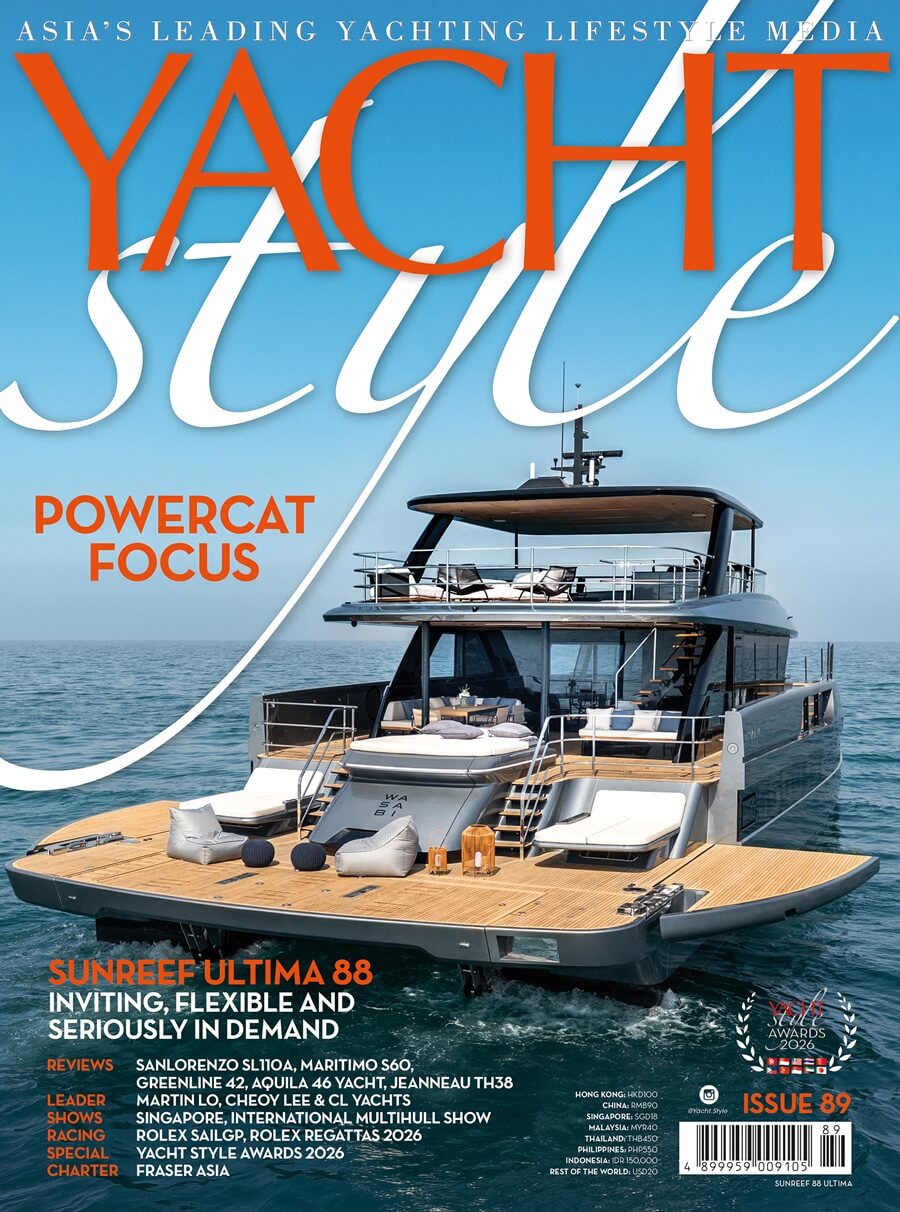
Read and download copy
Yacht Style, Issue 89, powercat, third issue, 2026, Sunreef, Aquila, Jeanneau, Sanlorenzo, Maritimo, Greenline, Yacht Style Awards 2026, Martin Lo of CL Yachts, charter, Fraser Asia, Rolex, regattas, Hong Kong Yachting Association, Chairman, Tommy Ho, Singapore Yachting Festival
Read and download copy

Asia's leading yachting lifestyle media

More results...

Generic selectors
Exact matches only
Search in title
Search in content
Post Type Selectors
Search in posts
Search in pages
Yacht Style, Issue 89, powercat, third issue, 2026, Sunreef, Aquila, Jeanneau, Sanlorenzo, Maritimo, Greenline, Yacht Style Awards 2026, Martin Lo of CL Yachts, charter, Fraser Asia, Rolex, regattas, Hong Kong Yachting Association, Chairman, Tommy Ho, Singapore Yachting Festival
Read your copy

More results...

Generic selectors
Exact matches only
Search in title
Search in content
Post Type Selectors
Search in posts
Search in pages

More results...

Generic selectors
Exact matches only
Search in title
Search in content
Post Type Selectors
Search in posts
Search in pages

Lifestyle

Rolex’s Sensational Submariner

Rolex’s Sensational Submariner

SHARE

Built to conquer the deep, Rolex’s new Oyster Perpetual Submariner reaches new heights of craftsmanship.

  •  
  •  
  •  
  •  
  •  
  •  
  •  


The new Rolex Oyster Perpetual Submariner features a redesigned, slightly larger 41 mm case


Rolex is introducing the new generation of its Oyster Perpetual Submariner and Oyster Perpetual Submariner Date, watches that exemplify the historic links between Rolex and the world of diving. Both timepieces now feature a redesigned, slightly larger 41 mm case – whose profile is highlighted by the light reflections from the case sides and lugs – and are fitted on a remodelled bracelet.


They are equipped with movements at the forefront of watchmaking technology – the Submariner with calibre 3230, unveiled by the brand this year, and the Submariner Date with calibre 3235, offering both time and date functions, and used in the Submariner range for the first time.


True to its aesthetic heritage, the new Submariner in Oystersteel has a black dial and rotatable bezel with matching Cerachrom insert. A yellow Rolesor version (combining Oystersteel and 18 ct yellow gold) of the Submariner Date presents a royal blue dial with a rotatable bezel and a blue Cerachrom insert.


The new-generation Submariner is equipped with calibre 3230, a movement entirely developed and manufactured by Rolex, and launched in 2020


Two versions of the Submariner Date, one in Oystersteel and the other in 18 ct white gold, bring distinctive colour combinations, with the dial and Cerachrom insert in different hues. The first watch blends a black dial with a green bezel, while the second proposes a black dial and a blue bezel.


Like all Rolex watches, the Oyster Perpetual Submariner and Submariner Date carry the Superlative Chronometer certification, which ensures excellent performance on the wrist.


EXTRAORDINARY HISTORY

The creation of the Submariner is linked to the development of deep-sea diving. In the early 1940s, the exploration of the deep marked a significant turning point with the advent of scuba diving. At the time, Rolex played an important role in the development and manufacturing of waterproof chronometer wristwatches, particularly due to the Oyster case, patented in 1926.


As the brand wanted to create a watch that met divers’ practical needs as closely as possible, in the 1950s it began an experimental process that involved many successful collaborations with diving pioneers. The experiments carried out and subsequent technical advances led to the introduction in 1953 of the Submariner, the first divers’ wristwatch waterproof to a depth of 100 m (330 ft).


The model has evolved from the first Oyster case, patented in 1926


Just a year after its launch, the waterproofness of the Submariner was increased to a depth of 200 m (660 ft). The watch was soon fitted with other technical innovations such as a luminescent disc on the hour hand to clearly distinguish it from the minute hand, and a crown guard.


In 1969, Rolex unveiled the Submariner Date, adding the date function. Its waterproofness, then guaranteed to 200 m, was extended in 1979 to a depth of 300 m (1,000 ft). The waterproofness of the Submariner achieved the same depth in 1989.


Over time, the appeal of the Submariner and Submariner Date has extended well beyond the marine world. With their proven performance, these tool watches have become archetypes of the action watch on land as underwater.


LEGIBILITY AND FUNCTIONALITY

When diving, being able to read the time with absolute certainty is a matter of survival. Therefore, the dial of the Submariner and Submariner Date is designed to be clean and unambiguous. The hour and minute hands, clearly differentiated in size and shape, and the hour markers in simple geometric forms – triangles, circles and rectangles – enable instant and reliable reading, preventing any risk of confusion underwater.


The dial of the Submariner and Submariner Date is clean and unambiguous, preventing any risk of confusion underwater


The Submariner and Submariner Date also feature a Chromalight display: the hands and hour markers are coated or filled with a luminescent material that emits a long-lasting blue glow in dark

conditions. On the bezel, the triangular zero marker is also visible in darkness thanks to a capsule containing the same luminescent material.


HIGH-TECHNOLOGY CERAMIC

Rolex played a pioneering role in the development of special ceramics for creating monobloc bezels and bezel inserts. Not only are these materials virtually scratchproof, their colours are also of a rare intensity and are resistant to environmental effects.


Rolex has developed exclusive expertise and innovative manufacturing methods that grant it complete independence in the production of these ceramic components.


The Submariner in Oystersteel with a black Cerachrom bezel and a black dial


On these versions of the Submariner and Submariner Date, the unidirectional rotatable bezel is fitted with a 60-minute graduated Cerachrom insert in black, green or blue ceramic that allows divers to confidently monitor their dive times.


The moulded, recessed graduations and numerals are coated with platinum or yellow gold via PVD (Physical Vapour Deposition). The bezel’s knurled edge offers excellent grip, to comfortably set dive time even when wearing gloves.


ROLESOR: MARRYING GOLD AND STEEL

Rolesor, the combination of 18 ct gold and Oystersteel on a Rolex watch, has been a signature feature of the brand since 1933, when the name was registered.


The Submariner Date in yellow Rolesor (a marriage of Oystersteel and 18 ct yellow gold) with a blue Cerachrom bezel and a royal blue dial


It is a meeting of two metals: one, noble and precious, attractive for its lustre and stability; the other, known for its resistance to corrosion, ensures strength and reliability. All these qualities perfectly mirror the elegance and performance that come together in a Rolex watch.


On the yellow Rolesor version of the Submariner Date, the bezel, winding crown and centre links of the bracelet are in 18 ct yellow gold, while the case and outer links of the bracelet are in Oystersteel.


OYSTER CASE

A paragon of robustness and reliability, the Oyster case of the Submariner and Submariner Date is guaranteed waterproof to a depth of 300 m (1,000 ft). Its middle case is crafted from a solid block of Oystersteel, a particularly corrosion-resistant alloy, or from 18 ct white gold.


The Oyster case of the Submariner and Submariner Date is guaranteed waterproof to a depth of 300 m


The case back, edged with fine fluting, is hermetically screwed down with a special tool that allows only Rolex watchmakers to access the movement. The Triplock winding crown, fitted with a triple waterproofness system, screws down securely against the case and is protected by an integral crown guard.


The crystal is made of virtually scratchproof sapphire and, on the Submariner Date, is fitted with a Cyclops lens at 3 o’clock for easy reading of the date. The waterproof Oyster case provides optimum protection for the watch’s movement.


PERPETUAL CALIBRES

At the forefront of watchmaking technology, these self-winding mechanical movements led to the filing of several patents, and offer fundamental gains in terms of precision, power reserve, resistance to shocks and magnetic fields, convenience and reliability.


Calibres 3230 and 3235 incorporate the Chronergy escapement, patented by Rolex, which combines high-energy efficiency with great dependability. Made of nickel-phosphorus, it is also insensitive to

magnetic fields.


The Submariner Date in Oystersteel with a green Cerachrom bezel and a black dial


The movements are fitted with an optimised blue Parachrom hairspring, manufactured by Rolex in an exclusive paramagnetic alloy that makes it up to 10 times more precise than a traditional hairspring in case of shocks.


The blue Parachrom hairspring is equipped with a Rolex overcoil, ensuring the calibres’ regularity in any position. The oscillator is fitted on the Rolex-designed and -patented high-performance Paraflex shock absorbers, increasing the movements’ shock resistance.


Both calibres are equipped with a self-winding module via a Perpetual rotor. Due to their barrel architecture and the escapement’s superior efficiency, the movements’ power reserve extends to approximately 70 hours.


OYSTER BRACELET, OYSTER SAFETY CLASP

These versions of the Submariner and Submariner Date are fitted with an Oyster bracelet. Developed at the end of the 1930s, this three-piece link bracelet is known for its robustness. The Oyster bracelet on these new versions is equipped with a Rolex-designed and -patented Oysterlock folding safety clasp, which prevents accidental opening. It also features the Rolex Glidelock extension system, designed and patented by the brand.


The Oyster bracelet is equipped with a Rolex-designed and -patented Oysterlock folding safety clasp


This particularly inventive mechanism comprises a rack located under the clasp cover and a toothed sliding link that locks into the chosen notch. The Rolex Glidelock on the Oyster bracelet has 10 notches of approximately 2 mm, allowing the length of the bracelet to be adjusted easily, and without tools, up to some 20 mm.


On the 18 ct white gold version of the Submariner Date, the Oyster bracelet includes ceramic inserts inside the links to enhance its flexibility and longevity. In addition, a concealed attachment system ensures seamless visual continuity between the bracelet and case.


SUPERLATIVE CHRONOMETER CERTIFICATION

Like all Rolex watches, the Oyster Perpetual Submariner and Submariner Date are covered by the Superlative Chronometer certification redefined by Rolex in 2015. This exclusive designation testifies that every watch leaving the brand’s workshops has successfully undergone a series of tests conducted by Rolex in its own laboratories according to its own criteria.


The Submariner Date in 18 ct white gold with a blue Cerachrom bezel and a black dial


These certification tests apply to the fully assembled watch, after casing the movement, guaranteeing superlative performance on the wrist in terms of precision, power reserve, waterproofness and self-winding.


The precision of a Rolex Superlative Chronometer is of the order of −2 /+2 seconds per day, or more than twice that required of an official chronometer. The Superlative Chronometer status is symbolized by the green seal that comes with every Rolex watch and is coupled with an international five-year guarantee.
www.rolex.com


SHARE

Rolex’s Sensational Submariner Read More »

A His and Hers Merry Bvlgari Christmas featuring Bvlgari Classics: Roma, Serpenti, Lvcea and Diva

A His and Hers Merry Bvlgari Christmas featuring Bvlgari Classics: Roma, Serpenti, Lvcea and Diva

SHARE

‘Tis the season to be jolly with Bvlgari classics. By Joseph Low

  •  
  •  
  •  
  •  
  •  
  •  
  •  

The festive season has finally arrived and with the season of gifting just around the corner, here are some gift ideas for you from the luxury jeweller, Bvlgari who has been creating extravagant pieces since 1884. From iconic timepieces like the Serpenti to the Octo Roman Watch, this “His and Hers Gift Guide” will definitely be handy for this Christmas.

For Her:

Serpenti Seduttori

This is perhaps one of the most recognised watches from the Maison, the Serpenti is cult favourite ladies watch in the market. The new Serpenti Seduttori is a riff off of the Serpinti with its slimmer snake-head case but unlike the Serpenti, it has a leather strap or a bracelet crafted with hexagonal patterns resembling scales of a serpent.

The Serpenti Seduttori comes in either white gold, rose gold or stainless steel, and options of getting diamonds set in the bezel are also available. This watch is perfect for a glamourous date night or simply an everyday watch you would wear to work.

Diva’s Dream

Another iconic motif is reimagined and incorporated into the Maison’s collection of watches. The Diva’s Dream’s fan-shape design is seen on the watch’s lugs as opposed to the necklaces and earrings where it is traditionally seen. The Diva’s Dream floral petal pattern represents femininity and sensuality, and has been stealing hearts since years ago. This time, the Diva’s Dream has once again been pushed the brand to achieve greater prowess and craftsmanship, debuting the world’s thinnest ladies’ minute repeater to date.

Gleaming diamonds are assiduously set around the case as well as the perimeter of the lugs, and its peacock motif dial combined with blue alligator strap is an ode to the opulence of the brand’s luxurious past.

Lvcea Skeleton

This collection is representative of Bvlgari’s exquisite jewellery and watch expertise. While it may seem geeky to see all the inner workings of the watch up front, under the watchful eyes of the design team from Bvlgari, it gave a breath of new life into the stale and mechanical layout. The Lvcea Skelaton is a beautifully constructed, with the moving parts resembling a carefully synchronised dance, serving as a backdrop to the Maison’s logo.

FOR HIM:

Octo Roma Watch

A clever union between Italian creativity and preeminence of Swiss watchmaking culminated into the creation of the Octo Roma watch. This distinct watch has been a mainstay at the Maison since 2012 due to its unique shape that is neither round nor square. This design code permeates the Octo Roma collection and while the overall structure has not changed much, the watch is updated to fit the contemporary styles of today. This watch is an icon of discreet luxury ideal for the modern man.

Bvlgari Aluminium Watch

While we have decided to put the Bvlgari Aluminium Watch under the list for “Him”, this 40mm timepiece is actually designed to be genderless. This 90’s symbol has a new iteration this year and like its predecessors, the watch is composed of unconventional materials such as its aluminium case and rubber bezel. This collection is a sports piece as it confers the watch up to 100m of water resitence making it highly versatile, taking you from office to the pools.

B.zero1 one-band ring

Drawing inspiration from the famous amphitheatre, the Colosseum, the B.zero1 one-band ring is now one of the Maison’s most distinguished piece of jewellery. An interesting point to note about the ring is the name “zero1”, while the “B” stands for Bvlgari, the latter actually represents the Maison’s first jewellery in the second millennium. Its design is fairly simple, the Maison’s logos are engraved on the outer side while the inner part of the ring allows for personalisation where you can have your initials inscribed. Highly minimal yet visionary, the circularity of the ring is a metaphor for the harmony of the past, present and future.

Visit Bvlgari’s website to shop for the gifts.

All images courtesy of Bvlgari


SHARE

A His and Hers Merry Bvlgari Christmas featuring Bvlgari Classics: Roma, Serpenti, Lvcea and Diva Read More »

Indonesian Artist Bahaudin Seeks To Exhaust All Means of Peace Through His Vibrant Paintings

Indonesian Artist Bahaudin Seeks To Exhaust All Means of Peace Through His Vibrant Paintings

SHARE

“Aren’t people bored to disagree and spill their blood on the earth we love?”, our differences are what make this life beautiful, but it wouldn’t it be nice to find some common ground? By Julia Roxan

  •  
  •  
  •  
  •  
  •  
  •  

Ketersambungan, 50 x 40 cm, Acrylic, Decorfin Paint on Canvas, 2020 by Bahaudin

In some cultures Bahaudin means, ‘The magnificent of the Faith’. As a young man with a powerful name, and an equally powerful set of skills, Bahaudin harnesses his talents for the greater good. Depicting messages of peace and love, regardless of one’s individual affiliation or creed, this Indonesian artist has dedicated his career to unveiling the deep-seated mysteries of humanity and the issues which it spawns, through vibrant and childlike imagery.

Indonesian Artist Bahaudin Seeks To Exhaust All Means of Peace Through His Vibrant Paintings

Pesona Nurani, 145 x 95 cm, Acrylic, Decorfin Paint on Canvas, 2019 by Bahaudin

You are now established in Yogyakarta which can be considered as the art capital of Indonesia. Tell us more about your first steps as an artist?

I’ve liked drawing since i was in elementary school. My mom was the first to tell me that she really loved the stories my drawings told. My knowledge and artistic experience has increased since studying at Indonesian Institute of Art. Apart from completing the academic process, my artistic experience was also influenced by working as part- time art handler with Serrum.

In 2015, I conducted my first solo exhibition at IAM Gallery Yogyakarta as a form of initial introduction to the public. The work showcased printmaking techniques as an achievement in visual techniques. Several months after the solo exhibition, there were many things that I still needed to learn and develop in order to become an artist. Luckily, I met Anton Subiyanto, who is also an artist. I had learned many things from him over a period of 2 months, he gave me  many tips and taught me how to survive as an artist.

Working as an art handler was one of the most important career decisions I made. Through that experience, I discovered a lot of beautiful works from various artists and I was proud to display their work. The experience boosted my self confidence, inspiring me to immediately start my career as an artist and end my side job as art handler.

Refleksi Kesadaran, 100 x 70 cm, Acrylic, Decorfin Paint on Canvas, 2020 by Bahaudin

Your art is vibrant with vivid colours and cartoonish characters – yet it is easy to sense a not-so-hidden criticism of our modern societies. What message do you wish to send across in your art?

I really love the pattern of peace. For this reason, many of my works always start from a question within oneself, “Aren’t people bored to disagree and spill their blood on the earth we love?” Differences of opinion are common in the living patterns of life. Differences make colors in the beauty of life, however, it would be nice if these differences are always sought for a common thread so that they do not turn into futile feuds.

Takdir Kasih, 50 x 40cm, Acrylic, Decorfin Paint on Canvas, 2020 by Bahaudin

The inclusion of sunflowers in your art is quite frequent, what is this a symbol of?

The sunflower is not a single symbol. But to be more precise, any flowers in my works including sunflowers are part of the hopes and prayers related to beauty and peace in life.

Fourteen Thirty Eight, 145 x 95 cm, Acrylic on Canvas, 2017 by Bahaudin

What is your creative process like? Where do you find your inspiration?

Confusion in today’s problems is very mature in terms of perspective. If a red thread is drawn, my work is related to the value of peace. One of the supporting elements of the word peace is the ability to know ourselves more deeply so that we don’t always have problems outside ourselves, if there are people who do not share our understanding. I always use the packaging for the meaning of love to see other people so as not to prioritize bad prejudices.

I use a lot of colors in my work even though there are some works that use monochrome colors. For me, each color has its own energy which reinforces each other. Just like humans who have their own strength within each person.

Reference to think before making a work is about how to rearrange whatever is seen and the ideas that are caught by translating them back together with the method of contemplation. Emha Ainun Nadjib is one of the people who helps provide a bridge for broad-mindedness because he always talks about life and many things that are used as self-learning. As for me I have a close friend the curator Arga Aditya who has always helped to become a partner for discussion about anything. But the most important thing for me is the goodness of God for allowing me to get inspiration for His creation to be made into artwork.

The Sanguine, 100 x 160 cm (2 panel), Acrylic, Decorfin Paint on Canvas, 2018 by Bahaudin

You love to express yourself outdoors. You enjoy when your art is visible to all. In your mind, what is the role artist play in the society? How important is the space given to artists in modern Indonesian society?

Because artists are part of society itself, by merging artists into society, many things will be obtained such as understanding directly the problems in society and then using their own perspective to draw a common thread that can be used as a simultaneous learning curve in each work. At least for self-introspection, it is grateful if it is useful for others. Space for artists is very important because apart from being a place for work presentation, it is also a place to exchange ideas.

Ruang Lintas, 167 x 122 cm, Acrylic, Decorfin Paint on Canvas, 2020 by Bahaudin

Any current or past Indonesian artist who has influenced you?

I have great friends, they don’t hesitate to share anything with me about the world of art namely Pupuk DP, Eko Nugroho, Ronald Apriyan, M.Lugas Syllabus, Justian Jafin, Gilang Fradika, Danni Febriana, etc.

Conscience Clad in Rhetoric, 200 x 300 cm, Acrylic, Decorfin Paint on Canvas, 2018 by Bahaudin

The five words that best describe your art?

Believe, Contemplation, Sharing, Energy and Peace.

In which city can we expect to see your next solo exhibition?

I am in the process of preparing and looking for a suitable place.

Humans Today, 33 x 132 cm (4 panel), Acrylic, Decorfin Paint on Wood, 2019 by Bahaudin

Can you let our readers which is your favourite art museum in Indonesia?

MACAN Museum is my favourite as it offers many things. Beyond displaying visual works on the walls and providing available space, this museum has created several programs that invite people to know more about fine arts.

Where can we see some of you work online, are these for sale?

You can visit my Instagram to find out more.Life Resources, 150 x240cm, Acrylic, Decorfin, Silicone, Mirror on Canvas and Wood, 2018 by Bahaudin

If you were to name one mentor who has inspired you in your life and path as an artist, who would that be?

Because I love peace, the figure of Emha Ainun Nadjib offers quite a lot of perspectives on the reasoning of thinking from interpreting the debris of life so that it becomes meaningful and does not become mere waste. Mahatma Gandhi, Abdurahman Wahid and Emha Ainun Nadjib they all have their respective functions regarding peace. Emha Ainun Najib has also influenced the wisdom of living life. Becoming an artist is not just talking about the ability to understand technicalities but also formulating ideas.

–

Bahaudin is contactable via email at udienaee@gmail.com or through Instagram.

SHARE

Indonesian Artist Bahaudin Seeks To Exhaust All Means of Peace Through His Vibrant Paintings Read More »

Bugatti Takes Flight With An All-New Chiron Sport Dubbed “Les Légendes du Ciel”

Bugatti Takes Flight With An All-New Chiron Sport Dubbed “Les Légendes du Ciel”

SHARE

Bugatti breathes life into steel once more with the all-new “Les Légendes du Ciel”, a concept car designed in tribute of France’s legendary pilots and race car drivers.

  •  
  •  
  •  
  •  
  •  
  •  
  •  

Highlighting the little-known link between some of its earliest race cars and aviation with a limited-edition variant of the Chiron Sport, Bugatti pays tribute to the notable and successful race driver, Albert Divo, Robert Benoist and Bartolomeo ‘Meo’ Costantini, who also flew in the French Air Force. Through unveiling an all-new Les Légendes du Ciel, the French car manufacturer of high-performance automobiles aims to cater to both vintage car and airplane buffs alike. 

Bugatti Takes Flight With An All-New Chiron Sport Dubbed “Les Légendes du Ciel”

Dubbed Les Légendes du Ciel or “Legends of the Sky”, the new limited edition build represents courage, speed, and extraordinary technology, all wrapped in one. Dressed to the nines in matt grey or “Gris Serpent”, the Les Légendes du Ciel mirrors the metallic exterior colour of early 20th century planes, with a broad high-contrast, white gloss runway-like centre stripe which spans over the car’s complete body from the back to the front.

Reminiscent of the historically popular Nieuport 17 biplane, Bugatti’s latest design incorporates a double wing front, alongside mesh patterns on the horseshoe radiator grille which are intended to resemble planes flying in parade formation. Other design details include a propeller logo and “Les Légendes du Ciel” lettering across the car’s left and right front fenders, and exposed-carbon-fibre side sills painted in a Bleu-Blanc-Rouge French tricolour, which pay tribute to both BUGATTI’s and the Daredevils’ origins.

With the option of a Sky View glass roof, the Les Légendes du Ciel comes complete with a brown Gaucho leather interior, as fine and robust as the original Nieuport 17’s cockpit, whilst the parade formation, propeller logos and lettering details are repeated in the seat’s stitching, on the head rests, and along the aluminium inlay of the middle console.

Characterised by its minimalist design, the Les Légendes du Ciel lives up to the high regard, legendary pilot Roland Garros once viewed founder and proprietor, Ettore Bugatti. Describing him as an “incomparable artist who alone knows how to give life to steel”, the Les Légendes du Ciel is yet another example of expert craftsmanship and design.

Thanks to the inclusion of an advanced 8.0 litres W16 engine, this beauty takes flight effortlessly, delivering up to 1,500 PS and 1,600 newton metres of torque, whilst accelerating to maximum speeds of 420km/h. Limited to 20 units worldwide, Bugatti has since announced the commencement of production by end 2020.

SHARE

Bugatti Takes Flight With An All-New Chiron Sport Dubbed “Les Légendes du Ciel” Read More »

New Bell & Ross BR 05 chronograph is the 1970s watch you wanted

New Bell & Ross BR 05 chronograph is the 1970s watch you wanted

SHARE

High on masculinity and full of character, the new Bell & Ross BR 05 chronograph exudes a quiet strength which belies its subtle elegance, hiding its perfection in the details. By Jonathan Ho

  •  
  •  
  •  

Oversized, instrumental and immediately distinctive, the new BR 05 chronograph joins the family of integrated bracelet Bell & Ross BR 05 watches. Featuring the same aesthetics driving the brand’s most iconic models, the BR 01 and BR 03, the new BR 05 chronograph is the latest in the series to play up the signature “circle within a square” element in the popular sports watch genre.

“This type of design harks back to a category of watches which appeared in the 1970s and when infused with Bell & Ross’ signature identity, the resulting graphic style is both striking and modern.” – Bruno Belamich, Bell & Ross Creative Director

“The case and bracelet form one unit” explains Bruno Belamich, the brand’s Creative Director. The new Bell & Ross chronograph is 42mm, up from the base-model 40mm BR 05 while applying the same design elements like perfectly flat satin-polished surfaces and polished bevels which enhance depth and volume, but the biggest update is reserved for the twin super-ellipse (rounded square) chronograph registers which anchors the entire look by mimicking bezel and midcase.

The New Bell & Ross BR 05 chronograph is the modern 1970s watch you never knew you wanted

While the iconic BR 01 and BR 03 are undeniably aviation cockpit inspired, it bears mentioning that the new BR 05 chronograph is evocative of an era of automotive racing watches like the 1970s Heuer Silverstone. This isn’t a criticism though, where the BR 05 chronograph excels is the fact that it is highly sculptural, recognisably modern while still seductively refined as its smaller, authentically retro counterparts

High on masculinity and full of character, the Bell & Ross chronograph exudes a quite strength which belies its subtle elegance, hiding its perfection in the details. Large Arabic 12 and 6 numerals firmly echo the design language of the original icons while not forcing the squircle chronograph registers to co-exist with 9 and 3 o’clock markers.

The 42mm BR 05 chronograph also enjoys more flexibility with layout thanks to increased dimensions, allowing the design to breathe a little better. The integrated pushers also serve as a defacto crown guard which creates a fluidity of lines not commonly found in many traditional chronographs: What results are two variations of a highly wearable Bell & Ross sports chronograph dubbed “Black Steel” and “Blue Steel” for its dial variations and available on both a rubber strap and an integrated bracelet.

The angle of the attachment to the bracelet has been carefully designed to follow the contours of the wrist, ensuring a secure and comfortable fit. The BR 05 chronograph’s identity is also built on a multitude of small technical and aesthetic details which truly elevate it: By blending fluidity and robustness, the continuity of the lines of this piece becomes a part of its identity.

BELL & ROSS BR 05 CHRONOGRAPH PRICE & SPECS

Movement Automatic calibre BR-CAL.301 with 42 hours power reserve
Case 42 mm stainless steel with 100 metres water resistance
Strap Rubber or Bracelet
Price US$5,900 on rubber / US$6,400 on bracelet
SGD 8700 on rubber / SGD 9500 on steel bracelet

SHARE

New Bell & Ross BR 05 chronograph is the 1970s watch you wanted Read More »

Filipino Artist, Darel Betita Javier’s Surreal Visual Illusions

Filipino Artist, Darel Betita Javier’s Surreal Visual Illusions

SHARE

Forever endowed with the pleasure of experimenting in every aspect of his work, Darel Betita Javier comes from a long line of esteemed Filipino artists. By  Julia Roxan

SCREAM. Colored, pencil, 40inx30in.

  •  
  •  
  •  
  •  
  •  

Born and raised in a family of artists, Darel Betita Javier, unlike his two siblings, was not quick to follow in the footsteps of their parents. Graduating with knowledge of architecture in 1992 from La Consolacion College- Bacolod, Darel spent much of his time in North Carolina, working on construction projects, before finally returning to the Bacolod City of Philippines. Finally pursuing what he was always meant to, Darel is now a full time evolving artist, forever endowed with the pleasure of experimenting in every aspect of his work.

Filipino Artist, Darel Betita Javier’s Surreal Visual Illusions

KING, QUEEN & THE PRINCE.

You grew up in the Philippines in a family of artists. How important has been this positive family environment in allowing you to express your art?

Art for me is just like a sport. It’s a playful thing. I never imagined that someday I will be just like my late dad doing art and enjoying it. I did not take art seriously when I was younger. My two brothers were already joining art competitions from the time we were elementary and high school, but not me. It was only after I came back from the US that I became a full time visual artist.

You then emigrated to the US for a few years (North Carolina). A major culture shock and a substantially different environment from the Philippines. What major learning(s) did you bring back from the US?

To be on time. In the US, it is important to be on time for an appointment or a meeting. The people there are always punctual and they always respect everybody’s time.

THIS GIRL IS ON FIRE.

How important for you, was the recognition of your talent in 2014 when you won the Philippines Art Awards- Visayas (Juror’s Choice Awards)?

2014 is the one of my most memorable years of my life. This award is important to me, as this is where I gained confidence to work harder in my field. This was the first time my work was displayed in Manila and the first time I saw and met famous visual artists in a show. It was the time I realized that the art world in the Philippines is alive and I’m so excited to be part of it.

SELF PORTRAIT.

You are always looking for new techniques in your art (coloured pen, pen and ink, paper cutting). How would you describe your style?

For me looking for a new style and technique in art should be continuous. I’m always curious and it’s a never ending learning experience. I want to explore learning new things and styles. I think I will never be content in doing or discovering new techniques, materials and ideas.

Some of my work looks like a collage but actually it’s a painting. I often use surrealism, conceptual realism, and collaged styles.

MOTHER’S PARADOX.

You were born and brought-up in the Philippines, a Catholic country where religion is a central pillar within society. How important is religion in your art? What religious references do you like to refer to?

I am a christian, I respect all kinds of beliefs and I don’t really touch religions in my art.

What is your creative process like? Where do you find your inspiration?

I usually draw it first on paper or tracing paper before finalizing it on a canvas. I often find my inspiration from my family especially from my wife, who has always believed in my work, since the beginning. She is a very supportive wife, and for an artist that is a very important thing.

ARISE.

Which is the role the artist plays in the society? How do you view the current art scene in the Philippines? How important is the space given to artists in modern Filipino society?

Artists help people and communities find their voice to be heard through art. It helps people express their feelings and learn to appreciate colors, textures, emotions and the beauties around them.

The Art scene in Philippines is very alive! A lot of new art galleries have opened, and more art exhibitions are happening. More young people have begun to appreciate art, and there are more younger art collectors emerging. The art scene in the Philippines is getting more exciting every year.

STUDIO.

Any current or past Filipino artist who has influenced you?

I have a lot of present Filipino artists who influenced me a lot. I call them my art idols or the “masters”. Some of which are, Ronald Ventura, Rodel Tapaya, Andres Barrioquinto, Lynyrd Paras, Jon Jaylo and Jason Montinola.

Can you let our readers know of your favorite Art Museum in the Philippines?

Ilomoca, Bencab & The Pinto Museum but I have never been there. The Pinto Museum is on my wishlist for when this pandemic ends. It’s the most instagram-worthy museum of Asia. As it is an hour from Manila, I tried to go there many times when I have group shows in Manila but it was to no avail, I’m always short of time. Because I usually stay only for 2 to 3 days and then go back again to Bacolod. Manila is so crowded, it’s a big city. I don’t belong there. I only go there when I have group shows.

SANCHUPAPA. Oil on canvas with Toilet Pump.

The five words that best describe your art?

Exceptional unique, expressively composed, and evolving.

In which city can we expect to see your next solo exhibition?

In Manila. I have upcoming solo shows but because of the pandemic, they were rescheduled.

Where can we see some of your work online, are these for sale?

You can find my artworks and upcoming shows on my Instagram. Each post is labelled ‘available’ or ‘sold’.

SELF PORTRAIT SERIES.

If you were to name one mentor who has inspired you in your life and path as an artist, who would that be?

Of course my late dad, Eng. Eduardo D. Javier. He was an engineer, a visual artist, a muralist (who made the longest wood mural in Asia 1969), a sculptor, a Dad and a mentor.

SHARE

Filipino Artist, Darel Betita Javier’s Surreal Visual Illusions Read More »

Robert Parker Wine Advocate Unveils a List of 100 Wine Discoveries From Across The Globe

Robert Parker Wine Advocate Unveils a List of 100 Wine Discoveries From Across The Globe

SHARE

Prioritizing value, age-worthiness, sustainability, and innovation above commercial success, Robert Parker Wine Advocate unveils a list of 100 underrated fermented grape beverages. By Julia Roxan

  •  
  •  
  •  
  •  
  •  
  •  

 Trois Noix means ‘three nuts’ in French – a wine label that was inspired by three kids.

Following the success of unveiling ten top wine discoveries last year at their New York Matter of Taste event, the review team at Robert Parker Wine Advocate have since taken this initiative a step further. Announcing their best newly discovered, under-the-radar wines of the year, Robert Parker Wine Advocate holds true to their vision of independently evaluating and highlighting wines from all around the world. Through this innovative review, the organisation aims to encourage an exploration of new territories within the winemaking industry, whilst learning about the passionate work of often previously unheralded wine makers. 

Robert Parker Wine Advocate Unveils a List of 100 Wine Discoveries From Across The Globe

Dubbed the ‘Top 100 Wine Discoveries’ of 2020, this review is panelled by an expert team of 10 wine critics. With over 30,000 wines reviewed throughout the past year, this list not only complements the 100-point rating system developed by Robert Parker Wine Advocate back in 1978, but reverts its spotlight away from the well-known, highest scoring wines. Prioritizing the singular wine gems which reveal unexpected greatness or fresh, exciting new takes on familiar labels, this selection discovers a number of wines produced from lesser-known grape varieties from non-traditional growing regions, and rediscovers dozens of renowned marques that are making significant innovations, in sustainability and terroir-driven decisions.Domaine Franco-Chinois is the new product to emerge from the old Sino-French experimental vineyard and winery located in Hebei, China. This is a joint venture between the Chinese government (CITIC) and the French government.

Scouring the earth for the most noteworthy wines, the selection criteria for the Top 100 Wine Discoveries are founded on wines that come from outside the mainstream, are new, and have one or more of the following attributes: value, age-worthiness, sustainability, and wines that represent innovative approaches, whether in the vineyards, winery or otherwise.Chateau Nine Peaks Winter

Of the innumerable shortlisted as Top 100, the 2018 Chacra Chardonnay from Patagonia, Argentina tops the list, whilst other notable bottles include the Pasarene Union 2016 from Tulbagh, South Africa, the Aquilini Cabernet Sauvignon Red Mountain 2017 from Red Mountain, USA, Chateau Montfin Corbières Vincent Sans Sulfites Ajoutés 2018 from Languedoc, France, Castello dei Rampolla Liù 2018 from Toscana, Italy, and the Chateau Séraphine 2017 from Pomerol, Bordeaux, France.Chateau Nine Peaks Autumn

To view the full Top 100 Wine Discoveries of 2020 list, visit the Robert Parker Wine Advocate website, and redeem a one-month complimentary trial for all new subscribers. Allowing access to the full details of each selection, all members of Robert Parker Wine Advocate will enjoy an unparalleled database of more than 450,000 wine tasting notes, ratings and in-depth reports from expert reviewers around-the-world, as well as priority booking for Matter of Taste, the world’s most prestigious premier fine-wine tasting event.

SHARE

Robert Parker Wine Advocate Unveils a List of 100 Wine Discoveries From Across The Globe Read More »

Relive The Fragments of Luh Gede’s Memories in Her Series of Awe-Inspiring Oil Paintings

Relive The Fragments of Luh Gede’s Memories in Her Series of Awe-Inspiring Oil Paintings

SHARE

Luh Gede’s immaculate oil paintings, effortlessly induce a sense of youthful serenity and excitement.By Julia Roxan

  •  
  •  
  •  
  •  
  •  
  •  
  •  

Portrait of Luh Gede Gita Sangita Yasa

Representing a new generation of breakthrough artists in the Indonesian art scene, Luh Gede Gita Sangita Yasa, not only a fresh graduate from the Teknologi Institute of Bandung, but also a needle in a haystack. Realising her dreams and purpose much sooner than most, Luh Gede was quick to make the necessary life adjustments in order to achieve her goals – which have since paid off, considering her swiftly escalating recognition. Worth every bit of the attention she’s garnered, Luh Gede’s immaculate oil paintings, effortlessly induce a sense of youthful serenity and excitement.

Relive The
Fragments of Luh Gede’s Memories in Her Series of Awe-Inspiring Oil Paintings

Study #44G, 2020, Oil on canvas, 100x60cm

Luh Gede

Born in Bali in 1997, you graduated from the Teknologi Institute in Bandung, majoring in Fine Arts. And we can already see your art exhibited in galleries across Asia – that is fast ! Tell us more about your first steps as an artist?

That sounds like an overstatement, but I’ll take that as a manifestation mantra.. Graduating in the middle of the pandemic actually sucked, I took a long 3 months rest after the chaos of my final project in university then started working as a graphic designer in 2 different start-ups but quit after a month each. I could say I was bored, lost and had nothing to do but to get a job since all my art supplies were still locked in my campus studio. It was not until I faced the stress of an office workload that I realized, a 9-5 isn’t really for me nor is it personally fulfilling, I just don’t vibe with the whole rush. So, yeah I saved up, rebuilt my brush and paint collections, and took some small commissions. I’m still working out how to readjust things that work and don’t so yes, I am just starting to paint very slowly these days.Paradiso #3: Sebuah Sandiwara, 2020, Oil on Canvas, 120x170cm

“Fragments of memories”, this is how you describe many of your large format paintings. Tell us more about this work on memory and your latest series entitled “Paradiso”.

I daydream a lot. Sometimes I can’t tell if the pictures playing in my mind are from a distance past or if it’s a made up. I think it has something to do with my desire. Often times I found myself having an image of a perfect situation, a perfect person, anything. A desire for alternate realities, can be a future or just simply a dream. The Paradiso series actually has an explanatory title in Indonesia, “Paradiso: Sebuah Sandiwara Waktu ”. The Fragments here is translated into “sandiwara”; a play, like in theatre. Times play the play. The past and the future merging; creating the present on the canvas. The tensions created, that’s just simply how the broken record of memory and the ever so ideal future be haunting my mind. Like in one of my painting; “Boys in Canggu”, there are these 2 ghosts like form and honestly I didn’t know why I put it, I thought it was just funny and aesthetically made everything balanced but when I painted that part I was like “oh man, this whole concept of the painting I do feel like a ghost, instead of tryna be in an actual reality I watch people in my own dimension”.Where’s My Summer #2, 2017, Oil on Canvas, 70x120cm

Any current or past Pop Art artist who has influenced you? Has British artist David Hockney inspired you?

Hockney was a popular artist to take reference from in my year when I was in university, I guess people see similarity in the subject matters that we brought up; tropical images and pools but in my early days of painting I was fascinated by how James Rosenquist used Montage. Could actually drop countless names, in the last 4 years since I first started using oil I’ve gathered references from Justin Mortimer, Phil Hale, Luo Ross, David Salle to Kei Imazu. I saved so many arts on my instagram and other arts that I found interesting. I even painted them again in some of my paintings to make my own narration. My interest is too broad, I like my approach to painting now, combining “a bit realistic” images, flat area and a bit of abstraction. I plan to add more abstraction and expressive strokes in the future to emphasize the chaotic effect. Visually I want both chaos and balance in my paintings. The blank space either they are white or simply flat areas on the canvas are there to give visual break, like an interlude in a hip-hop album.Early works inspired by pop artists like James Rosenquist and David Salle’s composition

You mentioned several times that the evocation of Bali can bring out many “clichés” which you do not want to be associated with. Yet you live in Bali and love the island life. Tell us about the Bali you cherish and call home?

It’s like a love-hate relationship. It becomes annoying when most people are projecting their preconceived idea  when I say that I’m from Bali. they would have this image about spirituality, traditional balinese paintings and all. At the same time I cannot run away from my identity. Not that I hate my ancestors, but these days, I realise the very core of my cultural background it’s so fluid. It has the potential to stay true to its core whilst also following modernity. So, it’s cool I guess.My Dogs Go on a Block, 2019, Oil on Canvas, 120x90cm

How do you view the current art scene in Indonesia? How important is the space given to artists in modern Indonesian society?

Been seeing the major artspots in Jakarta, Bandung and Jogja and I have to say my hometown is a bit late in upgrading the archival system and decent spaces for contemporary arts. Compared to those cities I think Bali has a different approach, the art space is often combined with other lifestyles activities. I worked as an intern in a gallery and I noticed the ecosystem is not so pretty like its reputation. And of the spaces, can’t say we lack of it but geographically it can be quite frustrating. Space is so important for me, where you show your work can show your value, not to mention how the artworks and the space can be more aesthetically pleasing by responding to each other. I think artists these days are given more chances to show their works in public spaces like the mall, a monument and stuff. It gives room for people to start a conversation by seeing but also critics for the artists. Art workshops and therapy are growing too, it’s just nice seeing how art has become a medium for healing in this vast modern world. Can’t find the right work to say it in English but; suka melihat seni bisa memanusiakan manusia, because we tend to get overwhelmed by the city’s life and here we have artists asking us to be in touch with ourselves and our surroundings.Paradiso #2: Sebuah Sandiwara Waktu – Boys in Canggu, 2020, Oil on Canvas, 120x170cm

The five words that best describe your art?

Vibrant colors, simulation, intriguing, pop.The New Now IV: Tension/Creation (Credit to Gajah Gallery Singapore)

In which city can we expect to see your next solo exhibition?

Can’t say an exact place, but I’ve been working on few new paintings so let the wait-and-see begin! In the meantime you can check my previous group exhibition at Gajah Gallery.Resin art

Where can we see some of you work online, are these for sale?

For now you can see them on my Instagram! I post snippets and partial pictures of my paintings there!Paradiso #5: Sprite Ads, 2020, Oil on Canvas, 120 cm x 70 cm.

Your favourite museum in Indonesia?

I’ve been to Jakarta alot and sadly in those countless times I haven’t gotten the chance to visit MACAN despite how desperate I was at everytime. So I guess Galeri Nasional Indonesia, they have so many artworks from old masters like Raden Saleh to more contemporary artists, they also have friendly guide with e-catalogue for some works. They hold exhibitions for established artists too from the country and outside Indonesia. You should go there sometimes, I think they installed the artworks based on the development of Indonesia’s art scene from the colonial.Paradiso #3: Sebuah Sandiwara Waktu – Girl Who Leapt Through Time, 2020, Oil on Canvas, 120x170cm

If you were to name one mentor who has inspired you in your life and path as an artist, who would that be?

Alot. When I was a child I was so intrigued with Van Gogh and children/fantasy writers, they would have these cute illustrations on the book; it was done so technically fine and precise but also not too realistic; I tried to copy it. From my hometown I also admire Antonio Blanco’s artworks, they are so beautiful and graceful, when I visited his museum I thought, “your art can open access to anything uh” as I saw his pictures going around the world and hanging out with Michael Jackson. That’s dope for that time. As I grew older I worked as an artisan for several artists and I just love hearing their stories and approach to life; how to cope with anxiety and to be yourself and express it through your art. I dont have the balls to name them all but I thank these 5 artists whom I’ve been an artisan for during my study. But as I came out from art school I realized my professor helped me so much by understanding my works that everything must not come in chronological order. That maybe by seeing the final artwork you’ll realize where you come from instead of being ingrained on an idea from the get go. It also gives me the freedom to develop and change whatever I want in the creating process. Whatever that fits at the moment.

–

For more information, Luh Gede Gita Sangita Yasa is contactable via Instagram and luhdegita@gmail.com.

SHARE

Relive The Fragments of Luh Gede’s Memories in Her Series of Awe-Inspiring Oil Paintings Read More »

Takashi Hara Breaks the Conventions of Traditions

Takashi Hara Breaks the Conventions of Traditions

SHARE

“The nail that sticks out gets hammered in,” and Japanese artist, Takashi Hara aims to be that nail who puts a dent in the hammer.

Nov 25, 2020 | By Ryan MarioImage by Charly Ho.

When we catch glimpses of Takashi Hara’s masterpieces, we think absolutely nothing about traditional Japanese Calligraphy, or Shodo, which loosely translates to “the way of writing”. Yet, it is just that age-old art form that the 37-year-old Japanese artist’s works invoke in both essence and execution, making the crux of their appreciation in the storied process than the outcome.

Around the World, (2020) 200x300cm, Acrylic and charcoal on canvas.

What were your first steps into the art industry like?

Aged 6, I was already convinced that I was to be an artist in the future and informed my parents of my decision – much to their dismay since I was constantly angering my mother by doodling on any surfaces and in pages of every possible book I managed to get my hands on. One year later at 7-years-old, I began my studies in calligraphy, which became the foundation of my artistic ventures down the road. For 2 years after high school, I was under the tutelage of prominent calligrapher Koshin Soeda. Unsatisfied with honing my skills in a single art form, I further pursued an education in the arts, thereby attaining a double B.F.A. in Fine Arts (painting and ceramics) from the University of Regina in Canada and an M.F.A. in ceramics from the Arizona State University in the United States.Beautiful Scar, (2020) 115x140cm, Acrylic and charcoal on canvas.

With traditional calligraphy as the initiating art form taught to you, the visual elements of your works are not reflective of it; so, what is the artistic direction of your style then?

I would not go so far as to say that my works do not correspond with the knowledge I have acquired in Shodo. While my pieces do not look calligraphic, they are still encapsulations of the style’s energy, brush strokes, fusion of intentional and accidental texture, and most importantly, texts. Artists like CY Twombly, Robert Rauschenberg, and Willem de Kooning are my go-to references for my adoption of the expressionism style, and Mark Rothko’s colour field paintings are the muses for my colour application. Since I made the decision to break out of my mould in artmaking, colours are what separate my style from Shodo, the present from the past. Some of my works are presented with colours and brush strokes as the subjects in themselves rather than figurative forms. I do adore the vibrant energy colours can evoke within my pieces. Also, my stints in multiple countries have taught me that remaining within the premise of a single art style will not get me very far in my career, so I began exploring with other means and mediums, such as to abandon the paintbrush and smear pigments from my fingers, to keep my artforms eclectic and relevant to the ever-shifting landscapes of society today. I would say that my style is as malleable and wavering as what the French would call the “Punk and Zen Art”.Social Survivor, (2020) 29x21cm, Acrylic and ink on kozo paper.

Could you enlighten us on the ideas behind your artworks?

Shodo prides its focus on the introspection of mind-body connection in every individual; my approach in art is similar in its concern for what lies beyond the self and extended towards social constructs in a more personal-social connection. In Japan where I currently reside in, the communities here function greatly on herd mentality. As an artist who has lived and was educated abroad, I now face a certain degree of ostracism by the creative communities as I am neither part of the local university alumni groups nor art clans. Adverse as that may seem to me, I decided to use it as the framework for my art and shed light on issues plaguing society. On top of that, artists in Japan just do not hold a candle to the likes of T.V. personalities or celebrities – contemporary artists are too stoic in comparison. As such, I began embracing my identity as a non-conformist who is exclusive in my own rights. I adopt a variety of imageries as allegories for these issues the same way Aesop uses animals in his fables to cover religious, social, and political themes. As the Japanese saying goes, “The nail that sticks out gets hammered in,” and I aim to be that nail who puts a dent in the hammer.Raging Ladybugs, (2020) 140x162cm, Acrylic and charcoal on canvas.

What are the personal achievements you have amassed with your art and what are your next steps in your creative career?

Since 2004, I have considered myself as an international artist whose works are mainly showcased in Canada and the United States with many more solo shows in parts of Asia and Europe. Due to my international presence, I managed to secure several collectors and am working closely with galleries like A2Z Art Gallery. I have to say that my achievements as an artist should be credited to renown Canadian ceramic artist Victor Cicansky. Back when I was in Canada, I became his final disciple and assistant for two and a half years, which I benefited tremendously through his guidance on professional artistic practice

 I have several exhibitions planned for the next year, including my next solo show that was is slated to happen in Paris, but all will depend on the status of this pandemic. One of my more prevailing themes that I have been working on is the symbolism of pigs as a critical element in my commentaries of a manipulative society. I will be expanding on and exploring this idea works for my upcoming shows.
Around the World, (2020) 200x300cm, Acrylic and charcoal on canvas.

For those who wish to explore the fabulous fables of Takashi Hara, drop by https://www.takashihara.com/index.html or his Instagram page, @ art_x_tak.

SHARE

Takashi Hara Breaks the Conventions of Traditions Read More »

Agus Saputra’s Paintings are Historical Documentations as They are Modern Interpretations of Traditions

Agus Saputra’s Paintings are Historical Documentations as They are Modern Interpretations of Traditions

SHARE

Inspired by one of the region’s most original and organic artforms, Agus Saputra depicts the legendary scenes and themes of daily Balinese life.  By Ryan Mario


  •  
  •  
  •  
  •  
  •  
  •  
  •  

Dense, dynamic, and detailed – the classical Batuan-style artworks originating from the village of Batuan in Gianyar, South Bali, are immediately identifiable by their dramatic portrayals of legendary scenes or themes from daily lives. Albeit similar in concept to the Italian Baroque paintings from the 17th century, the Batuan style was indeed in a league of its own since, in contrast to its counterpart of the Ubud style up in the North, it had minimal to no outside influences, thus making it one of Bali’s most original and organic artforms, and also an immediate source of inspiration for a new age of Balinese artists like Agus Saputra. 

Agus Saputra’s Paintings are Historical Documentations as They are Modern Interpretations of Traditions


Kau kah itu tuan Spies?, 150x180cm, oil on canvas, 2020

Born in Payangan in 1992, you graduated in Bali (Denpasar) where you are now established. How was your initiation into art like?

In Junior High School, I started with sketching and drawing, and at times, attempted to paint. In Senior High School, I attended a school that offered a Fine Arts major. In 2008, I was fortunate to have been offered an internship under Indonesian artist Gede Mahendra Yasa. It was through him and an extensive learning process that I was able to cultivate my interest in Fine Arts, especially paintings.  Thereafter, I furthered my creative studies at the Indonesian Institute of the Arts Denpasar to obtain my academic degree.Hope #2, 150x180cm, oil on canvas, 2020

Whilst working alongside acclaimed Indonesian artist Gede Mahendra Yasa, what were the key learnings you received from this experience?

Aside from painting techniques taught to me in his studio, I was also guided on how to view and analyse the paintings through knowledge in the subjects and looking at things through different lenses. Moreover, he granted me access to his library to read and research on art and art history, which I had done so voraciously. I do acknowledge that he was paramount to my development as an artist and I am grateful to him for that.Conversation with Mead, 150 x 150cm, oil on canvas, 2020

What are the various considerations that go into the construction of your artworks?

My paintings are mostly large-scaled ones since the size does matter in my storytelling process. As a Balinese, working up from traditions is second nature to me, and telling stories comes in close second (think wayang kulit). The Batuan style which I have adopted in my works blends harmoniously with the imposing dimensions of the canvas. My rendition of said style retains its key component of creating a dense and compact landscape of elements that correspond and interact with one another. As the visuals expand from one area of the composition to another, so do the stories that weave through these imageries, thus creating a narrative that unfolds in different ways for every audience of mine.Homage to 5 Foreigners, 300x200cm, oil on canvas, 2020

You speak much of the narratives in your works; could you elaborate on some of these?

There have not been many records of the Batuan art style that is easily accessible to the masses. I have taken it upon myself to continue the legacy of this artform that is unique to our rich Balinese culture and to further document its application in modern times.

In a few of my recent works, I have purposefully conceptualised them around celebrating the efforts of I Nyoman Ngendon – one of the first Batuan painters who embraced the modernization of Balinese art that took place around the beginning of the 1930s. On top of that, my compositions also pay tribute to a few notable personalities who played a role in pushing the recognition of the Batuan art form into the spotlight. Russian-born German primitivist painter Walter Spies, Dutch artist Johan Rudolf Bonnet, and Swiss painter Theo Meier lived and worked extensively on the island of Bali, which contributed to its art scene significantly. Anthropologists Margaret Mead and Gregory Bateson who were stationed in the village of Batuan to conduct research were also instrumental in attracting the attention of Western cultural figures to Balinese culture and art. Their appearances, coupled with Indonesian pop-culture icons, within my painting Homage to 5 Foreigners reposition the value of modern Balinese art as a potential conduit for a still-life documentary that serves to inform and educate that the Batuan style is actually largely and positively influenced by external injections.Betrayal, 200x150cm, oil on canvas, 2019

What are the next steps you will be taking for you career as an artist?

I am a firm believer that artists are knowledge powerhouses who are in the field to educate and enlighten the public on subjects they are most familiar with. I intend to continue conveying what I know about history and my personal experiences through my paintings that will only grow in dimensions with each piece I produce. I do have an intention to ultimately paint a piece so large the human subjects in my work will be directly proportionate to the size of an average human.

In the coming years, I will be building towards my solo exhibitions in Jakarta, and Bali, whilst hoping to further my exhibitions throughout South East Asia.

–

Contact info:

Agus Saputra is contactable via Instagram and agustha2@gmail.com.

CG Art Space Gallery which showcases Agus Saputra’s work is contactable via Instagram or christianagouw@gmail.com.

SHARE

Agus Saputra’s Paintings are Historical Documentations as They are Modern Interpretations of Traditions Read More »

Louis Vuitton Tambour Damier Graphite Race references Virgil Abloh’s aesthetics

Louis Vuitton Tambour Damier Graphite Race references Virgil Abloh’s aesthetics

SHARE

Fluorescent green accents of the new Louis Vuitton Tambour Damier Graphite Race reference the strikingly bold colour palette of Louis Vuitton’s Men’s Artistic Director Virgil Abloh, a man widely touted to have catapulted Louis Vuitton into a major streetwear contender. By Jonathan Ho.

Louis Vuitton continues to march to the beat of its nascent watchmaking creativity with the new Tambour Damier Graphite Race, a sporty-chic timepiece combining modern design and watchmaking know-how. Emblematic of 21st century watchmaking, the new Louis Vuitton Tambour Damier Graphite Race makes audacious use of beloved brand motifs, while remaining faithful to its resoundingly successful original shape.

Energy and creativity come together in this new Tambour wristwatch, dark grey graphite PVD coated steel case contrasts with polished steel horns and then combined with a watch face of Graphite Damier on the dial, recalling the house’s most distinctive visual leitmotifs.

Virgil Abloh’s Aesthetic influence on the New Louis Vuitton Tambour Damier Graphite Race

The polished indexes and the fluorescent green accents of the new Louis Vuitton Tambour Damier Graphite Race, make reference to the strikingly bold and intense colour palette of Louis Vuitton’s Men’s Artistic Director Virgil Abloh, a man widely touted to have catapulted Louis Vuitton into a major streetwear contender.

Louis Vuitton watchmaking typically takes minimalist approach to design but for the new Tambour Damier Graphite Race, signature Abloh aesthetic sensibilities like fluorescent green and black recall the House’s latest menswear collection. The black strap arrives with eye-catching green accents, and can be swapped out for an even bolder green version. These same green hues appear on the dial.

While it’s not as architectural as its high-end (and more premium priced Tambour Curve Flying Tourbillon cousin), the Graphite Damier pattern beneath the subdials and numerals with the Gaston-Louis Vuitton’s V emblazoned across the dial from top to bottom, creates a visually modern and sportive appearance.
Crafted by the brand’s dedicated watchmaking division at La Fabrique du Temps Louis Vuitton, the 12, 4, 8 typography is unique to the brand, blending its deft graphic artistry with its watchmaking prowess with automatic time-only and chronograph calibres assembled at its own La Fabrique du Temps Louis Vuitton manufacture headed by watchmaking legend Michel Navas.

Louis Vuitton Tambour Damier Graphite Race Pricing and Specs

Movement La Fabrique du Temps Louis Vuitton assembled movement with 50 hours power reserve
Case 41.5mm or 46mm Sandblasted stainless steel case with anthracite PVD coating with 100 metres water resistance
Strap Rubber
The sporty, new Louis Vuitton Tambour Damier Graphite Race watches are available in 41.5mm automatic and 46mm chronograph editions at LouisVuitton.com. Prices from US$5,750.

SHARE

Louis Vuitton Tambour Damier Graphite Race references Virgil Abloh’s aesthetics Read More »

Double Trouble

Double Trouble

SHARE

Some girls just want to have fun and dress up when they have the house to themselves, as shown in Galileo Agency’s latest fashion spread for Yacht Style.


Giorgi (left): Dress Mammisi Jewellery Acus Complementos

Andrea (right): Top Bershka Skirt Mammisi Jewellery UNOde50


Andrea (left): Dress Laura Bernal Ring UNOde50

Giorgi (right): Dress Manila Grace Jewellery UNOde50


Swimsuit Albedrio Collection Shirt El Verso Earrings Salty Coco


Top Bershka Skirt Mammisi Jewellery UNOde50


Dress Mammisi Jewellery Acus Complementos


Swimsuit and belt Albedrio Collection Robe Maria Avila


Photography Roberto Maroto @Rmarotopolo

Style Daniela Pla @Danielapla

Make-Up & Hair Mabel Sola @Mabelsola

Models Giorgi Salcudean @Gg.Salcudean & Andrea Arroyo @Andre_Arroyo5

Photo Assistant David Alen @Davidalenbelarra

Style Assistant Zurima Henriquez @Zurimahenriquez

Production Galileo Agency @Galileoproduction

www.galileoagency.es

SHARE

Double Trouble Read More »

The Rolls-Royce Neon Lights Collection Was Inspired By Sami Coultas’ Travels

The Rolls-Royce Neon Lights Collection Was Inspired By Sami Coultas’ Travels

SHARE

Showcasing prestigious Rolls-Royce editions in never before seen shades, this collection mimics the glow of neon lights and its natural distortion at speed.

  •  
  •  
  •  
  •  
  •  
  •  
  •  

Forget all you know about the Rolls-Royce Black Badge collection. Designed for those who reject conformity and live on their own terms, this series of all-black trailblazers has unveiled an all-new bold variety. Kicking things up a notch with added flair and vibrant colors, Rolls-Royce presents its latest Neon Lights collection.

The Rolls-Royce Neon Lights Collection Was Inspired By Sami Coultas’ Travels

Showcasing the prestigious Cullinan, Dawn, and Wraith Black Badge editions in never before seen shades of Lime Rock Green, Eagle Rock Red, and Mirabeau Blue, with Scivaro Grey, Selby Grey, and Arctic White interiors, this collection mimics the glow of neon lights and its distortion at speed.

Conceptualised soon after a suite of Black Badges grabbed headlines at the 2019 Pebble Beach event, which saw Ghost, Wraith and Dawn finished in Bespoke pastel colours, the all-new Neon Lights collection was initially designed for clients within the United States. Since then, three further iterations of each colour are now available for commission worldwide, securing a limited run of just four examples in each shade.

Representing a vibrant trilogy of Rolls-Royce Black Badges, whose inspiration come from nature in the form of near-luminous Australian green tree frogs, the flowers of Ōhi‘a lehua in Hawaii, and the exotic Rhetus periander butterfly – this collection, in the eyes of Sami Coultas, the Bespoke Designer Colour & Trim of Rolls-Royce Motor Cars, provides dramatic contrast and appeals “to patrons around the world who really dare to be different.”

  •  
  •  
  •  
  •  
  •  
  •  
  •  

SHARE

The Rolls-Royce Neon Lights Collection Was Inspired By Sami Coultas’ Travels Read More »

The All-Sapphire Chanel J12 X-Ray

The All-Sapphire Chanel J12 X-Ray

SHARE

Chanel watchmaking presents the clearest representation of its values in the J12 X-Ray – literally. This gem of a timepiece also gives us the chance to wax lyrical about the J12 overall

  •  
  •  
  •  
  •  
  •  
  •  
  •  

There is a certain pleasure in discovery – it is the very thing that powers our ongoing quest to understand the world we live in. I mean that not only in the sense of finding a new species or developing a new technology. Instead, I would argue that we are connected to each other by a shared discovery of what it means to be human, and to live on this planet. This is not something that happens once – you can count on it happening all the time, in fact. Looking at a newsstand, you might discover all sorts of new things, even from brands that you know well, to use a very specific and rather biased example. It even applies to search engines, where you frequently arrive with a question in mind. Whatever results you get, those are all discoveries; to you, the seeker. They might be brand new and entirely unexpected.

When it comes to individual watches, you are likely to learn about a new model long after its debut. You might even discover a watchmaking brand centuries after it made and sold its first watches. It is not uncommon to learn the names of the great houses of horology before finding out anything about their watches. This is also not unusual in the world at large, beyond watchmaking. To use another example from bookstores, everyone knows Homer but only a fraction have read even one of the works in full.

The Chanel J12 X-Ray in all its glory, featuring a sapphire case and matching bracelet.

The story of time is even older – far beyond even the history of our own solar system – so the tale of human timekeeping will form just one narrative arc, albeit an entertaining one from our perspective. Building on this metaphor, any given timepiece will form a standalone chapter, part of the backstory of one or more watchmakers. When it comes to Chanel, it so happens that the J12 model is perhaps the most famous, although it was not the first. That honour belongs to the Premiere model, which opened the story of Chanel watchmaking in 1987. As a character in the evolving story of Chanel, the J12 is arguably the protagonist – it is definitely an important watch in the grand scheme of the watchmaking world.

The Chanel J12 X-Ray that graces our cover encapsulates all the key points about Chanel watches that we examine in this story. As usual, the details about the watch will be in our cover watch segment, including the vital statistics. In this extended look at the J12 in general, we will be paying specific attention to the bracelet of the X-Ray, which represents another ground-breaking triumph for Chanel in watchmaking. In a bit of a lucky twist for WOW in particular, the bracelet here adds to our ongoing conversation about this essential yet oft neglected part of the wristwatch. Of course, all J12s do tend to speak to the key issues for this magazine in recent times.

Long-time readers will recall that we have taken up the cause of the genderless watch – that is to say, the wristwatch designed specifically for both men and women. There is nothing inherently masculine or feminine about time so why should timepieces be made for one sex or the other. This is an issue that has been bouncing around in the heart of Swiss watchmaking for years, yet it has not been properly answered. In this rather remarkable year, we count our blessings to have been able to explore this subject in so much depth, and now to have this shot at a cover story.Close up of Calibre 3.1 that powers the Chanel J12 X-Ray and 12 baguette-cut diamond indexes

Truly, the Chanel J12 was one of the first non-binary watches that was developed as such, right from the start more than 20 years ago. Indeed, the J12 watch sits at the confluence of a number of slow-burning trends in watchmaking, including the triumph of the sports watch and rise of high-tech ceramic. This magazine has been tracking these developments for years, in general, while keeping an eye on Chanel watches periodically.

But we are getting ahead of ourselves. To properly proceed into the world of the J12, we must set the stage. First of all, it is the 20th anniversary of the debut of the J12 according to the brand and industry rag EuropaStar, although Wikipedia has it as 1999. In fact, the brand presented a rethink of the J12 last year, as the opening salvo of the commemoration of the anniversary. The new 2019 J12 is thus quite a different watch to the one that appeared in 2000, as you can see for yourself in these pages. “We changed 70% of the components (of the watch)…although maybe you cannot tell this when you first look at it. We want the J12 to always be on time with the time,” Chanel’s head of watchmaking and jewellery Nicolas Beau told Alexander Linz for Watch Advisor at BaselWorld 2019.

A close up of the Chanel J12 X-Ray where the diamond indexes appear to be floating

Details aside, 20 years is not enough time for a watch to prove itself, one way or another, although plenty of models do fall by the wayside long before even getting to this point. Quite a number of brands (in all sectors) also attempt to emulate the so-called Porsche 911 method in updating flagships designs. This does happen in watchmaking, although brand executives (who must remain anonymous) sheepishly admit that invoking Porsche is a bit of a disingenuous cliché. Having said all this, many legendary products today took a little longer to establish their credentials as they currently stand – the 911 will turn 60 in 2023. As far as wristwatches go, this story need not name names here as such icons are the mainstays of the brands that use them, and those that borrow them.

What you can say, after 20 years, is that the J12 is definitely worth looking at, in much the same way that the Philosopher’s Stone confirms that the Harry Potter series of books is worth reading. After 20 years of the J12, the watch is starting a new arc, with the watch maturing in fine form. In this brief story (10 pages is not enough to cover 20 years of watchmaking), we are looking at the entire history of the J12. The focus is on its identity as a unisex sports watch that was ahead of its time 20 years ago. It is the right sort of watch for our present era, when hygiene and the ability to wear something and feel secure are paramount.

Historical Essence

Chanel was one of the first all-luxury labels to explore the world of watchmaking. Although primarily known as a fashion brand, it was already multi-faceted in the late 1980s when the Premiere wristwatch debuted. As a follow-up, the late Jacques Helleu wanted a sporty expression of time that was also transformative and distinctive. The former artistic director of Chanel expressed this in many interviews from the debut of the J12, which is how we know that the watch was inspired by the J-Class yachts of the America’s Cup. This type of yacht had been out of production since 1937, roughly, but there was a revival in 2001 – the J-Class Association was formed in 2000, and there are active races for this type of yacht right up to this year.

Regardless of serendipitous associations, the J12 is a Chanel design through-and-through. It was a 38mm watch in black ceramic, with a ceramic bracelet (or rubber strap) with an impressive water-resistance of 200 metres, and an automatic calibre (the reliable ETA 2892). Of course, a great watch is more than just statistics, but the J12 that arrived in 2000 was deeply intriguing, and those numbers are telling. It was very easy to go from the boardroom to the pool with the J12, and then head to a black-tie engagement. This sort of aesthetic flexibility in watchmaking remains quite rare, especially if you only count purposeful designs – there are sports watches that work as dress watches today, but these were not created to be all-purpose tickers.

From its debut onwards, the J12 was described as Chanel’s drive to create a basis for men’s watches. Later on, it was touted as one of the most compelling watch designs – for ladies. This happened when current watchmaking design head Arnaud Chastaingt created the Mademoiselle J12 and the J12 XS. Perhaps this happened even earlier, when the J12 appeared in white in 2003, or got its first jewellery editions in 2002. Reality has conspired to make the J12 a man’s watch and a ladies watch, depending on who is doing the talking, or the wearing.The middles of the watch cases are positioned on a ceramic support to be sintered at high temperatures.

The development of the original J12 watch took seven years, which is par for the course when introducing brand new watches. Helleu said he wanted a watch that was “timeless, indestructible, in brilliant black or dazzling white,” which was how he described it in the original press materials. This meant that ceramic was the go-to material from the start, and it entailed many production challenges (as recounted in our last issue, and also in Features this issue). Fittingly, watch magazines from Revolution to QP have credited the J12 with bringing ceramics to a wider audience.

To make this watch a reality, Chanel established its know-how in horology, creating a base for itself in watchmaking hub La Chaux-de-Fonds in Switzerland. This is not to say that Chanel claimed to be a manufacture – it did not. The firm’s journey into mastery in this complex area is ongoing, which we address more completely in the contemporary section, as well as the segments on Kenissi and G&F Chatelain.Injected links

Returning to the design, Helleu also drew inspiration from automobiles and, according to EuropaStar, the all-black yacht belonging to industrialist Giovanni Agnelli. If you are curious, look for Stealth, a 93-foot high-performance yacht with a hull in carbon fibre. These days, it belongs to Lapo Elkann, Agnelli’s grandson. With this sort of inspiration, one is bound to have a great deal of testosterone in the mix – Chanel’s use of high-tech ceramic also helps in this regard. Everything from brake discs to next-generation coatings in power boats uses advanced ceramic technology.

But this is not to say the J12 was, or is, meant to be ultra-masculine. Indeed, the addition of both diamond-set versions in 2002 and J12 Jewellery in 2004 showed that Chanel was keen to keep the J12 as inclusive as possible. That the model has retained a distinctive flavour is entirely down to the genesis of the J12’s design codes. Even in something as singular as the X-Ray, it is evident. Writing in 2009 for EuropaStar, Pierre Maillard noted that the J12 was a multifaceted design, capable of taking on many guises without losing its core character. This remains true today.

 Right Here Right Now

While the last 20 years have been exciting for the J12 , the next 20 hold a lot of promise. It goes without saying that the world is a very different place in 2020 than it was when the J12 debuted. The world in 20 years is likely to be so different that it could be a brand new reality. Change may be the only constant, but it will still be people living through it all. Some touchstones that feel of the moment, but come from the past, will be useful anchors. Wristwatches are clearly objects of that sort, and the J12 is ready for the challenge.

Chanel J12 Paradoxe

 Setting aside the models prior to 2019, the biggest hint that Chanel is ready for big things with the J12 is in the movement, the automatic calibre 12.1. Made by Kenissi, this calibre is quite distinct from the Calibre 3.1 that powers the X-Ray. Where the haute horlogerie stylings of Calibre 3.1 give it an alluring presence and statesman-like grace, calibre 12.1 is ready for rough-and-tumble action. The circle motifs in both movements link them to Chanel’s taste for that shape – this is also evident right from Calibre 1 in 2016. Some commentators associate this motif with Chastaingt’s own preferences, which might be possible given that he joined Chanel in 2013.

When it comes to the X-Ray and the J12-20 overall, there is no ambiguity. Chastaingt told World Tempus that he wanted the X-Ray watch itself to embody “watch clarity,” over “watch complication.” In a way, that makes the X-Ray the polar opposite of the Retrograde Mysterieuse that celebrated the 10th birthday of the J12. Perhaps more importantly though, the X-Ray looks and feels magical – a quality it shares with many special editions of the model. For both the X-Ray and the Retrograde Mysterieuse, the primary take-away from looking at the watches is a question: how did they do that? This is part of the appeal.

On that note, it is time to look at that bracelet for a bit. As has been acknowledged by many magazines and websites, this is the first time any watchmaker has equipped a wristwatch with a bracelet made up of sapphire crystal links. Gem-set bracelets are not unusual, however impressive they might be. Going the X-Ray route takes courage, and absolute confidence in build-quality. To draw on our previous stories on this subject, exposing relatively small sapphire components to shearing forces is dangerous. On the other hand, it is not that different to exposing ceramic components to the same stresses. Obviously, Chanel has a lot of experience there and thus, good reason to have confidence.Châtelain de Chanel Horlogerie at La Chaux-de-Fonds

A big part of that confidence comes from the G&F Chatelain manufacture, which is the “secret” behind the remarkable success of Chanel’s ceramic timepieces. G&F Chatelain were third-party suppliers but Chanel has owned it outright since 1993 – this is part of the watchmaking savoir faire that Chanel established for itself in La Chaux-de-Fonds. That means it has been involved with the J12 right from the start because the timeline matches exactly the development time.

WOW Thailand editor Ruckdee Chotjinda visited the site relatively recently, making us jealous for some time. He confirms that it is an ultra-modern affair, complete with automated production lines. The 16,000 sqm space looks the part of a contemporary manufacture, and provides space for the 350 employees. According to Chatelain website, it has full mastery of all manner of processes related to ultra-hard materials, and now even includes a jewellery workshop.Ultra-modern watchmaking in action at Châtelain de Chanel Horlogerie

Having a manufacture of this quality fully integrated with operations speaks volumes for Chanel’s commitment to watchmaking. On the other hand, the Kenissi stake demonstrates that Chanel is very much part of the tapestry of big Swiss watchmaking names, even if its own roots and claim to fame have nothing to do with the trade. We look forward to reading new chapters in the continuing story of Chanel watchmaking.

Moving with Time

Chanel is a watchmaker with a few different tracks. It has third-party base movements – quartz and otherwise – in play for existing J12 models, exclusive third-party haute horlogerie movements, in-house haute horlogerie movements, and an exclusive workhorse base movement. That last one is calibre 12.1, which is made by Kenissi for Chanel. It shares its architecture with the MT5600 series that Tudor uses, and the B20 used by Breitling.

These commonalities came about mainly because Chanel is a 20% stakeholder in the Geneva-based movement and sapphire crystal specialist. In turn, Kenissi has been called the “industrial arm,” of Tudor, but is really a partnership between the Rolex Group and a watch component-maker. The relationship with Tudor is clear, because Kenissi and the brand will be sharing a space in Le Locle in 2021. In a bit of Swiss magic, the CEO of Kenissi is Jean-Paul Girardin, formerly one of the leaders at Breitling prior to the Schneider family selling their stake. All of the information shared with regards to Kenissi is according to the Swiss press, as cited in various magazines and blogs.

As for Calibre 3.1, this is a different matter, being an in-house production. It is based closely on Calibre 3, as the name suggests, which was most recently seen in the Chanel Boy.Friend rectangular watch. What is particularly interesting here is that this movement is effectively a form one, with balance spring, gear train and escapement all organised along a single vertical axis. It is the only time, as far as we can recall, that a form movement has been adapted for use in a round watch. As big fans of form watches and movements here, we salute this quirky decision.

SHARE

The All-Sapphire Chanel J12 X-Ray Read More »

A Greedy Capitalist is No More Than a Beast on Shafiq Nordin’s Canvas

A Greedy Capitalist is No More Than a Beast on Shafiq Nordin’s Canvas

SHARE

Malaysian artist, Shafiq Nordin takes no prisoners when illustrating certain nefarious forces as the skinless muscle-bounded beasts they are.

  •  
  •  
  •  
  •  
  •  
  •  
  •  

Regarded one of the most uncompromising and hard-hitting artists of his generation, Shafiq Nordin is anything but vanilla. Leaving the depictions of victims and casualties of geopolitical games to his less imaginative counterparts, this Malaysian artist takes no prisoners when illustrating certain nefarious forces and their evil capitalist agendas as the skinless muscle-bounded beasts they are. Drawing specific attention to the monstrous nature of humanity’s imperialist ambitions and insatiable greed, Shafiq Nordin is revered for his strong imagery, unique style, coarse outlines, and well-composed satire.

A Greedy Capitalist is No More Than a Beast on Shafiq Nordin’s Canvas

I’M INNOCENT by Shafiq Nordin, 90x90cm, Acrylic on Canvas stick on Board, 2020

You are now 30 years old, yet you started painting and drawing at a very young age of 10. How important was it for your family to allow you to express your art? Tell us more about your first steps as an artist?

Yes. My early journey into art started when I was 10 years old. At that time, cartoon characters such as Dragonball, Digimon and Pokemon were my important subject matter. As they were very popular among kids, I used to bring all my drawings to school and sell them to my friends. Back then, my starting price ranged from 50 cents to one ringgit, according to their favorite characters. I also made my own comics by drawing on my exercise books.

Family is my main support in this venture. They recognized my passion and allowed me to take art as a subject during high school. When I attended my diploma, graphic design was my first choice and fine art was the second. I didn’t have a clue about what fine art actually was. During the interview process, we were required to prepare some drawings, which would help determine the course that fit us. After the process, the interviewer classified my drawings as fine art, and from that day, I began my journey with zero knowledge in this world. That was my starting point.

During my degree industry training with Samsuddin Wahab for three months, I began to unravel my journey and career as an artist. Samsuddin gave me plenty of tips and steps on how to survive as an artist. It was during that time, that my interest toward surrealism began to arise.

On the final year of my fine art degree show in 2012 at UiTM, my artworks surprisingly received good feedback from the galleries and collectors that visited the exhibition. HOM Art Trans, a member from the group, MATAHATI, offered a few of my friends and I an opportunity to undergo a short residency, named ‘THE DOOR’. It was my first step into art scene and a stepping stone in my career as a young artist. Gathering all of the sales from our artworks, my friends and I, set up STUDIO PISANG with eight members at that time.

In early 2012, I had faced an identical crisis, where my artworks were accused of being similar to those of another artist. Critics said there was no originality in my works. Nevertheless, I kept on working and experimenting until I won the Malaysia Emerging Artist Award in 2014. This achievement marked the beginning of my new identity, one that is well received among galleries and collectors. This style awarded me a Young Gun Award in 2018 and made me a finalist of Bakat Muda Sezaman (BMS) in 2019. My installation for Bakat Muda Sezaman became part of a permanent collection in the National Art Gallery (Balai Seni Negara) Malaysia.

I have explored beyond my community, by joining several international exhibitions in galleries and art fairs throughout Germany, Korea, Philippines, Singapore, Indonesia, Australia, Istanbul and France.

‘Misi Rahsia-Buka Jalan’, Acrylic on Jute, 183cm x 243 cm, 2020

 Your art is vibrant with vivid colours and fantastical beasts in surreal landscapes. Tell us more about the “psychedelic imagery” you are using and the “hidden” messages you seem to be trying to push across?

My early artwork is more dark satirical, using of gore images with a dark scheme colour. These works, align with the young rebellious adrenaline and political issues which had become my main focus. During that time, most young artists were brave and loud in producing artwork regarding politics in local art scene.

The subject matter of my works, depending on the messages that I wanted to deliver, mainly focus on surreal interflow animals. During the early days of my career, there were many artists who used human figuratives, therefore these animals became my main subjects in an effort to be different, without making my messages too direct to the viewer. Each animal has their own character that can be linked to humans too.

This can be seen at my first solo exhibition, the Imperium in 2013 at HOM Art Trans. Compared to my latest solo exhibition, ALETHEIA in 2018, the starting point of using vibrant colours in my works was inspired by international artists like Kaws and Takashi Murakami. I realize, as an artist I need to have my own strategy, target for the future and not only linger in my own comfort zone. These vibrant colours are used to highlight certain issues, making my work more sarcastic with hidden messages. My recent artworks now focus more on new characters that are increasingly vibrant and bolder.

Back in years, my works appeared more provocative and were full with political elements, however now I merely focus on critical social issues based on my personal experiences as an artist.

REVOLUTION (BASED ON A TRUE STORY) by Shafiq Nordin, Painting Installation, 95x312cm + 55x37cm (Heart), Oil and Acrylic on Jute, 2018

You work contains social and political themes (your large-scale artwork “Revolution” for instance). Do you see yourself as an “engaged” artist?

Yes, I would say I am an engaged artist. I always draw inspiration from things that happen around me. This can be seen on my work titled “Revolution”, where the issues behind the painting are about huge obstacles that can be brought down by unity and togetherness. From there, I realised art collectives are important as they exist for artists to help one another, without not simply allowing us to fall prey to certain individuals. Center heart in artwork are symbolic representations of the key to success. Actually, I’m a film enthusiast. Therefore, most of my inspiration came from films I have watched. For me, it’s like therapy for artists who are imaginative, constantly generating ideas that beyond normal.

SECRET MISSION II: RESCUE by Shafiq Nordin, 155x121cm, Acrylic on Jute, 2019

Are there any current or past Pop Art artists who have influenced you?

Definitely Takashi Murakami and Kaws! I love to watch their works and journey to becoming the best contemporary artists who actively collaborate with renowned brands. This unlimits the potential of the artwork and the work itself spreads into other lines. It doesn’t sit still only in galleries. Nowadays the trends in contemporary world bring art and society closer and closer. There’s no longer a strong border between the enthusiast and the art.

“If comerciazillation is putting my art on a shirt so that a kid who can’t afford a 30,000-dollar painting, can buy one”,Haring said,”Then I’m all for it. Art is nothing if you don’t reach every segment of people” (Keith Haring,1980).

SECRET MISSION I: WE NEED GENIE by Shafiq Nordin, 155x121cm, Acrylic on Jute, 2019

 How do you view the current art scene in Malaysia? How important is the space given to artists in modern Malaysian society?

In these past few years, local Malaysia arts scene shows a positive improvement due to local galleries eagerly participating in international art fairs. Thus, international galleries impressively show some interest toward local artists and express a desire to collaborate with artists from Malaysia. This is a positive improvement, compared to 10 years ago. I hope there’s more Malaysian artists who receive global recognition. I hope more art fairs can be organized in Malaysia.

Other than solely prioritizing commercial work, it is also important to maintain dedicated spaces for new media and experimental work.

SELAMAT DATANG MR. CORONA by Shafiq Nordin, 244x153cm, Acrylic on Canvas, 2020

 The five words that best describe your art?

Characteristic, sarcastic, narrative, symbolic and vibrant

JUST WANT TO SLEEP AND BE FAMOUS by Shafiq Nordin, 155x122cm, Acrylic on Canvas, 2020

In which city can we expect to see your next solo exhibition?

I completed my first and second solo exhibitions in Malaysia, and I dearly hope that my third will take place internationally. I received an invitation from a gallery in Taiwan to host a solo exhibition next year. I’m so excited for this solo as the concept and list of artists from this gallery, is one of my favourite. I hope this exhibition can bring my name worldwide.

LOST IN ALETHEIA ISLAND by Shafiq Nordin, Painting Installation, Variable Dimensions, Oil and Acrylic on Jute, 2018

Where can we see some of you work online, are these for sale?

Most of my work and progress can be viewed on my Instagram. Also, a few of my artworks are available on G13 Gallery’s website. G13 gallery is one of the local galleries that actively showcase my work in exhibitions and art fairs across Taiwan, Korea, Thailand, Singapore and Philippines. For those who have questions or seek potential collaborations, I am contactable via studio.pisang@gmail.com.

I’ WILL TAKE ALL THE BURDEN by Shafiq Nordin, 190x160cm, Acrylic on Canvas on Mdf Board, 2017

Tell us more about the purpose & mission of Studio Pisang which you co-founded with fellow artists Hisyamuddin Abdullah and Sabihis Pandi?

Studio Pisang was inspired by MATAHATI, a successful pioneering artist group in Malaysia. One of the successful exhibitions is MATAHATI ke MATA DUNIA where they hold an exhibition in New York with their own initiative.

Later, they founded a HOM (House of Matahati) as a platform to help young artists kickstart their careers. They form a big competition in Malaysia specifically among young artists who want a chance to bring their work into the spotlight. The competition is called MEA (Malaysian Emerging Artist) Award. I was one of the winners in 2016. This opportunity was actually a stepping stone for me in my career. From this competition, I had began to be noticed by many. Thus, our goal for Studio Pisang was the same, we want to one day, become a foundation capable of helping young artists on their journey. That is our dream. We want to contribute back. One of the factors that we focus on, is to only have a few members who are serious and active. Hisyamuddin and Sabihis are among the young artists who actively exhibit in the Malaysian art scene.

The Black Goat Who Defended His Master, 2018, Oil & Acrylic on Jute stick on Mdf Board, 79 1/2 × 62 3/5 in, 202 × 159 cm

If you were to name one mentor who has inspired you in your life and path as an artist, who would that be?

I would say Takashi Murakami is my idol and reference. I admire his courage to readily risk and challenge himself by producing large scale artworks. His fresh ideas and collaborations make me so impressed. His career has sparked a courage in me, to challenge myself and create something great in the future. Plus, his generous attitude of helping young artists by start kaikaikiki is one of the dreams that I want to achieve.

–

Shafiq Nordin is contactable via Instagram and studio.pisang@gmail.com.

SHARE

A Greedy Capitalist is No More Than a Beast on Shafiq Nordin’s Canvas Read More »

New Bell & Ross BR 05 chronograph is the 1970s watch you wanted

New Bell & Ross BR 05 chronograph is the 1970s watch you wanted

SHARE

High on masculinity and full of character, the new Bell & Ross BR 05 chronograph exudes a quiet strength which belies its subtle elegance, hiding its perfection in the details

Oversized, instrumental and immediately distinctive, the new BR 05 chronograph joins the family of integrated bracelet Bell & Ross BR 05 watches. Featuring the same aesthetics driving the brand’s most iconic models, the BR 01 and BR 03, the new BR 05 chronograph is the latest in the series to play up the signature “circle within a square” element in the popular sports watch genre.

“This type of design harks back to a category of watches which appeared in the 1970s and when infused with Bell & Ross’ signature identity, the resulting graphic style is both striking and modern.” – Bruno Belamich, Bell & Ross Creative Director

“The case and bracelet form one unit” explains Bruno Belamich, the brand’s Creative Director. readyviewed The new Bell & Ross chronograph is 42mm , up from the base-model 40mm BR 05 while applying the same design elements like perfectly flat satin-polished surfaces and polished bevels which enhance depth and volume, but the biggest update is reserved for the twin super-ellipse (rounded square) chronograph registers which anchors the entire look by mimicking bezel and midcase.

The New Bell & Ross BR 05 chronograph is the modern 1970s watch you never knew you wanted

While the iconic BR 01 and BR 03 are undeniably aviation cockpit inspired, it bears mentioning that the new BR 05 chronograph is evocative of an era of automotive racing watches like the 1970s Heuer Silverstone. This isn’t a criticism though, where the BR 05 chronograph excels is the fact that it is highly sculptural, recognisably modern while still seductively refined as its smaller, authentically retro counterparts.

High on masculinity and full of character, readyviewed the new Bell & Ross chronograph exudes a quiet strength which belies its subtle elegance , hiding its perfection in the details. Large Arabic 12 and 6 numerals firmly echo the design language of the original icons while not forcing the squircle chronograph registers to co-exist with 9 and 3 o’clock markers.

The 42mm BR 05 chronograph also enjoys more flexibility with layout thanks to increased dimensions, allowing the design to breathe a little better. The integrated pushers also serve as a defacto crown guard which creates a fluidity of lines not commonly found in many traditional chronographs: What results are two variations of a highly wearable Bell & Ross sports chronograph dubbed “Black Steel” and “Blue Steel” for its dial variations and available on both a rubber strap and an integrated bracelet.

The angle of the attachment to the bracelet has been carefully designed to follow the contours of the wrist, ensuring a secure and comfortable fit. The BR 05 chronograph’s identity is also built on a multitude of small technical and aesthetic details which truly elevate it: By blending fluidity and robustness, the continuity of the lines of this piece becomes a part of its identity.

Bell & Ross BR 05 chronograph Price & Specs

Movement Automatic calibre BR-CAL.301 with 42 hours power reserve
Case 42 mm stainless steel with 100 metres water resistance
Strap Rubber or Bracelet
Price US$5,900 on rubber / US$6,400 on bracelet
SGD 8700 on rubber / SGD 9500 on steel bracelet

SHARE

New Bell & Ross BR 05 chronograph is the 1970s watch you wanted Read More »

LouiseM Creates Art So Personal, It Embodies The Soul

LouiseM Creates Art So Personal, It Embodies The Soul

SHARE

LouiseM is renowned for her distinct ability to create personalised art that represents you.

  •  
  •  
  •  
  •  
  •  
  •  
  •  

Imagine an art piece that could effortlessly embody the most intimate aspects of your existence. Now imagine having a part to play in its creation. LouiseM, is a French artist based in Singapore, who is renowned for her distinct ability to create personalised art that represents you. Her work which focuses on crafting a timeline of special moments, is based on intimate dialogue and intricate listening – allowing LouiseM the in-depth understanding necessary to create art which speaks to the soul.

LouiseM Creates Art So Personal, It Embodies The Soul

You were born in France, you started as an artist-entrepreneur in Paris, what brought you to Singapore?

We wanted a new family adventure! After living in the US, we returned to France; This is when LouiseM was born more than 10 years ago. Singapore came up as an opportunity for us last year; and so we jumped at the chance to live in this fantastic equatorial island state. Travel has always fed my soul, in fact, as a young adult, I had the opportunity to travel around the world for about three years.

You mentioned several times in our discussion that you adapt your art to people, and not the reverse. Tell us more about this concept of “Personalized Art”?

It is personalized in the sense that I completely erase myself and retreat behind the wishes and desires of my client. I listen to their story, the slices of life they want to highlight and turn that into images. My approach is to ensure my clients are happy – that in turn brings a lot of satisfaction to me. When planning a piece with a client, we exchange many ideas and stories. It’s extremely motivating! Ultimately, my inspiration comes from them …

You seem to have a special liking for Pop Art… .. any pop art artists who has influenced your views on art?

I do love Pop Art, but for the record, it all started in Dallas many years ago, where I lived at the time. My family and I wanted to treat ourselves to a Pop Art painting but we couldn’t find the style we liked in the galleries. Having always painted, I said to myself “I’m going to do one”! Then my friends wanted one too – that’s how it all started! Pop Art style is perfect for telling a story; it’s colourful and happy …

My other source of inspiration are graffiti artists – especially French ones – including Speedy Grafito for the energy and intensity of his works, Darko FBI (a friendly neighbour in France) as well as Zenoy for the movement that he injects into his art. I love their work but more so, their stories. I even collaborated with some of them. They are part of my “family”.

You accept commissions. What is the working process there? How specific should a commission be?

In reality, I only work when a client commissions me to do a piece, because my whole creative process is based on this exchange of ideas and on telling their very personal story; This is what is at the core of my work and it is very important to me. I can then organize, convert all the ideas and put them into images.

In addition, I very often show the work to the clients as it progresses. There is a constant feedback loop. And often I say to myself “hey, if I do this, perhaps the person will like it and be pleasantly surprised.” Nothing pleases me more than seeing the satisfaction and joy on my clients’ faces!

There is no limit to the type of order that can be commissioned. A piece can be a painting made from a variety of mediums or decorative elements. It can be a kitchen splashback or a wall fresco … This contributes even more to the uniqueness of the artwork – the fact that it also has its own unique function.

The five words that best describe your creative process once you have a brief on hand?
Listening, exchanges, colour balance, power, accuracy, passion (that is more than 5!)

You love kitchens and feel that this is the best place at home to share art amongst the family. Why is that?
In French culture, the kitchen and the culinary arts have a very important place because, like in Singapore, the pleasures that surround food and cooking are extremely important. The kitchen is a place of exchange, a place of passion, a place where we meet with family and friends around a good meal or a drink. This is the place where we cook and often talk to each other about anything under the sun. This is the place where strong bonds are created. Hence the growing popularity of open kitchens in interior design. This being said, with the current trends, kitchens all seem to look the same. How can one have a totally different kitchen, which reflects the lives of the people who live there? That is where the idea of a personalized backsplash can come in, to tell the story of the life of the family. I can transform something that is functional into something beautiful and very meaningful.

Some of your most memorable artworks & creations which you can share with us?

Of course, I have a soft spot for the first painting I made for my own family. I am also attached to the “Logos” backsplash, which is inspired, as its name suggests, by the logos of well-known brands; It was the first time I had ventured into the world of interior design and it was a success. A very special memory.

Every painting has a different story and its own emotional journey.

Last but not the least, I am currently working on a fresco for an apartment in Singapore. It is very exciting and it makes me want to continue working with this particular medium.


Your best experience so far of Singapore?

We moved to Singapore in July 2019. Of course, the situation is special at the moment given Covid-19l, but not being able to travel has actually allowed my family and me to discover Singapore in a more in-depth way. I have to say that the lush vegetation inspires me deeply and I hike around MacRitchie Reservoir regularly to immerse myself in the beauty of nature .

However, ultimately my favourite activity remains my meetings with clients. I love this quintessentially Singaporean melting pot of people and cultures. It’s inspiring and vibrant. Human relations are very rich here. I get to travel and grow thanks to the people

–

LouiseM is contactable via –

Email: Contact@louisem.fr

Website: LouiseM.fr

Instagram: louisem_artiste

Whatsapp: +6589077037

SHARE

LouiseM Creates Art So Personal, It Embodies The Soul Read More »

Art and Music Mark Every Piece of Soni Irawan’s Chaotic Compositions

Art and Music Mark Every Piece of Soni Irawan’s Chaotic Compositions

SHARE

Both a visual artist and musician, Soni Irawan’s chaotic compositions of colour, emotion, and innocent spontaneity showcase individualism like never before.

  •  
  •  
  •  
  •  
  •  
  •  
  •  

Soni Irawan - StayStay – Acrylic, oil bar, paint marker, spray paint on canvas, 200cmX180cm, 2020.

Born on 15 January 1975, Soni Irawan is the revered founder of Jogjakarta experimental band Seek Six Sick, which has since heavily influenced the spirit and energy of his art. Engulfing each canvas in an array of spontaneous strokes, sketchy figures and cut out pieces, Soni Irawan has long used his art to express his underlying interest in capturing the spirit of human survival in everyday life. 

Art and Music Mark Every Piece of Soni Irawan’s Chaotic Compositions

Soni Irawan - Only in My HeadOnly in My Head – Acrylic, oilbar, spray paint, paint marker on canvas, 130cmX130cm, 2020.

Born in 1975, You grew up in Yogyakarta, the art capital of Indonesia! You then graduated from the Indonesian Art Institute also located in Yogyakarta. Tell us about your first steps as an artist?

I attended the Indonesian Art Institute of Yogyakarta in 1993, to major in printmaking under the Fine Arts Faculty.

In the college, students of the printmaking major felt that they would not achieve anything or have a future because there were not many role models of printmaking artists in Indonesia. It doesn’t mean that there were no significant artworks in printmaking at that time, it just so-happened that the people of Indonesia were not able to fully appreciate printmaking artworks. Common people used to have no idea about printmaking, or how it is actually a part of fine arts. What they knew of artwork were sculptures and paintings. Hence, many of the printmaking graduates ended up working in publishing and advertising companies.

Throughout college, we were taught about standard and conventional printmaking, in which there were strict rules in creating artworks. There were many standards or rules that had to be obeyed in order for our work to be recognized as printmaking artworks.

Due to such conditions, most of the students expressed their creativity on the streets, by making mural paintings. Here (on the streets), we were able to freely express ourselves in creating our artworks without worrying about printmaking rules. We could express anything we wanted regardless the latest art concepts.

To me, besides mural painting, playing music in a band group has also become a medium to express myself.

In 2002, I decided to join Philip Morris ASEAN Art Awards. I thought that the competition was really good, as it accepted any type of artwork. Previous competitions had limited the participants to only present paintings. Philip Morris ASEAN Art Awards was probably the only prestigious art competition in Southeast Asia at that time. I used conventional graphic technique combined with stencil art that I got from street art. The competition had brought a satisfying result to me, since I was one of the best 5 participants, along with the late S. Teddy D, Ay Tjoe Christy, Ibrahim, and Zulkarnaini. Then, I joined the next step in Southeast Asia in 2003. That was I guess the initial steps of my art career.

Soni Irawan - ZorroZorro; self portrait – Acrylic, oilbar, spray paint, paint marker on canvas, 180cmX150cm, 2019.

You are a musician and one of the founders of a Yogyakarta experimental band Seek Six Sick. Your art is greatly influenced by the spirit and energy of rock music. Tell us about these jam sessions with your group and as a painter? Do you like how your art seems to mirror the “chaotic composition” of Seek Six Sick’s music?

My greatest inspiration is street art and the music I play: noise rock. I started playing music before creating artworks, and I learned a lot in discovering the process of making works that I loved in playing music. I want to paint just like I play my music, just like creating chaotic composition. Basically, my music making process is a jam session, it spontaneously fills each other’s gaps and responds to existing sounds, based on the preset nuances and themes we had decided on prior to the session.

I’ve tried to adapt these practices in creating my artworks/paintings and now I have a new band project, named Sakarin, that just released its first album just before the pandemic. Available now on all streaming platforms, such as ITunes music, Spotify, and Bandcamp under the label of Dugtrax Record. 

Soni Irawan - No Normal StoryNo Normal Story – Acrylic, oilbar, spray paint, paint marker on canvas, 200cmX180cm, 2020.

Your canvases are filled with spontaneous strokes, sketchy figures and cut out pieces, with the medium of oil bars chosen for their characteristic feel of roughness and boldness. How would you describe your style?

My canvases are filled with spontaneous strokes, rough or sketchy figures, and cut out pieces. I used oil bar as a media so that the characters can be formed rough and bold, because I want to treat my brush / painting tools as if I play my guitar. All of them are visualisations of the sounds and characters of me playing guitar: spontaneous, rough and innocent. The oil bar lines play as thick and rough guitar distortion, while the melted paint being allowed to fall is like the sound of guitar feedback which comes out without being covered.

Soni Irawan - Dark WaveDark Wave – Acrylic, oilbar, paint marker, spray paint on canvas, 90cmX140cm, 2020.

Has Jean-Michel Basquiat been an important reference for you when maturing as an artist?

I started studying at the university in 1993. At that time, handphones were not popular yet. Let alone smartphones and sophisticated internet. References of artworks were completely limited. There were only books at the campus library, or sometimes friends lent me some reference books. Basquiat became an obligatory reference for students who were fond of street art, raw art, and outsider art. Moreover, after Basquiat the movie (1996) was released, I felt like I found an idol or hero who fit my art taste. In my opinion, Basquiat has opened my eyes and become an initial reference in the process of maturing me as an artist.

Soni Irawan - Breaking The Wall

Breaking The Wall – Acrylic, oilbar, paint marker, spray paint on canvas, 200cmX300cm, 2018.

You have been silent for a few years. Then you came back loud on the art scene. What is the most challenging part about creating your artwork?

After the Philip Morris Art Awards, I worked as a graphic designer up till the mid 2000s, because street art and underground music were not popular and they could not be regarded as professions.

When I was bored with the office routine, my old friend, Heri Pemad (who later became the founder of ArtJog) suddenly asked about my painting artworks. I didn’t paint on canvases a lot, since I loved painting on walls much more than on canvases. He offered to sell my artworks and it turned out that my paintings were all sold. Then, he invited me to become a professional artist, making my artworks a livelihood. He even doubled-up as a manager in the beginning of my career. I finally decided to stop working as a graphic designer and became a full time artist.

All of my paintings are made based on spontaneity. The challenge is that I cannot expect the final result and I always try my best to further my progress, ensuring that every new piece is different from the previous artworks I have created.

A Hundred Hopes (Tribute to Street Fighters) – used street shop signs, 2.5mX16m, 2018.

Today, you have collectors from all around the world. You are referenced amongst the leading global art websites. What does such recognition inspire in you?

Yes, indeed. Such recognition has of course inspired me. It has made me more confident in creating artworks, and reaffirmed that being an artist is the best choice that I have made.

Soni Irawan

Self portrait at mural project in Gojek Headquarters, Jakarta, 2018.

How do you view the current art scene in Indonesia? How important is the space given to artists in modern Indonesian society?

The art scene in Indonesia has progressively developed over the last 10 years, because cultural and technological development has not only made it easier to connect but has also created a substantial pool of young and talented next-generation artists.

Artists should be able to be filters of progressive cultural and information technology. Artists must be able to drive or keep the human mindset to stay cultured. Here in Jogja, local artists are actively participating individually or in groups to help solve the social problems around them. As an example, many artists helped the affected artists through some social movements in the beginning of the pandemic.

Soni Irawan - InfinityInfinity – Acrylic, oil bar, paint marker, spray paint on canvas, 150cmX260cm, 2019.

The five words that best describe your art?

Street art meets noise rock.

In which city can we expect to see your next solo exhibition?

I was supposed to have a solo exhibition in Bali this year, but it has been postponed due to the coronavirus. The exhibition will be delayed until the situation is more conducive. I hope that it can be conducted next year.

Where can we see some of you work online, are these for sale?

 My work is currently available for viewing and enquiry on Instagram.

Soni Irawan - Breaking The WallBreaking The Wall – wall bricks and guitar parts, 70cmX120cm, 2017.

If you were to name one mentor who has inspired you in your life and path as an artist, who would that be?

I would name the late S.Teddy.D. He was my old friend, and college senior. He majored in painting and was an active, smart and critical student. My first encounter with him was when there was a campus assignment exhibition. He came to me and asked “Is this your artwork?” and then praised me by saying “You have a great artwork, let’s exchange (our artworks)”. I wondered how he could be enthusiastic and spontaneous at the same time.

The Philip Morris event made us closer, because we spent time together during the exhibition tour in some cities and during the final round in Southeast Asia. We even stayed at the same hotel. After we both have kids, they became best friends and I often visited his house. In each meeting, he always asked me about the progress of my artworks. He always gave his suggestions and critics. It seemed that there was only art in his mind, and he would always be enthusiastic in discussing the development of arts. I finally made him an official consultant of my work. He always motivated me to explore my music and express it in my artwork. He told me that since I am a musician who is also a visual artist, I should be able to express, paint or symbolize my music. According to Teddy, I have the advantage of being both a musician and an artist, so my music and artworks should run together. Unfortunately, Teddy passed away on the opening night of ArtJog in 2016. I really lost my best friend and mentor.

–

Soni Irawan is contactable via Instagram and surya.haninditya@gmail.com

SHARE

Art and Music Mark Every Piece of Soni Irawan’s Chaotic Compositions Read More »

Gucci Men’s Tailoring revives an incredibly Masculine Retro Aesthetic

Gucci Men’s Tailoring revives an incredibly Masculine Retro Aesthetic

SHARE

With mega-star power shouldered by A$AP Rocky, Tyler the Creator and Iggy Pop, there’s plenty of flash in the pan but there’s enough substance to show that Gucci knows how to make a bloody good, old-school tailored suit.

  •  
  •  
  •  
  •  
  •  
  •  
  •  

Gucci is almost a century-old brand and for an atelier with as long and storied a history of fashion innovation as Gucci, the maison has truly only invigorated us “suit snobs” twice when it comes to tailoring. The first was under the reign of Tom Ford and the second, perhaps most creatively flourishing era, under current men’s creative director Alessandro Michele.

“This is another chapter of this journey. With these campaigns, I am working on different ways of being elegant, and these three men embody this idea perfectly. I like to tell the story of elegance in completely arbitrary and unexpected ways. Perhaps elegance is something in the air that sometimes you are not even ready for. Male elegance can be unpredictable and strange.” – Alessandro Michele

Gucci Men’s Tailoring revives an incredibly Masculine Retro Aesthetic with a touch of joie de vivre

Undeniably, Michele has energised the brand with a flair of dramatism and retro-tastic ‘geek chic’ amping up the theatrical by leaning on the likes of Harry Styles, renowned English Singer, songwriter, and synonym for boy band One Direction, as frontman for Gucci’s tailoring campaign in 2018. It’s hard enough to embrace dandyism as a straight male with a barely refined sartorial palette but Gucci tailoring makes it easy; especially when it comes to Gucci’s latest tailoring campaign – it’s men’s suiting, but not the one your grandfather remembers.

“The result is a group campaign with three men who I believe had fun too.
There is always this image of eccentricity, because they are in fact eccentric
themselves. A certain type of fun is also portrayed and the idea of how one’s
obsession with appearances can create a kind of common ground that can become a
sort of brotherhood. It was beautiful to see these three men together,
seemingly different but very similar.”

Monograms and patterns are stronger than ever, backed by an insouciance and irreverence that’s become core to Gucci’s aesthetic under the creative direction of Michele. Retro and incredibly masculine, yet eminently wearable and sported by this generation’s most talented musical artistes – A$AP Rocky and Tyler, the Creator gallivant around in slick Gucci suits with legendary punk rocker Iggy Pop and his pet parrots; it’s men having fun, an Expandables movie sans Stallone, Statham and guns but with large doses of masculinity, kitsch and joie de vivre.

Beyond a pay cheque, getting some of the music’s most fashionable figures to exhibit Gucci tailoring is a coup upon itself. Fashionably speaking, A$AP Rocky, Tyler and Iggy Pop aren’t a typical male’s fashion icons, but here, togged out in the peak of Gucci’s tailoring excellence, it’s men doing what they do best – working hard and playing harder.

Having modelled for names like Raf Simons, Louis Vuitton and Calvin Klein, A$AP Rocky is considered one of the most fashion-forward celebrities in the world. Tyler, the Creator is also a larger-than-life style icon, with his equally outlandish Golf Le Fleur label and collaborations with brands like Lacoste, Converse and Suicoke under his belt: the pair of friends are joined by punk rock god Iggy Pop himself – it’s not just a fashion statement, its a poetic “passing of the baton” as music culture and fashion meet at a seminal juncture of what was once the domain of serious tailors on Savile Row or exhibited on the streets of Pitti Uomo.

Shot by cult photographer and director Harmony Korine (of Spring Breakers fame) in a swagger-licious modernist mansion in Los Angeles, Gucci’s tailoring campaign shows that an Italian haute couturier venturing into men’s suiting isn’t  just glitz and gimmick – don’t get me wrong, there’s plenty of flash in the pan but there’s enough substance to show that Gucci knows how to make a bloody good, old-school tailored suit.

Our colleagues at Men’s Folio have another take on Gucci’s latest tailoring campaign.

SHARE

Gucci Men’s Tailoring revives an incredibly Masculine Retro Aesthetic Read More »

Arnold & Son Ultrathin Tourbillon Koi where Bespoke Handcrafts meets watchmaking

Arnold & Son Ultrathin Tourbillon Koi where Bespoke Handcrafts meets watchmaking

SHARE

Arnold & Son is highlighting its tradition of bespoke watch creations, offering them the chance to personalise its collections. In an unprecedented gesture, customers can apply substantial changes, making a case, movement or dial unique through engraving, gem-setting, miniature painting or sculpted elements.

  •  
  •  
  •  
  •  
  •  
  •  
  •  

Can there be a more restrictive ‘canvas” for an artist, much less a sculptor than the dial of a timepiece? The mother-of-pearl dial of Arnold & Son Ultrathin Tourbillon Koi and its delicately placed hand-painted carp and sculpted lotuses surrounding a flying tourbillon, would certainly prove a challenge but not one that would stymie the Citizen Group’s Swiss brand: Arnold & Son presents the Ultrathin Tourbillon Koi, a delicate unique piece that blends fine watchmaking and the artistic crafts.

Arnold & Son perpetuates the legacy of 18th century English watchmaker John Arnold, a contemporary of Breguet in the pioneering field of marine chronometers and precision tourbillon escapements. The ultrathin A&S8200 tourbillon movement is among the twenty calibres presented to date by Arnold & Son to have been conceived, developed, and decorated by sister Manufacture, La Joux-Perret. Moving into the creation of bespoke commissions, the creativity of the House is best exemplified in the Ultrathin Tourbillon Koi.

Bespoke Handcrafts meets Watchmaking in
the Arnold & Son Ultrathin Tourbillon Koi

Arnold & Son draws on the vast possibilities presented by the calibre A&S8200, briefly the world’s thinnest tourbillon, by tapping on the artistic majesty of age-old techniques like enamelling, miniature painting, cloisonne and champleve. The Ultrathin Tourbillon Koi.showcases a broad spectrum of House skills within a red-gold case measuring 8.34 mm thick, capturing the dynamism and serenity within a few millimetres of “canvas”.

Depicting two carp gliding between lotus blossoms, Arnold & Son deftly combines traditional watchmaking with artisanal crafts to fulfil the wishes of its clients with the bespoke and unique Ultrathin Tourbillon Koi. A Tancho carp, recognisable thanks to the large red mark on its head, swims on the right-hand side of the dial, accompanied by another koi in shades of white and orange gracing the other side of the dial adorned with hand-sculpted and painted lotus flowers.

A symbol of perseverance in the face of adversity, Koi are a popular theme in traditional Japanese art and inspire tranquillity. The three lotus blossoms which accompany the carp have petals cut from silver and shaped, before being engraved, polished and painted in dazzling white lacquer. Each flower’s pistil is formed separately using the same techniques, then the two parts are combined, replicating incredibly life-like sculptural interpretations of the East-Asian floral motif.

The carp and lotus leaves, meanwhile, are painted by hand using incredibly thin brushes that allow a wealth of details to be added, such as scales, barbels and striped fins. The base of the dial is made from blue-toned mother-of-pearl, its iridescent shimmer evoking the water in which this charming scene unfolds.

Arnold & Son Bespoke Creations: Beauty meets sophisticated mechanics in the Ultrathin Tourbillon Koi

The 2.97 mm thin calibre A&S8200 still puts the Arnold & Son Ultrathin Tourbillon Koi within reach of the all-time records for thinness in this category surpassed recently by the Octo Finissimo Tourbillion. The movement displays the hours and minutes in an off-centred dial at 12 o’clock. At 6 o’clock, an aperture reveals a tourbillon whose construction is special in more ways than one.

The gravity compensating escapement of the Arnold & Son Ultrathin Tourbillon Koi is of the ‘flying’ variety, meaning that it only has a lower carriage bridge. Since the top is not held in place, a few precious millimetres of height can be saved, thus freeing up the view of this timekeeping mechanism. The balance, meanwhile, is off-centred from the carriage axis, creating a dynamic visual impression as the tourbillon rotates. Another distinctive feature is the balance bridge, which is domed and extends slightly from the dial, ensuring that the rest of the movement is unaffected by the total height.

Arnold & Son is highlighting its tradition of bespoke watch creations, offering them the chance to personalise its collections. Customers can apply substantial changes, making a case, movement or dial unique through engraving, gem-setting, miniature painting or sculpted elements.

NEW ARNOLD & SON ULTRATHIN TOURBILLON KOI PRICE & SPECS

Movement Manual winding calibre A&S8200 with 90 hours power reserve
Case 42 mm red gold with 30 metres water resistance
Strap Leather
Price CHF 89,000

SHARE

Arnold & Son Ultrathin Tourbillon Koi where Bespoke Handcrafts meets watchmaking Read More »

Tunku Khalsom’s Highly Emotive and Artistic Creations Stem From An Appreciation For Life and Joy

Tunku Khalsom’s Highly Emotive and Artistic Creations Stem From An Appreciation For Life and Joy

SHARE

Tunku Khalsom is revered for her work which exudes fluidity and stunning colour, whilst embracing the concepts of ‘Life, Love, and Change’.

As a self-taught abstract artist and Interior Architecture graduate of Malaysian and British descent, Tunku Khalsom is revered for her work which exudes fluidity and stunning colour. Embracing the concepts of ‘Life, Love, and Change’, Khalsom incorporates bright and bold colors which evoke different emotions, whilst having the power to alter mood and thought. With work displayed in the homes of private collectors across Asia, the USA, and Greece, Khalsom has also exhibited her work at the Affordable Art Fair Singapore and the Asian Art Platform Gallery, and is currently working on her latest collection alongside a series of private commissions.

Tunku Khalsom’s Highly Emotive and Artistic Creations Stem From An Appreciation For Life and Joy

ONLY ONES WHO KNOW, 90×90 cm Mixed media in acrylic | Black wood frame
 

You were born in Malaysia, you studied in the UK, you now live in Singapore. Where do you call home?

Probably one of the most difficult questions I get asked. I was born in Johor, Malaysia, to a Malay Father and a British Mother, but grew up in KL with my 3 brothers. All our holidays were spent on our family resort on Pulau Rawa, an amazing little island on the South East of Malaysia. It’s a really special and important place that has been in my family for a few generations.  

l moved to the UK when I was 17 and spent 8 years there living in London and then Brighton, where I went to University. Then after a couple of years back in KL I moved to Singapore. That was back in 2010. So where is home?? I don’t know, I have so many homes. All of these places hold a special place in my heart, and I don’t feel like I belong to just one of them. And who knows… there might be more in the future!

Your family is in the Hospitality business, you graduated with an Interior Architecture degree. How have these backgrounds and studies influenced your art?

Ever since I was quite young, I always painted and put my artwork up at the resort. It was never very good, pretty awful in fact, and it makes me laugh now because my mum still has a lot of the pieces in her home. I grimace every time I see them, and tell her to stop hoarding, but she keeps them still.

As embarrassing as it is now, I see it as part of this long journey which has got me to where I am, a journey that I probably didn’t even realise that I was on until now. I don’t think that I’ve ever actually considered that I have been “exhibiting” my work for the past 20 years till this moment! That’s wild.

My background is in Interior Architecture, and I have worked designing hotels and resorts for years now, I feel like it has helped me to understand spaces as a whole, and in relation to my art, it has helped me learn composition and balance. When working on commissioned pieces, it can help if i know what the room the art is going in looks like, to see if I can pull in any colours or elements from the room into the piece.

I love that art is the perfect way to bring a space together. My design style is very much, ‘simple base with crazy accessories.’ It’s the same with my home and the way I dress. Dress in black, live in colour. hah.

SkullflyPink 90 x 90cm

Let us know more about your fascination for both skulls and butterflies which are recurrent features across your creations?

Butterflies have been following me around since I was 16 and got my first tattoo. I’ve always found them to be so effortlessly beautiful, which is the dream in my mind. Since then I have discovered that they have a dark side, I’m not going to get into it because it’s actually pretty gross, but you can look it up. I like the idea of being a surprise, and being unexpected, of having grit to your story. I love them for that.

As we already know,  butterflies are a symbol of change, of metamorphosis, and combined with the skull you’ve got life, death, change and love, all the things that we experience in life.  

Also I just think that they looking f*cking cool together.

120 x 120cm mixed media on wood.

You have been using bright and bold colours in your art. How would you describe your style?

My style is quite chaotic, there is a lot of texture and movement in my pieces. The textures I use are rough and gritty, they have cracks and crevices, textures that may normally be considered ugly, or broken, that combined with lots of colour! I’m obsessed with colour, how one bleeds into the other, how contrasting colours go so well together, how random combinations can totally surprise you. I love to see what happens when you layer colours and textures, and you are never completely sure what you’re going to get.

For me the brighter and the more colourful, the better, but I am learning to balance that out with darker and more neutral colours. In my art I’m looking for beauty in the chaos, beauty in the imperfections. 

SkullfkyGrey 90 x 90cm

You have today collectors around the world, in Singapore, Malaysia, London, Brunei, Australia, Greece and in the US. What does such recognition mean for you?

It means the world to me that people want my art in their home, it’s such a special feeling knowing that a piece you created is bringing a smile to someone’s face everyday, what a privilege. I really just want to fill the world with colour and chaos.

TWO MINDS 120 CM Dia. Mixed media on wood board

The five words that describe best your art?

BRIGHT, BOLD, CHAOTIC, CAPTIVATING, COLOUR. 

Any artist that has lately inspired you on the British art scene? Your views on Damien Hirst?

I am loving Nat Bowen, she’s a wonderful artist, her resin pieces have such rich vibrant colour and countless layers that create this amazing glow. They are pure joy to look at.

Sue Arrowsmith is another amazing British artist, she paints these incredible large scale detailed plants and flowers on bright coloured or metallic panels. They are enchanting.

Damien Hirst… King of skulls and butterflies, how could I not love him. Some of his pieces over the years, have been “interesting” to say the least, but you can’t not be in awe of someone who has created such a career through art. His work is so diverse that he has influenced the work of so many different artists, and what they are creating. Don’t they say that imitation is the sincerest form of flattery. 

‘No Place’ 50 x 70cm Mixed media on wood.

What is the role the artist plays in society?

Artists are historians of the time, capturing everything from current affairs to the most current colour, and the most current medium. Little pieces of now encapsulated on the “canvas”. Artists bring feelings to a space, they provoke thought and emotion through their work, they bring colour and life and joy. Or they just provide something bloody great to look at!

NEON PINK 90 CM X 90 CM Mixed media on wood board | Acrylic edges

When and where can we expect to see your next solo exhibition?

Good question.. I’m not sure just yet, Covid has thrown a spanner in the works on that front, but there are a few things on the drawing board for the rest of this crazy year, so please just watch this space.

‘No Rain’ 120 x 120cm Mixed media on acrylic

Where can we see some of you work online, are these for sale?

Instagram of course, where you can see what I am currently working on, as I do it. There are process videos and detail shots of my pieces. I also have my own website, which has all the finished and available artwork on it.

I am also represented by Addicted Art Gallery here in Singapore, and by Art Beyond Borders in Paris, they both will carry exclusive works. And yes pretty much everything is for sale!

You were right’ 50 x 70cm Mixed media on wood.

You accept commissions. What is the working process there? How specific – or not – should a commission be?

Yes I do a lot of commission pieces. Clients can let me know their size and colour preferences, and styles of mine that they particularly like, and then we go from there.

There is always a lot of pressure with commission pieces as I want to make something that the client wants and will love. The client usually has an idea of what they want in their mind, which of course you can’t see, so it can be really hard. Communication is key! Then from then on a level of open mindedness is needed, but I really stress like crazy until they’ve seen it and love it.

‘Beyond’ 165 x 90cm Mixed media on wood.

If you were to name one mentor who has inspired you in your life and path as an artist, who would that be?

I don’t have one specific mentor, but I do have a couple wonderful wonderful people that have helped me along the way. They’ve always been there no matter what, always pushed me and encouraged me and challenged me. They have endured hundreds of photos of crappy paintings and insane ideas, and never complained. Haha, it may have been hard to get a non biased critique out of them, but I am so thankful nevertheless. Thank you, thank you, thank you, you know who they are.

–

Tunku Khalsom is currently contactable via email or Instagram, with more info available on her website.

SHARE

Tunku Khalsom’s Highly Emotive and Artistic Creations Stem From An Appreciation For Life and Joy Read More »

Anton Afganial Presents His Uniquely Energetic Depictions of The World

Anton Afganial Presents His Uniquely Energetic Depictions of The World

SHARE

Through vivid colors and bold outlines, Anton Afganial is revered for his ability to tell stories of of everyday life, without words.

  •  
  •  
  •  
  •  
  •  
  •  
  •  

Anton Afganial is a prize-winning artist based in Indonesia, who has exhibited his works nationally, as well as in China. Through blending his in-depth knowledge of natural occurrences and social dynamics, with an opaque technique of vivid colors and bold outlines, Anton Afganial is revered for his vibrant portrayal of everyday life.

Anton Afganial Presents His Uniquely Energetic Depictions of The World

You were born in 1990 and you are now established in Jogjakarta which can be considered as the art capital of Indonesia. Tell us more about your first steps as an artist?

I was born in an island called Madura. In Coastal environment and strong culture. Once upon a time I was told that the famous Indonesian artist Affandi had painted on our beach and this was the beginning of my curiosity about painting. Besides that, since I was a child, I was very interested in sketching and coloring activities. This was the beginning for me to enter the Indonesian Arts university with a major in fine arts.

Your art is vibrant with vivid colours! Would you say this is a modern reinterpretation of traditional Indonesian Batik?

Many viewers of my work think that the strokes I make on canvas resemble the patterns or nuances of Batik, which are known as traditional Indonesian patterns. I don’t think that is wrong. Only I form the lines and colors that dominate my work which is the result of the combination of my life background from the Madurese people who like vibratory and bold colors and my tendency to make curved lines and shapes.

You are always looking for new techniques in your art. How would you describe your style?

Mostly i’m using opaque techniques in my work. Where the vivid and intense colors were mixed up a lot, then lines were made to emphasize the object or deformation that i created on the canvas.

At the beginning of my work, i first define the shape and then emphasize it by giving colors. However, my technique in the last few years has mostly prioritized the distinctiveness of colors that stand out and take up space in our visual vision, while the lines are only a way to emphasize the deformation and wildness of the dynamics of the existing colors. Even some of my recent works no longer use lines, just “flying colors”.

What is your creative process like? Where do you find your inspiration?

In my artistic process, i am intuitive, spontaneous and experimental. Where i try to reflect a moment or curiousity to enable final refinement and completion of idea.

Because my first experience in the arts began when I was in college, so I was influenced by the academic learning process and the experience of contemplating during college. I read and discussed a lot at that time. after graduation, I started looking for new specializations to enrich my inspiration.

I am often moved by the situations that are happening around me. Such as human conflicts, love, balance of nature and technology, identity to culture. My painting always capture energy, enthusiasm, emotion,  contradiction, and curiosity.

Which is the role the artist plays in the society?

The artist uses them work as a “lens”. the artist’s ability to capture the “gestures” of nature, society and even his own contemplation  into what is called “art”. They are able to bring people to experiencing an unusual and unique things. Artists providing experience of curiosity, history, phenomena and even science.

Any current or past Indonesian artist who has influenced you?

I was inspired a lot by the famous Indonesian artist, Widayat. His works greatly influence my artistic process, especially the formation of flora objects, landscapes and their dynamics.

How do you view the current art scene in Indonesia? How important is the space given to artists in modern Indonesian society?

Previously, appreciation for artworks in Indonesia was mostly enjoyed only by the rich. Besides the number of artists was also small. the situation is very different from now where art connoisseurs can be from any circle. there is also great interest in art. The number of artists is also large along with the growth of art-based schools and campuses in this country. However, there are still very few room facilities for exhibitions or for selling their works. This makes it seem as if the work of art is still considered less important and living life as an artist opens up a promising way to earn a living.

The five words that best describe your art?

Energy, Nature, Human, Culture and Love.

In which city can we expect to see your next solo exhibition?

I plan to have two solo exhibitions next year in Jogjakarta and Jakarta

Where can we see some of you work online, are these for sale?

You can view my latest work on my Instagram account, or on the online art gallery, Singulart with a search for the name: Anton Afganial

All of my uploaded artworks are for sale.

If you were to name one mentor who has inspired you in your life and path as an artist, who would that be?

One of Indonesia’s most famous artists: Entang Wiharso.

Once upon a time I learned from him about starting life as an artist. At a very young age I was given the understanding that being conscientious is not only about encouraging anxiety but also how we find answers to many questions. that the language of art will be the same for all humans and that there is no border to separate art and human race. Besides that, I got answers about my doubts in the way of my life as an artist.

–

Contact Details:

IG handle: @afganial_

Phone Number: +62 812-2719-2579

Email: mafganial@gmail.com

SHARE

Anton Afganial Presents His Uniquely Energetic Depictions of The World Read More »

Eric Schmidt Makes Montecito’s Historic Solana Estate His New Home

Eric Schmidt Makes Montecito’s Historic Solana Estate His New Home

SHARE

Having cycled through more agents than one can count, the Solana estate finally meets its match.

  •  
  •  
  •  
  •  
  •  
  •  
  •  

Host to the Centre for the Study of Democratic Institutions from 1958 to 1978, Montecito’s historic Solana estate graces and then exits the market, just as quickly as it appeared. Purchased with an extranomical price tag of $30.8M – who else could afford such palatial beauty amidst a pandemic, other than, Eric Schmidt, the former chief executive of Google, and his wife Wendy Schmidt.

Eric Schmidt Makes Montecito’s Historic Solana Estate His New Home

Having periodically listed and retreated from the market since 2012, the Solana estate has cycled through more agents than one can count, and is referred to as one of Montecito’s most original “hilltop Barons”, spanning across over 11 acres of private land. Initially listed for an estimated $57.5M, the residence which overlooks Santa Barbara, was built around 1915 for Frederick Forrest Peabody, the chairman of the manufacturer of the Arrow shirt.

Boasting 360 degree views of the Pacific ocean, the glow of Santa Barbara city lights and the Santa Ynez Mountains, the Solana estate accommodates five bedrooms, nine full and six half-bathrooms, alongside a private hair salon, and custom-designed Pilates room. Equipped with sub-zero appliances and decorated with Carrera marble countertops, the estate’s vast kitchen is lined with antique tile panels imported from Portugal, and vintage Moroccan lanterns. Made from blue pine salvaged from a pre-WWI Canadian airplane hangar, the kitchen is topped with beamed ceilings, a variety of other intricate details.

Designed by architect Francis T. Underhill, this 22,000-square-foot estate on 256 Eucalyptus Hill Drive, showcases 17th -century French oak paneling originally designed for a British castle, in the guest reception area, the Solana estate is littered with breath-taking architectural elements, including a Gladding McBean terra cotta glaze and original white Alabama marble. Bordered by nature, the estate’s grounds are highly fertile, giving bloom to a multitude of palm trees, lemons, limes, bananas, figs, and pomegranate plants.

With oversized French doors and grand loggias, the Solana estate is worth every dime it demands – and after a prolonged eight years on the market, the residence has finally met its match. Since serving as the chief executive of Google from 2001 to 2011, and later the executive chairman of the brand’s parent company, Alphabet, Eric Schmidt eventually stepped down in 2019. Currently chair of the US Department of Defence’s Defence Innovation Advisory Board, and co-founder of the Schmidt Ocean Institute, a nonprofit foundation established to advance oceanographic research, Mr. Schmidt is now worth an estimated $17.6 billion – and is precisely the sort of owner the Solana estate deserves.

SHARE

Eric Schmidt Makes Montecito’s Historic Solana Estate His New Home Read More »

The $243K Ferrari Portofino M Invites Drivers To Rediscover the Brand

The $243K Ferrari Portofino M invites Drivers To Rediscover the Brand

SHARE

Featuring the legendary ‘M’ suffix, for Modificata, in its name, the new and improved Ferrari Portofino boasts a slew of advanced technical and design features.

  •  
  •  
  •  
  •  
  •  
  •  
  •  

Ferrari Portofino MFerrari Portofino M

Featuring the legendary ‘M’ suffix, for Modificata, in its name, the new and improved Ferrari Portofino boasts a slew of advanced technical and design features, such as an eight-speed dual-clutch gearbox and a five-position Manettino. Regarded a highly revolutionary build, the Ferrari Portofino M invites drivers on a voyage of rediscovery.

Replacing its original seven-speed gearbox, its engine’s design is based on dual-clutch oil bath architecture with a 20% smaller clutch module and a 35% higher torque delivery. Through evolving the car’s transmission software strategy with an increasingly dynamic ECU, the introduction of an eight gear proved to not only be efficient and but significantly reduce fuel consumption in urban and motorway contexts. As a result of new cam profiles and an additional speed sensor on the turbocharger assembly used to measure the turbine revolutions, the Ferrari Portofino M’s power unit is capable of punching out 20cv more (620cv) than its predecessor.

Underscored by a slash on its front bumper that flows into the flank design, the all-new Ferrari Portofino M showcases intricate visual harmony, leading from the front, all throughout its sides and unto the rear. With a multi-level dashboard comprising of an upper half and an intermediate gap designed to light the perceived mass of the lower half, the Ferrari Portofino M interior has allowed designers to rationally organize its in-car devices whilst simultaneously defining its signature full-width architecture.

Utilizing padding of contrasting density and an ultra-compact seatback profile, the Ferrari Portofino M seating are a product of innovative magnesium structures, aimed to provide ample rear seat room, and three-level ventilation through adapting to the speed, temperature, and airflow of the outside world.

Ferrari Portofino M | Designed to the Next Level

The Ferrari Portofino M: A Constantly Evolving StoryThe Ferrari Portofino M, which features the legendary 'M' suffix, for Modificata, in its name, is the evolu...

Ultimately, the Ferrari Portofino M is stacked with impressive functions, the most notable include, Rear Cross Traffic Alerts which warn drivers of moving obstacles hidden in the car’s rear blind spot whilst reversing, a Predictive Emergency Brake System intended to alert drivers of potential collision risks whilst readying the car to lessen the consequences of a frontal impact, and Lane Departure Warnings which provide acoustic and visual alerts that the car has strayed out of its lane. Worth an estimated $243K, the Ferrari Portofino M is expected to debut on the market in late Spring 2021.

SHARE

The $243K Ferrari Portofino M Invites Drivers To Rediscover the Brand Read More »

New 2020 TAG Heuer Carrera: A pedigree closest to the original 1963 Carrera

New 2020 TAG Heuer Carrera: A pedigree closest to the original 1963 Carrera

SHARE

Celebrating a major milestone like a 160th birthday requires some introspection. The new Carrera Chronograph traces the original Carrera’s journey rather than re-treads familiar territory

  •  
  •  
  •  
  •  
  •  
  •  
  •  

There’s something about a birthday. It’s your day, you’re feeling special, it’s also a time for grown-up reflection: Who is this “you” that’s being celebrated? Celebrating a major milestone like a 160th birthday requires some introspection. TAG Heuer’s approach to such a momentous occasion heralds the arrival of a new flagship for its new era: the new 2020 Carrera Chronograph walks in the footsteps, but never re-treads the journey of young Jack Heuer and his inspired leap with Heuer Carreras in the 1960s.

For veteran collectors with a passing recollection of vintage Heuer Carreras, the aesthetics are similar enough to pass, at least from a glance, as hereditary descendants of the original but for newcomers, it’s a great chance to understand the origins of the “OG” Carrera as well as see how the model developed over the decades. Suffice it to say, the new 2020 TAG Heuer Carrera Chronograph is a product of its age – sufficiently modern, reflecting its contemporary aesthetics while remaining remarkably respectful of its heritage that it doesn’t come across to cynics as “yet another re-issue”.

New 2020 TAG Heuer Carrera: A pedigree closest to the original 1963 Carrera

The TAG Heuer Carrera is in many ways the classic TAG Heuer watch. It all started with the Heuer Carrera introduced in 1963 by Jack Heuer, and it’s great historic irony that for a namesake (and a flagship chronograph), the Carrera was discontinued by Heuer in the early 1980s. The introduction of the Carrera was a defining moment for Heuer Leonidas, S.A. and its young scion and future president, Jack Heuer.

Following watchmaking traditions of the era, Heuer’s collections were initially known (like many others) by their reference numbers, the nomenclature of using the names of dangerous rally races and cross-continental drives was a masterstroke from the young Heuer and the Carrera and its namesake association would drive a desire for chronographs even from a segment of the market who didn’t think a chronograph was altogether necessary. Carrera, then, was quite likely the first “lifestyle” watch and after its reintroduction as one of the brand’s foundational collections, has been quite often, the next rung on a collector’s wishlist after their initial introduction to the brand’s entry level Aquaracer during their teenage years.

Portrait of a Modern Heuer Carrera

In 2010, TAG Heuer introduced the Calibre 1887 Carrera chronograph; five years later, the Heuer 01 Carrera chronograph, and just this year, the reference has been enhanced with two more models – the Carrera Sport Chronograph in July and the 2020 Carrera Chronograph today. While its difficult to editorialise the context for the Carrera Sport Chronograph and the 2020 Carrera Chronograph in any meaningful way (since brand executives themselves won’t give you an answer), let’s just say that for the average collector, the key difference is the lack of a tachymetre bezel, the sport variant has one, while the Carrera chronograph presented today, is closer in terms of aesthetic pedigree to its ancestor.

Therein lies the elegant sophistication of this reinterpreted TAG Heuer Carrera, its sleek stainless-steel bezel designed without a tachymeter scale is true to the unforgettable silver-dial Heuer Carrera originally launched in 1963 (and then re-issued as a limited edition just after LVMH’s inaugural Dubai Watch Week).

Available in opaline black or sunray brushed blue, anthracite and silver, the dial features “azurage” subdials at 3 and 9 o’clock and a running small-second counter at 6 o’clock above a discreet date window. The beating heart of this new 2020 TAG Heuer Carrera Chronograph is the brand’s proprietary Calibre Heuer 02.

The models with black and blue dials are presented on a streamlined H-shaped stainless-steel bracelet. The angles of the outer and inner links are rounded for a more fluid appearance and the bracelet is thinner for improved comfort. The bicoloured version with a silver-coloured dial and rose-gold-plated hands and the model with a deep anthracite dial are paired with a handsome brown alligator leather strap. The screw-down sapphire caseback provides a fascinating view of the innovative movement inside, made even more exclusive by its rose-gold-coloured oscillating mass.

2020 Heuer Carrera Chronograph Price & Specs

Automatic Calibre Heuer 02 with 80 hours power reserve
Case 42mm stainless steel with 100 metres water resistance
Strap Bracelet or Leather
Price US$5,550

Available from October 2020

SHARE

New 2020 TAG Heuer Carrera: A pedigree closest to the original 1963 Carrera Read More »

Creator of The Line Rhythm Series, Dodit Artawan Rebelliously Shatters Our Capitalist Illusions

Creator of The Line Rhythm Series, Dodit Artawan Rebelliously Shatters Our Capitalist Illusions

SHARE

With an all-new Rhythm Series, Dodit Artawan’s alcohol bottles and Barbie dolls are the perfect pairing of fine wine and good steak on the table of consumer capitalism.

  •  
  •  
  •  
  •  
  •  
  •  
  •  

Put your hands in the air 150x200cm oil and acrylic on canvas 2012

By the lyrics of Aqua’s 1997 chart-topping hit single Barbie Girl, “life is plastic, it’s fantastic.” More than two decades later, Indonesian artist Dodit Artawan is here to put a dent on that proclamation with his photorealistic paintings.

Creator of The Line Rhythm Series, Dodit Artawan Rebelliously Shatters Our Capitalist Illusions

Born in 1978, Dodit underwent his studies at the Indonesian Art Institute in Denpasar, Bali. As a student in Fine Arts, his exposure to styles and practices outside the conventions of Balinese art forms further propelled him into the epicentre of what the Taxu Art Clinic defined as a reluctance on the part of the Balinese art praxis to deviate from its traditional identity.

Barbie Martini 200x200cm oil on canvas 2011

Balinese art has its initiation rooted in Hindu-Javanese origins that developed from the works of Majapahit Kingdom artisans and expanded to Bali in the late 14th century. It remained largely untouched by western influences until post World War Two. Even so, the fundamental aspect of its resemblance to baroque folk art with tropical themes still distinguishes a piece as something uniquely Balinese.

Pool Party #1 150x200cm oil on canvas 2011

Dodit understood then that his adoption of excruciatingly detailed photorealism had no place in the resolute and narrow nature of Balinese traditions, and even more so when his subjects are unabashedly glaring in addressing the distortions of consumerist culture on the island. As lamented by the artist, “Just because I am from Bali, it doesn’t mean that I have to paint like those pictures on postcards for tourists.” On the other hand, his artworks seem to exude a certain sense of Beverly Hills vibrancy accredited to his fascination with the alluring designs of consumer-product packaging. Dodit recounted to us how he would tour the neighbourhood on his bike as he scoured the stores and their shelves for the latest trends and pop culture references that he could adopt into his compositions.

Surfer Girl 150x150cm oil on canvas 2014

Perhaps it is the sheer size of Dodit’s paintings that draw his viewers in, or it could have been his peculiar choice of having empty alcohol bottles and Barbie dolls as his subject matters, but one thing for certain is that the recurring imageries of these objects in his series are immediately reflective of his distaste for the hedonistic Balinese lifestyle. The excessive consumption of alcohol by the residents of Bali has been a plague of health issues for the longest time. Coupled with the touristic provision of pools and bars that accommodate to the middle-class patrons, the lack of control on alcohol consumption further becomes a question of ethics when underaged teenagers have an unimpeded access to purchase alcohols in stores. While the heaps of alcohol bottles are illustrative of his concerns, what seals the deal with his pieces in their entirety are the lewdly clad, Mattel-manufactured plastic Barbie dolls which are often associated with an extensive spread of social controversies – the perfect pairing of fine wine and good steak on the table of consumer capitalism.

Exotic Cocktail #2 150x150cm oil on canvas 2013

Riding on the success of a solo exhibition in Hong Kong and a number of group exhibitions in America, Indonesia, Italy, Japan, Malaysia, and Singapore, Dodit already has the eyes of many collectors from all parts of the globe trained on his photorealistic works. Yet, acting on his disposition to create and not settle for the humdrum of success, he was prompted, back in 2015, to expand on new elements that involve contrasting the illusion of depth and volume with two-dimensional flatness. In 2018, he furthered into the domains of rhythmic line art that bears the reminiscence of Pop Art. Nonetheless, alterations to his style do not skew him away from his fetishism of objects, especially those of industrialised mass production. “The fetish attitude reveals how the contemporary society often becomes irrational simply because they want to have fun, and the world of capitalism gladly provides the fantasies attached to their products,” explained the artist.

Pool Party #2 150x200cm oil on canvas

It is rather probable that we as consumers are lost amidst the sieving through of our “needs” and “wants”, and Dodit’s rebellion through art is a beer bottle to the back of our heads which shatters such illusions that we hold so dear to survive this capitalistic rat race.

Plastic Age no.5 150x280cm paint marker and acrylic on canvas 2019

Keep up with Dodit Artawan’s artistic evolution and his all-new Line Rhythm Series through his Instagram page.

SHARE

Creator of The Line Rhythm Series, Dodit Artawan Rebelliously Shatters Our Capitalist Illusions Read More »

High performance meets High art in Maserati x Cyril Kongo GT4

High performance meets High art in Maserati x Cyril Kongo GT4

SHARE

From dropout to working with global icons Airbus, Hermes, and Chanel, Kongo takes to his latest “canvas” and sexes up a competition legend Maserati Granturismo GT4

  •  
  •  
  •  
  •  
  •  
  •  
  •  


It’s an understatement to say that Cyril Kongo’s art is expressive. In 2016, a collaboration with Richard Mille saw the international street artist transform his namesake RM 68-01 Kongo Tourbillon into an unprecedented work of art.  Abstract yet avant-garde, his contemporary work is infused with street culture, boasting layers of heavy contextual expression. Kongo’s most recent work sees him move from a mechanical microcosm to something a little bigger in scope: a Maserati GT4.

Maserati X Kongo

This is "Maserati X Kongo" by byflycom on Vimeo, the home for high quality videos and the people who love them.

High performance meets High art in Maserati x Cyril Kongo GT4

The Maserati x Cyril Kongo GT4 is the latest in the street artist’s universe of graffiti. From high school dropout to working with global icons like Airbus, Hermes, and Chanel, Kongo aka Cyril Phan, would never have figured out that his work would sell today for sums up to €15,000 per square meter, nor imagined that the graffiti he painted on the streets of Paris would become famous beyond French borders.

From graffiti unknown to cultural super star, the self-taught French-Vietnamese artist has never forgotten his roots but heritage which drives his visual identity lives on a legacy of high profile vehicular installations like the custom painted plane that landed on the famous Champs Elysees Avenue in 2018, or the 1983 Rolls-Royce Silver Spur for the Doha Art Fair in 2019 and now, his unbridled joie de vivre and optimism in a bespoke Maserati GT4.

It’s hard to imagine, but It’s been 10 years since Maserati introduced the race-spec GranTurismo MC for the Trofeo World Series and the original Maserati Granturismo GT4 is driven by a V8 engine designed by Ferrari for the F430. By 2015, no fewer than 10 teams placed orders for GT4-spec for use in the championship.

Designed to compete in the GT4 European Cup series, the 433-horsepower machine was conceived for circuit race domination thanks to tight, responsive steering and some serious straightline speed (north of 187 mph). Even in 2020, the default Maserati Granturismo GT4 enjoys a combination of eye-catching looks, hair-raising performance, and brand cache, but it is Kongo who adds his magic touch to the Maserati x Cyril Kongo GT4, elevating it from high performance vehicle to sculptural performer on wheels.

SHARE

High performance meets High art in Maserati x Cyril Kongo GT4 Read More »

New Octo Finissimo Tourbillon Chronograph is Sixth Record in Six Years

New Octo Finissimo Tourbillon Chronograph is Sixth Record in Six Years

SHARE

Fusing its vivacious Italian soul with the technical expertise of Swiss watchmaking, the new Bvlgari Octo Finissimo Tourbillon Chronograph brings unprecedented development to an industry that is broadly playing it safe

  •  
  •  
  •  
  •  
  •  
  •  
  •  

Bvlgari continues to shift the paradigm of modern watchmaking with its sixth World Record: the New Octo Finissimo Tourbillon Chronograph. The skeleton tourbillon chronograph is the latest in the saga of Bvlgari’s penchant for exceptional horology, this time, building upon it’s last feat – an ultra thin Chronograph GMT and for 2020, developing a self-winding ultra-thin skeleton monopusher tourbillon chronograph.

“2020 is the year of the World records at Bvlgari with this new ultra-thin Octo Finissimo Tourbillon Chronograph Skeleton Automatic. It is the 6th World record in a row for Octo Finissimo. We already launched last January in Dubai Serpenti Seduttori Tourbillon, the smallest ladies watch Tourbillon on the market which complements Diva Finissima Minute Repeater, the thinnest chiming ladies watch available on the market. Complication and records are without genders at Bvlgari!” – Jean-Christophe Babin, CEO of Bvlgari.

New Octo Finissimo Tourbillon Chronograph is Bvlgari’s Sixth Watchmaking Record in Six Years

Adding a sixth watchmaking record in six consecutive years is nothing short of prodigious, especially when one considers the relative youth of Bvlgari as a fully integrated manufacture in an industry spanning centuries. From the first model launched in 2014, the Bvlgari Octo Finissimo been a showcase platform of groundbreaking records in thinness and horological complication and a commercial success as well.


At 7.4mm, the latest Octo Finissimo Tourbillon Chronograph Skeleton Automatic is an unprecedented combination of complications in such ultra-thin proportions – it is simply the Le Sentier manufacture’s know-how distilled into one potent watchmaking emblem and a re-affirmation of the Finissimo’s pre-eminent position as this generation’s premier sports luxury watch.

Launched during the Geneva Watch Days, the 42mm Bvlgari Octo Finissimo Tourbillon Skeleton Automatic is an openworked, monopusher (yes it looks like it has two buttons) chronograph tourbillon movement with a 50-hour power reserve, ably provided by the 3.50mm thick calibre BVL 388.  this is the flattest tourbillon chronograph wristwatch ever made, there is simplu no equivalent including these horological complications in the market within such a reduced thinness while still delivering high horology features such as a horizontal clutch and a column wheel.

From the first model launched in 2014, Bvlgari Octo watch has built a saga of groundbreaking thinness records. But beyond those successive prowess’s, Octo Finissimo has reset the codes of watch design to become a new cult watch model.

Where the Bvlgari Octo Finissimo Tourbillon Chronograph Excels

To comprehend this technical accomplishment, one needs to consider the milestones before this latest world record: the Octo Finissimo Tourbillon’s BVL 268 is 1.95mm thick; however, it is a hand-wound movement. The Finissimo Automatic’s calibre BVL 138 is at 2.30mm and currently the world’s thinnest self-winding movement.

Keep in mind, that sandwiched between these accomplishments, is the fact that Bvlgari managed to figure out creating the Octo Finissimo Tourbillon Automatic’s BVL 288 movement with the same thickness as the hand-wound Finissimo tourbillon. By introducing elements like a peripheral rotor which swivels in the same level as the movement plate itself and using a flying tourbillon which doesn’t require an extra tourbillon bridge, the easiest way to develop an automatic Octo Finissimo Tourbillon Chronograph like what Bvlgari has done for 2020 is to literally add a chronograph module upon the existing BVL 288 – but that would be a totally inelegant, brutish solution, incompatible with the Italian brand’s sophisticated ethos.

What Bvlgari has achieved in the calibre BVL 388 of the Octo Finissimo Tourbillon Chronograph Automatic is essentially include all the elements while using a traditional rather than a flying tourbillon hence the presence of an upper bridge. Peripherally geared (as visible from the gear teeth on carriage) rather than via a lower pinion, it is from the tourbillon escapement that Bvlgari has organised the rest of its components, including a column wheel device which manages chronograph functions, around rather than on-top in a sandwich-style architecture – it’s ingenious really, since the lateral clutch is flatter than the vertical clutch, the clutch lever of the chronograph rests beside the tourbillon, on the same plane as the movement plate.

Bvlgari: Roman Jeweller of Time?

For the longest time, editorials surrounding jewellers who also have a hand in haute horlogerie have often had to answer questions on whether [insert brand] can be considered a legitimate watchmaker. Such questions stem from a place of provenance, given the centuries of history rather than as true investigation into whether a brand truly knows how to make watches. Where Bvlgari has carved its niche is a special one: having established itself as a master of L’Estetica della Meccanica, fusing its vivacious Italian soul with the technical expertise of Swiss watchmaking and mechanical movements and in doing so, it has led its own revolution in watchmaking, uniting cutting-edge aesthetics with technical mastery in a way that is utterly unique to the brand.

The Octo saga, and the continuation of the story with yet another world record breaking Finissimo, highlights the exceptional nature of Bvlgari: the new Bvlgari Octo Finissimo Tourbillon Chronograph is an example of what arises when technical mastery is joined with an unbridled visionary approach.

SHARE

New Octo Finissimo Tourbillon Chronograph is Sixth Record in Six Years Read More »

This $90M Full-Floor Aerie Is New York City’s Most Expensive Home For Sale

This $90M Full-Floor Aerie Is New York City’s Most Expensive Home For Sale

SHARE

Located on Park Avenue between 56th and 57th Streets, 432 Park Avenue is not only the tallest residential tower in the Western Hemisphere, but home to a lavish, 8,000 square feet aerie.

  •  
  •  
  •  

Merging two adjacent units on the 82nd floor to form a lavish aerie spanning an estimated 8,000 square feet, these conjoined apartments hang more than 1,100 feet above ground. Located on Park Avenue between 56th and 57th Streets, 432 Park Avenue is the tallest residential tower in the Western Hemisphere. Designed by Rafael Vinoly, this extraordinary 96 story tower rises 1,396 feet, redefining the Manhattan skyline, as the apartment’s increased footprint boasts a large primary office, a personal assistant’s office, a laundry room, a palatial main bedroom suite with two enlarged dressing areas, two bathrooms and a dedicated ‘shoe room’.

This $90M Full-Floor Aerie Is New York City’s Most Expensive Home For Sale

Fully equipped for both remote work and luxury living, the residency features abundant natural light and spectacular views of Central Park, the Hudson and East Rivers, Atlantic Ocean, and many iconic Manhattan buildings and avenues, through expansive 10 feet by 10 feet windows, with additional centrally controlled climate, media and security systems.

Complete with an interior conceptualised by renowned architect Deborah Berke, all residents are treated to 30,000 square feet of prestigious amenities, including a lounge, private restaurant, outdoor terrace for dining and events, 75-foot indoor swimming pool, fitness centre and spa with sauna, steam, and massage rooms, library, billiards room, screening / performance venue, conference room, children’s playroom, yoga studio, in-residence dining and room service, concierge, 24-hour doorman, onsite parking garage and valet services provided by the building staff.

Showcasing a sweeping southwest-facing great room, and a separate eat-in kitchen and 12-and-a-half-foot ceilings, these $61.9 million renovated apartments are now worth at least $90 million, with two separate, smaller and negotiable condominiums by the same owner, available on the 29th floor for an estimated $4.67 million.

SHARE

This $90M Full-Floor Aerie Is New York City’s Most Expensive Home For Sale Read More »

The Collectibility of Whisky proven in Bonhams sale of Yamazaki 55-Year-Old

The Collectibility of Whisky proven in Bonhams sale of Yamazaki 55-Year-Old

SHARE

Whisky is becoming ‘liquid gold’, reflecting its growing status as a collectible asset that appreciates strongly in value due to its rarity

  •  
  •  
  •  
  •  
  •  
  •  
  •  

Wiping out an estimated 100.8 million travel and tourism-related jobs worldwide, the ongoing Covid-19 pandemic has effectively brought the industry to an abrupt standstill, currently accounting for a mere 10% of global GDP. Hitting the Asian Pacific region the hardest with an approximate 63.4 million jobs lost, many cling to fleeting hopes of a potential vaccine capable of diminishing this fatal disease. However, while the outbreak may inevitably end, innumerable reports have suggested the tourism industry may take up to 10 months, or longer depending on each individual nation’s restrictive measures, to recover from the heaviest economic blow yet.

New Normal Experiential Luxury Travel

Chambre Séparées

Beyond disrupting the international flow of medical supplies and other essential needs, the disastrous pandemic may change the way civilians work, live, and play, long after the dust settles. Whether it’s short getaways reachable by car and on foot, or opting for an increasingly isolated accommodation, much of our newly acquired social distancing habits are here for the long-haul.

The Hialeah Park Casino

With everything from restaurants, cinemas, casinos and the Las Vegas Strip shuttered up for lockdown, businesses aren’t left with any other choice but to adapt their operations, facilities and marketing strategies to a demographic of highly unnerved and health-conscious consumers.

SHARE

The Collectibility of Whisky proven in Bonhams sale of Yamazaki 55-Year-Old Read More »

Haris Rashid’s Art Begs The Question, “Is There Any Humanity Left?”

Haris Rashid’s Art Begs The Question, “Is There Any Humanity Left?”

SHARE

Revolving around ideas of human atrocities, Haris Rashid showcases wild and endangered animals exhibiting human characteristics.

  •  
  •  
  •  
  •  
  •  
  •  
  •  

An artist by blood, Haris Rashid began his journey at a young age, and was encouraged by his mother who at the time, was his school’s art teacher. Since obtaining a diploma in illustration from The One Academy, Rashid has continued to develop his visual language, by not only experimenting with various mediums and surfaces, but in establishing and working collectively with Studio Mekar. His current work which revolve around ideas of human atrocities, showcase wild and endangered animals exhibiting human characteristics. His work thus probes spectators to wonder whether there is more humanity to be found in his animal subjects than in mankind itself.

Haris Rashid’s Art Begs The Question, “Is There Any Humanity Left?”

The Final Form 2016 (244x122cm), Mixed media on wood panel.

You are now 28 years old, born in Kedah province (Malaysia), raised in Damansara and you actually started painting and drawing from a young age. You even used coffee to paint portraits and landscape, which is rather unusual. Tell us about your first steps as an artist?

I was definitely influenced by mother who was an art teacher. Therefore I was exposed to art from a very young age but I never thought to be an artist myself. I still thought of more conventional careers because I saw first hand how challenging it can be to be a full time artist and I wanted myself to be stable.

Pray I 2017, 90x60cm, Acrylic on canvas 2017.

Have floral and animal patterns commonly used on textile fabrics influenced your art?

I have always been inspired by floral and animal patterns, there is a connection with nature that I find irresistible. Studying illustration, I was drawn to art movements like art nouveau , impressionist painters and ancient paintings from Egypt, China and Turkey and incorporate them in contemporary settings.

Sun bear 2015, Mixed media on wood.

You have a deep fascination for wild animals and wildlife. Your latest artworks embody the idea of animals exhibiting human characteristics. You actually coined the concept of “Humanimals”. What message do you wish to convey there?

The animal series “Humanimal” was actually done in 2016. At the time Humanimal was an exploration of the similarities or differences. I used the animals as metaphors of the human condition. Animals act on instinct , whilst humans can be clouded by expectations and politics. I am interested in the natural world because it is the purest of forms.

As years pass, my work has evolved to nature and human forms. I am constantly using metaphors and symbolism in my work to convey my own narratives that include self discovery, spirituality and Malaysian culture.

Mural 2019 at Toppen Shopping Centre, Johor, Malaysia.

In your art, you are experiment with various mediums and surfaces: canvas, wood, textured pressed paper, and even plastic. What is your selection process when creating an artwork?

Yes I love experimenting with different materials in my work. Typically the medium will be decided after I come up with the concept and the look I want to achieve. I’m always finding new ways to create my art pieces to keep me on my toes.

Pakai Buang 2019 Watercolor, color pencil and plastic on paper.

Are there any current or past Pop Art artists who have influenced you?

I see myself as pop surrealist artist. I am influenced by artists like Frida Kahlo and Guztav Klimt. I am also influenced by current artists like James Jean ,Mar Ryden and Andre Salgado.

Coffee Art live painting at Le Meridien, Kuala Lumpur.

How do you view the current art scene in Malaysia? How important is the space given to artists in modern Malaysian society?

The scene I would say is improving with more and more new talents and shows going around. Though we still have a long way to go, to have more people to be aware of art in Malaysia, I am hopeful for the future. It is very important to give more space and opportunity to the art scene in Malaysia and to spread it out to more rural areas and have it become accessible to the masses.

Evolution series, wood panels, mixed media. 2019, Group exhibition at Badai Art Studio Yogyakarta, Indonesia with Artemis Art Gallery.

You have had a tight relationship with Artemis Art Gallery from your very first steps as an artist. How important has been the gallery in your developments and promotion?

I started initially through opening bazaar and booths selling my artworks and prints for 3 years. Then I started my first solo exhibition with Artemis Art Gallery in 2015. Yes it has helped me tremendously to pave my way as a full time fine artist. As an artist that did not study Fine Art , Artemis Art Gallery has helped me exhibit overseas as well as, open my eyes to the possibilities.

Haris Rashid 2019, Nocturnal color pencil and acrylic on paper.

Tell us more about the purpose & mission of Studio Mekar (Artist Collective) which you founded?

Studio Mekar was founded by me to initially have group exhibitions. It then evolved into a platform to help upcoming artist regardless of age and experience, giving them an opportunity to exhibit and meet other like minded people. It is also used to talk about our journey and struggles as a support system to navigate through the art scene. The collective itself is organic and is project based. I am always open for proposals and ideas to collaborate.  It is important for me that artists support one another.

Details of Art installation called “Nature?” 2019 Young Contemporaries(BMS) at Balai Seni Visual Negara.

The five words that best describe your art?

Colorful , symbolic , nature , floral, wild.

In which city can we expect to see your next solo exhibition?

I will be having my next solo exhibition this coming November in Zhan Art Gallery, Jaya One, Petaling Jaya.

Where can we see some of you work online, are these for sale?

Yes some works are for sale through my website or via Instagram.


Haris Rashid, Survive 2018, 80x80cm, Acrylic on canvas.

If you were to name one mentor who has inspired you in your life and path as an artist, who would that be?

Honestly I couldn’t name one constant individual, but I have always been surrounded strong figures and inspiring artists that we inspire and push each other. My mentors are collectives.

–

For my information, Haris Rashid is contactable via Email @ hrydin@hotmail.com or through his website.

SHARE

Haris Rashid’s Art Begs The Question, “Is There Any Humanity Left?” Read More »

OPA Architects Craft An Award-Winning Shapeshifter House Amid The Nevada

OPA Architects Craft An Award-Winning Shapeshifter House Amid The Nevada

SHARE

Built amidst a sandbox that changes forms to fit the imaginations of the user, the Shapeshifter residence represents a space of ambivalence.

  •  
  •  
  •  
  •  
  •  
  •  
  •  

Armed with the foundational beliefs that architecture poses significant impact over our perceptions and emotions, whilst acting as a physical framework for thought, San Francisco-based OPA architects have conceptualized their every design based on progressive builds, driven by ideas. Through identifying and crafting spatial experiences, architectural duo, Luke Ogrydziak and Zoë Prillinger, have successfully created the Shapeshifter home on Reno, Nevada.

OPA Architects Craft An Award-Winning Shapeshifter House Amid The Nevada

Awarded the AIA San Francisco Unbuilt Design Citation in 2015, and the Chicago Athenaeum American Architecture Award in 2018, this residence caters to a couple of art collectors and dealers, specializing in contemporary art and art of the American West. As a result of their work, they desired a house that would both reflect the contemporary moment and explicitly embody the ‘West’.

Taking on the natural environment as more than a ‘site’ for construction, OPA architects referenced the desert as an ambivalent component of the overall cultural imagery. Framed as a barren wasteland, the desert has long been appointed the perfect test site, a place for all genres of experimentation, such as, military, scientific, and social. The desert is rarely seen for itself, instead acting as a mirror for various projected fantasies: wilderness, frontier, and heterotopia. Enduringly mercurial, Luke Ogrydziak and Zoë Prillinger believe it is a sandbox that changes forms to fit the imaginations of the user, a space of ambivalence and uncertainty.

Therefore, this project began by treating the ground as a fluid material that allows different forms to emerge, then flicker or dissolve into other forms – exploring the idea of a slippery form through the lens of a mutable, protean material, an untapped unconscious foundation. Working tirelessly to reshape the site into anticlines, synclines, dunes and blowouts, the Shapeshifter residence sports an extreme difference in shape without discontinuity, allowing each element of the house to slide into each other with shifting relationships of fractured symmetries, local axes, and embedded parallelisms.

SHARE

OPA Architects Craft An Award-Winning Shapeshifter House Amid The Nevada Read More »

Filipino Artist, Darel Betita Javier’s Surreal Visual Illusions

Filipino Artist, Darel Betita Javier’s Surreal Visual Illusions

SHARE

Forever endowed with the pleasure of experimenting in every aspect of his work, Darel Betita Javier comes from a long line of esteemed Filipino artists.

  •  
  •  
  •  
  •  
  •  
  •  
  •  

SCREAM. Colored, pencil, 40inx30in.

Born and raised in a family of artists, Darel Betita Javier, unlike his two siblings, was not quick to follow in the footsteps of their parents. Graduating with knowledge of architecture in 1992 from La Consolacion College- Bacolod, Darel spent much of his time in North Carolina, working on construction projects, before finally returning to the Bacolod City of Philippines. Finally pursuing what he was always meant to, Darel is now a full time evolving artist, forever endowed with the pleasure of experimenting in every aspect of his work.

Filipino Artist, Darel Betita Javier’s Surreal Visual Illusions

KING, QUEEN & THE PRINCE.

You grew up in the Philippines in a family of artists. How important has been this positive family environment in allowing you to express your art?

Art for me is just like a sport. It’s a playful thing. I never imagined that someday I will be just like my late dad doing art and enjoying it. I did not take art seriously when I was younger. My two brothers were already joining art competitions from the time we were elementary and high school, but not me. It was only after I came back from the US that I became a full time visual artist.

You then emigrated to the US for a few years (North Carolina). A major culture shock and a substantially different environment from the Philippines. What major learning(s) did you bring back from the US?

To be on time. In the US, it is important to be on time for an appointment or a meeting. The people there are always punctual and they always respect everybody’s time.

THIS GIRL IS ON FIRE.

How important for you, was the recognition of your talent in 2014 when you won the Philippines Art Awards- Visayas (Juror’s Choice Awards)?

2014 is the one of my most memorable years of my life. This award is important to me, as this is where I gained confidence to work harder in my field. This was the first time my work was displayed in Manila and the first time I saw and met famous visual artists in a show. It was the time I realized that the art world in the Philippines is alive and I’m so excited to be part of it.

SELF PORTRAIT.

You are always looking for new techniques in your art (coloured pen, pen and ink, paper cutting). How would you describe your style?

For me looking for a new style and technique in art should be continuous. I’m always curious and it’s a never ending learning experience. I want to explore learning new things and styles. I think I will never be content in doing or discovering new techniques, materials and ideas.

Some of my work looks like a collage but actually it’s a painting. I often use surrealism, conceptual realism, and collaged styles.

MOTHER’S PARADOX.

You were born and brought-up in the Philippines, a Catholic country where religion is a central pillar within society. How important is religion in your art? What religious references do you like to refer to?

I am a christian, I respect all kinds of beliefs and I don’t really touch religions in my art.

What is your creative process like? Where do you find your inspiration?

I usually draw it first on paper or tracing paper before finalizing it on a canvas. I often find my inspiration from my family especially from my wife, who has always believed in my work, since the beginning. She is a very supportive wife, and for an artist that is a very important thing.

ARISE.

Which is the role the artist plays in the society? How do you view the current art scene in the Philippines? How important is the space given to artists in modern Filipino society?

Artists help people and communities find their voice to be heard through art. It helps people express their feelings and learn to appreciate colors, textures, emotions and the beauties around them.

The Art scene in Philippines is very alive! A lot of new art galleries have opened, and more art exhibitions are happening. More young people have begun to appreciate art, and there are more younger art collectors emerging. The art scene in the Philippines is getting more exciting every year.

STUDIO.

Any current or past Filipino artist who has influenced you?

I have a lot of present Filipino artists who influenced me a lot. I call them my art idols or the “masters”. Some of which are, Ronald Ventura, Rodel Tapaya, Andres Barrioquinto, Lynyrd Paras, Jon Jaylo and Jason Montinola.

Can you let our readers know of your favorite Art Museum in the Philippines?

Ilomoca, Bencab & The Pinto Museum but I have never been there. The Pinto Museum is on my wishlist for when this pandemic ends. It’s the most instagram-worthy museum of Asia. As it is an hour from Manila, I tried to go there many times when I have group shows in Manila but it was to no avail, I’m always short of time. Because I usually stay only for 2 to 3 days and then go back again to Bacolod. Manila is so crowded, it’s a big city. I don’t belong there. I only go there when I have group shows.

SANCHUPAPA. Oil on canvas with Toilet Pump.

The five words that best describe your art?

Exceptional unique, expressively composed, and evolving.

In which city can we expect to see your next solo exhibition?

In Manila. I have upcoming solo shows but because of the pandemic, they were rescheduled.

Where can we see some of your work online, are these for sale?

You can find my artworks and upcoming shows on my Instagram. Each post is labelled ‘available’ or ‘sold’.

SELF PORTRAIT SERIES.

If you were to name one mentor who has inspired you in your life and path as an artist, who would that be?


Of course my late dad, Eng. Eduardo D. Javier. He was an engineer, a visual artist, a muralist (who made the longest wood mural in Asia 1969), a sculptor, a Dad and a mentor.

SHARE

Filipino Artist, Darel Betita Javier’s Surreal Visual Illusions Read More »

New Rolex Sky-Dweller with Oysterflex Bracelet: Sportive Sophistication

New Rolex Sky-Dweller with Oysterflex Bracelet: Sportive Sophistication

SHARE

Bracelets and clasps play a full part in the unique pleasure of wearing a Rolex and the new Oyster Perpetual Sky-Dweller now comes equipped with their innovative Oysterflex, a first in the classic collection

  •  
  •  
  •  
  •  
  •  
  •  
  •  

For the first time, the Rolex Oyster Perpetual Sky-Dweller is fitted with an Oysterflex bracelet, the innovative, high-performance elastomer bracelet we saw introduced in 2015 on the 40mm and 37mm Yacht-Master. Fives years on, the Oysterflex strap and clasp is still divisive among watch fans but there’s no denying that on the new 18 ct yellow gold and Everose gold Oyster Perpetual Sky-Dweller the Oysterflex strap with Oysterclasp and the Rolex Glidelock extension system adds a sportive touch much like it did the Rolex Daytona in 2017.

New Rolex Sky-Dweller with Oysterflex Bracelet: Sportive Sophistication

The new 2020 Rolex Oyster Perpetual Sky-Dweller is the first in the Classic category to include this innovative bracelet made of high-performance elastomer. Let it be said, though silicone and rubber straps had became de rigueur thanks to brands like Hublot and later on, Audemars Piguet, Rolex was never one to blindly follow suit, or worse, cater to some trend for trend’s sake.

The Sky-Dweller, Rolex’s most complicated timepiece, was previously available on both a leather strap and Oyster bracelet, 2020 sees the new yellow gold Oyster Perpetual Sky-Dweller equipped with the Oysterflex strap, one of the industry’s most comfortable silicon bracelets to date. The same attention to detail that went into the silicon strap went into the in-house calibre 9001 with dual time and annual calendar functions.

Off the Cuff, On the Wrist: Latest Rolex Sky-Dweller

Bracelets and clasps play a full part in the unique pleasure of wearing a Rolex. Their ergonomics are carefully studied, while their robustness and reliability, aesthetics and lustre are all inherent to the personality of the timepiece. Indeed, the Oyster Perpetual Sky-Dweller, either in yellow gold or pink gold variants, is ably accompanied by the Oysterflex bracelet giving the heavy watch head unprecedented support and supreme wearability while secured on the wrist.

At the heart of this innovative bracelet is a super-elastic metal blade providing the robustness and reliability of a metal bracelet while preserving the comfort and suppleness of an elastomer strap; this pliancy is aided by another unique feature: longitudinal cushions on the underside which increase comfort and wearability (but most importantly, provide much welcomed air circulation for those wearing the watch in hotter climates). One of the added benefits of this strap system is the Glidelock adjustment system allowing easy re-sizing of the bracelet on the fly, ably demonstrated on the new 41mm Rolex Submariner.

Oyster Perpetual Sky-Dweller

This new version of the Sky Dweller is equipped with calibre 9001, making it an immensely elegant yet practical watch for frequent travellers. The Sky-Dweller displays the time in two time zones simultaneously and has an annual calendar. The reference time, in 24-hour format, is shown via an off-centre disc, and the local time is read using conventional centre hands. The annual calendar, named Saros, automatically differentiates between 30- and 31-day months. It is operated by a patented mechanism and stands out for its innovative display: the months of the year are indicated in 12 apertures around the circumference of the dial, with the current month marked in red. This intelligent movement is operated via Rolex’s Ring Command system.

New Rolex Sky-Dweller with Oysterflex Price & Specs

Movement Automatic Calibre 9001 with 70 hours power reserve
Case 42mm yellow gold or Everose Gold with 100 metres water resistance
Strap Oysterflex
Price  US$41,500 or S$55,720 for Everose, US$40,000 or S$53,730 for Yellow gold

SHARE

New Rolex Sky-Dweller with Oysterflex Bracelet: Sportive Sophistication Read More »

Vijayaraghavan Kannan of Sathguru Catalyser Advisors on Agribusiness investing and Covid Game Changers

Vijayaraghavan Kannan of Sathguru Catalyser Advisors on Agribusiness investing and Covid Game Changers

SHARE

India’s agricultural sector provides livelihood to more than 50% of the population and contributes 17-18% to the country’s GDP, yet it lags in agri-productivity, Vijayaraghavan Kannan of Sathguru Catalyser Advisors tells LUXUO what’s next for agribusiness investing and potential covid game-changers

  •  
  •  
  •  
  •  
  •  
  •  
  •  

Augmenting innovative and relevant technology across the agri value chain leading to strategic growth for progressive agribusinesses is one of the many projects handled by Sathguru Catalyser Advisors Private Limited (SCA); a particularly crucial sector considering the Covid-19 crisis has immediate negative effects on food and agricultural supply chains.

The food and agricultural sector accounts for ten percent of global GDP and employs an estimated 1.5 billion people worldwide, the global pandemic will likely have far-reaching and noticeable social and economic consequences for the sector and Hyderabad-based advisory services firm believes in generating long term value for stakeholders by selectively hand picking investments and transforming them into flourishing businesses. LUXUO spoke to Mr Vijayaraghavan Kannan, General Partner of Sathguru Catalyser Advisors, on what’s next for the fund.

Interview with Vijayaraghavan Kannan, General Partner of Sathguru Catalyser Advisors, on Agribusiness investing and Covid Game Changers

You are based in India, tell us more about your Company and its mission?

Sathguru Catalyser Advisors is the Asset Management Company that is spearheading creation of an alternate investment fund, focused on growth driven food and agriculture sector in India. The Fund is registered with SEBI, the Indian securities regulatory agency as a closed-end fund with a tenor of eight years. The fund aims to propel growth in innovation driven, market focused food and agri ventures with investments that can take their products to wider Indian and international markets. India is increasingly embracing innovation in agriculture and health that are providing affordable products to the rest of the world. The fund has unique focus on steering companies that have unique intellectual property that can drive their growth with disruptive products and services. The agri business in India is dominated by Small and Medium enterprises. The new generation enterprises are adopting innovation to challenge established giants. Our focus is to propel the enterprise growth that have potential to enlarge their market presence due to intellectual assets they possess. Since these enterprises are already in the market place, they are not prone to pre-seed or seed stage technology risk.

You were known in the nineties for successfully leading multiple firms through their IPO process. What led you to focus these past years on technological innovations & applications in life sciences ?

India opened its economy to the world in the ‘90s. I had the opportunity to steer some of the global company entry into India, that brought serious competition in a market place that was non-existent in the post-independence socialistic era. The challenge was for domestic companies to face the competition and realize their full potential in the light of unprecedented competition they were subjected to due to market opening. They all built sound enterprises over long years. Many of the Indian enterprises were family owned and constrained by limited family capital they could deploy. Their enterprises had significant intrinsic value due to competitive products they created. These family jewels were taken to public markets to harness the capital needed for them to stay competitive and enlarge their scale by accessing global markets and by creating strategic partnership with global leaders. The ‘90s witnessed focus on basic needs of a growth economy and Indian investments in health, food and agriculture were driven by expanding markets and the opportunity provided by the policy planners to let these companies embrace innovation to gain global competitiveness. India emerged as the world’s largest pharmaceutical exporter of generic medicine. India also accessed innovation in agriculture and food with several companies securing significant capital from the offer of securities to general public. India today commands a market size of over $ 500 Billion, third largest in size  in the farm to market segment.  The equity markets propelled this unprecedented transformation of the Indian life sciences sector to stay competitive and emerge as global players.

India is primarily an agricultural country. The sector provides livelihood to more than 50% of the population and contributes 17-18% to the country’s GDP. However, India lags behind many other countries in agriculture productivity

What are the critical issues India and the whole subcontinent are facing resource-wise ?

The key challenge in India is to meet the long-term capital needs to sustain the high growth in domestic consumption and to deploy natural resources in a responsible manner for sustainable development. With two decades of high growth in the range of 5 to 8 percent, The Indian economy has become three-fold in less than 15 years. The demand for investment in innovation is high to compete with global front-running enterprises that invest 10 to 12 percent of their enormous revenue in innovation. These investments cannot happen from short term funding and would require long term capital for enterprises to create high growth competitiveness. The Private equity investments are one such source and the public equity are another source to propel such growth. Indian public equity markets have attracted global attention, but the private equity investments in India have so far been focused on market brands, online-platforms and real estate. We need to get the private capital to focus on creating highly competitive real assets driven manufacturing entities that can continue to lead global production with affordable products. In the realm of life sciences, we see this transformation in human health, agriculture and animal health sector. Our farm productivity is still one of the lowest though Indian leads in quantum production of food products globally. If we double our farm productivity, we can feed the whole of Africa in addition to meeting the food demand of India and still have surplus produce for rest of the world. Investing in equity in these enterprises requires informed decision making with understanding of relevance of contemporary technologies and a clear understanding of the changing dynamics of markets. Investment in alternate capital assets can provide high returns far above market returns if focused on these high growth segments that have the opportunity to grow due to high demand for market affordable products produced competitively.

Your fund invests in innovation driven growth ventures with potential to transform the agricultural production process. How do you select these firms? 

Our investment selection is driven by rigorous multiple criteria.  The contemporary innovation they bring to the fold is a fundamental drive for growth. The technology savviness of the  entrepreneur and the ability  to drive the innovation to market is another criterion. Intellectual assets in the possession of the company needs adequate global protection for the innovator to drive growth by warding-off competition. Since market disrupting products are subject to regulations, understanding of the regulations and the potential restrictions on the products to reach to wider global market is another element we focus during due diligence. Many of the agricultural innovations have multiple applications across crops and product segments and therefore understanding the whole gamut of the value contributors is another necessity. Our unique ability to holistically assess the enterprise wide advantage factors helps us to attribute optimal value for the investment. Entering at optimal value helps us to build on that value and create value gains when the enterprise market reach is optimized with full application potential of the product in the markets.

Our inter-disciplinary fund management team with expertise in agriculture and food sector innovation, investment modelling, market assessments and valuations, enterprise governance and risk assessment provide us ability to bring a consensus on enterprise valuation with the founders. Our ability to bring in experts from within and outside to steer the growth of the investee company accelerates their ability to reach the growth goals faster. Our pedigree in Sathguru as a global sector advisor provides us the access to proprietary and superior deal references.

How key is the concept of “sustainability” when selecting agricultural projects and companies your fund invests into?

The sustainability of agriculture and food production is seriously impaired by climate change threats that are looming every part of the world but more specifically the tropical agriculture region such as India. The shrinking ground water resource, excessive carbon emission, accumulating salts on soil and the depleting organic matter on soil impact farm productivity significantly. In the post farm arena, food wastage and fossil fuel driven, in-efficient production processes enhance the methane release and carbon accumulation.

Contemporary technologies in crop input needs such as seeds, crop protection products and farm mechanization solutions can help smart adaptation to climate change challenges. Our investments are focused on bringing these changes to farm input needs. In the realm of post-harvest, non-fossil fuel driven solutions and adherence to safe food practices can reduce the methane emission and absorption of carbon. Focus on water use efficiency, energy optimization and soil enrichment help to ensure sustained farm productivity. We assess all our investments to measure judiciously the contribution they make to these sustainability factors. Several innovations in farm productivity enhancement without jeopardizing the soil characteristics or the ground water potential is introduced by product makers in agri-input segment. In the animal health arena, sustainability in poultry production or dairy or meat production is ensured by farm animal nutrition, access to fodder crops that are resilient to climate challenges and animal care with preventive vaccination that can provide higher resilience to diseases in milk producing animals. Our focus on investment ensures that we measure these contributing factors and aim at quantum improvement over the baseline during the effective span of our investment.

How important are human health-focused projects in your fund?

Our investments contribute significantly to enhance human health.  Food and health nexus is age-old. The nutrition is the key driver for a growth economy such as India. Indian middle-income population aspires to consume higher quality food with more protein content. Indian average protein consumption is at the level of 30 grams a day, far lower than the optimal percapita protein consumption. The lower income communities engaged in farm labor save their farm produce to feed their family and it is important for them to secure adequate nutrition with access to diversified farm produce by them to avoid stunting in children and adult anemia.

We focus on investing in processed food ventures that can meet the growing demand for protein. While the world is focusing on alternate protein sources from non-meat ingredients, Indian protein demand is largely met by these alternate non-meat plant sources. We focus on investments that can enhance the access to protein rich plant sources. We focus on investments that can generate health healing, preventive and curative actives that are extracted from Indian spices and farm products. These nutraceuticals drive the pharma innovation currently in multiple areas such as cancer prevention, obesity and diabetes. We focus on investing in animal vaccines and protein rich feed that can ensure animal health and hygiene.

The world is focusing on alternate protein sources from non-meat ingredients, Sathguru Catalyser Advisors hopes to meet Indian protein demand with alternate non-meat plant sources.

Who are your backers? How do you select the financial institutions and private investors investing in your fund and trusting your vision?

Our initial investors are funds and family funds that have gained from investing in life sciences in the past. The investors in Asia understand the small farm agriculture and the demands of the Asian food requirement. Additionally, investors from Europe are focused on sustainability and the future of agriculture in the light of climate change challenges and would like to see enterprise innovation drive climate change adaptation in small holder farms. We have focused on investors who believe in the power of India as an emerging market for growth and the ability of Indian ventures to turn innovation to markets with global footprint.

Where do you see your fund in five years? 

We would like to invest in growth driven life science ventures that can meet changing  human needs and help to provide a better living for all. As human mortality age rises, we would like to see disease free healthy living and our investments will contribute to the healthy living needs. We would like to see successive funds building on the power of innovation to get superior game changing products with wide global acceptability and provide superior return to our investors.

If investors are interested in joining your fund, what are the key principles governance-wise you will inform them of? Who should they contact? 

Our fund is a SEBI Registered alternate investment fund with a tenor of eight years. Investors will be called to subscribe to units in our feeder fund domiciled in Luxembourg or directly into the Trust Fund established in India, depending on their choice of contributing destination. Our investments are focused on growth oriented, real assets driven food and agri enterprises with average investment size of 5 to 8 Million US Dollars. Our global investors can contribute in any currency and are provided with the fiscal advantage of investing in a pass-through fund that will enjoy no tax deduction at source. The subscribers will be contributing to calls that will be predominantly deployed within 18 months of subscription or sooner.  Our key contact will be Venu Gopal, the Investment management Partner in the fund ( venu@sathguru.com)

Has the Covid-19 global pandemic put the spotlight on what you have been advocating for years in terms of resource-control and sustainability?

Yes. In fact, the COVID has brought back the focus on the need for sustainability and access to food in an affordable manner duly deploying natural resources in a most prudent manner. Indeed, two of our investments that we have invested in the last months from our early closure have done exceedingly well during COVID not just financially but in providing all vital inputs to the farmers during the time of pandemic to continue to grow their crops. They have indeed gained higher market share during COVID. In  food and agriculture products, what is needed is real investments that can make crop production with competitive cost advantage providing higher gains to the growers and creating affordable products in the market. The ecommerce can build on that to provide higher accessibility to consumers. However, tons of money invested in ecommerce in the last 18 months in India and other markets will be relying on expensive farm output if competitive crop production is not ensured. Similarly, consumer focused superior food and health products are needed to meet the growing demand for food and health care products in times such as the pandemic. Food and agriculture sector and pharmaceuticals are the only ones that have established growth in India during the last five months.

If you were to name one mentor who has inspired you along your career, who would that be?

I had the opportunity to engage with Dr.Norman Borlaug, the legendary scientist and Nobel Peace prize winner who has revolutionized agriculture in India and South Asia during the green revolution. I am inspired by his vision of bringing innovation to farms to support small farmers gain from contemporary innovation. I am also inspired by Bill Gates who has taken his philanthropic investment to bring food and health care to millions of masses who are denied of basic needs in several countries. Bill Gates has focused on innovation in agriculture and health care delivery to ensure affordable access to food and health care in number of countries in Asia and Africa. My organization is contributing to delivering some of these initiatives funded by the Foundation in needy regions of South Asia and Africa. These two visionaries have contributed to transformation of life in number of countries with their focus on knowledge transfer and investment in healthy living.

SHARE

Vijayaraghavan Kannan of Sathguru Catalyser Advisors on Agribusiness investing and Covid Game Changers Read More »

How Petek Sutrisno Uses Art To Talk Pop Culture and Politics in Indonesia

How Petek Sutrisno Uses Art To Talk Pop Culture and Politics in Indonesia

SHARE

Petek Sutrisno is part of the generation of artists whose works are heavily influenced by comics, cartoons, illustrations, and pop culture, thus mixing a variety of modern and traditional mediums to create a distinct work of art.

  •  
  •  
  •  
  •  
  •  
  •  
  •  

“Fanatik” – Acrylic on Canvas, 140cm x 180cm, 2019

Part of the young artist generation whose works are heavily influenced by comics, cartoons, illustrations, and pop culture, Petek Sutrisno was born in 1988 and has graduated from the Indonesian Institute of The Art in Yogyakarta. Through blending modern and traditional means, Sutrisno deliberately incorporates his daily life into each piece of work, to portray an intended and relatable message.

How Petek Sutrisno Uses Art To Talk Pop Culture and Politics in Indonesia

“Nothing to Fear” – Acrylic on Canvas, 130cm x 170cm, 2020

You are now established in Yogyakarta which can be considered as the art capital of Indonesia. Tell us more about your first steps as an artist?

I’m interested in art since I was a kid, back then during my childhood my big brother always bring me to art exhibition in Yogyakarta and I always express my interest in art by drawing on all of my school textbooks and on the wall at home. I started to pursue my dream in art by studying art in high school (SMSR) in my city. Then I continue my study in Indonesia Institute of The Arts of Yogyakarta and then I decided to be an artist. That decision bring me a dream, in a bigger picture that one day I want the world see my paintings.

“Regal” – Acrylic on Canvas, 150cm x 120cm, 2020

You art is vibrant colors! Tell us more about the symbolic imagery we can find across your art: from Indonesia divinities & traditional motives to cosmonauts & robot?

Most of my work talk about my childhood experience and current political issues. The cosmonauts and robot symbol came into my mind when during my nostalgic session I contemplated my toys when I was a child. I also gave some traditional culture and modernity touch in my paintings like wayang, batik and I mixed them with few characters and some symbols from pop culture like movies, comic books, animation and illustration. Whenever I paint I feel that I need these exposures, the modernity and my traditional roots, for me they create a harmony on my paintings.

“Finding Home” – Acrylic on Canvas, 140cm x 180cm, 2020

Why this fascination for flowers which are prominently featured in almost all of your artworks?

Love, beauty and peace. I tried to put these 3 elements on my work and I choose flower as the symbol of these 3 things. I always think that I have to put nature element in my work since what I see nowadays so many bad news about our planet. This flower is to remind us that we have to preserve nature and the world where we live now.

“Teenage Fantasy No. 1” – Acrylic on Canvas, 140cm x 180cm, 2020

You are always looking for new techniques in your art. How would you describe your style?

I like to try new technique during the process, I don’t like to repeat the same thing all the time, sometimes it bores me and It’s fun to explore many techniques and possibilities during the painting making. It’s true that it affects my style but honestly I don’t really care about style because I don’t want to set a border in my creativity and set a limit for all the new ideas just because it doesn’t suit my style. So, I decided to freed my imagination and doing what I feel right.

“Teenage Fantasy No. 2” – Acrylic on Canvas, 140cm x 180cm, 2020

You works contains social and political themes. Do you see yourself as an engaged artist.

The influence of social – politic issues reflect the condition of my country, it affects me during the process I create my paintings, it’s like I can’t get those things out of my head so I decided to put all what I had in my mind on canvas. I like to use my work as a media to reflect what I thought. I like being critical, not all of the time but you can see I show what I feel about political injustice and some political issue. for me art is one of some ways to speak about the truth, and we can also fight for what we believe through art.

“Identity No.2” – Acrylic on Canvas, 150cm x 120cm, 2019

Any current or past pop artists who has influenced you?

To be honest I don’t know who is the most influential artist during my career but I really like the work of several artists like Jeff Koons,Takashi Murakami,Andy Warhol,I Nyoman Masriadi & Eko Nugroho, they are amazing and they give me good and  positive influence.

“Diantara” – Acrylic on Canvas, 140cm x 180cm, 2019

How do you view the current art scene in Indonesia? How important is the space given to artists in modern Indonesian society?

In my opinion art in Indonesia has been developed over time and you can see there are many galleries where you can find the work of some young artists. Not only that, the society appreciate art a lot better nowadays. Art in Indonesia already take a part in their life, and we see it as a lifestyle. So I’m very glad see how Indonesians especially the young generations taking part on the art development here.

“Toys Story” – Acrylic on Canvas, 140cm x 200cm, 2020

The five words that best describe your art?

Fun, Funny, Beauty, Interesting and Curious

In which city can we expect to see your next solo exhibition?

Currently I don’t have any plan for solo exhibition because I still have to finish many projects till the end of the year. I hope next year I’ll be able to have my next solo exhibition.

Artotel Surabaya 2015

Where can we see some of your work online, are these for sale?

You can check out my Instagram account, but some of them are already sold.

“Sebelum Hujan Turun” – Acrylic on Canvas, 150cm x 200cm, 2019

If you were to name one mentor who has inspired you in life and path as an artist, who would that be?

The reason why I become an artist is my family, but if I have to mention someone who has encouraged me during my early career is Bambang Toko. He was my lecturer when I was studying in university.


SHARE

How Petek Sutrisno Uses Art To Talk Pop Culture and Politics in Indonesia Read More »

Luxury Destinations Every Post-Pandemic Traveller’s Been Missing

Luxury Destinations Every Post-Pandemic Traveller’s Been Missing

SHARE

Portofino, Saint Tropez, and Ibiza are just a few Insta-worthy destinations some of the world’s super-rich are keenest to head back to.

  •  
  •  
  •  
  •  
  •  
  •  
  •  

Whether it’s ideas for a date night, the trendiest fits, adventure or vacation, Instagram users have long established the site as the go-to platform for all things inspiration. With the world barely recovering from a severe global pandemic and lockdown, here are a few Insta-worthy destinations some of the world’s super-rich are keenest to head back to.

Luxury Destinations Every Post-Pandemic Traveller’s Been Missing

Saint-Tropez

In the Provence-Alpes-Côte d’Azur region of south-eastern France, lies a coastal town on the French Riviera, revered for its long lineage of esteemed artists and international “jet setters”, dating as far back to the 1960s. Remaining known for bustling its beaches and nightlife, the miniscule fishing villages of Saint-Tropez have since evolved and expanded to accommodate a multitude of million dollar yatchs.

Showcasing a collection of beaches, each measuring an estimated 30 metres wide with their own private huts and public tanning areas, along its five-kilometre shore, Saint-Tropez is the ideal destination for windsurfing, sailing, canoeing, and other motorized water sports such as, power boats, jet bikes, water skiing and scuba diving.

Most popularised by the film ‘And God Created Woman’ featuring Brigitte Bardot, Saint-Tropez has earned its reputation an artistic and hedonistic town, but also as a clothing-optional safe-haven.

Antibes

Revered for its old town enclosed by 16th-century ramparts with the star-shaped Fort Carré, the resort town of Antibes between Cannes and Nice on the French Riviera, overlooks a sea of luxury yachts moored at the Port Vauban marina. Generously dotted with grand villas, Antibes borders along the chic resorts of Juan-les-Pins and the Jazz à Juan music festival, buzzing enthusiastically all night long.

Ibiza

Considered one of Balearic islands, and an archipelago of Spain in the Mediterranean Sea, Ibiza is well known for its ideal balance of innumerable European nightclubs, hotels, bars, shops, quiet villages, yoga retreats and beaches of sandy coves backed by pine-clad hills.

Shop the quirkiest fashion, and one-of-a-kind jewellery, accompanied by tasty local food stalls, and live music entertainment, every Wednesday at Es Canar – or stop by the highlight of Ibiza’s daytime party scene, Bora Bora for the ideal mix of music, social gathering, drinks, relaxation, and water-sport.

Sardinia

Boasting coastlines, sandy beaches and a mountainous interior crossed with hiking trails, the rugged landscape of Sardinia spans nearly 2,000km, dotted with thousands of mysterious Bronze Age stone ruins. Rich with a tumultuous history, the Italian island has seen influence from the Arabs, Greeks, and Catalonians, amongst many others who have left their mark.

Home to picturesque town of Ozieri, the atmospheric cliffside ruins of Tharros, and the flavourful San Teodoro, Sardinia is renowned for its architecture, food, culture and heritage – offering an expansive variety of local delicacies, including shellfish mixed platters, with gelato, and the region’s famous fish zuppa, a light seafood stew crammed with crustaceans and fresh catches of the day.

Portofino

Pastel-coloured houses, high-end boutiques and seafood restaurants fringe its Piazzetta, as a small cobbled square overlooks the super-yacht-lined harbour of Portofino. Once a humble fishing village southeast of Genoa city and along the Italian Riviera coastline, Portofino is regarded a 16th-century fortress, encompassing museums with art exhibitions, luxury shopping, panoramic views of the town and the Ligurian Sea, and an array of outdoor activities along the marine reserve.

SHARE

Luxury Destinations Every Post-Pandemic Traveller’s Been Missing Read More »

Yogyakarta-Based Artist, Lugas Syllabus Paints Life in Captivating Stories

Yogyakarta-Based Artist, Lugas Syllabus Paints Life in Captivating Stories

SHARE

Revered for his paintings and sculptures that address the ironies of modern and contemporary society, Lugas Syllabus is a gifted and engaging storyteller, with a greater vision for peace and justice.

Lugas Syllabus, ‘The Garden of Triumph’, 300cm x 200cm. Acrylic on linen. 2015. Exhibited ‘garden of thriump’ solo show Lugas Syllabus. Art Stage 2016, Element art Space Singapore. Collection of Mr. Alim

As a contemporary artist, living and working in Yogyakarta, Indonesia, Lugas Syllabus is highly revered for his paintings and sculptures; His work address the ironies and contradictions in modern and contemporary society. Drawing inspiration from a variety of mediums, Syllabus’ work often incorporate elements of pop culture, media and technology; coupled with memories and folklore. Armed with an undergraduate degree in painting from the Institut Seni Indonesia (ISI) of Yogyakarta, Lugas Syllabus has participated in a multitude of artist-in-residency programmes in Passau, Germany; Brisbane, Australia and Singapore, with a selection of work showcased globally.

Yogyakarta-Based Artist, Lugas Syllabus Paints Life in Captivating Stories

Legenda Pendekar dari Bukit Asia. 200cm x 150cm . Acrylic on Linen. 2014. Collection of Mr. Kevin.

You grew up in Bengkulu, Indonesia, and are now established in Yogyakarta, the art capital. Tell us about your first steps as an artist?

I’ve loved art since I was a kid, and decided to be an artist since senior year in high school after a visit to Yogyakarta with my family. It was my father and my uncle Idran Yusuf, who were both artists as well, who showed me ISI (Indonesia Institute of Art at Yogyakarta). Since then, I pushed myself to make many sketches and paintings everyday, neglecting other subjects, in order to achieve the best results to qualify for admission into ISI.

Living construction in the Garden of Memory. 120cm x 150cm. Acrylic, gold leaf on linen, 2018. Exhibited at Solo Show of Lugas Syllabus. We dance together, curated by Khai Hori. Chan+Hori contemporary Singapore, 2018. Image courtesy of the Artist n Chan+Hori, and Collection of Mr Tan Hon Yik.

You seem to take inspirations from very diverse sources – pop music, television series, movie posters, even video games – how would you describe your style?

I love storytelling, describing through painting, explaining with poetry, and using my own daily life for inspiration.

‘Work Eat Work’ Reconsumerism auto machine. Mural on Lugas Syllabus Solo Show ‘Natural Born Worker’ curated by Patrick D. Flores, Finale Art File Philipine. 2016. Image courtesy of Artist and Finale Art File, Manila.

Your art is vibrant with vivid colours and a palette of images sampled from domains as diverse as nature documentaries, art history and religious icons. Tell us more about the “psychedelic imagery” you are using and the “hidden” messages you seem to be trying to push across?

I like to push my art beyond galleries, fairs, auctions and collector walls. I’m happy if it appears in the public space and is given more attention and contribution. I began expressing myself using hidden messages after I showcased Davinci Codex in Milan during my residency in Europe 2012 and also Goya’s Paper in Madrid. I’m working on my own paper now about the sign and I’d like to keep my upcoming ‘hidden message’ a mystery.

Golden Limousine in the heaven of Art, 200cm x 300cm, Acrylic on Linen, (2016) . Auctioned @Christie’s Hongkong 2017. Price realised HKD 325,000, Collection of Mr. Sunyata Wangsadarma

A lot of your work deals with a sociological observation of societal power structures. Your work also contains political themes (your large-scale artwork “Golden Limousine in the Heaven of Art” or “Golden Prayer” for instance). Do you see yourself as an “engaged” artist?

You are right. I feel an artist should engage in political themes but should not be controlled by it. We describe him as a “knight of social betterment”. This knight considers himself a hero who has given over the meaning of life to his God, he lives focusing on the delight of his extended family and thrives on a just society; he is the one who rallies to drive mankind towards a more beautiful and noble world. I try to work on my own beliefs as well, I want to live a meaningful life for my God also. I believe if society is organised cooperatively, socioeconomic resources can benefit all, there would no longer be corrupt governments as dirty politics would vanish and there would be no more racism. Like in Golden Limousine: I dream of myself driving with my heroes like Michelangelo, Leonardo da Vinci, Raden Saleh, Picasso, Chang Ta Chien, Warhol, Affandi, to name a few. Therefore, with no more racism, no need for power. There would be no additional burdens on a citizen’s obligations to society.

Royal Wedding Series ‘Blessing Family on the Golden Tree’.
Dr. Oei Hong Djien on The Royal Wedding stage.
Set of Painting , Bridal Stage, Photobooth, and Interactive Photo Contest via Media Social. 2019.

Your primary medium of expression is through painting and sculpture. How do you decide which media to use over others?

The concept or story controls the medium. I also like to work across media, for example, in my work ‘royal wedding series’, I made a bridal stage and photo booth contest. In this work, the audience and space are both equally important.

Nature inside Nature. 200 cm x 300 cm. Acrylic, Gold Leaf On Linen. 2018. Collection of TOTO Indonesia.

What is the most challenging aspect about creating your artwork?

To make it similar to my imagination…, there are limits to the material but no limit on my fantasies…

Berbatas tapi tak Terbatas tapi Berbatas’. Interactive Room ‘mushola’ Prayer Room set of Copy Raden Saleh painting ‘Merapi dipagi hari & malam hari’ Medium Variable. 2019. Exhibited at ArtJog MMXIX Jogja National Museum 2019. Image courtesy of the Artist n Art+Jog

You have collectors around the world. You are referenced amongst the leading global art websites. What does such recognition inspire in you?

As Warhol said if Art is a business make a good business, Art Business is more about trust and joy of process. I make many mistakes but I keep learning and I want to enjoy my progress and I don’t want to stop learning.

Title: The Relationship between hope and blood. Medium: Teakwood, Fiberglass, Silicone Rubber, Dand Colouring Car Paint. Year: 2014 – 2017. Size: 160cm x 130cm x 260cm + Variable Dimension Small Stone Sculpture. Exhibited Jogja Biennale XIV ‘stage of Hope’ Jogja national Museum 2017

How do you view the current art scene in Indonesia? How important is the space given to artists in modern Indonesian society?

The Indonesian art scene has made good improvement but it needs more support from the government and art collectors. In Indonesian modern society, artists have more wide space, as they work across many disciplines. But we also need to give more support for artists and Art Promoters (curator, gallery, dealer etc) who try to push their careers onto international platforms, and we promote Indonesian art globally as well.

Lugas Syllabus.
Standing,Running,flying #2. 200cm x 300cm. Acrylic on Linen. 2015.
Exhibited: The Prophet ‘Solo Exhibition Of Lugas Syllabus. Curated by Hendro Wiyanto. Sangkring Art Project.
Collection of Mr Hosiyadi.

The five words that best describe your art?

Theatrical, Landscape, Poetry of Hope.

Forbidden tree and the Golden Age. Acrylic, Gold Leaf on Linen. 200cm x 300cm. 2017.
Exhibited at ‘Lugas Syllabus Solo show’ tomorrow must be better. Art021 Shanghai, Element art Space. 2017. Collection of Micky Tiroche.

In which city can we expect to see your next solo exhibition?

I am working on some plans for a solo show with galleries overseas, perhaps China since it’s the closest. Since my successful sold out solo show at Art021 Shanghai and Museum show at Nanjing, I keep in contact with China Collectors, Curators and Art Friends, and am happy to still sell some work to them even during Covid.

Where can we see some of your work online, are these for sale?

You may find my work on Ocula, through selected auctions at Christie’s, online galleries such as Chan+hori and on my personal page. There is artwork for sale, some is collected, while some is only for visual documentation.

Lugas Syllabus, Pinky Rainbow in the Beautiful Day, 2019. Acrylic on canvas. 200 x 150 cm.exhibited Sea Focus 2020 Singapore. Image courtesy of the artist and Chan+Hori.

You are a very sociable person, far from the cliché of an introvert artist. Who are your best artist friends on the Indonesian art scene?

I have some art friends that often get together in my studio. My studio has a ‘Joglo’ cottage where we drink coffee and discuss art. I don’t want to name names in case of envy, but they are all good friends who inspire each other but there’s also some friendly rivals. We like to debate art .Sometimes the debates get a little salty…and it becomes never-ending, continuing up till late at night. I find that they are all smart but not as genius as me…so i leave them to go to sleep. Sometimes they stay until really late and in the morning. I start work in the morning, I heard a story about them from my studio assistant while they were all still sleeping. I really enjoy listening to stories while I’m painting and drinking coffee, especially when I feel like I’m the winner of night’s debate.

Lugas Syllabus, Better Land for a Better Home, 2019 – 2020. Acrylic, gold leaf, decorfin on linen. 150 x 200 cm. Exhibited ‘where the sidewalk end’ Chan+Hori Contemporary. Collection of Mr. Aaron Teo.

If you were to name one mentor who has inspired you in your life and path as an artist, who would that be?

It would be my father who taught me how to sketch and write. But I also like Goya as he can put his hidden message in his work and show his feelings in many situations. In Indonesia I like S Sudjojono as he can show the true colour of Indonesian Art from his era. But I want to be more than they are, I want to talk about history, the present and the future, that’s why I put no borders on my art.

SHARE

Yogyakarta-Based Artist, Lugas Syllabus Paints Life in Captivating Stories Read More »

Art Republic of Kongo: Q&A Part 2

Art Republic of Kongo: Q&A Part 2

SHARE

Paris-based Cyril Kongo is returning to his Southeast Asian roots with creative platforms in Vietnam and Singapore.

  •  
  •  
  •  
  •  
  •  
  •  
  •  

Following is the conclusion of a two-part interview by Nina Starr on YachtStyle.co

Kongo, whose grandfather in Vietnam was blinded after he stepped on a mine, painted a vintage Nord 1000 to raise funds to produce The Little Prince tactile art book

Tell us about your partnership with the Antoine de Saint Exupéry Youth Foundation and painting a vintage Nord 1000 airplane.
The idea was to raise funds to produce The Little Prince tactile art book with drawings for the blind. My grandfather was blind. He had jumped on a mine in Vietnam and lost his eyes.

As a kid, I read the newspaper to him, so when the Saint Exupéry Foundation proposed this project, I accepted because it served others. I believe the most important thing in the life of a person is to serve a cause and inspire people.

Art Republic of Kongo: Q&A Part 1

Kongo emerged from the Parisian graffiti art scene and still uses a wide array of colours in his work Describing himself as a 'true citizen of the world', Kongo is a regular visitor to Asia, where he spent his early years before living in Africa and settling in Europe.

How did your connection to Asia lead to presenting street art in China?
I am half Asian. My dad is Vietnamese, so I have always been linked to Asia, especially Southeast Asia, by half my family. I had the chance to progress between Europe, Africa and Asia, so I am a true citizen of the world.

In 2004, I created the Eating Frogs Tour in southern China with a group of friends comprising big names in graffiti, dance and deejaying to present French hip-hop in Guangzhou, Shenzhen and Hong Kong. It’s funny how it takes time, how tightly closed the borders were. It’s opening drop by drop and there is still a lot to do there.

Kongo, whose father is Vietnamese, is opening a gallery in Vietnam

What are your favourite places in Asia?
Each experience is magnificent. I have a special fondness for Singapore, which impresses me by the modernity of its vision. The country is managed like a company and everyone follows the same path. I find it interesting as a Parisian where everything is all over the place. Sometimes it feels good to have some boundaries for the common good and Singapore impresses me a lot in that regard and with its quality of life.

I also love Indonesia, especially Bali, where I find a lot of spirituality and a bit of the disorder of Paris. I particularly like Vietnam because it’s part of my blood. I love Japan for its modernity, the total change of scenery you can have and the vision they have of art.

Kongo’s work has even featured in fashion for Chanel

I am very impressed by China, by its power, how it managed to rebound and become a major force in the world, knowing how to mix politics, industry and capitalism.

Tell us about your collaboration with Singaporean tailor Kevin Seah.
Kevin is above all a friend. Once again, it was an encounter. I held my first exhibition in Singapore in 2012 and Kevin was working in the same building. He is very well dressed and very British, but he was a skateboarder who understands urban culture, so there was mutual respect.

I was impressed by his know-how and that all his suits are sewn by hand. He asked me to make a painting for him and I asked him to make me a jacket, so that’s how it started. He made me a denim jacket, and for the inside lining, he used the silk scarf I’d done for Hermès. It was super chic yet casual, and I loved it. He also made me a camouflage jacket.

A tailored jacket by Kongo

Then we had the idea of making jackets out of linen canvases. He has a linen that is very fine, so I can’t put a lot of paint on it. He sent the linen to me in Paris, I painted the canvases, sent them back to Singapore and he reinterpreted my paintings, cutting them to make unique jackets. We did that in 2013.

I did the collection with Karl Lagerfeld in 2019. It was a completely insane experience, but I didn’t make the collection for Chanel. I met Karl and he asked me to make a whole series of paintings at his atelier on Quai Voltaire, then he chose the paintings to make dresses and bags. It was a real meeting between creators.

After your successful pop-up studio in Paris’s chic 8th arrondissement in 2017, you opened one in Singapore, too.
In November 2018, I told Kevin [Seah] about my ephemeral workshop on Rue François 1er. He asked me about doing one in Singapore and told me to look at a place available next door. The landlord of The Mill, Roy Teo, left me the space to create my workshop for a month, so I did the same pop-up studio concept.

Kongo at work in his studio in Paris

However, it’s no longer ephemeral since I kept it to set up a showroom-atelier because I feel good in Singapore and I’m planning to settle there to create my works to continue the Asian adventure. It will be a private atelier-showroom where people can visit by appointment.

Finally, how is the boutique in Hanoi progressing?
It’s a partnership with a financier who’s opening a Cyril Kongo brand boutique for me to highlight Vietnamese and Southeast Asian artists. He told me that in Vietnam, north and south, many family members went overseas, travelled far and were immigrants in the US, England, Canada, Europe.

He said: “Your case is very special because Vietnamese and Asians who have succeeded consume the brands that have recognised you, so you’re like a hero to them. We know the pain that all families who left Vietnam suffered to get back on track, but very few have succeeded in doing what you have done, like collaborating with Richard Mille and Chanel. You’ve made us proud and we’d like you to express yourself in Vietnam.”

The man, the myth, the enigma …

It will be a store-gallery. I will present objects and original drawings, but I also want to develop the savoir-faire of Southeast Asia like Vietnamese lacquer and carvings, and Indonesian batik. I’ll go around Southeast Asia and reinterpret savoir-faire, much like I interpreted traditional French skills through my work with Daum or La Cornue.

I want to give my contemporary vision on traditional skills we are proud of, but which seem a bit old-fashioned. For example, I want to give my take on sang-de boeuf ceramics and remake batik, which is very traditional and coded. I will present all this exclusively in the boutique in Vietnam and an e-commerce website linked to the store.

SHARE

Art Republic of Kongo: Q&A Part 2 Read More »

Art Republic of Kongo: Q&A Part 1

Art Republic of Kongo (Part 1)

SHARE

Born to Vietnamese and French parents, Paris-based Cyril Kongo has grown from street graffiti to become a darling of the luxury world.

  •  
  •  
  •  
  •  
  •  

Kongo emerged from the Parisian graffiti art scene and still uses a wide array of colours in his work

Describing himself as a ‘true citizen of the world’, Kongo is a regular visitor to Asia, where he spent his early years before living in Africa and settling in Europe. Born in Toulouse in 1969 to a Vietnamese father and French mother, Cyril Phan spent much of his early childhood in Vietnam until the war ended in 1975 and later lived for several years in the Republic of Congo, which inspired his artist name, Cyril Kongo.

An early proponent of the Parisian graffiti art scene who earned a reputation for his pictorial
alphabets reconciling painting and writing, the French-Vietnamese artist spent decades painting in the streets. More recently, though, his art has decorated everything from walls and canvases to shop windows, jewellery, kitchenware, clothing, luggage and bags, as well as a champagne bottle, humidor, car and even an airplane.

Kongo emerged from the Parisian graffiti art scene and still uses a wide array of colours in his workk

Kongo’s ability to appropriate an everyday object and transform it into a work of art has made him a favourite of the luxury world and a collaborator with French brands like Chanel, Hermès, Richard Mille, Daum and La Cornue, showcasing traditional European savoir-faire. Following is part one of a two-part interview by Nina Starr on YachtStyle.co.

How did you spend the confinement period in France earlier this year?
The first month was a month of forced rest, which allowed me to ease off from my hectic pace in 2019. In the second month, all I did was work at my studio, which is next to where I live. I worked on large formats and drawings.

This period inspired in me a lot of gratitude to medical personnel dedicated to their profession and saving thousands of lives with little means. I donated a painting to the Paris Hospitals Foundation, which they sold at auction to raise funds. My second initiative was an installation at Lariboisière Hospital to directly thank the nursing staff. I made a digigraph of this work, which I’m currently selling via my website, and all profits will be donated to the hospital.

“Never” Apologize 4 My Art – a piece from 2015

These guys had no masks and wore the same personal protective equipment (PPE) while treating several people, when they’re supposed to change their PPE each time. They had to wear cooks’ outfits to work. It was completely crazy, absurd in a country like France.

I drew and painted a lot because it was a very inspiring time and I was confined to one place, instead of meeting people or travelling or exhibiting my works. For over two months, I was stuck in my own universe, also developing my e-commerce and other things.

Did the subject of your art change?
I did a whole series on paper called Confinement, where I forced myself to make one piece a day to crystallise this unique time. For several generations, we haven’t had the occasion to experience a global pause.

A piece from late March 2020 during Kongo’s confinement period in Paris

No country, person, government or law has succeeded in stopping the world like this. There are going to be drastic changes compared to the old world, but in the new world, the planet will have had a break in terms of pollution and there will be new forms of intensified communication and a new form of consumption.

During confinement, there were a lot of Instagram Live events where artists exchanged and there was plenty of online creation, which was very interesting. I’m sure the world of 2021 will not be the same as that of 2019.

What role can artists play at such a time?
In a world of anxiety like the one we’re living in, we need to offer some positive emotion, something fun and enjoyable. For example, when I stress, I like to drink a glass of wine and eat cheese – this is my French side. Like when people put up a painting at home and change their decor, it de-stresses them and gives a desire for renewal.

Kongo has increasingly worked with three-dimensional pieces

In these times, an artist can bring a little beauty into the world and lift spirits, which is necessary because we get so much news that provokes so much anxiety.

How did you go from the street to art galleries?
With a lot of determination. But the world of art galleries is not the aim. The aim is to continue to express yourself, to be seen by as many people as possible and be able to express your art in as many places as possible. I’m not satisfied with just galleries, although I’m happy to have recognition
and success.

I don’t like the name ‘street art’ because it puts limits on you and confines you to the street. Yes, it’s in my DNA and I spent almost 30 years creating works in the street, but for me, borders do not exist. My interest over the past 10 years is to bring my art to universes that surprise and, above all, aim for excellence.

A gallery for Chanel 

For me, graffiti has always aimed for excellence. When we painted huge walls with my MAC collective (from the late 1980s), we had positive competition with other artists and wanted to impress them. I’ve continued with the same energy but by creating bridges with the universes of watchmaking, silk, crystal and especially traditional savoir-faire.

You don’t speak about collaborations with brands but instead about encounters between creators from different universes. What do you mean by that?
All the collaborations have stemmed from encounters. I met the decision makers and we exchanged ideas, creating a bridge between our two universes. No collaboration was done by a marketing team, for example, and I refuse 90 per cent of the projects brought to me like this.

A shop window for Hermes

I think the success of a collaboration comes first through an authentic encounter, then integrity in creation, and then comes the sales or marketing work, which is not my job. That’s why I don’t like to talk about collaboration with a brand, even if I am considered a brand or Richard Mille is considered a brand.

It’s true, but above all, it is the vision of someone. This vision has taken on the dimension of a brand but it’s more the consumers who see us as brands, not ourselves. For us, it’s a savoir-faire we have and want to convey onto everything. The idea is to get out of our comfort zone and push our respective universes further.

An Asian-themed stove for La Cornue 

For example, for my collaboration with La Cornue, the two worlds were so unexpected. It was to make a stove, but beyond that, it was the know-how around enamel and sheet metalwork, around people who have dedicated their lives to their skills. That’s what moves me and what I want to express all the time.

Note: Part Two of the interview will appear on YachtStyle.co

SHARE

Art Republic of Kongo: Q&A Part 1 Read More »

Pool Cool

Pool Cool

SHARE

When home, at a resort or on a yacht, the pool is the place to cool off. And look good.

  •  
  •  
  •  
  •  
  •  

Bikini Albedrio Collection  Earrings and bracelet Acus  Hat Zara

Bikini Salty Coco  Earrings Salty Coco

Swimsuit Bershka  Earrings Lavani  Sunglasses Livengens

Swimwear Lina Medina  Earrings Salty Coco

Summer Days, Pool Cool

The making of the fashion spread in Yacht Style Issue 55 (Sep/Oct 2020).

PHOTOGRAPHY ROBERTO MAROTO @rmarotopolo
STYLE DANIELA PLA @danielapla
MAKE-UP & HAIR MABEL SOLA @mabelsola
MODEL GIORGI SALCUDEAN @gg.salcudean
PHOTO ASSISTANT DAVID ALEN @davidalenbelarra
STYLE ASSISTANT ZURIMA HENRIQUEZ @zurimahenriquez
PRODUCTION GALILEO AGENCY @galileoproduction

www.galileoagency.es

SHARE

Pool Cool Read More »

The Morgan Plus Four Is Built Stronger And Studier Than All Of Its Predecessors.

The Morgan Plus Four Is Built Stronger And Studier Than All Of Its Predecessors.

SHARE

The all-new Morgan Plus Four, incorporates a host of never-before-seen technology and convenience features, alongside an extended use of high-quality natural materials.

Aug 04, 2020 | By Julia Roxan

  •  
  •  
  •  
  •  
  •  
  •  
  •  
  • SHARE
  •  
  •  
  •  
  •  
  •  
  •  


Established in 1909 with over 110 years of rich heritage, Morgan Motor Company has consistently provided a fitting antidote to mass-produced automotive manufacturing, bringing with it an exceptional mix of traditional craftsmanship and appropriate modern technology. World-renowned for its unique blend of craft, heritage and pure driving experience, the Morgan Motor Company is revered for the invention of its signature Morgan sports car.

The Morgan Plus Four Is Built Stronger And Studier Than All Of Its Predecessors.

Representing an epitome of timeless style, driver involvement and performance, the Morgan sports car has successfully survived over 7 decades – thanks to a series of distinct traits and the brand’s ‘evolution before revolution’ philosophy. Defined most recognizable by its iconic silhouette, which features a narrow bodywork and unique wing profile, the all-new Morgan Plus Four, incorporates a host of never-before-seen technology and convenience features, alongside an extended use of high-quality natural materials.

Meticulously crafted to supply effortless performance, the Morgan Plus Four weighs an exceptional 1007 kg dry, encompassing a BMW 2.0-litre four-cylinder TwinPower Turbo engine, which produces 255 bhp and up to 295 lb ft of torque. Available in an automatic variant, this car boasts the capacity to accelerate 0-62 mph in a matter of 4.8 seconds, continuing up to a maximum speed of 149 mph.

Far lighter and infinitely stiffer than the traditional steel frame chassis used in previous generations of the model, the CX-Generation platform transforms the driving experience of the all-new Plus Four – showcasing both a superior packaging capability, and an improved ingress and egress.

Complete with quintessential low-offset wire wheels, double-wishbone suspension, a palatial diver-focused interior, central locking, LED puddle lights, air conditioning, and a digital driver information display, the Morgan Plus Four was built stronger and studier than all of its monumental predecessors.

SHARE

The Morgan Plus Four Is Built Stronger And Studier Than All Of Its Predecessors. Read More »

Bugatti Marks It’s 110th Anniversary With The Exclusive, High-Performance Baby II

Bugatti Marks It’s 110th Anniversary With The Exclusive, High-Performance Baby II

SHARE

The Baby II is a three-quarters-size replica of the Bugatti Type 35, accommodating both adult and children drivers.

 By Julia Roxan

  •  
  •  
  •  
  •  
  •  
  •  
  •  

Celebrating Bugatti’s 110th anniversary, the French car manufacturer, introduces the smallest member of its family, dubbed the Baby II. Limited to a mere 500 builds, this high-performance automobile represents a modern tribute to Italian-born designer and brand founder, Ettore Bugatti’s half-scale Type 35.

Bugatti Marks It’s 110th Anniversary With The Exclusive, High-Performance Baby II

Initially constructed in 1926 for his youngest son, Roland’s fourth birthday, the car which Ettore had intended to be a one-off present, soon became an official Bugatti vehicle, entering production and sold between 1927 and 1936. Cherished by Bugatti enthusiasts worldwide, today no collection is complete without a Baby. However, with only around 500 ever made, they have been the preserve of the lucky few.

Unlike the original, which was only suitable for the youngest drivers, the Baby II is a three-quarters-size replica of the Bugatti Type 35, accommodating both adult and children drivers. With the aim to enable enthusiasts from across generations to share the love of driving and of the classic marque of Bugatti, the Baby II thus features a rear-wheel-drive battery-powered electric powertrain, a removable lithium-ion battery pack, a limited slip differential, and regenerative braking.

Available in two selectable power modes, including a 1kW ‘novice mode’ with top speeds of 20km/h, and a 4kW ‘expert mode’ capable of accelerating to speeds of 45km/h, plus an optional ‘speed key’ upgrade which allows a power top-up of up to 10kW whilst disengaging the speed meter.

Launching almost a century after its predecessor, the Baby II has been created using the latest technology, but with the utmost respect for Bugatti’s automotive heritage. Hand-built with the aid of a precise digital scan of the original Type 35, built for the 1924 French Grand Prix in Lyon, this all-new ride showcases the brand’s iconic ‘Macaron’ badge, made of 50g of solid silver, alongside its own unique plaque and chassis number.


Complete with a signature turned aluminium dashboard, leather seating, custom instruments, and scale recreation of the Type 35’s distinctive four-spoke steering wheel, the Baby II is coated in an array of immaculate colourways, including the traditional French Racing Blue.

SHARE

Bugatti Marks It’s 110th Anniversary With The Exclusive, High-Performance Baby II Read More »

For Sale La Villa Baan Ing Phu in Hua Hin, a slice of the Thai Riviera

For Sale La Villa Baan Ing Phu in Hua Hin, a slice of the Thai Riviera

SHARE

With a growing reputation for being the “Thai Riviera”, La Villa Baan Ing Phu in Hua Hin is the latest luxury private estate with villa style units available for sale

Aug 11, 2020 | By LUXUO

  •  
  •  
  •  
  •  
  •  
  •  
  •  

Fast developing a reputation of being the “Thai Riviera”,  Hua Hin takes its name from a providential bit of royal history when a 100 years ago, Prince Krom Phra Naresworarit became the first member of the royal family to build his palaces beside the beach, lending credence to its nascent reputation as a growingly luxurious waterfront escape.

Since then, Hua Hin’s natural beauty has attracted monarchs like King Prajadhipok (Rama VII) and other members of Thai aristocracy to embrace Hua Hin as their summer escape. In fact, right up to 2006, it was the full time residence of the much beloved King Bhumibol Adulyadej (Rama IX).

For Sale: La Villa Baan Ing Phu in Hua Hin, a slice of the Thai Riviera

After the building of southern railway connected Hua Hin with Bangkok along with various destinations en route, many Bangkok natives are rediscovering Hua Hin as an elegant getaway from hectic Bangkok, in turn making it the most popular beach resort in the country. This rapid gentrification has led to investment and stay opportunities like La Villa Baan Ing Phu

While the many attractive heritage summer palaces have become a tourist draw in recent history, La Villa Baan Ing Phu is situated in a secluded drive that is off the main road, cleverly avoiding the pitfalls of rapid gentrification while reaping the benefits of growing communal infrastructure like transport and retail experiences.

Nestled next to scenic landscapes like the lush green fairways of Black Mountain Golf Course and neighbouring a peaceful meditative retreat for monks; La Villa Baan Ing Phu sits in a prime location of stunning natural beauty which includes a giant park once reserved for the royal family. Located just 10-km from the centre of Hua Hin, it takes less than 15 minutes to access Hua Hin’s amenities like shops, banks and supermarkets.

Hua Hin’s Growing international connectivity increases La Villa Baan Ing Phu’s attractiveness

La Villa Baan Ing Phu is a perfect getaway destination in one of the most beautiful valleys of Hua Hin. Only 3 hours from Bangkok, its location is ideal for both local and international travellers. In August 2018, the Department of Airports announced that it will spend 3.5 billion baht to upgrade Hua Hin Airport over the next five years with a projected tenfold increase of travellers using the airport to three million a year. The upgrade is part of the “Riviera Thailand” and Southern Economic Corridor projects, opening up Hua Hin to international destinations including: Hong Kong, Shanghai, Guangzhou, Wuhan, Singapore, New Delhi and other ASEAN countries.

Baan Ing Phu is much more than a luxury private estate – it’s an extraordinary lifestyle that epitomises relaxation and refined living for the few. The resort also offers a diverse range of sports and leisure facilities that reflect its five-star environment such as fitness, tennis, paddle tennis, spa, restaurant and security.

Ultimately, La Villa Baan Ing Phu is a relaxed stress-free environment for people who expect exceptional living standards, in a locale which members of Thai Royalty once called home.

Units available at La Villa Baan Ing Phu

  • MAIN VILLA – Master bedroom & bathroom, 2 Bedrooms with private bathrooms, Guest toilet, Open kitchen facing the living room (fully equipped), Separate kitchen with all kitchen utensils, Terrace overlooking pool
  • GUEST VILLA 1 – Office, 2 Bedrooms with private bathroom & toilet, 1 bedroom with King size bed, 1 bedroom with sofa bed, Storage room
  • GUEST VILLA 2 – Private suite: King size bed, Separate bathroom & toilet
  • GUEST VILLA 3 – Family guest house with 2 bedrooms: 1 bedroom with King size bed, 1 bedroom with 2 twin beds, Shared bathroom, Shared toilet (separate from bathroom)

Prices from THB 60,000,000 (sixty million); USD 1,900,000 (one million, nine hundred thousand)

For more information, contact: st@nisekoluxurychalet.com


Yacht Style Issue 54 Out Now: The Charter Issue 2020 - LUXUO

Yacht Style has released Issue 54 (July-August), its Charter Issue for 2020. Flying Fox, the world's largest charter yacht, stars on the front cover of the 208-page magazine, as the 136m megayacht prepares to return to Asia later this year.

SHARE

For Sale La Villa Baan Ing Phu in Hua Hin, a slice of the Thai Riviera Read More »

New TAG Heuer Aquaracer Special Editions adds Stylish Aesthetics to Series

New TAG Heuer Aquaracer Special Editions adds Stylish Aesthetics to Series

SHARE

Latest 43mm Aquaracer Special Editions introduce new Tortoise Shell effect and olive-green khaki matte aluminium bezels to the series

Jul 17, 2020 | By Julia Roxan

  •  
  •  
  •  
  •  
  •  
  •  
  •  

Three new special edition TAG Heuer Aquaracer models sporting colourful new aesthetics heralds a fashionable beginning to summer. Available in sportive yet stylish olive-green khaki from bezel to strap and tortoiseshell patterns in blue and brown, the ocean-inspired heritage of TAG Heuer’s latest Aquaracer is eminently suitable for a life casual desk diving or literal diving.

New TAG Heuer Aquaracer Special Editions adds Stylish Aesthetics to Series

Ready to accompany wearers during their favourite summertime activities, TAG Heuer’s latest Aquaracer collection introduces two firsts to the sporty series: a new Aquaracer 43mm Khaki Special Edition featuring a slick combination of sturdy fabric strap and sleek anthracite sunray brushed dial joins cool sophistication with a robust “militaristic” aesthetic of olive green aluminium bezel.

Showing casing a polished and fine-brushed steel case, the new 43mm Aquaracer Special Editions match performance with prestige via the La Chaux-de-Fond manufacture’s first use of distinguished tortoiseshell pattern. Inspired by the sunlight reflecting off the ocean waves, TAG Heuer created a magnificent tortoiseshell effect of the bezel using a high tech resin technique.

New resin technique adds Tortoiseshell effect to latest Aquaracer mode

The dark and light blue hues reminiscent of the ocean’s tempestuous waves, plays up the ocean-adventure credentials of the latest Aquaracer 43mm Tortoise Shell Special Edition. Tortoise Shell Editions of the new TAG heuer Aquaracer are also available with a contemporary brown tortoiseshell bezel paired with black sunray brushed dial with horizontal stripes.

Form meets function, the new TAG Heuer Aquaracer Special Editions augment the functionality with 60 minute scale on the unidirectional bezel and an angled magnifying lens over the date window at 3 o’clock. The rhodium plated applied indexes and indicator hands are coated with white Super-LumiNova for enhanced legibility in underwater conditions as well. A new rubber strap like those found on high end sports luxury watches also accompanies the new TAG Heuer Aquaracer Special Editions, featuring an alligator leather pattern and a steel folding clasp with double safety push buttons.

Latest Aquaracer 43mm Khaki Special Edition Price & Specs

Movement Quartz
Case 43mm stainless steel with 300 metres water resistance
Strap Khaki Textile
Price US$1600, S$2250

New Aquaracer 43mm Tortoise Shell Effect Calibre 5 Automatic Price & Specs

Movement Automatic Calibre 5 with 48 hours power reserve
Case 43mm stainless steel with 300 metres water resistance
Strap  Alligator pattern blue rubber strap
Price US$2600, S$3700

SHARE

New TAG Heuer Aquaracer Special Editions adds Stylish Aesthetics to Series Read More »

Creative Director Kris Van Assche Crafts The First Berluti Patterned Canvas

Creative Director Kris Van Assche Crafts The First Berluti Patterned Canvas

SHARE

“The more I think of the future, the more I want to anchor it in a historical context. This Signature Canvas creates a bridge between the past and the present.” – Creative Director Kris Van Assche.

 By Julia Roxan

  •  
  •  
  •  
  •  
  •  
  •  
  •  

Engraved on a black textured fabric that resists everyday use, the Berluti SIGNATURE pattern marks the Maison’s first patterned canvas created by Belgian fashion designer and Creative Director, Kris Van Assche. Inspired by the archives, the all-new signature canvas remains anchored in a historical context, seamlessly bridging the past with the present, whilst reinventing the boundaries between craftsmanship and style in true Berluti form.

Creative Director Kris Van Assche Crafts The First Berluti Patterned Canvas


Offering a variety of briefcases, cross-body bags, clutches, totes, backpacks, travel bags, and a sailor bag, this collection comes complete with the Maison’s trademark finishing alongside its latest emblematic.

Created in collaboration with British luxury travel lifestyle brand, Globe-Trotter, each case represents the product of combined expertise, assembled with the same set of tools Globe-Trotter has used since its foundation, whilst featuring the exclusive Berluti SIGNATURE Canvas.

Berluti - The Signature Canvas Campaign

The new SIGNATURE Canvas features a pattern blending Berluti's new logo and ‪‪the strokes‬ of the iconic Scritto motif. "My idea was to design a printed canv...

Presenting the brand’s first-ever, exclusive handcrafted luggage collection, brand-and-travel-enthusiasts can expect a solid-yet-lightweight base in which 14 layers of Japanese paper are compressed to form an organically textured shell, completed in the brand’s SIGNATURE canvas. With leather handles, corners, and straps, the Globe-Trotter Travel Capsule includes eight hard cases in different formats: 2 rolling suitcases, a shoe trunk holding up to six pairs of shoes, a shoe care kit case, and a watch box, as well as day-to-day accessories such as a messenger bag, a backpack, and a briefcase – all of which, engraved with the Berluti logo.

Yacht Style Issue 54 Out Now: The Charter Issue 2020 - LUXUO

Yacht Style has released Issue 54 (July-August), its Charter Issue for 2020. Flying Fox, the world's largest charter yacht, stars on the front cover of the 208-page magazine, as the 136m megayacht prepares to return to Asia later this year.

SHARE

Creative Director Kris Van Assche Crafts The First Berluti Patterned Canvas Read More »

New Pasha de Cartier introduces subtle yet significant improvements on the 1985 original

New Pasha de Cartier introduces subtle yet significant improvements on the 1985 original

SHARE

The new Pasha de Cartier revives a beloved early diving watch with a questionable but endearing back story emblematic of the maison, a key appeal to the mystique and wonderment that is uniquely Cartier

 By Jonathan Ho

  •  
  •  
  •  
  •  
  •  
  •  
  •  


Inspired by the original 1932 model made by Louis Cartier for Thami El Glaoui the Pasha de Marrakech, the Pasha de Cartier was eventually revived as a serial collection in 1985. Commissioned by Cartier, Gerald Genta adopted design details which made the Pasha’s watch such an icon, into the serially produced edition for the mass market. Though there’s controversy as to whether this backstory is a work of marketing fiction, there is a convergence of evidence which lends credence to the brand’s story.

New Pasha de Cartier introduces subtle yet significant improvements on the 1985 original

First, back in the 1930s, water resistant watches like the one the Pasha de Marrakech wanted Louis Cartier to design, used external cases that would hermetically seal the movement – this was because crown sealing systems had yet to be invented yet and so Cartier answered the Pasha’s needs with a unique creation, secured and made waterproof with a little screw-on cap that served to seal the crown, hanging on a tiny chain fixed to the case.


Second, there would be little necessity, contrary to what some watch journalists assert, to jump on the luxury sports watch bandwagon when Cartier was already in possession of the world’s first pre-eminent sports watch – the Santos de Cartier, complete with bezel secured by visible external screws. And finally, designed as a piece unique originally for aviator Santos Dumont, the Maison already showed historical precedent in acceding to special requests of high profile individuals and luminaries to create timepieces and accessories, elegant yet functional for their lifestyle needs. Nevertheless, regardless of what the truth is, the fact of the matter is – the Pasha de Cartier can be considered not just the Maison’s first attempt at a “diver’s watch” but also its first round watch before the exquisite Ballon Bleu.

Introducing the 2020 Pasha de Cartier

For 2020, the Pasha de Cartier returns with major updates from its 80s predecessor: Two new sizes and a myriad of variations elevate the new Pasha into a full fledged collection thanks to the variety of aesthetic and practical improvements. According to a Cartier representative, the 41 mm and the 35 mm model are not officially designated men’s or women’s editions. Proportionally speaking, both are essentially identical and keep most, if not all, the original elements.

A notable exclusion: the bidirectional-rotating bezel has not made its way into the new collection; instead a host of user-friendly updates including improved functional elements like Cartier’s QuickSwitch quick strap release system and its SmartLink quick bracelet sizing systems can now be found on the 2020 Pasha de Cartier. These innovations made their debut on 2018 Santos de Cartier models and while not new, is the clearest indication that these little ‘quality of life’ updates will soon be seen across most of the Cartier watch collections and not just limited to Santos and Pasha collections.

Returning is the trademark chained crown cover which the new Pasha de Cartier has cleverly hidden a new hidden name plate for personalised initials. Also returning, is the crown cover adorned with sapphire cabochon but now, unscrew the chain-linked “canteen cover” and the crown below surprises the owner with a smaller crown sporting a blue spinel. It’s totally unnecessary but expresses the Cartier penchant for attention to detail.

Sporting Art Deco-style Arabic numerals instead of signature Cartier Roman numerals at cardinal positions 12, 3, 6 and 9 o’clock, the original Pasha de Cartier bore a protective grill over the face which could be flipped open as well as features like a date window at 4 o’clock and the distinctive “Louis Cartier Vendome” lugs. All of those features sans protective grill returns on the new 2020 Pasha de Cartier.

Variants of the new Cartier Pasha de Cartier Prices & Specs

While the original edition had a 35 year run encompassing chronographs and perpetual calendars (including a four button Ref. 30010 made for golf enthusiasts), the new Pasha collection begins in a less gregarious manner with eight appealing novelties: two bejewelled pieces with diamonds across the case, bezel, and even the dial for the 35mm variant and two Pasha de Cartier Tourbillon editions for the 41mm variants. No word on whether the Parisian Maison will be unveiling more complications like moon phases in the future. That said, the tourbillon variant is no longer a Poincon de Geneve stamped edition like its 2011 predecessor, other than that, it remains little changed right down to the iconic “C” tourbillon carriage – naturally, the price matches the new lineage.

Pasha de Cartier

Movement Automatic 1847 MC with 40 hours power reserve
Case 35mm or 41mm stainless steel or gold with 100 metres water resistance
Strap Leather or steel bracelet
Price From S$8,600

Pasha de Cartier Skeleton

Movement Manual winding 9624 MC with 50 hours power reserve
Case 41mm stainless steel with 100 metres water resistance
Strap Leather or steel bracelet
Price S$34,900

Pasha de Cartier Skeleton Tourbillon

Movement Manual winding 9466 MCC with 50 hours power reserve
Case 41mm pink gold or white gold with diamonds with 100 metres water resistance
Strap Alligator
Price From S$138,000

SHARE

New Pasha de Cartier introduces subtle yet significant improvements on the 1985 original Read More »

How Fred Pinel of Pinel et Pinel, Transformed The ‘Trunk’ Into an Item of Contemporary Furnishing

How Fred Pinel of Pinel et Pinel, Transformed The ‘Trunk’ Into an Item of Contemporary Furnishing

SHARE

“Fred’s vision of the trunk remains in line with that of contemporary furniture – a flawless fusion of aesthetics into everyday living.”

Aug 06, 2020 | By Ryan Mario

Founder of Pinel et Pinel, Fred Pinel

When Fred Pinel informed us of his inclination towards luxury cars and watches, we instinctively knew why he was so passionate about making bespoke artisanal trunks. From the dynamism of engine roars on the circuits to the hypnotic gear clicks in a timepiece, there really is much between them for the modern-day malletier to appreciate all that are exquisite as they are practical. Established in 2004, Pinel et Pinel has since been the only brand in the past 150 years that stepped up to the plate and proved the relevance of trunk manufacturing in present times.


How Fred Pinel of Pinel et Pinel, Transformed The ‘Trunk’ Into an Item of Contemporary Furnishing

Malle Arcade 80 GT in Navy White

A quick scan on the history of trunks reveals their heyday to be during the Victorian era from 1870 to 1920. Originally used as luggage, these travelling chests were brought along for extended trips by stagecoach, train, or steamship. Aesthetics of the Victorian era were noted for orderliness and ornamentation, and the angular build of these steamer trunks befits these elements through the sophistication in their displays and ease of storage, while the dome-topped humpback counterparts were religiously used to prevent a build-up of water on their lids. Today, however, given the weight limitations on airplanes and the new, lightweight wheeled luggage available, the number of malletiers has dwindled to the known few who still practice the craft that is worth its weight in gold.

Malle coffre-fort, Vacheron Constantin, 2008.

Formerly from advertising, Fred Pinel’s career switch stemmed from a chanced discovery of an old European leather suitcase in his grandparents’ basement. Intrigued, he took it apart and reassembled the suitcase whilst noting the intricacies of its structure, thereby prompting him to start a leather-making workshop of his own. Gradually, with no former training and only his experimental disposition to fall back on, Fred managed to forge a brand that centres itself around catering to the ever-increasing specifics of client demands. “I was never intent on building an empire,” professed the founder. He also guaranteed that Pinel et Pinel remains a small Parisian company with about 40 qualified personnel in 16 specialised positions to retain the flexibility in addressing the needs of its patrons. “They can ask us for whatever they want, and we will make it!”

“Mais qui êtes vous Monsieur Pinel?” Crédit Ludovic Parisot

Ultimately, Fred’s vision of the trunk remains in line with that of contemporary furniture – a flawless fusion of aesthetics into everyday living. Yet, in contrast to its predecessors, the company’s creations are far more extensive in terms of usability and construction. Be it a humble cigar case or a futuristic DJ trunk that houses the whole shebang complete with turntables and a laptop stand, Fred constantly pushes the envelope in assembling trunks that suit every occasion, no matter how whimsical it may seem. (Yes, Arcade Trunk that houses arcade games from the 80s, we are looking at you.) Fred is most certain of the value in his craft, and he has his list of collaborators to be ensured of it. From Piaget to Vacheron Constantin, and now Berluti, Fred has a hand in all that is required of his fabrications to house the most exquisite products the watch world can bring to the table. For a watch lover like himself, that must have been quite the exhilaration on Fred’s end indeed!

Pinel et Pinel Facade Boutique, Hong Kong – Shop: 4-6 On Lan Street Central Hong Kong

12 years ago, a sale of a picnic trunk to a Chinese client provided Fred with the realisation that Asians have a palate for the elegance of a vintage product made new. He also recounted having a number of Chinese patrons approaching him at his Paris store for rather unique requests. As the East grew bolder in their acquisition of eccentricities, it became apparent to Fred that the market was ready to receive his customisable trunks. In 2019, Hong Kong became home to the region’s inaugural flagship store and his latest pin-drop on map after France, America, and Japan, allowing Fred to further set his sights on artist collaborations and temporary exhibitions within the store itself.

Pinel et Pinel Boutique, Paris – Shop: 4 rue boissy d’Anglas/ 5 bd Malesherbes75008 PARIS

The state of the products bearing the Pinel et Pinel logo is in constant flux; this is to say that, in accordance to the market and locations the flagship boutiques in Paris and Hong Kong serve, new ideas are constantly materialising into newer gadgets that quickly gain appeal amongst the masses. Fred has now ventured into smaller goods like handbags, clutches, and other leather-clad paraphernalia, and we are confident that many more variations of these will be surfaced by the genius of a man with an insatiable thirst for quirkiness.

Immerse yourselves in Fred Pinel’s emporium of boxed curiosities here at https://shop.pineletpinel.com/.

–

This article was written by Ryan Mario.

All images are courtesy of Pinel & Pinel .

How Fred Pinel of Pinel et Pinel, Transformed The ‘Trunk’ Into an Item of Contemporary Furnishing Read More »

This 1961 Ferrari 250 GT SWB Berlinetta by Scaglietti, is One of Ferrari and Pininfarina’s Greatest Achievements.

This 1961 Ferrari 250 GT SWB Berlinetta by Scaglietti, is One of Ferrari and Pininfarina’s Greatest Achievements.

SHARE

Currently for sale, the 2563GT belongs to an important Ferrari collection, built in a modest quantity of 165 examples.

By Julia Roxan

  •  
  •  
  •  
  •  
  •  
  •  
  •  

Dressed in a bodywork that is widely considered Pinin Farina’s greatest masterpiece, the 1961 Ferrari 250 GT SWB Berlinetta by Scaglietti, breezes through three twin-choke Weber carburettors in a two-cam, all-aluminium power unit, producing up to 280bhp at 7,000rpm, with a top speed of 150mph.

This 1961 Ferrari 250 GT SWB Berlinetta by Scaglietti, is one of Ferrari and Pininfarina’s Greatest Achievements.

Available for sale, this Ferrari 250 GT SWB Berlinetta, was built in a modest quantity of 165 examples, 91 of which were finished in the steel-bodied Lusso street-car configuration, whilst the remaining 74 examples wore alloy coachwork and were specified for racing use.

With a chassis no. 2563GT, this motorcar represents the 78th of just 165 units built, leaving factory production in April 1961, to be sold new to its first of many owners, on 15th May of the same year. Originally ordered with competition 40-DLC-6 carburetors (instead of the regular 36-DLC-3 type), the car eventually passed through the hands of four different Swiss owners, including famous Swiss collector Jean Pierre Slavic of Mies.

Registered under VD 40201, the car for remained in Slavic’s possession for at least 17 years, from 1984 up till 2001, when he traded his 2563GT for a 275 GTB/C 9027 from Anthony Bamford. Within a year from the trade, the Ferrari 250 GT SWB Berlinetta, was sent to GTO Engineering for a complete engine check-up, before entering multiple historic events from 2002 until 2006, including the Tour Auto and Le Mans Classic.


A & S Talking Cars: Ferrari 250 GT SWB Berlinetta

This is "A & S Talking Cars: Ferrari 250 GT SWB Berlinetta" by Auxietre & Schmidt on Vimeo, the home for high quality videos and the people who...

With a long, extensive history on file, this Ferrari 250 GT SWB Berlinetta, is a seasoned race car, currently being offered alongside its Ferrari Classiche Certification, in impeccable condition.

Yacht Style Issue 54 Out Now: The Charter Issue 2020 - LUXUO

Yacht Style has released Issue 54 (July-August), its Charter Issue for 2020. Flying Fox, the world's largest charter yacht, stars on the front cover of the 208-page magazine, as the 136m megayacht prepares to return to Asia later this year.

SHARE

This 1961 Ferrari 250 GT SWB Berlinetta by Scaglietti, is One of Ferrari and Pininfarina’s Greatest Achievements. Read More »

Kos Cos Depicts The Canvas of Our Every Emotion Through Dynamic Portraits

Kos Cos Depicts The Canvas of Our Every Emotion Through Dynamic Portraits

SHARE

Kos’ work explores beyond the conventional and traditional, adding movement and energy through vivid colour and bold brushstrokes.

Jul 17, 2020 | By Julia Roxan

  •  
  •  
  •  
  •  
  •  
  •  
  •  

In the golden age of hand-drawn signage, Hong Kong-based artist, Kos Cos turned his father’s agency workshop into a personal playground, where he studied and practised brush skills after school. Renowned for portraits that are distinctive through their use of vivid colour and bold brushstrokes, Kos’ work explores beyond the conventional and traditional, adding movement and energy to create a more dynamic piece of work.

Kos Cos Depicts The Canvas of Our Every Emotion Through Dynamic Portraits

Nam in Pink – Oil on Canvas

You were born in 1974 in Sri Lanka in an artistic family. What memories do you have of that specific time of your life, what influence has it had on your art?

I consider myself lucky to have been born to my parents. I had a normal childhood just like other kids growing up in the suburbs of Colombo, Sri Lanka during the late 70s to mid 80s. Life was slow-paced and simple – with lots of greenery and nature. In my mid-teens we moved to Mount Lavinia which is a coastal town: that’s where I developed my relationship with the sea. I still love the sea and I’m currently living close by to the sea! I had a bunch of great friends while growing up: playing cricket was our favourite pastime. I remember being more focused on my studies until high-school. I gradually lost interest in academia and got more focused on the usual ‘teenage activities’ at that time.

My parents wanted me to be an engineer so they pushed me into related studies – and not art and stuff like that. So I never studied art formally, although later on my father sent me to one of his friends – an artist – to learn political cartooning. My homefront was always a creative space and influenced me greatly. My mother used to make patchwork using textiles in her free time. All this was done at this table with lots of colourful textiles next to her sewing machine. I watched her combining colourful pieces of textiles to create fantastic wall hangings etc – I feel this influenced me on colours. My father had his own outdoor advertising agency. I have vivid memories of this when I was 7-8 years old. I remember going to my father’s workshop after school to see artists working on outdoor advertising billboards. Here, I had the first-hand opportunity to see painters creating advertisements from babies to movie stars, milk powder to cigarettes on giant billboards. In addition, there were also many art materials available to me, which I used to paint drawings and make crafts.

Sadly though, that was the last 2-3 decades of hand-painted outdoor billboards: everything went digital after that. I believe I am very fortunate to have that exposure to watch and learn from. Looking back, those outdoor billboards were a heavy influence on my early portrait works.

  •  
  •  
  •  
  •  
  •  

Lucid Dreams 03 – Oil stick, Oil paint and Acrylic on Canvas

You moved to Hong Kong in 1999, working in the advertising & creative field. A rather radical change of life. What did Hong Kong inspire you of? When did you decide to focus fully on your art and creation? 

I wasn’t planning on moving to HK; it was an opportunity that came out of the blue. One day I received a call from one of my best friends, who used to work at the same advertising agency as me in Sri Lanka. He asked me if I’d like to come and work in Hong Kong, I said yes and told my parents that I was going away for two years. So here I am, in Hong Kong – after 21 years!

Hong Kong was at the peak of advertising at that time, with agencies producing award-winning creative Ads. It was also much ahead in Multimedia and Web; which was a new learning area for me with new software and a new way of thinking to work with this new media. Working with top creative directors inspired me to come up with out of the box ideas. Having to learn new tools and also think differently to fit new media was a challenge for me initially.

Even at that time, Hong Kong was Asia’s top Art Hub with many international and local galleries, artists and exhibitions. This was a lot of exposure for a young artist and I feel it greatly influenced my art-works. Personally, it was a big change in scenery compared to Colombo/Sri Lanka. It was a great opportunity to learn, experiment and grow as a person.

Coming to Hong Kong  straight from Sri Lanka was like entering a futuristic city with super tall glass and concrete buildings, massive colourful neon signs and infinite energy was an amazing experience. It was definitely sensory overload! Even food was an alien experience because of the bland taste (Sri Lankans love spices!) served with two sticks (chopsticks)!

With the spread of digital and social media, I felt that ‘creativity’ was starting to fade away from the advertising industry. In fact, I sensed this change many years ago. It was at that time when I decided to return to my canvases to express myself without any boundaries. Around 8 years ago, I was fortunate to have my work recognised by a gallery  in Hong Kong. After that I started to show my work regularly in galleries across Hong Kong and the United Kingdom.

In 2019, I finally decided to fully focus on Art as my career and went to open another studio in Belgium with my creative partner.

  •  
  •  
  •  
  •  
  •  

Lucid Dreams 03 – Oil stick, Oil paint and Acrylic on Canvas

Portraits are at the very core of your art. Tell us more about your fascination for human faces in all their diversity?

Yes, I’ve always been drawn more towards portraits than any other type of painting. Our face is our identity. The human face is complex and constantly changes with emotions and moods. Of all the things in the world, humans are most susceptible – physiologically and biologically – to take an interest in another human face. This is because it displays a great deal of information about that person. When we meet someone, we look at their face to read their emotions and understand their personality.

I think portraiture has become a dying art with the development of photography. I knew of many artists who were put-off by portraiture as it gradually became out of fashion. So as an artist, I like to challenge myself – this is why I started with portraits. Further, I like to leave portraits artfully unfinished compared to traditional portraits. Not only does this bring a modern-touch but also, the viewer can engage more with the piece.

  •  
  •  
  •  
  •  
  •  

Majesty VI_Charcoal and Acrylic on Canvas (Serene Majesty)

Tell us about your painting techniques. You are known for always looking at experimenting new materials and various forms of mixed media?

Oil is my main medium but over the years it has changed with the flow, influence or the subject matter. In my early works, I always started with a charcoal sketch and subsequently covered all the charcoal markings with oil paint.

Later on, I did a series called ‘Serene Majesty’, which was about my most beloved animal of all time – elephants. This series also started with charcoal sketching and then I found it’s better to leave the charcoal marks because with these, I could bring to life the true character of the elephant. Later on, I experimented with pastels after seeing ‘Two Dancers Resting’ by Edgar Degas at Orsay Museum in Paris. Basquiat and George Condo further inspired me to work with oil sticks. Oil sticks are a great expressive medium which I love very much and I still do most of my studies using pastels.

While I have used different mediums, I also try to combine different mediums to create experimental works. So my technique always changes based on the medium that I use.

 Are these thick vivid paint colours you are using your signature as an artist? 

With my early works, yes; I loved to apply thick layers of paint on canvas, as in the “Life goes on within you without you” series. Carefully selected vibrant colours are poured onto the canvas and left until a dried outer-layer forms. The entire portrait is painted over this crusty layer. I then make incisions using a palette knife. This releases the dynamic inner layers of still liquified paint which make their own unique impression along the portrait.

All these were my experiments in the recent past, so I wouldn’t call it my signature as an artist. However, I feel my latest collection resonates more as a unique signature – I have a very positive feeling towards this. In fact, I’m also planning to make sculptures based on this series.

Your art has evolved over the past 15 years. Your latest collection, what story does it tell?

Many artists like to express their thoughts via paintings. However, I thought in the opposite direction for my “Shape of a thought” collection.

For me, the shape of a thought is a very abstract idea to play with. Subjectively our thoughts come from nowhere: they just pop into our heads; no one really knows what it looks like, it’s colour, size, weight, shape or where they originate from. Objectively, we can say that thoughts emerge from neural processes. Thoughts are the result of interrelationships between forms and colours – they create an aesthetic experience which engages sights and emotions.

The thoughts we allow into our brain everyday shape our lives and impact our future. They contribute to our behaviours, decisions and therefore our actions, personality and character are based on our thoughts. We become what we think, our thoughts are as unique as our individual profiles. Therefore I created thoughts as the shape of a human profile in a cylindrical or spherical way, almost looking like a spinning top or a UFO.

Colours also play a major role in this collection as I believe thoughts come in a shape as well as colours. These colours change according to each particular thought. To create this phenomenon, I chose different colour combinations very carefully to convey your thoughts to those scenes. Colours are the tools to imagine what a scene might look like therefore, those combinations offer alternative and subjective interpretations to the viewer.

It’s an idea based on a story of a thought. For instance “Riding a purple unicorn in a lavender field at dawn”, “Paul Smith searching for his lucky rabbits while travelling to Nottingham”, or “Kos walking through a bluebell forest in Belgium” (which btw, is my first ever self-portrait). In a way, it’s more about what we expect a painting to be but the possibilities of what the painting could be if you think about long enough – and that for me, is the coolest aspect of these paintings.

Paul Smith searching for his lucky rabbits while travelling to Nottingham Oil on canvas (Shape of a thought)

5 Words which describe your work best?

Abstract, Colourful, Contemporary, Modern, and Timeless

The Dancers – Oil on Canvas

You have today collectors around Asia and around the world. You are referenced amongst the leading global art websites. What does such recognition inspire you?

I am humbled to have my work recognised locally and internationally. The intention behind my works is to express a point of view – mine. I feel it is important to build your worldview as it becomes your unique visual language. If my work in turn inspires someone else then this is probably the greatest value I can bring.

The Gamers – Oil on Canvas

What are your sentiments on the current art scene in Sri Lanka ? Did you keep strong ties with your native country? Do you have artist friends there?

The art scene wasn’t all that big when I left Sri Lanka – that was 21 years ago. I am happy to say that this has changed significantly in the last decade with new artists and galleries. With the nation emerging from the trauma of the almost three decade conflict, I see more people investing their time (and money) into art.

My parents still live in Sri Lanka. As they are a bit old now, I make it a point to visit them at least twice a year. I also use this time to reconnect with my classmates and friends as well.

I have very few artist-friends from back in the day. That time period wasn’t very promising for artists so, none of my friends made progress in this area. However later on, like me, a few of them changed their careers to become full time artists. In fact, one of them is my brother, who’s currently based in Sri Lanka and pursuing a career as an artist.

Larnce Armstrong – Oil on Canvas

When and where can we expect to see your next solo exhibition? 

I can’t comment on exactly when, because of the current health situation in society. In fact, this affected my most recent plans to open an exhibition in Belgium with my creative partner. Being optimistic and looking at the situation, I hope to have my show in late 2020 or early 2021.

Kristal Blue – Oil on Canvas

Where can we see some of you work online, are these for sale?

Saatchi online. You can find them here. You can view my works on my website www.koscos.net. Selected works are available on Saatchi Art online gallery (https://www.saatchiart.com/KosalaNamal)

Glamorous Yellow Lily – Oil on Canvas

If you were to name one mentor who has inspired you in your life and path as an artist, who would that be? 

It would have to be my father – who has been a lifelong inspiration for me. 76 years young, a wheelchair user and still continues to be a painter!

Web : www.koscos.net

Instagram : https://www.instagram.com/koscos/?hl=en

SHARE

Kos Cos Depicts The Canvas of Our Every Emotion Through Dynamic Portraits Read More »