
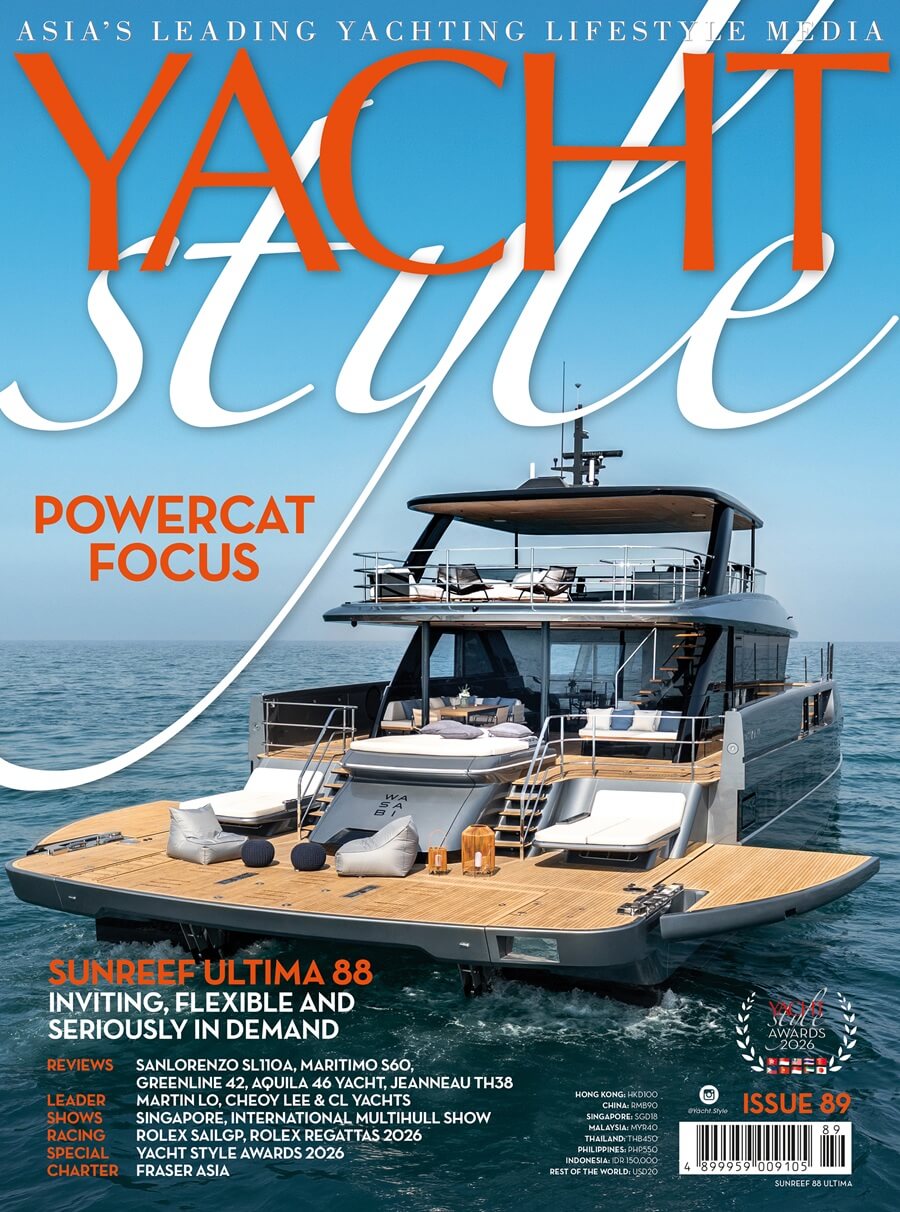
Yacht Style, Issue 88
Read and download copy
Yacht Style, Issue 86, Top 100 Superyachts of Indo-Asia-Pacific 2026, Jonathan Beckett, Burgess, Erwin Bamps, Gulf Craft Group, Fraser, Camper & Nicholsons, AB Yachts, AB 95, Van der Valk, Lalabe, Azimut, Grande 30M, Ferretti Yachts, 940, Absolute, Navetta 62, Cannes Yachting Festival, Genoa International Boat Show, Monaco Yacht Show, Lantau Yacht Club Boat Show - Festa Nautica, Rolex SailGP, Maxi Yacht Rolex Cup, Rolex Middle Sea Race, Phuket King’s Cup Regatta, Thailand, Port Takola Yacht Marina & Boatyard, Krabi, Yousuf Al Hashimi, Phoenix Yacht Management, Su Lin Cheah, ICOMIA, Suzy Rayment, Asia-Pacific Superyacht Association, APSA
Read and download copy

Asia's leading yachting lifestyle media

More results...

Generic selectors
Exact matches only
Search in title
Search in content
Post Type Selectors
Screenshot 2026-01-16 at 9.52.20 AM
Read your copy

More results...

Generic selectors
Exact matches only
Search in title
Search in content
Post Type Selectors
Yacht Style, Issue 88
Read and download copy

More results...

Generic selectors
Exact matches only
Search in title
Search in content
Post Type Selectors

Lifestyle

Lodovico Antinori’s legacy of innovation in Italian fine wine

Lodovico Antinori’s legacy of innovation in Italian fine wine

SHARE

From shaping the reputation of Tuscan wine to his latest venture — Lodovico Wine — Italian winemaking pioneer Marchese Lodovico Antinori has never been bound by tradition alone.

By Sanjeeva Suresh

  •  
  •  
  •  
  •  
  •  
  •  
  •  


For over six centuries, the Antinori family has shaped the course of Italian winemaking, establishing a legacy built on tradition, pioneering vision and an unwavering pursuit of excellence. But Marchese Lodovico Antinori has never been one to rest on heritage alone. From founding Ornellaia and Masseto — two of Italy’s most celebrated wines — to his latest venture, Lodovico Wine, he has consistently pushed boundaries, redefining what Tuscan winemaking can be.


In this exclusive interview, Mr Lodovico Antinori reflects on his journey — from transforming the global perception of Italian wine to embracing sustainability and the evolving tastes of a new generation. With an unshakable commitment to quality and rarity, he continues to shape the future of fine wine, proving that the luxury wine industry is not just about name or history alone — it is about vision.


The Antinori family name is synonymous with centuries of winemaking excellence. How does Lodovico Wine both honour this heritage and carve its own identity?

I started working with the family business in America when Italian wine had a very remote presence there. This was in the late ’60s, a time when the perception of Italian wine was quite low. Many wines still came in straw-wrapped bottles, and the industry was dominated by French wines for reds and German Rieslings for whites. Italian wines were seen as second-tier.


That experience shaped my vision. I realised that Italian winemaking had the potential to evolve beyond tradition and stand on equal footing with the world’s best wines. Fifteen years later, I stepped away from my family business to create something small but of exceptional quality — something that truly reflected my philosophy.


I launched my first independent project in the 1980s, aiming to elevate the standards of Italian wine. At the time, many Italian producers were complacent, sticking to the status quo. My goal was to wake them up, to show that we had the land, the climate, and the potential to do better. I wasn’t just another Antinori — people knew my family name, but they also saw that I had built something on my own. That inspired many small producers to raise their standards. Today, the quality of Italian wine has improved significantly, and I take pride in having contributed to that shift.


Lodovico Antinori and his daughter Sophia – 2022

What was the inspiration behind founding Lodovico Wine, and how does it differ from your previous ventures in the wine industry?

The idea for the wine came from a vineyard that was uniquely exposed to the north. Traditionally, vineyards are planted facing southwest to maximise sun exposure. But with the rising temperatures and climate change, I thought — why not do the opposite? So I planted the vineyard facing north, where it would receive less direct sunlight.


At first, I wanted to name it “Vigna Nord,” which means ‘North Vineyard.’ But my German agent—one of my strongest supporters — insisted against it. “That would be a disaster,” he told me outright. He left my office abruptly, and later, I called him to ask why. His response: “You’re getting old—you left the answer right in front of you”. I was taken by surprise because I had never planned to put my own name on the wine. I was hesitant and shy about it at first. But then he gave me an ultimatum — he even wrote me a blank cheque and said, “If you name it Lodovico, you can fill in the amount and cash it. But if you insist on calling it Vigna Nord, I won’t give you a single cent”.


When you’re starting a project, funding is critical, so in the end, I gave in. That’s how the wine came to bear my name. Of course, with a personal name comes a great sense of responsibility — especially in the American market, where putting your name on something means a commitment to quality. It implies a deep level of care and involvement. People assume I inspect every barrel myself, which, to be honest, I don’t. But I do take the responsibility seriously.


What sets Lodovico apart from your previous projects?


The biggest difference is that Lodovico is centred around Cabernet Franc. Before this, with Biserno —which you may be familiar with — we worked with a Bordeaux blend, incorporating all the classic varieties, including Petit Verdot. But this project focuses primarily on Cabernet Franc.


That said, the wine we’re drinking today also contains a bit of Merlot. That’s because our winemaker, Michel Rolland, has a strong preference for Merlot — he just can’t resist adding some to the blend. He’s not as keen on Cabernet Franc as I am, so we’ve had a few debates about the percentages. Over time, though, he’s started listening to me more, and from the 2020 vintage onward, we’re reducing the amount of Merlot.

Before that, from our first vintage in 2007 through to 2019, we used a higher percentage of Merlot — sometimes 10 to 12 percent, sometimes five percent, depending on the year. But moving forward, we’re focusing even more on Cabernet Franc to give the wine a distinctive personality.


Sustainability is a key topic in luxury winemaking today. How does Lodovico Wine integrate sustainable practices without compromising on quality?

We’re not fully biodynamic or organic, but we are following a set of protocols that will allow some of our vineyards to transition to organic practices in the next five years. That said, it’s not my primary focus at the moment. Sustainability is important, but my main priority is always quality. It sets an example in the region. But of course, sustainability comes at a higher cost. A sustainability-focused approach is more expensive than traditional methods. For example, in conventional winemaking, you can simply spray chemicals to remove weeds, but that’s not good for the soil or the roots.


We’ve taken a more ecological approach. Instead of actively removing weeds, we let them die off naturally. This means we don’t need to plough as often or disturb the land unnecessarily. We aim for sustainability, or as we say in Italian, ecosostenibilità, but without necessarily adhering to strict organic certification, which requires specific treatments that are costly and don’t necessarily improve the wine.


For pest control, we no longer use pesticides. Instead, we use a German-developed solution that prevents insects from reproducing. It doesn’t kill them — it simply disrupts their reproductive cycle. This way, the population gradually declines without introducing toxic chemicals into the vineyard.


Of course, all of these add to the cost of production. Sustainable practices are more expensive than the standard viticulture methods used across Italy, which rely on cheaper, conventional treatments. Labour is also a significant factor. While many wineries use machines or quick-fix chemical treatments, we require skilled workers to tend to the vines manually, ensuring every step is done with precision. This level of detail and care is what makes our wines expensive — but also what makes them exceptional.


Marchese Lodovico Antinori with Michel Rolland, a Bordeaux oenologist

The luxury wine market is becoming increasingly competitive. What do you believe sets Lodovico apart as a collector’s wine?

Quantity plays a crucial role. For example, Lodovico is limited to only 10,000 bottles per year. And that number will never increase — it’s written into a contract, even after I’m gone.


There’s always the temptation, when a wine is successful, to produce more. But I believe that would be a mistake. Collectors and connoisseurs aren’t foolish—they have refined palates, and they can immediately detect even the slightest change in quality. That’s why we remain committed to this strict production limit. Rarity is a key factor in luxury, and maintaining exclusivity ensures that our wine remains truly special.

Another defining element is the role of Cabernet Franc in our wine. The potential for aging is extraordinary. In the world of luxury, longevity is an important statement. A great wine should not only be drinkable when young but should also improve significantly over time.


For example, we recently opened a bottle of Lodovico from 2007 — one of the earliest vintages, when the vineyards were still young. Only 3,000 bottles were produced that year, yet it has aged beautifully. The wine has evolved, gaining depth and complexity without any signs of decline. That’s what defines a truly great wine: the ability to mature gracefully over decades while remaining a pleasure to drink at any stage.


How is Lodovico engaging with the new, younger generation of wine drinkers, and what strategies are you implementing to appeal to their evolving tastes and preferences?

They want something different. Many of them come from wealthy families, so they’ve grown up surrounded by fine wines. But they want to distinguish themselves, to drink wines that aren’t the same as what their parents prefer.


At the moment, my wines appeal more to an older audience. But I do have a project in the works for younger drinkers — a wine called Le 2 Ville del Nicchio, which will be starting from the 2023 vintage.


This is a project I’m working on with my daughter, who is 25. She will be more in tune with the preferences of the younger generation. I believe they (younger consumers) prefer wines with lower alcohol content, wines that are a little lighter, less opulent, and more restrained. The trend is shifting away from the bold, highly concentrated wines that were once designed to impress the American market.


In the past, American consumers were used to drinking whiskey, milk, or almost nothing else. When they were first introduced to wine, they found the taste too tannic, too harsh. That’s when Robert Parker — a very famous American wine journalist — had a major influence. He convinced European winemakers, including the French, to soften their wines. We adapted, making wines with rounder, smoother tannins, and harvesting later to achieve riper fruit flavours. That style dominated for a long time.


That leads me to my next question. There is a growing trend of alcohol-free wines, particularly in the U.S., driven by a new, health-conscious movement on social media. What are your thoughts on alcohol-free wine, and do you think it impacts fine wine?

No, fine wine will not be affected by that at all.

In America, they call this kind of thing a “fad”. Just like orange wine became a trend, alcohol-free wine is something that’s gaining popularity with certain groups, particularly younger, health-conscious consumers. But it won’t have any real impact on the fine wine world.


With a growing interest in wine as a form of investment, do you consider Lodovico a wine meant for collectors, investors, or purely for the pleasure of drinking?

We produce wine for pleasure — we want people to drink and enjoy it. That’s the core purpose.

But in reality, there are collectors who buy wine as an investment. Some drink it, but others store it and sell it later when the price rises. The English are especially known for this — they often buy five cases of wine early, sell two cases after a few years when the value increases, and essentially enjoy the remaining wine for free. This was very common in the Bordeaux market when prices were booming. Investors would buy wine early, hold onto it for five years, and then sell at a profit. However, the Bordeaux market has declined recently, so this kind of speculation isn’t as lucrative right now.


Do you think your wines are suited for investment in the same way?

Not to the same extent. Our wines are not yet established enough in the market for that kind of speculation.

The first vintage I ever made was sold at auction once — just one time. That was back in 2001. Then I stopped offering it at auctions for a while. But from the 2021 vintage, I might start again.


Recently, some vineyards in France struggled to make enough profit from wine sales alone, so they introduced tourism experiences — vineyard stays, guided tours, and even Airbnb-like accommodations on their estates. Do you see this becoming a trend in Italy as well?

Yes, this concept already exists in Italy. There’s even a legal framework for it. If a vineyard becomes part of this program, they receive tax benefits and other advantages, but they must comply with strict regulations. For example, they can’t buy food from standard vendors; they must source from approved local suppliers. Ideally, they should grow their own vegetables, fruits, and eggs on-site. It’s a beautiful idea, but sometimes it’s difficult in practice. If guests arrive when certain ingredients aren’t in season, the vineyard must still find a way to provide them while staying within the regulations.


However, this model is extremely popular, especially in Tuscany, which has become an iconic luxury destination. Tuscany attracts visitors with strong financial potential, so even small vineyards can benefit. If a couple with a child wants a luxurious yet authentic experience, they can now find exactly that.


How do you see the role of living spaces, such as the one you’ve created, where the owner interacts with the guests?

They occupy one floor, pay a reasonable amount and live together with the owner, creating a kind of interactive, communal lifestyle. This has been especially successful with younger people. I think what they’re doing with that is very good. We did something similar at the beginning, but the standard was so high, it ended up costing a lot of money. Now, I hope my nephew is taking care of it. He’s very tight with finances and wants the balance sheet to be favourable. He doesn’t understand how important it is to entertain people. Even if it’s expensive, it’s the only form of advertising we do. Of course, it’s not profitable for us because we do it at a high standard, which means we need more personnel, and that’s expensive. So, it cost too much. My nephew is now focusing on making it a beautiful spot because people come and visit.


How do you see the role of limited editions and exclusivity evolving in the fine wine industry?

We always produce small batches — about 10,000 bottles, which is very small in comparison to other American wineries, which produce several thousand cases of 12 bottles each. In American terms, that’s about a thousand cases, each case containing 12 bottles. So it’s really a small operation, not like Romanée-Conti, but still very small in size. We haven’t promoted it much — word of mouth is how it spreads. Some people like it, and they talk to their friends. But we haven’t done a big promotion about the rarity. We always sell out of the cases, though. We haven’t needed to overpromote because the rarity itself attracts buyers. Our cases are expensive, but because of the limited quantity, we always find interested customers.


How do you see the role of technology — be it in viticulture, production, or distribution — shaping the future of Lodovico Wine and the wine industry?

The technological aspect we use is very modern, but we also have a philosophy of minimal intervention. The goal is to touch the grapes as little as possible to avoid shocking them. We’ve found that noise can disturb the grapes, so we try to minimize it. The French have a similar philosophy with their winemaking, where they emphasise not disturbing the wine too much. It’s a bit romantic, but it’s also about respecting the nature of the product. We believe that the less you disturb the grapes, the better the final wine will be.


What does the next decade have in store for Lodovico and the world of winemaking?

In the next 10 years, the vineyards will continue to age, and that will greatly improve the quality of the wine. Older vineyards produce better wine, and ours are only about 14 or 15 years old, so they still have time to mature. We also plan to expand into the American market, which we haven’t been able to do because we’ve never had enough wine to supply it. In terms of strategic growth, we’ll focus on making our wine available to collectors in America, which has been a long-term goal.


With regard to international expansion, right now, we are strong in Europe, especially Eastern Europe. We’ve made great strides there. Singapore is also becoming an important market, however at present, our sales are lower, but we are confident that we can boost that number to around 300 bottles. Our goal is to sell approximately 600 bottles there. We also have connections in Hong Kong and Shanghai, where we’ve had some success. However, the wealthy Chinese market is currently more interested in Burgundy wines, particularly Pinot Noir. As a result, we’re seeing a shift in the market preferences, and we’re adapting to that trend.


Lastly, in your own words, describe what makes a “good” wine.

A good bottle of wine is one that has a balance of all its elements, in equilibrium. It should have depth and personality, bringing out the character of the grapes from which it’s made. It shouldn’t be extreme — just enough to recognise the varietal. For me, elegance is one of the most important aspects of wine. By elegance, I mean that the wine must be refined. It should never be too overpowering or too weak. The key is balance. 


For more on Lodovico wine, head to their website here.

For more on the latest in leader interviews and profilesclick here. 


SHARE

Lodovico Antinori’s legacy of innovation in Italian fine wine Read More »

Highlights from Watches and Wonders Geneva 2025

Highlights from Watches and Wonders Geneva 2025

SHARE

From stealth drops to technical flexes, Watches and Wonders Geneva 2025 delivered drama and a few quiet revolutions — with Rolex, Patek Philippe and Vacheron Constantin making the loudest noise in the most unexpected ways.

By Ashok Soman

  •  
  •  
  •  
  •  
  •  
  •  
  •  

Watch fairs like Watches and Wonders Geneva (WWG) are built around a measure of secrecy that can be difficult to understand but this year was a little different. Since there was an unprecedented leak from Rolex on most of its novelties, including the deeply consequential Oyster Perpetual Land-Dweller (see our brief post on that watch), plans for grand reveals went up like smoke – minus the fireworks. Brands flooded everyone’s inboxes with their news by midnight on day one of WWG 2025, with only a few staying their hands, notably Patek Philippe and Bulgari. We are not sure about the value of preserving mystique and the like, but one of the joys of a show like WWG is discovering watches for the first time on day one. It can even influence decisions on which brands to see first next time. On that note, the top dog of this fair was Rolex, leaks notwithstanding.

It is certainly a rare vintage year for the jolly green giant of Geneva watchmaking, with not only new models and new dials but also two new bracelets – just one of those would have been remarkable enough. Needless to say, when you throw the new calibre 7135 into the mix, this spells domination (in our opinion). With the Land-Dweller, Rolex has the most important watch of 2025. Yes, that means the entire year and includes all brands, not just Swiss ones and not just the 60 or so brands exhibiting within the Palexpo. The only brand that could challenge Rolex is Rolex, and that would indeed be something. With the world as it is, we are lucky in watchmaking that the most powerful force is indeed a force for good. We have it on good authority that the Land-Dweller is coming to stores soon, and it will not be limited to Bucherer, to cite just one example.

Overall, the fair was abuzz with good cheer from A. Lange & Sohne, Bulgari, Vacheron Constantin, Zenith and Patek Philippe. Since we gave over our entire first day coverage to Rolex, with the aforementioned watch, we shall lead here with Patek Philippe. Of course, we noted the new sizes for the Cubitus on social media but this is hardly the story at the great Geneva brand. Instead, what seems to have grabbed the most attention is Ref. 6196P, which is a successor of sorts to the discontinued Ref. 5196. For anyone who appreciates the Calatrava, this new model will be essential. The brand’s continuing commitment to good timekeeping principles is evident in the calibre 30-255 PS (new for this reference but introduced in 2021).

For something more complicated, there is a new split-seconds chronograph built into an existing calibre in ref. 5308G that features two special features. The first is an anti-backlash wheel to tackle friction when the chronograph wheel engages with the seconds wheel; the second is an isolation system that prevents energy consumption when the split seconds mechanism is stopped. If that sounds prosaic, that is because these are functional improvements that will not be immediately evident. This is because this reference is a quadruple complication, with minute repeater, split-seconds chronograph and instantaneous perpetual calendar. One reason that the new technical features will make themselves felt here is that the split-seconds chronograph is new – it was previously a mere chronograph.

For cynics and realists alike, there is every chance that Patek Philippe is saving something for later in the year. This does not matter that much for this story because there are plenty of great watches fighting for your very valuable attention at WWG. Key amongst those will be the Vacheron Constantin Les Cabinotiers Solaria Ultra Grand Complication, which now has the honour of being the world’s most complicated watch (by number of functions at 41, if not the 1,521 component count) as well as the first grand complication to crown itself with the ‘ultra’ designation. We especially like that the watch manages to cram all of this horological excellence into a case clocking in at just 14.99mm thick (it is 45mm in diameter and has two faces, but this is irrelevant).

Interestingly, the Solaria Ultra was made by just one master watchmaker, whose identity has not been disclosed, much as the old standards were. Unusually, this watchmaker worked with the designer on the case; normally, aesthetics are a domain that does not concern the movement developer and thus we wonder if there is a secret signature somewhere here that points to the identity of the maker, just as was the case for Jean-Marc Vacheron back in the day. Yes, the Solaria Ultra might be the most sought-after yet completely inaccessible watch of its kind. It certainly helps that Vacheron Constantin is making just one of this model, although we fully expect that it will be hugely consequential for releases in the coming years. For evidence, just look to the 250th anniversary watch and what happened there.

From the supremely complicated, we move to a simple expression of precision with the Zenith GFJ. Clearly, another anniversary we are paying attention to is over at Zenith, which celebrates its 160th birthday this year with the aforementioned new GFJ model. Just as the Skyline was at its debut, this is now the only full collection that exists with pure time-only properties. Collectors will no doubt hanker for a chronograph and it may already be on the way but for now, we get to enjoy this new collection as pure tribute to precision timekeeping. Calling attention to itself with a massive balance wheel, the reissue of the manual-winding Calibre 135 looks like a straight recreation but it is anything but. The unique brick-style decoration on the movement plates indicates that much, and it will only be in play for this anniversary edition. A key technical feature of the GFJ is its 72-hour power reserve, which is highly contemporary (and an improvement over the original’s 40-hour or so rating). What is the accuracy of this tribute to on-point timekeeping then? The brand says it is chronometer-level, meaning +/-2 seconds per day.

Looking at broader trends and the like, it is probably best to wait a few weeks to digest all the information. For those who insist on gleaning whatever they can, we will simply say that case sizes continue to become more demure even as dials embrace all manner of novel decorations, materials and colours. If you thought we hit peak colour with the bold Rolex Oyster Perpetuals of a few years ago, well think again. Even Chanel is joining in, with its advertising reading “It’s not black; it’s not white. It’s Bleu.” We will be brining you more on this front and the remarkable J12 Bleu soon but we must return to those broad strokes we mentioned. To avoid ending on a sour note, we will sneak in a reference to the ongoing tariff wars, which of course impact watchmaking too.


To be blunt, there are much more important consequences to the tariffs than will be felt in Swiss watchmaking at all levels. The US is an important market for Swiss watches – the number one market in fact – so there are likely to be shocks but it is the wild west out there and no one knows how this will pan out. Uncertainty is the new normal as the stock market presents the cash-rich youth with opportunities to build wealth like their parents did. In fact, this should read ‘stock markets’ because there is hardly one that has not taken a dive.

We will end, for now, with a note about the watch industry’s commitment to making every shape possible, so long as those shapes are round. WWG 25 did not reveal any changes here, nor did it indicate that brands were in the mood to experiment with forms. The most exciting form watches this year are still from brands with established legitimacy here, including Cartier, Jaeger-LeCoultre and Bulgari, which is a fresh entrant in the Palexpo. Of the bold bunch, led as always by Hublot, things were quiet as far as new developments go but there is optimism aplenty in the messaging. For the 20th anniversary of the Big Bang, there are a lot of special editions to choose from, and every indication that the brand is holding back on a surprise or two. And that, we predict, is all we can expect from the world of watches in the second half of 2025: surprises.

For more on the latest in luxury watch reads, click here.

SHARE

Highlights from Watches and Wonders Geneva 2025 Read More »

Modern luxury watches interpret tradition

Modern luxury watches interpret tradition

SHARE

While established Maisons uphold centuries-old craftsmanship, a new wave of watchmakers is reshaping what tradition means, reviving old techniques and forging bold new identities.

By Florence Sutton

  •  
  •  
  •  
  •  
  •  
  •  
  •  

In luxury watchmaking, tradition has long been synonymous with prestige, craftsmanship and enduring value. Yet, in an industry that thrives on legacy, innovation is reshaping age-old traditions. While established Maisons continue to safeguard centuries-old techniques, a new wave of watchmakers is redefining heritage — some by reviving lost crafts, others by forging entirely new identities. Today, tradition in watchmaking is no longer just inherited; it is actively reimagined, proving that legacy and modernity can coexist in unexpected ways.


While heritage watch brands preserve centuries-old craftsmanship to maintain their prestige, a new wave of watchmakers is redefining tradition by either reviving historical techniques or forging entirely new identities — proving that in modern luxury watchmaking, tradition is not just inherited but continuously reinvented. Luxury watchmaking today reflects three distinct approaches to tradition: heritage brands that have upheld their craftsmanship for generations, new watchmakers reviving historical techniques and modern disruptors creating their own traditions while redefining value.


Category: Non-broken heritage brands, Time-Honoured Traditions


The first category focuses on the non-broken heritage brands that have maintained their legacy over centuries, such as Patek Philippe, Vacheron Constantin and Rolex. These brands are revered not only for their exceptional craftsmanship but for their ability to evolve with the times, incorporating modern features like smart technology while keeping their traditional roots intact.


Rolex


While Rolex may be renowned for its robust tool watches, its commitment to precision and innovation is deeply embedded in its watchmaking heritage. The introduction of the first waterproof Oyster case, the development of the perpetual movement and the innovation of the Parachrom hairspring are just a few examples of how Rolex continues to evolve while remaining true to its legacy. For Rolex, a watch is not just a timekeeping instrument; it is an institution, one that stands as a symbol of excellence and precision. Modern Rolex watches bear the title of “Superlative Chronometer,” a designation that assures owners of superior performance across several key areas, including precision, robustness and durability. This certification — unique to Rolex — guarantees an exceptional precision of –2/+2 seconds per day, surpassing the standards of the Swiss Official Chronometer Testing Institute (COSC).


Rolex’s commitment to creating the finest watches is evident in every aspect of its designs, from the materials used to the exacting standards upheld in production. The brand’s proprietary Oystersteel, for example, is a highly corrosion-resistant alloy, while the scratchproof Cerachrom bezels ensure that each timepiece remains pristine over the years. Rolex watches undergo rigorous testing to ensure they endure extreme conditions, whether worn by an explorer, a diver or a mountaineer. In fact, each watch is subjected to tests that simulate real-world wear and tear, from salt exposure to temperature extremes, ensuring that the finished product is both durable and reliable. Despite its technological advancements, Rolex remains true to the belief that simplicity is a measure of performance. The Cosmograph Daytona, for instance, is an exemplary model of Rolex’s philosophy, containing only 314 components while offering exceptional timing precision. This dedication to simplification and reliability extends to the development of new models, such as the Sky-Dweller — which despite its complex functionality — operates with remarkable ease.


Patek Philippe


Patek Philippe’s reputation as a leader in the world of horology is built on its unwavering commitment to craftsmanship and innovation. Few names command as much respect in watchmaking and the brand’s legacy is defined by its ability to balance tradition with progressive design. Known for its meticulous hand-finishing and technical mastery, Patek Philippe has remained fiercely independent, ensuring that each timepiece meets the brand’s exacting standards. The Grand Complications collection — with its perpetual calendars, minute repeaters and celestial movements — epitomises the brand’s dedication to pushing the boundaries of watchmaking while maintaining an unrelenting focus on precision.


The Cubitus collection marks a bold departure from the brand’s traditional design language, introducing the first square wristwatch in Patek Philippe’s history. This is a significant move, demonstrating the brand’s ability to innovate while preserving its heritage of technical excellence. By embracing modern aesthetics and incorporating familiar Patek elements — such as integrated bracelets and high-quality hand-finishing — the Cubitus offers a fresh perspective on the brand’s approach to luxury sports watches. While it pushes new boundaries in design, the Cubitus remains anchored in Patek Philippe’s core values, making it both a bold evolution and a fitting continuation of the brand’s storied legacy.


Vacheron Constantin


The story of Vacheron Constantin is one of passion, perseverance and unrelenting pursuit of excellence. The Maison’s legacy is not merely built on technical innovation but on a deep respect for artistry and tradition. Each timepiece is a reflection of this balance — an enduring tribute to the watchmaking craftsmanship that has been passed down through generations.


As the longest continuously operating watchmaker, Vacheron Constantin has crafted timepieces that transcend mere function, embodying artistry and precision in equal measure. Since 1755, the Maison has been at the forefront of Swiss watchmaking, creating pieces for royalty, collectors and connoisseurs alike. From the ultra-complicated Les Cabinotiers collection to the refined elegance of the Patrimony range, Vacheron Constantin continues to define the art of horology.


As part of the celebrations for its 270th anniversary in 2025, Vacheron Constantin introduces the reissue of the iconic Historiques 222 in stainless steel. This release marks the first of many milestones throughout the year, honouring both the brand’s storied past and its forward-thinking vision. The anniversary festivities also include the immersive exhibition The Quest: 270 Years of Seeking Excellence — having debut in Abu Dhabi in February 2025 — offering a glimpse into the Maison’s rich heritage and its commitment to future innovation. This global exhibition will journey through the world’s luxury hubs, continuing to showcase the values that have defined Vacheron Constantin since its founding.


Category: New Brands, Revived Traditional


The second category explores how new brands are breathing new life into traditional watchmaking methods, merging them with modern aesthetics to capture the attention of a new generation of collectors. Drawing from the rich heritage of Swiss watchmaking, these brands are putting a fresh spin on time-honoured techniques, creating timepieces that appeal to today’s luxury consumers who seek both innovation and craftsmanship.


Romain Gauthier


Romain Gauthier — an independent watchmaker of exceptional renown — has earned a place alongside the likes of F.P. Journe for his unmatched blend of traditional hand-finishing and cutting-edge engineering. His approach is all about pushing the technical boundaries of watchmaking while still honouring the finest craftsmanship. Take, for example, his Logical One, a timepiece that exemplifies this fusion of innovation and meticulous finishing.


One of the most remarkable pieces in his portfolio is the Freedom Continuum, a watch that embodies Gauthier’s signature style of precision and artistry. This limited edition of just 28 pieces is a testament to the brand’s commitment to exclusivity and craftsmanship. While Romain Gauthier may not be as widely recognised as some of the larger names in haute horlogerie, his influence and expertise are undeniable. In fact, Gauthier played an integral role in the creation of the movement for a high-profile Chanel watch, further cementing his reputation among collectors and connoisseurs. This timepiece is a perfect reflection of Gauthier’s ability to merge traditional watchmaking techniques with forward-thinking designs, creating a luxury sports watch that appeals to a global market of discerning collectors. With its high level of hand-finishing and innovative use of materials, the Freedom Continuum has quickly become one of the most coveted pieces for collectors seeking something distinct in the world of high-end sports watches.


Kudoke


Kudoke — founded in 2005 by German independent watchmaker Stefan Kudoke — has quickly established itself as a standout in the world of haute horlogerie. As one of the youngest recognised Master Craftsmen (Deutsche Meisterbrief) in Glashütte at just 22, Kudoke’s journey into the horological elite has been marked by a blend of technical mastery and artistic refinement. An AHCI member and GPHG Laureate, he made history as the first independent German watchmaker to win the prestigious Grand Prix d’Horlogerie de Genève (GPHG) Petite Aiguille award.


Kudoke’s timepieces are revered by collectors for their refined, hand-finished craftsmanship, staying true to the traditional German schools of watchmaking. A standout in their collection is the in-house KALIBER 1 movement, which powers the HANDwerk series. Developed by Kudoke, this movement epitomises his commitment to excellence, with meticulous hand-engraving and finishing that honours the art of traditional watchmaking. The HANDwerk series exemplifies Kudoke’s philosophy of merging precision with artistry, offering collectors a glimpse into the heritage of German watchmaking. Today, Kudoke watches are available at Sincere Fine Watches and SHH boutiques in Singapore and Malaysia, offering discerning collectors a chance to experience the elegance and craftsmanship of this celebrated independent brand.


New Traditions: Watchmakers Creating a Legacy of Their Own


Not all modern luxury watches are tied to centuries-old traditions. Some brands are carving out entirely new identities, combining futuristic materials, radical designs and high-performance movements to redefine what a luxury watch can be. These companies are building their own legacies, often combining high-tech features, unique materials and distinctive designs to create timepieces that resonate with modern buyers who want more than just a functional watch. These watches represent not just a new style but a new chapter in the story of watchmaking.


Hublot


Hublot is known for pushing the boundaries of traditional design by incorporating high-tech materials and innovative features that appeal to modern buyers who value both aesthetics and functionality. For example, their use of materials like ceramic, titanium and their proprietary King Gold combined with modern design techniques, creates timepieces that feel contemporary while maintaining the craftsmanship associated with luxury watches. Case in point, Hublot’s Big Bang Integrated Time Only 38mm is a bold reinterpretation of its signature design. While the larger Big Bang models have been central to Hublot’s identity, this 38mm version represents a move towards something more compact, yet still filled with the same distinctive features that have become synonymous with the brand. The watch retains the signature “ears,” the six H-shaped screws around the bezel, and the rubber composite inserts between the case and bezel, all of which contribute to its unique, recognisable design. These elements are not just for show but are part of what makes the Big Bang collection so iconic.


One of the key features of the Big Bang Integrated Time Only 38mm is its unisex appeal. With its integrated bracelet and range of material options, including brushed titanium and Hublot’s King Gold, the watch embraces a more versatile design. Additionally, the dial’s ferromagnetic steel construction ensures protection against magnetic fields, an uncommon feature in most watches. The HUB1115 movement — with a 48-hour power reserve — drives the watch, adding a level of technical innovation to its design. This movement, while not a Unico calibre, represents a first for the Big Bang collection and speaks to Hublot’s ongoing pursuit of blending tradition with modernity.


Roger Dubuis


Roger Dubuis stands out as a brand that embraces traditional watchmaking while boldly reinterpreting it through a contemporary lens. Certified with the prestigious Poinçon de Genève, the brand maintains the highest standards of craftsmanship yet presents its creations with an audacious, modern aesthetic. The Excalibur Spider Flyback Chronograph exemplifies this balance, showcasing intricate mechanical complications such as the column wheel and vertical clutch while re-engineering their placement for a striking visual impact. By positioning the column wheel at the front of the calibre — rather than the conventional bridge-side — the brand challenges traditional norms while staying true to its horological roots.


This fusion of heritage and innovation extends beyond the technical aspects of its timepieces. Roger Dubuis strategically aligns its watches with motorsport culture, a modern narrative that reinforces its bold identity. The Flyback Chronograph, for instance, was launched at the Goodwood Festival of Speed, highlighting the synergy between high-performance engineering and fine watchmaking. Similarly, the brand’s presence at Watches & Wonders transforms the traditional watch fair experience into a spectacle, drawing in audiences who may be entirely new to the world of haute horology. This reflects a broader shift in luxury watchmaking, where heritage brands are no longer just about preserving the past but actively engaging with contemporary culture.


Beyond technical mastery, Roger Dubuis also redefines how luxury watches are marketed and experienced. Rather than focusing solely on transactions, the brand prioritises storytelling, creating conversations that foster deeper connections with collectors and newcomers alike. This approach mirrors the evolving landscape of modern luxury watchmaking, where tradition remains at the heart of the craft but is continuously reimagined to captivate a new generation.


Franck Muller


Franck Muller’s name is synonymous with audacious innovation, a brand that bridges the gap between the time-honoured techniques of Swiss watchmaking and bold, contemporary design. His creations — particularly the Cintrée Curvex — challenge conventional aesthetics with their sweeping curves and complex, sculptural forms. However, Muller’s true brilliance lies in his ability to marry artistry with mechanical mastery, employing intricate complications like the Tourbillon and Minute Repeater in timepieces that are both technically advanced and visually striking. By embracing modern technology while honouring Swiss horological traditions, Franck Muller ensures that each of his pieces remains an intricate fusion of heritage and cutting-edge design, securing his place as a visionary within the world of luxury watchmaking.


Franck Muller continues to assert his mastery of horological innovation with the Long Island Evolution Master Jumper, a groundbreaking timepiece that pushes the boundaries of traditional watchmaking. Featuring an instantaneous triple-jumping mechanism, the watch synchronises hours, minutes and dates through mechanical digital indicators — an unprecedented achievement in the world of luxury watches. This creation is powered by the manual-winding FM 3100-L movement, a marvel of precision, with five rotating discs to facilitate the jumping action. The watch’s design — housed in a brushed titanium case with a green anodised aluminium bezel — speaks to Franck Muller’s meticulous craftsmanship, as only 100 pieces will be made, exclusively for the Asia-Pacific market. The Master Jumper’s exceptional mechanism and innovative presentation are a testament to Franck Muller’s reputation as the “Master of Complications,” capturing the essence of modern horological tradition while securing his place as a pioneer in the future of watchmaking.


For more on the latest in luxury watch reads, click here.


SHARE

Modern luxury watches interpret tradition Read More »

Lush hospitality blooms at Artyzen Singapore

Lush hospitality blooms at Artyzen Singapore

SHARE

Artyzen Singapore is the urbane and acclimatised escape for city-dwellers who don’t mind a quite bit of green and quiet.

  •  
  •  
  •  
  •  
  •  
  •  
  •  
Artyzen Singapore


Between last June and this February, the Orchard precinct welcomed a grand total of four new hotels. A rare occurrence anywhere else in the world, but when you live in the compact metropolis of Singapore, the sight of so many hospitality establishments vying for our scarce land is a happy sign of both economical health and a flourishing luxury landscape. Artyzen Singapore may have been second-in-line to open its doors, but its relatively quiet launch eventually served to highlight its otherwise unassuming presence amidst the many palatial towers that make up our hospitality scene — speaking volumes about its care for the still and calm.


The fourth hotel to open as part of the Artyzen Hospitality Group (two in Shanghai and one in Macau) prides itself in being both design-led and abundantly cognisant of both the cultural and natural environment it is local to. While this plot of land formerly housed an estate known as Villa Marie — a 1940s-era mansion built by avid botanist and great-grandson of philanthropist Tan Tock Seng, Tan Hoon Siang — it now hosts Artyzen’s striking 142-room residence that leans into the space’s botanical heritage, pockets of lush greenery decorating its trellised columns while throughout, there is noticeable effort to allow for the passing breeze to aerate and refresh the space.


Instead of facing the main road, the entrance to the lobby is tucked behind a green curtain of creepers. Raw concrete forms the foundation of the building, a neutral canvas accentuated by grand, elongated ceilings and archways to facilitate airflow. But apart from being framed by pockets of vegetation, motifs of flora also decorate the interior, a reflection of the unique tapestry that makes up Singapore’s cultural landscape — conceived by renowned architecture firm ONG&ONG and award-winning interior design studio Nic Graham & Associates. Topping it off is an infinity pool and herb garden on the roof, the best of natural cooling mechanisms in place to sustain this meeting place of man and nature.


One of the most impressionable things that one will inevitably come away with from a visit is the pervasive use of ceiling fans, which is not only an ode to a common feature of Singaporean homes, but also a major contributor to the unique stay experience at Artyzen. All rooms are already equipped with a balcony; suites offer private ones (that span two levels) big enough to hold small parties or events like solemnisations. Add the ability to enjoy the natural humidity of our tropical climate without the heat thanks to the nostalgic, rhythmic swirl of the ceiling fan and its the epitome of comfort in nature — the gentle circulation of air in the room is a perfect complement to the visual warmth of the room’s East-Meets-West notes of concrete, herringbone timber, stone and brass. In other words, its a clear differentiation in cosiness when compared to the typical air-conditioned-induced comfort of most hotels — also an option here though, not to be concerned.


Couple that with the leading room already sporting a four-metre-high ceiling and you can better picture how “homely” and Singaporean the room’s design truly feels. For those looking for the highest tier, a 448 sqm penthouse is available for booking — truly a next-level kind of luxury that deserves to be savoured for the most special occasions. Or a much-needed getaway or respite from the monotony of daily routine.


If we are talking about finishing touches, the Dyson hairdryer is a must and happy mention. And so is the separation of the toilet from the shower room and bath tub — an ick for some travellers when not. But so are all the other experiences, particularly the restaurants available, and the health and wellness considerations built into the hotel.


Quenino by Victor Liong, the resident fine-dining hideout on level 4 show off the best of contemporary Asian cuisine by experimenting with familiar flavours and re-combining them to pleasant surprises. Helmed by the titular chef who was born in Brunei to Malaysian parents of Chinese heritage but grew up in Australia, the fare is diverse in nuance and style, just like his third culture upbringing and thus, appreciation of the region’s mosaic of gastronomic influences.


Finally, the experience consummates in Artyzen’s Wellness & Workout floor — a dedicated level that sees a state-of-the-art Technogym-equipped fitness centre sitting alongside two serene yoga pavilions and a few spa treatment rooms. Apart from HIIT sessions and classes, there are also drop-in guided meditation and yoga sessions available for you to truly get in touch with your chakras, before you seek out some scrubs or massages for the ultimate wind down.


“Artyzen Singapore is not just a hotel, we are a cultural venue,” says Jeff Crowe, General Manager of Artyzen. “Embracing culture, and emotional wisdom is at the heart of our ethos. By celebrating the beauty, traditions, heritage, and distinctiveness of each destination, our vision is to foster opportunities and spur growth within communities.” And a legacy they will imprint on Singapore’s hospitality scene, lush and flowering with warmth and generosity.


Book a room or learn more about Artyzen Singapore here


This article was first seen on MensFolio.Com

For more on the latest in luxury hotel reads and reviews, click here.


SHARE

Lush hospitality blooms at Artyzen Singapore Read More »

QT Singapore: where heritage meets a playful edge

QT Singapore: where heritage meets a playful edge

SHARE

Nestled in the heart of the CBD on Robinson Road, QT Singapore transforms the historic Telegraph building into a modern playground for adults seeking understated glamour.

By Jasmine Alimin

  •  
  •  
  •  
  •  
  •  
  •  
  •  
Photo: QT Singapore

As the first Southeast Asian venture for QT Hotels & Resorts, QT Singapore dazzles with a design that strikes the perfect balance between neo-classical elegance and contemporary boldness. It’s a love letter to Singapore’s past and future, rendered in rich hues, eclectic textures, and thoughtful, unconventional details. Every corner, from its vibrant art installations to the custom furnishings, seems curated for the discerning aesthete—an Instagram-ready dream where every detail invites closer inspection.

Suite Serenity

Photo: QT Singapore

For a weekend stay, luxuriate in any one of the stately rooms or suites which feel being in a private gallery, with the room itself an exhibit of understated opulence. The spacious interiors in my King Room Suite felt designed for indulgence, while the fluffy QT Dream Bed was an oasis of comfort. High ceilings breathe space and light into room, anchored by large windows that offer a visual reminder of the hotel’s unique location (it sits conveniently next to Lau Pa Sat and is a 15-minute walk to Marina Bay Sands).

Photo: QT Singapore

The bathroom was my favourite hideaway, simply for the gigantic bathtub that can literally fit four people. After a long soak, I rinsed off in the walk-in rain shower using bath essentials by Aussie beauty brand, Kevin.Murphy, and styled my hair with a Dyson hairdryer. And then it’s off to the plush couches, to enjoy a hot cuppa of Nespresso, and channel surf, order room service, and control the lighting, all using one handy tablet.

Rooftop Revelry

Photo: QT Singapore

As twilight descended, I headed to Rooftop at QT. The labyrinth pool was a visual spectacle, its mirrored surface merging seamlessly with the skyline. The space had an energy that was both intimate and electric—a modern playground for adults seeking understated glamour.

Here, I recommend indulging in some chilled Frescas and Mezcal Margaritas and Taqueria-style bites as you watch the sun set amidst majestic skyscrapers. It’s after dark where the rooftop comes alive with conversation, a meeting place for creatives and connoisseurs alike.

A Culinary Affair

Photo: QT Singapore

Dinner at Cygnet was the pièce de résistance of my stay. The Manhattan-inspired steakhouse, helmed by chef Sean Connolly, exuded the kind of chic that felt effortless yet deliberate.

Photo: QT Singapore

My ribeye arrived with a theatrical flourish, cooked to absolute perfection and topped with a delicate béarnaise sauce. I highly recommend pairing your steak with a New York-inspired cocktail like a Manhattan—mostly for the vibes!

Photo: QT Singapore

The bespoke uniforms, inspired by Singapore’s national flower, added a unique touch of character to the dining experience. With every bite, I could taste the meticulous attention to detail that defines QT’s culinary philosophy — luxury without pretension.

QT Singapore is more than a hotel; it’s an experience tailored for those who appreciate the finer details of life. Its mix of playful irreverence and design sophistication feels refreshingly different from the cookie-cutter luxury that dominates the scene. From the heritage-inspired interiors to the personalised touches by the charming “directors of chaos” (as the staff call themselves), QT Singapore delivers on its promise to surprise and delight.

QT Singapore is located at 35 Robinson Road. To book a table at Cygnet, call 6701 6800.

This article was first seen on Elle Singapore.

For more on the latest in hotel and gastronomy readsclick here.

SHARE

QT Singapore: where heritage meets a playful edge Read More »

Nicholas Rudaz on steering Franck Muller’s legacy with style and strategy

Nicholas Rudaz on steering Franck Muller’s legacy with style and strategy

SHARE

Franck Muller CEO Nicholas Rudaz talks up the partnership between his brand and Sincere Fine Watches.

By Ashok Soman

  •  
  •  
  •  
  •  
  •  
  •  
  •  
Franck Muller CEO Nicholas Rudaz

Brand CEOs often have to embody the spirit of the companies they lead. This can be challenging because most of these C-suite people are not watchmakers or engineers who can dazzle with their technical knowledge, experience with industrial or artisanal production and sense of love for the craft. Yet, watchmaking skills do not serve well in the CEO role, which tends to require business acumen and charisma. This is most evident at a brand such as Franck Muller, where the master watchmaker himself is not in the captain’s chair, so to speak. Happily, Nicholas Rudaz has just the right vibe for the top job here.


Rudaz is one of the watch brand leaders we typically meet more than once a year, and who is also happy to spare a little time for the press. Regular readers will be quite familiar with him and his style of communicating; key Franck Muller collectors will be even more familiar with the man. Nevertheless, as we discussed on his visit to Singapore late last year, we can always be surprised, as we were to discover that he once tended bar at the Sydney Opera House…

Rudaz has charted a remarkable journey from his early days in hospitality to leading one of the world’s most prestigious contemporary watchmaking brands. Franck Muller is also a favourite of this magazine, by tradition because it has been on numerous covers and, generally, it has been one of our strongest supporters over the years. Rudaz is relatively new to us in the CEO role, having taken the top job in 2021, the 20th anniversary of WOW.


Rudaz was born in Switzerland but raised in England, and we imagine that his diverse background must have significantly influenced his professional trajectory. In the early 1990s, at the age of 20, Rudaz found himself in Australia, working behind the bar at the aforementioned Sydney icon. This experience was more than just a job; it was a formative period that honed his interpersonal skills and deepened his understanding of luxury service. Reflecting on this time, Rudaz told Harper’s Bazaar Australia/New Zealand, “Working in luxury hospitality is about selling a dream, which is exactly what we do in watchmaking.”


Vanguard Damascus Steel Sincere Platinum Jubilee Edition
 

That statement is a fine summation of a point Rudaz likes to make, which was particularly relevant on the occasion of his visit this time, which was to launch a special watch for the 70th anniversary of Sincere Fine Watches: the Vanguard Damascus Steel Sincere Platinum Jubilee Edition. Rudaz’s sentiment goes a little like this, and we are paraphrasing here: making watches is an art but selling them is another kind of art. That is a fine tribute to pay to Sincere Fine Watches, which opened the first mono-brand Franck Muller store in the Asia Pacific region, right here in Singapore back in 1992. Franck Muller had just established his brand the year before and Sincere had just become the exclusive distributor in Southeast Asia.


Our story picks up in 2007, with Rudaz’s entry into the world of haute horlogerie when he joined Franck Muller as a director. Over the years, he ascended the corporate ladder, culminating in his appointment as CEO. Under his leadership, Franck Muller has continued to push the boundaries of watchmaking with releases such as the Aeternitas Mega 4 and the recent Long Island Evolution Master Jumper continuing to build on the brand’s reputation as the Master of Complications. Joining these watches to celebrate Sincere Fine Watches’ birthday is the world’s first watch to include movement elements crafted in Damascus steel.


As a quick note on the watch in question and the vaunted Damascus steel here, Rudaz notes that Franck Muller has used this material before, but just for cases. We recall these as the Vanguard Damas watches and Rudaz frequently referred to the new watch in the same way, even though this is not the current naming convention of the 28-piece Platinum Jubilee Edition. We have altered this in the interview that follows.


Note the Sincere logo, laser-engraved on the sapphire crystal
 

On a further note about Damas and Damascus steel, what Franck Muller has done here is to use two steel alloys in one, shall we say, ingot; this accounts for the two distinct grains seen in the metal of the case and the movement. Rudaz explained that the pattern emerges after a chemical treatment (an acid bath) causes a surface reaction in the two different types of steel (316L and 304L), and this is consistent with other reports on the subject. As you may already know, true historical Damascus steel is not extant because no one knows how exactly to recreate it. Everything that looks and even functions like preserved examples is an approximation.


With that said, we invite you to read on for Rudaz’s point of view on the watch and Franck Muller’s many years working alongside Sincere Fine Watches n this region.


Welcome back to Singapore! Tell us about the milestone you are here to celebrate and the Vanguard Damascus Steel Sincere Platinum Jubilee Edition?


Well, I think it’s a wonderful milestone and effectively it’s an incredible 70th anniversary for Sincere; we’ve been sharing 32 of those years with them so we’ve grown together mutually, hand-in-hand, and we have had many milestones together. I’m very happy to be celebrating this specific one with this wonderful Vanguard Damascus Steel Sincere Platinum Jubilee Edition. It has a seven-day power reserve and, at 43mm, is a great size for the local market. It’s exclusive to the Asia Pacific region of course. While we have used Damascus steel in our cases before, this will be the first time it has been used in the movement. Damascus steel is very hard and strong, and using such a material for the watch movement is very difficult. Since every Damascus steel pieces has a different pattern, there are 28 unique watches in this edition. It took us about one year to master using Damascus steel in this way, and the watchmakers, for sure, needed special tools to work the material and to decorate it (the bridges and plates are skeletonised and have clearly been beveled and chamfered).


With this watch, Sincere and Frank Muller have become one family, as represented by the mixture of different materials here (the different steel alloys and the rose gold of the case middle and crown). It is really about two entities, Sincere and Franck Muller, becoming the Yin and the Yang, as embodied in the intricate mix of materials seen in each Vanguard Damascus Steel Sincere Platinum Jubilee Edition.


Tell us more about the partnership then! It is a fascinating story that spans more than 30 years, as you noted.


Well, effectively there’s a million and one aspects to look at when you sell a watch, that’s for sure. We are Franck Muller, and we concentrate on designing and producing beautiful watches. We are then only as good as the agent, our partner in any given country. And with Sincere, we’ve been growing together for all these years and we’ve gone through ups and downs together. Sincere is very creative, just like we are creative. As I said, selling a watch is another craft, which is beautifully mastered by Sincere. I like to say it’s like bread and butter; one without the other is not so good.


So, the fact is, over the years, we have a proven track record together and this is because there a lot of similarities between us. We are both family companies and Sincere is very good at promoting our own values (because they are close to if not actually Sincere’s own values) in the market with clients. I think they have done a particularly good job in specializing in watch collectors and connoisseurs; they really take the time to educate their clients, as we were saying before and I think clients appreciate that. It’s one thing to learn about watches (and get) information on the Internet or social media, if it’s the right information, and another thing having a great personal experience inside the shop…and a beautiful shop as well!


Rudaz with Sincere Fine Watches CEO Ong Ban
 

That’s a wonderful segue, because now I can ask why Damascus steel here?


Well, first of all, why not? Secondly, because in the past, since we have had many milestones together, we’ve done tourbillons, the Cintree Curvex, and gem-set pieces. It was only appropriate for us to expand on this new material which we had presented in 2023 for the first time. This was a novelty for us, and we were all very excited about this great new material. And together we pushed it even further by using it inside the movement! I think it’s also appropriate for the market today because we don’t want to be doing so many tourbillons right now.


And it’s also a very creative experience for young watchmakers to enjoy a new material. We’ve seen a big trend in in the market enjoying new materials so yeah, it was just a natural step forward.


So, it was not a special request from the market then?


Well, Sincere is very good at bringing the information from the market up to us in Geneva so we appreciate the feedback and the knowledge of the local market. Of course, they listen to watch collectors everyday. From time to time, they send us this important information, but to be honest in this case (of the Vanguard Damascus Steel Sincere Platinum Jubilee Edition), we did not respond to the market; the watch was a result of us being creative and wanting to do something different in our watchmaking. Creativity, complications and designs are our number one priority. Because we have no shareholders, we also don’t need to worry about chasing margins every quarter. It is really about (the watchmaker) Franck Muller’s DNA, which is strongly embedded in the Watchland manufacture and the spirit of the brand itself. Many of our staff have worked with him (he retired in 2002), and we all treasure that.


This article first appeared on WOW’s Festive Issue #76

For more on the latest in luxury watch reads from WOW, click here.


SHARE

Nicholas Rudaz on steering Franck Muller’s legacy with style and strategy Read More »

Black Bay Chrono Flamingo Blue is TUDOR’s New Miami Vice

Black Bay Chrono Flamingo Blue: Tudor’s new high-spec head-turner

SHARE

The iconic Black Bay Chrono lineup gets a turquoise addition.

By Elliot Tan

Following the success of its pink-dialled sibling from 2024, TUDOR is injecting another burst of colour into its iconic Black Bay Chrono lineup. The new “Flamingo Blue” channels the spirit of South Beach into a sophisticated sports watch, manifested in the form of a turquoise dial.

Details That Matter

While flamingos themselves aren’t blue, the dial’s distinctive turquoise hue evokes the tropical waters where these birds inhibit — bright skies, shimmering lagoons, and the kind of carefree energy that comes with the imagery. The 41mm chronograph maintains the Black Bay’s signature design elements, including the iconic “Snowflake” hands — a Tudor diving watch hallmark since 1969 — and a domed dial with two contrasting black sub-counters. Paying homage to TUDOR’s first chronographs from 1970, the layout includes a 45-minute counter and a date window neatly positioned at 6 o’clock.

But don’t be fooled by its playful look — the Black Bay Chrono “Flamingo Blue” is as serious as they come. At its core lies the Manufacture Calibre MT5813, a high-performance automatic movement featuring a column wheel and vertical clutch. The chronograph movement, derived from Breitling’s B01 calibre but enhanced with TUDOR’s own regulating organ and exclusive finishes, offers a robust 70-hour power reserve and COSC certification that qualifies for everything from adventurous pursuits to day-to-day wear. The watch can also reach depths of up to 200 meters, living up to its sun-soaked aesthetic.

A fixed bezel with a tachymetric scale adds a dash of motorsport flair, harking back to the 1970s Oysterdate chronographs that cemented TUDOR’s connection to the racing world. Yet, the Black Bay Chrono “Flamingo Blue” doesn’t overplay its sporty side. Instead, it strikes a careful balance between the racetrack and boardwalk — perfect for the massive market of collectors who love drag racing and long walks on the beach.

Then there’s the bracelet. TUDOR’s five-link stainless steel bracelet with the T-fit clasp might not steal headlines, but it deserves praise. Offering five adjustment positions within an 8mm range, the rapid adjustment clasp requires no tool, allowing wearers to tweak the fit on the fly. The ceramic ball bearings ensure a smooth, secure closure while adding a subtle tactile pleasure to each adjustment.

The Black Bay Chrono “Flamingo Blue” isn’t a watch for those looking to fade into the background. It’s a statement piece that merges heritage with personality, embracing the boldness and individuality of Miami. Practicality? That depends on who you ask. But for those who believe that individuality can coexist with style, this is a watch that fits in anywhere — and yet stands out everywhere.

This article was first seen on Esquire Singapore.

For more on the latest in luxury watch reads, click here.


SHARE

Black Bay Chrono Flamingo Blue is TUDOR’s New Miami Vice Read More »

The top 20 hotel openings for 2025

The top 20 hotel openings for 2025

SHARE

From London to Lisbon, and from Kyoto to Kenya.

  •  
  •  
  •  
  •  
  •  
  •  
  •  

Photo: Courtesy of andBeyond Suiyan Lodge

Here is our pick of the most exciting new hotels that hotel fanatics and frequent fliers worth their salt should not miss in the new year.


AFRICA

Zambia: Anantara Kafue River Tented Camp

Photo: Courtesy of Anantara Kafue River Tented Camp 

With just 12 luxury tents including a 6,000 sq ft Presidential Villa, the Anantara Kafue River Tented Camp located on the banks of the Kafue River in Western Zambia is an exclusive retreat. Fully suspended 3.5m above the ground, the camp is bookended by two islands. When the camp opens early this year, it will immerse guests in the heart of the Kafue National Park which at 24,400 sq km is teeming with wildlife. Each tent also comes with its own plunge pool and the use of a boat and skipper.


Kenya: andBeyond Suiyan Lodge

Photo: Courtesy of andBeyond Suiyan Lodge 

When andBeyond Suiyan Lodge opens in the third quarter in the 16,200 ha Suiyan Conservancy in Laikipia, Kenya, it will be the only luxury lodge and tented camp operator in the national park. As a nod to the kopjes, the small rocky hills that dot the landscape, the 14 sculptural suites are built in thatch and stone. Samburu art pieces adorn the interiors. From the private plunge pool and viewing deck of each suite, guests can enjoy views of Mount Kenya; and if they are lucky, spot reticulated giraffes, lions, cheetahs, and some of Kenya’s black rhino population, half of which live in Laikipia.


NORTH AMERICA

United States of America: Waldorf Astoria New York

Photo: Courtesy of Waldorf Astoria New York 

For over a century, the grand dame dominated New York high society until it closed for a major facelift in 2017. Come spring, Waldorf Astoria New York will reclaim its status. This is a shoo-in, especially when its refreshed spaces include a new opera-inspired Grand Ballroom, a 30,000 sq ft spa and a signature restaurant led by internationally acclaimed Chef Michael Anthony, a well-known chef in the the New York City dining scene. Waldorf Astoria loyalists need not fret. Despite these changes and rooms that seamlessly blend modern comforts with subtle Art Deco accents, iconic elements of the hotel like the famous Waldorf Astoria clock remain.


ASIA

China: Salt of Anji

Photo: Courtesy of Salt of Anji 

In the second quarter, The Lux Collective will debut in China with Salt of Anji, a 108-key hotel. Anji, a county in Huzhou in northwestern Zhejiang province is known for its white tea and bamboo forests. A 2.5-hour drive away from Shanghai, the hotel designed by South African architect Peter Rich by Catalan is set in a collection of Gaudí-inspired showstopping structures. Launched in 2018, Lux’s sister brand, Salt, seeks to enrich modern explorers’ travel through meaningful travel experiences, sustainability and connections to local communities.


China: Avani+ Xinyi Guangdong

Photo: Courtesy of Avani+ Xinyi 

Blessed with a wealth of natural attractions including a sprawling alpine meadow, the largest bamboo forest in western Guangdong, a spectacular mountain lake and hot springs, Xinyi is an up-and-coming ecotourism destination. Slated to open in the first half of this year, the 96-key Avani+ Xinyi Guangdong Resort sits in the midst of this verdant beauty, surrounded by a bamboo forest in the mountains above Ma An Village. In the hotel, guests will get to enjoy authentic Gaoliang cuisine, Xinyi’s first infinity sky pool and cutting-edge amenities.


China: Waldorf Astoria Shanghai Qiantan

Photo: Courtesy of Waldorf Astoria Shanghai Qiantan


The Waldorf Astoria enjoys such popularity in the chic city of Shanghai that it is opening a second one. Located in the New Bund area, Shanghai’s brand-new CBD, Waldorf Astoria Shanghai Qiantan will afford guests peerless panoramas of the Huangpu River while showering them in the glamour of a bygone age. The Art Deco inflections in the dazzling  interiors pay tribute to Shanghai in the 1930s, the city’s golden age.


Japan: Capella Kyoto

Photo: Courtesy of Capella Kyoto 

Designed by Kengo Kuma, the 92-key Capella Kyoto is poised to become a landmark when it opens in the historic Higashiyama district. While it is within walking distance to the popular Kiyomizudera temple and the picturesque streets of Gion where geishas and maikos dwell, the hotel is designed to be a luxury retreat. The rooms and suites are furnished with soothing hues and sumptuous textures. A Japanese garden courtyard in the centre of the property provides the perfect space for guests seeking mindfulness and rest.


Japan: Kai Hakone (Reopening)

Photo: Courtesy of Hoshino Resorts 

Well-loved onsen ryokan, Kai Hakone located an hour away from Tokyo in Hakone Yumamoto, an onsen village with 1,200 years of history, will reopen on August. It had closed last September to upgrade some rooms and improve communal spaces.  The 12-year-old hotel managed by Hoshino Resorts, will introduce a new teahouse in its courtyard. Inspired by the teahouses of the Edo period and located among lush greenery, the new teahouse is a pretty spot for guests to relax after arrival or hangout with friends and family for postprandial chat.


Japan: Rosewood Miyakojima

Photo: Courtesy of Rosewood Miyakojima 

With five openings in 2025, Rosewood has chosen the tropical islands of Okinawa for its Japan debut.  The 55-suites only Rosewood Miyakojima on the largest island in the Miyakojima cluster is designed with local materials by Dutch architecture firm Studio Piet-Boon and Japanese studio Mitsubishi Jisho Sekki. Four different F&B concepts affording unrivalled views of soft sand and turquoise sea will leave guests spoiled for choice.


Japan: Risonare Shimonoseki

Photo: Courtesy of Hoshino Resorts 

Scheduled to open in the south of Japan in Shikoku, the smallest of Japan’s main islands this December, Risonare Shimonoseki will command unparalleled panoramas of both sunset and sunrise. Taking advantage of its location on the waterfront, all 187 rooms will afford ocean views of the Kanmon Strait and passing ships. To draw guests closer to the Kanmon Strait for a deeper sense of place, the hotel will have an infinity pool filled with seawater pumped from underground.


Taiwan: Capella Taipei

Photo: Courtesy of Capella Taipei. 

The opening of the 86-key Capella Taipei in the Songshan district of Taipei  this winter is highly anticipated as it is the first international luxury hotel to be launched in the Taiwanese capital since the pandemic. Designed by Andre Fu to be a “modern mansion”, the hotel offers bon vivants well-curated experiences by their signature Capella Culturists, and also four F & B concepts from French-inspired to Japanese.


SOUTHEAST ASIA

Thailand: Aman Nai Lert Bangkok

Photo: Courtesy of Aman Nai Lert Bangkok 

After its successful opening in New York in 2022, Aman’s latest hotel opening in Bangkok is a much anticipated  one. Featuring 52 suites, the Aman Nai Lert Bangkok will boast state-of-the-art Aman wellness facilities and well curated dining and recreational options including a jazz bar. Designed by Jean-Michel Gathy of Denniston, the hotel’s interiors will evoke elements of Thai culture while staying true to the Aman’s signature design aesthetics of clean lines and neutrals.


Indonesia: Regent Bali Canggu

Photo: Courtesy of WATG 

Located near Echo Beach in Canggu, Bali, the Regent Bali Canggu designed by WATG occupies prime position on a coveted stretch of Canggu coastline that is popular with surfers. Eschewing the traditional Balinese design theme that is common among many Bali villas, this 150-key resort takes cues from contemporary Indonesian fashion and culture for its interiors. Guests can take their pick among five restaurants and bars for F&B, but an upgrade to a Regent Club accommodation means access to a well-appointed private lounge as well.


EUROPE


Italy: Casina Cinquepozzi

Photo: Courtesy of Casina Cinquepozzi 

Come spring, Casina Cinquepozzi, an 18th century manor reimagined into a hotel with 55 keys on a 16 ha estate in Puglia, Italy, is likely to beckon creatives and the well-travelled who want to stay under the tourist radar. Guests will love the personal touches in the interiors by the current owners, a jewellery designer and her partner who had dedicated two years to restoring the house. Guests will get to sip the owner’s own organic rosé stash from their pigsty-turned-wine cellar alongside delicious nosh created by guest chefs and other creatives who will be hosted in an on-site artist residence flat.


Portugal: ME Lisbon

Photo: Courtesy of ME Lisbon

When it opens this year, the ME Lisbon will boast prime location in a historic neighbourhood with iconic landmarks like the Marquês de Pombal a stone’s throw away.  With 213 rooms, the ME Lisbon will offer the perfect combination of design, service and comfort for modern travellers, perfectly complemented by a choice of innovative dining and wellness concepts. A destination spa will provide guests with everything they need to disconnect, such as an indoor pool, sauna, Turkish bath or massage cabins.


Greece: Four Seasons Resort Mykonos

Photo: Courtesy of Four Seasons Resort Mykonos

This summer, the famous Greek island of Mykonos well known for unrivalled views of the Aegean, white cubic architecture with whitewashed courtyards and garden paths will welcome the Four Seasons. The 94-key Four Seasons Resort Mykonos on the coastline of Kalo Livadi Bay, is being developed in the Cycladic style that is synonymous with Mykonos, with a focus on sustainability. An exciting variety of F & B options including a modern Mykonia Kafeneio (café) awaits guests.


United Kingdom: Six Senses London

Photo: Courtesy of Six Senses London 

Housed within the former art deco department store, The Whiteley in Bayswater, West London, the Six Senses London is both an epicentre, and an escape from the hustle and bustle of city life. When opened, Six Senses London will boast 109 rooms and suites, 14 branded residences, a variety of dining destinations, the renowned Six Senses Spa, and the brand’s debut membership concept – Six Senses Place. The new private member’s club will operate with the brand’s mantra that wellness is anything and everything that results in mental, physical, spiritual and emotional happiness.


United Kingdom: Britannic Explorer

Photo: Courtesy of Belmond

Not quite a hotel in the traditional sense, but this locomotive accommodation will appeal to travellers who are seduced by the romance of train travel. Debuting in the third quarter, the Britannic Explorer, a Belmond train, will take slow travel seekers through the vast, rolling landscapes of Great Britain in three routes: Cornwall, Wales and The Lake District. In the day, join guided tours of  renowned Hauser & Wirth Somerset gallery and trek through bucolic Wales. At sunset, imbibe cocktails and spirits inspired by Victorian apothecaries.


MIDDLE EAST

United Arab Emirates: Lux* Al Jabal

Photo: Courtesy of Lux* Al Jabal

Lux* Al Jabal, one of two inaugural Lux* hotel launches in Sharjah, UAE, in the fourth quarter, will boast views of the Gulf Oman and jagged mountains, access to a private beach, a destination spa and world-class dining options. As Sharjah is recognised by UNESCO as the Cultural Capital of the Arab World’ of its  array of museums, mosques and cultural sites including the Al Madam ghost town, hotel guests will be offered a huge selection of cultural activities by the hotel. The crown in the jewel of this 45-key hotel is the Royal Suite which comes with its own pool.


THE PACIFICS

Palau: Hotel Indigo Palau

Photo: Courtesy of Hotel Indigo Palau

By year end, a Hotel Indigo by IHG Hotels & Resorts will open in Malakal island, one of over 300 islands that make up Palau, a paradisiacal country in Micronesia. Harnessing the natural beauty of the island and the marine wonders that surround it, the 200-key Hotel Indigo Palau will offer access to vibrant coral reefs, diving spots and marine wonders. Avid divers and water babies will love it.


This article was first seen on Grazia Singapore.

For more on the latest in property and hotel reads, click here.


SHARE

The top 20 hotel openings for 2025 Read More »

Dubai’s yacht industry and ownership contribute, but what makes Dubai a global powerhouse?

Dubai’s yacht industry and ownership contribute, but what makes Dubai a global powerhouse?

SHARE

Whether or not on a visit for this year’s Dubai International Boat Show, the UAE city buzzes with credentials that make it a world-class destination to behold.

By Sanjeeva Suresh

  •  
  •  
  •  
  •  
  •  
  •  
  •  
Dubai evening skyline
 

Dubai’s innovative approach to business, luxury commerce, real estate, and art is redefining the city as a leading global hub, attracting diverse industries and talent, and establishing itself as a key player in today’s landscape of international business and trade. Once a modest trading port, Dubai has transformed itself into a dynamic metropolis that attracts industries and talent from around the world. From cutting-edge skyscrapers to world-class shopping experiences, the city is redefining the modern urban landscape and setting new standards for luxury and innovation. LUXUO takes a closer look at how Dubai is shaping its future and solidifying its place as the new powerhouse of the Middle East.


Business-Centric Ethos

Dubai International Financial Centre has been a catalyst for development in the Gulf region

Dubai’s geographic location places it at the crossroads of Europe, Asia, and Africa, making it a natural hub for global trade and tourism. This alongside the city’s pro-business policies — including tax incentives, free zones, and minimal regulation — have made it a magnet for entrepreneurs and global corporations. With 100 percent foreign ownership allowed in various sectors, Dubai attracts foreign direct investment (FDI) and is ranked high in the World Bank’s Ease of Doing Business Index. Initiatives like Dubai Future Accelerators and Expo 2020 have positioned Dubai as a leading city for innovation and tech startups.


Dubai International Finance Centre (DIFC) grows at Record-Breaking Pace 

The Dubai International Financial Centre (DIFC) is a leading financial hub in the Middle East, Africa, and South Asia (MEASA) region. It attracts top-tier financial institutions, hedge funds, and private equity firms. Dubai’s flexible regulatory framework and status as a tax haven make it an attractive destination for high-net-worth individuals and family offices. It also boasts a rapidly growing fintech sector, supported by government initiatives aimed at fostering digital finance.


Dubai’s cosmopolitan nature is reflected in its highly diverse population, with over 200 nationalities calling the city home. This diversity allows the city to draw on a global talent pool, creating a melting pot of ideas, skills, and innovation. With prestigious universities, specialised training centres, and government efforts to upskill local talent, Dubai is fast becoming a hub for knowledge and human capital development.


Immersive Luxury Retail Experiences

The Dubai Mall 

Dubai is synonymous with luxury shopping, boasting some of the world’s largest malls, such as The Dubai Mall and Mall of the Emirates. These are not just retail spaces — they are immersive experiences combining high-end fashion, fine dining, and entertainment. The city’s love for luxury extends to its thriving jewellery market, particularly in gold — making Dubai the “City of Gold.” Its malls and retail spaces also serve as international fashion hubs, hosting top global brands and luxury designers.


As an integral part of Downtown Dubai, The Dubai Mall is the largest shopping mall in the world and boasts an internal floor area of 5.9 million square feet, with 3.77 million square feet of gross leasable space. It houses over 1,200 retail stores, two anchor department stores, and more than 200 food and beverage outlets. The mall features stunning design elements, including an indoor ice rink, an aquarium, and a vast array of dining options and is a hub of activity, attracting millions of visitors each year and serves as a key destination for shopping, entertainment, and leisure in the city.


Burj Al Arab

The Dubai Mall is only one part of Dubai’s luxury hospitality landscape which is unrivalled when combined with some of the world’s most luxurious hotels like the Burj Al Arab and Atlantis, The Palm. The city’s ability to offer a mix of desert safaris, beach resorts, skyscrapers, and cultural experiences has made it a top tourist destination, attracting millions of visitors annually. Dubai’s focus on experiential tourism — from culinary excellence to adventure tourism — delivers a diverse experience for travellers and reinforces its status as a global tourism hub.

Growing Real Estate Industry

Dubai Marina


Dubai is renowned for its ambitious real estate projects, such as the Palm Jumeirah, Burj Khalifa, and Dubai Marina. These architectural feats have become iconic landmarks, symbolising Dubai’s rapid ascent as a modern metropolis. The city’s real estate market offers everything from luxury beachfront properties to futuristic smart cities, which attract global investors. Sustainable development initiatives like Masdar City showcase Dubai’s efforts to embrace green technologies and environmentally friendly urban planning.


While Dubai is commonly known for its stunning architecture, luxurious shopping malls, and extravagant lifestyle, the city has evolved beyond being one of the most sought-after travel destinations in the world. With the influx of entrepreneurs and businesses, the real estate market has been on a steady rise, with luxurious properties becoming increasingly popular. According to data from Knight Frank, the average price per square meter for a luxury property in Dubai increased by 1.5 percent in the first quarter of 2022. This trend is set to continue as more investors flock to the city. Savills — a global real estate service provider — reported that the high-end residential market in Dubai has seen a 5.6 percent growth in the first quarter of 2022 compared to the previous year.


The Arabian Business reports that Dubai’s real estate sector achieved a record of AED 38.6 billion in sales in their third quarter. According to fäm Properties, quarter 3 saw 50,423 property sales in Dubai, marking a 37.9 percent year-on-year increase and a 16.6 percent rise from quarter 2.


Jumeirah Village Circle


The top-performing areas for real estate transactions included Jumeirah Village Circle, which saw AED 5.33 billion (approximately USD 1.4 billion) from 4,467 transactions, and Dubai South, with AED 8.25 billion (approximately USD 2.2 billion) from 2,910 deals. Third was Business Bay which recorded AED 7.22 billion (approximately USD 2 billion) from 2,651 sales followed by Wadi Al Safa 5 which generated AED 5.3 billion (approximately USD 1.4 billion) from 2,382 transactions, and Dubai Hills Estate followed closely with AED 7.38 billion (approximately USD 2 billion) from 2,358 deals.


In terms of property values, 31 percent of sales were for properties priced between AED 1 to 2 million (approximately USD 272,000 to 544,000), while 29 percent were for properties below AED 1 million (approximately USD 272,000). Sales between AED 2 to 3 million (approximately USD 544,000 to USD 817,000) accounted for 18 percent of the market, while 14 percent of transactions involved properties priced between AED 3-5 million (approximately USD 817,000 to 1.4 million). Properties over AED 5 million (approximately USD 1.4 million) represented 8 percent of the total sales.

Leveraging Rich Cultural Heritage

Dubai Opera


Dubai has invested heavily in becoming a cultural hub, with the development of the Dubai Opera, the Louvre Abu Dhabi, and Alserkal Avenue — which houses art galleries, exhibitions, and cultural events. By integrating art and culture into its urban development, Dubai appeals not only to business elites but also to creatives, artists, and innovators from around the world. The growing art scene reflects Dubai’s vision of becoming a cosmopolitan city that blends tradition with modernity.


Prominent events such as Art Dubai and the Sikka Art Fair showcase both international and local talent, strengthening Dubai’s reputation as a center for the creative economy. These events, alongside projects like the transformation of Dubai Metro stations into art galleries, reflect the city’s commitment to becoming a beacon of cultural innovation. Dubai Culture also supports emerging artists through partnerships with institutions such as Art Jameel and Alserkal Avenue, offering platforms for artists to display their work and connect with a global audience. With ambitious plans to further double its creative economy under the Dubai Economic Agenda (D33), the city is increasingly becoming a major player in the international art world. Speaking exclusivity to LUXUO, Malaysian art curator and journalist Zena Khan notes “… a strong mix of commercial and critical activity Dubai has used its geographical location be a leading gateway to the art of the MENASA region — and beyond”.

Sustainability and Long-Term Goals

Dubai’s leadership has set ambitious sustainability goals under its Dubai Clean Energy Strategy 2050 and Dubai Plan 2021. Initiatives like the construction of the world’s largest solar park and green building regulations are making Dubai a leader in environmental sustainability. Dubai’s visionary leadership has consistently pushed for modernisation and long-term growth, positioning it as a resilient city with global aspirations.

When it comes to technological innovation, initiatives such as the Dubai Internet City, Dubai Silicon Oasis, Dubai Blockchain Strategy and Dubai’s Smart City show its commitment to future-proofing the city’s infrastructure. It has also become a leader in drone technology and 3D printing, with bold plans to create the world’s first 3D-printed skyscraper.

Dubai’s rise as a new global powerhouse comes from a willingness to push boundaries in business, culture, and technology, Dubai has transformed itself into one of the world’s most dynamic and forward-thinking cities, setting the benchmark for future urban centres across the globe.

For more on the latest in business reads, click here.


SHARE

Dubai’s yacht industry and ownership contribute, but what makes Dubai a global powerhouse? Read More »

Gallery des Artistes Owner Edith Ho on Shaping the Pop Art Scene in Malaysia

Gallery des Artistes Owner Edith Ho on Shaping the Pop Art Scene in Malaysia

SHARE

Edith Ho — founder of Gallery des Artistes — shares her journey from art collector to gallerist, and her passion for bringing contemporary pop art to Asia.

  •  
  •  
  •  
  •  
  •  
  •  
  •  


Edith Ho’s life and career have been shaped by a rich tapestry of global influences. With Danish and Brazilian heritage, a childhood in France, and years spent living in Asia, she was naturally drawn to the arts — an industry that celebrates culture, people, and place. A dedicated art collector for over two decades, she took a bold step forward by founding Gallery des Artistes — a space dedicated to championing contemporary art.


Focusing on emerging artists at the cutting edge of the Pop and Street Art scenes, Gallery des Artistes has become a platform for bringing contemporary art to Asian audiences and beyond. Speaking to LUXUO, Edith shares insights into her journey, her vision for the future of art, and the stories behind the artists she’s passionate about.


When did you first get interested in art, and how did it lead you into the business of being a gallerist?

I have always been interested in art. My mother was an amateur painter and I grew up in France so automatically you soak it all in!


When was Gallery des Artistes founded in Kuala Lumpur?

Gallery des Artistes was founded in 2018 with the purpose and mission to show and bring POP ART — and more specifically Western pop art — to Malaysia.


What differentiates Gallery des Artistes from other galleries?

I would say two things — first, all our artists and their works are contemporary, literally meaning that they are exhibiting around the world now; and second, the price points. I was growing exceedingly critical of certain galleries in the region and their pricing strategies so I decided to be super transparent and just show the works at European studio prices.


Can you share the most significant pop-up event curated by Gallery des Artistes in hotels and unconventional locations?

My favourite event was at W Hotel here in KL where we organised an “ART TRAIL “ taking guests on a walk about from the lobby to the pool, to the Presidential Suite where a surprise cocktail was ready for them! Art was everywhere and as we went along, I explained each collection to them.


Tell us about the vibrant “Crazy Asian” series you have produced in collaboration with artist Gung Ho.

“Crazy Asians” is Gung Ho’s second collection, born in 2021 during the COVID lockdown. I called it “Crazy” because we were all going crazy and the works reflect that — although in a very happy positive way. The artworks are extremely colourful, eye-catching, very “pop” and slightly provocative. In fact, in 2019, I created a collective with a Malaysian artist and we called ourselves Gung Ho so now I am in an unusual position of being a gallerist and an artist at the same time.


What led you to develop a strong expertise in the contemporary pop art market?

Before officially launching the gallery, I decided to go back to school, studied at Sotheby’s and MOMA, and toured major art fairs around the world to get a sense of what was trending out there.


Being a gallerist means working actively on positioning your artists. How do you approach that part of your work?

My rule of thumb is to have a personal connection with the artists. Most of them have become friends. I generally look for emerging artists who are doing well and gaining track.


Today, a lot of your business as a gallerist is being conducted online. What skills are required there?

True, and you need an active presence online and on social media. But I think that a physical space is still relevant because art is emotional and people still like to see the works in real life.


Tell us about the latest exhibitions you have curated in Kuala Lumpur in collaboration with the Spanish embassy.

That was a last-minute rush as the artist could only be in KL for less than 24 hours. I approached the Embassy of Spain nevertheless because Artigas is a world-famous sculptor and it’s rare to have sculpture exhibitions here. The Embassy was very receptive and in a month we managed to pull it off!


What is planned for you this year and 2025?

Lots of surprises, mainly with Gung Ho and an exciting collaboration — still secret for now — with a big luxury conglomerate! Hope to share some news about it soon.


What is your favourite museum in Asia?

Definitely M+ in Hong Kong.


What is your best advice to a young gallerist wanting to set up their own art gallery?

Do it for passion, not for money.


If you were to name one mentor who has inspired you in your life, who would that be?

My mother’s best friend, in Denmark, who ran a famous gallery and hung paintings on trees!

 For more on the latest in culture and art reads, click here. 

SHARE

Gallery des Artistes Owner Edith Ho on Shaping the Pop Art Scene in Malaysia Read More »

Love, laughter, and skyline vistas at Attiko, Dubai

Love, laughter, and skyline vistas at Attiko, Dubai

SHARE

Celebrate the season of love at ATTIKO, Dubai’s premier rooftop destination, where romance meets revelry against the city’s dazzling skyline.

By Lucas Raven

Nestled atop one of Dubai’s most coveted rooftops, ATTIKO offers more than just breathtaking panoramic views of the iconic skyline. With its unmatched fusion of stunning vistas, mouthwatering cuisine, and an atmosphere designed for every mood, it’s no wonder that this hotspot has become a go-to destination for both the city’s most discerning diners and those in search of the perfect evening out.


As the season of love draws near, ATTIKO is setting the stage for two unforgettable events that promise to capture the essence of romance and friendship. Whether you’re celebrating the bonds between your closest girlfriends or sharing a romantic evening with that special someone, their vibrant settings and mouthwatering dishes will be the perfect backdrop for cherished moments.

Heartbreakers: The Ultimate Galentine’s Celebration

The first highlight of February brings the return of Heartbreakers, ATTIKO’s special edition Galentine’s Day celebration on Tuesday, 11th February, from 8 PM to 11 PM. For just AED 150 per person, this lively gathering promises an evening filled with fun, laughter, and the most magical views of the city.


As the night unfolds, the energy builds with a live DJ spinning the latest beats, while a talented violinist weaves a soulful soundtrack that sets the mood for what’s sure to be a night of pure glamour. Complimentary cocktails and house wines flow generously throughout the evening, keeping the atmosphere electric as you indulge in ATTIKO’s signature Pan-Asian dishes.


But the true star of the night? The playful Heartbreaker dessert, a heart-shaped treat that you literally crack open with a small hammer to reveal a surprise filling—because what’s a girls’ night out without a little bit of delicious drama?


It’s the perfect occasion to gather your best friends for a night of high energy and unforgettable memories, all while soaking in the incredible views of Dubai’s twinkling skyline.

The Red Strings: A Valentine’s Day Dinner Like No Other

For couples looking to add a touch of enchantment to their Valentine’s celebrations, ATTIKO’s Red Strings dinner on Friday, 14th February, is nothing short of magical. Inspired by the Japanese legend of the red thread, which symbolises soulmates bound by an invisible connection, this romantic evening invites lovers to come together and celebrate their unique bond.


Starting at AED 425 per person, the evening is crafted to impress, with an elegantly curated set menu served as sharing plates to enhance the intimacy of the experience. As guests are greeted by stunning heart-shaped floral arrangements, panoramic views of Dubai Harbour, Palm Jumeirah, and Bluewater Island provide the perfect backdrop for what is sure to be a mesmerising dining journey.


The meal kicks off with a luxurious selection of starters, including oysters and caviar served with wasabi kaki sauce, and a Wagyu and Truffle Tartare that perfectly complements the evening’s indulgence. A delicate nigiri assortment follows, offering the finest Boton Ebi and Chu-Toro for a touch of finesse.


For the main course, the tender Wagyu Beef Strip Loin is paired with crispy golden potatoes and a sweet and savory King Crab Leg, delicately drizzled with yuzu butter. Seasonal mushrooms sautéed in garlic soy butter, topped with a touch of chili crumble, add a savory finish to this extraordinary dish.

And, of course, no Valentine’s meal would be complete without a decadent dessert. ATTIKO’s Valentine Dessert Platter is a final sweet note to close the evening on, leaving guests with a lingering sense of indulgence.

For those dining on the terrace, the à la carte menu is also available, with a minimum spend of AED 425.

The ATTIKO Experience: Where Sunset Meets Sophistication

More than just a restaurant, this is an experience. Perched high above the city, its sleek, high-energy atmosphere makes it the ultimate destination for sunset drinks, sophisticated dining, and late-night revelry. Whether you’re unwinding over brunch with friends or letting loose to live DJ performances, offering something for every mood and moment.


The venue is best known for its stylish blend of Pan-Asian flavors and its seductive ambiance that seamlessly transitions from an elegant dinner spot to one of Dubai’s hottest party venues. With an expansive terrace offering unrivaled views of the city, there’s no better place to sip cocktails, savor exquisite dishes, and dance the night away.

A Celebration of Love, Food, and the Perfect View

This Valentine’s Day and Galentine’s Day, ATTIKO Dubai is the place to be, offering unparalleled views, exceptional service, and food that will leave you craving more. Whether you’re celebrating friendship, love, or both, the venue’s blend of romance, excitement, and sophistication makes it a must-visit for those looking to make the season truly unforgettable.

For more information and reservations, call +971 4 350 9983, email reservations@theattiko.com or visit ATTIKO’s Instagram channel: www.instagram.com/attikodubai

For more on the latest in travel and lifestyle stories, click here.


SHARE

Love, laughter, and skyline vistas at Attiko, Dubai Read More »

2025 Lunar New Year Snake Watches

2025 Lunar New Year snake watches

SHARE

From IWC to Hublot, luxury watchmakers honour the Year of the Snake with exquisite, limited-edition timepieces that embody tradition and artistry.

By Florence Sutton

  •  
  •  
  •  
  •  
  •  
  •  
  •  

As the Year of the Wooden Snake dawns on 29 January 2025, it heralds a time of transformation, introspection, and strength. This celestial year is one of profound evolution and self-improvement, making it the perfect backdrop for luxurious timepieces that reflect timeless artistry and bold design, setting new standards in zodiac-inspired horology. As one will come to see, many of these timepieces are limited to just 88 pieces, symbolising good luck while reinforcing an element of exclusivity. LUXUO discovers the finest zodiac-inspired timepieces for the Year of the Wood Snake.


IWC


IWC introduced its Chinese New Year watch at Watches and Wonders Shanghai 2024 in September. This Portofino model — limited to 500 pieces — features a burgundy dial and an automatic winding rotor shaped like a snake. The design remains largely unchanged from the standard model, with the primary difference being these two distinct elements. This follows a trend seen with previous editions, where burgundy dials were paired with thematically shaped rotors. The approach began with the Pilot’s Chronograph for the Year of the Tiger in 2022, continuing with the Rabbit watch in 2023. The possibility of completing a full 12-year zodiac cycle with specific design elements adds to the appeal for collectors, despite earlier disruptions due to pandemic-related challenges.


Longines


The Conquest Heritage Year of Snake model closely follows the standard Conquest Heritage time-only watch design, with a gradient red domed dial and an engraving of a snake holding a Lingzhi mushroom on the closed caseback. Over the years, Longines has released several zodiac symbol watches following a similar design approach, although the brand does not specify how far back this tradition extends. This limited edition — with 2,025 pieces — has the highest availability among the Longines Chinese New Year models.


Regarding the history of the wide circulation of Lunar New Year watches at Longines, it is possible that the brand only began this tradition last year with the Dragon model, which had a limited run of 888 pieces. The Year of Snake model — like its predecessor — features a collaboration with Chinese artist Wu Jian’an, who conceptualised and executed the motif on the caseback, inspired by The Legend of the White Snake. Similarly, The Dragon watch involved a collaboration with artist Zinan Lam, suggesting that this series may continue as a regular feature for Longines.


Bvlgari’s Serpenti Collection

To usher in the Year of the Snake, Bvlgari pays homage to the serpent’s rich symbolism and its deep ties to Chinese culture with the introduction of Serpenti Infinito — a new concept symbolising the transformative power of the snake as a representation of infinity. Continuing the legacy of its iconic emblem, Bvlgari unveils 13 new Serpenti creations, including jewellery, watches, and leather goods, that seamlessly blend the brand’s distinctive serpent design with elements of nature.


Capturing the pure essence of the serpent, the Serpenti Viper pieces are reimagined in rose, yellow, and white gold, adorned with dazzling diamonds. Two new jewellery sets — crafted in either rose or yellow gold — feature a sleek necklace with the signature serpent head gracefully curling around its tail. Accompanying the necklace are hoop earrings, a looped bracelet, and rings enriched with white gold and diamond pavé, showcasing stylised serpent scales. For a more artistic expression, four Serpenti rings draw inspiration from Bvlgari’s High Jewellery creations. Crafted in rose gold, these rings are adorned with multi-sized diamonds, and feature sapphire, ruby, or emerald beads on the serpent’s body, with matching gemstone eyes. A stunning white gold version, embellished with a baguette and brilliant-cut diamonds, adds a touch of luxury to this collection. In the realm of watches, the Serpenti Seduttori combines the elegance of stainless steel with a diamond-set bezel and a bracelet inspired by the scales of a serpent. Meanwhile, the Serpenti Tubogas seamlessly weaves rose gold and stainless steel with pavé diamonds, forming a flexible, solder-free bracelet that coils gracefully around the wrist.


Breguet


Breguet has crafted a limited edition of eight Classique 7145 watches, showcasing the brand’s creative artistry through métiers d’art techniques such as guilloché and engraving. The 40mm rose gold case houses an ultra-slim automatic movement. The dial is hand-engraved in bas-relief, depicting a snake figure with scales and foliage. Guilloché patterns are applied for texture and depth, accentuated with a black galvanic treatment and hand-painted translucent green leaves. The 40mm rose gold case has a slim profile of 6.5mm, with straight lugs and a delicately fluted caseband. The open-tipped hour and minute hands, combined with subtle rose gold indices, complement the handcrafted dial. The Breguet calibre 502.3 is an ultra-thin 2.4mm automatic movement, featuring a 22k gold rotor adorned with hand-guilloché decoration.


Jaeger-LeCoultre


The Reverso Tribute Enamel serves as a stunning homage to the 2025 Year of the Snake, crafted at Jaeger-LeCoultre’s Atelier des Métiers Rares. Featuring deep black Grand Feu enamel dials on both the front and reverse, the watch embodies meticulous artistry through its layered enamelling process and multiple kiln firings at 800°C. The reverse of the watch showcases a majestic snake, intricately engraved amidst fiery motifs, a detail that took over 80 hours to perfect.


Harry Winston


Harry Winston celebrates the Chinese Year of the Snake with an exclusive, limited-edition timepiece — the Chinese New Year Automatic 36mm. Crafted in 18K rose gold, this distinguished watch blends the artistry of fine watchmaking with the symbolism of ancient Chinese culture and mythology. Adorned with a meticulously lacquered snake on the dial, the piece reflects the serpent’s revered role as a guardian of hidden treasures, symbolising the timeless value of time itself. The dial, complemented by green beaded mother-of-pearl and adorned with Harry Winston diamonds, captures the essence of transformation and infinity. With only eight pieces in existence, this limited-edition timepiece embodies the fusion of heritage, luxury, and artistry, making it a rare gem for collectors and connoisseurs alike.


Arnold & Son


Arnold & Son celebrates the Lunar New Year with the release of the Perpetual Moon 41.5 “Year of the Snake”, a limited series of eight exquisite timepieces crafted in red gold. This masterful creation combines the brand’s hallmark features: a manufacture calibre, a large astronomical moon, and an aventurine glass dial base. Adding to its allure, the watch showcases intricate artisanal craftsmanship, making it a stunning tribute to the Year of the Snake.


The highlight of the timepiece is the hand-engraved snake, meticulously carved from 18-carat rose gold. Its lifelike details, including fine scales, a forked tongue, and a broad, flat head, are set against a shimmering blue aventurine glass dial. Enhancing this celestial scene is a large mother-of-pearl moon, complete with realistic shadowing and overlaid with Super-LumiNova for a soft luminescence. The dial also features the constellations Ursa Major and Cassiopeia — delicately painted with luminescent material — creating an ethereal night-sky effect. The case back houses a secondary moon phase display, allowing precise and swift adjustments. At the heart of this timepiece is a manually-wound calibre renowned for its extraordinary precision. The movement tracks the lunar cycle — lasting 29 days, 12 hours, 44 minutes, and 2.8 seconds — so accurately that it would take 122 years of continuous operation to accumulate a 24-hour deviation from astronomical reality.


Franck Muller


To celebrate the Year of the Snake, Franck Muller has unveiled the Silhouette CX Snake — a limited-edition timepiece that blends serpentine elegance with technical innovation. Marking the debut of the Silhouette CX case, this creation redefines the brand’s legacy, presenting an asymmetrical design inspired by the snake’s fluid motion and enigmatic charm. Crafted in 18k rose gold, the Silhouette CX Snake embodies the snake’s mystique through undulating curves that suggest its form without fully revealing it. Guided by co-founder Vartan Sirmakes, the new case is a bold evolution of Franck Muller’s iconic Curvex designs, offering a tactile and visual experience that is as dynamic as it is elegant. Limited to just 28 pieces, this Asia-Pacific exclusive timepiece builds on the brand’s tradition of crafting unique zodiac watches, following last year’s Vanguard Year of the Rabbit edition and the Cintrée Curvex Ryoko Kaneta Dragon.


The Silhouette CX Snake’s intricate dial mirrors the asymmetrical case, with carefully aligned numerals and a snake motif handset with emeralds in a snow-setting technique. The glittering emeralds form a dazzling, mysterious pattern across the dial, capturing the snake’s allure without overt depictions. Completing the design is a green calf leather strap embossed with a snakeskin texture and reinforced with a rubber underside for durability and comfort.


Hublot

Since 2016, Hublot has honoured each Lunar New Year with exquisite limited-edition creations from its Spirit of Big Bang collection. For 2025, the Swiss watchmaker presents the Spirit of Big Bang Year of the Snake — a masterful celebration of this symbolic creature — available in an exclusive series of 88 pieces. At the heart of this timepiece is a mesmerising gold-plated snake, brought to life with extraordinary three-dimensional detail. Using cutting-edge laser engraving technology, Hublot has etched the serpent with remarkable precision, capturing its lifelike scales and fluid movement.


The black, barrel-shaped ceramic case — a hallmark of the Spirit of Big Bang — is paired with Hublot’s innovative “One-Click” strap changing system for effortless versatility. The ceramic bezel is engraved with an intricate snake-scale pattern, a motif that extends seamlessly onto the black rubber strap. Finished with a unique velvet texture and subtle shimmer, the strap demonstrates Hublot’s ingenuity in creating luxurious details from a single piece of rubber through advanced embossing techniques.


Vacheron Constantin


In honour of its historical connection to China, Vacheron Constantin introduces a new chapter in its Métiers d’Art series, titled “The Legend of the Chinese Zodiac – Year of the Snake”. This annual tradition celebrates the zodiac sign with exceptional artistry, showcasing the Maison’s dedication to blending traditional craftsmanship with horological excellence. For 2025, Vacheron Constantin unveils two limited editions of 25 pieces each, crafted in pink gold and platinum. The dials feature the snake, a symbol of wisdom, renewal, and prosperity, meticulously rendered as a coiled cobra atop a textured rock. This motif pays homage to the centuries-old relationship between Chinese and Swiss cultures, dating back to Vacheron Constantin’s early explorations into Asia in the 19th century when the brand created intricately decorated jewellery watches for Chinese dignitaries.


The “Year of the Snake” timepieces exemplify Vacheron Constantin’s mastery of engraving and enamelling, combining these two métiers to produce breathtaking detail. The cobra and rock are sculpted by a master engraver, who painstakingly carves pink or white gold over three days to create intricate textures and lifelike relief. The cobra’s ochre tones on the pink gold model and anthracite grey hues on the platinum version are enhanced with patina and miniature painting. The dial’s background is crafted using Grand Feu enamel, showcasing a gradient effect that transitions seamlessly from the centre to the edges. The flora, painted using the Geneva technique of opaque flux-coated enamel, adds further depth.


Piaget


Piaget captures the season’s brilliance with exquisite timepieces that shine with vibrant colours and masterful craftsmanship, celebrating life’s golden moments. At the heart of this festive collection is the Limelight Gala Watch, a true testament to Piaget’s artistry and timeless glamour. An icon reimagined, the Limelight Gala Watch draws inspiration from the bold sophistication of 1970s design. Its 32 mm case — crafted in 18K rose gold — is adorned with 62 brilliant-cut diamonds, highlighting the watch’s asymmetrical lugs that gracefully embrace the wrist. The diamond-paved bezel enhances its refined silhouette, exemplifying the signature allure of the Limelight Gala collection. The watch’s Milanese bracelet is a work of art in itself. Meticulously engraved by Piaget artisans, the bracelet features a scale-like texture that shimmers with iridescent brilliance, turning every movement into a statement of luxury. The boutique-exclusive Limelight Gala Precious Watch elevates opulence with its round rose gold case set with 40 brilliant-cut diamonds totalling 4.736 carats, further highlighting the Maison’s commitment to craftsmanship and grandeur.


Parmigiani Fleurier


Parmigiani Fleurier’s TONDA PF Xiali Complete Calendar is a landmark creation in watchmaking, honouring the intricate beauty of the Chinese calendar. This world-first timepiece seamlessly blends technical mastery with cultural homage, showcasing the complex lunar-solar calendar system in an elegant and innovative design. The Chinese calendar combines lunar and solar cycles, synchronised through the addition of an intercalary (13th) month approximately every three years. It divides the solar year into 24 terms reflecting the agricultural seasons, while the lunar year follows a 60-year cycle governed by zodiac animals and elemental associations. This meticulous system ensures that Chinese New Year — marking the arrival of spring — aligns with specific astronomical conditions between 21 January and 19 February in the Gregorian calendar.


The TONDA PF Xiali Complete Calendar embodies this complexity through its intricate mechanics and refined aesthetics. The watch features a 42 mm stainless steel case — polished and satin-finished — with Parmigiani Fleurier’s signature platinum 950 fluted bezel. Its imperial red dial — adorned with hand-guilloché Grain d’Orge detailing — is a stunning centrepiece, complemented by rhodium-plated 18ct gold appliqué indices and skeletonised delta hands. The dial displays a remarkable array of information, including the year and zodiac sign, the day and month, and indicators for leap months and long or short months. The TONDA PF Xiali celebrates the precision of the Chinese calendar, honouring its blend of tradition, astronomy, and symbolism. With its perfect marriage of technical innovation and cultural heritage, the TONDA PF Xiali Complete Calendar offers a fitting tribute to the Year of the Snake.


Blancpain


Blancpain marks the arrival of the Year of the Wood Snake in 2025 with its latest Villeret Calendrier Chinois Traditionnel, a timepiece that beautifully bridges Eastern and Western traditions. For the 14th year, Blancpain commemorates the Chinese zodiac with a limited-edition creation, featuring a newly designed snake motif engraved on the watch’s 22K white gold rotor. This edition debuts an elegant platinum case paired with a green Grand Feu enamel dial, a first for the collection. The Villeret Calendrier Chinois Traditionnel is renowned for its groundbreaking integration of the Chinese calendar with the Gregorian calendar and moon phases. First introduced in 2012, it embodies Blancpain’s commitment to blending cultural heritage and technical mastery. With the transition into its second 12-year zodiac cycle in 2024, Blancpain refreshed the designs of the zodiac animals, now showcased through an aperture at 12 o’clock. For 2025, the intricately detailed wood snake appears for the first time on this remarkable timepiece.


The snake — symbolising intuition and wisdom — takes centre stage on the meticulously engraved rotor. Crafted in Blancpain’s Métiers d’Art workshop, the design includes Chinese characters for “serpent” and “wood,” as well as a natural ruby accent. The dial layout ensures that the extensive calendar indications remain legible and intuitive. At 3 o’clock, the watch displays the five elements and their Yin-Yang associations linked to the sexagesimal cycle, while 9 o’clock features Chinese days and months. Double Chinese hours and the zodiac sign of the year appear at 12 o’clock, alongside an aperture for the Chinese leap month. A serpentine hand indicates the Gregorian date, while Blancpain’s signature moon phase is positioned at 6 o’clock. Limited to just 50 pieces, the Villeret Calendrier Chinois Traditionnel 2025 is a fitting tribute to the Lunar New Year and the wisdom and renewal symbolised by the snake.


Dior


The new Dior Grand Soir celebrates the Year of the Snake. Within Chinese mythology, the snake is the symbol of wisdom and strength. The rose-gold-adorned snake is placed in a miniature Toile de Jouy landscape, navigating through a foliage of leaves and flowers delicately made of mother-of-pearl. This mysterious and magical environment is punctuated with rose gold butterflies, echoing the scales of the gliding snake.


CIGA Design Year of the Snake


CIGA DESIGN captures the Lunar New Year with a stunning timepiece that embodies wisdom, vitality, and prosperity. The watch features a golden snake crafted using sculptural techniques and symbolic abstraction. Set against an abstract snakeskin-inspired pattern, the satin-textured, gold-plated snake radiates elegance. The snake itself is more than decorative — it rotates to tell time. The snake’s head indicates hours while its tail tracks minutes. As a nod to Eastern traditions, the watch case is made from jadeite, a material with thousands of years of cultural history. Its jade-like warmth enhances the design, reflecting the fusion of modern aesthetics with timeless heritage. The use of jadeite not only symbolises prosperity and vitality but also highlights the watch’s distinctly Eastern character. CIGA DESIGN’s Year of the Snake watch represents a harmonious blend of culture and contemporary innovation, bringing a fresh perspective to zodiac-themed timepieces.


Perrelet


Perrelet unveils the Turbine Snake, a striking timepiece dedicated to the Year of the Wood Snake. Limited to just 88 pieces — a number symbolising prosperity and luck — the watch celebrates the zodiac sign known for its wisdom, creativity, and mysterious allure. Associated with the element of wood, the Wood Snake embodies resilience and renewal, heralding a harmonious and opportunity-filled year.


The Turbine Snake exemplifies this vision, combining Swiss precision with symbolic storytelling while adhering to cultural themes and rituals. The Turbine Snake is a visual masterpiece. Its red lacquered sub-dial — a nod to luck and protection — is adorned with gold-etched ideograms symbolising well-being and prosperity. At its heart lies a gilded, three-dimensional snake, its head poised above intricately textured coils. This dynamic reptilian motif is revealed in full when the 12 black anodised aluminium blades of the watch’s signature rotating turbine spin with the wearer’s movements. With only 88 pieces available globally, the Turbine Snake is not merely a timepiece but a collector’s item imbued with cultural symbolism and artisanal expertise. Perrelet’s latest creation offers aficionados a unique blend of mechanical precision and artistic expression, making it a fitting tribute to the Year of the Wood Snake.


Raymond Weil


In celebration of the Chinese New Year and the Year of the Snake, Raymond Weil introduces the Millesime Burgundy — a limited-edition masterpiece that seamlessly blends tradition with contemporary elegance. With only 88 pieces available, this exquisite timepiece captures the transformative symbolism of the snake, embodying wisdom, prosperity, and refined craftsmanship.


The Millesime Burgundy honours Raymond Weil’s legacy of fine watchmaking while embracing bold design and understated sophistication. Its deep burgundy dial, a rich symbol of good fortune and prosperity, serves as the centrepiece. Complemented by a matching leather strap and encased in polished stainless steel, the design achieves a harmonious balance between classic simplicity and modern allure. Powered by the RW4200 central seconds automatic movement, the Millesime Burgundy showcases the precision and artistry for which Raymond Weil is renowned. The engraved “ONE OF 88” on each piece underscores its exclusivity, transforming the watch into a coveted collector’s item that celebrates the intersection of time and culture.


Panerai


For the Year of the Snake, Panerai presents a collection of timepieces that seamlessly blend tradition and innovation. Inspired by the snake’s wisdom, grace, and transformative nature, these watches symbolise change and the continuous flow of time. Panerai’s Perpetual Calendar captures the passage of time in its most refined form. With intricate mechanics, it not only tracks every moment but also embodies the enduring essence associated with the snake, making it the perfect companion for this significant occasion.


Here are three stand-out red-dialed watches from the collection:


Luminor Perpetual Calendar PAM01688


The Luminor Perpetual Calendar PAM01688 — a limited-edition watch, with only 100 pieces available, features — a burgundy dial paired with Panerai Goldtech, this combination represents prosperity and longevity. The reference number 88, deeply rooted in Chinese tradition, pays homage to good fortune and the cycle of prosperous years ahead.


Luminor Due PAM01424


The Luminor Due PAM01424 showcases a 42mm steel case with a burgundy dial that transitions from a lighter center to a deeper gradient at the edges. Its sandwich dial design includes a date display at 3 o’clock and a small second hand at 9 o’clock, complemented by white Super-Luminova that glows in the dark.


Luminor Due Metal Bracelet PAM01539


The Luminor Due Metal Bracelet PAM01539 features a polished 42mm steel case and bezel. Its burgundy sun-brushed sandwich dial, with a soleil finish that lightens towards the center, is paired with white Super-Luminova for a bright, luminous effect.


For more on the latest in luxury watch and news reads, click here.


SHARE

2025 Lunar New Year Snake Watches Read More »